Business

No Image

The Homeless Count

57,795

The homeless population in most of the country has been declining for years, thanks to a strong economy and a low unemployment rate. But in Los Angeles County, the homeless population has been rising fast—nearly 25% in the last year.

A team from USC set out to figure out what was going on. They launched a big survey to ask people how they had ended up on the street. They found that the new homeless population has changed. A lot of homeless people are educated, have jobs, and many are elderly.

Half of them had become homeless for the first time in just the last 30 days.

Music by Drop Electric. Find us: Twitter/ Facebook.

Subscribe to our show on Apple Podcasts, PocketCasts and NPR One.

Let’s block ads! (Why?)


No Image

Former NBC Correspondent Accuses Tom Brokaw Of Sexual Misconduct

Journalist Tom Brokaw is introduced before being awarded the Presidential Medal of Freedom during a ceremony in the East Room of the White House in Washington, in 2014.

Pablo Martinez Monsivais/AP

hide caption

toggle caption

Pablo Martinez Monsivais/AP

A woman who worked as an NBC correspondent says long-time network anchor Tom Brokaw made unwanted advances toward her some two decades ago, groping her and trying forcibly to kiss her.

Linda Vester, who covered the Middle East and Africa for NBC and later joined Fox News, was in her 20s at the time she alleges Brokaw made the advances, Variety magazine reports.

Vester produced contemporaneous journals that corroborated her story, the magazine says.

Brokaw, now 78, responded through an NBC spokesman. “I met with Linda Vester on two occasions, both at her request, 23 years ago because she wanted advice with respect to her career at NBC,” he said. “The meetings were brief, cordial and appropriate, and despite Linda’s allegations, I made no romantic overtures towards her at that time or any other.”

Vester says that in August 1993, she was in Denver to cover the visit of Pope John Paul II. “While I was standing there in the Denver bureau with my back to the door, from behind me, out of nowhere, Tom Brokaw walked up, put his hands on my waist and tickled me all up and down my waist,” she said.

“It was physically unpleasant and humiliating,” Vester told Variety. “I jumped a foot [and] looked the editor of Nightly News in the eye. He looked back at me and his jaw dropped.”

“No one did a thing,” she said. “And, there was nothing I could really do or say because I was so low on the totem pole.”

She described another incident in New York when Brokaw insisted on visiting her in her hotel room and then twice tried to kiss her.

“I felt trapped, because it wasn’t a request, it was more like an order,” she said.

“I barely knew him and I didn’t work for his broadcast,” she said. “But when the most powerful man at the network sends you a computer message, you answer him.”

Vester, who was hired by NBC in 1989, left in 1999 to join Fox News, where she remained until 2006.

According to Variety: “She’s speaking out now, because she believes her story sheds light on the culture at NBC News, where she believes male bosses treated their female colleagues as objects. After Today co-host Matt Lauer was fired for inappropriate conduct involving an NBC employee last November, NBC launched an internal review of its practices but didn’t bring in an outside firm to investigate — a step Vester believes is necessary to fix NBC’s culture.”

Brokaw is one of several prominent media figures accused of sexual misconduct in recent months at various news organizations, including NPR.

Let’s block ads! (Why?)


No Image

The Consumer Complaints Database That Could Disappear From View

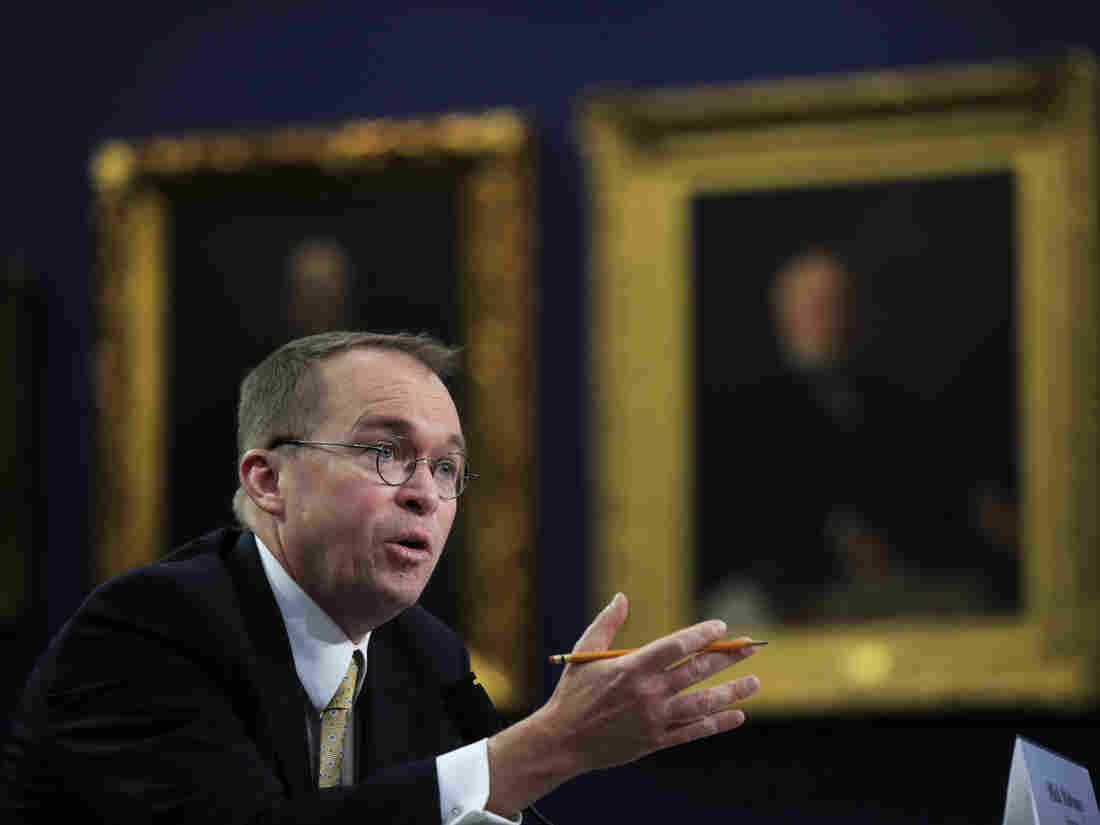
Mick Mulvaney, acting director of the CFPB, testifies at a House hearing. Mulvaney says he doesn’t need to run “a Yelp for financial services sponsored by the federal government.”

Manuel Balce Ceneta/AP

hide caption

toggle caption

Manuel Balce Ceneta/AP

When a consumer has a complaint about a bank, whether it’s dealing with a mortgage or a credit card, right now there’s a place to lodge that complaint online.

It’s easy to click around and search for other similar complaints. And it’s a tool consumers can use when trying to weigh whether to do business with a particular bank or other kind of financial firm. Investigators like this database as well, because when thousands of similar complaints pop up, it could be a red flag that there’s a problem at a bank that they need to dig into.

The Trump administration’s Mick Mulvaney was in the news again this week because he said he wanted to shut down public access to this popular government database at the Consumer Financial Protection Bureau.

The industry likes this idea and has long complained about the database, because it says the complaints aren’t vetted enough. Consumer groups say that keeping the public from seeing the database is a move that panders to companies the consumer regulator is supposed to be policing.

The CFPB is a powerful watchdog regulator set up after the financial crisis. It’s currently being run by Mulvaney, who once sponsored legislation to abolish the bureau when he was in Congress. He has often called the bureau too powerful and aggressive.

Mulvaney has made a series of moves that have drawn sharp criticism from consumer groups. On Tuesday, he spoke to a group of bankers and suggested he might take the CFPB’s online database and hide the complaints from public view.

In looking at the law that created the CFPB, he told the room full of lobbyists and bankers at an American Bankers Association conference, “I don’t see anything [that says] I have to run a Yelp for financial services sponsored by the federal government.

“I am thinking I could make the case,” Mulvaney continued, “that having a database that is publicly facing, but is not completely vetted, is probably not consistent with our overall mission.”

The database was designed to hold financial firms accountable. For example, if someone refinances their house and has a bad experience with a bank, they can go online and file a complaint that is added to the database.

So far, Americans have filed more than a million of these complaints. And regulators can use that data to decide whether to investigate financial firms.

Consumer Financial Protection Bureau chief Mick Mulvaney has said he would like to end public access to the agency’s consumer complaint database.


Consumer Financial Protection Bureau
hide caption

toggle caption


Consumer Financial Protection Bureau

For years, the financial industry has said that people can post complaints that aren’t true, which introduces “unreliable and misleading information into the market.”

Kim Gustafson, an executive with Fortis Private Bank in Denver, says, “There are a lot of comments on [the database] that are just people’s feelings about something without any substantiated facts or actual complaints around a specific issue.”

The CFPB does give companies a chance to determine whether the person is in fact a customer and also to file a written response to a complaint before any of the information is posted on the database.

Consumer protection advocates are not happy about the direction the bureau is heading or this latest revelation that Mulvaney may move to hide complaints in the database from the public.

“Daylight is a great disinfectant and the American people have a right to know when tens of thousands of their fellow citizens are complaining about a financial institution,” says Karl Frisch, the executive director of the consumer advocacy group Allied Progress. “The CFPB received tens of thousands complaints about Wells Fargo and that issue is now being resolved.”

Frisch opposes closing the database to the public in part because he says academics, journalists, consumer groups like his should be able to have access to the information.

Let’s block ads! (Why?)


No Image

When China's Ships Come In

7.5 million

The Port of Long Beach is one of the biggest ports in the country. It and its neighbor, the Port of Los Angeles, handle 390 billion dollars worth of goods every year.

And business has boomed as the economy has improved. U.S. consumers bought more stuff; ships started getting bigger to meet demand; the Port of Long Beach invested billions.

Seventy percent of the ships that dock at the port come from China. So talk of a trade war has everybody’s attention down on the docks.

Music by Drop Electric. Find us: Twitter/ Facebook.

Subscribe to our show on Apple Podcasts, PocketCasts and NPR One.

Let’s block ads! (Why?)


No Image

Puerto Rico Board, Governor Clash Over Finances

Still reeling from damages caused by Hurricane Maria, Puerto Rico’s financial situation is in major free fall. The federal oversight board ordered Gov. Ricardo Rosselló to cut public pensions by 10 percent.

MICHEL MARTIN, HOST:

We want to head to Puerto Rico now. The damage caused by Hurricane Maria is not the island’s only crisis. It is also in the middle of a fiscal crisis. To start turning that around, this week, a federal board with power over the island’s finances ordered the governor to cut public pensions. NPR’s Adrian Florido reports that the governor said, no, setting up a battle for control of the island’s financial future.

ADRIAN FLORIDO, BYLINE: Shortly after the governor said no, Franciso Flores was sitting on a plaza near the governor’s mansion. He’s 64, a retired mechanic for the city of San Juan. He lives on his government pension.

FRANCISO FLORES: (Speaking Spanish).

FLORIDO: He says, “Puerto Rico’s pensions allow you to survive, nothing more.” But he says his pension is 600 a month at a few hundred in Social Security, and his monthly income is about $1000. That’s right around the poverty line.

FLORES: (Speaking Spanish).

FLORIDO: On top of that, Flores says, “the price of utilities and food is going up.” He says he probably couldn’t live on less than he does now. But he may have to, and here’s why. Puerto Rico has been massively in debt for years. In 2016, Congress did two things to pull it out of its fiscal crisis. It allowed the island to seek protection from its creditors, and it created the financial oversight board with power over the island’s finances. This week, the board ordered a long list of cost-cutting measures, including cutting public pensions an average of 10 percent. To Flores, it came as no surprise. He holds a view held by many on the island.

FLORES: (Speaking Spanish).

FLORIDO: “Here in Puerto Rico,” he says, “it’s that fiscal board that has the power, not the governor.” The governor, Ricardo Rossello, has said, not so fast.

RICARDO ROSSELLO: On matters of public policy, it is the government that has the decision-making power.

FLORIDO: Rossello has said he will implement many of the board’s cost-cutting measures, but has refused to cut pensions or vacation or sick time or Christmas bonuses for workers.

ROSSELLO: And so on those matters that we oppose – those are just not going to be seen in the legislature nor in my desk.

FLORIDO: Puerto Rico is very much still recovering from Hurricane Maria as it prepares for the next hurricane. At the same time, an even larger struggle is playing out. Its governor and the federal oversight board are in a war of words over who has the power to set the island’s fiscal policy. On Thursday, Jose Carrion, the federal board’s chairman, issued a warning.

(SOUNBITE OF ARCHIVED RECORDING)

JOSE CARRION: (Through interpreter) We hope the government and the legislature will comply. We don’t want to sue the government, but we have to fulfill the duties that we understand the law gives us.

MARIELY LOPEZ-SANTANA: It’s basically a question of sovereignty, autonomy and, in the end, who is ultimately responsible for making decisions in Puerto Rico?

FLORIDO: Mariely Lopez-Santana is a political scientist at George Mason University. She says the question of who gets the last word on fiscal policy can’t be answered yet. The board’s powers haven’t been fully tested in court. Professor Lopez-Santana points out that, in fact, the board and the governor agree on many policies – tax reform, cuts to the school system, consolidating government agencies and selling off the island’s electrical grid. But politically, Lopez-Santana says the governor has to oppose the board.

LOPEZ-SANTANA: The governor cares about winning election, so even if it’s cheap talk, he’s gonna say, well, I’m gonna protect my people. I’m going to protect pensions – all that.

FLORIDO: Rossello has asked the members of the oversight board to reconsider their demands. If they don’t, the governor says he’s prepared to fight the board in court. Adrian Florido, NPR News, San Juan, Puerto Rico.

Copyright © 2018 NPR. All rights reserved. Visit our website terms of use and permissions pages at www.npr.org for further information.

NPR transcripts are created on a rush deadline by Verb8tm, Inc., an NPR contractor, and produced using a proprietary transcription process developed with NPR. This text may not be in its final form and may be updated or revised in the future. Accuracy and availability may vary. The authoritative record of NPR’s programming is the audio record.

Let’s block ads! (Why?)


No Image

Wells Fargo Fined $1 Billion Over Mortgage And Auto Loans

Wells Fargo will pay a $1 billion fine to settle claims that it had taken advantage of mortgage and auto loan customers. Federal regulators also said the bank did not have adequate compliance or risk management programs.

ARI SHAPIRO, HOST:

Wells Fargo Bank has agreed to pay up to a billion dollars to settle allegations that it overcharged people for auto and mortgage loans, among other things. The fines were imposed by the Office of the Comptroller of the Currency, and the Consumer Financial Protection Bureau, marking the first major action against a bank by the Trump administration. This is just the latest blow for the bank. We’re joined by NPR’s Jim Zarroli for more. Hi, Jim.

JIM ZARROLI, BYLINE: Hi, Ari.

SHAPIRO: Remind us what the bank is accused of.

ZARROLI: This has to do with allegations about the way Wells Fargo handled some of its customers’ mortgages and auto loans. It’s accused of attaching improper charges to some of them. And this comes on top of the really big scandal you may remember that happened in 2016 when the bank was found to have opened some 3.5 million accounts for its customers without their knowledge. And federal regulators say these things were happening, and senior management really didn’t do enough to stop them.

SHAPIRO: We should say that Wells Fargo is an NPR funder. What do the banks say about these charges?

ZARROLI: It has acknowledged that it did a lot of things wrong. It says it’s working to change them, to reform. The senior management of the bank was basically forced out after the scandals happened. There’s a new CEO, and he said – there was a statement today in which he said, we have more work to do, but we have the same priorities as our regulators and we are committed to working with them.

SHAPIRO: A billion dollars sounds like a really big number. How much will it actually hurt a bank the size of Wells Fargo?

ZARROLI: Well, it kind of depends on how you look at it. I mean, this is a bank with $2 trillion in assets. So, you know, compared to that, a billion isn’t very much. The bank earned nearly $6 billion in profits during the first three months of this year. You know. So how much does this hurt the bank? You know, I put that question to Lawrence White, who is a professor at New York University and an expert on banking, and here’s what he had to say.

LAWRENCE WHITE: It’s not going to cripple the bank, but nobody likes to write a check that has 10 digits on it.

ZARROLI: And then we have to keep in mind that Wells Fargo also faces lawsuits from its customers who were hurt by some of the things the bank has done and allowed to have happened. And it’s set, Wells Fargo has set aside another $4 billion for future liability. So this is not nothing.

SHAPIRO: But even if it does have to pay $4 billion in the future, as you say, that’s less than the bank makes in a single quarter. So is this really enough to force big changes?

ZARROLI: Well, that’s right. But keep in mind the fine isn’t the only thing that regulators are doing. The Federal Reserve has essentially told Wells Fargo earlier this year that they cannot grow any more until they’ve persuaded the government that they have reformed. There’s going to be a pretty heavy oversight role by regulators. Bloomberg had a really good article today that pointed out that the settlement that Wells Fargo has signed allows regulators to remove executives and board members if they see fit.

SHAPIRO: What kind of a message does a fine like this send to other big banks?

ZARROLI: Well, this was a really big and embarrassing scandal for Wells Fargo, and it really did suggest that, you know, at the very least, senior managers were sort of asleep at the switch. And Lawrence White of NYU says you really have to look at this in context.

WHITE: I think fundamentally it’s about very poor management on the part of Wells, and it really raises the question, are these big banks too big to manage effectively?

ZARROLI: And, White says, just look at some of the other big scandals that have happened at major banks, like the London Whale case. That was when a single trader at JPMorgan Chase’s London office caused $6 billion in derivatives losses. So you have these big, huge problems developing in parts of the bank, and senior managers can be unaware of them because they preside over these really huge operations, and that’s a problem.

SHAPIRO: NPR’s Jim Zarroli. Thank you.

ZARROLI: You’re welcome.

Copyright © 2018 NPR. All rights reserved. Visit our website terms of use and permissions pages at www.npr.org for further information.

NPR transcripts are created on a rush deadline by Verb8tm, Inc., an NPR contractor, and produced using a proprietary transcription process developed with NPR. This text may not be in its final form and may be updated or revised in the future. Accuracy and availability may vary. The authoritative record of NPR’s programming is the audio record.

Let’s block ads! (Why?)


No Image

Recent Tariffs On Canadian Newsprint Are Hurting U.S. Papers, Could Trigger Job Cuts

Recent tariffs on Canadian newsprint are hurting U.S. newspapers, potentially triggering further job cuts and consolidation. The duties of up to 32 percent come after a complaint from a single U.S. supplier, and are opposed by the domestic paper industry trade group.

ARI SHAPIRO, HOST:

The actual paper that newspapers are printed on just got much more expensive. The Commerce Department has imposed steep tariffs on newsprint imported from Canada. On one hand, that’s boosting profits for the five remaining newsprint mills in the U.S. On the other hand, it’s pummelling the newspaper industry, which was already hurting. Frank Morris of member station KCUR has the story.

FRANK MORRIS, BYLINE: If you want to know the latest about the local hospital funding crisis, city hall or high school sports in rural Marysville, Kan., the Advocate has you covered.

SARAH KESSINGER: And this is our old press room back here. The press used to be here.

MORRIS: These days, publisher Sarah Kessinger contracts out for printing to save money. Income is down. And newsprint, the paper’s second largest operating expense, that is way up.

KESSINGER: It’s tough. It’s getting tougher especially with these newsprint tariffs coming in to the picture.

MORRIS: Over the last few months, the U.S. Commerce Department has slapped tariffs of up to 32 percent on Canadian newsprint, raising prices nationwide.

KESSINGER: If that trend continues, it will really make our profits disappear.

MORRIS: And it’s not just small papers. The Tampa Bay Times, for instance, is laying off around 50 people – responding to price hikes it claims will drive up its newsprint bill by $3 million a year. Al Cross, who heads the Institute for Rural Journalism at University of Kentucky, blames a single manufacturer.

AL CROSS: We have a complaint brought by one paper mill. It’s just crazy. The industry is being turned on its head by the manipulation of trade laws.

MORRIS: That one mill is NORPAC in Longview, Wash. And Craig Anneberg is the CEO.

CRAIG ANNEBERG: We strongly disagree with the notion that the industry requires low-priced, subsidized newsprint from Canada to sustain their business model.

MORRIS: Anneberg says canadian newsprint mills benefit from cheap hydroelectric power and state-owned forests. He claims that some sell below cost in the U.S. – taking over most of the market, depressing prices and forcing layoffs at his mill.

ANNEBERG: We have some of the largest, fastest, most technologically advanced paper machines in the world. And if we couldn’t compete – if we were having to shut down one of our machines, it looked like something wasn’t right.

MORRIS: The newsprint business has been rough. Mark Pitts with the American Forest and Paper Association says U.S. demand has cratered – falling about 80 percent in the past two decades, shuttering newsprint mills on both sides of the border.

MARK PITTS: I think it’s pretty clear that the predominant challenge out there isn’t about imports. It’s really about the declining demand.

MORRIS: Because more and more people read news on screens, not paper – and Pitts says the tariffs driving up newsprint prices will just accelerate that trend. Avis Little Eagle in the Standing Rock Indian Reservation agrees. She says tariffs are killing her paper, the Teton Times.

AVIS LITTLE EAGLE: It’s like a stranglehold. I just feel like you’re getting the life choked out of you. And it’s like little by little, more and more, the life of the newspaper is leaving.

MORRIS: Little Eagle says most of her customers don’t have internet access, so her printed paper is the only way they know what’s going on with local government. But two weeks ago, she reached an impasse.

LITTLE EAGLE: I was like, oh, my God, I can’t even print the paper this week. And so that’s pretty darn close.

MORRIS: The Commerce Department will decide whether to finalize or lift the tariffs on Canadian newsprint by late summer. Meantime, high newsprint prices will keep cutting into newspaper profits and undermining demand for the paper in newspaper. For NPR News, I’m Frank Morris.

(SOUNDBITE OF STEVE REICH’S “ELECTRIC COUNTERPOINT-FAST (MOVEMENT 3)”)

Copyright © 2018 NPR. All rights reserved. Visit our website terms of use and permissions pages at www.npr.org for further information.

NPR transcripts are created on a rush deadline by Verb8tm, Inc., an NPR contractor, and produced using a proprietary transcription process developed with NPR. This text may not be in its final form and may be updated or revised in the future. Accuracy and availability may vary. The authoritative record of NPR’s programming is the audio record.
Let’s block ads! (Why?)


No Image

Long Kept Secret, Amazon Says Number Of Prime Customers Topped 100 Million

Amazon CEO Jeff Bezos says more than 100 million people around the world pay for Prime membership.

Leon Neal/Getty Images

For years, this has been one of Amazon’s biggest secrets: how many people pay for the Prime membership.

A big round number appears to have prompted CEO Jeff Bezos to finally lift the veil: “13 years post-launch, we have exceeded 100 million paid Prime members globally,” he wrote in this year’s letter to shareholders.

He added that in 2017, more new members joined Prime than in any other year. The membership generally costs $99 a year in the U.S. and lures people in with free two-day shipping and access to video and music streaming. Last year and earlier this year, Amazon added discounted Prime rates for recipients of Medicaid and government assistance programs.

Prime subscribers are known to be more lucrative to Amazon, estimated to spend twice as much money every year than non-members, according to Consumer Intelligence Research Partners. Analysts have been projecting the number of Amazon’s paid subscribers as around 65 million to 85 million, while the company had historically just referred to “tens of millions.”

In a letter to shareholders released in 2016, Bezos wrote: “We want Prime to be such a good value, you’d be irresponsible not to be a member.”

Annual letters from Bezos to shareholders are a popular read in the business world. In this year’s note, he muses about the value of setting the highest standards (“I believe high standards are teachable”), the art of great memos (“They simply can’t be done in a day or two”) and the human nature of ever-rising customer expectations (“We didn’t ascend from our hunter-gatherer days by being satisfied”).

Wednesday’s letter, in running through Amazon’s recent milestones, highlights the sheer scope of the company’s reach: its massive cloud-server business, smart assistant Alexa and the Alexa-powered home devices, award-winning TV and movie production, streaming deals with cable and TV networks, a recent push into fashion, the launch of a cashierless store in Seattle and the blockbuster $14 billion acquisition of Whole Foods.

Not mentioned were Amazon’s relatively nascent push into home security with the purchase of smart-doorbell maker Ring and the company’s for-now vague plans in health care, which had spooked the industry. In Wednesday’s letter, Bezos said Amazon employs more than 560,000 globally.

Amazon has also dramatically grown the number of small businesses and other third-party sellers who compete alongside Amazon’s own retail business on the shopping platform. In the letter, Bezos said 2017 marked the first year when more than half of the goods sold on Amazon worldwide were from third-party sellers.

Let’s block ads! (Why?)


No Image

T-Mobile Fined $40M Over 'False Ring Tones' That Masked Failed Calls

A billboard advertising T-Mobile stands over Hialeah, Fla., last year.

Alan Diaz/AP

T-Mobile has agreed to pay a $40 million fine to settle a federal investigation into its former practice of faking ring tones when calls couldn’t connect in rural areas. The Federal Communications Commission announced the settlement Monday, saying that in the course of the agency’s investigation, T-Mobile acknowledged it had injected such false ring tones into “hundreds of millions of calls.”

“It is a basic tenet of the nation’s phone system that calls be completed to the called party, without a reduction in the call quality—even when the calls pass through intermediate providers,” FCC Chairman Ajit Pai said in a statement. “The FCC is committed to ensuring that phone calls to all Americans, including rural Americans, go through.”

In the order released Monday, the agency noted it had received complaints from callers and several local telephone companies in rural Wisconsin. The complaints alleged that, though their call attempts had failed, they had nevertheless heard ringing on the other end — prompting suspicions T-Mobile was violating a previous FCC order by prematurely triggering the sounds of a connected phone call in rural areas.

“That is, the calling party believes the phone is ringing at the called party’s
premises when it is not,” that order explained. “An originating or intermediate provider may do this to mask the silence that the caller would otherwise hear during excessive call setup time. As a result, the caller may often hang up, thinking nobody is available to receive the call.”

T-Mobile acknowledged the “oversight” in a statement to NPR on Tuesday, adding that the issue was fixed early last year.

“Our actions have always been focused on better serving our customers and the ringtone oversight, which was corrected in January 2017, was unintentional,” the company said. “We have settled this matter — and will continue to focus on our mission to change wireless for good for consumers everywhere.”

The company is not the first to be dinged by the FCC for troubles completing calls in rural areas. The agency notes that this is the sixth such settlement.

Not everyone was satisfied with the agreement, however.

Mignon Clyburn, an FCC commissioner, issued a strongly worded dissent to Monday’s decision, objecting to what she described as a “severely mismatched consent decree.”

For one thing, Clyburn said the fine on the major publicly traded corporation was “dwarfed” by penalties levied on individuals for comparable violations; for another, she criticized the fact that all of the money collected on that fine would be going to the U.S. Treasury and not the actual consumers affected.

“How many times was a loved one calling to check on the wellbeing of an elderly relative, only to have the phone ring and ring with no answer? How many times did a consumer try calling his or her doctor for an urgent refill of an important prescription, only to think that nobody was picking up on the other end of the call?” she asked.

“Childcare providers, employers, local businesses, old friends—what critical information was missed?”

Let’s block ads! (Why?)