
Facebook Faces Class Action Lawsuit Challenging Its Use Of Facial Recognition Data

Cardboard cutouts of Facebook founder and CEO Mark Zuckerberg stand outside the U.S. Capitol in Washington as he testified before a Senate panel last week.
Kevin Wolf/AP
hide caption
toggle caption
Kevin Wolf/AP
A federal judge in California has ruled that Facebook can be sued in a class-action lawsuit brought by users in Illinois who say the social network improperly used facial recognition technology on their uploaded photographs.
The plaintiffs are three Illinois Facebook users who sued under a state law that says a private entity such as Facebook can’t collect and store a person’s biometric facial information without their written consent. The law, known as the Biometric Information Privacy Act, also says that information that uniquely identifies an individual is, in essence, their property. The law prohibits a private entity from selling, leasing, trading or otherwise profiting from a person’s biometric information.
U.S. District Judge James Donato ruled that the lawsuit can proceed as a class action representing potentially millions of Facebook users in Illinois. The judge is based in San Francisco where the case had been moved at Facebook’s request.
The suit seeks penalties of up to $5,000 for every time a user’s facial image is used without his or her permission. The judge said the potential damages could amount to billions of dollars.
Facebook issued a statement saying it continued to believe that the lawsuit has no merit. It argued in court that individual plaintiffs should have to pursue their legal claims proving that they were “aggrieved” and suffered an actual injury beyond an invasion of privacy.
Martin Sorrell Steps Down As CEO Of World's Largest Ad Company
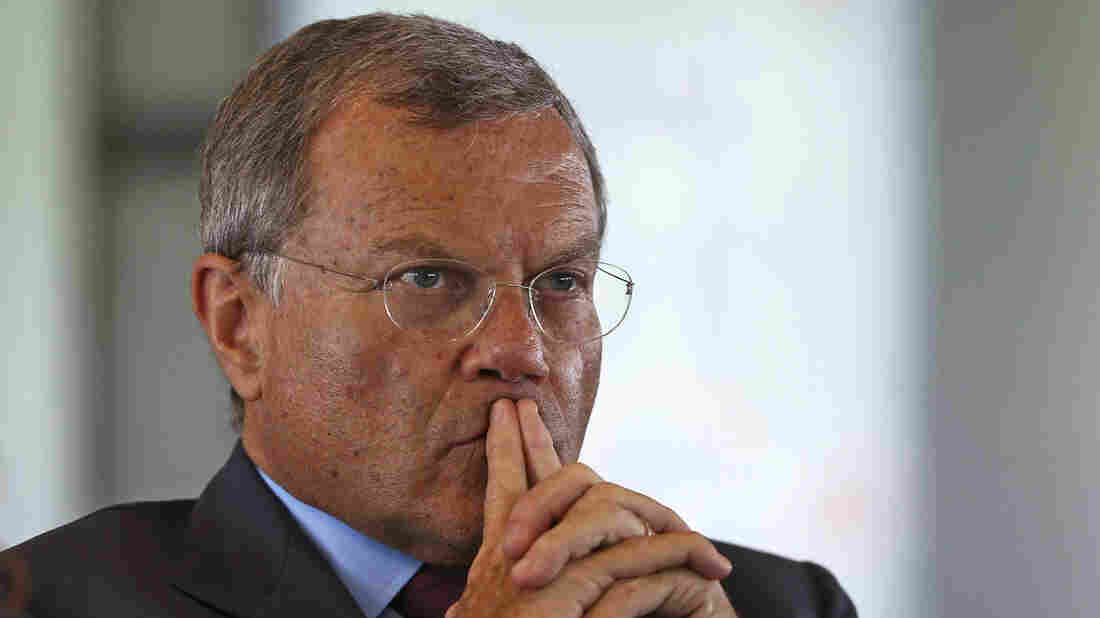
Martin Sorrell, the longtime CEO of WPP, attends a summit in June 2016, in London. He has stepped down after an investigation into alleged misconduct.
Neil Hall/WPA Pool/Getty Images
hide caption
toggle caption
Neil Hall/WPA Pool/Getty Images
Martin Sorrell, the powerful CEO who turned WPP into the world’s largest advertising and PR firm, has resigned after allegations of misconduct.
The misconduct reportedly involved misuse of company funds — though not at a level “material” to the massive organization — as well as “personal misconduct.”
WPP has completed its investigation into the allegations, but has not released any public details about what the allegations were, or whether they were substantiated. Sorrell has denied that the allegations have merit.
Sorrell “will be treated as having retired,” WPP says in a statement. The Guardian reports that Sorrell, 73, is due to receive in the neighborhood of £20 million ($28 million) as part of his exit.
As NPR previously reported:
“Sorrell is a giant in the global advertising industry, and one of Britain’s most prominent businessmen. He’s famously well-compensated, earning £210 million (nearly $300 million) over the course of 5 years in a controversial pay package that some shareholders resisted.
“Within the last year, he’s come under pressure because of his company’s performance — WPP has seen poorer-than-expected growth and slumping stocks.
“Sorrell, formerly the finance director at Saatchi & Saatchi, created WPP in the mid-’80s. He invested in a manufacturing company called Wire and Plastic Products Plc, took over as chief executive and converted the company into a marketing firm. Through acquisition after acquisition, the renamed WPP Group grew from a small operation into a behemoth.
“Today, it is the world’s largest advertising company, and Sorrell has been called the world’s ‘most important advertising executive.’ “
In a statement to employees at WPP — more than 200,000 of them — Sorrell described the company as a “family” and praised its growth over the last three decades.
He acknowledged the allegations of misconduct only obliquely.
“I see that the current disruption we are experiencing is simply putting too much unnecessary pressure on the business,” he wrote. “That is why I have decided that in your interest, in the interest of our clients, in the interest of all shareowners, both big and small, and in the interest of all our other stakeholders, it is best for me to step aside.”
“As a Founder, I can say that WPP is not just a matter of life or death, it was, is and will be more important than that,” he wrote.
Sorrell, whose name has been inextricably bound with WPP’s identity since he reinvented the company in the ’80s, has never discussed stepping down from the firm before. But he says there is a succession plan in place.
Chairman Roberto Quarta is stepping in as executive chairman until a new CEO is appointed, WPP says. Mark Read and Andrew Scott, current WPP executives, will serve as joint chief operating officers.
Congress Does Not Compute

Facebook CEO Mark Zuckerberg was in Congress this week. Redfin CEO Glenn Kelman was watching.
He heard the senators’ questions and wondered how many of our congressional representatives have any kind of computer background.
The answer? Not that many. Right around three percent. And, Kellman says, that’s a problem for all of us.
Music by Drop Electric. Find us: Twitter/ Facebook.
Subscribe to our show on Apple Podcasts, PocketCasts and NPR One.
NTSB: Tesla Booted From Crash Investigation For Not Following Rules

Tesla vehicles sit parked outside of a new Tesla showroom and service center in Red Hook, Brooklyn in 2016.
Spencer Platt/Getty Images
hide caption
toggle caption
Spencer Platt/Getty Images
Updated at 3 a.m. ET
The National Transportation Safety Board, which is looking into the fatal crash last month of an SUV using Tesla’s Autopilot system, said it is removing the high-tech automaker from the probe for improperly disclosing details of the investigation.
Tesla says it withdrew from the investigation.
The NTSB is examining last month’s crash of a 2017 Tesla Model X near Mountain View, Calif. The vehicle crashed into a concrete lane divider, killing the driver, Walter Huang.
Earlier this week, Tesla blamed Huang for the accident, which the NTSB contends runs counter to agency protocols.
As Bloomberg notes, “The NTSB guards the integrity of its investigations closely, demanding that participants adhere to rules about what information they can release and their expected cooperation. These so-called parties to investigations must sign legal agreements laying out their responsibilities.”
“Tesla violated the party agreement by releasing investigative information before it was vetted and confirmed by the NTSB,” the agency said in a statement. “Such releases of incomplete information often lead to speculation and incorrect assumptions about the probable cause of a crash.”
“It is unfortunate that Tesla, by its actions, did not abide by the party agreement,” said NTSB Chairman Robert Sumwalt. “We decided to revoke Tesla’s party status and informed Mr. Musk in a phone call last evening and via letter today. While we understand the demand for information that parties face during an NTSB investigation, uncoordinated releases of incomplete information do not further transportation safety or serve the public interest.”
In a statement emailed to NPR, a Tesla spokesperson said the company decided to withdraw from the agreement of its own accord.
“Last week, in a conversation with the NTSB, we were told that if we made additional statements before their 12-24 month investigative process is complete, we would no longer be a party to the investigation agreement. On Tuesday, we chose to withdraw from the agreement and issued a statement to correct misleading claims that had been made about Autopilot — claims which made it seem as though Autopilot creates safety problems when the opposite is true,” the statement said.
“It’s been clear in our conversations with the NTSB that they’re more concerned with press headlines than actually promoting safety,” Tesla said. “Among other things, they repeatedly released partial bits of incomplete information to the media in violation of their own rules, at the same time that they were trying to prevent us from telling all the facts.”
As The Wall Street Journal writes:
“Removals from NTSB party agreements are rare. The agency in 2014 revoked party status for United Parcel Service Inc. and a pilots union in the probe of a crash of one of the package-delivery company’s cargo planes after public comments were made by each side about circumstances surrounding the accident.
For Tesla, a departure from the NTSB agreement risks diminishing the car maker’s influence over and insight into an investigation that could ultimately reach critical conclusions about one of the company’s signature products.”
Episode 661: The Less Deadly Catch

Jess Jiang/NPR
Note: This episode originally ran in 2015.
What kind of person would go out in a tiny boat in dangerous weather to catch fish for 24 hours straight? Everyone. Well, everyone in Homer, Alaska.
Halibut fishermen in Alaska used to defy storms, exhaustion and good judgment. That’s because they could only fish in these handful of 24-hour periods. It was called the derby, and the derby made fishing the deadliest job in America. But then the government totally changed the system.
Today on the show, the economic fix that made fishing safer. And why a lot of people hate it.
Music: “Everything.”
Find us: Twitter/ Facebook / Instagram
Subscribe to our show on Apple Podcasts, PocketCasts and NPR One.
European Antitrust Investigators Raid 21st Century Fox Offices In London

Rupert Murdoch, executive chairman of News Corp and chairman of Fox News, arrives on the third day of the annual Allen & Company Sun Valley Conference, in July in Sun Valley, Idaho.
Drew Angerer/Getty Images
hide caption
toggle caption
Drew Angerer/Getty Images
The London offices of Rupert Murdoch’s 21st Century Fox have been raided by European investigators looking into possible anti-trust violations related to the media giant’s dominant position in broadcasting sports events.
Fox’s office in Hammersmith, west London, were just the highest-profile target among several targets in a number of EC member states that were raided on Tuesday in connection with what investigators said were “companies active in the distribution of media rights and related rights pertaining to various sports events and/or their broadcasting.”
In a statement, the European Commission said it had concerns that Fox and other companies that were raided “violated EU antitrust rules that prohibit cartels and restrictive business practices.”
“Unannounced inspections are a preliminary step into suspected anticompetitive practices. (It) … does not mean that the companies are guilty of anti-competitive behaviour nor does it prejudge the outcome of the investigation itself,” the statement said.
The Guardian newspaper reports: “The raids, during which documents and computer records were reportedly taken, had been prompted by concerns of the regulators in Brussels.”
Fox is currently in a protracted takeover bid of Sky News, which has caught the eye of U.K. and European regulators. Fox wants to buy the 61 percent of Sky that it does not already own as part of a $15 billion deal.
According to The Guardian:
“In January the UK’s competition and markets authority provisionally found that if the deal went ahead as planned, it would give the Murdoch family too much control over news providers in the UK.
The regulator scrutinising the deal feared it could lead to the Murdoch family trust holding too much influence over public opinion and the political agenda.”
In an effort to satisfy regulators and allay antitrust concerns, in December, the Walt Disney Co. struck a deal to acquire much of 21st Century Fox for $52.4 billion.
As NPR’s David Folkenflik reported at the time, “The most profitable and controversial part of the Fox empire — Fox News —would not be part of the deal. Yet the [Murdoch] family is selling off other defining properties, including the movie studio 20th Century Fox. The deal is expected to face regulatory scrutiny, as it would greatly concentrate similar holdings in Disney.”
Ky. Lawmakers Didn't Consult Federal Experts About Limiting Black Lung Claims Reviews

Excised and preserved lungs on display at the National Institute for Occupational Safety and Health in Morgantown, W.Va., in 2012, show the dramatic effect of black lung disease.
Howard Berkes/NPR
hide caption
toggle caption
Howard Berkes/NPR
Updated at 8 p.m. ET
The federal agency that trains, tests and certifies the physicians who read X-rays and diagnose the deadly coal miners’ disease black lung said today it was not consulted by Kentucky lawmakers in the 14 months they considered a new law that mostly limits diagnoses to pulmonologists working for coal companies.
As NPR and Ohio Valley ReSource first reported, the new Kentucky law bans certified radiologists from reading X-rays used to award state black lung compensation. That leaves out radiologists with extensive experience in reading chest X-rays and diagnosing black lung, a disease caused by inhalation of coal and silica dust.
Instead, the law reserves that task for pulmonologists, and only six in Kentucky are certified to read black lung X-rays. Four of those six typically work for coal companies, according to an NPR review of federal black lung claims.
Training, testing and certification are provided by the National Institute for Occupational Safety and Health, a federal research agency. The agency certifies “B readers” who are uniquely qualified to diagnose black lung based on X-rays.
“NIOSH was not consulted about this bill,” said spokeswoman Christina Spring, who also provided the comparative pass/fail rates of certified physicians who are required to take recertification exams.
“There is no evidence that performing ILO classification, a standardized process for describing findings present on chest radiographic images used in evaluating black lung cases, is done differently by B Readers with medical backgrounds in radiology vs. pulmonology,” Spring said.
In fact, radiologists have a slight edge with 90 percent passing the exams in the last 10 years, while 85 percent of pulmonologists were recertified.
Calling for repeal
“To have that established process superseded by legislators and a political process is inappropriate,” said Dr. William Thorwarth, CEO of the American College of Radiology.
“This is a matter of life and death for many people,” Thorwarth added. “Politics should be left out of it.”
Thorwarth also called on the Kentucky Legislature to repeal the changes, which came in larger “reforms” of the state’s workers’ compensation law.
The revised law is “off base,” said Bill Bruce, the executive director of the American College of Occupational and Environmental Medicine, a group representing 5,000 physicians who specialize in occupational and environmental injury, illness and disability.
“There is no rationale for limiting X-ray interpretation to pulmonary physicians,” Bruce told NPR Monday. “Qualified physicians in other specialties should be allowed to do so if they have demonstrated competency.”
Coal miners in Kentucky suffering from black lung can seek state or federal compensation for black lung disease, although state benefits may be greater and easier to obtain.
As NPR has reported, the rate of the advanced stage of disease, known as complicated black lung, is at epidemic levels.
State black lung claims in Kentucky have risen about 40 percent since 2014, according to an analysis of state data by Ohio Valley ReSource.
The state Department of Workers’ Claims reports that more than $3.3 million in black lung benefits went to coal miners in 2014.
“Open to a better way of doing it”
The lead sponsor of the legislation was Rep. Adam Koenig, a Republican and real estate agent from Erlanger, Ky., who told NPR he “relied on the expertise of those who understand the issue — the industry, coal companies and attorneys” during the 14 months he spent working on the changes.
In response to criticism of the law, Koenig said “not everyone who had a specific interest was involved. … I’m not sure I was even aware of NIOSH.”
Koenig added that he is “open to a better way of doing it” and may seek a hearing on possible changes in the law during legislative interim committee meetings this summer and fall.
“If the radiologists feel slighted, we’re going to talk about it,” he said. “And if they’re right, we’ll fix it.”
Kentucky’s Legislature has completed its 2018 regular session except for addressing any vetoes by Republican Gov. Matt Bevin, who signed the workers’ comp law that contains the new black lung provisions.
Pulmonologists object
“For all practical purposes, this eliminates the state workers’ compensation black lung program,” said Timothy Wilson, a Lexington attorney who represents coal miners.
Wilson is also president of the Kentucky Workers’ Association and participated in confidential negotiations focused on the black lung claims legislation.
“The coal industry was directly involved,” Wilson said, but he would not name the participants in the talks given an agreement that the discussions remain confidential.
Even one of the nation’s leading groups on pulmonology and respiratory disease has criticized the Kentucky law and urged repeal.
“This law seems to have been specifically passed to exclude physicians who are neutral” in assessing black lung disease, said Dr. Robert Cohen, a pulmonologist at the University of Illinois, Chicago who has spent 30 years focused on black lung disease.
Cohen spoke on behalf of the American Thoracic Society, which represents more than 15,000 pulmonologists, physicians, other health care providers and researchers focused on respiratory disease.
The Kentucky law “is a disservice to miners,” Cohen said. “It was ill-considered.”
Benny Becker is a reporter with Ohio Valley ReSource, a regional journalism collaborative reporting on economic and social change in Kentucky, Ohio and West Virginia.
A Career Trucker Helps To Steer The Path For Self-Driving Trucks

Safety driver Jeff Runions with one of Starsky Robotics’ autonomous testing trucks.
Alexi Horowitz-Ghazi/NPR
hide caption
toggle caption
Alexi Horowitz-Ghazi/NPR
When Jeff Runions started his trucking career nearly 40 years ago, he had high hopes for what the job might bring.
“I wanted the American dream.”
Since then he’s seen the industry from every step of the ladder — as an independent owner-operator, a full-time company driver, a parts manager, and finally a trucking depot manager.
In his latest job developing autonomous trucks, Runions, 58, has a front row seat to what many see as the future of the 700 billion dollar trucking industry. He’s found himself in the middle of a heated race between Silicon Valley juggernauts like Uber and Google to get their self-driving trucks out onto the road first.
“It’s like when they went to the moon,” Runions says. “We’re not going to the moon, but it feels kinda like a new technology’s coming up and how many people would think a semi would be driving itself?”

Jeff Runions, during his years as an owner-operator, with his truck.
Courtesy of Jeff Runions/Courtesy of Jeff Runions
hide caption
toggle caption
Courtesy of Jeff Runions/Courtesy of Jeff Runions
Runions, who lives in Jacksonville, Fla.,works a startup called Starsky Robotics — a company smaller than Uber or Google. Instead of trying to beat their competition to developing fully autonomous vehicles, Starsky’s strategy is to develop trucks that are fully autonomous on the highway — then let remote drivers take the wheel from offices filled with arcade-style consoles, when they hit city streets.
The strategy is still in its testing phase: Runions is a safety-driver. He sits in the driver’s seat of the truck cabin, ready to take control if there’s trouble.His test rides range from an hour and a half to eight hours-long.
He also works alongside his company’s programmers to test and tweak the truck’s sensors and software.
“I come up with some suggestions once in a while and they do work. I’m not an engineer like these guys are, but sometimes they listen to me. So, that means I’m part of the team too,” he said.
Runions, after all, has nearly four decades of experience in the trucking industry under his belt.
In the mid-80s, he became an owner-operator, and purchasing a truck and leasing out his services on contract to freight companies.
For a while, Runions enjoyed the freedom that came with having his own truck and the camaraderie he found with fellow truckers he met while crisscrossing the country.
“We were like the cowboys of the old days, doing our own thing,” he said. “We were truckers, and we were young. We were having a good time.”
But as the years dragged on, life on the road began to lose its luster. Between regular sleep deprivation and a diet based on truck stop junk food, Runions started to feel that the trucker lifestyle was unhealthy. And the hectic schedule took a toll on his family life.
“You just get tired of the same stuff all the time and sleeping in the truck,” he said. You’re in this little box all the time. You can’t really go anywhere. The only thing you gotta do is go to sleep and get up and do it again.”
After fuel prices surged in the early 2000s, Runions decided that going it alone didn’t make financial sense for him anymore. After more than 20 years of contracting himself out, Runions sold his truck and took a job with a commercial trucking company.
But he soon found that the new gig had its own downsides.
“A normal driver that works for a company, they gotta stay out three weeks at a time, and they give them two days off when they get home,” he said. “Soon as they get home, after their two days, they gotta go right back out for 21 more days. That ain’t much of a life. Then you’re staying in that box again.”
Runions eventually worked his way up to management, but despite the position’s better pay, he found its hours and stress were even worse.
“I was always in there from 3 o’ clock in the morning to 3 o’ clock in the afternoon,” he said. “I was [worn] out, so I decided to try something that was different. And you can’t get more different than this.”
Runions came across an online ad for a technology company in search of experienced truck drivers. At first, he was unsure about getting behind the wheel of a self-driving truck, but he says he’s come to enjoy the work and its hours. “I’m home when I need to be,” he said. “I’m a happy person now.”
Runions says that since he began as a test-driver in early 2017, he’s heard pushback from people who doubt the safety of autonomous vehicles.
“People are scared of this technology because they don’t understand exactly what’s going on with it,” he said.
That’s one of the reasons Runions finds his new job meaningful.
“I feel like I’m helping make this truck right. And we want to make sure that it’s safe as it can be being on the highway,” he said.
He’s also heard from fellow truckers who fear that the new technology will put them out work. But Runions points out the of tens of thousands of open trucking jobs now that the industry is struggling to fill. He thinks that demand plus the growing need for remote drivers mean there’ll be plenty of trucking jobs down the road.
And, Runions says that allowing drivers to work remotely will ultimately make their lives better.
“If you can get where you can [have] a 40-hour hourly [weekly] job like a regular person and be home for your family, can’t ask no more than that,” Runions said.
“That’s like a regular life. A lot of drivers don’t have that.”
NPR’s Emily Sullivan produced this story for digital. NPR’s Eliza Dennis helped produce this story for broadcast.
Rep. Ro Khanna On Silicon Valley And Facebook

Facebook’s Mark Zuckerberg heads to Congress next week. NPR’s Scott Detrow talks to Rep. Ro Khanna, Democrat of California, who represents Silicon Valley.
SCOTT DETROW, HOST:
This coming week, Facebook CEO Mark Zuckerberg will sit before House and Senate committees. He’ll be answering questions about how a conservative political firm improperly obtained data about up to 87 million Facebook users. The Cambridge Analytica scandal looks like it may be a tipping point when it comes to how the public and how politicians view social media.
Congressman Ro Khanna is a Democrat, and he represents Silicon Valley in Congress, and he joins us now. Congressman, thanks for coming on the show.
RO KHANNA: Absolutely.
DETROW: So what do you want to hear from Mark Zuckerberg this week? What questions do you think he needs to answer?
KHANNA: Well, I’m glad he’s testifying. I’m glad he’s doing media interviews, and I hope he will come out for well-crafted regulations. I personally have advocated that we need an Internet Bill of Rights. It’s time that tech leaders like Zuckerberg embrace that, including a right to know what your data is, a right to be able to transfer your data, a right to be able to delete your data. There are a number of commonsense provisions that we need enshrined into law.
DETROW: Do you think there’s room, especially in an election year, to get something passed that deals with this?
KHANNA: I absolutely think there is. The reason is that even Republicans and Libertarians will support, I believe, an individual’s right to privacy to their own data. This is a case where technology has moved lightning-fast, and the laws haven’t caught up. There should be some commonsense principles that will assure the American public that their rights are going to be protected online.
DETROW: You know, both political parties have long embraced Silicon Valley, and you yourself got a lot of key endorsements from tech figures, including Facebook COO Sheryl Sandberg. But from the beginning, the whole point of social media was to monetize people’s personal data. And in recent years, campaigns have done a lot of bragging about how efficiently they can microtarget voters. So what’s changed here?
KHANNA: Well, I’m still very proud of representing Silicon Valley, proud of having Sheryl’s support, and I think she can play a very constructive role now in articulating the right type of regulation that we need. I guess what I’d say is I still believe in the power of social media. The Parkland kids are using Facebook Live to get their message out and mobilize – and Twitter to help mobilize a new generation. It would be wrong to say, let’s not have social media, when the next generation is being inspired politically by it.
DETROW: Yeah.
KHANNA: But what 2016 showed us is that these technologies can be very dangerous if they are abused.
DETROW: Sandberg and Zuckerberg have both said in recent days that they misjudged this. They focused too much on the positive and not enough on the potential downsides of social media. Do you think Congress misjudged this as well?
KHANNA: I do. I put more blame on Congress. I mean, we shouldn’t rely on 30-year-old entrepreneurs to come up with legal frameworks for protecting our national security or protecting American citizens. This is an area where Congress, I think, has been derelict, and where we need to step up and do our jobs.
DETROW: You know, to the joy and relief of congressional reporters like me, Congress has been in recess over the past two weeks, so you’ve been able to spend a lot of time in your district. And I’m wondering what the mood is there. Is there a circling of the wagons in the tech community?
KHANNA: There’s a sense that tech needs to get out ahead of this – that we need to take the lead on being a positive force when it comes to job creation and when it comes to protecting American citizens. So I think there’s been a social, political awakening of the valley – a recognition that they really need to engage in thinking about the common good and the proper types of regulation to make sure that they safeguard their reputation.
DETROW: That’s Congressman Ro Khanna. He represents California’s 17th Congressional District, which includes a lot of Silicon Valley. Thanks for coming on the show.
KHANNA: Thanks for having me.
Copyright © 2018 NPR. All rights reserved. Visit our website terms of use and permissions pages at www.npr.org for further information.
NPR transcripts are created on a rush deadline by Verb8tm, Inc., an NPR contractor, and produced using a proprietary transcription process developed with NPR. This text may not be in its final form and may be updated or revised in the future. Accuracy and availability may vary. The authoritative record of NPR’s programming is the audio record.
What It Takes For An American To Do Business In China
NPR’s Mary Louise Kelly speaks with Claire Reade from the Center for Strategic and International Studies about what the newest round of proposed tariffs mean for U.S.-China trade relations.
MARY LOUISE KELLY, HOST:
To talk more about this looming trade war, we turn to Claire Reade. As an assistant trade representative for the Obama administration, she was responsible for developing U.S. trade policy toward China. Claire Reade, thanks for being here.
CLAIRE READE: It’s my pleasure.
KELLY: So give me some perspective on what has been quite a week, the U.S. and China lobbing threats back and forth. What is your takeaway as we head home from the workweek?
READE: Well, I hope the United States expected the response that they got because any China watcher would tell you that China will not want to come to a negotiating table from a position of weakness. China would definitely respond with an immediate and clear message.
KELLY: The Chinese cannot respond in kind, though, because the U.S. doesn’t send $150 billion worth of goods to China, right?
READE: Correct, but the trade relationship is bigger than just the production and export of goods. There’s a whole services side to the trade, and it’s a number of things that you don’t necessarily think about. So it includes tourism, which is in the billions of dollars. It also includes education.
KELLY: Help me set the negotiating table here. If the U.S. and China are hoping to sit down, which remains the hope among most the people we’ve been interviewing this week, and maybe not come to this full-out trade war, what kind of leverage does the U.S. bring to that table?
READE: I think the U.S. brings without question a certain amount of leverage. My worry is that the U.S. may have an overestimate of its leverage because economists will tell you that if the U.S. blocked every single product made in China from the U.S. market, it would have an effect on China’s GDP of about 3 percent. So what that means in plain English is that the U.S. market is not absolutely critical to China’s survival.
KELLY: Let me ask you the flip side of that. I mean, stand up and walk around to the other side of the negotiating table with me. What leverage does China bring to the situation?
READE: Yes. It has an autocratic government that can bring all its people in line, and they can therefore tolerate a lot of pain in terms of, you know, loss of sales, loss of investment, et cetera, if the government tells them they need to. And China may be of the view that the combination of the pressure from a democracy and perhaps the volatility of the stock markets may cause the United States to want to come to the table and get a deal rather than live with those adverse consequences.
KELLY: And what about the goal here? One of the original rationales that was laid out for – when President Trump started talking about throwing tariffs at China was protecting intellectual property, protecting the intellectual property of U.S. business people and companies trying to do business in China. How big a problem is that?
READE: That is really a big problem.
KELLY: Are these sanctions that the U.S. has threatened this week the right approach?
READE: What the proposed sanctions do is give everyone a jolt. Nobody quite knows what we are facing, but everyone is paying attention, so the tariffs themselves are not the answer. They are the wakeup call.
KELLY: A wakeup call to what?
READE: I think a wakeup call to China to understand that it should probably try to come to the table with something that is not just a marginal shift in its economic behavior but is a bigger shift and a meaningful shift that can be measured and can be enforced.
KELLY: That’s Claire Reade, a former assistant U.S. trade representative, now at the Center for Strategic and International Studies. Claire Reade, thanks very much.
READE: My pleasure.
(SOUNDBITE OF CASHMERE CAT’S “MIRROR MARU”)
Copyright © 2018 NPR. All rights reserved. Visit our website terms of use and permissions pages at www.npr.org for further information.
NPR transcripts are created on a rush deadline by Verb8tm, Inc., an NPR contractor, and produced using a proprietary transcription process developed with NPR. This text may not be in its final form and may be updated or revised in the future. Accuracy and availability may vary. The authoritative record of NPR’s programming is the audio record.
