
Congress Rolls Back Anti-Discrimination Auto Loan Rule

A worker on a Chrysler car lot passes lines of Jeeps in 2014. The House on Tuesday passed a measure to roll back guidance on auto lending issued by the Consumer Financial Protection Bureau.
Gregory Bull/AP
hide caption
toggle caption
Gregory Bull/AP
The House on Tuesday passed a measure to roll back guidance on auto lending issued by the Consumer Financial Protection Bureau. The vote is the first test for a new strategy employed by Republicans in Congress, which could enable the repeal of hundreds of administrative regulations passed in recent decades.
The guidance, issued in 2013, was intended to limit discriminatory practices in the auto loan business. Congress repealed the guidance using the Congressional Review Act, a little-known law that allows Congress to undo the rules issued by administrative agencies and government regulators.
Congressional Republicans used the act in 2017 to repeal more than a dozen Obama-era regulations. Prior to 2017, the Congressional Review Act had been used only once since being passed in 1996.
Normally, the act requires Congress to exercise this power within a narrow window of time — 60 days after the new regulation is submitted to Congress.
But Tuesday’s vote marks the first time it has been wielded to reverse administrative guidance — meaning the regulatory agencies’ interpretations of federal laws. Because most guidance is not “submitted to Congress,” lawmakers argue they can start the clock whenever they want on hundreds of rules issued over the past two decades.
Critics worry this could open the door for congressional rollback of any number of hard-fought consumer and environmental protections. And because the act also prevents federal agencies from re-enacting “substantially similar” regulations and guidance, it means that reinstating the rules could require future congressional action.
Reports: Intel Firm Was Hired To Discredit Former Obama Iran Deal Negotiators

An Israeli intelligence firm was reportedly hired last year to compile background dossiers on several former Obama administration officials, including Colin Kahl, seen here in 2012.
Chip Somodevilla/Getty Images
hide caption
toggle caption
Chip Somodevilla/Getty Images
An Israeli intelligence firm was hired last year to do “dirty ops” research on former Obama administration officials who worked on the Iran nuclear deal, according to reports in the U.K.’s Observer and The New Yorker.
The firm is Black Cube, according toThe New Yorker: the same company reportedly hired by Harvey Weinstein in 2016 to investigate the women and journalists he thought might come forward with allegations against him. Black Cube touts that the company is run by “a select group of veterans from the Israeli elite intelligence units.”
The reports differ on who hired Black Cube.
The Observerreports that an Israeli intelligence firm was hired by aides to President Trump, “who contacted private investigators in May last year to ‘get dirt’ on Ben Rhodes, who had been one of Barack Obama’s top national security advisers, and Colin Kahl, deputy assistant to Obama, as part of an elaborate attempt to discredit the deal.”
Sources told the Observer that Trump’s team had contacted the firm just days after he visited Israel last May. “The idea was that people acting for Trump would discredit those who were pivotal in selling the deal, making it easier to pull out of it,” a source told the newspaper.
A Black Cube spokesman told NPR that the firm was never hired by anyone within the Trump administration and said Black Cube’s clients have business rather than political interests. But the company would neither confirm nor deny that a business client had hired the firm to do the work described in the New Yorker and Observer reports.
The White House did not respond to NPR’s request for comment.
In the New Yorker, Ronan Farrow writes that a source told him “it was, in fact, part of Black Cube’s work for a private-sector client pursuing commercial interests related to sanctions on Iran.”
The documents he reviewed, Farrow says,
“show that Black Cube compiled detailed background profiles of several individuals, including Rhodes and Kahl, that featured their addresses, information on their family members, and even the makes of their cars. Black Cube agents were instructed to try to find damaging information about them, including unsubstantiated claims that Rhodes and Kahl had worked closely with Iran lobbyists and were personally enriched through their policy work on Iran (they denied those claims); rumors that Rhodes was one of the Obama staffers responsible for “unmasking” Trump transition officials who were named in intelligence documents (Rhodes denied the claim); and an allegation that one of the individuals targeted by the campaign had an affair.
The campaign is strikingly similar to an operation that Black Cube ran on behalf of Harvey Weinstein, which was reported in The New Yorker last fall. One of Weinstein’s attorneys, David Boies, hired Black Cube to halt the publication of sexual-misconduct allegations against Weinstein. Black Cube operatives used false identities to track women with allegations, and also reporters seeking to expose the story.”
Kahl tells NPR that he first heard he had been a target of the firm’s smear campaign about a week ago, “when reporters who were working on the story for The Observer and Guardian just sent me an email out of the blue, saying that in the course of their previous investigation on Cambridge Analytica, they had uncovered information suggesting that Ben Rhodes and I had been targeted by some firm. … They asked if I had any information about it or ever heard about it, and I hadn’t.”
After reading the Observer story on Saturday, Kahl’s wife remembered suspicious emails she had received in late May or early June last year, from someone who claimed to be with a finance company in the U.K. and wanted information about the Washington, D.C., school their daughter attended.
After a conversation with Farrow on Sunday, “it became clear that the fake company that had reached out to my wife was actually the same fake company that this Israeli firm, Black Cube, had used to try to discredit some of the accusers of Harvey Weinstein,” Kahl says.
Farrow tells NPR that when he was reporting on the allegations against Weinstein, agents using false identities reached out to him, too, at Weinstein’s behest — “in some cases using the same front companies used in the Iran operation.”
Kahl, now a senior fellow at the Center for International Security and Cooperation at Stanford University, called the targeting “outrageous.”
“There’s the outrage that anybody would target former government officials and try to dig up dirt on them in their personal capacity to try to discredit the policy positions they had in government — that’s just that just awful, period. It’s especially awful that they not only went after me, but that they went after my family,” he says. “So it’s just creepy on a bunch of levels. And then you know even the mere possibility that it might somehow be tied to the current administration, of course, takes it to a stratospheric level of authoritarian creepiness.”
Kahl says he doesn’t know who hired Black Cube or why he and Rhodes were its targets. But he notes that during the same period when the firm was reportedly hired, he and Rhodes were repeatedly the subject of attacks by senior Trump aides.
Last May, former White House aide Sebastian Gorka referred on Fox News to “the Ben Rhodes/Colin Kahl nexus.” A month later, a senior Trump official toldThe Washington Free Beacon that Rhodes and Kahl “provide marching orders to a broader group of people that are associated with the broader [Democratic Party] Podesta-Clinton network.”
And Kahl notes one thing that makes him an odd target for spies: He is no longer working in government.
“I mean it happens in the intel world,” he says. “Intelligence communities spy on foreign officials. It’s, I think, rarer for them to spy on former government officials. And so one of the weird things about this is not that there would be intelligence collected on officials of the Obama administration, but why that intelligence would be collected on them after we left the Obama administration.”
Under Pressure, Tronc Recognizes 'Chicago Tribune' Union
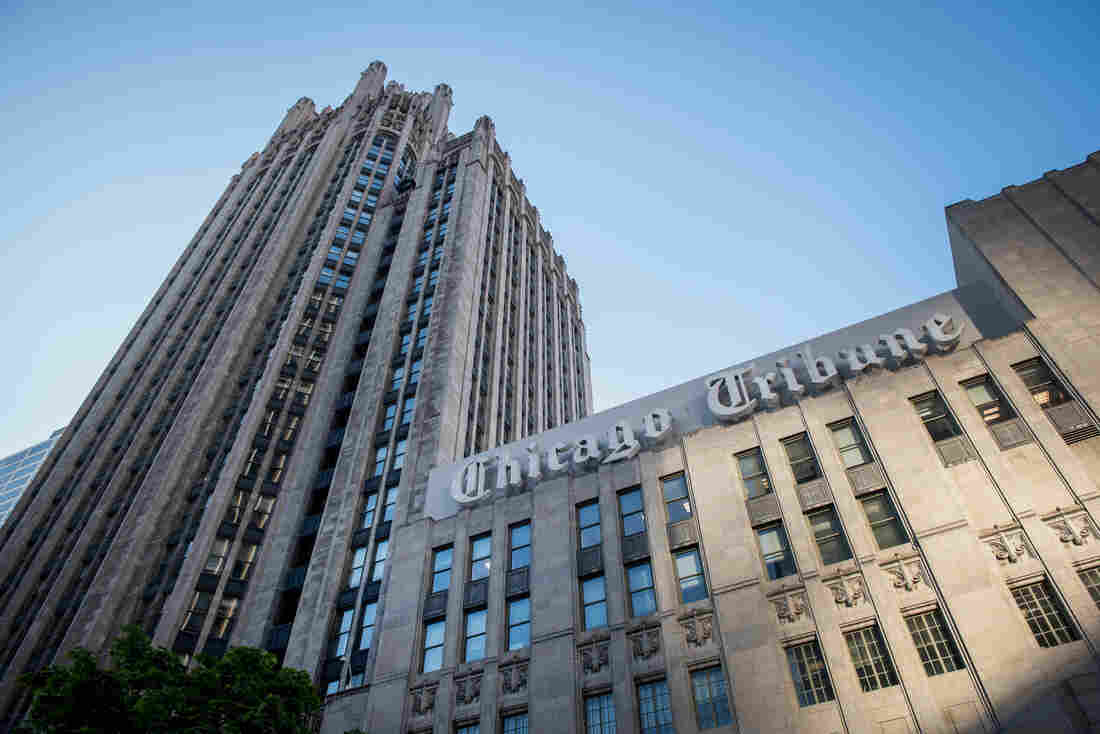
According to labor organizers, Tronc has agreed to recognize three separate bargaining units within the same union at its Chicago-area publications, including the Chicago Tribune.
Bloomberg/Getty Images
hide caption
toggle caption
Bloomberg/Getty Images
The troubled Tronc media company agreed Sunday evening to recognize unions to represent journalists in negotiations at its Chicago-area publications, including its iconic Chicago Tribune, heading off a looming confrontation involving federal regulators, NPR has learned.
It is a notable reversal for Tronc, historically known in various corporate iterations for its hostility to organized labor.
Tronc struck a conciliatory tone in a statement to NPR Sunday night, saying that it looked forward to productive conversations with union representatives.
“As we move ahead, we need to be united as one organization with an important purpose — to help the company transform and thrive as a business, and to serve our readers world class journalism,” the statement read.
This is the second time in four months that a major Tronc newsroom has successfully gone the union route.
In January, Tronc was badly defeated in a federally overseen labor vote at its dominant paper, The Los Angeles Times, despite a concerted management campaign to thwart the unionizing effort.
Both the Chicago and Los Angeles papers have anti-union editorial traditions stretching back more than a century. Now, both will have unions.
Just weeks after the overwhelming vote, Tronc struck a deal to sell the LA Times to one of the parent company’s largest shareholders, Patrick Soon-Shiong. That deal has not closed, though it was expected to do so by late April.
Labor organizers said Tronc has agreed to recognize three bargaining units within the same Chicago union: one for the Chicago Tribune and the entertainment-oriented tabloid RedEye; a second for the company’s suburban publications and the Spanish-language Chicago newspaper Hoy; and a third for the growing corporate-based design and print center that has centralized many editorial production functions for Tronc’s publications in Chicago and beyond.
The first two union chapters, representing workers at the larger publications and the smaller suburban ones, will engage in joint bargaining with the company.
“It’s long past time that the journalists at the Tribune and its community publications have a say in how our newspaper operates,” said Charles J. Johnson, a Tribune homepage editor who is one of the core organizers of the Chicago Newspaper Guild chapter. “We have been badly mistreated by a series of corporate owners, Tronc only being the most recent, and we’ve decided to take some control over the future of our journalism in the city of Chicago.”
In Chicago, organizers said they had collected signed union cards from more than 85 percent of the more than 280 journalists they sought to represent.
Tronc leadership and the top executive at the Tribune, Bruce Dold, had initially rejected the organizers’ appeal for a voluntarily recognition while saying they shared common goals. “We believe in transparency, open dialogue and fairness. That’s who we are as journalists and what guides the Tribune,” Dold wrote last month.
The reversal of fortunes in Chicago is likely to embolden newsroom employees at other Tronc papers, such as the company’s publications in Hartford, Conn.; Orlando, Fla.; and South Florida. The Baltimore Sun newsroom is already unionized.
The Chicago organizers cited concerns about noncompetitive pay compared with peers in the industry; fairness in compensation for women and journalists of color; and Tronc’s commitment to journalism.
Those questions have been echoed at other newspapers of late, particularly those owned by the Alden Global Capital. The editorial page editor of the Boulder Daily Camera was fired for posting an essay critical of the paper’s corporate ownership, and the editorial page editor of The Denver Post resigned last week after the paper killed a second editorial he wrote excoriating Alden Global.
Former Tronc chairman and controlling owner Michael Ferro resigned in March and agreed to sell his entire stake in the company in April after facing accusations of sexual harassment from two female business associates. His stake was bought by a private investment company controlled by a relative of the late Col. Robert McCormick, the legendary leader of Tronc’s predecessor corporation, the Tribune Company. The company is now being circled by potential buyers, reportedly including Japan-based SoftBank.
The Tribune labor organizing effort not only drew inspiration from the Los Angeles efforts but also was fueled by a series of revelations about Tronc’s business performance and corporate decisions, including compensation of executives.
Tronc agreed to pay Ferro $5 million a year as a consulting fee even as he served as chairman of the board. The company’s CEO (and new chairman) Justin Dearborn, a longtime Ferro aide, was given a compensation package in excess of $8 million last year. The former CEO of the LA Times, Ross Levinsohn, was given $6.9 million in pay and compensation last year, despite starting in late August. Levinsohn was sidelined after NPR raised questions about his past workplace conduct but is now Tronc’s digital CEO.
“The people who do this work at the Tribune — and I think this is true generally, and especially at American newspapers — do this work because they believe in its importance, and because they believe it is essential to the functioning of a democratic society,” Johnson said. “This work is done as a labor of love. But as pay and benefits continue to erode, and as mistreatment by corporate ownership continues not only at Tronc but at other employers as well … people wonder if this is work they can continue to afford to do.”
As Karl Marx Turns 200, Visitors Pay Respect — And A Fee — At Disputed Tomb Site



The Perks Of Counting The Wallflowers

The U.S. economy is improving steadily. The unemployment rate continues to fall. Usually, when companies expand their workforces and start hiring, the supply of workers dries up and wages start to climb faster.
But that’s not happening right now. Wages are rising at a measly 2.6 percent. That’s barely higher than inflation.
Elise Gould, a senior economist at the Economic Policy Institute, says the way we classify workers misses a key part of the potential workforce. And there’s a lot more slack in the labor market than you’d think just by looking at the unemployment rate.
Links:
Newly Employed People Who Weren’t Looking for a Job
Music by Drop Electric. Find us: Twitter/ Facebook.
Subscribe to our show on Apple Podcasts, PocketCasts and NPR One.
More Employers Avoid Legal Minefield By Not Asking About Pay History

Asking questions about prior salary can be used by employers to discriminate against women and minorities who earn less, critics say.
Neil Webb/Getty Images/Ikon Images
hide caption
toggle caption
Neil Webb/Getty Images/Ikon Images
How much did you make in your previous job?
This dreaded interview question can sound like a trap. Your answer could be used to set your salary below someone else who is doing the same job.
And, critics say, the question can be used by employers to discriminate against women and minorities who earn less.
Employers are allowed to ask this salary question in most parts of the country. But, hoping to narrow racial and gender pay gaps, seven states and several cities and counties have banned employers from asking about prior pay.
Making matters more complex, courts have issued varying interpretations of what’s legal.
This week, for example, a federal district court struck down a Philadelphia law banning questions about prior pay, saying it impinged on free speech. But last month, the 9th Circuit Court of Appeals ruled in favor of Aileen Rizo, who sued her employer for paying her less than her male colleague because of her previous salary. (Still other circuits have ruled in different ways, allowing employers to ask the question.)
Some companies aren’t waiting for the legal questions to settle: Amazon, Wells Fargo, American Express, Cisco, Google and Bank of America all recently changed hiring policies to eliminate questions about pay history.
Part of the appeal is ease and uniformity, says Tom McMullen, a partner at executive advisory firm Korn Ferry. Last year, a survey by his firm found 46 percent of employers said they would adopt policies to comply with the strictest laws in their region.
“We’re seeing a tipping point with more and more of these states and cities coming on board with the ban … ” McMullen says.
He argues the question isn’t necessary; an employer can always ask what a candidate expects to earn, for example. In fact companies eliminating the question can adapt by improving their internal processes and doing more research before making an offer, he says.
That is exactly what has happened at CareHere, a Nashville-based health care provider with 1,000 employees.
Jeremy Tolley, CareHere’s chief people officer, says he hated probing someone’s salary history, because it always felt intrusive and awkward. Ten months ago, the company eliminated that question in response to some of the regulatory changes. Now it sets salary ranges for each job, then shares that information with candidates up front.
“Our recruiters say that it’s easier now because we’re showing our hand to the candidate,” Tolley says. “We’re telling them what our pay range is, right out of the gate. And it’s really improved candidate relations, that’s for sure.”
He says there is another benefit: A bigger, more diverse pool of candidates. For example, job candidates aren’t automatically turned down just because they earn more than the salary range.
“They’re interested in the company’s culture and they’re more interested in flexibility and remote work — all of those things factor in and not just straight compensation,” Tolley says. “So when you eliminate someone just based on simply what they expect to make then you could be eliminating a candidate without good reason.”
Tracey Diamond, a Philadelphia employment attorney, says many of her clients are taking prior pay questions out of their hiring process. But some are sticking to the practice, even as the law changes around them.
“It was important for them to know their applicant salary history coming in,” Diamond says. So those employers have taken the position that until it’s illegal in their jurisdiction, they will continue using it as a tool in assessing their candidates, she says.
It’s a risky policy, she says, and one that may have to change soon.
In The New York Real Estate Market, Trump's Name May Be Losing Its Luster
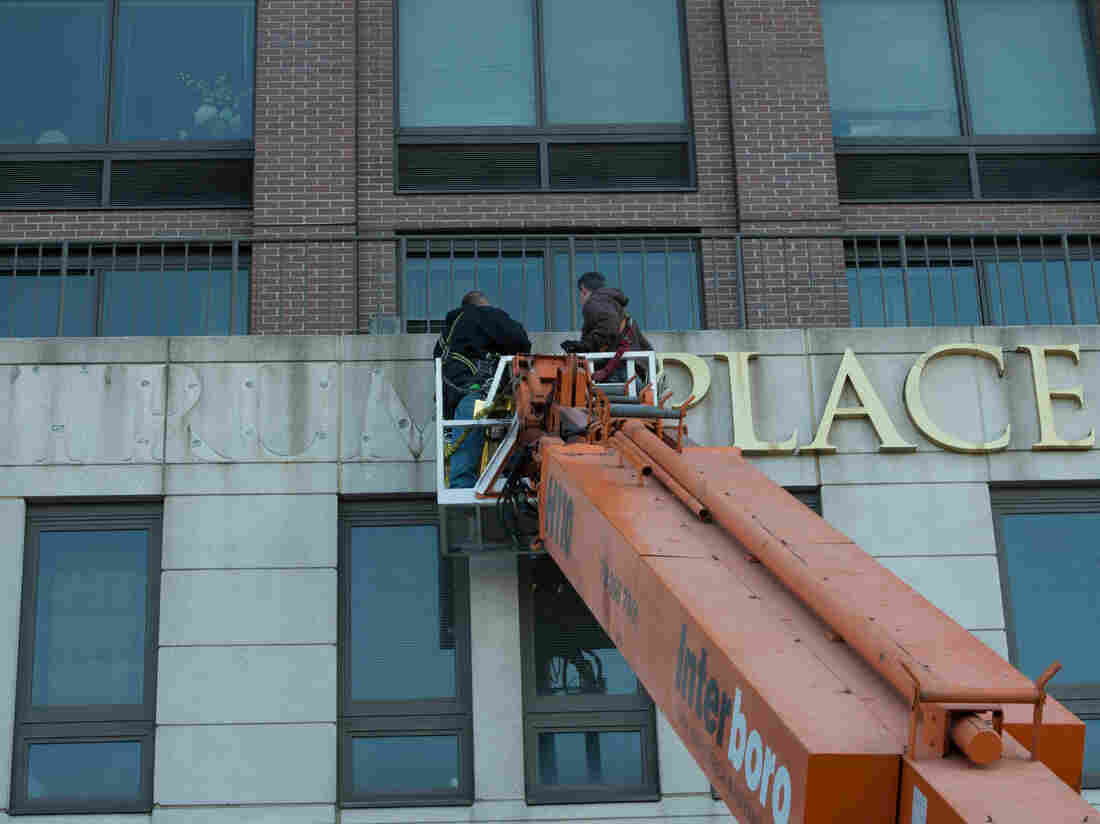
Workers remove Trump signage from Trump Place on Riverside Boulevard. on Manhattan’s West Side on Nov. 16, 2016. A separate building nearby has asked for permission to remove Trump’s name.
Bryan R. Smith/AFP/Getty Images
hide caption
toggle caption
Bryan R. Smith/AFP/Getty Images
James Tufenkian loves everything about the 72-story glass tower where he lives on Manhattan’s East Side, near the United Nations. It has great views, a helpful and accommodating staff and is very well managed.
The only thing he doesn’t like is the name: Trump World Tower.
“I have to explain to everybody who comes to visit me that I’m sorry about the name on the building, that I live there doesn’t constitute any kind of endorsement,” says Tufenkian, who heads a New York carpet company.
New York may be the place Donald Trump calls home and made his fortune, but he remains distinctly unpopular in much of the city and lost the 2016 election to Hillary Clinton by a landslide there.
Now, there are signs the Trump name, emblazoned on high-end properties all over the city, is suffering the consequences.
Several buildings on the Upper West Side have already dropped the Trump name. The Trump Soho, a condo hotel launched with great fanfare a decade ago, is now known as the Dominick.
On Thursday, a condominium building at 200 Riverside Blvd. will ask a New York Supreme Court judge whether it has the right to drop Trump’s name if it chooses. A recent straw poll of building residents indicated that most want to do so.
The building, now known as Trump Place, is not owned by Trump, but it’s managed by the Trump Organization, which opposes the name change.
Elizabeth Holub, who owns an apartment there, says she has no complaints about the way the building, which has a highly desirable view of the Hudson River, is run.
“The reality is, it’s the best run building. It’s unbelievable. Every member of the staff. There’s no better place in the world to raise a family,” Holub says.
Still, she wishes it were named something other than Trump.
“Look, I can’t stand Donald Trump. I’m sorry he’s the president. I don’t support his policies,” she adds.
It’s not just politics that is making some buildings think about de-Trumping themselves. It’s also a matter of money.
While real estate prices have softened in much of New York over the past two years, especially at the high end, some evidence suggests that the Trump name can hurt sales.
One business official with deep knowledge of the real estate industry, who didn’t want his name used to protect his business relationships, said there’s no question Trump apartments are sitting on the market longer than they used to.
Even Trump Tower has recorded many fewer sales so far this year than it did during previous periods in 2016 and 2017, the official said.
As the home of the president, Trump Tower is guarded by the Secret Service, and residents have to endure intense security measures, which may have temporarily scared some buyers away.
But there are signs other Trump buildings in the city may also be losing value.
The online brokerage firm Zumper has studied rental prices at Trump buildings. Nathan Tondow, managing broker at the firm’s New York office, says in most cases, Trump buildings now fetch somewhat lower rents and sit on the market longer than they did two years ago.
More recently, the differences have narrowed, although Tondow says that may be due to seasonable factors.
This being New York, good apartments are always in short supply, and prospective tenants will always snatch up good deals, even when they’re named Trump, he says. But the Trump name does matter in some cases.
“We’ve had rental clients who didn’t want to see buildings, because they did have the Trump name on them. And we tried to explain that it is owned by someone else. It’s just the Trump name. And they say, “I know. But walking into that everyday just feels wrong.”
The Trump Organization did not respond to a request for comment. But the company has pushed back against the lawsuit by 200 Riverside Blvd., insisting that the building is obligated to use the Trump name.
The president’s son, Eric Trump, recently told David Fahrenthold of The Washington Post, “I will always fight vehemently against rogue individuals not only to protect our incredible owners but also to protect the legacy of a true visionary who did so much to shape the New York City skyline.”
States Sue The EPA To Protect Obama-Era Fuel Efficiency Standards

Vehicles pass during the afternoon commute on Highway 101 in Los Angeles on April 2. California is suing the EPA over a plan to revise fuel efficiency standards for vehicles, weakening Obama-era limits on greenhouse gas emissions.
Mario Tama/Getty Images
hide caption
toggle caption
Mario Tama/Getty Images
A coalition of 17 states and the District of Columbia, led by California, is suing the Environmental Protection Agency over its plan to change vehicle efficiency standards. The states are asking a court to review the EPA’s proposed actions, arguing that they violate the Clean Air Act.
“We’re not looking to pick a fight with the Trump administration, but when the stakes are this high for our families’ health and our economic prosperity, we have a responsibility to do what is necessary to defend them,” California’s attorney general, Xavier Becerra, said.
In a news release, the states said their lawsuit “seeks to set aside and hold unlawful the EPA’s effort to weaken the nation’s existing clean car rules … based on the fact that the EPA acted arbitrarily and capriciously, failed to follow its own regulations, and violated the Clean Air Act.”
Specifically, the EPA is reconsidering Obama-era rules designed to reduce greenhouse gas emissions from cars. The regulations call for average fuel efficiency to increase to 54.5 mpg by 2025. EPA head Scott Pruitt said the current standards “may be too stringent,” and has initiated the process of rewriting them.
In its announcement last month, the EPA said that the ambitious Obama-era standards present “challenges to auto manufacturers” and impose extra costs on consumers.
Today, we announced @EPA plans to roll back Obama Admin fuel standards. These standards were inappropriate & needed to be revised. The focus should be on providing consumer choice and the strongest environmental protections.
Catch the full event here?? https://t.co/2LPgSu5iXOpic.twitter.com/rbqixkEhK5
— Administrator Pruitt (@EPAScottPruitt) April 3, 2018
In response Consumers Union, the advocacy division of Consumer Reports,said that efficiency standards actually save consumers money.
And a report released by the Institute for Policy Integrity at the New York University School of Law said the EPA’s reasoning was “not grounded in fact.” For instance, the EPA says lower gas prices are making fuel-efficient cars less attractive, and cites flagging demand for electric cars as a sign the current standards are unrealistic. However, the report notes, “both fuel prices and electric vehicle sales are in fact rising.”
The legal battle between California and the EPA ultimatelycould lead to two competing emissions standards — one for California and the states that follow it, and another for the rest of the country. That’s an outcome automakers would prefer to avoid.
Trump Administration Delays Most Tariffs On Steel, Aluminum

Steel coils sit on wagons leaving a factory in Duisburg, Germany on March 2. U.S. President Trump Monday decided to hold off on imposing most steel and aluminum tariffs until at least June 1.
Martin Meissner/AP
hide caption
toggle caption
Martin Meissner/AP
The Trump administration has decided to hold off on imposing most of its tariffs on imported steel and aluminum until at least June 1.
Tariffs were scheduled to take effect at 12:01 a.m. Tuesday on imports from Canada, the largest U.S. supplier of steel and aluminum, as well as Mexico, Argentina, Australia, Brazil and the EU.
A source familiar with the decision says the administration has reached an agreement in principle with Australia, Argentina and Brazil, which may avoid the need for tariffs against those countries altogether.
Talks continue with Canada, Mexico and the EU.
Trump initially ordered the tariffs — 25 percent on imported steel and 10 percent on imported aluminum — in March, ostensibly to protect domestic industries, which the president called critical to national security.
But before the levies took effect, the administration granted temporary waivers to most major U.S. allies.
In recent weeks, Trump has used the tariffs — or the threat of tariffs — as a bargaining chip in broader trade negotiations.
Mexico and Canada are in talks with the U.S. on a revised North American Free Trade Agreement.
South Korean officials won a permanent exemption from steel tariffs in March as part of an updated free trade agreement with the U.S. But in exchange, South Korea had to reduce its steel exports to the U.S. by about 30 percent, Similar quotas could be imposed on other countries as part of a final deal.
Japan never got a break from the tariffs, so Japanese exporters have been subject to the levies since late March. That was a source of some friction when Trump hosted Japanese Prime Minister Shinzo Abe at Mar-a-Lago two weeks ago.
The EU had threatened to retaliate if the steel and aluminum tariffs took effect, by imposing levies of its own on politically sensitive American exports. Potential targets include Harley Davidson motorcycles, from the home state of House Speaker Paul Ryan, and Kentucky bourbon, which could get the attention of Senate Majority Leader Mitch McConnell, R-Ky.
The steel and aluminum tariffs are part of a broader effort to crack down on what Trump calls unfair trading practices. The administration has also imposed tariffs on imported solar panels and washing machines. And it’s threatening hefty penalties against a wide range of exports from China.
A U.S. delegation is on its way to Beijing for trade talks later this week.
“You see what’s happening with respect to trade and the United States,” Trump said Monday. “We are being respected again.”
Economists have warned that tariffs could backfire, by raising prices for U.S. businesses and consumers and sparking a backlash against American exports.
Comedian's Controversial Performance At D.C. Gala Prompts Renewed Criticism

Saturday night’s White House Correspondents Dinner featured a controversial performance by comedian Michelle Wolf, prompting renewed criticism of the annual event.
MICHEL MARTIN, HOST:
Even in the supposedly freewheeling times, comedy and comedians still occasionally make news, and we have a couple of stories about that. And we’ll start with last night’s White House Correspondents’ Dinner, where comedian Michelle Wolf delivered a performance that took aim at the president, many of his aides and, of course, her hosts, the media.
(SOUNDBITE OF WHITE HOUSE CORRESPONDENTS’ DINNER)
MICHELLE WOLF: You guys are obsessed with Trump. Did you used to date him? Because you pretend like you hate him, but I think you love him.
MARTIN: Here’s NPR’s media correspondent David Folkenflik now to talk about the dinner and why some people are apparently upset. David. Thanks so much for joining us.
DAVID FOLKENFLIK, BYLINE: Great to join you.
MARTIN: So, David, lots of comedians have been criticized for their performances at this dinner and other dinners over the years. Was there something different about this one?
FOLKENFLIK: Well, I think a lot of people focused on Michelle Wolf’s comments particularly about Sarah Huckabee Sanders, who, in the absence of the president in some ways, was one of the leading figures and representatives of the Trump administration who came. Last year, you may recall, all the staffers boycotted in honor of the president, declaring that the whole thing was an affront to him. This time, he encouraged them to go. She was there. And some of the barbs were quite pointed and quite personal. So I think a lot of conservatives and Trump fans looked at that and said, oh, this is beyond the pale.
MARTIN: Here’s an example of one of the jokes that apparently did not sit well. Here it is.
(SOUNDBITE OF WHITE HOUSE CORRESPONDENTS’ DINNER)
WOLF: And I’m never really sure what to call Sarah Huckabee Sanders. You know, is it Sarah Sanders? Is it Sarah Huckabee Sanders? Is it Cousin Huckabee? Is it Auntie Huckabee Sanders? Like, what’s Uncle Tom but for white women who disappoint other white women? Oh, I know, Aunt Coulter.
MARTIN: Well, so you can hear some of the audience reaction in the background. As it has to be said, that is a very large dinner. There are thousands of people in that room. So what is the argument about? What exactly was beyond the pale?
FOLKENFLIK: The argument is that Michelle Wolf is using Sarah Huckabee Sanders, a woman, and taking her down on the basis, in some ways, of her gender and the role that she plays in a way that wouldn’t be done to a man. You know, the accusation is that Michelle Wolf is behaving like a political comedian in a comedy room but instead, you know, in our living rooms because this is a televised thing.
And in some ways, the tension inherent every year is that the White House Correspondents’ Association wants this to be a lively and sort of, in quotes, “outrageous” event so that people pay attention and so that it’s a great gala and they can get, you know, celebrity guests. And they can raise money for their scholarships and hail the First Amendment and the hard work that people do. But in so doing, they often attract people who are genuinely outrageous and genuinely make pointed barbs, not barbs that are carefully sanded on the edges.
You know, I remember when Don Imus pointed barbs at then-President Clinton. I was there when President George W. Bush was satirized. I wasn’t there when Stephen Colbert did his infamous and quite wonderful approach in 2006. I watched it on TV. But that is the one that I thought was most effective. And surprisingly, that’s the one that people in the room took most affront to.
MARTIN: Well, the elephant in the room here though, David, is that the president has his own record of making vulgar comments and personally attacking people in public venues that are also televised and which his supporters have heartily defended. For example, a conservative commentator, Ana Navarro, posted a picture on Twitter of a couple with a Trump T-shirt with a vulgarity saying – basically dismissing your feelings. Basically, your feelings are not of interest. And there’s a vulgarity that we don’t use. So the question then becomes is what is the standard here?
FOLKENFLIK: I mean, look. I would call it an irony, but it’s an abject hypocrisy if you think about what the president has said about his female critics, whether, you know, former Secretary of State Clinton, Senator Kirsten Gillibrand, many other women – Mika Brzezinski of MSNBC, you name it. The things that the president has said have been far more personalized, far more vulgar, far more hostile, in some ways just, you know, definitionally (ph) sexist. There’s just a deep disingenuousness about the degree to which people decide to take offense at this given the nature of the discourse we’ve had in the last several years, much of it from the mouth of the president himself.
MARTIN: That’s NPR media correspondent David Folkenflik. David, thank you.
FOLKENFLIK: You bet.
Copyright © 2018 NPR. All rights reserved. Visit our website terms of use and permissions pages at www.npr.org for further information.
NPR transcripts are created on a rush deadline by Verb8tm, Inc., an NPR contractor, and produced using a proprietary transcription process developed with NPR. This text may not be in its final form and may be updated or revised in the future. Accuracy and availability may vary. The authoritative record of NPR’s programming is the audio record.
