
Baseball Hall Of Famer And Pioneer Frank Robinson Dies At 83
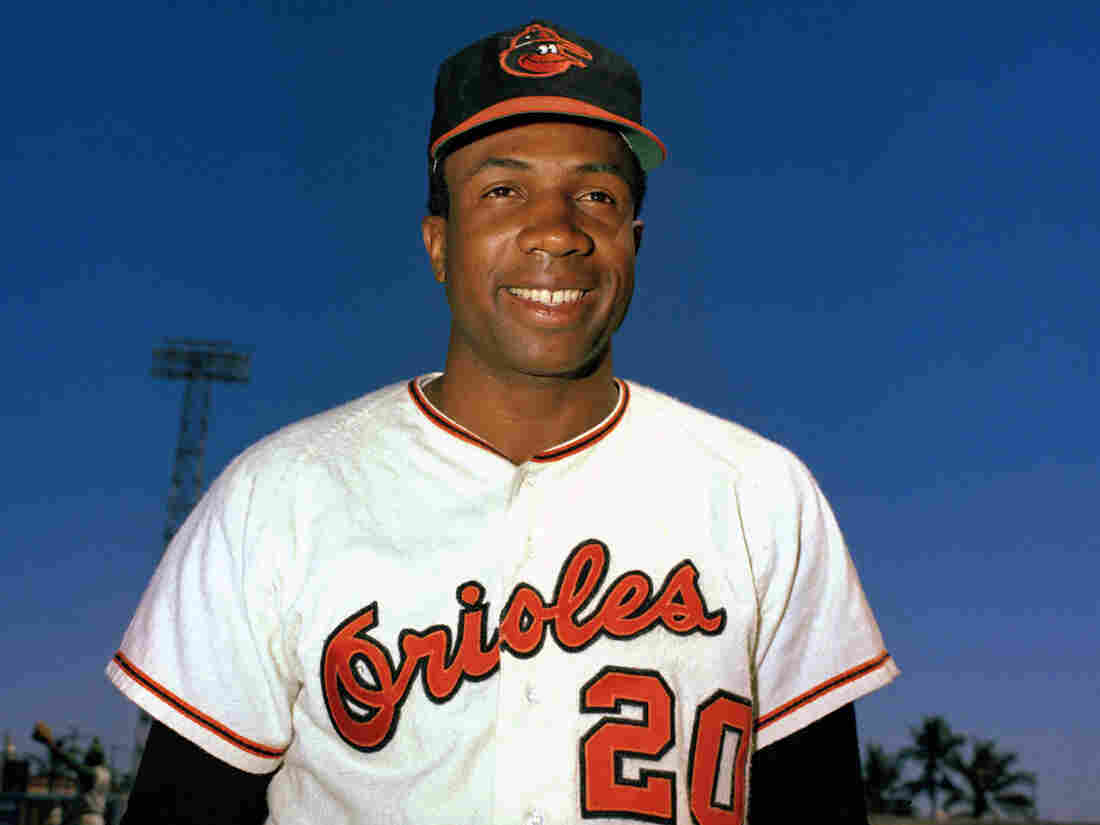
Hall of Famer Frank Robinson was the only player to win the MVP award in both major leagues. He was also baseball’s first black manager.
AP
hide caption
toggle caption
AP
Baseball Hall of Famer Frank Robinson, who made history as a player, manager and league executive, has died at 83 at his home in California.
Robinson, one of the game’s most feared sluggers and a fierce competitor, starred in both of baseball’s major leagues. He later became baseball’s first African-American manager.
“Frank Robinson’s resume in our game is without parallel, a trailblazer in every sense, whose impact spanned generations,” Commissioner Rob Manfred said in a statement. “He was one of the greatest players in the history of our game, but that was just the beginning of a multifaceted baseball career.”
Robinson broke into the majors in 1956 as a hot hitter and graceful fielder with the National League’s Cincinnati Reds. He was the NL Most Valuable Player in 1961, the same year the Reds won the league pennant. But by 1965, despite hitting 33 home runs and driving in 113 runs, the team’s management considered him old and expendable. Robinson responded to that judgment with a vengeance: In 1966, the year after he was traded to the American League’s Baltimore Orioles, he led the team to a World Series victory while winning the Triple Crown and the Most Valuable Player awards.
“Frank took us from being a good team in 1965 to being a great team in 1966,” Hall of Fame pitcher Jim Palmer told the Baltimore Sun. “I’m glad Cincinnati thought he was ‘an old 30’ when they traded him.”
In the six years Robinson spent as an Oriole, the team went to the World Series four times and won twice, in 1966 and 1970.
ESPN’s Tim Kurkjian writes that “Robinson is one of the most underrated superstar players ever to play the game.”
“With that 1966 season, Robinson became the first — and remains the only — player to win the MVP in both leagues. He also finished third in the MVP voting twice, fourth twice and in the top 10 a total of 10 times. He made 13 All-Star teams. He won National League Rookie of the Year in 1956, hitting .290 with 38 home runs at age 20 for the Reds. And while he never led his league in a Triple Crown category other than in 1966 when he managed it in all three, he led his league in slugging percentage, OPS and OPS+ four times, including three years in a row (1960-62). And he led his league in runs scored three times, in being hit by pitches seven times and in intentional walks four times.”
Robinson is currently 10th on the all-time home run list with 586.
There are statues of Robinson at the ballparks in Baltimore and Cincinnati.
Robinson became a player-manager of the Cleveland Indians in 1975, hitting a home run on opening day that year at the age of 39.
He went on to manage the San Francisco Giants (1981-1984), and then returned to Baltimore as skipper (1988-1991) before ending his field career managing the Montreal Expos/Washington Nationals franchise (2002-2006).
Robinson also worked for the game off the field as a consultant, and then executive, with the commissioner’s office.
Born in Beaumont, Texas, Robinson was raised in West Oakland, Calif., where he attended McClymonds High School along with future NBA Hall of Famer Bill Russell.
In 2005, he was awarded the Presidential Medal of Freedom by President George W. Bush.
But it was as a slugger that Robinson may be best remembered. On June 26, 1970, he hit grand slam home runs in consecutive innings.
Consider this quote from his Hall of Fame page at Cooperstown:
“When asked by a fan how he would pitch to Frank Robinson, All-Star pitcher Jim Bouton replied, ‘Reluctantly.’ “
Avoiding The Ouch: Scientists Are Working On Ways To Swap The Needle For A Pill

A team of researchers in Boston has developed an insulin-delivery system that injects the medicine directly into the stomach wall, which is painless.
Felice Frankel/MIT
hide caption
toggle caption
Felice Frankel/MIT
Many vaccines and some medicines, such as insulin, have to be delivered by injection. That’s a pain, both for patients and for health care providers. But two groups of researchers are trying to put some of these medications in pill form to avoid the needle.
One team of scientists, from MIT’s Koch Institute for Integrative Cancer Research and Harvard’s Brigham and Women’s Hospital, developed a system to deliver insulin that actually still uses a needle — but is so small you can swallow it and the injection doesn’t hurt.
They built a pea-size device containing a spring that ejects a tiny dart of solid insulin into the wall of the stomach, says gastroenterologist Carlo Giovanni Traverso, an associate physician at Brigham and Women’s Hospital.
“We chose the stomach as the site of delivery because we recognized that the stomach is a thick and robust part of the GI tract,” Traverso says.
Once the device gets into the stomach, the humidity there allows the spring to launch the insulin dart.
So far so good, but Traverso says there was a problem the team had to overcome: “How do we get these devices to self-orient such that the end that is doing the injecting part is in direct contact with a tissue?”
To get it to roll into the right position all on its own, they turned to nature.
“Leopard tortoises happened to have evolved a way of doing this,” Traverso says. The shape of the tortoise shell helps the turtle flip over if it happens to wind up on its back.
And there was another source of inspiration: Weebles, those egg-shape toys that wobble but don’t fall down.

The self-righting capsule orients itself inside the stomach and ejects a tiny dart of solid insulin that’s about a quarter of an inch long.
Ania Hupalowska, Alex Abramson, Muhammad Mahdi Karim/Science
hide caption
toggle caption
Ania Hupalowska, Alex Abramson, Muhammad Mahdi Karim/Science
As the researchers report in the journal Science, they’ve tested the device on pigs, and it can deliver a therapeutic dose of insulin provided the pig has an empty stomach.
Traverso and his colleagues have been working with the global health care company Novo Nordisk to ready the device for human testing. He has received consulting fees from the company and is a co-inventor on patent applications describing oral biologic delivery. Traverso hopes their device will be ready for human tests in a few years.
On the other side of the U.S., nanoengineer Ronnie Fang of the University of California, San Diego and his colleagues have a different delivery system. Theirs is a kind of ingestible microrocket, about the size of a grain of sand, that is designed to zip past the stomach and into the small intestine.
“It actually propels [itself] using bubbles in a reaction of magnesium with biological fluids,” Fang says.
The rocket has a coating that protects its payload from the acidic and enzyme-filled environment of the stomach. Once the rocket enters the small intestine, the change in acidity causes the coating to dissolve and lets the rocket stick to the intestinal wall to release its payload, in this case a vaccine protein.
Much like Traverso’s design was inspired by the shape of a tortoise shell, the bubble-propelled microrocket travels like a bacterium.
“If you had bacteria invade your gut, they’re not just going to be sitting around statically, they’re going to be swimming around, and they’re going to make it to the intestinal wall,” Fang says.
As Fang and his colleagues report in Nano Letters, their delivery system works in mice, but human testing is probably many years off.
Today in Movie Culture: 'Jurassic Park' Meets 'Fyre Fraud,' 'Ralph Breaks the Internet' Easter Eggs and More
[unable to retrieve full-text content]
Here are a bunch of little bites to satisfy your hunger for movie culture:
Mashup of the Day:
Nerdist perfectly crossed the Netflix documentary Fyre Fraud with Jurassic Park (and its sequels):
Easter Eggs of the Day:
To celebrate the upcoming home video release of Ralph Breaks the Internet, Disney shares some of the Disney and Pixar Easter eggs located in the animated feature:
Video Essay of the Day:
With The Lego Movie 2: The Second Part out this weekend, Matt Draper looks at the first movie’s exploration of the healing power of nostalgia:
Fan Theory of the Day:
In the latest Film Theory, MatPat attempts to figure out what the monster is in the hit Netflix movie Bird Box:
Genre Celebration of the…
Read More
India's Poverty Paradox

India’s finance minister included a radical proposal in his 2019 budget: Give India’s poorest farmers a guaranteed income of 6000 rupees a year (about $84). The move is probably largely political: the Prime Minister of India, Narendra Modi, and his party have elections coming up and they need rural votes. Still, the payout would significantly increase the income of more than 100 million of India’s very poorest families, so a lot of people say the handouts would be a good thing. Today on The Indicator, we look at the pros and cons of payouts.
Music by Drop Electric. Find us: Twitter/ Facebook.
Subscribe to our show on Apple Podcasts, PocketCasts and NPR One.
GOP Rep. Ann Wagner Discusses Prospect Of National Paid Leave

NPR’s Mary Louise Kelly speaks with Rep. Ann Wagner, R-Mo., who enthusiastically shouted “Yes!” when President Trump raised the prospect of national paid leave in his State of the Union address.
MARY LOUISE KELLY, HOST:
If you were listening closely to the State of the Union last night, you might have leaned in at an unexpected whoop when the president arrived at this line.
(SOUNDBITE OF 2019 STATE OF THE UNION ADDRESS)
PRESIDENT DONALD TRUMP: I am also proud to be the first president to include in my budget a plan for nationwide paid family leave so that every new parent has the chance to bond with their newborn child.
ANN WAGNER: (Screaming) Yes.
KELLY: That hollered, yes, came from Congresswoman Ann Wagner, Missouri Republican. She and Florida Republican Senator Marco Rubio have been pushing for a paid leave law.
We are following up on lots of threads from the State of the Union throughout this hour, but we thought we’d start here, with one of the few issues that maybe has a bipartisan future.
Congresswoman Wagner, welcome. And if I may start by asking, what came over you there?
WAGNER: I have been a proponent of paid family leave for years. I think I gave the same kind of shout when President Obama was also giving his State of the Union.
KELLY: So that was a bipartisan whoop we heard last night.
WAGNER: It most certainly was. And I’m certainly working on a paid family leave bill in a bipartisan fashion. I’m a mom – a mother of three.
KELLY: I was going to ask if there’s a personal story behind your push for this.
WAGNER: Sure. And – mother, a grandmother and someone who has employed new moms and dads. And having a baby is both a time of, obviously, great joy and, oftentimes, anxiety, too. So babies change their parents’ lives for the better, but they also introduce some serious new challenges and costs. And along with rent and groceries and medical bills, diapers, countless baby supplies, sleepless nights – you could go on and on and on.
And the last thing a new mom should ever have to worry about is whether she is going to lose her job or miss a paycheck because she’s chosen to have a child and start a family.
KELLY: So let’s get into the details. Your plan, in a nutshell, would allow people to postpone Social Security benefits, retire a few months later down the road, in order to use that money to take parental leave now. Is that right?
WAGNER: That’s correct. We have a plan here that would allow young moms and dads to take kind of an advance on their Social Security benefits to help them during this difficult transition. At their retirement – again, it’s totally voluntary if you want to do it this way – the worker who chose to take this option for a paid family leave will repay any parental benefits received through either, one, a temporary benefit reduction upon retirement, or a delay in their retirement to offset the costs.
Because what’s so important, Mary Louise, is that we do not affect the future solvency of the Social Security trust fund. And we’re making sure that we do not affect any senior who’s currently benefiting…
KELLY: OK.
WAGNER: …From Social Security.
KELLY: Nonetheless, a lot of Democrats say this is the wrong way to go. I’ll put to you a point that Senator Tammy Duckworth made to me when I was interviewing her last year. And she said, why should I have to rob from my retirement in order to take care of my children now?
I mean, to her point, and to the point you’ve made, other countries manage both to provide paid leave and leave retirement intact. Why is that not possible here?
WAGNER: Well, we are running such a high deficit at this point, and our national debt is over $21 trillion. It’s my feeling, from a conservative standpoint, that we really can’t fix this problem or address it through new taxes or mandates.
KELLY: Do you have Democratic co-sponsors for your plan?
WAGNER: We do have Democrat support for our plan.
KELLY: Officially co-sponsoring, or saying they would vote for it?
WAGNER: Well, we haven’t dropped the piece of legislation yet, but we have a number of folks that are working on it. And Ivanka Trump and others at the White House are very, very interested in how we pulled this together. Senator Joni Ernst, Senator Lee – there are a number of Republicans and Democrats. I think we can find real common ground, I hope, on this.
KELLY: Missouri Republican Ann Wagner. Congresswoman, thanks so much for your time.
WAGNER: Thank you, Mary Louise, very much for shining a light on, I think, this very important issue that I hope will bring us all together.
Copyright © 2019 NPR. All rights reserved. Visit our website terms of use and permissions pages at www.npr.org for further information.
NPR transcripts are created on a rush deadline by Verb8tm, Inc., an NPR contractor, and produced using a proprietary transcription process developed with NPR. This text may not be in its final form and may be updated or revised in the future. Accuracy and availability may vary. The authoritative record of NPR’s programming is the audio record.
Opinion: Now Is The Winter Of The NBA Players' Discontent
Sports commentator Mike Pesca opines on the high levels of discontent among the NBA’s top players.
DAVID GREENE, HOST:
Thursday is the NBA’s trade deadline, and there are a lot of great players who could be moved to a different team. Quite a few of them, actually, are demanding to be traded to another team. Sports commentator Mike Pesca says he can’t remember a time of more widespread discontent among the NBA’s elite. And Mike has some thoughts on how we got here.
(SOUNDBITE OF MONTAGE)
UNIDENTIFIED REPORTER #1: The Lakers have offered an improved Anthony Davis package.
UNIDENTIFIED REPORTER #2: The Blazers acquired Rodney Hood in exchange for sauce Castillo, Wade Baldwin…
UNIDENTIFIED REPORTER #3: Should the Sixers at least think about moving Jimmy Butler?
MIKE PESCA, BYLINE: And in other NBA unhappiness news, Anthony Davis demands a trade out of New Orleans, Kentavious Caldwell-Pope is unhappy with the Lakers, Kristaps Porzingis dealt by the Knicks, who he had grown weary of, Kyrie Irving wants out of Boston, and, oh yeah, Thon Maker, who plays for the team with the NBA’s best record, the Milwaukee Bucks, wants out. NBA players get paid an average of $7 million a year and get to wear shorts to work. What’s the problem, guys?
Thirty-one years ago, before there was free agency actually, players could be traded or cut. That was it. Things are absolutely better for players now. They’re richer and have more freedom. That’s the free part of free agency. But I believe the agency part is harder to deal with on a psychological level.
(SOUNDBITE OF ARCHIVED RECORDING)
LEBRON JAMES: And this fall, I’m going to take my talents to South Beach.
PESCA: In 2010, LeBron James took his talents to South Beach and created a super team with the Miami Heat. In less than a decade since, other groups of players have tried to do the same thing, meaning a great player now also has to be a great general manager, mixing and matching or sometimes demanding and wheedling to find a better situation for himself. A player in 1985 might just put his head down and grind it out for an uncaring owner.
But now when a player has ownership over his own career, he has no one to blame but himself. It seems un-American to argue for the old dictatorial system, and I’m not doing that. I’m just noting that the first flush of openness, as when a government topples or, say, when the Berlin Wall came down, eventually leads to habituation. Freedom stops feeling like freedom and just starts feeling like life. And the agency in free agency stops meaning the opportunity to choose and starts meeting the burden of choice.
Aside from psychology, common to all humans, there is something specific to the NBA that is causing such mass discontent. Pat Riley, famed NBA player, coach and executive, once said, in the NBA, there is winning and there is misery. By winning, he meant championships, and in the NBA these days, it seems only the Golden State Warriors can do that. It is true that every year only one team wins, but in past seasons, several teams at least thought they could win. And sometimes, especially if LeBron James was on the team, they were right.
But this year, the perception of hopelessness casts a pall on every player who is not on the Warriors. What’s the point, they ask. The only chance is to orchestrate for myself a better situation, to create my own group of superstars and only then might I find contentment to go along with my average of $7 million and casual workplace attire.
(SOUNDBITE OF GOD SENSE’S “SUN RAYS”)
GREENE: We hope sports commentator Mike Pesca keeps finding contentment right here. We would never trade him away.
Copyright © 2019 NPR. All rights reserved. Visit our website terms of use and permissions pages at www.npr.org for further information.
NPR transcripts are created on a rush deadline by Verb8tm, Inc., an NPR contractor, and produced using a proprietary transcription process developed with NPR. This text may not be in its final form and may be updated or revised in the future. Accuracy and availability may vary. The authoritative record of NPR’s programming is the audio record.
Today in Movie Culture: 'Avengers: Endgame' Easter Eggs, the Brilliance of the 'A Star is Born' Sound Mix and More
[unable to retrieve full-text content]
Here are a bunch of little bites to satisfy your hunger for movie culture:
Easter Eggs of the Day:
How many Easter eggs did Marvel pack into the 30-second Avengers: Endgame Super Bowl teaser? Mr. Sunday Movies finds out:
Movie Craft of the Day:
Insider spotlights the four engineers behind the Oscar-nominated sound mix of A Star is Born:
Oscar Montage of the Day:
Burger Fiction highlights every movie nominated for the Oscar for Best Visual Effects starting with 1927’s Wings:
Video Essay of the Day:
This video from Cinema Cartography celebrates the existential excellence of Ingmar Bergman’s Persona:
Vintage Image of the Day:
Red Buttons, who was born 100 years ago today, with director Billy Wilder and…
Read More
Fact Check: Trump's State Of The Union Address

President Trump delivers his State of the Union address Tuesday to a joint session of Congress on Capitol Hill in Washington, as Vice President Pence and Speaker of the House Nancy Pelosi, D-Calif., watch.
Andrew Harnik/AP
hide caption
toggle caption
Andrew Harnik/AP
President Trump is delivering his State of the Union address Tuesday night, a speech that had been delayed during the government shutdown.
The annual remarks come as a bipartisan group of lawmakers continue to negotiate border security funding and Trump’s wall proposal — the central issue that led to the longest shutdown in U.S. history.
NPR reporters will be annotating Trump’s remarks live, adding context and analysis.
Loading…
Texans Can Appeal Surprise Medical Bills, But The Process Can Be Draining

Austin, Texas, dentist Brad Buckingham received a bill for more than $70,000 after a bike accident landed him in the hospital and he needed emergency hip surgery.
Gabriel C. Pérez/KUT
hide caption
toggle caption
Gabriel C. Pérez/KUT
In Texas, a growing number of patients are turning to a little-known state mediation program to deal with unexpected hospital bills.
The bills in question often arrive in patients’ mailboxes with shocking balances that run into the tens or even hundreds of thousands of dollars.
When patients, through no fault of their own, are treated outside their insurers’ network of hospitals, the result can be a surprise bill. Other times, insurers won’t agree to pay what the hospital charges, and the patient is on the hook for the balance.
The Texas Department of Insurance’s mediation program can intervene when Texans complain about an unexpected bill — often after an emergency in which a patient rushed for treatment at an out-of-network hospital.
Historically, the state program had many restrictions that left few consumers eligible for help. But the Texas Legislature expanded it in 2017.
Since then, more patients have been filing complaints. In 2014, the department was asked to mediate 686 medical bills. During the 2018 fiscal year, however, it received 4,445 bills, more than double the 2,063 bills received in 2017.
Even after the changes, the mediation program could be a lot more robust and is likely addressing only a fraction of these problematic bills, consumer advocates say.
The road to a surprise medical bill
Brad Buckingham says he had to deal with a surprise medical bill after a bicycle accident in 2016.
Buckingham sent his bill to Kaiser Health News and NPR’s Bill of the Month portal last year.
The Austin, Texas, dentist says he was on a ride with friends in December 2016 when he crossed some train tracks at an angle to avoid a pileup. His wheel slipped out from under him, and he landed hard on his left hip.
“All I could do was scream,” he says. “I couldn’t even make words.”
His friends called an ambulance, and Buckingham was taken to the nearest hospital: St. David’s South Austin Medical Center.
“I specifically remember I gave them my health insurance information in the ambulance,” he says. “And they put me in the ER, and from the ER they took my insurance information again.”
Buckingham had insurance through Baylor Scott & White Health, which he bought through the Affordable Care Act marketplace. St. David’s was out of his plan’s network, but no one told him that — at first.
Buckingham had broken his hip, and doctors took him into surgery the same day.
“They held me in the hospital for three days just for recovery and never told me I was out of network until the time of my discharge,” he says.
A few weeks later, Buckingham got a bill that said he owed $71,543.
The total bill eventually came to $75,346. Baylor Scott & White, which left the ACA marketplace the following year, paid only $3,812.
Buckingham says he thought it was a mistake. He called the hospital and the insurer to sort it out. But after weeks of inquiring about it, there was no resolution.
Both the hospital and insurer insisted payment was his responsibility.
“I’m sitting there thinking to myself that there is no way – there is no way — this is right,” he says.
Baylor Scott & White says it couldn’t discuss Buckingham’s bill “due to confidentiality requirements.”
After Buckingham gave St. David’s permission to discuss his case with the media, the hospital released a statement saying his bill was actually the amount he owed from his deductible and coinsurance — not a balance bill.
The hospital also said the bill was so large because of his “high deductible plan.”
Those plans “may be attractive to some people because they cost less, though they place more financial responsibility on the patient,” the statement from St. David’s said.
NPR-Kaiser Health News Bill of the Month
Read the stories from the project here.
Buckingham says his policy had a deductible of $5,000 for in-network care and $10,000 for out-of-network care. He says he still doesn’t know how his bill got to be so high.
Buckingham didn’t know about the state’s mediation program. But even if he had known, he wasn’t eligible for the program at the time. His bike accident and the billing dispute with the hospital happened months before the Texas Legislature decided to expand the pool of eligible patients. So he hired his own lawyer to help him negotiate with the hospital.
Buckingham says he now owes a couple of thousand dollars to St. David’s, but he remains frustrated by the experience.
“You know, whenever I tell my story to anybody, they kind of agree — like, ‘Oh my gosh, this is ridiculous,’ ” he says. “But then when you talk to the people that have any control over it, it’s the exact opposite. It’s: ‘You owe it; we don’t.’ “
‘A total roll of the dice’
A surprise bill can happen to anyone who makes an urgent trip to the nearest emergency room.
“It’s a total roll of the dice,” says Stacey Pogue, a senior policy analyst with the Center for Public Policy Priorities in Austin. She has been looking into balance billing for years. “The medical emergency that’s going to send you to the hospital where you could get a surprise bill — is that emergency room going to be in or out of network?”
Pogue says the Texas Department of Insurance’s mediation process forces an insurance company and the hospital or medical provider to negotiate a fair price for services. She says 90 percent of the time those negotiations happen over the phone.
There are two big reasons the number of bills sent for mediation more than doubled from 2017 to 2018, Pogue says.
“One is just increased awareness,” she says. “There is constant media attention now to surprise medical bills because the stories are so shocking, right? We see them covered more, so people are more aware that when they get one, they could do something about it.”
The second reason is that in 2017, the Texas Legislature opened the mediation program up to more people, including teachers.

Stacey Shapiro got a $6,720 bill after being treated in the hospital for a hypoglycemic attack.
Gabriel C. Pérez/KUT
hide caption
toggle caption
Gabriel C. Pérez/KUT
Can’t wish it away
Stacey Shapiro, a first-grade teacher in Austin, also received a surprise bill from St. David’s South Austin Medical Center after she landed in the emergency room last March.
The marathon runner said she woke up one Saturday for an early run and wasn’t feeling well.
“All of a sudden the whole room started spinning. … I started sweating, sweating like buckets,” she says. “It was terrible, and then all I remember is that my ears started popping, my vision got blurred and then the next thing I knew, I had passed out.”
Shapiro’s boyfriend heard her hit the bathroom floor. He found her passed out, with her eyes open and hardly breathing. He took her to St. David’s because it was the closest hospital.
Shapiro says she was taken care of in a few hours. Hospital staff gave her fluids and anti-nausea medication. Doctors found she had a dramatic change in her blood pressure that was likely due to a spell of hypoglycemia, or low blood sugar.
Two months later, a bill for $6,720 came in the mail.
Like many teachers in Austin, Shapiro gets her health insurance from Aetna.
In a statement, the insurer said Austin school district employees are supposed to use the Seton Accountable Care network, comprising several Catholic hospitals in the area. St. David’s parent company, the for-profit hospital chain HCA, doesn’t participate in that network.
“Unfortunately, HCA is not currently accepting payments through Aetna’s [contracted payment] program, which provides set payment fees for non-participating providers. This has resulted in Ms. Shapiro being balance billed for her emergency room visit,” Aetna wrote in a statement.
Shapiro says she had heard of other Austin Independent School District employees dealing with high hospital bills. In fact, Shapiro reached out to KUT after hearing the story of Drew Calver, an Austin high school teacher who was balance billed for nearly $109,000 by St. David’s after a heart attack. Calver’s story was part of Kaiser Health News and NPR’s Bill of the Month series last year.
Shapiro says that in her case, Aetna told her not to pay what the hospital was charging her. She says she was told to pay only her deductible ($1,275), which she did right away. But St. David’s kept sending her bills for the remaining balance, which was more than $5,000.
“I guess I just thought that it was going to go away,” Shapiro says.
But it didn’t. For a public school teacher, $5,000 would have been a huge blow to her budget, she says.
Shapiro applied for financial assistance, but St. David’s told her she didn’t qualify. She says she felt like she was out of options — until a friend told her about the state’s mediation program.
After she contacted the program, a state mediator set up a scheduled call with Aetna and St. David’s. But before it took place, a KUT reporter asked St. David’s for a comment on the situation. Shortly afterward, Shapiro says, St. David’s told her she no longer owed anything.
St. David’s later told KUT that Shapiro had “already satisfied her financial obligation.” It also denied that she was balance billed to begin with.
Shapiro says the whole experience has been exhausting. “It’s just very frustrating because this has been very time-consuming,” she says.
More work to do
The Center for Public Policy Priorities’ Pogue has been arguing that the state needs to find more ways to get involved.
She says the current mediation process is pretty good, but not enough people know it’s an option.
“Because first, the instructions for how to do it are on your medical bill and your explanation of benefits — the most indecipherable documents you are going to get,” she says.
And even if people understand they have a right to mediation, they might get scared off by the concept and think they need a lawyer, Pogue adds.
But when people use the program, it tends to work by saving patients money.
In fiscal year 2018, the initial complaints amounted to $9.7 million worth of medical bills, according to the state insurance agency. After mediation, the final charges had been negotiated down to $1.3 million.
Pogue says mediation is helpful, but it still puts a big burden on the patient, who may be confused. “Why didn’t this happen in the first place?” Pogue says. “How come I had to, while recovering from an emergency, decipher medical bills, fill out paperwork with the state department of insurance, jump through all these hoops, when all that needed to happen was a phone call?”
The ideal solution to surprise medical bills would remove consumers from this confusing web altogether, she says.
Pogue points out that states like New York, California and Florida have systems that make things easier for consumers. She thinks Texas should do that too.
In 2015, New York became the first state to pass a law aimed at protecting patients from surprise medical bills from out-of-network hospitals. The Emergency Medical Services and Surprise Bills Law holds consumers harmless if they are treated by an out-of-network doctor at a participating hospital, among other things.
In 2016, Florida lawmakers passed legislation protecting consumers from receiving surprise medical bills “from doctors and hospitals that don’t have a contract with the patient’s insurance plan,” the Miami Herald reported.
And in 2017, California passed a law shielding patients from balance billing. The law kicks in if someone visits an in-network provider, including a hospital, imaging center or lab, according to the San Francisco Chronicle. Under the law, patients “will be responsible only for [their] in-network share of the cost, even if [they are] seen by an out-of-network provider,” the Chronicle reported.
In the meantime, Pogue says, more Texans should take advantage of what’s already in place in the state.
The number of people who seek mediation is “tiny compared to the number of people who get surprise bills,” she says, “so there is a ton of work to be done.”
This story is part of NPR’s reporting partnership with KUT and Kaiser Health News. You can follow Ashley Lopez on Twitter: @AshLopezRadio.
Football Fans Call Sunday's Super Bowl Dull, TV Ratings Were Down Too
The two teams combined for 16 points, and the Patriots won. That’s unlike last year when the teams combined for 74 points, and the Patriots lost. TV ratings were down to about 100 million viewers.
STEVE INSKEEP, HOST:
Good morning. I’m Steve Inskeep. Many viewers called Sunday’s Super Bowl dull. The two teams combined for only 16 points, and the Patriots won, as usual. That’s unlike last year when the teams combined for 74 points, and the Patriots lost. And now we know this year’s TV ratings are down to about 100 million viewers. But if you do the math and count it as TV viewers per point scored, this year’s game was a big success. It’s MORNING EDITION.
Copyright © 2019 NPR. All rights reserved. Visit our website terms of use and permissions pages at www.npr.org for further information.
NPR transcripts are created on a rush deadline by Verb8tm, Inc., an NPR contractor, and produced using a proprietary transcription process developed with NPR. This text may not be in its final form and may be updated or revised in the future. Accuracy and availability may vary. The authoritative record of NPR’s programming is the audio record.
