Articles by admin

No Image

The Real Super Bowl Drama Wasn't During The Game, But The Beer Commercials

There was little drama during Sunday’s Super Bowl. But one ad did start a Twitter war between Bud Light and Big Corn.


MARY LOUISE KELLY, HOST:

Last night’s Super Bowl had the lowest score ever, and it was every bit as boring as that sounds. If you wanted drama, you had to turn to the commercials.

(SOUNDBITE OF ARCHIVED RECORDING)

SYDNEY LEMMON: (As Dilly Dilly Queen) My king, this corn syrup was just delivered.

JOHN HOOGENAKKER: (As Dilly Dilly King) That’s not ours. We don’t brew Bud Light with corn syrup.

LEMMON: (As Dilly Dilly Queen) Miller Lite uses corn syrup.

HOOGENAKKER: (As Dilly Dilly King) Let us take it to them at once.

ARI SHAPIRO, HOST:

Yes, corn syrup. The Budweiser family of products, famous for Super Bowl ads like the Bud frogs, among others, settled on corn syrup for its major push this year.

KELLY: The implication being that corn syrup, used by rival brands in the brewing process, is not healthy. The response on Twitter was immediate.

SHAPIRO: MillerCoors tweeted, Bud Light uses rice to aid fermentation. We use corn syrup. Interestingly, none of our products use high fructose corn syrup, yet several of Anheuser-Busch’s do.

KELLY: Big corn, meanwhile, was a big mass of hurt feelings. The National Corn Growers Association tweeted, America’s corn farmers are disappointed in you. Our office is right down the road. We would love to discuss with you the many benefits of corn.

SHAPIRO: Corn farmer Kevin Ross wanted in on the conversation, too. He posted a video of him pouring cans of Bud Light down the drain.

(SOUNDBITE OF ARCHIVED RECORDING)

KEVIN ROSS: Bud Light, you’re not standing with corn farmers. We’re not standing with you.

KELLY: Marion Nestle saw the ad, too.

MARION NESTLE: From a nutritional standpoint, it’s absolutely hilarious, and I laughed all the way through it.

SHAPIRO: Nestle is a nutrition expert at New York University. She says that sugar is used to feed yeast during the fermentation process. It doesn’t care where the sugar comes from.

NESTLE: From a physiological standpoint in the body, it makes absolutely no difference at all. The yeast can’t tell them apart.

KELLY: So why call out corn syrup?

NESTLE: Well, they’re trying to say that their ingredients are healthier and more natural than the ingredients in the competitor’s beers.

SHAPIRO: So after millions of dollars spent throwing shade on corn syrup, the difference between Bud and others, according to Nestle, isn’t much of a difference at all.

Copyright © 2019 NPR. All rights reserved. Visit our website terms of use and permissions pages at www.npr.org for further information.

NPR transcripts are created on a rush deadline by Verb8tm, Inc., an NPR contractor, and produced using a proprietary transcription process developed with NPR. This text may not be in its final form and may be updated or revised in the future. Accuracy and availability may vary. The authoritative record of NPR’s programming is the audio record.

Let’s block ads! (Why?)


No Image

Cold-o-nomics

Frigid temperatures arrived in the Upper Midwest with a polar vortex. In Chicago on Wednesday, Marius Radoi walked along a freezing Lake Michigan.

Joshua Lott/AFP/Getty Images

Climate change is snowballing into more extreme weather. Between hurricanes, tornadoes, and yes, polar vortices, life on earth is becoming increasingly disrupted by weather conditions. And that can get expensive. Today on The Indicator, we look at how extreme weather can affect the economy, and what the most costly climate conditions can be.

Music by Drop Electric. Find us: Twitter/ Facebook.

Subscribe to our show on Apple Podcasts, PocketCasts and NPR One.

Let’s block ads! (Why?)


No Image

Super Bowl Ads 2019: Stunts, Self-Deprecation And Celebrity Sightings

Harrison Ford and a dog stand in front of a house in a still from an Amazon commercial that ran during the 2019 Super Bowl.

Amazon YouTube

Pepsi should have chosen a different slogan for its ads during this year’s Super Bowl.

The company’s slogan was “More than okay.” Well, not really. In fact, most of the high-priced commercials we saw between the football plays were just OK. They were so careful to avoid scandal and backlash they felt leached of originality or bite.

That’s pretty much what Greg Lyons, Chief Marketing Officer of PepsiCo Beverages North America, predicted when I asked him last week what this year’s spots would look like: nothing controversial.

“The Super Bowl is a time for people to enjoy themselves and enjoy the ads,” Lyons said, deftly avoiding direct mention of the elephant in this particular room — allegations that the NFL blackballed former quarterback Colin Kaepernick for his silent protests over social justice issues, leading to the hashtag #Imwithkap trending before the big game started.

Super Bowl ad time was costly — CBS charged up to $5.3 million for each 30 seconds of time — so the commercials sidestepped anything that might offend. That left viewers with a lot of spots centered on emotional tributes to first responders and soldiers, artificial intelligence and robots acting out and awkward celebrity cameos. One example: Charlie Sheen, reading a newspaper as Mr. Peanut speeds by in a car shaped like a peanut, looking up to say, “and people think I’m nuts.” Really.

Here’s my take on what worked — and so much more that didn’t — on the world’s biggest showcase for TV advertising:

Best argument for a free press: “The Washington Post Spot” “Democracy Dies in Darkness.”

Yeah, as a journalist and sometime media critic, I’m a little biased. And at a time when journalists are enduring layoffs across many outlets the price of a Super Bowl ad may seem foolish. But The Washington Post spot reminded us how journalism informs every facet of our lives, with clips of fallen reporters like Marie Colvin and Jamal Khashoggi with the reassuring voice of Tom Hanks telling viewers “knowing keeps us free.” Would an “enemy of the people” do that? I don’t think so.

[embedded content]


The Washington Post
YouTube

Best mashup of two things that probably shouldn’t be mashed up: Bud Light and HBO’s Game of Thrones.

Last year, Bud Light featured a bunch of ads in a medieval setting with characters saying the catchphrase “dilly, dilly.” This year, they upped the ante by showing one of their Bud Light knights killed in a jousting contest by a character from Game of Thrones — The Mountain — before a dragon from the show sets everyone on fire. I’ll give Bud Light points for teaming up with a cool, highly anticipated TV event. But in a Super Bowl advertising environment that’s mostly about humor and sentimentality, selling your beer with a commercial that shows scores of people getting killed feels a bit, well, off brand.

[embedded content]


HBO
YouTube

Good try making the best of a bad thing: “Is Pepsi OK?”

Props to the company for not shying away from something that could be considered a serious weakness: the fact that wait staff often ask customers “Is Pepsi OK?” when customers ask for a Coke, but the restaurant serves only Pepsi products. The ad featured Steve Carell berating a waiter before rappers Cardi B and Lil Jon show up bellowing the word “okay” in their signature styles. Carell’s patter did feel a little like watching your dad joke about a pop music video. But at least he admits trying to cop Cardi B’s style is probably a bad idea.

[embedded content]


Pepsi
YouTube

Best use of celebrities: Harrison Ford, Forest Whitaker, Abbi Jacobson, Ilana Glazer, Mark and Scott Kelly Cope with Amazon Fails

Give Amazon points for making Harrison Ford’s increasingly curmudgeonly style look charming. The premise of the ad is simple: after showing off a microwave with Alexa, the commercial features celebrities trying other Alexa/Amazon products that didn’t turn out so well. It’s cute seeing Forest Whitaker struggle to hear a podcast through an Alexa-enabled toothbrush stuck in his mouth, while the stars of Broad City, Jacobson and Glazer, get accidentally ejected from an Alexa-powered hot tub. But it’s Ford jousting with his dog, who keeps ordering stuff through his Alexa-outfitted dog collar, who steals the show. (I think he just might have found his partner for the next Indiana Jones movie.)

[embedded content]


amazon
YouTube

Worst use of a celebrity: Jason Bateman for Hyundai

Jason Bateman is an under-appreciated talent with a skill for serving up dry humor. So it’s sad to see Hyundai stick him in a role anyone could have played: an elevator operator descending with a car-shopping couple, going past floors with awful activities like getting a root canal or attending a vegan dinner party, until they finally land in the basement, where there’s a car dealership. Frankly, I expected him to pass a floor where people were watching this commercial, which might have rescued the whole thing.

[embedded content]


Hyundai
YouTube

Let’s block ads! (Why?)


No Image

Poor Students More Likely To Play Football, Despite Brain Injury Concerns

Mo Better Jaguars’ coaches and players huddle at the end of practice at Betsy Head Park in Brownsville, Brooklyn in September 2014.

Courtesy of Albert Samaha


hide caption

toggle caption

Courtesy of Albert Samaha

Fears of brain injuries has deterred many parents and their children from choosing to play football.

After years of publicity about how dangerous football can be, football enrollment has declined 6.6 percent in the past decade, according to data from the National Federation of State High School Associations.

Those who still play the sport are increasingly low-income students.

Over the past five years in Illinois, the proportion of high school football rosters filled by low-income boys rose nearly 25 percent – even as the number of players in the state has fallen by 14.8 percent over the same period, according to a story out this week from HBO’s Real Sports.

[embedded content]


HBO
YouTube

This doesn’t surprise Albert Samaha, a BuzzFeed News investigative reporter and author of “Never Ran, Never Will: Boyhood and Football in a Changing American Inner City.”

Samaha spent two seasons embedded with the Mo Better Jaguar football program in Brownsville, a small Brooklyn neighborhood overburdened with poverty and crime. The program is for children ages 7-13, who are all aware of the risks of playing football, but play anyway.

“The reason that football is so valuable to them is the fact that it’s still the sport that that’s the most popular in America, that is getting the most money from high schools and colleges in America,” Samaha said in an interview with NPR’s Michel Martin on All Things Considered. “At a time when the educational gap continues to widen between low income, particularly black and brown kids, and higher income white kids, football offers a path to upward mobility that is not really available through any other extracurricular activity.”

Many of the 10, 11, and 12-year olds who Samaha reported on told him that they were playing football not just for the chance of getting a college scholarship, but also for the chance to get financial aid for top private high schools in New York City.

Their hopes were reinforced by private high school coaches who attended Mo Better Jaguar football games and told the boys that if they played well enough, they could get a scholarship, and with that scholarship, avoid the student debt and poverty that so many in generations before them faced.

“Kids feel pressured to play football, it’s rooted in the problem of education,” Samaha said.

Kids on the Mo Better Jaguars football team board a bus in Brownsville, Brooklyn to go to a game in September 2014.

Courtesy of Albert Samaha


hide caption

toggle caption

Courtesy of Albert Samaha

So why do so many low-income students choose football, and not a different, less dangerous, sport? Why not try for a baseball scholarship? Or soccer?

It’s a numbers game.

The odds of getting a college scholarship for a man playing football at a NCAA or NAIA school is 43:1, according to MarketWatch, and football offers far more athletic scholarships at NCAA and NAIA schools than any other sport, numbering close to 26,000 per year.

At the high school level, schools are investing big money into football as well. One high school in Katy, Texas, just outside of Houston, recently spent over 70 million dollars on a new state-of-the-art football stadium.

“As long as the money is going into this activity this is where the opportunities are going to be,” Samaha said.

Additionally, unlike some sports, football has a relatively low barrier of entry of participation, because there are so many positions that rely on differing capabilities.

“Football unlike other sports doesn’t require you to be a certain size or certain height,” Samaha said. “You can sort of play it whether you’re overweight whether you’re underweight. It’s sort of the most in some ways meritocratic of all the sports available for these opportunities.”

But with the opportunity to achieve affordable higher education, playing football also brings the risk of long-term brain damage.

Boys on the Mo Better Jaguars Pee Wee football team collide during tackling drills on the first full-contact practice of the season in August 2014.

Courtesy of Albert Samaha


hide caption

toggle caption

Courtesy of Albert Samaha

A report by the Journal of the American Medical Association, published in 2017, showed that in a study of 111 brains of deceased former National Football League players, 110 had evidence of chronic traumatic encephalopathy (CTE).

CTE has been linked with repeated blows to the head, and can result in behavioral changes and cognitive decline.

Some of the behavioral side effects include difficulty with impulse control, aggression, emotional volatility and rage behavior. Extensive signs of CTE has been found in the brains of former NFL stars such as former New England Patriots tight end Aaron Hernandez, who hung himself in a prison cell while serving a life sentence for murder.

It’s not just NFL players though. The same study showed that in the 202 brains examined across all levels of play, nearly 88 percent of all the brains, 177, had CTE.

Low-income students who choose to play football know about these risks, Samaha said, but have factored it into a bigger risk assessment calculation. For them, playing football is still worth the risk, because they’re trying to avoid other dangers.

Boys on the Mo Better Jaguars youth football team line up for warm ups during practice in September 2014.

Courtesy of Albert Samaha


hide caption

toggle caption

Courtesy of Albert Samaha

“It’s a luxury to worry about these long-term, sort of abstract damages to these kids and their parents,” Samaha said. “The risks are all around them — the risks of not going to high school, the risks of not making it into college, or the risks of of falling into kind of the street path that they’d seen other people around them fall into.”

Football is their ticket out. But Samaha argues that America needs to reckon with the broader ethical implications of the sport.

“America’s dual commitments to football and racial oppression have meant that the danger of the sport will increasingly fall on the shoulders of low income black and brown kids,” Samaha said.

Meanwhile, he says, the money from the sport is mainly going to white coaches and white owners.

Samaha likened the disparity between the people who participate in football and the people who benefit to a “gladiatorial dichotomy.”

Meanwhile, there has been no real decline in viewership for the sport. A 2017 Gallup poll showed that football still leads as America’s favorite sport, with 37 percent of U.S. adults choosing it as their favorite sport to watch.

Millions are expected to watch the Super Bowl on Sunday, including Samaha.

“I feel guilty about it but I watch every Sunday,” he said. “I don’t know how to reckon with that.”

Sunday night, as millions look on, the players will inevitably clash in tangled lines of bodies on the field, perhaps risking a lot for a few yards — risking more to win.

Let’s block ads! (Why?)


No Image

Most Inmates With Mental Illness Still Wait For Decent Care

The Joliet Treatment Center, southwest of Chicago, is one of four facilities now providing mental health care to some of Illinois’ sickest inmates. It’s a start, say mental health advocates, but many more inmates in Illinois and across the U.S. still await treatment.

Christine Herman/Illinois Public Media


hide caption

toggle caption

Christine Herman/Illinois Public Media

Ashoor Rasho has spent more than half his life alone in a prison cell in Illinois — 22 to 24 hours a day. The cell was so narrow he could reach his arms out and touch both walls at once.

“It was pretty broke down — the whole system, the way they treated us,” says the 43-year-old Rasho, who has been diagnosed with several mental health conditions, including severe depression, schizophrenia and borderline personality disorder.

Rasho says little things would trigger him, and he’d react violently. Although he’d been sentenced to prison initially for robbery and burglary, his sentence was extended over and over for assaults on prison staff.

“Even if they would label us schizophrenic or bipolar, we would still be considered behavioral problems,” Rasho says. “So the only best thing for them to do was keep us isolated. Or they heavily medicate you.”

He spent most of his 26-year prison sentence in restrictive housing, or solitary confinement, where he had hallucinations, engaged in self-mutilation and tried to kill himself.

In 2007, Rasho and 12,000 other inmates with mental illness sued the Illinois Department of Corrections, alleging that the agency punishes inmates with mental illness instead of properly treating them.

A settlement was reached in 2016, when the state agreed to revamp mental health care and provide better treatment.

But a federal judge has ruled that care remains “grossly insufficient” and “extremely poor.” The agency has not hired enough mental health staff to provide care to everyone who needs it, and inmates with mental illness suffer as they continue to wait for long-overdue treatment.

Punishment, not treatment

Dr. Stuart Grassian is a psychiatrist who spent 25 years at Harvard studying how the conditions in solitary confinement cause harm — especially for people who are mentally ill.

“You’re looking at the population of a state psychiatric hospital,” says Grassian, who has met hundreds of inmates like Rasho who have served long sentences in extreme isolation.

“They’re not the worst of the worst,” Grassian says. “They’re the sickest of the sick; the wretched of the Earth. Maybe they weren’t even that bad before they got in, and they just get worse and worse. It’s a tragedy — absolutely immoral — to see that happen to people.”

Inadequate treatment of mentally ill prisoners is a problem across the U.S. When psychiatric institutions began closing down in the 1950s, they weren’t replaced with mental health services in the community. So, many people with mental illness have scrapes with the law, and end up in prisons that are ill-equipped to treat them.

According to federal data on state and federal prisons from 2011 to 2012, nearly 40 percent of inmates reported having been told by a mental health professional that they had a mental health disorder.

Yet among those who met the threshold for having serious psychological distress at the time of the survey, only about half were receiving treatment — medication, counseling, or both — for their illness. And they were more likely to be written up or charged with verbal or physical assault against correctional staff or other inmates than prisoners without an indicator of a mental health problem.

Correctional facilities in the U.S. are considered the largest provider of mental health services. Yet many prison systems are facing fiscal crises and struggle to provide constitutionally adequate treatment, even after lawsuits lead to court mandates for access to mental health care.

The problem is particularly bad in Illinois, which has long ranked near last in terms of the amount of money it spends on health care for inmates, according to the Pew Charitable Trusts.

And when prison inmates don’t receive the mental health care they need, they’re more likely to cycle in and out of the criminal justice system.

Alan Mills, one of the attorneys representing inmates in the 2007 class-action lawsuit, has made numerous visits to Illinois prison facilities in recent years.

“When you walk through these galleries, you get overwhelmed by the pain and suffering that you see in front of you,” says Mills, director of the Uptown People’s Law Center in Chicago.

An obvious problem

Even state officials acknowledge the prison system has not done well for inmates with mental illness.

“Corrections in Illinois was a little slow to recognize we are the mental health system for Illinois,” says John Baldwin, who directs the state’s corrections department. “Whether we want to be or not, we are; and we have to start acting like it.”

Baldwin says since he took over in 2015, the department has hired more mental health staff and provided training to all employees on how to engage with people who are mentally ill.

Most inmates now spend at least eight hours a week out of their cell and see a therapist once a month.

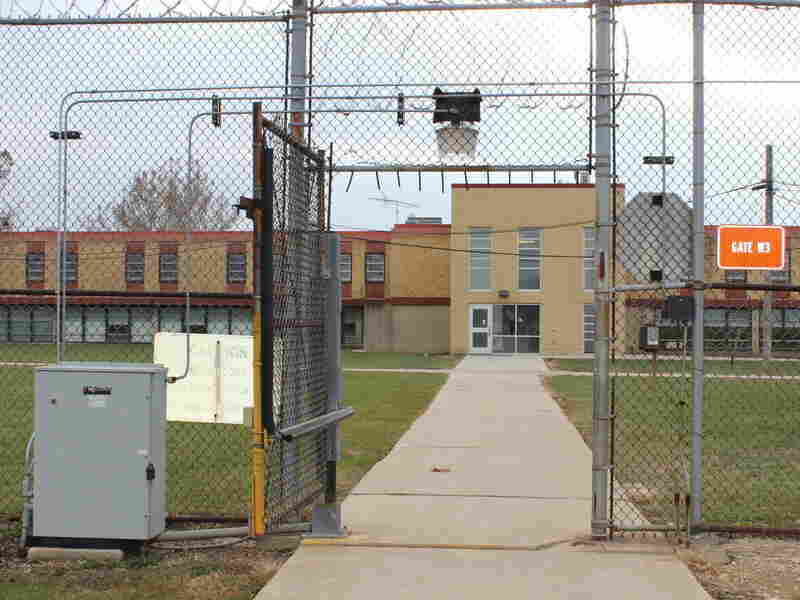
Nearly 800 Illinois inmates with serious mental illness have been transferred to Joliet Treatment Center and three similar treatment facilities. The campus includes single-story “dorms,” a dining hall, a gym and a vocational building. It’s also surrounded by two layers of barbed wire fencing.

Christine Herman/Illinois Public Media


hide caption

toggle caption

Christine Herman/Illinois Public Media

And about 765 of the inmates who are most ill have been transferred to new residential treatment facilities — where they are finally receiving appropriate care, Baldwin says.

But Mills points out: That’s a small fraction of the 12,000 who are mentally ill.

“And for the vast majority of those, not a lot has changed,” Mills says. “They simply aren’t getting the kind of treatment they need in order to improve their situation at all.”

A sign of progress

The Joliet Treatment Center in the southwest suburbs of Chicago doesn’t look like a typical prison facility.

Half a dozen single-story buildings — called dorms — surround a big grassy area. Walking paths connect the dorms.

“I always refer to it as the quad,” Warden Andrea Tack says, as she takes me on a tour. “It reminds me of some of the college campuses that have [a] big center lawn area and then all the classrooms surround it.”

But, unlike a college campus, this facility is surrounded by two layers of barbed wire fencing.

A few years ago, Illinois spent $17 million to convert what used to be a youth detention center at Joliet into a mental health treatment facility for inmates with serious mental illness.

The dining hall is at the center of the quad; the gym is just to the east, and a building to the south houses a library, medical clinic and classrooms where inmates take GED courses and receive job training.

Tack says the inmates here spend about 30 hours a week out of their cell in various activities, according to their individual treatment plans.

She says she’s seen inmates who’ve been transferred to the Joliet facility make huge strides over the past year.

People who were attempting to hang themselves and acting out aggressively, “now, they’re out and about in the community — going to classes, going to meals, interacting with others,” Tack says. “Some are serving as mentors for other residents.”

Mills says he, too, has seen this transformation in some inmates.

“And it’s a difficult transition,” he says, “because you’ve been treated in a place where you’re continually traumatized, and then you get to a place where actually people care about you.”

It takes time, Mills says, for many to learn that they can trust and receive help, instead of acting out aggressively the way they’ve been conditioned to do for so many years.

‘Culture of abuse’

The atmosphere at the Joliet center stands in stark contrast to the experience at some of the state’s other prisons, such as Pontiac Correctional Center, located about 60 miles south of Joliet.

There, inmates with mental illness are often kept isolated and are lucky to get even one hour of mental health treatment a month, says Dr. Pablo Stewart, a psychiatrist. He was appointed by the federal court to oversee the settlement in the lawsuit.

In his most recent report, Stewart singled out the prison at Pontiac for having a “culture of abuse and retaliation” against mentally ill inmates.

“Almost everyone at the mental health unit at Pontiac should be at Joliet,” Stewart says.

If they were getting that same level of mental health care, Stewart says, they wouldn’t have as many behavior issues.

The Pontiac prison has a high concentration of inmates with behavior problems; the most challenging inmates are transferred there from prison facilities across the state.

And the facility lacks the necessary mental health staff to provide treatment to everyone who needs it.

As a result, Stewart says, many mentally ill inmates are isolated from the rest of the prison population, with little or no meaningful social interaction. The conditions cause them to deteriorate, he says, making them more prone to acting out.

Mentally ill prisoners isolated this way “end up throwing feces or urine at staff; end up exposing themselves [or] masturbating in front of female staff,” Stewart says.

Inmates with untreated mental illness also often get into fights with other inmates and prison staff.

Stewart says the workers themselves are traumatized from their job, and that can make them prone to retaliate. Based on interviews with both inmates and staff, Stewart says he’s absolutely convinced that some staff members abuse inmates at Pontiac.

Asked about those abuse allegations, a spokesperson for the corrections department, Lindsey Hess, writes in an email that the agency takes allegations of excessive force seriously and investigates them.

In an interview prior to the latest court monitor’s report, Baldwin said he would “be surprised” if inmates with mental illness were being abused today.

“We take swift action to refer [any reports of abuse] we get to the state police or the state’s attorney,” he said. “We will not tolerate that.”

As for prison staff who may be traumatized by their job, Hess says the agency has implemented several initiatives in recent years to improve the mental, physical and emotional well-being of employees.

These include peer support groups for staff, access to professional counselors and a recurring class — called “From Corrections Fatigue to Fulfillment” — that teaches staff members about the psychological dynamics of working in the field of corrections.

Stewart says Joliet is one Illinois facility that is finally providing inmates with adequate mental health treatment. That should be the norm everywhere, he says. But it’s not.

“That’s the standard of care that’s required,” Stewart says.

A lingering problem

When I interviewed Rasho last May, he’d been out of prison for more than a year. But his many years spent in solitary confinement still haunt him.

“I don’t sleep right,” he told me. “Any little thing triggers something in me.”

Last fall, Rasho was arrested again, so he’s now back in the prison system.

Mills says the situation in Illinois shows that lawsuits don’t always solve the problems — at least not right away.

“A court order is great, but it’s a piece of paper,” he says. “It’s not actually treatment.”

The orders from U.S. District Judge Michael Mihm continue.

Days before Christmas, he ordered Illinois’ prison agency to correct widespread deficiencies. He gave the agency until March to hire enough mental health staff to provide adequate care to all inmates who need it.

This story was produced by Side Effects Public Media, a news collaborative covering public health. Christine Herman is a recipient of the 2018-2019 Rosalynn Carter Fellowships for Mental Health Journalism. Follow her on Twitter: @CTHerman.

Let’s block ads! (Why?)


No Image

Laundromats Fold In Learning Spaces For Busy Families

Some laundromat owners are teaming up with libraries to provide books, toys and even story time for kids forced to tag along on laundry day.


MICHEL MARTIN, HOST:

We had planned to bring you a conversation with the editor of the conservative website that first published that controversial photo from the medical school yearbook of the Virginia governor, Ralph Northam, but we are having technical difficulties. We’ll try to bring you that conversation as soon as we can. But first let’s go to the laundromat, where the average visit takes 2 1/2 hours. That time is not easy on working families with kids. But Allyson McCabe takes us to Queens, N.Y., where there is a growing effort to help families use laundry time to get more than just clean clothes.

ALLYSON MCCABE, BYLINE: The laundry must be done. But if you don’t have access to a washer and dryer in your home, chances are that means spending a lot of time at a self-service laundromat.

(SOUNDBITE OF MACHINE WHIRLING)

MCCABE: Nadine Pineda (ph) says that’s tough, especially with an active 16-month-old toddler in tow.

NADINE PINEDA: It’s – my working schedule is, like, off the charts, so I try to do laundry when I can.

MCCABE: Pineda says most laundromats don’t have anywhere for her son to play while she does the laundry. But at Lavanderia XI, there’s a comfy couch, toys and lots of books in English and Spanish.

PINEDA: I saw this. I was like, what? I’m like – it’s really the first laundromat that I’ve seen that has a center like this for kids. I think that more laundromats should reinforce this sort of idea not only because it helps the children but because it also helps the parents in a way.

MCCABE: Brian Wallace is president and CEO of the Coin Laundry Association. He says there are about 30,000 laundromats nationwide, and families with limited time and money make up a large share of their customers.

BRIAN WALLACE: And they’re coming to us with, you know, anywhere from, you know, 50 pounds of laundry to maybe a hundred or even a couple hundred pounds of laundry, depending on the size of their family.

MCCABE: All that laundry can run hundreds of dollars a month. So Wallace’s trade group formed a foundation to sponsor events, like free laundry days and food giveaways. Eventually, it started giving away books, and that sparked an idea. Last fall, it partnered with Libraries Without Borders and a Clinton Foundation program to bring learning spaces into laundromats. Queens Library outreach assistant Hal Schrieve says the new space allows families to use laundry time to boost learning, literacy and more.

HAL SCHRIEVE: A lot of times, families are here and focused on chores, and maybe kids are, like, watching the TVs or just kind of, like, hanging out. And I think the goal of this space, too, is to make sure that kids’ time in laundromats is being used to do creative things or to learn and to give families time to interact with each other.

MCCABE: Families like the Ramoses (ph), who come here every week.

UNIDENTIFIED PERSON: We have a laundromat around the corner of our house, and we travel six blocks just to get to this particular one because of the space, so…

SCHRIEVE: (Singing) I and J and tag-along K all on their way up the coconut tree.

MCCABE: On a recent Sunday morning, a group of kids gathered to hear Schrieve lead a reading activity while others played with puppets, blocks and literacy-themed coloring pages.

SCHRIEVE: (Singing) Chicka-chicka, boom boom. Will there be enough room? Look, who’s coming. Can you read these letters?

UNIDENTIFIED CHILD: Yeah.

MCCABE: Laundromat owner Jose Almonte says the learning space has given him an edge over nearby competitors, a win-win for the community and his business.

JOSE ALMONTE: The kids run to that area to play, to color. I mean, it’s entertainment.

MCCABE: As the pilot expands this spring, similar programs are planned at laundromats across the country, all part of a growing effort aimed at meeting busy families where they are.

For NPR News, in Queens, N.Y., I’m Allyson McCabe.

Copyright © 2019 NPR. All rights reserved. Visit our website terms of use and permissions pages at www.npr.org for further information.

NPR transcripts are created on a rush deadline by Verb8tm, Inc., an NPR contractor, and produced using a proprietary transcription process developed with NPR. This text may not be in its final form and may be updated or revised in the future. Accuracy and availability may vary. The authoritative record of NPR’s programming is the audio record.

Let’s block ads! (Why?)


No Image

Barbershop: Super Bowl Politics

NPR’s Michel Martin discusses how politics have seeped into this year’s Super Bowl with Mark Leibovich of The New York Times, Megan McArdle of The Washington Postand Rodney Carmichael of NPR Music.


MICHEL MARTIN, HOST:

And finally today, we’re going to head into the Barbershop. That’s where we invite interesting people to talk about what’s in the news and what’s on their minds. And, yes, there’s an awful lot going on in the news today. But we decided to talk about Super Bowl LIII, which is tomorrow in Atlanta.

We decided to focus on that because the Super Bowl is usually the most-watched or one of the most-watched television programs of the year. Usually, more than 100,000,000 watch it along with the halftime show and the commercials. And there have been controversies before about the game or the show, but this year, it seems as though the controversy or controversies are the story, from the officiating in the playoffs to the number of artists who apparently declined to perform during a halftime show in support of former San Francisco 49ers quarterback Colin Kaepernick, who hasn’t played in two seasons after setting off a wave of activism and condemnation for kneeling during the national anthem.

We wanted to talk about all of that, so we’ve called three people who’ve thought about the issues that we’re talking about here. And joining us now is Mark Leibovich. He’s the chief national correspondent for The New York Times Magazine. He’s also the author of “Big Game: The NFL In Dangerous Times.”

Welcome.

MARK LEIBOVICH: Good to be here.

MARTIN: We’re also joined by Rodney Carmichael, who reports on hip-hop for NPR and NPR Music.

Glad to have you back, Rodney.

LEIBOVICH: Hey, Michel. Thanks.

MARTIN: And Megan McArdle is with us. She’s opinion columnist at The Washington Post.

Welcome back to you as well.

MEGAN MCARDLE: Thanks for having me.

MARTIN: And Mark, I’m going to start with you because you’re a political reporter first, but you took some time off to report and write a book that looks at the inner workings of the NFL. And guess what? You’re still covering politics.

LEIBOVICH: (Laughter).

MARTIN: So is the Super Bowl more fraught this year than it’s been before? If that’s true, why is that? And is that OK?

LEIBOVICH: Absolutely it is more fraught, just like everything is more politicized. And you’re right. I mean, I decided to take a break from politics to jump into the National Football League for a couple of years, and, like, there is no break whatsoever. Since Donald Trump came upon the scene, everything has been more divided, including the Super Bowl.

MARTIN: And, Megan, you’ve written kind of – I don’t know, despairingly – do you think that’s a fair word…

MCARDLE: (Laughter) Yes.

MARTIN: …About that very issue. I mean, you’ve said that there don’t seem to be any places, safe spaces that don’t have politics attached to them, be it the NFL or the Oscars or any public awards show.

MCARDLE: Yeah.

MARTIN: Is that really a bad thing?

MCARDLE: I think it’s getting more and more like that. I think my favorite episode of this was that after the election, Penzeys Spices, where I buy a lot of spaces – the owner is very anti-Trump, and it turns out that there’s another spice company owned by his brother and sister-in-law, and they came out and said, well, we love everyone. And so now there is a Republican and a Democratic place to buy your bulk cinnamon. And I think that that’s really – it sort of sums up where America is today.

MARTIN: So tell us about the NFL, though. I mean, do you – you know, obviously people have very different feelings about the whole kneeling controversy and what that means and the fact that two years later, it’s still having an effect – the fact that, you know, artists – Rodney’s going to talk more about that – are saying in support of Kaepernick and in support of the idea that he has a right to protest that they decided not to participate in something that would normally be a plum opportunity for them.

MCARDLE: Right.

MARTIN: Is that…

MCARDLE: I mean, look, I think…

MARTIN: …Wrong?

MCARDLE: …That this is incredibly divisive, and people are taking stands on something they feel very strongly about. And I think one of the things that I have observed about all of this is the complete inability of either side of that debate – you know, I see both sides of that to some extent. I think Kaepernick certainly has a right to protest and that the artists certainly have a right to say no. Like, stand up – I admire people who stand up for what they believe in, even at personal cost.

But just the inability to kind of even frame the debate in a way that you can have a discussion about it because people cannot see beyond, I am outraged because he won’t stand for the national anthem. I am outraged because he is being punished for not standing for the national anthem. And there’s just – there’s sort of no in between anymore, and it’s really a sad place that America’s come to.

MARTIN: Rodney, how do you see all this?

RODNEY CARMICHAEL, BYLINE: I mean, I think the thing we have to remember is, you know, there’s really no form of racial justice protest that America has ever been supportive of. You know, in civil rights era, they fought back with dogs and water hoses. In Black Lives Matter, it was rubber bullets. You know, you’ve come to Atlanta with the Super Bowl. It is the black mecca. It’s the home of civil rights. It’s the home of hip-hop. There’s no way that, you know, the NFL isn’t going to be confronted in terms of their stance on racial politics.

MARTIN: And what is your thought about the fact that there could be or should be some place that is devoid of politics – that people could kind of just agree to take off – well, in hockey, take off your gloves has a different meaning…

(LAUGHTER)

MARTIN: So we’ll…

CARMICHAEL: Right.

MARTIN: …Use the other meaning of take off your gloves – just kind of chill.

CARMICHAEL: Yeah. I mean, the thing is, you have to remember, like, there’s a reason for protest in this country, and it’s because black people, marginalized people don’t have any other means of access in terms of historically being able to get their voice heard in systems of power. So protesting and, you know, at times like this where it seems like it’s comfortable for everybody else – it’s not comfortable for everybody else and for black folks at these other times, so that’s why we’re having protests at times like this.

MARTIN: So, Mark, talk a little bit more about where that that whole thing is. It’s not like the main feature of your book about the NFL, but it’s certainly…

LEIBOVICH: It intervened.

MARTIN: …Bubbling under the…

LEIBOVICH: Oh, there’s no question.

MARTIN: It’s infused…

LEIBOVICH: Well…

MARTIN: Right?

LEIBOVICH: Like, the reason I wanted to write about the National Football League is it has become the – just the great spectacle of American life. I mean, something like 48 of the top 50 top-watch shows in America every year are football games. Donald Trump became the other great spectacle of American life, the other great reality show. He’s wanted to end the National Football League for years, and he just sort of belly-flopped right into the middle of this pool. And this becomes a proxy fight for whether you support Donald Trump or not.

MARTIN: And is this still, do you think – you know, it’s interesting because at one point, hundreds of NFL players were kneeling, and then it became very fraught and complicated. Even some of the owners – one owner, let’s say…

LEIBOVICH: Right.

MARTIN: One owner at one point knelt with his team.

LEIBOVICH: Right – for one week.

MARTIN: But has it – has that – is this – is that controversy – so we’re going to talk about the entertainers in a minute.

LEIBOVICH: Yeah.

MARTIN: But is it still something that is very present for the league?

LEIBOVICH: It’s present in that Colin Kaepernick does not have a job, and people are acutely aware of that. But no, protest has not been a big story this year. Donald Trump has essentially laid off, and he was occupied on the midterms and the shutdown and so forth. So – but it’s very much beneath the surface. And, again, the Colin Kaepernick situation is something that a lot of people who are outside the league are very quick to weigh in on, musical acts being a great example here.

MARTIN: Megan, can I just ask you briefly about this? But not to belabor the point, but could you just address Rodney’s point for a minute? I mean, Rodney’s point is that, you know, the idea that some people get to have a safe place where they cannot think about the broader issues in their lives is something that some people never had. I mean, they’re going back to – you know, how many – it was a great writer who said, you know, what is the fourth of July to the Negro? And did you see my point? So…

MCARDLE: Absolutely. No, look, I think that’s an absolutely valid point. And I think there’s kind of two questions you have to separate in that. And one is, does the country need places where it can come together on a non-political footing? And I would say it does. I’m not going to tell a player protesting police brutality no, right? I’m not going to say that. I’m just saying, like, it is sad to watch all of those spaces collapsing at once, and it is sad that the NFL is one of them. I’m not saying that, you know, I therefore think Colin Kaepernick did something wrong or that the players did something wrong.

I think the second question, which is a different question, is, tactically, does this advance your cause? And I’m more skeptical on that front. I’m skeptical that the particular form of protest chosen – it gets a lot of attention. But there’s often in protesting – and I, you know, I did a lot of protesting in college, and I’ve looked at a lot of the social science literature on this – and it turns out that there’s often a direct tradeoff in protesting between how much attention you get and how much good you’re actually doing. The more attention you’re getting, often, that attention is negative.

You have turned off – it’s like closing down highways as a form of protest. Yes, you have attracted a lot of attention, but all of the people whose attention you have attracted hate you, so that, you know, you do have to think about. And I’m not sure that this has actually been a tactically effective protest, which is completely separate from the moral legitimacy of doing it.

MARTIN: So, Rodney, talk a little bit more about Atlanta, if you would…

CARMICHAEL: Right.

MARTIN: …And the significance of this event to Atlanta. And then talk a little bit, if you would, about the calculation, or the – calculation, is that right? – the debate that a number of artists have had about whether or not to participate.

CARMICHAEL: Yeah. Well, I mean, it’s definitely an interesting time to converge upon Atlanta. You know, like I said, it’s the black mecca in a lot of ways, especially in pop culture. You’ve got, you know, hip-hop capital, you’ve got the legacy of civil rights, the home of Dr. King. And so, you know, I think coming to Atlanta made the Kaepernick thing and the NFL that much more impossible for the NFL to escape, you know? And it’s a confrontation in a lot of ways. But I think, for a lot of entertainers, it’s been one of those things where your decision is your politics, and, you know, your politics affect your pocket. And so all of that is in play.

MARTIN: So what about Big Boi, Travis Scott, Maroon 5…

CARMICHAEL: Yeah.

MARTIN: …Gladys Knight, who…

CARMICHAEL: Yeah.

MARTIN: …Are participating. What is it for them? I know that’s a lot of people to talk about. But maybe…

CARMICHAEL: Well…

MARTIN: …Talk about Travis Scott and Big Boi.

MARTIN: Yeah. I mean, Big Boi, he’s, you know, home of outcasts, home of Atlanta. He’s done a lot for the city. I think one of the really interesting things about all of the people that are performing that you name – they all have ties to the same manager, Irving Azoff, whose management company has – you know, he’s been a really power player in the music industry for a long time. So, you know, you have this situation where a lot of performers are performing on a stage at a time when a lot of people don’t want them to. And I think you have to kind of look at the machinations of the music industry and how that plays…

MARTIN: Briefly, is it a plus or a minus for these artists? Will it be at the end of this?

CARMICHAEL: It’s a little more nuanced than that, you know? I think – you know, there’s still a lot of black fans of the NFL. A lot of black fans are going to be watching the Super Bowl. I think that you’ve got to be able to use your mike to say something in this country, and, you know, hip-hop has that tradition. So for Big Boi and Travis Scott, I think they’re going to be between a rock and a hard place if they don’t figure that out.

MARTIN: Mark, very briefly?

LEIBOVICH: Well, I would say yes. I mean, I think the racial politics of this are also inescapable. I mean, the Atlanta Falcons have a actually 40 percent black season ticket base, which is just unprecedented in the league. And Maroon 5 made some news this week by refusing to hold a press conference. So there’s speculation they might have a surprise in store. This is very much in keeping with the reality show.

MARTIN: Very briefly – such a cliche – Rams or Patriots? I’m sorry. I have to do it.

LEIBOVICH: You know, I grew up in New England, so I, as a birthright, root for the Patriots. And I know everyone else is rooting against them.

MARTIN: That’s true. Rodney?

CARMICHAEL: (Laughter) I’m going to pick Atlanta. I’m rooting for Atlanta.

MARTIN: OK. Megan?

MCARDLE: I come out – I’m descended from Boston people, so I have to also go with the Patriots, or they will kill me.

MARTIN: OK (laughter). That’s Megan McArdle of The Washington Post, Mark Leibovich, New York Times chief national correspondent, and NPR Music hip-hop writer Rodney Carmichael.

Thank you all so much for joining us.

CARMICHAEL: Thanks so much.

MCARDLE: Thanks for having me.

(SOUNDBITE OF LIL WAYNE FEAT. DRAKE SONG, “RIGHT ABOVE IT”)

Copyright © 2019 NPR. All rights reserved. Visit our website terms of use and permissions pages at www.npr.org for further information.

NPR transcripts are created on a rush deadline by Verb8tm, Inc., an NPR contractor, and produced using a proprietary transcription process developed with NPR. This text may not be in its final form and may be updated or revised in the future. Accuracy and availability may vary. The authoritative record of NPR’s programming is the audio record.

Let’s block ads! (Why?)


No Image

A Lesson In Classic Fair Division Problems And The Solutions

Fairly dividing goods is one of the hardest problems economists face. NPR’s Planet Money talks to economists about how best to solve it.


ARI SHAPIRO, HOST:

The recent government shutdown was in part a battle over how to fairly divide federal resources. This problem is one of fair division. Fair division is its own area of study, from how to fairly split rent between roommates to how to pick a movie and a group. Problems of fair division crop up all the time. Sally Herships from our Planet Money podcast walks us through some classic fair division problems and their solutions.

SALLY HERSHIPS, BYLINE: Recently, I ran an informal economic study. I presented a sealed cardboard box to two 10-year-old girls, then I backed way up.

UNIDENTIFIED CHILD #1: Oh, my God. It’s got candy on it.

UNIDENTIFIED CHILD #2: Marshmallows.

HERSHIPS: Inside the box with a cake with a lot of candy on it. I asked the girls to figure out how to fairly divide it.

How do you both feel about the marshmallows?

UNIDENTIFIED CHILD #1: I love marshmallows. I don’t really like Skittles, though. But they do…

UNIDENTIFIED CHILD #2: I love Skittles. But they do make different flavors if you combine them.

HERSHIPS: This problem is called fair division. Luckily, there is a solution – divide and choose.

UNIDENTIFIED CHILD #1: If one person cuts it and the other person decide – what – gets what, then it could be equal.

HERSHIPS: We see fair division problems all the time. How do you split a property after a divorce, profits in a business, runway space at an airport? Constantinos Daskalakis, or Costis, is an expert in game theory at MIT. He says there are some basics like the rental harmony problem. He asks Planet Money reporter Kenny Malone and I to imagine we have an apartment with two bedrooms. One is big, but it has no closet; the other does, but it’s small.

CONSTANTINOS DASKALAKIS: Maybe, you know, I value a smaller room that has a closet, but you value more a big room that – because you like space.

HERSHIPS: I’m taking the closet.

KENNY MALONE, BYLINE: Yeah, I don’t need the closet. It’s fine. I wear the same jeans every day for two weeks in a row.

DASKALAKIS: OK. Thanks for sharing. So, like, yeah, so the question is, you know, who gets what? But also, how is rent split?

HERSHIPS: Say the rent is $2,000. The roommates need to figure out what percentage of that they think each room is worth.

DASKALAKIS: Maybe for you, two rooms are equal. But for Kenny, big space is so much more valuable that he says, look, you know, I don’t care about the closet at all. I don’t even have clothes, OK. So what I care about is the space. So the protocol that we use with my roommate was – and it’s a classical one – each of the two roommates in a sealed envelope writes what they consider to be the right split, what they consider to be the right values of the two rooms.

HERSHIPS: And what they found, Costis’ roommate was willing to pay more for the big room – $1,400. Costis was willing to pay 1,000 for either.

DASKALAKIS: So each of us get the room where they’re the highest bidder. However, how much do we pay? We pay the average of the two prices.

HERSHIPS: So Costis only has to pay $800 even though he was willing to pay a thousand.

Are you free tonight? Because I feel like next time my boyfriend and I decide who gets to pick what movie to watch, I would like you to be part of the decision.

There’s a solution for this, too – fair random assignment, or coin flipping – for when you’re dealing with something that can’t be divided like what movie to watch. If you have more than two people, you can use a similar protocol, but it has a way cooler name.

DASKALAKIS: This has the eerie name of random dictatorship. Say you want to – say you have a group of five friends and you want to decide what to do tonight. OK. One way to be fair about the decision is to say, I’m going to flip a five-faced dice. OK.

HERSHIPS: Yeah.

DASKALAKIS: And, you know, whoever is elected will decide the whole plan.

HERSHIPS: Costis says there are other solutions – auctions, lotteries, time sharing. But, of course, if you want something badly enough and you can afford it, you can always buy yourself a cake and eat it too. Sally Herships, NPR News.

Copyright © 2019 NPR. All rights reserved. Visit our website terms of use and permissions pages at www.npr.org for further information.

NPR transcripts are created on a rush deadline by Verb8tm, Inc., an NPR contractor, and produced using a proprietary transcription process developed with NPR. This text may not be in its final form and may be updated or revised in the future. Accuracy and availability may vary. The authoritative record of NPR’s programming is the audio record.

Let’s block ads! (Why?)


No Image

How Former NFL Quarterback Tony Romo Got His Broadcast Break

Tony Romo never got to the Super Bowl as quarterback for the Dallas Cowboys. But he’s finally going as an analyst for CBS Sports. Romo made a seamless transition to the broadcast booth.


ARI SHAPIRO, HOST:

You know those sports fans who like to watch a game on TV and turn the sound down? Well, CBS has a message for those fans. Turn it up this Sunday when the network televises Super Bowl LIII between the New England Patriots and the LA Rams. That’s because Tony Romo’s in the booth. The longtime Dallas Cowboys quarterback is in his second year as CBS’s main NFL analyst, and he’s a hit with his own special skill. NPR’s Tom Goldman reports.

TOM GOLDMAN, BYLINE: Tony Romo can’t really be a seer of football plays, can he?

(SOUNDBITE OF ARCHIVED RECORDINGS)

JIM NANTZ: What do you see here, Tony?

TONY ROMO: (Laughter) Well, I thought they were going to run the ball to the right. Now he’s going back left with the run.

NANTZ: There you go. To the left it is. Rashard.

ROMO: The quarterback’s going to roll right and launch the ball out of bounds. It’s going to look weird.

(CHEERING)

NANTZ: Rolling right. Launching out of bounds. And Tony stealing the signals once again. Well done, my friend.

GOLDMAN: That’s a smattering of Romo’s seeming clairvoyance and his partner, Jim Nantz’s, bemusement. This week, the veteran play-by-play man, Nantz, repeated the nickname he’s given Romo, based on the 16th-century seer Nostradamus.

(SOUNDBITE OF ARCHIVED RECORDING)

NANTZ: Romo-stradamus.

GOLDMAN: The sports world has been buzzing about Romo’s ability to predict plays. It prompted The Wall Street Journal to dig in and find out if he’s really that good. The Journal studied every one of the 2,599 thousand plays Romo called this season. He was right on 68 percent of his predictions. Not bad, but not perfect, proving he’s not some soothsaying mystic, rather, a guy with a specific football skill set.

(SOUNDBITE OF ARCHIVED RECORDING)

ROMO: I feel like, when you’re broadcasting, for me, it’s like I’m still looking at it from the quarterback’s perspective.

GOLDMAN: And it’s working for him, says Jimmy Traina. He writes about sports media for Sports Illustrated.

JIMMY TRAINA: You know, he went from the field to the booth. So he knows the offenses and defense of all the teams in the league. He knows the players. He knows the schemes. The knowledge is there.

GOLDMAN: But it’s not just the knowledge that made CBS execs take what they say was a calculated risk throwing Romo into the lead analyst’s chair with no broadcast experience. They found in private conversations with Romo that he also was really easy to listen to and had an almost giddy enthusiasm about football. Again, Jimmy Traina.

TRAINA: He’s sort of a combination of a football idiot savant and the drunk guy at the end of the bar during a football game.

(SOUNDBITE OF ARCHIVED RECORDING)

ROMO: Oh, boy.

NANTZ: Yup.

ROMO: Field position, everything, points – this is huge, Jim.

GOLDMAN: That savant drunk-guy duality mirrors, a bit, his life on the field. He was a really good quarterback, but also one prone to injury and blunders, none more infamous than in a 2007 playoff game when Romo was the holder as Dallas prepared to attempt what should have been a game-winning field goal.

(SOUNDBITE OF ARCHIVED RECORDING)

UNIDENTIFIED SPORTSCASTER: Romo holds.

(CHEERING)

UNIDENTIFIED SPORTSCASTER: Nineteen-yard field goal attempt. And it’s fumbled by Romo. And then Romo’s going to…

GOLDMAN: Ten years after that moment, heard on NBC, Romo retired and began a broadcasting career that so far has hit all the right notes. Although, one is never safe from the snark. The Onion posted an article last week with the headline, “Tony Romo Realizes He Should Have Used Ability To Read Defenses Back When He Was Still Playing.” Romo tamped down his play-predicting this season. CBS denies it told him to. Romo says he doesn’t want to do the same thing over and over again. But this week, there was a hint of what may be in store Sunday. A reporter asked Romo to predict a Super Bowl score, and he didn’t dodge.

(SOUNDBITE OF ARCHIVED RECORDING)

ROMO: I’m going to go 28-24. And I think the team who has 24 has the ball at the end, and they don’t score.

GOLDMAN: He didn’t predict a winner because even Tony Romo-stradamus is only willing to go so far. Tom Goldman, NPR News.

Copyright © 2019 NPR. All rights reserved. Visit our website terms of use and permissions pages at www.npr.org for further information.

NPR transcripts are created on a rush deadline by Verb8tm, Inc., an NPR contractor, and produced using a proprietary transcription process developed with NPR. This text may not be in its final form and may be updated or revised in the future. Accuracy and availability may vary. The authoritative record of NPR’s programming is the audio record.

Let’s block ads! (Why?)


No Image

Lawsuit Details How The Sackler Family Allegedly Built An OxyContin Fortune

Families that lost loved ones to the opioid crisis protested outside Suffolk Superior Court in Boston as lawyers for Purdue Pharma entered the courthouse for a status update in the Massachusetts attorney general’s suit against the company on Jan. 25.

Suzanne Kreiter/Boston Globe via Getty Images


hide caption

toggle caption

Suzanne Kreiter/Boston Globe via Getty Images

Sign up for the CommonHealth newsletter to receive a weekly digest of WBUR’s best health, medicine and science coverage.

The first nine months of 2013 started off as a banner year for the Sackler family, owners of the pharmaceutical company that produces OxyContin, the addictive opioid pain medication. Purdue Pharma paid the family $400 million from its profits during that time, claims a lawsuit filed by the Massachusetts attorney general.

However, when profits dropped in the fourth quarter, the family allegedly supported the company’s intense push to increase sales representatives’ visits to doctors and other prescribers.

Purdue had hired a consulting firm to help reps target “high-prescribing” doctors, including several in Massachusetts. One physician in a town south of Boston wrote an additional 167 prescriptions for OxyContin after sales representatives increased their visits, according to the latest version of the lawsuit filed Thursday in Suffolk County Superior Court in Boston.

The lawsuit claims Purdue paid members of the Sackler family more than $4 billion between 2008 and 2016. Eight members of the family who served on the board or as executives as well as several directors and officers with Purdue are named in the lawsuit. This is the first lawsuit among hundreds of others that were previously filed across the country to charge the Sacklers with profiting from the harm and death of people taking the company’s opioids.

WBUR along with several other media outlets sued Purdue Pharma to force the release of previously redacted information that was filed in the Massachusetts Superior Court case. When a judge ordered the records to be released with few, if any, redactions this week, Purdue filed two appeals and lost.

Read the documents here or below:

[embedded content]

The complaint filed by Massachusetts Attorney General Maura Healey says that former Purdue Pharma CEO Richard Sackler allegedly suggested the family sell the company or, if they weren’t able to find a buyer, to milk the drugmaker’s profits and “distribute more free cash flow” to themselves.

That was in 2008, one year after Purdue pleaded guilty to a felony and agreed to stop misrepresenting the addictive potential of its highly profitable painkiller, OxyContin.

The complaint says the Sacklers voted to pay themselves $250 million at a board meeting in June 2008. Another payment in September totaled $199 million.

The company continued to receive complaints about OxyContin similar to those that led to the 2007 guilty plea, according to unredacted documents filed in the case.

While the company settled lawsuits in 2009 totaling $2.7 million brought by family members of those who had been harmed by OxyContin throughout the country, the company amped up its marketing of the drug to physicians by spending $121.6 million on sales reps for the coming year. The Sacklers paid themselves $335 million that year.

The lawsuit claims Sackler family members directed efforts to boost sales. An attorney for the family and other board directors is challenging the authority to make that claim in Massachusetts. A motion on jurisdiction in the case hasn’t been heard. That attorney hasn’t responded to a request for comment on the most recent allegations.

Purdue Pharma, in a statement, said the complaint filed by Healey is “part of a continuing effort to single out Purdue, blame it for the entire opioid crisis, and try the case in the court of public opinion rather than the justice system.”

Purdue went on to charge Healey with attempting to “vilify” Purdue in a complaint “riddled with demonstrably inaccurate allegations.” Purdue said it has more than 65 initiatives aimed at reducing the misuse of prescription opioids. The company says Healey fails to acknowledge that most opioid overdose deaths currently are the result of fentanyl.

Purdue fought the release of many sections of the 274-page complaint. Attorneys for the company said at a hearing on Jan. 25 that they had agreed to release much more information in Massachusetts than has been cleared by a judge overseeing hundreds of cases consolidated in Ohio. Purdue filed both state and federal appeals this week to block release of the compensation figures and other information about Purdue’s plan to expand into drugs to treat opioid addiction.

The attorney general’s complaint says that in a ploy to distance themselves from the emerging statistics and studies that showed OxyContin’s addictive characteristics, the Sacklers approved public marketing plans that labeled people hurt by opioids as “junkies” and “criminals.”

Richard Sackler allegedly wrote that Purdue should “hammer” them in every way possible.

While Purdue Pharma publicly denied its opioids were addictive, internally company officials were acknowledging it and devising a plan to profit off them even more, the complaint states.

Kathe Sackler, a board member, pitched Project Tango, a secret plan to grow Purdue beyond providing painkillers by also providing a drug, Suboxone, to treat those addicted.

“Addictive opioids and opioid addiction are ‘naturally linked,’ ” she allegedly wrote in September 2014.

According to the lawsuit, Purdue staff wrote: “It is an attractive market. Large unmet need for vulnerable, underserved and stigmatized patient population suffering from substance abuse, dependence and addiction.”

They predicted that 40-60 percent of the patients buying Suboxone for the first time would relapse and have to take it again, which meant more revenue.

Purdue never went through with it, but Healey contends this and other internal documents show the family’s greed and disregard for the welfare of patients.

A version of this story first ran on WBUR’s CommonHealth. You can follow @mbebinger on Twitter.

Let’s block ads! (Why?)