Articles by admin

No Image

Heroin, Opioid Abuse Put Extra Strain On U.S. Foster Care System

A young boy talks with Tina Cloer, director of the Children's Bureau, in Indianapolis. The nonprofit shelter takes in children from the state's Department of Child Services when a suitable foster family can't be found. Cloer says the average length of stay at the shelter has increased from two days to 10 in 2015.
3:55

Download

A young boy talks with Tina Cloer, director of the Children’s Bureau, in Indianapolis. The nonprofit shelter takes in children from the state’s Department of Child Services when a suitable foster family can’t be found. Cloer says the average length of stay at the shelter has increased from two days to 10 in 2015. Jake Harper/Side Effects Public Media hide caption

itoggle caption Jake Harper/Side Effects Public Media

Last year, Erin and Isaac Hougland of Indianapolis got certified to become foster parents, with the hope of adopting a baby. Just a few weeks later, they got a call.

An 8-week-old baby needed a home. All they knew was that the boy’s mother was a heroin addict and had left him at the hospital. They were told that because of the drugs, the baby might require some special care. But mostly, he just needed a place to go.

“Both of us were just like, ‘Let’s do it,’ ” says Isaac Hougland. “We wrapped up what we were doing at work and went to the hospital.”

The Houglands’ foster son is part of a new national influx of kids coming into foster care because parents abusing heroin or prescription painkillers can no longer care for them.

A recent report by the federal government shows that, after years of decline, the number of children in foster care is going up again. Roughly 265,000 kids entered foster care last year — the highest number since 2008.

Between September of 2013 and September of 2015, Indiana saw the number of “children in need of services” jump by 40 percent. In more than half of new cases in which children had to be removed from their homes, substance abuse was listed as a reason. As in other states (such as nearby Ohio), officials in Indiana blame heroin and prescription painkillers.

The increase is taxing the child welfare system, officials say. Children of addicts often need special care and counseling, and they often stay in the system longer because it can take months or years for their parents to get clean.

Marilyn Moores, a juvenile court judge in Indianapolis, says many case managers and court employees are feeling overwhelmed with the rising number of child welfare cases they're seeing.

Marilyn Moores, a juvenile court judge in Indianapolis, says many case managers and court employees are feeling overwhelmed with the rising number of child welfare cases they’re seeing. Jake Harper/Side Effects Public Media hide caption

itoggle caption Jake Harper/Side Effects Public Media

“We have more children than we’ve ever had in our system in Indiana,” says Mary Beth Bonaventura, director of the state’s Department of Child Services. “That puts a stress on the staff, a stress and strain on providers.” And it’s increasingly a challenge, she says, “to find and recruit and train qualified foster families.”

If the Houglands hadn’t provided a home for their foster son, he might have ended up at an emergency shelter like the Children’s Bureau, a nonprofit in Indianapolis. The organization takes in kids from the Department of Child Services when a foster family can’t be found quickly.

“Kids come in here 24/7,” says Tina Cloer, who directs the Children’s Bureau. “So we accept kids all day and all night, and we get calls all day and all night.”

The shelter has been full more often this year, she says, as it has become harder to find kids foster homes. Last year, the average stay was just two days — now, it’s 10. “We have kids that have been here as long as 2 [or] 2 1/2 months,” Cloer says.

The large number of cases burdens other parts of the system, too.

Indiana’s Department of Child Services has a burnout problem: It has lost about a quarter of its case managers in the past year.

“I’ve had a case where we’ve had nine case managers on it — in a year,” says Marilyn Moores, a juvenile court judge in Indianapolis. “That’s the far end, but it’s not unusual to have three or four.”

This year, the child services department started a counseling program for employees, in hopes of retaining more case managers. And the state approved the hiring of 230 more people, but finding and training them will take time. Recruiting can be tough, says Bonaventura.

“If you don’t recruit the right people, they’re out the door the minute they realize how stressful and how gut-wrenching this work is,” she says.

Meanwhile, as the number of cases rises, Moores says, the stress continues to mount for everyone involved, including court employees.

“It just reached a point where every system partner involved in this that I’ve talked to in the last week, when I’ve talked to them, at some point they get tears in their eyes,” she says. “They are just overwhelmed.”

After more than a year of waiting, Erin and Isaac Hougland are looking forward to finally adopting their foster son. But it might take a little longer than usual. Adoption paperwork is piling up, too.

This piece comes from Side Effects Public Media, a public radio reporting collaborative that explores the impacts of place, policy and economics on health.

This entry passed through the Full-Text RSS service – if this is your content and you’re reading it on someone else’s site, please read the FAQ at fivefilters.org/content-only/faq.php#publishers.


No Image

Today in Movie Culture: 'Captain America: Civil War' Opening Credits, Beyonce as Storm and More

Here are a bunch of little bites to satisfy your hunger for movie culture:

Fan-made Credits Sequence of the Day:

We still have many months before the release of Captain America: Civil War, so in the meantime here’s a fan-made opening title sequence for the upcoming sequel (via Heroic Hollywood):

[embedded content]

Movie Culture Parody of the Day:

Speaking of movie geek patience, Leigh Lahav sums up a lot of today’s movie culture, mainly the build up of a tentpole release, in her latest fangirl cartoon, “Waiting For That Movie”:

[embedded content]

Cosplay of the Day:

Beyonce as Storm from X-Men! The internet has already declared this cosplay of the year, if not all time. From a costume party in honor of fellow singer Ciara‘s birthday:

Star Wars of the Day:

The latest reactions to the new Star Wars: The Force Awakens trailer come from the characters of Apollo 13:

[embedded content]

Classic Cartoon of the Day:

Today is the 75th anniversary of the classic Merrie Melodies animated short Good Night Elmer, directed by Chuck Jones and starring Elmer Fudd in an effort to fall asleep. Watch the cartoon in full below.

Supercut of the Day:

Have you heard about how movies always look better when shot during the “magic hour” around dawn or dusk? The latest supercut by Jacob T. Swinney for Fandor offers some evidence from films such as Top Gun, Apocalypse Now and of course everything by Terrence Malick:

[embedded content]

Fan Build of the Day:

The DIY Prop Shop shows us how to make our own homemade copy of Necronomicon Ex-Mortis, aka “The Book of the Dead” from Evil Dead (via Bloody Disgusting):

[embedded content]

Movie Mashup of the Day:

What if Disney princesses and princes went to Hogwarts? Below is artist Isiah K. Thompson’s mashup of Aladdin and the Harry Potter movies indicating that broomsticks are more difficult to fly than magic carpets. See more at Cosmopolitan.

Movie Tutorial of the Day:

This supercut offers a lesson in how to kill a zombie, according to the movies (via Cinematic Montage Creators):

[embedded content]

Classic Trailer of the Day:

Tomorrow is the 15th anniversary of the release of Book of Shadows: Blair Witch 2. Watch a trailer for the sequel, which temporarily brought the great documentarian Joe Berlinger (the Paradise Lost trilogy) into fiction filmmaking, below.

[embedded content]

and

This entry passed through the Full-Text RSS service – if this is your content and you’re reading it on someone else’s site, please read the FAQ at fivefilters.org/content-only/faq.php#publishers.


No Image

Ready, Set, Drone: Walmart Joins Amazon, Google In Testing Delivery Drones

Joining Amazon, Google and other companies, Walmart will test drones for commercial uses like home deliveries.

Joining Amazon, Google and other companies, Walmart will test drones for commercial uses like home deliveries. Danny Johnston/AP hide caption

itoggle caption Danny Johnston/AP

Signaling its intent to compete with Amazon and other companies in using drones to fill and deliver online orders, Walmart has applied for permission to test drones for home deliveries and curbside pickup.

NPR’s Laura Sydell reports for our Newscast unit that Walmart has already been testing drones inside:

“According to an application filed with the Federal Aviation Administration the company wants permission to research drone use in deliveries to customers at Walmart facilities as well as consumer homes. The application comes as Amazon, Google and other companies test drones. The FAA is expected to establish rules for use of commercial drones over the next 12 months.

“Commercial drone use is currently illegal, and polls show that the majority of Americans don’t like the idea of drones making deliveries. The FAA will review Walmart’s application and decide if it should be fast-tracked or if the company qualifies for an exemption from the rules, which would involve seeking public comment.”

The drones will also be used to check warehouse inventory and make distribution more efficient.

“Drones have a lot of potential to further connect our vast network of stores, distribution centers, fulfillment centers and transportation fleet,” a Walmart spokesman told Reuters. “There is a Walmart within five miles of 70 percent of the U.S. population, which creates some unique and interesting possibilities for serving customers with drones.”

This entry passed through the Full-Text RSS service – if this is your content and you’re reading it on someone else’s site, please read the FAQ at fivefilters.org/content-only/faq.php#publishers.


No Image

Governors Bet On World Series Win

0:30

Download

Gov. Andrew Cuomo of New York says he’d wear a Kansas City Royals jersey if he loses. Missouri’s Jay Nixon would wear a Mets jersey. That’s nothing compared to what Rep. Adam Schiff of California did.

This entry passed through the Full-Text RSS service – if this is your content and you’re reading it on someone else’s site, please read the FAQ at fivefilters.org/content-only/faq.php#publishers.


No Image

Supporters In Congress Make New Attempt To Revive The Export-Import Bank

Outside the Export-Import Bank in July, after its charter was allowed to expire.

Outside the Export-Import Bank in July, after its charter was allowed to expire. AP hide caption

itoggle caption AP

On Monday a bipartisan group of House members will try to revive the Export-Import Bank, a federal government agency that finances exports — which its critics deride as little more than a slush fund for big corporations.

The agency, known as the Ex-Im bank, essentially stopped doing new business on July 1, after House leaders let its charter lapse at the behest of conservative Republicans who attacked it as “corporate welfare.”

But the bank has plenty of friends in Washington, and earlier this month 42 Republicans joined 176 Democrats to sign a discharge petition, a rarely used legislative maneuver designed to force a measure up for a vote.

Supporters in the House appear to have enough votes to re-authorize the bank, although it’s less clear it can pass the Senate.

Created during the Depression, the Ex-Im Bank provides insurance and loan guarantees to overseas buyers of American products. Republican Rep. Billy Long of Missouri argues that it plays, and has long played, an important role in America’s economy:

“It’s been a critical part of our country’s history — making the Pan American Highway a reality, helping to keep airlines flying after September 11th, and weathering the 2008 financial crisis while many other banks were unable to.”

The bank also provides guarantees to U.S. companies doing business overseas to ensure they get paid.

Supporters say without the bank, U.S. exporters are at a disadvantage, because many foreign countries bar them from getting contracts without a financing agency to provide loan guarantees.

A small handful of companies, including General Electric, have already said they will move jobs out of the country to countries that provide financing, as a result of the decision to let the bank’s authorization lapse.

The bank has backing from both labor unions and big business groups such as the U.S. Chamber of Commerce, which lobbied hard for its re-authorization.

But it’s opposed by the small government group the Club for Growth, as well as many of the most conservative Republicans, including Jeb Hensarling of Texas, chairman of the House Financial Services Committee.

Opponents see closing the bank as a moral issue, calling it a form of crony capitalism that allows the federal government to pick winners and losers.

“If we’re ever going to get rid of all the corporate connectedness and all the corporate welfare, you got to start with the most egregious one and the most obvious one, and that’s the Export-Import Bank,” Republican Jim Jordan of Ohio told NPR in June.

One study by Veronique de Rugy of the libertarian Mercatus Center at George Mason University and Diane Katz of the conservative Heritage Foundation found that the bank “mainly benefits very large exporters.”

Of the top 10 foreign companies that use the bank to finance U.S. goods, five are in the oil and natural gas business, while the rest are airlines buying aircraft from Boeing, the report said.

This entry passed through the Full-Text RSS service – if this is your content and you’re reading it on someone else’s site, please read the FAQ at fivefilters.org/content-only/faq.php#publishers.


No Image

Longtime NBA Coach Flip Saunders Dies At Age 60

Minnesota Timberwolves announced Sunday its two-time coach Flip Saunders died. Shown here during the second half of a game against the Golden State Warriors in April.

Minnesota Timberwolves announced Sunday its two-time coach Flip Saunders died. Shown here during the second half of a game against the Golden State Warriors in April. Marcio Jose Sanchez/AP hide caption

itoggle caption Marcio Jose Sanchez/AP

Longtime NBA coach and Minnesota Timberwolves president of basketball operations Flip Saunders has died.

He was 60 years old, and had been undergoing treatment for Hodgkin’s lymphoma over the past few months.

We are extremely saddened to learn today Phil “Flip” Saunders has passed away at age 60.

— Timberwolves (@Timberwolves) October 25, 2015

The Timberwolves organization announced Saunders’ passing via Twitter Sunday afternoon.

In a statement, the team’s owner Glen Taylor said the organization was “devastated” by Saunders’ passing.

“Flip was a symbol of strength, compassion, and dignity for our organization. He was a shining example of what a true leader should be, defined by his integrity and kindness to all he encountered.

“Today is not a day to reflect on Flip’s accomplishments in basketball or what he brought to us as an organization on the court, but rather to indicate what he meant to us as a co-worker, friend, member of the community and the basketball world at large.”

Saunders, who over his nearly two decades as a head coach hauled in more than 650 career victories, is best known as the head coach of the Timberwolves, but also had a successful run with the Detroit Pistons from 2005-2008, where he took that team to three straight appearances in the Eastern Conference Finals.

He also coached the Washington Wizards and worked as an ESPN analyst in between coaching gigs.

As ESPN reports, Saunders “was in the process of a major rebuilding effort” with the Timberwolves that also included the building of a new practice facility and renovations at the team’s arena, the Target Center.

“Saunders first became an NBA coach in 1996 with the Timberwolves and eventually led the team to eight straight playoff appearances. A standout offensive coach, Saunders specialized in coaching point guards.

“But perhaps the player he had the greatest impact on was a big man, a wiry kid who came straight from high school in 1995 named Kevin Garnett. Under Saunders’ tutelage, Garnett developed into one of the best players in the NBA and eventually an MVP.”

Born Philip Daniel Saunders, the Minneapolis Star Tribune reports, Saunders received the nickname “Flip” from his mother — a former beautician who heard a customer in the salon refer to her older son Greg by the moniker. But it stuck to her younger son more or less his entire life.

The Star Tribune also reports:

“Long after he was deemed too small to make it big in the sport he so loved, Flip Saunders rose from collegiate-playing and professional-coaching careers to become one of the most powerful team executives in the entire National Basketball Association during his second time around with the Timberwolves.

“He returned to Minnesota full-time to run the Wolves basketball operations in May 2013, more than eight years after friend and former college coach Kevin McHale fired him as coach the first time around.

“Saunders is by a lopsided margin the winningest coach in franchise history — with a 654-592 record in nearly 11 full seasons — and is the only man to coach the team into the playoffs …”

Below is a sampling of condolences from current and former NBA players on Twitter.

#FlipSaunders good coach better man. @Timberwolves He will be missed.

— Kurt Rambis (@KRambis) October 25, 2015

You have done so much for so many people, including myself. Thank you coach! You will be truly missed.
R.I.P coach Flip

— Tyus Jones (@Tyusjones06) October 25, 2015

Flip you were one of a kind. Great basketball mind and even better human being. You had a great… https://t.co/W84KYPitsx

— Kevin Love (@kevinlove) October 25, 2015

My condolences to the Saunders and @Timberwolves family! Lost a great person in our fraternity way to early. So sad #RIPFlip

— LeBron James (@KingJames) October 25, 2015

This entry passed through the Full-Text RSS service – if this is your content and you’re reading it on someone else’s site, please read the FAQ at fivefilters.org/content-only/faq.php#publishers.


No Image

Could Depression Be Caused By An Infection?

Katherine Streeter for NPR

Katherine Streeter for NPR

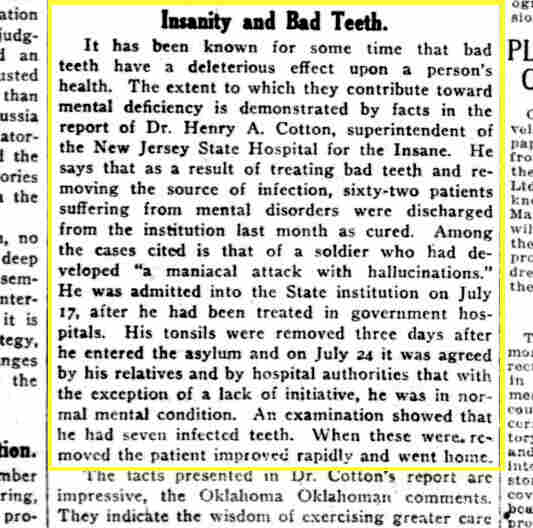
Sometime around 1907, well before the modern randomized clinical trial was routine, American psychiatrist Henry Cotton began removing decaying teeth from his patients in hopes of curing their mental disorders. If that didn’t work he moved on to more invasive excisions: tonsils, testicles, ovaries and, in some cases, colons.

Cotton was the newly appointed director of the New Jersey State Hospital for the Insane and was acting on a theory proposed by influential Johns Hopkins psychiatrist Adolph Meyer, under whom Cotton had studied, that psychiatric illness is the result of chronic infection. Meyer’s idea was based on observations that patients with high fevers sometimes experience delusions and hallucinations.

Cotton ran with the idea, scalpel in hand.

This 1920 newspaper clipping from The Washington Herald highlights Dr. Henry Cotton’s practice of removing infected teeth to treat mental health problems.

A 1920 newspaper clipping from The Washington Herald.

Library of Congress

In 1921 he published a well-received book on the theory called The Defective Delinquent and Insane: the Relation of Focal Infections to Their Causation, Treatment and Prevention. A few years later The New York Times wrote, “eminent physicians and surgeons testified that the New Jersey State Hospital for the Insane was the most progressive institution in the world for the care of the insane, and that the newer method of treating the insane by the removal of focal infection placed the institution in a unique position with respect to hospitals for the mentally ill.” Eventually Cotton opened a hugely successful private practice, catering to the infected molars of Trenton, N.J., high society.

Following his death in 1933, interest in Cotton’s cures waned. His mortality rates hovered at a troubling 45 percent, and in all likelihood his treatments didn’t work. But though his rogue surgeries were dreadfully misguided and disfiguring, a growing body of research suggests that there might be something to his belief that infection – and with it inflammation – is involved in some forms of mental illness.

Symptoms Of Mental And Physical Illness Can Overlap

Late last year Turhan Canli, an associate professor of psychology and radiology at Stony Brook University, published a paper in the journal Biology of Mood and Anxiety Disorders asserting that depression should be thought of as an infectious disease. “Depressed patients act physically sick,” says Canli. “They’re tired, they lose their appetite, they don’t want to get out of bed.” He notes that while Western medicine practitioners tend to focus on the psychological symptoms of depression, in many non-Western cultures patients who would qualify for a depression diagnosis report primarily physical symptoms, in part because of the stigmatization of mental illness.

“The idea that depression is caused simply by changes in serotonin is not panning out. We need to think about other possible causes and treatments for psychiatric disorders,” says Canli.

His assertion that depression results from infection might seem far-fetched, or at least premature, but there are some data to bolster his claim.

Harkening back to Adolph Meyer’s early 20th century theory, Canli notes how certain infections of the brain – perhaps most notably Toxoplasma gondii — can result in emotional disturbances that mimic psychiatric conditions. He also notes that numerous pathogens have been associated with mental illnesses, including Borna disease virus, Epstein-Barr and certain strains of herpes, including varicella zoster, the virus that causes chickenpox and shingles.

Toxoplasma gondii, a parasitic protozoan, afflicts cats and other mammals. Acute toxoplasmosis produces flu-like symptoms and has been linked to behavioral changes in humans.

Toxoplasma gondii, a parasitic protozoan, afflicts cats and other mammals. Acute toxoplasmosis produces flu-like symptoms and has been linked to behavioral changes in humans. Eye of Science/Science Source hide caption

itoggle caption Eye of Science/Science Source

A Danish study published in JAMA Psychiatry in 2013 looked at the medical records of over three million people and found that any history of hospitalization for infection was associated with a 62 percent increased risk of later developing a mood disorder, including depression and bipolar disorder.

Canli believes that pathogens acting directly on the brain may result in psychiatric symptoms; but also that autoimmune activity — or the body’s immune system attacking itself — triggered by infection may also contribute. The Danish study also reported that a past history of an autoimmune disorder increases the risk of a future mood disorder by 45 percent.

Antibodies Provide A Clue

The idea there could be a relationship between the immune system and brain disease isn’t new. Autoantibodies were reported in schizophrenia patients in the 1930s. Subsequent work has detected antibodies to various neurotransmitter receptors in the brains of psychiatric patients, while a number of brain disorders, including multiple sclerosis, are known to involve abnormal immune system activity. Researchers at the University of Virginia recently identified a previously undiscovered network of vessels directly connecting the brain with the immune system; the authors concluded that an interplay between the two could significantly contribute to certain neurologic and psychiatric conditions.

Both infection and autoimmune activity result in inflammation, our body’s response to harmful stimuli, which in part involves a surge in immune system activity. And it’s thought by many in the psychiatric research community that inflammation is somehow involved in depression and perhaps other mental illnesses.

Multiple studies have linked depression with elevated markers of inflammation, including two analyses from 2010 and 2012 that collectively reviewed data from 53 studies, as well as several post-mortem studies. A large body of related research confirms that autoimmune and inflammatory activity in the brain is linked with psychiatric symptoms.

Still, for the most part the research so far finds associations but doesn’t prove cause and effect between inflammation and mental health issues. The apparent links could be a matter of chance or there might be some another factor that hasn’t been identified.

Dr. Roger McIntyre, a professor of psychiatry and pharmacology at the University of Toronto, tells Shots that he believes an upset in the “immune-inflammatory system” is at the core of mental illness and that psychiatric disorders might be an unfortunate cost of our powerful immune defenses. “Throughout evolution our enemy up until vaccines and antibiotics were developed was infection,” he says, “Our immune system evolved to fight infections so we could survive and pass our genes to the next generation. However our immune-inflammatory system doesn’t distinguish between what’s provoking it.” McIntyre explains how stressors of any kind – physical or sexual abuse, sleep deprivation, grief – can activate our immune alarms. “For reasons other than fighting infection our immune-inflammatory response can stay activated for weeks, months or years and result in collateral damage,” he says.

Unlike Canli, McIntyre implicates inflammation in general, not exclusively inflammation caused by infection or direct effects of infection itself, as a major contributor to mental maladies. “It’s unlikely that most people with a mental illness have it as a result of infection,” he says, “But it would be reasonable to hypothesize that a subpopulation of people with depression or bipolar disorder or schizophrenia ended up that way because an infection activated their immune-inflammatory system.” McIntyre says that infection, particularly in the womb, could work in concert with genetics, psychosocial factors and our diet and microbiome to influence immune and inflammatory activity and, in turn, our risk of psychiatric disease.

Trying Drugs Against Inflammation For Mental Illness

The idea that inflammation – whether stirred up by infection or other factors — contributes to or causes mental illness comes with caveats, at least in terms of potential treatments. Trials testing anti-inflammatory drugs have been overall mixed or underwhelming.

A recent meta-analysis reported that supplementing SSRIs like Prozac with regular low-dose aspirin use is associated with a reduced risk of depression and ibuprofen supplementation is linked with lower chances of obtaining psychiatric care. However concomitant treatment with SSRIs and diclofenac or celecoxib – two other anti-inflammatories often used to treat arthritis – was associated with increased risk of needing hospital care due to psychiatric symptoms.

A 2013 study explored the antidepressant potential of Remicade, an drug used in rheumatoid arthritis. Overall, three infusions of the medication were found to be no more effective than a placebo, but patients whose blood had higher levels of an inflammatory marker called C-reactive protein did experience modest benefit.

“The truth of the matter is that there is probably a subset of people who get depressed in response to inflammation,” says lead author Dr. Charles Raison, a psychiatry professor at the University of Arizona. “Maybe their bodies generate more inflammation, or maybe they’re more sensitive to it.”

How infection and other causes of inflammation and overly-aggressive immune activity may contribute to depression and other mental illnesses – and whether or not it’s actually depression driving the inflammation — is still being investigated, and likely will be for some time. But plenty of leading psychiatrists agree that the search for alternative pathologic explanations and treatments for psychiatric disorders is could help jump-start the field.

“I’m not convinced that anti-inflammatory strategies are going to turn out to be the most powerful treatments around,” cautions Raison. “But I think if we really want to understand depression, we definitely have to understand how the immune system talks to the brain. I just don’t think we’ve identified immune-based or anti-inflammatory treatments yet that are going to have big effects in depression.”

But the University of Toronto’s McIntyre has a slightly brighter outlook. “Is depression due to infection, or is it due to something else?” he asks. “The answer is yes and yes. The bottom line is inflammation appears to contribute to depression, and we have interventions to address this.”

McIntyre notes that while the science of psychiatry has a long way to go, and that these interventions haven’t been proved effective, numerous approaches with minimal side effects exist that appear to be generally anti-inflammatory, including exercise, meditation and healthy sleep habits.

He also finds promise in the work of his colleague: “Like most cases in medicine, Charles Raison showed that anti-inflammatory approaches may benefit some people with depression, but not everybody. If you try on your friend’s eyeglasses, chances are they won’t help your vision very much.”

Bret Stetka is a writer based in New York and an editorial director at Medscape. His work has appeared in Wired and Scientific American, and on The Atlantic.com. He graduated from the University of Virginia School of Medicine in 2005. He’s also on Twitter: @BretStetka

This entry passed through the Full-Text RSS service – if this is your content and you’re reading it on someone else’s site, please read the FAQ at fivefilters.org/content-only/faq.php#publishers.


No Image

There Were Fewer Black Men In Medical School In 2014 Than In 1978

Jeffrey Okonye (left) and Oviea Akpotaire are fourth-year medical students at the University of Texas Southwestern.

Jeffrey Okonye (left) and Oviea Akpotaire are fourth-year medical students at the University of Texas Southwestern. Lauren Silverman/KERA hide caption

itoggle caption Lauren Silverman/KERA

Oviea Akpotaire and Jeffrey Okonye put in long days working with patients at the veterans’ hospital in south Dallas as fourth-year medical students at the University of Texas Southwestern.

They’re in a class of 237 people and they’re two of only five black men in their class.

“I knew the ones above us, below us,” Okonye says. “We all kind of know each other. It’s comforting to see another person that looks like you.”

While more black men graduated from college over the past few decades, the number of black men applying to medical school has dropped. In 1978, 1,410 black men applied to medical school and 542 ended up enrolling. In 2014, both those numbers were down — 1,337 applied and 515 enrolled.

Those figures come from a report from the Association of American Medical Colleges. Every other minority group — including Asians and Hispanics — saw growth in applicants. There was also an uptick in applications by black women.

Enrollment statistics for 2015 are just out and they show a modest gain of 8 percent more black men entering medical school over the year before.

“This is a positive sign,” says Marc Nivet, AAMC’s chief diversity officer, “but it does not change the fact that for 35 years the number has been trending poorly.”

“I was really surprised,” says Akpotaire, who is studying internal medicine. “I sent [the study] to my mom and dad immediately. You would think the conditions would be a lot different than they were in 1978.”

Diversity among doctors is important for patient health. People are more likely to follow doctors’ directions on things like medication or exercise if they can identify with them.

Dr. Dale Okorodudu, a third-year pulmonary and critical care fellow at UT Southwestern, says making cultural connections can make a big difference.

“If you can relate to [patients], it’s a lot easier for them to feel at home and comfortable with you,” he says.

Okorodudu wrote a blog post about an experience at Parkland Hospital that stuck with him. He was walking down the hallway on the 10th floor when a black man stopped him:

“It’s good to see you brother!” I had never met this man, but I knew exactly what he was talking about. With a large smile on his face and a look of pride, he extended his arm to give me a handshake. “There aren’t too many of us doing what you do. I’m glad we got some representation in here.”

For years, Okorodudu has been trying to figure out why so few black men go into medicine. His conclusion: the lack of role models.

“If you’re a black male, let’s say you’re growing up in an inner-city neighborhood,” he says. “There’s so many things directly in front of you that you have the option to go into.”

The options range from music and sports to small business and church, Okorodudu says those professions are visible and present in the lives of young African-American boys. “But when you talk about the medical workforce, none of us are directly there in front of them,” he says.

Okorodudu decided to become a doctor when he was 18. A year from now, when he’s done with his fellowship, he’ll be 32.

Med student Jeffrey Okonye points out that for students like him, who embraced math and science, there are much faster ways to “make it.”

“A lot of friends of mine, black males, are engineers,” Okonye says. “They go to school for four years. They have a job, great pay, even had internships in undergrad I was highly jealous of. Whereas my route, four years undergrad, then another four years of school, and then another X amount of training after that.”

So why did he take the longer route?

“It’s hard to describe the feeling you get when you make someone actually feel better,” Okonye says. “When you can see them go from one state to another and recognize that you were a part of literally changing this person’s life.”

A desire to care for others isn’t the only thing that Okonye, Akpotaire and Okorodudu have in common. All three have had doctors or nurses in their families. And all three are the children of immigrants from Nigeria. Okorodudu says that means the group of black men who are applying to medical school now is very different from the group in 1978.

“In 1978, those people we’re looking at, a lot of them were probably black American males” whose families had been in this country for generations, he says. Today’s black medical school students may be more recent immigrants from Nigeria or the Caribbean, he says. “So if we broke it down that way, that factoid is actually even more alarming.”

The AAMC report suggests how to restock the doctor pipeline. Among the ideas: create more mentoring programs, expand financial aid options, and persuade medical schools to put less emphasis on standardized tests scores like the MCATs.

Okorodudu is trying to help with an online service called DiverseMedicine. Users connect with mentors on chat or video.

Sometimes, he says, the key to getting kids interested is simply seeing a black man in a white coat.

This story is part of a reporting partnership that includes NPR, local member stations and Kaiser Health News.

This entry passed through the Full-Text RSS service – if this is your content and you’re reading it on someone else’s site, please read the FAQ at fivefilters.org/content-only/faq.php#publishers.


No Image

Sports At The Roundtable: A Rocky Week On Court, Diamond And Web

10:21

Download

Jimi Izrael, Kevin Blackistone and Kavitha Davidson join NPR’s Michel Martin for a sports-focused Barbershop. They discuss ESPN’s website The Undefeated, the Louisville basketball scandal and the MLB.

Transcript

MICHEL MARTIN, HOST:

It’s time for our weekly visit to The Barbershop. That’s where a group of interesting folks gets together for a shapeup on what’s in the news. With us this week are Jimi Izrael, blogger and longtime member of The Barbershop. He joins us from WCPN in Cleveland. Hi, Jimi.

JIMI IZRAEL: How you doin’?

MARTIN: I’m good. And another old pro in The Barbershop today, Kevin Blackistone – he’s a panelist on ESPN’s “Around The Horn,” a sports columnist and a journalism professor at the University of Maryland. Good to have you back, professor.

KEVIN BLACKISTONE: Love to have the band back together.

MARTIN: That’s right, getting the squad – and a new voice joining us today – from NPR’s New York Bureau, Kavitha Davidson. She is a sports columnist for Bloomberg View. Make her welcome, gentlemen.

IZRAEL: Welcome…

BLACKISTONE: Hey, what’s up?

IZRAEL: …Have a seat.

MARTIN: That’s what’s up.

KAVITHA DAVIDSON: Hi, thanks guys.

MARTIN: All right, so we’re going to focus on some big sports stories this week, so let’s start off with some news. I’m talking about ESPN’s decision to reboot their website The Undefeated. It was supposed to be an offshoot of espn.com that focused on race in sports. And if you’ve never heard of it, well, it’s probably part of the reason for a major leadership change that was announced this week. Editor-in-chief Jason Whitlock is out. Kevin Merida of The Washington Post is in. And I’m going to start with you, Kevin, because you are an ESPN contributor. You’re also a good friend of Kevin Merida. Is this a big deal? And explain to people who might not be aware of it why this is a big deal, why so many…

BLACKISTONE: Sure.

MARTIN: …People who are involved in sports are talking about it.

BLACKISTONE: Well, it’s a big deal for Kevin because Kevin had just become managing editor at The Washington Post – first black managing editor of The Washington Post I might add – and for him to leave that post to take over this site at ESPN was a big deal for him. And it’s a big get for ESPN because they’ve really gone from having someone in Jason Whitlock who, unfortunately, did not have management in his toolbox and gotten someone who’s managing – who’s managed award-winning staffs at major newspapers, been an outstanding, award-winning journalist in his own right. And I think really when you look at the breadth of Kevin’s work, has really understood the nexus of race and culture and politics in this country and also has written at times about sports within that – within that soup as well.

MARTIN: But Kavitha, can I ask you this – some might argue why do you need that? Why do you need a site like that? I mean, shouldn’t ESPN be covering that anyway? What do you think?

DAVIDSON: Well, sure. I mean, I think that’s – that’s a legitimate question to ask. It was the same question that was asked when espnW launched about women’s sports coverage and covering sports from a woman’s point of view that these should just be things that are in the mainstream. And I think the hope for The Undefeated is that you get a little bit more support from the main site and you don’t kind of have, you know, these stories pushed to the sidelines because the coverage that they’ve done so far has been very minimal but has been excellent. The stories that they’ve put out have not been promoted enough, and, you know, that speaks to the inner turmoil, obviously. But I think that a site like this is also just necessary because, you know, you don’t – within a mainstream organization, you won’t have that kind of singular focus on these issues. And it’s really important to have a targeted voice, to have a coherent vision of where you’re going when you’re covering things like gender and race in sports. And, you know, hopefully the – you know, this new hire shows that they’re doubling down on that and they’re not just kind of relegating it to the sidelines.

MARTIN: Jimi, what do you think?

IZRAEL: Always worry when organizations get a black version of anything. It kind of gives them a reason to marginalize our voices in the regular content. You know, it becomes the black complaint box. It’s, like, well, if something black is happening, go to the black site. Don’t come here expecting that we’ll cover it. Go see what black people are talking about in the place where black people congregate. I’m always – I don’t like when organizations do it. I don’t like it that ESPN is doing it. And I think Kevin – respect – is a really heavy hammer for this particular job. I – his sports chops are present but light. And I also worry when organizations put these kind of heavy hammers in these places that don’t have a lot of experience in a certain – in what it is exactly that they do, that these people become easily controllable because sports isn’t your thing, so we’re going to – although this is probably not going to be Kevin, but I’m just saying – sports isn’t your thing, so we’re going to, like, try and help you out. So I’m a little worried.

BLACKISTONE: Yeah…

MARTIN: Interesting.

BLACKISTONE: Yeah, and that’s a…

MARTIN: Something to keep track of, interesting.

BLACKISTONE: Yeah, exactly, and that’s a legitimate concern. I think Kevin had those concerns when the conversations first came up. But I know that he got a lot of assurances about what it is he will be able to do there, and I’m very confident that he’ll do an admirable job at best, and a great job even better.

MARTIN: Well, it’s something to watch. So…

BLACKISTONE: Right.

MARTIN: …It’s something to watch. So moving on to a different story in the world of sports, allegations that the University of Louisville basketball recruits were brought to parties that included strippers and prostitutes who were hired by team officials. And this is based on reporting by ESPN. And now one of the assistant coaches has resigned, I think a day ago. The Louisville Cardinals are a legendary team. Their famous coach, Rick Pitino, who said he will not resign over this – gosh, jump ball here. Who wants to go first? Kavitha, you want to go first on this? What’s your take on it?

DAVIDSON: I’m really kind of surprised at the shock that everyone’s been expressing about this. Not just because, you know, it’s prostitution and money changed hands and I suppose that that’s really what makes this more salacious, but the sex part of it? This kind of thing has been going on. We’ve know that this is going on in terms of using women and their bodies as prizes for recruits to – in order to entice them. We’ve known about hostess programs where female students are kind of urged to, quote, “do what it takes” at parties and, you know, we’ve had a lot of sexual assault allegations come out of that. So this transactional relationship that we have with recruits, with high school boys, by the way, is something that has existed in the culture of the NCAA for decades. So the fact that people are kind of up in arms about it right now, I’m – you know, I’m glad that people are paying attention to it, but I would like to know where this outrage has been the last few years.

MARTIN: Kevin, you’re a professor, so that’s part of the reason I’m interested in talking to you about this. I – OK, call me stupid, but I don’t understand how that conversation even starts that you – what, do you approach a student – what is it? – and say go make sure this kid – I don’t even…

BLACKISTONE: Well, Kavitha’s actually…

MARTIN: I’m sorry.

BLACKISTONE: …Right. I mean, women as prizes for star athletes has been going on for a very long time. And I’ll also add it’s not going to stop because of this. But this is particularly salacious. And at a time when we’re talking about the trafficking of young girls into prostitution and to have this going on and have the – a mother who is prostituting her own progeny is not something I think we’ve really discussed. And even more, the other thing about this is people have to understand – you know, why is it that Rick Pitino can dig in his heels on this? Why is it that the athletic director is standing in his corner? Why is it that the university president of Louisville is saying nothing to the extent of let’s sit him down until this gets fixed because this is the number one most profitable college basketball team in the country. It brings in anywhere from $24 to $27 million in revenues to the University of Louisville. And if you’ve ever been to Louisville, where they play, the Yum! Center, is this sparkling brand-new facility in the heart of Louisville – not the campus, not the campus – in the heart of the Louisville the city. So that’s why this is a really, really big deal.

MARTIN: Jimi, final thought on that?

IZRAEL: Yeah. You know, I spent some time down there working for the Lexington Herald Leader. And let me just say, they take their basketball way, way, way too serious. They’ve got to get their priorities right.

MARTIN: Well, before we let you all go, we want to end on a lighter note. The Mets are going to the baseball World Series – jumping up and down, wooooo! – sorry, I’m sorry…

BLACKISTONE: All right, all right.

MARTIN: I’m done now. I’m sorry. I’m sorry. I am from Brooklyn. I may have mentioned that about 17 times, I don’t know, to each of you individually.

IZRAEL: Represent.

MARTIN: OK…

BLACKISTONE: Congrats.

MARTIN: …Kavitha, I understand that you’re a Yankees fan, so thoughts about this?

DAVIDSON: You know what? I am not from a time when there was a lot of animosity between Mets and Yankees fans, so I have no problem rooting for the Mets to do well. But it’s really great to see my Mets fans have something to cheer about after 15 years of having nothing to cheer about and having their ownership completely let them down, so this is really…

MARTIN: Oh, oh…

IZRAEL: Shots fired…

BLACKISTONE: Shade.

IZRAEL: …Shots fired.

MARTIN: I know, shade…

DAVIDSON: I don’t mean that to be a shot. I mean, you know, most Mets fans will tell you that it’s been very disappointing. And that – you know what? I’m a Knicks fan, so I’m also not a stranger to that feeling. So it’s a really great thing for New York, I think.

MARTIN: Kevin – Jimi, you’re in the land of teams that…

IZRAEL: Cleve…

MARTIN: …Teams that haven’t always won. I’m just trying to be nice. I’m trying to be a little nice about it – thoughts about this?

IZRAEL: Yeah. Well, as you pointed out, I live in Cleveland. And I’m only vaguely aware of this sport you call baseball. However, I do love an underdog. And so I’m on team Mets.

MARTIN: OK.

IZRAEL: Team Mets, baby…

MARTIN: All right, I feel good…

IZRAEL: …All day.

MARTIN: …About it. All right, Kevin?

BLACKISTONE: Well, I can’t support the Mets being a Nats fan. Andt the Mets absolutely destroyed the Nats this year, sweeping them twice…

MARTIN: Could you say that again, just so I could hear it?

BLACKISTONE: No, I cannot.

MARTIN: OK.

BLACKISTONE: You can play it back later on. But congratulations, have your fun now, best of luck.

MARTIN: OK, all right (laughter). I’ll leave it at, and someone else will be escorting you out. Kevin Blackistone is a panelist on ESPN’s “Around The Horn,” a sports columnist, professor of journalism at the University of Maryland. Jimi Izrael is a blogger, a longtime member of The Barbershop, with us from WCPN in Cleveland and Kavitha Davidson, sports columnist for Bloomberg View, with us from New York. Great talking to you all. Thank you so much.

IZRAEL: Yup.

BLACKISTONE: Peace, see you later.

DAVIDSON: Bye.

Copyright © 2015 NPR. All rights reserved. Visit our website terms of use and permissions pages at www.npr.org for further information.

NPR transcripts are created on a rush deadline by a contractor for NPR, and accuracy and availability may vary. This text may not be in its final form and may be updated or revised in the future. Please be aware that the authoritative record of NPR’s programming is the audio.


This entry passed through the Full-Text RSS service – if this is your content and you’re reading it on someone else’s site, please read the FAQ at fivefilters.org/content-only/faq.php#publishers.


No Image

Why You Shouldn't Stare Up At The Debt Ceiling And Yawn

Unless Congress raises the debt limit by Nov. 3, the U.S. Treasury may be left with only incoming taxes and fees to cover expenses, which would not be enough to pay all bills.

Unless Congress raises the debt limit by Nov. 3, the U.S. Treasury may be left with only incoming taxes and fees to cover expenses, which would not be enough to pay all bills. Mandel Ngan/AFP/Getty Images hide caption

itoggle caption Mandel Ngan/AFP/Getty Images

Most likely, Congress will — as it always does — find a last-minute way to dodge a debt-ceiling crisis.

It’s easy to get bored with it all. Scores of times over recent decades, lawmakers have taken the country to the brink of financial catastrophe only to swerve away by voting to allow more debt.

Now here we are again. Treasury says it will run out of money to pay bills — in full and on time — as early as Nov. 3. That means Congress will wait until the last minute, vote — and we can all go back to ignoring this weird debt drama until the next time. Right?

Well, what if this year, the House is too cranky and distracted to pull off another late save? Remember that the Republican-led chamber is in the midst of a leadership change, with a vote for House speaker set for Thursday, Oct. 29 — mighty close to Nov. 3.

And don’t forget that several senators are running for their party’s presidential nomination. They may want to make lengthy debt-related speeches on the Senate floor — a time-consuming process that might push votes past Nov. 3.

So what if, amid these political stresses, Congress actually blows the deadline and the country runs out of money? What does that even mean?

This may help you understand what’s happening:

  • Debt Ceiling: The term used to describe the limit Congress sets on how much money government may borrow. The current cap is $18.113 trillion.
  • Hitting The Ceiling: Unless Congress raises the cap by Nov. 3, Treasury may be left with only incoming taxes and fees to cover expenses, which would not be enough to pay all bills.
  • Fixing The Problem: Congress can raise the ceiling, or suspend it or eliminate it entirely.
  • Why This Is Happening: The White House and Democrats want to simply raise the ceiling, but many Republicans see the deadline as an opportunity to force deeper spending cuts and other reforms.
  • Why It Matters: Having a reputation for always paying its debts allows the U.S. Treasury to borrow at very low interest rates. Investors everywhere count on the United States to be the one safe haven where they can park money and always get paid the principle and interest. It’s not a stretch to say the global financial system is built around U.S. stability.

If the United States were to run out of cash, the injured parties would be too numerous to count. Here’s a short list:

  • Social Security and Medicare recipients: Treasury Secretary Jacob Lew told Congress the U.S. makes about 80 million payments a month, “including Social Security and veteran benefits, military salaries, Medicare reimbursements and many others. In the absence of congressional action, Treasury would be unable to satisfy all of these obligations.” Not getting a government check could mean going hungry for millions of Americans.
  • Bondholders: If the Treasury were to run out of cash, it may not be able to pay public investors, including foreign governments. That default could trigger bond market chaos that sets off a global financial panic.
  • Stockholders: Trouble in the bond market would spill over to stocks. Share prices took a huge hit in August 2011, when a bruising debt-ceiling battle led to a U.S. credit downgrade.
  • Homebuyers and other borrowers: If Treasury were to default even briefly, the result could be a lower credit rating. A lower rating potentially could mean higher interest rates, and many consumer loans are pegged to Treasury rates.
  • Taxpayers: If Treasury ends up having to pay higher interest rates, then maintaining the huge U.S. debt would become even more expensive for taxpayers.

As chairman of the House Ways and Means Committee, Rep. Paul Ryan, R-Wis., said last month that “if the United States missed a bond payment, it would shake the confidence of the world economy.”

If the House speakership election goes as planned next week, Ryan would be in charge of rallying his troops behind a solution. But his path forward is not clear because Republicans disagree with each other about what to demand in exchange for approving a higher ceiling. They promise action next week.

Democrats sent a letter to Republicans Friday, begging for a “clean” bill to lift the cap. “Raising the debt ceiling will ensure that America pays its bills for expenses already incurred, and does not authorize any new spending,” they wrote.

At a press conference Friday, Minority Leader Nancy Pelosi, D-Calif., said Republicans who want to address spending cuts should save their arguments for a separate debate over funding legislation needed to avert a government shutdown on Dec. 11.

“We stand ready to cooperate, to negotiate on the keeping-government-open legislation,” Pelosi said.

While the arguments continue in Washington, on Wall Street, there is no debate. Economists and investors are urging Congress to act. Citi strategist Andrew Hollenhorst summed up the sentiment in his understated note to investors. A failure to solve the problem next week would be “highly imprudent,” he wrote.

This entry passed through the Full-Text RSS service – if this is your content and you’re reading it on someone else’s site, please read the FAQ at fivefilters.org/content-only/faq.php#publishers.