Jennifer Schuble trains at the velodrome in Atlanta this summer before the Paralympics, which begin Sept. 7 in Rio de Janeiro. Esther Ciammachilli/WBHMhide caption
toggle captionEsther Ciammachilli/WBHM
On a muggy afternoon in Atlanta, Jennifer Schuble, 40, hops on her bicycle and clips into the pedals. She zooms around the steep banks of a velodrome. She drafts behind her coach, who’s on a motorcycle, holding the pace steady at 30 miles per hour.
The Olympics are over in Rio de Janeiro, which means it’s now time for the 2016 Paralympic Games, which begin Wednesday in the Brazilian city. There have been issues in the run-up to the Paralympics, with organizers announcing some cutbacks due to funding shortages. But thousands of athletes will be there as planned.
The United States is sending almost 300 para athletes, including Schuble, who won a gold and two silver medals in Beijing eight years ago, while taking a silver and a bronze in London in 2012.
At just 5-foot-3, Schuble is short for a cyclist, but she has explosive power. She displays no outward signs of a disability at first glance.
Schuble, who lives and trains in Birmingham, Ala., grew up playing soccer and running track. Then a series of accidents beginning in 1997 changed her life. It started when Schuble attended the U.S. Military Academy at West Point.
“I was in a hand to hand combat class and I did a flip and landed on my head,” she said. “I ended up with a concussion [and] my neck had four partially bulged discs.”
That’s when she suffered her first traumatic brain injury, or TBI. She began to struggle — both academically and physically — and withdrew from West Point.
Bronze medalists Jennifer Schuble (right), Sam Kavanagh (center) and Joseph Berenyi of the United States stand on the podium for the Mixed C1 to 5 cycling team sprint finals at the 2012 Paralympic Games in London. Bryn Lennon/Getty Imageshide caption
toggle captionBryn Lennon/Getty Images
A few years later, Schuble was in a car accident that resulted in a second TBI. Then in 2004, doctors diagnosed her with multiple sclerosis.
At that point, she said, “What next?”
Schuble says her biggest physical ailments are because of MS.
“MS is like an old house short-circuiting,” she said. “So when your core body temperature gets hotter as in when you’re exercising … you start misfiring. Your brain stops communicating. So, as an athlete that makes it harder.”
When her body temperature rises she loses feeling in her feet, which makes running almost impossible. But on a bike, her feet lock into the pedals and her legs do the work. Schuble says cycling helps to keep her MS at bay and she constantly pushes the limits despite her disability.
Paralympic athletes are divided into groups based on physical ability. Schuble competes with athletes who have mild physical impairments. Back in 2008, she came out of nowhere to break the world record in the women’s 500 meters in Beijing.
“That was just a huge moment because I don’t think anyone in that arena thought I’d win the 500 and break the world record,” said Schuble. “And for me to actually pull that off and actually do the start that I did, it was huge.”
She came close to winning gold again in London in 2012, but had to settle for an individual silver and a team bronze. That gave her a renewed purpose and fueled her quest to once again be the top Paralympic cyclist on the podium, this time in Rio.
Ziggy Marley is true music royalty. On KCRW’s Morning BecomesEclectic, the seven-time Grammy-winning reggae musician recently played a career-spanning set of music from his incredible catalog — including the hopeful “Start It Up” from his new self-titled album.
SET LIST
“Start It Up”
Photo by Dustin Downing/KCRW.
Watch Ziggy Marley’s full Morning Becomes Eclectic performance at KCRW.com.
County mosquito control inspector Yasser “Jazz” Compagines sprays a storm drain in Miami Beach to thwart mosquitoes that spread Zika. Alan Diaz/APhide caption
toggle captionAlan Diaz/AP
Summer is winding down, but when members of Congress return to Washington from their vacations next week, many of their constituents want them to do something about the mosquitoes — the ones carrying Zika virus, to be specific.
A new survey shows that three quarters of Americans say Congress should make the allocation of more money to deal with the Zika outbreaks in Florida and Puerto Rico an “important” or “top priority” when they return to Washington.
“People generally do value spending money when there is sort of a public health emergency,” says Mollyann Brodie, executive director of public opinion and survey research at the Kaiser Family Foundation, which conducted the survey.
About half those surveyed said they’d be uncomfortable traveling to the areas of Florida where people have been infected by Zika. And 77 percent said pregnant woman are not safe in those areas.
“It is something that the local officials have to take really seriously,” Brodie says, “because in many of those areas the tourism industry is a big part of those communities.”
President Obama asked for $1.9 billion in emergency federal funding back in February to fight Zika. So far, Congress hasn’t allocated anything.
So the administration has been using money shifted from other accounts — including money that had been specified for studying and fighting Ebola, and for state-level emergency preparedness — to address the Zika threat, instead.
Dr. Tom Frieden, director of the Centers for Disease Control and Prevention, says his agency will be out of funds to fight Zika by the end of the month. Health and Human Services Secretary Sylvia Burwell issued a similar warning in August.
But Mark Harkins, a senior fellow at Georgetown University’s Government Affairs Institute, says that — at least technically — the Obama administration could move even more money from other programs to fight Zika.
Even though lawmakers usually allocate money for specific purposes, the federal budget allows for some shifting of funds, Harkins says.
“As part of the appropriations bills themselves there’s always a provision that says you may transfer money or reprogram money, based on certain levels,” he says. “And then they put in a little out that says, you can move money at any point, at any amount, as long as you give 15 days notice.”
Some lawmakers seem to be daring the administration to do just that.
Senators Charles Grassley, R-Iowa, and James Lankford, R-Oklahoma, wrote a letter to Burwell, dated Aug. 26, that pointed to $20 billion that is sitting unspent in the HHS and State Department budgets. It could be spent on Zika, the senators say.
Lankford’s staff provided NPR with a list of the accounts the letter refers to. They included Food and Drug Administration salaries and expenses, the State Department’s diplomatic and consular programs and programs in nonproliferation and anti-terrorism.
The Senators simply added up all the money that remains unspent in the accounts Obama specified as needing additional funds, Harkins says.
Grassley “doesn’t care that that money is supposed to be used for multiple different things,” says Harkins. “He’s just saying, ‘If you think money should come out of that account, take any money that’s left in that account.'”
Meanwhile, as the White House and Congress debate the budget, state health officials are scrambling.
Frank Welch, the head of community preparedness at Louisiana’s health department, says his federal grant to prepare for all kinds of health emergencies was cut, and replaced with money that can only be used for Zika.
“But none of those other threats or emergencies that are very real possibilities have gone away,” he says, “and we took about a $700,000 dollar cut.”
Louisiana is using the Zika money for mosquito control, to do public outreach and education about how to recognize and prevent infection. The state is also updating its lab to be able to do Zika testing.
Welch says they’ve done a good job with prevention and preparedness, but there just isn’t enough money left to deal with a Zika response if there’s an outbreak in that state.
Here are a bunch of little bites to satisfy your hunger for movie culture:
Reworked Trailer of the Day:
Fox got IBM’s artificial intelligence computer program Watson to create a trailer for Morgan. Here’s what it looks like followed by a featurette on its making (via io9):
[embedded content]
Franchise Crossover of the Day:
CineFix compiled all of Stan Lee’s cameos in the Marvel Cinematic Universe and X-Men and Spider-Man movies for a trailer starring him as The Watcher:
[embedded content]
Movie Mashup of the Day:
The next episode of the greatest movie mashup series, Antonio Maria Da Silva’s Hell’s Club, is here. This one is set in the bathroom and features characters from The Big Lebowski, Saturday Night Fever, Star Wars, Jurassic Park, Ghoulies and many more.
[embedded content]
Vintage Image of the Day:
Marilyn Monroe poses for a pin-up style promotional photo for Bus Stop, which was released 60 years ago today:
Movie Comparison of the Day:
Couch Tomato shows 24 reasons why San Andreas is pretty much a remake of 2012:
[embedded content]
Cosplay of the Day:
Cosplayer Raquel Sparrow inhabited the part of El Diablo from Suicide Squad for a cool photoshoot. See more pics and a behind the scenes video at Fashionably Geek.
Video Essay of the Day:
The Nerdwriter examines what The Truman Show teaches us about politics and how it is more relevant today than when it was released:
[embedded content]
Fan Art of the Day:
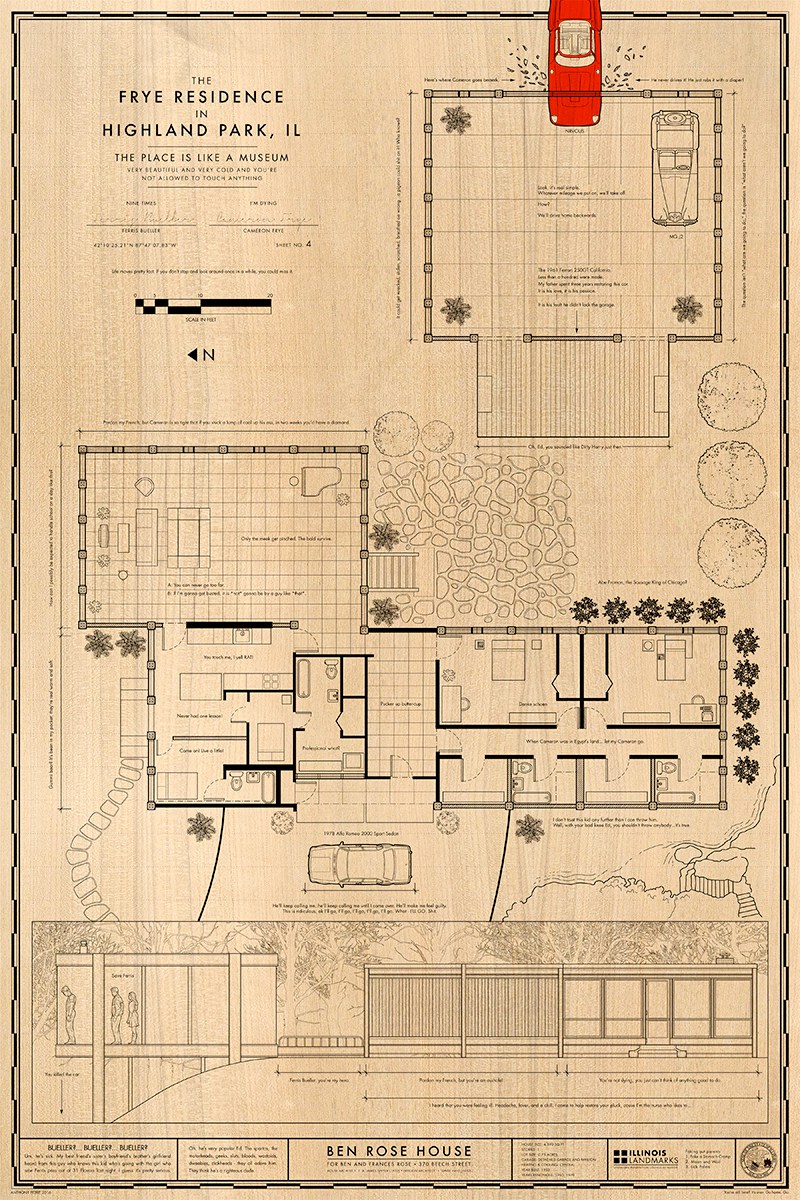
Artist Anthony Petrie has a new series of “Charts” prints, including the below blueprints of Cameron Frye’s home from Ferris Bueller’s Day Off, which will be showing at Gallery 1988 next week (via /Film):
Actor in the Spotlight:
In honor of the late Gene Wilder, Raging Cinema presents a look at Gene Wilder’s mastery of the comedic pause:
[embedded content]
Classic Trailer of the Day:
Today is the 70th anniversary of the release of The Big Sleep. Watch the original trailer for the classic film noir starring Humphrey Bogart and Lauren Bacall below.
U.S. Treasury Jack Lew says a better case needs to be made to U.S. workers who fear the effects of proposed trade deals with Asia and Europe. Fred Dufour/AFP/Getty Imageshide caption
toggle captionFred Dufour/AFP/Getty Images
Proposed trade deals with Asia and Europe have suffered setbacks recently. But Treasury Secretary Jack Lew says he isn’t ready to write off the Trans-Pacific Partnership and the Transatlantic Trade and Investment Partnership.
In an interview with NPR’s Robert Siegel before Lew departs for a Group of 20 meeting in China, Lew acknowledged the anxiety among workers who have felt the impacts of the globalized economy but said the benefits of the trade deals need to be made “more clear.”
Lew also spoke about the U.S. budget deficit and the European Commission’s finding that Apple owes $14.5 billion in taxes to Ireland.
Robert Siegel: At this point, are the TPP and a proposed deal with Europe, the TTIP, dead?
Jack Lew: No, there’s a strong case for a good trade agreement, which TPP is, and we’re going to continue to press forward as the president has indicated. We’re going to continue to work with the Europeans. Whether we can finish it or not I can’t guarantee, but we’re gonna still try to get that done.
But on TPP, where you’ve lost Secretary Clinton as a supporter it seems, do you read the opposition to that as just an election-year kerfuffle, or is there something changing in the way Americans see trade agreements, and in the way Washington had better negotiate trade agreements?
I think that the benefits of market access for American workers are clear. I think what we need to be more clear at is how the benefits of trade agreements get to workers, how workers are equipped with the training they need to have the jobs in the new economy, how companies share the benefits of growth with workers. We have to make a stronger case, a better case, but the substance, the facts are clear.
I’m not hearing you feeling the tectonic plates about trade policy shifting in the United States. I hear you feeling things haven’t been presented exactly right, they could be sold better. I’m not hearing you detect some fundamental change on this issue.
Look, what I believe is that there’s a lot of anxiety and anger amongst working people around the world. It’s not just in the U.S. We’re seeing it in many, many parts of the world. I think that is a message to global financial policymakers that what we’ve been saying for a long time has to become central: That is how do we make sure that the benefits of a growing economy reach working people. It will not help working people to have a shrinking economy. Right now the United States economy would be doing better if global growth was stronger. That would mean more demand for U.S. goods and services. So we need a stronger global economy, but we also need to make sure the benefits are broadly shared.
What would you tell an American who’s anxious about the budget deficit and the debt and who sees the economy not strong enough for us to undertake either the spending cuts or the tax increases that might reduce the deficit and not strong enough to grow in a way that there’d be more revenues, and just watching the deficit grow?
People have to focus on not just the nominal number of what the size of the deficit is, but the deficit as a share of the economy. When we came into office, it was roughly 10 percent of GDP. It’s now under 3 percent of GDP. That is the most dramatic reduction in deficit in history. It’s comparable with the post-World War II reduction.
Isn’t that share moving up a little bit right now?
It has ticked up a little bit, but it’s in the zone of a sustainable level and when, if you asked me today what is the most pressing need, it is more important to invest more in infrastructure and training today to build the economic foundation for growth that will throw off more income and more revenue in the future, then to get an incremental amount of deficit and debt reduction over the next few years.
I want to ask you about Ireland, Apple and taxes. Why is the U.S. critical of the European Commission billing Apple for billions in taxes to pay Ireland? Aren’t they trying to cope with global tax evasion, something which we think is a problem that should be handled?
We have a shared view that companies should not be able to avoid taxation by shifting profits and by using loopholes in international tax laws. What’s not appropriate is for, in the name of state aid, Europe to be rewriting tax law retroactively, reaching into a tax base that properly should be a U.S. tax base, because it’s U.S. income, and doing it in a way that I think ultimately will hurt the business environment because it’s going to create uncertainty in Europe.
But in the case of Apple, it sounds odd. It sounds as if the U.S. is saying to Europe, how dare you do something about this, we’re busy not doing something about this. It’s our job not to do.
I think that the process of working tax reform through Congress typically takes many years. It’s not unusual for it to start in one administration and end in another. What’s not appropriate is for Europe to preempt the ability for the U.S. to address that, which is what I’ve said is a potential outcome of the European action.
…
Lew insists he’s optimistic about the economy, although he says policymakers should pay attention to the global economic debates that have been so heated this year. He says more attention should be paid to spreading the benefits of trade, not reducing it. And he paints a glowing picture of an economic future that he says is possible.
Lew: It will be a 21st century economy. It will have technology that’s is different. It will have trade practices that are different. But we can have high standards that protect workers’ rights, the environmental standards, good business practices and global markets that give U.S. workers and businesses the ability to get a fair share of the global markets. That’s what we’re fighting for.
That sounds like a beautiful world. That sounds a far cry from the anxiety you’ve described of working people from all around the world.
I don’t disagree that the anxiety is there, but I also take optimism from the fact that there are policies to address that and if you look for example at the TPP, there are labor provisions in the TPP that are already driving an improvement in labor standards in countries like Vietnam and Mexico, and it is already having an impact to level the playing field and improve the ability for U.S. competition. What we can’t do is pull away from the world.
But what are the chances of the TPP being approved in the lame duck session of Congress?
We are going to continue to press for it. We think the case is strong and the opportunity is there and we’re determined to get it done.
San Francisco 49ers quarterback Colin Kaepernick stands on the field during an NFL football game against the Atlanta Falcons in Santa Clara, Calif. Ben Margot/APhide caption
toggle captionBen Margot/AP
Daddy would not have liked Colin Kaepernick. Had the San Francisco quarterback refused to stand for the national anthem in my father’s presence, Daddy would have fixed him in a stare that could freeze the blood in your veins. Then, to no one in particular — but to everyone within earshot — he’d give the young man a two-sentence lesson in patriotic etiquette.
“You stand during the national anthem,” he’d say, punctuating his words with fire. “People died for that flag.”
As a child coming of age in New Orleans in the 1960s, I found my father’s love of country utterly bewildering. His was the generation of men born free but shackled by bigotry. Yet, every time he took my brothers and me to see the Saints play football at old Tulane Stadium, we all stood for the national anthem. We took off our caps, faced the flag, and placed hands over hearts.
And Daddy sang.
O say can you see …
He sang with a pride I could not comprehend, in a gorgeous tenor’s voice that he didn’t mind showing off. In a city that once denied him the simple dignity of being called Mister Verdun P. Woods, Sr. In a land that would have his black countrymen fight on the front lines but sit in the back of the bus. He sang so that other people would hear.
What so proudly we hailed …
Verdun P. Woods Sr. Courtesy of Keith Woodshide caption
toggle captionCourtesy of Keith Woods
My father was an insatiable learner with intelligence that his baby brother once told me bordered on genius. He and his uncles, brothers and nephews joined the military in the 1940s as young men. He went to Manila, Okinawa and Korea, trained as a medic, worked as a communications clerk, learned a bit of German and enough Japanese to make you believe he knew more. After he’d served his country for eight years, he took a job with the U.S. Postal Service, one of those limited career tracks that a racist America reserved for black men.
Daddy was not one for self-reflection. Feelings didn’t flow from him; they escaped. So when he talked to me about his military years, the anger would burst from him like steam from a busted radiator. Any mention of the white commanding officer in Korea who treated him like trash and took credit for his work, and Daddy’s hands would start shaking and he’d bite down on his tongue like a Maori warrior dancing a Haka.
We watched a documentary years after he retired about the architects of American democracy. I saw his eyes combust, and he shouted, to no one in particular, “Yes, and they built it on the backs of the black man!”
This man. This accountant, camera buff, would-be linguist, postal clerk, kite maker, father of nine. This veteran. He would take us to the football game to see Peyton Manning’s father play, and he would face the flag and sing with a devotion that belied the truth I knew.
And the rocket’s red glare …
His singing was loud and embarrassing to me, a child who would rather have gone unnoticed. And it only got worse whenever some guy two seats down or three rows below us would rise but keep his hands at his side, or his hat on his head, as the Tulane University marching band struck the opening chords.
“You know,” Daddy would say, ostensibly to us but loud enough for the fan to hear, “you should take your HAT OFF when they play the national anthem.”
I can’t imagine that he would sympathize with Kaepernick, who’s struggling to reclaim lost magic on the field and courting infamy on the bench. I doubt Daddy would buy the quarterback’s refusal to “show pride in a flag for a country that oppresses black people and people of color.”
But for me, the words roused an old ambivalence. I’m a father of five. A grandfather of four. I live unrestrained by the immoral laws that constrained my elders. My dreams are brimming with hopes of unlimited tomorrows for my children, and theirs. And I’m fully aware that America teems still with the racial injustices against which my father railed and Colin Kaepernick now stands — or sits.
I can’t condemn him. I won’t. Love of country can’t be accurately measured by whether someone sits or stands or slouches or sings. It’s not that simple. If I could ask my father, I believe he’d say that he sang because he earned that right. I believe he sang to affirm a citizenship denied him through housing discrimination, police brutality, economic inequities and educational apartheid. Does that make him more or less like Kaepernick?
And what of me? When Daddy died on Halloween morning 2005, two months after Hurricane Katrina, he left me a strange inheritance: I’m incapable of going to a sporting event without noticing who leaves their hat on during the anthem and who doesn’t cover their heart. I still get anxious every time I see someone hold the American flag too low, even though I now know that, unlike what my father always said, you don’t have to burn the flag if it touches the ground. These things still mean something to me, but mostly because they meant everything to him.
At his burial, a military honor guard met my father’s flag-draped casket. Daddy would have geeked out. He would have made sure we noticed how, in a slow-motion ritual of glorious precision, the soldiers sharpened every crease and smoothed every fold, tucking in the last bit of the flag so that it formed a perfect triangle and showed no red. He would have savored the sad, tender spectacle of a lone soldier standing in the distance between crumbling New Orleans crypts, blowing taps into the autumn air.
I took it all in, and savored it on his behalf.
That is my relationship to the national anthem. It means what it does to me because it meant what it did to him. Yes, I stand even before the first strains of the song begin, but what rises in my chest is less my own expression of patriotism and more an artifact of the pride my father was forced to wrench from the stingy grip of his country. I have nothing to prove of my fealty to America, least of all by how I treat a song written by someone who believed black people are born inferior.
But I hold no grudge against Francis Scott Key. I’d be a tired, miserable man if I litigated every act of slaveholders in a place called Washington D.C. The truth is, I like the song. I like the way its lyrics call for emotion deep inside me. I like the flush of blood that rushes through my brain with its crescendo.
Who am I to decide what it should mean to Colin Kaepernick?
Who could possibly know what it meant to the people Daddy chided in the old Tulane Stadium?
And what could you truly make of me just a week ago, when that beautiful music started and I rose to my feet at a Washington Nationals baseball game. If what you saw was an unmitigated display of patriotism, you were wrong. My relationship to my flawed homeland is too complicated for that.
All you would know for sure is that I stood. I faced the flag, hand over heart.
And I sang.
O say does that star-spangled banner yet wave
O’er the land of the free and the home of the brave?
Noura Mint Seymali with her bandmates Ousmane Touré, Jeiche Ould Chighaly and Matthew Tinari. Bechir Malum/Courtesy of the artisthide caption
toggle captionBechir Malum/Courtesy of the artist
It was just two years ago that Mauritanian vocalist Noura Mint Seymali hit the international scene — but now, it’s hard to imagine the scope of African music without her. The singer and her band blow listeners away with giddily woozy and dreamlike vocals; blistering guitar played by her husband, Jeiche Ould Chighaly; and the grounding elements of Ousmane Touré’s bass and Matthew Tinari’s drums.
Now, Seymali is about to release her second internationally available album, Arbina. She’s kicking things off with a video — for her song “Na Sane” — that gives audiences abroad a little glimpse of her native land, which is wedged between the Berber and Arab countries of northwestern Africa and the sub-Saharan south. The desert stretches over the vast majority of Mauritania’s territory and is capped by the Richat Structure, a famous “bull’s-eye” — also known as the “Eye of the Sahara” — that astronauts can see from space. Just over 4 million people live in this country that is nearly twice as big as Texas. It’s a severe and unforgiving landscape, but one that possesses a very particular kind of melancholy beauty.
[embedded content]
YouTube
Director Loïc Hoquet and producer-drummer Tinari decided to shoot the video for “Na Sane” on a road trip through Mauritania. They rented a Toyota Hilux pick-up truck and a black Mercedes taxi and set off on the road that links Mauritania’s capital city, Nouakchott, with its second-largest city, Nouadhibou (population roughly 118,000), near the border of Western Sahara territory.
The scenes from the road are intercut with glimpses of a party — and everyone in the video is a relative or friend of Seymali and Chighaly. As Tinari wrote in an email, “Essentially, we just threw an impromptu family barbecue. One of the dancers is Noura’s brother Baba; some of the younger boys are nephews of Jeiche. The girl dancer is a friend from the neighborhood. It was a family affair!”
Noura Mint Seymali, Arbina. Courtesy of the artisthide caption
toggle captionCourtesy of the artist
Part of the shoot also took place at a ridge that overlooks the Atlantic Ocean — yes, this is still Mauritania. The band plays at Cap Blanc, which used to be known as the “largest ship graveyard in the world.” It’s where owners paid bribes to illegally abandon their old vessels and left them to rot in the Cap Blanc harbor. Tinari says, “There has been a recent U.N. project to dismantle the decaying ships, and many of them are no longer there.” Still, one can imagine those ghostly shipping boats shimmering in the waters behind the band.
This Mauritanian sojourn is a perfect fit for Seymali, considering how deeply rooted she is in her home culture. Both she and her husband are Moorish griots; in west Africa, griots are a community’s storytellers, historians, poets — and musicians. Seymali comes from a long line of griots, in fact; her stepmother, Dimi Mint Abba, was a famous Mauritanian singer.
Fittingly, then, Seymali calls upon tradition even as she infuses her music with psychedelia; her lyrics, too, intertwine those ideas of heritage and innovation. “Na Sane” begins with two traditional lines, followed by a line penned in honor of Chighaly’s older brother Lamar (also a talented guitarist) by Seymali’s late father-in-law, the musician Youba El Moctar Chighaly, before concluding with words of her own:
You are getting sleepy, go to sleep, go to sleep,
Go to sleep at the house of Dakhman
God, keep Lamar safe, help him to avoid malicious energy.
The music of the band, the azawan, is blending well with my song,
Protect us from bad energy, help us preserve the vibe.
European Union regulators on Tuesday said Apple must pay a tax bill of $14.5 billion on its European profits earned in Ireland. Lots of people are reacting, including the Irish finance minister, the White House and stock analysts.
Transcript
ROBERT SIEGEL, HOST:
Apple is vowing to appeal the ruling by the European Union ordering the U.S. tech giant to pay more than $14 billion in back taxes. EU regulators announced the long awaited ruling earlier today, saying the tax arrangement between Apple and the Irish government is illegal and gives Apple an unfair advantage over its competitors. NPR’s Jim Zarroli reports.
JIM ZARROLI, BYLINE: EU officials say that for years Apple benefited from a complex agreement that essentially allowed it to escape paying taxes on many of the products it sold overseas. The sales were recorded by a pair of subsidiaries called Apple Sales International and Apple Operations Europe. The head office for these two entities was ostensibly in Ireland. Margrethe Vestager, the EU’s competition commissioner, spoke at a press conference today.
(SOUNDBITE OF PRESS CONFERENCE)
MARGRETHE VESTAGER: This so-called head office only existed on paper. It has no employees. It has no premises, and it has no real activities.
ZARROLI: Vestager says even though profits were recorded by these Irish subsidiaries, Ireland itself ruled that Apple didn’t have to pay taxes on them. Reuven Avi-Yonah is a professor of tax law at the University of Michigan. He says Ireland didn’t view the subsidiaries as legally Irish.
REUVEN AVI-YONAH: Well, the way the Irish let them record it is that it’s not, from an Irish perspective, treated as being in Ireland at all, and the result is that the tax rate on that is effectively zero.
ZARROLI: Ireland was foregoing billions of dollars in tax revenue. Avi-Yonah says that may have something to do with the fact that Apple is a big employer there. It has nearly 6,000 workers in the country.
Whatever the reason, Ireland has insisted it doesn’t want the money. Finance Minister Michael Noonan told CNBC his government would appeal the ruling, a process that could take years.
MICHAEL NOONAN: If they owe tax, they do not owe it to the Irish authorities. They may owe it elsewhere but not to the Irish authorities.
ZARROLI: Apple issued a statement. It said, we find ourselves in the unusual position of being ordered to pay additional taxes to a government that says we don’t owe any more than we’ve already paid.
As for the U.S. government, Treasury Department officials said retroactive tax assessments are unfair, contrary to well-established legal principles and call into question the tax rules of individual states. Jim Zarroli, NPR News, New York.
NPR transcripts are created on a rush deadline by Verb8tm, Inc., an NPR contractor, and produced using a proprietary transcription process developed with NPR. This text may not be in its final form and may be updated or revised in the future. Accuracy and availability may vary. The authoritative record of NPR’s programming is the audio record.
Amanda McMacken, a registered nurse at Temple University Hospital, shows North Philadelphia residents how to slow bleeding in trauma victims. Kimberly Paynter/WHYYhide caption
toggle captionKimberly Paynter/WHYY
When a young African-American man dies in the city of Philadelphia, more than half the time there’s one main reason why, says Scott Charles.
“It’s because somebody pointed a gun at him and pulled that trigger. It’s not because of cancer; it’s not because of car accidents; it’s not because of house fires. It’s because somebody pointed a trigger,” he says.
Charles is trauma outreach coordinator at Temple University Hospital. The medical center now offers bystander first-aid training, called Fighting Chance, to give friends and family something to do in the minutes before help arrives.
At 6 o’clock one evening, kids run around while their parents and neighbors gather in an elementary school cafeteria. There are training stations set up, and at the back a nurse is showing people how stop blood flow from a gunshot wound.
“The pressure point is located on the inside of the arm,” he explains. “And basically, you’re going to take your hand and get up underneath the inside of the arm and clamp it down.”
Each person takes a turn, taking an old towel or T-shirt and wrapping it around the fake bloody arm tight until help arrives.
Registered nurse Danielle Vetter demonstrates use of a tourniquet. Kimberly Paynter/WHYYhide caption
toggle captionKimberly Paynter/WHYY
Everyone’s talking, but emergency medicine doctor Tim Bryan’s voice is the loudest. He’s a Navy veteran, a former combat medic, and he’s used to giving commands. A shooting scene is chaotic and frightening, but Bryan says in just two hours of training, people get enough of the basics so they will know how to respond.
“You have that ‘aha’ moment and people are like, ‘Wow, I can do this. I can control the scene. I can remember to call 911 and tell the person to put direct pressure on even if I don’t do anything else.’ And it does make a difference,” he says.
The topic is serious, but the mood isn’t. Alice Kellam, 63, wears a camouflage tracksuit and rhinestone hoop earrings. She’s chatty and laughs with friends all evening — except when she talks about her husband, who was murdered in 1990. She doesn’t have a lot to say about that, except that it was senseless.
“They took his sneaks and his hat. That was it,” she says.
Many people in this North Philadelphia neighborhood have a story about someone and remember a moment when they felt helpless.
Louise Smith (“Everybody calls me Miss Midge,” she says) is a perpetual volunteer, and at the big summer block party at 12th and Cambria, she’s the lady who hands out the flavored water ice.
“About a year ago, we seen a shooting around here,” she says. “It was a shame the two boys died right on the sidewalk, there wasn’t nobody there to help them.”
A severely injured person can bleed to death in less than 10 minutes. But it can take much longer for police to arrive and calm the situation, so the trainers teach the class how to move a victim away from danger and flying bullets.
Registered nurse Maureen Quigg explains how to do a two-person lift-and-carry.
“The knee closest to the victim is down and the other knee is up, and that’s what you stand up with, the power from your legs and not your back,” she says.
Quigg reassures the smaller women that they indeed can help a 200-pound person.
“If it’s someone you care about or in a situation where there’s a lot of activity your adrenaline is going — you have all this extra energy, you have all this extra power,” she says. “And if you focus on doing it and doing it the right way, you can lift someone you’d never think you could lift, and you can do it without hurting yourself.”
Advocates say learning first-aid skills to stop bleeding is the essential step in bystander education, not unlike learning CPR or making sure a defibrillator is nearby to jump-start someone’s heart. The federal Department of Homeland Security provides an introduction to these lifesaving techniques online in its Stop The Bleed program.
Neighbors learn how to move gunshot victims safely at the Fighting Chance emergency response training. Kimberly Paynter/WHYYhide caption
toggle captionKimberly Paynter/WHYY
At the end of the evening, the trainers stage a minidrama to test the group.
Bryan sets the chaotic scene and calls out directions. One person is the victim. There’s a pretend shooter.
“Remember, you can ask somebody: ‘Help me control the scene.’ That’s good,” he calls out.
Charles helped develop the first-aid education program after a local resident came to him to complain that he was sick and tired of hearing about young men who died before getting to the ER.
“As we wait for laws to be changed, many people are going to find themselves on the wrong end of a gun,” Charles says. “While those things are certainly important, we have to we have to put the power in people’s hands to address this issue.”
The goal is to saturate one neighborhood with people who have basic lifesaving skills. About 250 people have been trained so far.