A government watchdog’s report says Flint residents’ exposure to lead in city drinking water could have been stopped months earlier by federal regulators. Carlos Osorio/APhide caption
toggle caption
Carlos Osorio/AP
The Environmental Protection Agency had the authority and information to issue an emergency order protecting residents of Flint, Mich., from lead-tainted water a full seven months before it did so, an EPA internal investigation has concluded.
By June 2015, the EPA regional office “had information that the city of Flint exceeded the lead level at which corrosion control is required, and that Flint was not using a corrosion inhibitor.” It also knew that testing showed high levels of lead in at least four homes. Finally, the regional office “knew that the state and local authorities were not acting quickly to protect human health.”
That is enough to issue an emergency order, the report says. Such action “could have required the city and state to provide alternative water supplies to affected residents, study the extent and severity of lead contamination within the water system, or immediately begin corrective actions to reduce and eliminate lead contamination in the drinking water system.”
And yet, the EPA did not issue an order until January 2016. According to the report, local authorities “believed that the state of Michigan’s actions to address the Flint situation barred formal federal action.” But that was incorrect – the Safe Drinking Water Act states that the EPA can take action if “state actions are deemed insufficient.”
The watchdog’s report concludes that the agency “needs to clarify for its employees how its emergency authority can and should be used to intervene in a public health threat.”
The EPA is among the people and groups under fire for the slow response to Flint’s lead-laced water. An independent task force concluded earlier this year that a state environmental agency called the Michigan Department of Environmental Quality bears primary responsibility, though others are also to blame.
The problem began when Flint switched to a new water source in 2014 for cost reasons. But water from that new source, the Flint River, was not adequately treated with corrosion controls and caused lead from the city’s pipes to leach into the drinking water supply. And as we’ve reported, the city switched back to its original water supply late last year, but it was too late to reverse the damage to the pipes.
The city is in the process of treating its water system and recent test results show that lead levels have improved.
High levels of lead are especially dangerous for children and can cause “learning disabilities, behavioral problems and mental retardation,” the World Health Organization said.
Catching up on the lead crisis in Flint? Our timeline takes you through how the public health disaster unfolded, step by step.
Here are a bunch of little bites to satisfy your hunger for movie culture:
Musical Mashup of the Day:
Characters from 49 movies sing the theme song to Friends in this musical montage from The Unusual Suspect:
[embedded content]
Bad Movie Analysis of the Day:
Watch an alien from the future describing the plot of Batman Begins in the latest episode of Earthling Cinema:
[embedded content]
Adorable Cosplay of the day:
Kids are doing a great job representing Ghostbusters costumes this Halloween, as seen in the below Ghostbuster and Ecto-1 getup for a boy and his wheelchair (see a full video at io9) plus a little girl inspired by Leslie Jones in the new movie:
Now that Nike has put out real self-lacing shoes, Candice Drouet spotlights sneakers in movies, including Back to the Future Part II and Aliens (via One Perfect Shot):
[embedded content]
Political Campaign Video of the Day:
Even the presidential candidates are getting into supercuts now, with this pro-Clinton ad featuring a number of movie bullies, including those from Back to the Future and The Karate Kid (via A.V. Club):
There are a lot of bullies in this world. The last thing we need is one in the White House. pic.twitter.com/M0owOglPjy
Howard Schneider was a doctor treating psychiatric patients in the ER when he decided to transform the grocery store experience. He set out to invent the self checkout machine.
Some parts of the design were pretty straightforward, like reading barcodes and taking payments. Other things, it turned out, were not so easy. Like figuring out when people are stealing. Schneider solves these problems. Or at least makes a machine that’s good enough to use. In 1992, he eventually convinces a grocery store to install the machines. The result? Angry shoppers.
Now, hundreds of thousands of grocery stores all around the world use self-checkout machines. But customers are still frustrated.
Today on the show, how a doctor created the first self-checkout machine in his spare time. Also: why does grocery store checkout still suck?
Secretary of Health and Human Services Sylvia Burwell at a Senate hearing in 2014. “We expect this to be a transition period for the marketplace,” she told reporters Wednesday. “Issuers are adjusting their prices, bringing them in line with actual data on costs.” Alex Wong/Getty Imageshide caption
toggle caption
Alex Wong/Getty Images
Rate hikes are likely on the way for insurance plans issued under the Affordable Care Act, health policy analysts say. Consumers’ out-of-pocket costs are expected to climb in 2017 and some major insurers have signaled they are pulling out of the health insurance exchanges in a number of states.
In a meeting Wednesday with reporters and representatives of groups working to increase enrollment in the health plans, Department of Health and Human Services Secretary Sylvia Burwell acknowledged that the Affordable Care Act’s fourth enrollment season — scheduled to begin Nov. 1 and run until Jan. 31 — is a pivotal time for the federal health law.
“Building a new market is never easy,” she told the group at HHS headquarters. “We expect this to be a transition period for the marketplace. Issuers are adjusting their prices, bringing them in line with actual data on costs.”
Burwell’s comments foreshadow the higher premiums expected when federal officials release details on the health plans to be offered on HealthCare.gov for 2017. Those details are likely to come just days before a presidential election that could determine whether the ACA is repealed or revamped.
While the health law hasn’t been a central issue in the current election season, it has been at the center of a bitter battle between political parties since it was passed in 2010. The House of Representatives has voted more than 60 times to repeal all or part of the measure. The law has survived some court challenges and faces others.
Burwell noted those fights Wednesday when talking about issues that arose in the law’s implementation. “It also hasn’t helped,” she said, “that at nearly every turn, we’ve had to overcome partisan attempts to repeal and undermine the law through legislation and litigation.”
Enrollment in the state and federal marketplaces is expected to grow by about a million people next year — from about 12.7 million to 13.8 million, according to federal estimates released Wednesday. The number of consumers who actually pay premiums and stay in the market is expected to average about 10.5 million per month in 2016 and about 11.4 million per month in 2017.
Consumers flow in and out of ACA plans because they change jobs, get coverage from other sources and face other factors that affect where and how they enroll in health insurance, including affordability. About 9.2 million of the 13.8 million people who now have ACA coverage are expected to reenroll, according to HHS.
This year, Burwell said, health officials working to increase insurance coverage among the uninsured are intent on making the enrollment process faster and simpler, and will particularly focus on signing up healthier consumers – including people between the ages of 18 and 34, who tend to have fewer ailments. They will also remind consumers of the penalty for not having coverage, which for adults in 2016 is $695 or 2.5 percent of income, whichever is higher. The flat penalty will be adjusted for inflation in 2017.
Federal officials are also focusing enrollment efforts on the 5.1 million Americans who are eligible to purchase health care coverage on the exchanges but buy it elsewhere, according to HHS figures. Of that group, 2.5 million people could be eligible for the law’s financial assistance if they sign up for coverage during open enrollment, which ends Jan. 31.
The outcome of the November elections may well determine the future of the ACA. Republican presidential nominee Donald Trump has promised to repeal and replace the law, while Democratic nominee Hillary Clinton has said she wants to fix the law, making it more affordable for consumers who don’t qualify for subsidies, yet struggle to afford coverage.
Burwell called on Congress to work with her and the Obama administration to make needed changes to the law. “To make more substantial changes — like a public option to encourage competition — we’ll need cooperation from Congress,” she said. “And we are hopeful that soon, we’ll see more bipartisan efforts to make improvement.”
Bipartisan cooperation isn’t likely to happen until the next Congress meets, if then. Much will depend on the outcome of the presidential and congressional elections – on who is in power and whether GOP leaders think the ACA is still a potent political issue, as well as on how willing Democrats are to make changes that appeal to Republicans.
Mary Agnes Carey reports for Kaiser Health News, an editorially independent news service that is part of the nonpartisan Henry J. Kaiser Family Foundation.
NBA star Derrick Rose leaves federal court in Los Angeles. Jurors cleared Rose and two friends in a lawsuit that accused them of gang raping his ex-girlfriend when she was incapacitated. Nick Ut/APhide caption
toggle caption
Nick Ut/AP
A federal jury in Los Angeles found New York Knicks guard Derrick Rose not liable Wednesday in a civil suit that accused him and two friends of rape. Ryan Allen and Randall Hampton, the two friends, were also cleared.
The suit accused Rose, Allen and Hampton of breaking into the home of a Los Angeles woman. The alleged victim, a former girlfriend of Rose, had sued for $21 million, according to the Los Angeles Times. Rose, a former NBA MVP and Rookie of the year, testified during the trial as reported in the Times.
“Contradicting the woman’s claim that she became severely intoxicated and ‘blacked out’ while drinking with the three men the evening before the alleged rape, Rose said the woman appeared lucid at the Beverly Hills house he was renting. He described how the woman, whom he had dated casually for two years, made repeated sexual advances toward him and eventually initiated sex with Hampton and him.
“Several hours later, when the woman had gone home, Rose claimed she agreed to have the three men come to her apartment, let them in and willingly had sex with each of them in turn.
“The woman testified that she believes the men slipped an unnamed drug into one of her drinks and that she has only ‘flashes’ of memory of what occurred at Rose’s house and in her apartment. She told jurors that she passed out in her bed and awoke to find the men in her room having sex with her.”
Neither side denied Rose, Allen and Hampton had sex with the woman. At issue was whether she was too intoxicated to consent.
The three men have been friends since childhood in Chicago. Both Allen and Hampton work for Rose.
Criminal charges have not been filed but a Los Angeles Police investigation is still pending. In a strange twist, LA police detective Nadine Hernandez, one of the officers investigating the potential criminal case against Rose, Allen, and Hampton, was killed last week, as reported by member station KPCC.
Rose, once a top draft pick, was traded by his hometown Chicago Bulls earlier this year to the New York Knicks. Rose has been plagued my knee problems for years, though last year he was free of injuries. In 2016-2017 season, Rose is expected to make $21 million.
“I am thankful that the jury understood and agreed with me.” Rose said in a statement to the Associated Press, “This experience and my sensitivity to it was deep. I am ready to put this behind me and focus on my family and career.”
Here are a bunch of little bites to satisfy your hunger for movie culture:
Fake Sequel of the Day:
Screen Rant’s fan trailer for Frozen 2 pits Elsa against Big Hero 6 villain Yokai and also mashes in characters from Toy Story, Finding Nemo, Wall-E, The Incredibles and Zootopia:
[embedded content]
Mashup of the Day:
Darth Vader learns about the Millennium Falcon‘s cloaking device during the events of The Empire Strikes Back in this Veep parody sketch from Nerdist:
[embedded content]
Cosplay of the Day:
Speaking of The Empire Strikes Back, this kid’s tauntaun/rider Halloween costume is one of the coolest we’ve ever seen. See additional photos at Geek Tyrant.
[embedded content]
Crowdfunding Project of the Day:
A documentary about the origins of Sesame Street called Street Gang is crowdfunding on Indiegogo. Check out the campaign video:
[embedded content]
Alternate Poster Series of the Day:
Olly Moss created seven amazing posters for the seven Harry Potter stories — the last of which was, of course, two movies (via Olly Moss):
Alternate Ending of the Day:
Watch what might have occurred after the end of X-Men: Apocalypse after the credits were over:
[embedded content]
Movie Takedown of the Day:
Honest Trailers busts the Ghostbusters reboot for not being good enough to quiet all the prejudiced hate against it:
[embedded content]
Vintage Image of the Day:
Klaus Kinski, who was born on this day in 1926, in a famous image choking filmmaker Werner Herzog on the set of the 1987 film Cobra Verde, also used as the poster for the 1999 documentary My Best Fiend:
Movie Trivia of the Day:
The most fittingly titled movie to get a list of seven obscure bits of trivia via CineFix is, of course, Se7en:
[embedded content]
Classic Trailer of the Day:
Today is the 20th anniversary of the theatrical release of Swingers. Watch the original trailer for the indie hit below.
It can cost billions to put on the Olympic games. Those high costs can be a burden to host cities and will be among the topics discussed Tuesday when International Olympic Committee President Thomas Bach meets with organizers in Tokyo, home of the 2020 games.
KELLY MCEVERS, HOST:
In Tokyo today, the president of the International Olympic Committee says the IOC can work with that city to cut the cost of hosting the 2020 Summer Olympics. Soaring prices have become a constant problem for host cities as the IOC moves its massive sports spectacle around the globe. NPR’s Tom Goldman says the situation is renewing calls for change.
TOM GOLDMAN, BYLINE: As far as envelope-opening moments ago, it’s hard to beat the excitement of announcing a winning Olympic bid.
(SOUNDBITE OF ARCHIVED RECORDING)
UNIDENTIFIED MAN: Awarded to the city of Tokyo.
(APPLAUSE)
GOLDMAN: That ecstasy in 2013 has been replaced by anxiety in 2016. A panel studying Tokyo’s finances recently reported it could cost more than $30 billion, four times the initial estimate. The International Olympic Committee refused to call it a crisis meeting today between IOC President Thomas Bach and Tokyo’s governor. But there’s ample reason for concern, and not just in Japan. A week ago, Rome withdrew its bid for the 2024 Summer Games. Rome’s mayor, Virginia Raggi, has been an outspoken critic.
(SOUNDBITE OF ARCHIVED RECORDING)
VIRGINIA RAGGI: (Speaking Italian).
GOLDMAN: “With the Olympics,” Raggi said last month, “we are being asked to take on more debt.”
There’s been a similar message from Boston and Hamburg, Germany. They also pulled out of the 2024 Games. Several other cities pulled out of the 2022 Winter Games. Those that bailed out have to look no further than those that went all in and paid a big price. Sochi 2014 – more than $50 billion. Beijing 2008 – more than $40 billion. Rio 2016 – economist Andrew Zimbalist says it could end up costing more than $20 billion.
ANDREW ZIMBALIST: The IOC’s asking too much. And there has been a general tendency to expect the next Olympic host to outdo the previous host.
GOLDMAN: Here’s Olympic historian Idy Uyoe.
IDY UYOE: The IOC typically demands that for Summer Games you have a stadium that seats about 80,000 people and is within a certain radius of the center of the city.
GOLDMAN: Uyoe says there are huge demands for lodging – 42,000 hotel rooms – for transportation, for city and sports infrastructure. And then there’s the expense of housing IOC members, who don’t exactly stay at the Holiday Inn.
UYOE: Their staff have to be in a certain class of hotel.
GOLDMAN: Andrew Zimbalist, whose book “Circus Maximus” is about the high cost of hosting the Olympics, says many host cities have had cost overruns – massive ones, in fact. There’s the last-minute rush to complete building before the games. And overall, prices go up in the seven years between winning the bid and putting on the games. A growing number of critics, Zimbalist included, say the fix is obvious.
ZIMBALIST: If you had a permanent Olympic host or you had two or three Olympic hosts, you would pick cities not only that were developed cities economically…
GOLDMAN: …But that had the transportation, communication, hospitality and sports infrastructure to support the Olympics, like Los Angeles, which is one of three remaining 2024 bidders. Would the IOC, so dedicated to spreading the games worldwide, go for a permanent host?
ZIMBALIST: Well, probably not.
GOLDMAN: But if potential bid cities keep dropping out, if corporate sponsors start saying the Olympic brand is tarnishing us instead of burnishing our products, perhaps. Until then, the IOC, which declined two interview requests for this story, is talking change. The committee is considering reforms that include countries sharing host duties and costs. With Tokyo, the IOC appears to have a put-your-money-where-your-mouth-is moment. Today, IOC President Bach said he’s confident there will be, quote, “a significant reduction in the cost of the next Summer Games.” Tom Goldman, NPR News.
NPR transcripts are created on a rush deadline by Verb8tm, Inc., an NPR contractor, and produced using a proprietary transcription process developed with NPR. This text may not be in its final form and may be updated or revised in the future. Accuracy and availability may vary. The authoritative record of NPR’s programming is the audio record.
Once-a-day HIV pills that combine multiple medicines, such as Truvada, are easier to take, but they can be more expensive than pills that contain only one active ingredient. Justin Sullivan/Getty Imageshide caption
toggle caption
Justin Sullivan/Getty Images
The Affordable Care Act prohibits insurers from discriminating against people with serious illnesses, but some marketplace plans sidestep that taboo by making the drugs that people with HIV need unavailable or unaffordable, complaints filed recently with the Department of Health and Human Services’ Office for Civil Rights allege.
The effect may be to discourage people with HIV from buying a particular health plan or getting the treatment they need, according to the complaints.
The complaints – brought by Harvard Law School’s Center for Health Law and Policy Innovation – charge that plans offered by seven insurers in eight states are discriminatory because they don’t cover drugs that are essential to the treatment of HIV or require high out-of-pocket spending by patients for covered drugs.
The center filed complaints against Humana plans in six states: Alabama, Georgia, Illinois, Louisiana, Tennessee and Texas. Cigna plans were targeted in three states: Georgia, Tennessee and Texas. The group filed complaints against five other insurers: three in Pennsylvania, including Highmark, Independence Blue Cross and UPMC Health Plan; a complaint against Community Health Choice in Texas and a complaint against Anthem Blue Cross Blue Shield in Wisconsin.
“What’s most important to us is that there’s a robust enforcement mechanism around the promises … in the [Affordable Care Act] and its regulations, especially the anti-discrimination provisions,” said Kevin Costello, director of litigation at the health law center.
Although the center’s focus is on HIV drugs, the complaints may help people with other chronic illnesses who may face similar hurdles on access to drugs, Costello said.
The HHS Office for Civil Rights investigates and enforces violations of civil rights and health information privacy. The Harvard center complaints were filed in September.
Federal rules prohibit marketplace plans from adopting benefit designs — such as coverage rules or reimbursement rates — that discriminate based on age, illness, race, gender or sexual orientation, among other things. But federal regulators have declined to define discriminatory plan design, noting that they will examine the facts on a case-by-case basis.
They’ve hinted, however, at some specifics in the regulations. They say, for example, that refusing to cover a single-tablet drug regimen, which is often associated with better compliance because a number of different drugs are combined in one pill, or placing most or all of the drugs that treat a specific condition in the highest cost tiers are examples of “potentially discriminatory practices.”
Working with local AIDS groups in several states, the Harvard center examined hundreds of silver-level plans sold on the marketplaces to gauge whether their formularies would allow access to six treatment regimens that are the current standard of care for treating people who are newly diagnosed with HIV. In addition, they looked at the plans’ cost-sharing requirements, Costello said.
They found, for example, that this year Anthem silver plans in Wisconsin cover only four of the 16 drugs or combination products that are recommended to meet the current standard of care, and they fail to cover any single-tablet regimens. In Illinois, the center charged that Humana’s silver plans place 16 of the 24 most commonly prescribed HIV drugs in the highest cost-sharing tier, which requires patients to pay 50 percent of the cost. With estimated monthly costs ranging from $377 to $684 for different drug regimens, enrollees in the Illinois Humana plans would have to pony up between 8 and 14 percent of their average monthly income, according to the complaint.
“All Humana health insurance plans offered through the Health Insurance Marketplace fully comply with state and federal laws and regulations,” said Alex Kepnes, Humana’s director of corporate communications. He added, “Humana shares the concerns of HIV/AIDS organizations regarding the high cost of HIV/AIDS drugs and we are committed to working with them to lower prescription drug costs.”
Similarly, Anthem spokesman Scott Larrivee said, “Anthem Blue Cross and Blue Shield is committed to providing all of our members with access to the care and services they need, including appropriate coverage of medications for the treatment of HIV/AIDS. Anthem Blue Cross and Blue Shield in Wisconsin covers more than a dozen medications for the treatment of HIV/AIDS and all required therapeutic drug categories are included on our formulary/drug list which is compliant with (marketplace) requirements.”
Cigna spokesman Mark Slitt said his company doesn’t comment on pending legal matters.
The center’s work builds on an earlier discrimination complaint filed in 2014 with the Office for Civil Rights by two advocacy groups, the AIDS Institute and the National Health Law Program, against four Florida insurers that were selling marketplace plans. That complaint, against some of the same insurers highlighted by the Harvard center, charged that the insurers placed all the HIV drugs in the highest cost-sharing tier. The Florida insurance commissioner reached agreements with the four plans to move the HIV drugs to generic tiers and reduce cost sharing, and the same arrangement will continue in 2017, said Carl Schmid, deputy executive director of the AIDS Institute.
“We’ve been talking about these issues for years now,” Schmid said. “These things need to be addressed, and it could be through enforcement” by the Office for Civil Rights.
Marketplace coverage of drugs to treat HIV and other serious conditions have improved somewhat in recent years, according to research by Avalere Health, a consulting company. An analysis found that in the case of five classes of drugs that treat cancer, HIV and multiple sclerosis, fewer silver plans in 2016 placed all the drugs in the class in the top tier with the highest cost sharing or charged patients more than 40 percent of the cost for each drug in the class.
Speaking about HIV drugs, Caroline Pearson, a senior vice president at Avalere, said that while access and costs in marketplace plans are improving, they vary widely from plan to plan. Employer plans tend to offer better coverage, she said.
The new complaints may put more pressure on the Office for Civil Rights to address this issue, said Katie Keith, a steering committee member for Out2Enroll, a health insurance advocacy group for the lesbian, gay, bisexual and transgender community.
“It’s smart to do this in multiple states,” she said. “People are really pushing for more concrete guidance.”
Kaiser Health News is an editorially independent news service that is part of the nonpartisan Henry J. Kaiser Family Foundation.Michelle Andrews is on Twitter:@mandrews110.
Ronny Marty, who’s from the Dominican Republic, came to the U.S. with the promise of a job. He ended up living in a tiny apartment with three men, with most of his earnings going back to his employer. Ben de la Cruz/NPRhide caption
toggle caption
Ben de la Cruz/NPR
The U.S Advisory Council on Human Trafficking issued its first-ever report on Tuesday. This group was founded last year when President Obama appointed 11 people, all of whom are survivors of human trafficking themselves, to run the council.
This council is the first organization of its kind that allows survivors to directly recommend policy to government agencies. The first report offers 15 recommendations on five topics, ranging from seeking and allocating grant funding for survivor services to training law enforcement agents to recognize the signs of human trafficking.
We spoke to Ronny Marty, a victim of labor trafficking who came to the U.S. from the Dominican Republic in 2009. Though today he’s an activist against human trafficking and a member of the advisory council, back then, he just wanted the hotel job he’d been promised.
What did you find when you got to the U.S.?
Everything changed. It was nothing they promised me. I was supposed to work in a hotel, but they said they only had jobs in a DVD manufacturing company. I didn’t have any other options, because I had borrowed so much money to pay the $4,000 I needed to come here.
[The five of us working together] were making so little money because of all the deductions. They were deducting for visa extensions, housing, transportation to move us from Kansas City to Huntsville. They put three of us in a one-bedroom apartment with three tiny beds and made us each pay the employer $300 a month. But the employer was only paying $400 a month for the apartment. They told us if we left, they would call immigration and we’d be sent back home. They told us we needed them to extend our work visas to stay legally. They told us they knew where our families lived and they’d go after them.
How did you escape that situation?
Once the employer stopped paying rent I had to talk to the landlord, because I was the only one of us who spoke English. She looked at my pay stubs and knew that something was wrong, [because of the deductions] so she got me to talk to the local newspaper. Then, that helped us [move and] find other jobs in Biloxi, Mississippi. In Biloxi, we talked to [federal Immigration and Customs Enforcement] agents. They put us in touch with NGOs [nongovernmental organizations] that gave us food, housing, everything we needed. Everything started going for the better.
My story is kind of odd compared to most of the cases because everything worked out pretty good at the end. I got the services that I needed at the time that I needed them. Most of the survivors I talk to now had a much worse time. No one would help them and they were very scared to ask for help. That’s why we’re so glad survivors are part of this report because we know about how bad this can be.
How is this report different because it was written by survivors?
Our involvement is essential in this movement to end human trafficking. We went through the tough time. We have the expertise, because of our time in the field, you could say. So with that role, we can help. The government, NGOs, any organization that wants to really fight human trafficking should be asking survivors. We know, for example, why people don’t report their experiences with human trafficking, because they’re scared of the police and their trafficker told them they’re going after their families if they report.
What recommendations do you have for law enforcement?
We need agencies to understand what a survivor goes through to report their case, so the agencies can approach the survivors properly. It’s how you can make a case successful or not. It’s all about trust, because the trafficker has probably told them that the police are just going to take your information and kick you out.
At the point that I went to see [U.S. Immigration and Customs Enforcement], I didn’t trust anyone but I had nothing to lose so I went. [ICE agent] Julie Gray was so kind and professional that I started believing in people again. In 2014, when I came to my first survivor forum, I was in shock when I heard all the survivors and what they went through with the police.
Most people associate human trafficking with women and girls, but clearly, men are affected as well. Does that get enough attention?
This is a problem I face when I go to do a training or talk about human trafficking. People talk mainly just about sex trafficking, because that’s the idea that people have. But that’s why it’s important to bring the message and make them understand that the problem includes child slavery, forced labor, migrant labor. It can happen to anyone.
This report focuses mostly on how government agencies can address human trafficking. Can everyday people help?
Learn as much as you can about the signs. If they have the information, if they know what it is, if they know how to identify human trafficking, they can report it. If you don’t know what you’re looking for, it could be right next to you and you don’t know it. When my landlord saw that something was going on with me and my pay stub, she was the first person who started helping me. That changed everything.
Now, your recommendations go to the President’s Interagency Task Force to Monitor and Combat Trafficking in Persons. What do you hope will come of this report?
This report is like a victory for us, just to get it out there. It’s the first step and now we’re going to be following up with the agencies to make sure that things are happening. We want to collaborate and follow up to help make these goals achievable before the 2017 report.
Here are a bunch of little bites to satisfy your hunger for movie culture:
Megatrailer of the Day:
GameSpot pieced together all the Rogue One: A Star Wars Story trailers in presumed chronological order for one long megatrailer (via Geek Tyrant):
[embedded content]
Fake Toy of the Day:
Given the era The Shining came out in, it woudn’t be surprising if this fake board game tie-in had actually existed (via One Perfect Shot):
[embedded content]
Halloween Decorations of the Day:
This incredible light show display basically has a house performing karaoke of “Time Warp” from The Rocky Horror Picture Show (via Laughing Squid):
[embedded content]
Cosplay of the Day:
Speaking of Halloween, here’s a great Lisa from Weird Science costume spotted at Dallas Comic Con:
Reworked Movie of the Day:
Speaking of weird things, here’s what the Arnold Schwarzenegger movie Commando would look like as a Japanese TV show (via One Perfect Shot):
[embedded content]
Vintage Image of the Day:
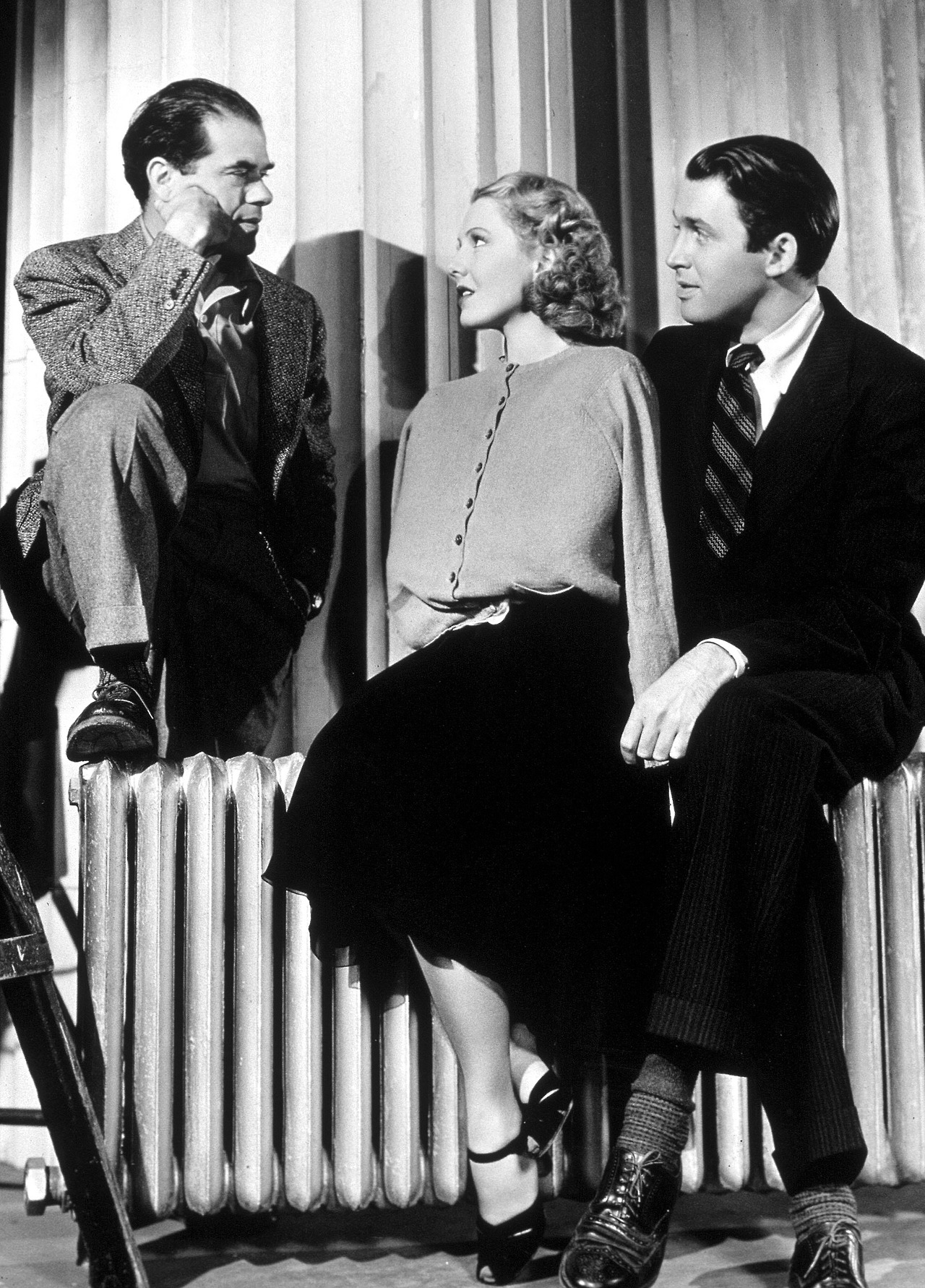
Jean Arthur, who was born on this day in 1900, sits between co-star James Stewart and director Frank Capra on the set of Mr. Smith Goes to Washington in 1939:
Film Festival Parody of the Day:
If you’ve ever been to a film festival and stayed for post-screening Q&As, you’ll recognize this Saturday Night Live parody as being spot-on:
Movie Scene Reenactment of the Day:
At the recent David Lynch Festival of Disruption, during a showcase mostly of Twin Peaks music, Rebekah Del Rio redid her performance of “Llorando” from Lynch’s Mulholland Drive (via Indiewire):
Political Satire of the Day:
Speaking of movie music, for Funny or Die, Danny Elfman personally scored parts from the last presidential debate with scary music (via THR):
Classic Trailer of the Day:
Today is the 60th anniversary of the release of Around the World in Eighty Days. Watch the original trailer for the star-studded Best Picture winner below.