Articles by admin

No Image

World Cafe Nashville: Ahmed And Hasan Alzuabi

Ahmed (left) and Hasan Alzuabi perform at Sound Stage Studios in Nashville.

Ann Powers/NPR

hide caption

toggle caption

Ann Powers/NPR

Almost a month ago, President Trump’s immigration ban pushed words with long histories back into the foreground of the public conversation; one was “refugee.” Since then, much analysis and inflated rhetoric has attached itself to that word, but not that many Americans have had (or have taken) the chance to interact directly with those to whom it applies. Music has long provided one way for outsiders to connect with refugees’ hopes and fears. A recent encounter in Nashville reminded me of the revelations it bears.

Scouting cultural responses to the current political moment, World Cafe producer Kimberly Junod and I headed to the Basement East in Nashville one night not long after President Trump had first presented his executive order on immigration to observe a benefit concert for the Tennessee Immigrant and Refugee Rights Coalition. The evening, co-organized by the spirited soul woman Alanna Royale, featured many local luminaries: Adia Victoria read from the works of Toni Morrison; Ariel Bui, herself the daughter of Vietnamese immigrants to Louisiana, sang of her parents’ experience; rock ‘n’ roll powerhouse Sarah Potenza covered Sam Cooke‘s secular gospel hymn “A Change Is Gonna Come.” But the night’s indisputable high point came when the Syrian father-and-son duo Ahmed and Hasan Alzuabi took the stage.

Article continues after sponsorship

The Alzuabis arrived in Nashville in August after spending four years in Jordan waiting for their visas to come through. In their homeland, the elder artist trained as a vocalist and oud player; after being blinded in an accident as a young man, the 59-year-old maintained a career performing at parties and other social gatherings. His 21-year-old son, a dazzlingly adept tarabaki player, dropped out of high school when the family was relocated to the South and, along with his father, has been fitfully pursuing a music career here, playing at the hookah bars and restaurants around Nolensville Road, the center of Nashville’s immigrant communities. (There is also a significant Kurdish community here.) Alanna Royale found the Alzuabis through a friend in the Syrian community, and they welcomed the chance to perform for a room full of tattooed hipsters on hand for some protest and a “Nasty Women” art show.

The craft-beer-drinking crowd chattered through most of the evening’s performances, but when the Alzuabis took the stage, they were rapt. People moved toward the front and danced as a couple of family friends cut their own bravado moves onstage. These 15 or so minutes of music might have been the most joyful I’ve experienced in recent months, and Kimberly turned and whispered to me that we should try to book the Alzuabis for a session. Two days later, after a circuitous tangle of communiqués, they joined us at Sound Stage Studios for a brief interview and performance.

Our chat challenged me in ways to which I’m not accustomed. The two friends who had joined the Alzuabis on stage served as translators, and words flew across the microphone-filled room in multiple languages. What I did quickly learn was that Hasan and Ahmed Alzuabi shared the same ambitions that most musicians carry with them to Music City: to make a living through their art, to delight bigger audiences than what greets them at an average Tuesday night bar gig and — in the words of Hasan, whose style and sweet smile would perfectly suit a boy band — to “get famous.” To my ears, the music they performed was mysterious and deeply powerful. When I asked Ahmed what the lyrics were about, what he said proved that these songs are also universal, but in a way I hadn’t expected. “They’re about flirting and loving our homeland,” he said. Just like country music, I thought.

Let’s block ads! (Why?)


No Image

Today in Movie Culture: Pixar's 'Pulp Fiction,' Romantic 'La La Land' Superfans and More

Here are a bunch of little bites to satisfy your hunger for movie culture:

Reimagined Movie of the Day:

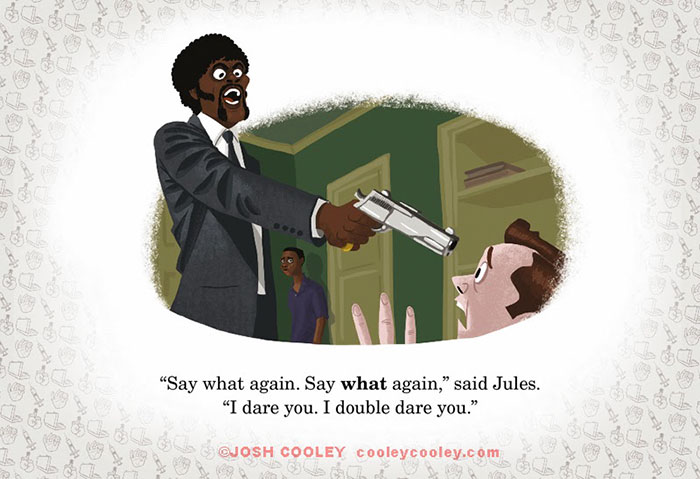
Samuel L. Jackson voices a character in Pixar’s The Incredibles, so he’d gladly return to the studio for an animated Pulp Fiction, right? See more of Pixar artist Josh Cooley’s children’s book versions of classic movies, including The Terminator, Fight Club and The Big Lebowski at Konbini (via Design Culture).

Movie Comparisons of the Day:

Speaking of Pixar, see how their movies are altered for international distribution in Oh My Disney’s side-by-side comparisons:

[embedded content]

Video Essay of the Day:

In the latest episode of Frame by Frame, Kyle shows how much Vincente Minnelli influenced Oscar nominee La La Land:

[embedded content]

Trailer Mashup of the Day:

Speaking of La La Land, almost 20 years ago, Titanic won Best Picture. Now see how easily that movie fits with this year’s Best Picture frontrunner:

[embedded content]

Engagement Photos of the Day:

Ellen Wleklinski and Corey Collins are such fans of La La Land that they reenacted scenes from the musical for their recent engagement photo shoot. See more at BuzzFeed.

Alternate Ending of the Day:

Now let’s switch to another Best Picture nominee with a parody of the diner scene from Moonlight:

[embedded content]

Vintage Images of the Day:

The disaster movie Volcano starring Tommy Lee Jones and Anne Heche turns 20 later this year, but here’s reason to celebrate the anniversary early:

I randomly found these publicity shots for Volcano and now you have too pic.twitter.com/bQvgURcha6

— Joannes Truyens (@playthroughline) February 16, 2017

Actress in the Spotlight:

Oscar nominee Isabelle Huppert, one of the frontrunners for Best Actress, gets a career-spanning supercut (via IndieWire):

[embedded content]

Fake Movie of the Day:

In anticipation of her new movie Get Out, Allison Williams stars in a fake trailer for College Humor for a horror movie about being awkward at parties:

[embedded content]

Classic Trailer of the Day:

This weekend is the 40th anniversary of the release of Slap Shot. Watch the original trailer for the hockey comedy classic below.

[embedded content]

and

Let’s block ads! (Why?)


No Image

Private Prisons Back In Mix For Federal Inmates As Sessions Rescinds Order

New Attorney General Jeff Sessions is rescinding an Obama-era memo that directed the Justice Department to reduce the use of private prisons, NPR’s Carrie Johnson reports

Sessions writes in the order that returning to the Bureau of Prisons’ earlier approach would provide flexibility.

“The memorandum changed long-standing policy and practice, and impaired the Bureau’s ability to meet the future needs of the federal correctional system,” Sessions writes.

Outside companies currently house about 21,000 inmates for the Justice Department, the agency reports, down from a peak of 30,000. The overall federal prison population has been falling in recent years because of changes in how some low-level offenders are sentenced.

In announcing a phasing out of private-prison use in August, then-Deputy Attorney General Sally Yates wrote that the outside companies’ facilities were less safe, more expensive, and “simply do not provide the same level of correctional services, programs and resources.”

Let’s block ads! (Why?)


No Image

Major League Baseball Poised To Change Intentional Walk Rule

Pittsburgh Pirates catcher Chris Stewart grabs an intentional walk throw in a game between Arizona and Pittsburgh last year in Phoenix.

Ross D. Franklin/AP

hide caption

toggle caption

Ross D. Franklin/AP

In baseball, if a pitcher wants to intentionally walk a batter, he has to actually lob the four pitches outside the strike zone. It’s a technique often used to bypass a particularly strong batter, or to set up a double play.

But that rule now appears poised to change.

The Major League Baseball commissioner’s office has proposed a rule change to have the pitcher forgo actually throwing four balls — instead, the bench would simply signal to the umpire that the batter will be intentionally walked.

The head of the players union, Tony Clark, has signaled that it is amenable to the change, according to The Associated Press.

“As part of a broader discussion with other moving pieces, the answer is yes,” Clark told the wire service. “There are details, as part of that discussion, that are still being worked through, however.”

Mike Teevan, vice president of communications for Major League Baseball, tells The Two-Way that the change is currently under consideration. Any rule change involves many parties, he explains, and “that process is not yet complete.”

Article continues after sponsorship

MLB.com has reported that we could see the change as early as this upcoming season.

This is part of a larger push to ramp up the pace of the game, and it comes after Commissioner Rob Manfred told reporters on Tuesday afternoon that there would be no “meaningful” rule changes for the upcoming season after they were not accepted by the players union.

“We didn’t make a deal; we couldn’t make a deal,” he said, sounding frustrated.

Among the proposed changes: introducing a pitch clock to reduce the time between pitches, and capping the number of times a catcher can conference with a pitcher. Manfred argued that these changes would have “little effect of the competitive character of the game” but would “take dead time out of the game” and “keep fans engaged.” These remain on the table, he said.

The changes would benefit the fans and respond to the ways the game has changed, Manfred said:

“I think it’s a mistake to stick our head in the sand and ignore the fact that our game has changed and continues to change. Since 1980, home runs are up 32 percent. And strikeouts are up 67 percent. Last year, balls in play were at a record low, and we all know that things like the use of relief pitchers has changed dramatically in the last 30 years. I’m firmly convinced that our fans — both our avid fans and casual fans — want us to respond to and manage the change that’s going on in the game.”

Not all fans are happy. As some social media users pointed out, intentional walks are not currently automatic — and that means exciting and unexpected things sometimes happen. For example, a wild pitch over a catcher’s head can provide a memorable opportunity to steal a base. And occasionally, a batter actually manages to hit the pitch. Here’s a compilation posted on Twitter of some of those exciting moments (h/t Washington Post):

•The MLB has approved to change the intentional walk rule. Which now will be granted following dugout signal. Take a look at these classics. pic.twitter.com/g3iyEW5kB3

— Dylan (@DylansFreshTake) February 22, 2017

“You’re changing or altering the essence of the sport under the guise of speeding it up minimally,” ESPN host Michael Smith argued. “The object of the game is to pitch to a batter — you should still have to execute those pitches.”

Some players aren’t happy, either. Blue Jays catcher Russell Martin made this sarcastic point, as quoted by Sportsnet columnist Shi Davidi:

“My thing is, if they really want to speed up the game, then when a guy hits a home run, to speed up the game should a guy, just like in softball, when he hits it, should he just walk to the dugout? It’d be quicker. I’m just wondering, at what point do we just keep the game, the game?”

It’s also worth noting that intentional walks don’t happen all that often. According to statistics provided by MLB, there were 932 intentional walks during the 2016 regular season. That’s about 1 every 3 games.

Let’s block ads! (Why?)


No Image

What's Next For The Affordable Care Act? Your Questions Answered

The one thing that’s certain is that there will be changes in the Affordable Care Act.

Joe Raedle/Getty Images

hide caption

toggle caption

Joe Raedle/Getty Images

No matter where you stand on the political spectrum, health care under the Affordable Care Act is going to change in the next few years. The Republican-led Congress has vowed to “repeal and replace” the health law known as Obamacare.

That has left many people anxious and confused about what will happen and when. So NPR’s Morning Edition asked listeners to post questions on Twitter and Facebook, and we will be answering some of them here and on the radio in the weeks ahead.

Many of the questions so far have to do with timing.

For example, Steva Stowell-Hardcastle of Lewisburg, Penn., says: “I’m confused about what parts of the ACA have been repealed and when those changes take place.”

First, despite social media headlines, nothing substantive has been changed in 2017. That’s because making these changes is harder than it looks.

In January, Republicans in Congress passed a budget resolution that called for major changes to the law to be made in a subsequent bill.

Even though that process would allow them to pass a bill without Democratic votes, they haven’t been able to agree on what those reforms should look like.

Article continues after sponsorship

And there are several other obstacles.

First of all, they won’t be able to repeal everything in one go, which counters a lot of the rhetoric coming out of the election. And they would be limited in what parts of the law they can replace.

That said, the Trump Administration has taken some action, but no concrete changes – yet. In January, Trump signed an executive order calling for federal agencies to “waive, defer, grant exemptions from, or delay the implementation of any provision or requirement of the act” that would “impose a fiscal burden” on states, individuals, healthcare providers, and others in the health industry.

While that could be widely interpreted, so far the only federal action in response to that order has come from the IRS. The IRS says it will not strictly enforce the “individual mandate” that requires most Americans to have health insurance. The agency noted, however, the requirement is still law.

A related question comes from Kathryn Henry of Iowa City, Iowa. She asks “if it is repealed, what happens to people like me who currently have insurance through it and when?”

Both President Trump and GOP congressional leaders have insisted that they want a smooth transition from the current system to a new one, particularly for the 11 million or so people who purchased coverage on the federal or state health insurance exchanges since the law took effect.

“We don’t want to pull the rug out from under people while we’re replacing this law,” said House Speaker Paul Ryan, R-Wisc., in January. Trump has insisted that repealing the law and replacing it be done “essentially simultaneously,” so as not to leave people without insurance.

Unless something unexpected happens, people who purchased insurance for 2017 should be covered through the remainder of the year.

The bigger question is what happens in 2018. The uncertainty alone is prompting some insurers to pull out of the individual insurance market the market in which people don’t get insurance through their employer. The individual market is the most affected by the health law.

For example, the insurance company Humana has already said it won’t participate in the health insurance exchanges next year, and the CEO of Aetna told reporters that his company might drop out, too. If Congress deadlocks over how to overhaul the health law, more insurance companies could follow suit.

Insurers were supposed to tell the federal government if they planned to participate in the insurance exchanges by May 3, but the Trump Administration has now given them until the end of June.

Got more questions about what’s happening to the ACA? I’ll be back next week with answers. Just tweet @MorningEdition using the hashtag #ACAchat.

Kaiser Health News (KHN) is a national health policy news service. It is an editorially independent program of the Henry J. Kaiser Family Foundation.

Let’s block ads! (Why?)


No Image

Today in Movie Culture: David Lynch's 'La La Land,' 'Zootopia' Parodies the Oscar Nominees and More

Here are a bunch of little bites to satisfy your hunger for movie culture:

Alternate Universe Movie of the Day:

La La Land may be Damien Chazelle’s baby, but here’s what it might have looked like if David Lynch directed it instead:

[embedded content]

Remade Movie of the Day:

What if La La Land had an old-school video game? It would look like this 8-Bit Cinema version of the Oscar nominee, also from CineFix:

[embedded content]

Movie Parody Poster of the Day:

And to make it a trio of La La Land items, here’s one of the Oscar nominee parodies made by the makers of Zootopia. See more at /Film.

Oscars Montage of the Day:

Speaking of La La Land, it could very well be the next movie to add to Burger Fiction’s new supercut of all the Best Picture winners ever:

[embedded content]

Film Crew Guide of the Day:

In honor of the Oscars, for Fandor Keyframe, LJ Frezza shows us what different film crew members do:

[embedded content]

Fake Film Crew Member of the Day:

Meanwhile, here’s Above Average with a profile of a guy working as a “scarf wrangler” specifically for Johnny Depp:

[embedded content]

Vintage Image of the Day:

Drew Barrymore, who was born on this day in 1975, sits on Steven Spielberg’s shoulders on the set of 1982’s E.T. the Extra-Terrestrial:

Cosplay of the Day:

Speaking of cute kids, here are a couple of brothers fighting each other as Poe Dameron and Kylo Ren in a special effects-heavy video made by Felt Tip Films:

[embedded content]

Actor in the Spotlight:

Today is also the birthday of Chinese-American character actor James Hong, who is honored with a very long episode of No Small Parts:

[embedded content]

Classic Trailer of the Day:

Today is the 60th anniversary of the release of The Incredible Shrinking Man. Watch the original Orson Welles-narrated teaser for the sci-fi classic below.

[embedded content]

Let’s block ads! (Why?)


No Image

First Listen: Ibibio Sound Machine, 'Uyai'

Ibibio Sound Machine’s new album, Uyai, comes out March 3.

Dan Wilton/Courtesy of the artist

hide caption

toggle caption

Dan Wilton/Courtesy of the artist

Eno Williams, the lead singer and spiritual force behind Ibibio Sound Machine, was born in London, but she relocated to her mother’s native Nigeria as a girl. It’s a move that, years, later, would make a profound impact on musical career. In 2014, Ibibio Sound Machine’s eponymous debut album skillfully combined London electronic club music with Nigerian funk and pop, making for a compelling, ear-popping experience. The band’s follow-up album, Uyai, strengthens and deepens that cross-cultural alchemy.

“Uyai” means “beauty” in the Nigerian language of Ibibio, and it’s a fitting title for this beautiful record. Awash in exultation and infused with melody, Uyai is a gorgeous vision of international pop. “The Chant (Iquo Isang)” starts out with a punch of clipped, stabbing electro, but it settles into a jazzy haze by song’s end — tied together, as its title implies, by Williams’ infectious chanting. Swaying and gently syncopated, “One That Lights Up (Andi Domo Ikang Uwem Mi)” evokes African countryside and urban jungles alike. And on “The Pot Is On Fire,” the song’s incendiary catchiness bubbles brightly, a workout of jittery percussion and kinetic joy.

Article continues after sponsorship

That celebratory mood simmers down on tracks like “Quiet” and “Cry (Eyed),” which creep along with a haunting, dreamy atmosphere. The hush doesn’t last long: From the lively call-and-response of “Guide You (Edu Kpeme)” to the fizzing disco of “Sunray (Eyio),” the album retains a minimalist, horn-punctuated vibe while undertaking a dynamic journey across continents of sound and feeling. Williams sings largely in Ibibio with a sprinkling of English; her use of language, like the band’s use of musical genres, is fluid. Supple and soulful, her voice scales dizzying heights one moment and dips into sultry snarls the next. “Trance Dance” makes no bones about its dancefloor aspirations: With stuttering polyrhythms and vast slabs of synth, the song builds and releases in a frenzy of Afro-futurist ecstasy.

For all her unrestrained uplift, Williams gets serious on one of the album’s most arresting cuts, “Give Me A Reason.” Beneath the dark, propulsive bass and bursts of brass, she tells the story of 276 Nigerian girls, yet to be found, who were kidnapped by Boko Harum in 2014. But she turns this tragedy into an impassioned call for empowerment, as the band slathers the groove in sleek, Prince-worthy hooks. With Uyai, Ibibio Sound Machine has crafted a collection of irresistible, multidimensional anthems that reach far beyond the borders of geography, music and emotion.

Ibibio Sound Machine: Uyai

Courtesy of the artist

hide caption

toggle caption

Courtesy of the artist

Ibibio Sound Machine, ‘Uyai’

01Give Me a Reason

4:18

  • <iframe src="https://www.npr.org/player/embed/516636924/516651453" width="100%" height="290" frameborder="0" scrolling="no" title="NPR embedded audio player">

    02The Chant (Iquo Isang)

    4:30

    • <iframe src="https://www.npr.org/player/embed/516636924/516651634" width="100%" height="290" frameborder="0" scrolling="no" title="NPR embedded audio player">

      03One That Lights Up (Andi Domo Ikang Uwem Mi)

      3:37

      • <iframe src="https://www.npr.org/player/embed/516636924/516651718" width="100%" height="290" frameborder="0" scrolling="no" title="NPR embedded audio player">

        04The Pot Is On Fire

        4:15

        • <iframe src="https://www.npr.org/player/embed/516636924/516651788" width="100%" height="290" frameborder="0" scrolling="no" title="NPR embedded audio player">

          05Quiet

          3:54

          • <iframe src="https://www.npr.org/player/embed/516636924/516652085" width="100%" height="290" frameborder="0" scrolling="no" title="NPR embedded audio player">

            06Joy (Idaresit)

            3:44

            • <iframe src="https://www.npr.org/player/embed/516636924/516652185" width="100%" height="290" frameborder="0" scrolling="no" title="NPR embedded audio player">

              07Power of 3

              4:22

              • <iframe src="https://www.npr.org/player/embed/516636924/516652239" width="100%" height="290" frameborder="0" scrolling="no" title="NPR embedded audio player">

                08Lullaby

                4:05

                • <iframe src="https://www.npr.org/player/embed/516636924/516652434" width="100%" height="290" frameborder="0" scrolling="no" title="NPR embedded audio player">

                  09Guide You (Edu Kpeme)

                  3:14

                  • <iframe src="https://www.npr.org/player/embed/516636924/516652628" width="100%" height="290" frameborder="0" scrolling="no" title="NPR embedded audio player">

                    10Sunray (Eyio)

                    4:27

                    • <iframe src="https://www.npr.org/player/embed/516636924/516652700" width="100%" height="290" frameborder="0" scrolling="no" title="NPR embedded audio player">

                      11Cry (Eyed)

                      2:10

                      • <iframe src="https://www.npr.org/player/embed/516636924/516652722" width="100%" height="290" frameborder="0" scrolling="no" title="NPR embedded audio player">

                        12Trance Dance

                        4:39

                        • <iframe src="https://www.npr.org/player/embed/516636924/516652759" width="100%" height="290" frameborder="0" scrolling="no" title="NPR embedded audio player">

                          Let’s block ads! (Why?)


                          No Image

                          Episode 654: When The Boats Arrive

                          Migrants from Syria and Afghanistan arrive on an overcrowded dinghy from the Turkish coasts to the Greek island of Lesbos, Monday, July 27, 2015.

                          Santi Palacios/AP

                          This episode originally ran in 2015.

                          In 1980, Fidel Castro had a problem. The Cuban economy was in shambles. And there was open dissent in his tightly controlled country. People wanted to leave.

                          Castro said they didn’t ‘have revolutionary blood.’ So he decided, you know what? If you don’t like it here, you can leave. Get on any boat you can find at the port of Mariel, near Havana.

                          Over the next few months, more than 100,000 Cubans left the island on fishing boats, sailboats, and makeshift rafts, for Miami, just over 120 miles away.

                          When they arrived, they didn’t have a jobs, and most just had the clothes on their back.

                          And the U.S. was thinking, now what?

                          Today on the show, what happened to Florida when thousands of migrants showed up, and what that tells us about immigration.

                          Music “Feeeel It” Find us: Twitter/ Facebook.

                          Subscribe to our show on iTunes or PocketCast.

                          NPR thanks our sponsors

                          Let’s block ads! (Why?)


                          No Image

                          Nick Dupree Fought To Live 'Like Anyone Else'

                          Nick Dupree arrives at the Federal Courthouse in Montgomery, Ala. on Feb. 11, 2003. His success in getting the state to continue support past age 21 enabled him to attend college and live in his own home.

                          Jamie Martin/AP

                          hide caption

                          toggle caption

                          Jamie Martin/AP

                          Disability rights activist Nick Dupree died last weekend. Tomorrow would have been his 35th birthday.

                          Back in 2003, he told NPR: “I want a life. I just want a life. Like anyone else. Just like your life. Or anyone else’s life.”

                          He got that life.

                          Dupree had a severe neuromuscular disease and was living in Mobile, Ala. He was in a wheelchair and depended on a respirator to breathe. The state paid for nurses to come into his home — even take him to college classes. But that care was about to end the day he turned 21. He faced going to a nursing home, where he feared he would die.

                          Every state has a program that pays for care for severely disabled children to live at home, but not every state continues that care into adulthood. When Dupree was 19, he started Nick’s Crusade — an online campaign to change the rules in Alabama.

                          Just a few days before his 21st birthday, he won. In 2008, he decided to move to New York City.

                          “I assisted him moving to New York, which was very, very scary for me,” says Dupree’s mother, Ruth Belasco. “But, I figured that his joy would outweigh my fear.”

                          Article continues after sponsorship

                          In New York, Dupree made friends. He went to museums. He could move just the tip of his thumb and his index finger. And if someone placed his hand on a computer track ball, he could draw. That’s how he made online comic books that reflected his quirky humor.

                          Dupree created webcomics — occasionally featuring Theodore Roosevelt and zombies — that reflected his quirky humor.


                          Superdude Comics/Courtesy of Alejandra Ospina
                          hide caption

                          toggle caption


                          Superdude Comics/Courtesy of Alejandra Ospina

                          Like Theodore Roosevelt and the Rough Riders versus Zombies.

                          Something else happened in New York, too:

                          “It was just wonderful that he fell in love,” Belasco says. “And it was a wonderful story. And it was something that he always hoped for; [he was a] very romantic young guy and he actually found someone who loved him and he loved in return.”

                          He’d met the love of his life — Alejandra Ospina — online. Their wedding ceremony was in Central Park.

                          “We had vows. We had lots of people,” says Ospina, who has cerebral palsy and also uses a wheelchair. “There was food. And it was very windy that day, which didn’t play well with the ventilators. But it was all right.”

                          Still, like many other people with disabilities, they didn’t legally marry. If they had, their incomes would have been counted together, and Medicaid would have cut Nick’s benefits.

                          “He lived with me in an apartment in the community for seven years and 8 months,” Ospina says.

                          She knows exactly because that’s how Nick — who wasn’t supposed to live past his 21st birthday — counted time.

                          A chapter Dupree wrote about his life and struggles was included in a disability rights anthology.

                          Courtesy of Alejandra Ospina

                          hide caption

                          toggle caption

                          Courtesy of Alejandra Ospina

                          The ending to Nick’s story, though, isn’t a happy one.

                          The people who loved him ended up feeling helpless and guilty. Providing the round-the-clock care became difficult. When nurses didn’t show up for their shifts, Ospina and Dupree would fight over caregiving.

                          They separated last spring and Dupree decided to move to a hospital — the place he’d tried to avoid his whole life.

                          In the past 10 months, he moved between a hospital and nursing homes. He got pneumonia and bed sores.

                          “Each time he got sick again, it would be worse and worse and worse,” Belasco says. “And his ability to withstand that just ran out.”

                          Belasco says she wanted her son to come home to Alabama. But that wasn’t easy. She already cares for his younger brother who has the same disease. She takes the night shift seven nights a week, sleeping during the day.

                          And then last week, Nick fell ill with sepsis and heart problems. He died at a hospital in New York City.

                          Let’s block ads! (Why?)


                          No Image

                          NBA Teams Enjoy 1 More Day Off Before All-Star Break Ends

                          Over the weekend, the NBA held its all-star game — which is the traditional mid-season break. In reality, the regular season already is two-thirds over. It’s now a sprint to the finish.

                          STEVE INSKEEP, HOST:

                          All right. The NBA returns to work on Thursday after this past weekend’s All-Star game – the traditional mid-season break for Pro Basketball. NPR sports correspondent Tom Goldman hardly ever takes a break. And he’s back with us. Hi, Tom.

                          TOM GOLDMAN, BYLINE: (Laughter) How are you?

                          INSKEEP: I’m doing fine. Good morning. Good morning. Not such a good start to the season – or first two-thirds of the season almost – for the Los Angeles Lakers. They’re 19-39. What do they do now?

                          GOLDMAN: Yuck. Well, you know, when in doubt, get Magic back. They got Magic back, Magic Johnson, probably the most popular and famous Laker of all. But unfortunately, they’re going to use him in a suit and tie and not in a jersey and shorts.

                          INSKEEP: Too bad for them.

                          GOLDMAN: Yeah. He was named as the team’s new head of basketball operations. He’s replacing Jim Buss, who said three years ago he would resign in three years if the struggling Lakers didn’t turn things around. Well, they didn’t. And his sister Jeanie, the team president, didn’t wait for him to walk away. She fired him.

                          INSKEEP: Wow.

                          GOLDMAN: Yeah.

                          INSKEEP: (Laughter) That is hardcore.

                          GOLDMAN: Thanks, sis. Although he’s still part-owner. There’s hope that Magic can help lead the Lakers back to greatness from the front office the way he led them to five titles in the 1980s on the court. Now, I should say he’s never really run a team. And he and Jeanie Buss warned this isn’t going to be easy or quick, but at least there’s a little hope in Laker land.

                          INSKEEP: So they’re not really hoping to salvage this season, but maybe in a future season they hope his – Magic can bring back magic?

                          GOLDMAN: Very good, yeah, absolutely.

                          INSKEEP: OK. All right. So tell me, Tom, we’re in this break, we’re about to get out of the break, isn’t this the last moment for teams to shuffle their lineups to get in some new talent and go for the playoffs?

                          GOLDMAN: Yeah. The trading deadline is coming up. And the biggest trade to date is a coveted center – DeMarcus Cousins – was traded to New Orleans and giving the Pelicans – the New Orlean (ph) Pelicans, New Orleans Pelicans – incredible potential. Both DeMarcus Cousins and Anthony Davis, who he’s joining in New Orleans, they’re called generational talents. Kind of like you, Steve, a generational talent. Once every generation, you come along.

                          INSKEEP: (Laughter).

                          GOLDMAN: But in the basketball world, these are guys that are big and skilled and versatile and they don’t come around often. And now they are playing together. Right now, New Orleans is outside the top eight teams in the Western Conference. The top eight from each conference go to the playoffs.

                          But if they can gel, if these two guys can work together, this team could be very interesting. And they could give the Warriors a little trouble. Because for all the Golden State Warriors do well, matching up against two active big men might be a weakness. Golden State doesn’t have the big guys to match. So it’ll be fun to watch.

                          INSKEEP: Well, when you talk about generational talents, Tom Goldman, once every generation it seems we have an Isaiah Thomas in the NBA. And literally another Isaiah Thomas in the NBA, short of six feet but making a big impact. Could he actually have an effect on the playoffs here?

                          GOLDMAN: I think he certainly could. He certainly had an effect on the regular season so far. He’s an amazing phenomenon. He’s listed at 5’9″. But I’ve heard that’s generous. He’s the second leading scorer in the league. He’s a deadly three point shooter. He drives to the hoop with a vengeance, which, Steve, is how you have to drive to the hoop when you’re 5’9″ and seven-footers are waiting at the hoop for you.

                          INSKEEP: Yeah. But he’s doing well for the Boston Celtics here. And he’s – what the namesake of the original Isaiah Thomas, I guess we should say.

                          GOLDMAN: Exactly, the original from Detroit. The current one is from Boston. And he is must-see NBA action.

                          INSKEEP: OK. Tom, thanks very much.

                          GOLDMAN: You’re welcome.

                          INSKEEP: That’s NPR sports correspondent Tom Goldman.

                          (SOUNDBITE OF DJ SORAMA’S “LOVE PROJECT – ADULT SWIM BUMP”)

                          Copyright © 2017 NPR. All rights reserved. Visit our website terms of use and permissions pages at www.npr.org for further information.

                          NPR transcripts are created on a rush deadline by Verb8tm, Inc., an NPR contractor, and produced using a proprietary transcription process developed with NPR. This text may not be in its final form and may be updated or revised in the future. Accuracy and availability may vary. The authoritative record of NPR’s programming is the audio record.

                          Let’s block ads! (Why?)