Articles by admin

No Image

Over-The-Counter Birth Control Pills Would Be Safe For Teens, Researchers Say

Birth control pills actually may be safer for teenagers than for older women, a study finds.

BSIP/UIG/Getty Images

hide caption

toggle caption

BSIP/UIG/Getty Images

Nearly five years ago, the nation’s leading group of obstetricians and gynecologists issued a policy statement saying the time had come for oral contraception to be available without a prescription.

We wrote about it and everything.

In the intervening years, some states have changed their laws. California authorized pharmacists to distribute most types of hormonal birth control. Oregon passed a similar law covering both pills and patches.

But neither law changed the status of birth control pills from prescription to over-the-counter. Only the Food and Drug Administration can do that. And in Oregon’s case, the law does not apply to people of all ages. People under 18 are still required to get their first contraceptive prescription from a doctor.

But researchers say there is no evidence that adolescents are at greater risk from birth control pills than adult women.

A review of oral contraceptive research presents the most comprehensive evidence yet that, as the authors state, “There is no scientific rationale for limiting access to a future over-the-counter oral contraceptive product by age.”

“There is a growing body of evidence that the safety risks are low and benefits are large,” says Krishna Upadhya, an assistant professor of pediatrics at the Johns Hopkins University School of Medicine and the lead author of the review, which was published this week in the Journal of Adolescent Health.

In fact, she says, some of the potential negative side effects of oral contraception are less likely in younger people. For example, birth control pills that contain both estrogen and progestin come with an increased risk of a type of blood clot called a venous thromboembolism, but that risk is lower in teenagers than in older women.

As a result, the pill is “potentially safer the younger you are,” says Upadhya.

The review also found no evidence that increased access to birth control would lead teenagers to have more sex or engage in riskier sex, a concern voiced by some critics of oral contraception access.

Teen pregnancy rates are way down in the U.S., and teenagers are using contraceptives more often. Between 2007 and 2013, the number of 15 to 19-year-olds giving birth dropped 36 percent. The abortion rate has also fallen.

“These pills are safe and effective and we should reduce barriers to using them. And teens should benefit just as adult women do,” Upadhya says.

One reason more girls and women are using birth control is that the Affordable Care Act requires insurers to fully cover prescribed contraception. That includes the pill, implanted hormonal birth control and intrauterine devices.

So what would happen if oral contraception no longer required a prescription? The Affordable Care Act does not require insurance companies to cover over-the-counter birth control like condoms, sponges and spermicide. If hormonal birth control was available over the counter, it too would fall outside the law’s coverage mandate.

Sen. Patty Murray, D-Wash., introduced a bill in 2015 that would automatically amend the language of the ACA to require insurance companies to pay for any contraceptive approved for over-the-counter sale by the FDA. Sen. Kelly Ayotte, R-N.H., introduced a separate bill that proposed giving priority to any request from a birth control manufacturer asking the FDA to consider over-the-counter status for its drug, as long as it only applied to women over 18. Neither bill has made it out of committee.

The current Republican proposal to repeal part of the ACA would not affect mandatory coverage for prescription contraceptives, as we have reported.

The American College of Obstetricians and Gynecologists has issued multiple statements in the past year stressing that, while the group still supports making oral contraception available without a prescription to teens as well as adults, such a change is not enough on its own for making birth control available to everyone who needs it.

“Over-the-counter contraception is not an acceptable substitute for the ACA contraceptive coverage mandate,” the group wrote in a statement issued in February.

Of course, there is currently no version of the pill has been approved by the FDA for use without a prescription.

An FDA spokesperson said the agency “generally cannot confirm or deny the existence of a pending product application,” so it is difficult to know whether any birth control manufacturers have requested that that their products be considered for over-the-counter status.

If a manufacturer did apply, the FDA would consider many of the same things Upadhya and her team looked at, including safety and efficacy data and potential age restrictions.


Let’s block ads! (Why?)


No Image

Today in Movie Culture: Behind the Visual Effects of 'Ghost in the Shell,' a New Pixar Fan Theory and More

Here are a bunch of little bites to satisfy your hunger for movie culture:

Visual Effects Demonstration of the Day:

Adam Savage visits Weta Workshop to see how they made the robot skeleton for Ghosts in the Shell:

[embedded content]

Remade Trailer of the Day:

The Belko Experiment has an obligatory Lego trailer ahead of its release, and the best part is that Michael Rooker is played by a Yondu minifig (via /Film):

[embedded content]

Movie Trivia of the Day:

Get ready for the new live-action Beauty and the Beast with ScreenCrush’s video of facts about the animated original:

[embedded content]

Cosplay of the Day:

Speaking of Beauty and the Beast, you can now go swimming as Belle with new Disney Princess bikinis. You don’t have to use them for summery cosplay, but that appears to be the intent of the marketing (via Buzzfeed):

Fan Theory of the Day:

Speaking of Disney animated movies, trade facts for a theory with MatPat of The Film Theorist’s explanation of why the characters in Cars aren’t cars:

[embedded content]

Supercut of the Day:

Editor Matt McGee compiles a cliche line of dialogue in this supercut of people saying “let’s go home”:

[embedded content]

Vintage Image of the Day:

David Cronenberg, who turns 74 today, directing a scene for The Fly, which we heard this week is definitely being remade:

David Cronenberg showing Jeff Goldblum how to walk like a fly: pic.twitter.com/9Ja69FRMP7

— Rare Horror (@RareHorror) March 1, 2017

Filmmaker in Focus:

For Fandor Keyframe in time for this week’s release of T2: Trainspotting, Bill Rwehera explores some of Danny Boyle’s trademarks:

[embedded content]

Actor in the Spotlight:

Ben Stiller’s favorite word might be “little,” because this video proves he says it a lot (via Geek Tyrant):

[embedded content]

Classic Trailer of the Day:

Today is the 45th anniversary of the release of Slaughterhouse-Five. Watch the original trailer for the Kurt Vonnegut adaptation below.

[embedded content]

Let’s block ads! (Why?)


No Image

Trump To Unveil 'Hard Power' Budget That Boosts Military Spending

President Trump is releasing his budget blueprint on Thursday, calling for a boost in military spending and deep cuts in the Environmental Protection Agency and other programs.

Win McNamee/Getty Images

hide caption

toggle caption

Win McNamee/Getty Images

The Trump administration’s new budget blueprint aims to quantify the president’s nationalistic agenda in dollars and cents. The plan, due out Thursday morning, calls for significant increases in military and border-security spending, along with corresponding cuts in many other parts of the government.

“This is the America First budget,” said Mick Mulvaney, director of the White House Office of Management and Budget, in a briefing with reporters. “In fact, we wrote it using the president’s own words. We went through his speeches. We went through articles that have been written about his policies … and we turned those policies into numbers.”

Like any White House budget, Trump’s blueprint is more of a political document than an accurate predictor of government spending. Congress controls the purse strings and lawmakers may have very different priorities. As a statement of presidential intention, though, the blueprint is crystal clear.

“There’s no question this is a hard-power budget,” Mulvaney said. “It is not a soft-power budget. This is a hard-power budget. And that was done intentionally. The president very clearly wants to send a message to our allies and our potential adversaries that this is a strong-power administration.”

Trump wants lawmakers to boost military spending in the coming year by 10 percent, or $54 billion. Rather than raise taxes or increase the deficit, the president is calling for equivalent cuts in other areas. Foreign aid would be especially hard hit, with the State Department’s budget cut by about 28 percent.

“The president ran [his campaign] saying he would spend less money overseas and more money back home,” Mulvaney said. “When you go to implement that policy, you go to things like foreign aid, and those get reduced.”

Critics argue the administration’s single-minded focus on hard power is short-sighted, and could ultimately be detrimental to national security. They point to past comments from Defense Secretary James Mattis, a retired Marine general, who once told lawmakers, “If you don’t fund the State Department fully, then I need to buy more ammunition, ultimately.”

The White House blueprint does not address major safety net programs such as Social Security and Medicare, which the president has promised to protect. But Trump is calling for sharp cuts in discretionary spending, including the Environmental Protection Agency.

The EPA’s new administrator, Scott Pruitt, is a longtime critic of what he sees as the agency’s activist agenda. He and the president have both promised to scale back environmental regulation, including efforts to curb carbon pollution and promote alternative energy. Last week, Pruitt reiterated his doubts that carbon emissions are a primary contributor to climate change. That puts him at odds with the overwhelming scientific consensus.

Climate research at NASA could also take a hit under Trump’s budget. The plan would reduce overall spending at NASA by around 1 percent, Mulvaney said, but would increase spending on space exploration, which Trump supports.

In a speech to a joint session of Congress last month, Trump promised to bring renewed hope and opportunity to what he called “our neglected inner cities.” The Department of Housing and Urban Development will not be the vehicle for that effort, though.

“We’ve spent a lot of money on housing and urban development over the last decades without a lot to show for it,” Mulvaney said. He added that Trump prefers to invest in cities’ infrastructure and school choice.

The president’s plan calls for a 6 percent increase in spending by the Department of Homeland Security, including $2.6 billion to begin work on a planned border wall. The White House is also asking Congress to devote $1.5 billion to the wall in the current fiscal year, which ends Sept. 30.

The administration also wants to eliminate funding for the Corporation for Public Broadcasting, which helps to finance public radio and television stations. CPB received $445 million in the current fiscal year.

Let’s block ads! (Why?)


No Image

Pelosi Says Democrats Have A Responsibility To Look For Common Ground On Health Law

House Minority Leader Nancy Pelosi says the proposed Republican health bill would lead to an enormous transfer of wealth from poorer Americans to richer ones.

Marian Carrasquero/NPR

hide caption

toggle caption

Marian Carrasquero/NPR

When Democrats held a majority of the seats in the U.S. House of Representatives, and Rep. Nancy Pelosi was the House speaker, she helped pass the Affordable Care Act, also known as Obamacare.

Now, after more than six years in the minority party, she is watching House Republicans move to repeal and replace parts of the law.

She says that although Democrats don’t have the votes to stop the GOP legislation alone, they can still show their opposition to it.

“In my office I have a painting of Abraham Lincoln, who said, ‘Public sentiment is everything,’ ” Pelosi told NPR’s Robert Siegel. “Regardless of the number of Democrats in the House, the number of people who are affected, 24 million [people] who would lose their care, I’m depending on public opinion. … The fact is the more we point out the shortcomings of the legislation, the fewer votes [Republicans] will have.”

The interview below has been edited for length and clarity.


Interview Highlights

On the shortcomings of the Affordable Care Act

Let’s go back to where we were before the Affordable Care Act, because that was a time where [some people] wouldn’t even be able to have any insurance. So what was the purpose of the Affordable Care Act? [It was] threefold. One, to lower cost. Two, to improve benefits. And three, to expand access for millions more people. And it’s done all three. …

Look, there hasn’t been a bill ever passed of this magnitude, whether it was Social Security, Medicare, Medicaid, voting rights, civil rights bill, that was not revisited. Some of the improvements we [could] have [had] in the Affordable Care Act were there, but the Republicans prevented them from happening. So you can be a self-fulfilling prophecy and say, “I’m gonna make sure this doesn’t work now. Now see, it didn’t work.”

On whether the Democrats could work with President Trump or House Speaker Paul Ryan on health care legislation

We have a responsibility to the American people to find as much common ground as we can. There has to be sincerity, though. … I don’t think he has the faintest idea — the president — about the health care thing.

[But Rep. Paul] Ryan … is [a] philosophical, right-wing, anti-government [person], and so an act of mercy for him is to reduce the government’s role. So we’re talking about two different things. They’re debating whether it’s “Trumpcare” or “Ryancare,” but neither of them wants it identified with themselves because it’s such a failure in the public mind.

On Trump’s knowledge of health care

The more the president might learn about [health care], then he might see where there’s a path [to working with Democrats], because to tell you the truth, the Affordable Care Act is a private sector initiative. It contains many Republican ideas.

Understand this about Republicans, and then you’ll understand part of what our challenge is here: They always are gearing whatever they do to benefit the high end. This is the biggest transfer of wealth in the history of our country, in terms of hundreds of billions of dollars going into the pockets of the top 1 percent of the people in our country, at the expense of the good health of our middle class and those who aspire to the middle class.

Let’s block ads! (Why?)


No Image

U.S. Women's Hockey Team Boycotting World Championships To Protest Low Pay

Team USA hockey goalie Alex Rigsby defends the goal during a practice session in Plymouth Township, Mich., in December 2016.

Carlos Osorio/AP

hide caption

toggle caption

Carlos Osorio/AP

The U.S. Women’s National Hockey Team — the reigning world champions — won’t be defending their title this year. They’re boycotting the championships as a protest against USA Hockey, citing stalled negotiations for “fair wages and equitable support” from the organization.

The U.S. national team is a dominant player in women’s ice hockey — they’ve medaled in all five Olympic Games that featured women’s hockey and won the world championships seven times since 2000. (Over the same time frame, the men won two Olympic and two World Championship silvers.)

The players are asking for higher wages — pointing out that in the past, USA Hockey paid them $1,000 a month for six months every Olympic cycle, and “virtually nothing” for the other 3 1/2 years. That works out to $1,500 a year.

Forward Meghan Duggan says it’s not fair for USA Hockey to pay them for only six months every four years when they train full time. “It’s 365 days a year to be an Olympic athlete,” she says. “It’s our life, our everything.”

The players do receive year-round support directly from the U.S. Olympic Committee — without which, Duggan says, “there would be no financial survival at all.”

Approximately half of the national team players hold “second or third jobs,” according to a press release from the lawyers representing the team.

Players on the men’s national team can also play on the NHL — where the minimum salary is more than half a million dollars. The NWHL, meanwhile, recently slashed its salaries, which were $10,000-$26,000 before the pay reduction.

In short, there’s “no apples to apples comparison” between the financial positions of the male and female Olympic teams, says John Langel, a lawyer representing the women’s team.

But their protest extends beyond paychecks. The women say there are pervasive, possibly illegal inequities in how USA Hockey treats male and female players — in terms of equipment, meals, hotel accommodations, staffing, marketing and PR, among other things.

The team’s lawyers highlight youth programs, in particular:

“At the younger levels, USA Hockey spends approximately $3.5 million annually to support a schedule of more than 60 games a season for boys participating in its National Team Development Program. There are no comparable development opportunities for girls, and the Women’s National Team plays only nine games in non-Olympic years. Over the course of its yearlong negotiations, the players have made repeated requests of USA Hockey for increased playing opportunities and financial support consistent with the boys’ teams.”

In a press release, USA Hockey said it was “disappointed” by the players’ decision to boycott the championships.

“USA Hockey has a long-standing commitment to the support, advancement and growth of girls and women’s hockey and any claims to the contrary are unfounded,” the organization said.

It also suggested that it has “proactively” increased its financial support for the women’s team and is preparing a package that “could result in each player receiving nearly $85,000 in cash over the Olympic training and performance period.”

Duggans and Langel say that’s misleading. Most of those funds wouldn’t come from USA Hockey. The figure represents mainly the money the players would get anyway from the USOC and is variable, depending on whether they win a medal and what kind.

It also only addresses payments during an Olympic year, not in the other three years that the women have to train and compete, the team says.

Besides, the stipend increase “does nothing to address the marketing and training support [which] is not on par with what it provides to the men’s and boys’ teams,” the women’s team said in a statement.

In the USA Hockey statement, president Jim Smith says, “USA Hockey’s role is not to employ athletes and we will not do so.”

Duggan said that was “difficult” to hear.

“They tell us when to be places, how long to be there. … We base where we live, what we do, when our alarms go off, when we sleep, what we eat, based on their orders, and their anticipation that we will show up and perform for them when asked.

“It is our life, every day, every minute — it’s for USA Hockey and this program.”

Let’s block ads! (Why?)


No Image

Today in Movie Culture: Alternate 'Beauty and the Beast' Endings, Animated 'Logan' Parody and More

Here are a bunch of little bites to satisfy your hunger for movie culture:

Alternate Ending of the Day:

With the Beauty and the Beast remake arriving in theaters this week, here are some logical ways the animated original should have ended:

[embedded content]

Movie Takedown of the Day:

Meanwhile, Honest Trailers revisits the animated version of Beauty and the Beast with claws out:

[embedded content]

Movie Parody of the Day:

Wolverine has a drinking problem in this animated spoof of Logan focusing on scenes from the trailer:

[embedded content]

Movie Quote Readings of the Day:

The Muppets from Sesame Street read the most iconic movie quotes of all time, from Frankenstein to The Help:

[embedded content]

Vintage Image of the Day:

Jamie Bell, who turns 31 today, waits for Stephen Daldry to call for action on the set of Billy Elliot at age 13 in 1999:

Filmmaker in Focus:

For Fandor Keyframe in honor of SXSW, Jacob T. Swinney takes a look at the current reputation of Terrence Malick:

[embedded content]

Screenwriting Lesson of the Day:

The new Lessons from the Screenplay focuses on how Quentin Tarantino writes such suspenseful scenes in Inglorious Basterds:

[embedded content]

Alternate Poster of the Day:

This year’s Best Picture, Moonlight, inspired this beautiful alternate poster by Edgar Ascensao:

An incredible #Moonlight poster by @edgar_ascensao. pic.twitter.com/qLGFIDjyKX

— The Film Stage ?? (@TheFilmStage) March 14, 2017

Supercut of the Day:

God vs. Satan is the subject of this supercut mashup of movie portrayals of those extreme Supreme beings (via Film School Rejects):

[embedded content]

Classic Trailer of the Day:

Today is the 50th anniversary of the Italian release of Camelot. Watch the original American trailer for the classic musical below.

[embedded content]

and

Let’s block ads! (Why?)


No Image

Brazilian Soccer Star, Convicted In Ex-Girlfriend's Murder, Returns To The Sport

Former star goalie Bruno Fernandes de Souza, shown in 2012 at his murder trial in Contagem, Brazil, was convicted of ordering his ex-girlfriend’s death. He was recently released on a technicality and has been signed by another professional soccer team.

Gualter Naves/AFP/AFP/Getty Images

hide caption

toggle caption

Gualter Naves/AFP/AFP/Getty Images

A former Brazilian soccer player, sentenced to more than two decades in prison for ordering the murder of an ex-girlfriend, has returned to the sport. He was released from prison on a technicality and swiftly signed by a team.

The decision has prompted outrage in Brazil, The Associated Press reports. Multiple sponsors have pledging to drop their support for Boa Esporte, the team that signed Bruno Fernandes de Souza.

Souza — known as “Bruno” in Brazil — used to play for Flamengo, in Rio de Janeiro. But his career seemed to be over after he was convicted in the grisly 2010 murder of a former girlfriend, Eliza Samudio. CNN has more on the case:

“Bruno, his lover and his ex-wife were among nine people charged with torturing and murdering Samudio, who had been trying to prove [Souza] had fathered her son. …

“Samudio’s body was never found, but the goalkeeper’s cousin told the court Samudio had been demanding child support payments and that he had helped to dismember her body and fed her to several dogs.”

DNA eventually proved that Souza, who was married at the time, was indeed the father of Samudio’s child, the AP reports.

In 2013, Souza was convicted of ordering her murder, hiding her body and kidnapping their son. He confessed that he knew she was strangled and fed to dogs, but denied ordering her death himself, according to the BBC.

Souza was sentenced to more than 22 years in prison, but he was unexpectedly released about a month ago.

“A Supreme Court justice ordered his release on the grounds that his appeal to a higher court was languishing,” the AP reports.

Brazil is one of the most dangerous places in the world to be a woman, as NPR’s Lulu Garcia Navarro reported in depth last summer.

“In Brazil, a woman is killed every two hours and assaulted every 15 seconds – often by someone she knows — according to a report from the nonprofit Mapa da Violencia,” Lulu wrote. There are “specific laws against femicide and violence against women” meant to stem the epidemic — “But those laws haven’t been working.”

For example, Lulu spoke with Andreza da Silva, whose sister was murdered after she reported her husband for abuse. Here’s more from Lulu:

“Her sister’s husband became relentless, Silva tells me. He would show up outside the house and threatened that if she didn’t come back to him, he would kill her.

“She and the family asked for help, but the police did nothing. The neighbors said nothing.

“She thought he would eventually leave her alone. But on that December morning in 2015, he finally made good on his threats — murdering her in plain view. She was 32.

” ‘Why do you think this happened?’ I ask Silva.

” ‘The men here think that if you are with a woman, you own her,’ she tells me.”

Teresa Cristina Cabral, a state judge in Brazil who works on domestic violence training and education initiatives, notes that when Bruno de Souza’s case was first unfolding some people were critical of Samudio, the murdered woman, for having been Souza’s lover in the first place.

“Her behavior was kind of judged … [like] since she was not a ‘good girl,’ she deserved to die,” she says.

And now, Souza’s return to professional soccer sends a disturbing message about Brazilian attitudes toward domestic violence, Cabral says.

Brazilian model Eliza Samudio, shown in August 2009, disappeared in 2010. Bruno Fernandes de Souza was convicted of ordering her murder.

Marcelo Theobald/AFP/Getty Images

hide caption

toggle caption

Marcelo Theobald/AFP/Getty Images

“We don’t care if he killed a woman — it doesn’t matter, really, because it doesn’t have anything to do with his ‘professional’ behavior,” she says. And she worries about the impact on young soccer fans who might absorb the message: ” ‘Well, it’s just a woman that was killed, whatever.’ “

Cabral says she was encouraged to see some companies taking a stand against Boa Esporte for signing Souza, but that it’s clear cultural attitudes haven’t shifted on the issue.

Meanwhile, Boa Esporte stands by the controversial decision.

In one Facebook post, the president of the team suggested the team was doing something positive by giving him a job, which could provide “dignity.”

In another post, the team said Souza “deserves a new opportunity as a professional,” according to a CNN translation.

Let’s block ads! (Why?)


No Image

Ethics Documents Suggest Conflict Of Interest By Trump Adviser

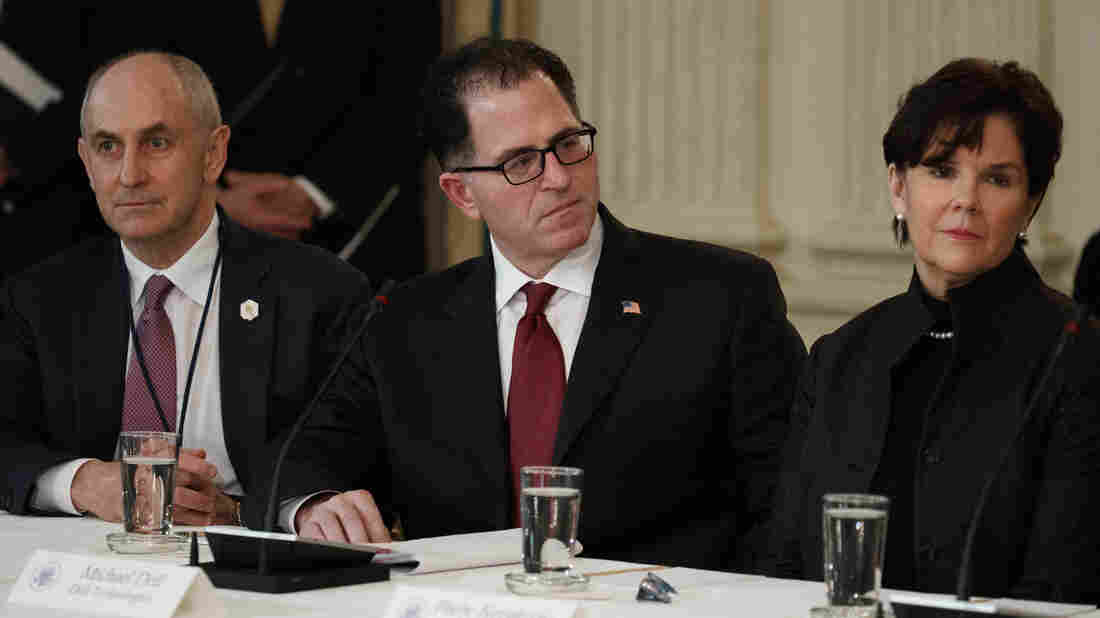
White House Director of Strategic Initiatives Christopher Liddell (from left) with Dell CEO Michael Dell and General Dynamics CEO Phebe Novakovic during a meeting with President Trump on Feb. 23.

Evan Vucci/AP

hide caption

toggle caption

Evan Vucci/AP

Federal records indicate that a key adviser to President Trump held substantial investments in 18 companies when he joined Trump in meetings with their CEOs.

The investments of Christopher Liddell, the president’s director of strategic initiatives, totaled between $3 million and $4 million. Among the companies in Liddell’s portfolio, and whose CEOs were in the meetings: Dell Technologies, Dow Chemical, Johnson & Johnson, JPMorgan Chase, Lockheed Martin and Wal-Mart.

When Trump conferred with the chiefs of Ford, General Motors and Fiat-Chrysler last month, Liddell attended the session. He was invested in all three companies at the time.

Details of Liddell’s investments are contained in documents he filed with the White House ethics officer in preparation for divesting his holdings. He was seeking certificates of divestiture, which allow federal appointees to defer paying capital-gains taxes by reinvesting in a blind trust or similar arrangement.

The watchdog group Citizens for Responsibility and Ethics in Washington filed a complaint Tuesday with White House Counsel Donald McGahn, raising concerns that Liddell may have violated the federal conflict of interest law, a criminal statute.

The complaint states: “If Mr. Liddell personally participated in meetings with companies in which he held significant amounts of stock, he may have violated these rules.”

The White House responded with this statement: “Mr. Liddell has been working with the Office of the White House Counsel to ensure he is fully compliant with his legal and ethical obligations in connection with his holdings and his duties in the White House.”

Liddell was born in New Zealand and is a U.S. citizen. In the past he has worked as chief financial officer of Ford Motors, International Paper and Microsoft.

It’s not clear whether Liddell now has sold off his investments, but he apparently had not done so before the meetings in question. The meetings were held on Jan. 23, Jan. 24 and Feb. 3. On Feb. 9, the Office of Government Ethics issued four certificates of divestiture for Liddell and his wife. They would be worthless if the assets had already been sold.

The complaint is one of several actions by CREW on White House ethics issues. The group says in a lawsuit that Trump is violating the Constitution’s ban on foreign emoluments (gifts); it has questioned the ethics of presidential counselor Kellyanne Conway after she urged TV viewers to buy Ivanka Trump’s fashion merchandise; and it challenged the lack of transparency of two White House advisory committees.

CREW Director Noah Bookbinder said of the White House, “It seems nobody is concerned about people making decisions based on their personal interests and not the interests of the American people.”

Let’s block ads! (Why?)


No Image

Planned Parenthood Would Lose $178 Million In Payments Under GOP Health Plan

Cecile Richards, the president of Planned Parenthood, says the health care provider takes in about $400 million per year in reimbursements under Medicaid and other federal programs.

Mark Wilson/Getty Images

hide caption

toggle caption

Mark Wilson/Getty Images

The proposed American Health Care Act targets the health provider Planned Parenthood with a set of proposed limits on Medicaid payments to the organization.

Monday, the nonpartisan Congressional Budget Office confirmed the magnitude of those limits. The Republican plan would block $178 million in Medicaid reimbursements to Planned Parenthood in 2017.

“The vast majority of our patients are on some kind of federal program,” Cecile Richards, president of Planned Parenthood, told NPR’s Ari Shapiro on Tuesday.

In all, she said, about 1.6 million patients receive health care from the organization each year through federal programs such as Medicaid, totaling upwards of $400 million in annual federal reimbursements.

“Planned Parenthood operates just like every other health care provider in this country that provides abortion services. We get reimbursed for preventive care,” she explained.

“I guess if you want to reduce unintended pregnancy and the need for abortion, the last thing you should do is try to deny women the access to family planning,” Richards said.

Tom Glessner, the president of the National Institute of Family and Life Advocates, which lobbies against abortion, is optimistic about the projected savings for the federal government.

“On the positive side, taxpayers benefit from this provision,” he told NPR.
“Taxpayers would spend $156 million less, over a decade, by defunding Planned Parenthood, even if women used more Medicaid dollars during their pregnancies.”

Glessner was referring to the increase in births the CBO projects if Medicaid patients are cut off from Planned Parenthood. The costs associated with about 45 percent of all births in the U.S. are paid for by the Medicaid program.

“In the one-year period in which federal funds for Planned Parenthood would be prohibited under the legislation, the number of births in the Medicaid program would increase by several thousand, increasing direct spending for Medicaid by $21 million in 2017,” the CBO report notes.

The Republican plan technically cuts off funding to Planned Parenthood for only one year. If the organization stops providing abortions, it will be eligible for Medicaid reimbursements again. But Richards said there is no chance that will happen.

“We provide full reproductive health care for people in this country,” she said. “And even though abortions may make up a small portion of what we do, women and families and young people come to Planned Parenthood because they count on us to be on their side, and to provide them with health care they need.”

Federal spending on abortions is already illegal, except in the case of pregnancies that are the result of rape or incest or that threaten the life of the mother, as NPR has reported.

Republican lawmakers and some clinicians have said that if Planned Parenthood closes clinics, other health providers would try to take on those patients. But community health clinics say they are already overburdened.

The Republican plan currently calls for tens of billions of dollars for states to spend as they see fit, including on preventive care for women.

“How will the states use that money? They have great flexibility,” Douglas Holtz-Eakin, former director of the Congressional Budget Office and current president of the conservative think tank American Action Forum, told Ari on Tuesday.

“They can give it to insurers as reinsurance for expensive patients; they can give it directly to individuals to cover out-of-pocket costs; they can create a variety of other programs like high-risk pools for expensive patients.”

But Richards argued that spending would need to address a supply problem in rural or poor communities.

“The public health community has been abundantly clear that they cannot absorb the 2.5 million patients that Planned Parenthood sees each year,” she said. “And particularly for women who have found a lump in their breast or need birth control immediately, and maybe a community health center can see them in a month or two months, that’s not good enough.”

Let’s block ads! (Why?)


No Image

Today in Movie Culture: Jeff Bridges Plays The Dude for John Goodman Honor, Women Cinematographer Showcase and More

Here are a bunch of little bites to satisfy your hunger for movie culture:

Movie Reunion of the Day:

Jeff Bridges donned his iconic sweater and, in character as the Dude from The Big Lebowski, gave a speech at John Goodman’s Hollywood Walk of Fame Ceremony (via Variety):

Movie Parody of the Day:

Speaking of 1990s movies, Saturday Night Live kind of parodied Independence Day with this alien invasion sketch starring Alec Baldwin as President Trump:

[embedded content]

Blooper Reel of the Day:

Ahead of this week’s release of Beauty and the Beast, check out some B-roll blooper footage from the singing sessions:

[embedded content]

Easter Eggs of the Day:

Oh My Disney tracks Easter eggs you probably missed connecting the last 26 years of Disney animated features:

[embedded content]

Vintage Movie Clip of the Day:

William H. Macy, who turns 67 today, with Frances McDormand in his breakout role in the 1996 Coen brothers classic Fargo:

[embedded content]

Cosplay of the Day:

For Women’s History Month, Girl Scouts dressed up as their favorite famous women, with these three adorably recreating the Hidden Figures poster (via BuzzFeed):

Cinematographers Showcase:

Speaking of important women, here’s a supercut from Art Regard showcasing films shot by women cinematographers (via Film School Rejects):

[embedded content]

Actress in the Spotlight:

With Charlize Theron the talk of SXSW thanks to Atomic Blonde, Jacob T. Swinney showcases the actress as a chameleon in this video for Fandor Keyframe:

[embedded content]

Bad Film Analysis of the Day:

Learn the true hidden meaning of Doctor Strange by way of an alien in the future:

[embedded content]

Classic Trailer of the Day:

Today is the 30th anniversary of the release of Raising Arizona. Watch the original trailer for the Coen brothers classic below.

[embedded content]

and

Let’s block ads! (Why?)