Articles by admin

No Image

'A Dream Come True' As New Orleans Plays In The First Four

New Orleans Privateer guard Nate Frye signs autographs after a Monday practice at the University of Dayton Arena. Frye, a senior, joined the team when it was going through a difficult period of deciding whether it had the resources to compete in Division I.

Tom Goldman/NPR

hide caption

toggle caption

Tom Goldman/NPR

The NCAA Division I men’s basketball tournament begins today with a game, if history holds, that will have absolutely no bearing on the ultimate tournament outcome in early April.

The University of New Orleans and Mount St. Mary’s kick things off at the First Four in Dayton, Ohio. Both teams are No. 16 seeds, the lowest, and they’re playing for a shot at the highest seed. The winner moves into the main draw to play Villanova – the tournament’s overall No. 1.

No 16 seed has ever beaten a 1 seed.

But New Orleans head coach Mark Slessinger refuses to see his Privateers as potential cannon fodder.

“It would be hard for me to believe that anybody [in the tournament] could appreciate this moment more [than his team],” Slessinger said Monday in Dayton.

Today is New Orleans’ first tournament appearance since 1996. But what really makes the Privateers appreciate this moment is the fact that within the last five to 10 years, there was a very real chance this Division I basketball team would be no more.

After the Storm

After Hurricane Katrina ravaged New Orleans in 2005, University of New Orleans enrollment was decimated. UNO traditionally has drawn students from the city, and many fled after the storm.

“[Enrollment] was around 16,000 before the storm and we’re a little over 8,000 now,” says Jude Young, a New Orleans native and for the past four years the broadcaster who calls Privateers games.

“Without [student] fees it was real difficult for the athletic department and they were making cuts everywhere,” Young says, adding, “The state of Louisiana also slashed budgets for higher education in recent years. That combination was really difficult.”

The athletic department reportedly was part of the problem as well, being indecisive at a critical time. In 2009, the school considered a dramatic money-saving step – dropping sports from Division I to Division III. Division III schools are prohibited from awarding athletic scholarships.

Instead UNO then considered going to Division II, until finally announcing, in 2012, that it would remain a D1 school.

It was during that period of time that current senior guard Nate Frye first signed up to go to UNO and play basketball.

“[My] first year, we couldn’t really compete for anything because we were transitioning from D2 to D1,” Frye says. “So like when I signed they were straight up and said we can’t compete. But they said we’ll get you here and they kept their promise.”

“Here” is the NCAA tournament.

“Dude, it’s a dream come true,” Frye said yesterday after a practice session at the University of Dayton Arena. “Things were looking pretty bleak but coach stuck with us and we stuck with coach. And we finally made it.”

Making the Most

And Frye is making the most of it. He and teammates signed autographs for kids after practice. Sometimes athletes will give a perfunctory scribble and not acknowledge the people waiting for their signature. But the Privateers were the sports cliché “happy to be here” come to life.

At one point, a man who’d brought several of the kids courtside told them it was time to pack up their stuff and leave.

“Hold on! Hold on,” Frye said. “One more from my phone if you don’t mind.” Frye had been taking selfies with several kids’ phones.

“All right you guys,” he said, posing with a half-dozen young fans, “this one’s for the Snap[chat]. One, two, three. All right, cool.”

Special…and Probably Quick

For many basketball fans, the First Four is the appetizer before Thursday’s entrée.

For the teams here, being a hoops spring roll isn’t such a bad deal.

Tuesday and Wednesday, teams without much chance of going far, are the show. They don’t have to compete with the craziness of all the other games in other regions. Hoops junkies may grumble about Dayton not being “the real tournament,” but they’ll tune in.

Of course, this moment in the limelight is destined to be short-lived. It could be over tonight for the Privateers, who’re led by four seniors, including Frye, and the Southland Conference player of the year, forward Erik Thomas. Or with a win over Mount St. Mary’s, the ride could continue until Thursday and a date with Villanova.

“No one needs a record book about that,” says Privateers broadcaster Jude Young. “16 are oh-fer against No. 1! But hey. Why not us?”

Let’s block ads! (Why?)


No Image

Congressional Budget Office Releases Report On GOP Health Care Bill

The non-partisan Congressional Budget Office released an analysis of the House GOP health care bill on Monday. Proponents of the bill downplayed the importance of what the CBO is likely to do.

AUDIE CORNISH, HOST:

Congressional forecasters are warning that 14 million more Americans will be without health insurance next year if Republicans succeed in their plan to repeal and replace Obamacare. The report put out by the Congressional Budget Office says the number of uninsured would grow by about 24 million over the next decade. NPR’s Scott Horsley joins me now in the studio. Hey there, Scott.

SCOTT HORSLEY, BYLINE: Hi, Audie.

CORNISH: So let’s start with this analysis from the CBO. They’re trying to predict what the GOP plan would cost the government and also how it would affect the insurance market, right? What are they saying?

HORSLEY: Well, as you say, the forecast from the CBO says the GOP plan would insure a lot fewer people than Obamacare does – 14 million fewer next year, 24 million fewer by 2026. Some of that would be voluntary. The GOP plan eliminates the tax penalty for not having insurance, so some people who were buying reluctantly just to avoid that penalty would stop doing so. House Speaker Paul Ryan says that’s OK.

(SOUNDBITE OF ARCHIVED RECORDING)

PAUL RYAN: They sort of overestimate the uninsured number, just like they overestimated who would be insured by Obamacare. But I do believe that if we’re not going to force people to buy something they don’t want to buy, they won’t buy it. And that’s kind of obvious.

HORSLEY: Now, CBO also cautioned, though, that some people would stop buying insurance because they won’t be able to afford it. Now, the government subsidies and the Republican plan are, on balance, less generous than in Obamacare, especially for the poor and older people. And finally, forecasters say we’re likely to see a drop in the Medicaid rolls as the federal government starts to limit its funding for that program and states cut back on eligibility.

CORNISH: Now, what about the cost of insurance itself? I mean, what could happen to premiums?

HORSLEY: Initially, CBO predicts that we will see an increase in insurance premiums on the individual market. Premiums will be 15 to 20 percent higher than under Obamacare. After about 2020, though, forecasters are predicting somewhat lower premiums as more stripped-down policies are introduced. That’s one of the few things in this report that White House budget director Mick Mulvaney likes. He says greater competition would be good for insurance prices.

(SOUNDBITE OF ARCHIVED RECORDING)

MICK MULVANEY: Every place else where the market is allowed to function, quality goes up and costs go down. And I think if you look for something the CBO may have gotten right in this report, it’s that the premiums are actually going to come down in cost.

HORSLEY: Now, the CBO also says the mix of people buying coverage would likely shift, with more healthy, young people who can afford that bare-bones coverage, but fewer people in their 50s and 60s who might need or want more comprehensive policies.

CORNISH: Now, even before the forecast came out this afternoon, you had the White House and some of their allies on Capitol Hill essentially discrediting the numbers. I thought this was a nonpartisan office. What’s going on here?

HORSLEY: Nobody wants to look like they’re knowingly taking health insurance away from millions of people, so the White House is trying to inject as much uncertainty as it can in these CBO numbers. White House spokesman Sean Spicer says lawmakers should take this forecast, which is known as a score, with a big grain of salt.

(SOUNDBITE OF ARCHIVED RECORDING)

SEAN SPICER: Obviously, they’re going to look at the score. I get it. But in the same way that members relied on the score last time, they were way off.

HORSLEY: The CBO did overestimate the number of people who’d gain coverage through the Obamacare exchanges. They also underestimated the number that would gain coverage through the Affordable Care Act’s Medicaid expansion. So this is tricky business, Audie, and the CBO concedes there is considerable uncertainty around these predictions.

CORNISH: In the meantime, there’s still a lot of criticism of the Affordable Care Act, right? What’s going on there?

HORSLEY: Yeah, Republicans are highlighting the rising premiums in the individual market, the drop in insurance company competition. President Trump tweeted this morning, Obamacare is imploding. He and other Republicans are trying to create a yardstick that will make the GOP plan look better by comparison. However, the Congressional Budget Office forecasts that in most parts of the country the individual insurance market will remain stable whether or not Obamacare is repealed.

CORNISH: That’s NPR’s Scott Horsley. Scott, thanks so much.

HORSLEY: Good to be with you, Audie.

Copyright © 2017 NPR. All rights reserved. Visit our website terms of use and permissions pages at www.npr.org for further information.

NPR transcripts are created on a rush deadline by Verb8tm, Inc., an NPR contractor, and produced using a proprietary transcription process developed with NPR. This text may not be in its final form and may be updated or revised in the future. Accuracy and availability may vary. The authoritative record of NPR’s programming is the audio record.

Let’s block ads! (Why?)


No Image

For Refugees In Germany, Hope And Frustration Mark Path Toward Integration

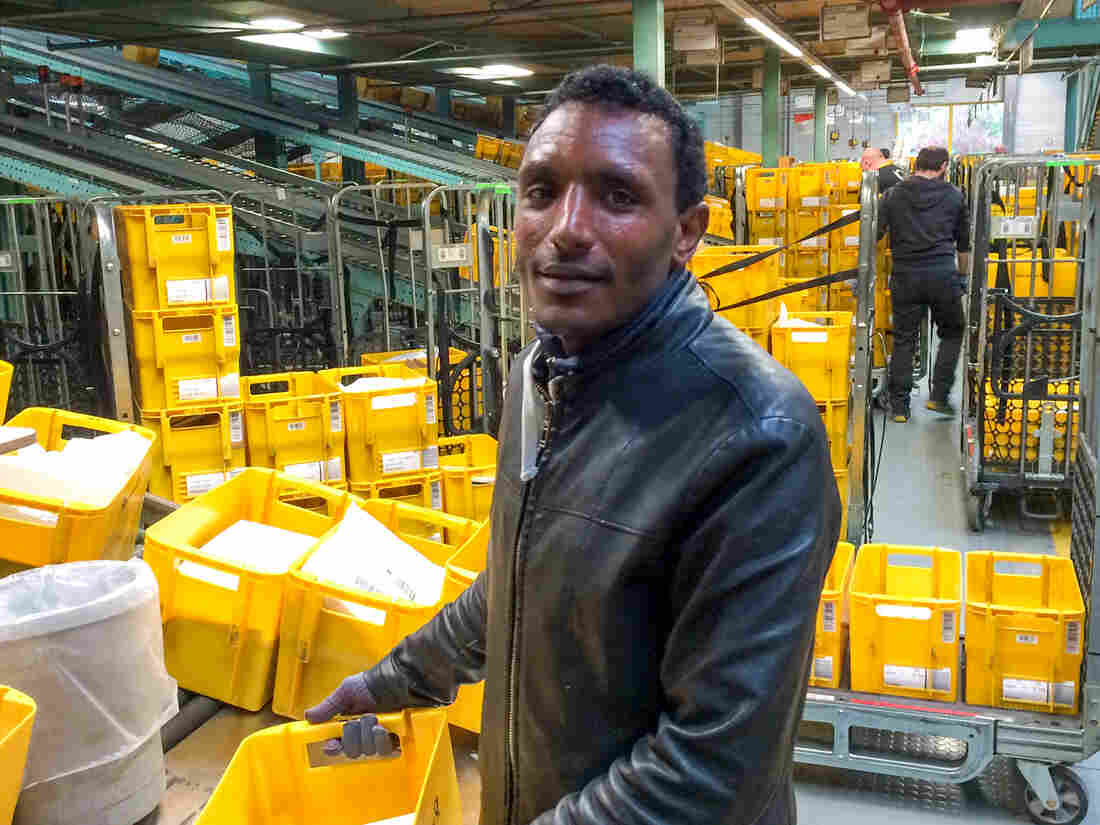
Solomon Yhdego gained asylum in Germany after escaping Eritrea when he was forced to join the army.

John Ydstie/NPR

hide caption

toggle caption

John Ydstie/NPR

Disagreements over immigration policy could flare when German Chancellor Angela Merkel visits the White House later this week. In just the past two years, more than 1 million refugees — many of them Syrians — have inundated Germany as Merkel opened Germany’s borders.

President Trump called that policy “catastrophic.” In fact, integrating refugees into German society has become a challenge for Merkel as she seeks re-election.

When the wave of refugees first surged into Germany there was lots of talk that they might be the answer to the country’s declining population and big worker shortage. But the mood soured after the assaults by male refugees on women during New Year’s Eve celebrations just over a year ago. It darkened further following the attack on a Berlin Christmas market by a Tunisian refugee three months ago.

Waiting for an interview

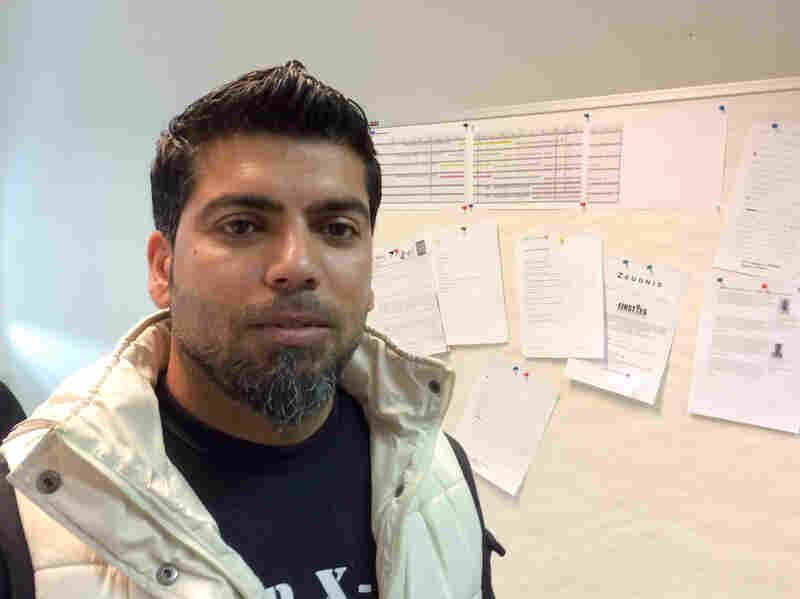
Those incidents raised even more hurdles for 27-year-old Akhlaq Hussain. A math teacher in his former life, he fled to Germany from Pakistan after he and his school received threats of kidnapping and death from the Taliban.

Akhlaq Hussain fled to Germany from Pakistan after he and his school received threats of kidnapping and death from the Taliban.

John Ydstie/NPR

hide caption

toggle caption

John Ydstie/NPR

“They demand some money. If we pay monies then childrens will be free,” Hussain says. “If we don’t pay monies, they kill the peoples and childrens and cut the head, you know, they say ‘Allahu Akbar.’

But a year and a half after a harrowing journey, much of it on foot, crossing mountainous borders and being beaten by police in Bulgaria, Hussain is stuck in refugee housing in Neuss, a German town across the Rhine River from Duesseldorf. Hussain says he has been treated well at the local refugee center, even though the self-service kitchen needs renovation and the bathrooms need work. He has spent more than a year and a half here waiting just to get an asylum interview. In the meantime, there’s not much to do except chores like vacuuming the carpets in the room he shares with another refugee.

Refugee from the wrong country

Hussain’s big problem is that he is Pakistani. Germany doesn’t recognize Pakistan as a country dangerous enough for its citizens to automatically receive asylum. As a result, few social services are available to him. Some local volunteers, like Ilona Valero, have been providing some aid. “I try to help with all the papers. In Germany there are a lot of papers,” she says with a resigned laugh. “They are waiting such a long time. There is no structure in the day. They’re waiting for German lessons. They’re waiting for permission to stay and permission to work.”

Recently the volunteers have managed to get temporary jobs for a few refugees, including work at a garden center for Hussain. It will help him pass the time while he awaits an asylum decision. But his odds are not good — during the past two years fewer than 10 percent of Pakistanis seeking asylum in Germany were successful.

Language versus alienation

Thirty miles up the Rhine River, in Cologne, refugees, most of them Syrians, sit in a classroom with the hum of traffic and fresh air flowing through an open window. They’re absorbing information about German laws and customs at an integration center in a new high-rise office building.

Karim Khayal, a counselor here, says the key to success for refugees is learning German.

“There is no integration without language.” He says that’s something the refugees have internalized. Khayal says they know that language is the No. 1 requirement and they understand that “speaking efficient German means having arrived in Germany.”

And there’s a lot at stake, Khayal says. He points to Germany’s experience with Turkish guest workers starting in the 1960s. The government failed to integrate them into German society, and there continues to be alienation in that community — which now numbers 3 million.

Khayal says the danger is very real that “if we don’t take care now, we’re going to have a larger group of alienated young men — men who are angry, who are bitter, who are both distant to their country of origin and distant to their new home country and who are going to, of course, have radical ideas.”

Integrating successfully

Thirty-three-year-old Ibrahim Habib, a refugee from Syria, appears to be well on his way to successful integration. He was at the center meeting with Khayal. In Damascus, Habib designed and cut clothing. He says that job is out of reach in Germany, so he wants be a bicycle mechanic.

Ibrahim Habib is a refugee from Syria, where he designed and cut clothing. Now, he hopes to be a bicycle mechanic.

John Ydstie/NPR

hide caption

toggle caption

John Ydstie/NPR

Like nearly all Syrian refugees, Habib has been granted asylum. That makes him eligible for government support while he learns German and gets job training. Habib says Germany is home now and he wants to be a German in the future. “The past life is gone,” he says, “and seeing the respect you got from the German society only means that you have to give this respect back, and want to be part of this society — not go back to your Syrian past.”

But with language and integration courses, plus an apprenticeship, it could still be years before Habib is fully employed. Christoph Moeller, until recently chief spokesman for the German Employment Agency, estimates it could take six years for Germany to fully integrate this wave of refugees into the workforce. “It’s a long journey and it’s going to be an expensive journey,” says Moeller, “but in the end for society these cost are actually justified, because the costs in not doing anything will be much higher.”

In the past year around 40,000 refugees found jobs in Germany. Meanwhile, close to half a million are seeking employment, but they need language and vocational training first.

One modest success story

Solomon Yhdego is one refugee who has found a job. He works 20 hours a week in a vast Deutsche Post/DHL sorting facility in Duisburg. He makes about $12 an hour moving big yellow boxes of mail onto metal racks for delivery.

Yhdego, who’s 31, easily gained asylum in Germany after escaping from Eritrea, which has one of the most repressive governments in the world. He was about to enter the university there when he was forced to join the army. He fled, leaving behind his wife. Yhdego says it has been very difficult, but going home is not an option. “When I go, they kill me,” he says. “It is very hard.”

Yhdego learned enough German to get an internship. He impressed Georg Schikowski, the plant manager, who gave him a six-month contract. “The goal is to [keep] him for a long, long time,” says Schikowski, “because he has shown us that he works good, and that’s the test.”

Some Germans are skeptical about the usefulness of low-skill refugee workers. But Christof Ehrhart, a Deutsche Post/DHL vice president, says they’re valuable, especially at companies like his that have lots of blue-collar jobs. And, he says, the refugees have demonstrated that they are motivated and engaged, “because what they had to do in order to leave their country and come to a different place needed a lot of ‘entrepreneurship’ and willingness to run risks.”

Deutsche Post/DHL is a leading corporate employer of refugees, but so far it has fewer than 300 on the payroll. For integration to be successful, big German firms will have to do better, and Ehrhart says Germany can’t afford to fail. “I think the world is watching us,” he says. “I have to put it another way: I think there is no alternative than finding a solution. Because if we don’t find a solution as one of the richest countries on the planet, who else should?”

Frustration and despair

Back at the refugee barracks in Neuss, another Pakistani, Kamal Hussain, is waiting for his asylum decision. He fled Pakistan more than two years ago after the Taliban threatened to kill him for administering polio vaccine. He left behind a pregnant wife. She gave birth, but the son Hussain never saw died within months. Hussain is frustrated. He has little to occupy his time. He knows that’s dangerous.

“If you’re alone here and you have no activities right now, you will be negative,” he says. “You will be fighting with someone, or maybe you do something bad.”

Germans are worried about that, too — frustrated young men who might turn to crime or even terrorism. It has fueled a rise in support for the nationalist Alternative for Germany party, which is threatening Merkel’s bid for re-election. There’s no doubt that integrating refugees into German society is a high-stakes project.

Let’s block ads! (Why?)


No Image

Tiny Desk Special Edition: Red Baraat's Holi Celebration

Red Baraat‘s fusion of bhangra, go-go, hip-hop and jazz is driven by frontman Sunny Jain’s percolating playing of the dhol, a double-sided drum which forms the rhythmic lattice of support for their boisterous horns and guitar. And though Red Baraat graced the Tiny Desk five years ago, we had to have Jain’s band back to celebrate Holi, the Hindu festival of color, of good over evil, and the coming of spring. Usually you’d see the dusting of brightly colored perfumed powders strewn in the air, covering bodies and clothing. The notion of doing that in the office was a fun thought, but the band (with my nudging) opted instead for confetti cannons and passing candied treats. It made for quicker cleanup, but their uplifting spirits lingered on, giving us a chance to shake off the final days of winter and demonstrating why music is so essential to the soul.

Bhangra Pirates is available for pre-order now. (iTunes) (Amazon)

Set List

  • “Sialkot”
  • “Zindabad”
  • “Bhangale”
  • “Se Hace Camino”

Musicians

Sunny Jain (dhol, vocals); Rohin Khemani (percussion); Chris Eddleton (drums); Sonny Singh (trumpet, vocals); Jonathan Goldberger (guitar); Jonathon Haffner (soprano sax); Raymond James Mason (trombone); Steven Duffy (sousaphone)


Credits

Producers: Bob Boilen, Niki Walker; Audio Engineer: Josh Rogosin; Videographers: Niki Walker, Colin Marshall, Nick Michael, Morgan Noelle Smith; Production Assistants: A Noah Harrison, Bronson Arcuri, Ameeta Ganatra; Photo: Marian Carrasquero/NPR.

For more Tiny Desk concerts, subscribe to our podcast.

Let’s block ads! (Why?)


No Image

Selection Sunday: 2017 Men's College Basketball Tournament Bracket Set

This image shows the 2017 NCAA Division I men’s college basketball tournament bracket. Villanova took the overall top seed on Selection Sunday, with Kansas, North Carolina and Gonzaga joining the defending national champions on the No. 1 line for the NCAA Tournament.

AP

hide caption

toggle caption

AP

College basketball fans — the choice is yours. Fill out your bracket now if you haven’t already. Or angst until Thursday, when the first round of the men’s NCAA tournament starts. On Sunday, the selection committee set the field for the annual descent into March Madness.

While the tournament officially starts Tuesday with the First Four in Dayton, Ohio, the first round — and where ballots start counting — is Thursday.

The four No. 1 seeds are defending champion Villanova, North Carolina, Kansas and Gonzaga.

It appears there’s a minimum of the controversy and grumbling that traditionally follows Selection Sunday. Most of the unhappiness is coming from the state of North Carolina, where the heated rivalry between Duke and North Carolina is playing out in the bracket.

Duke was given a two seed — many Blue Devil fans and basketball pundits think Duke got a bit jobbed by the committee — after all, Duke beat North Carolina two out of three times this season, including in last week’s ACC championship tournament. Duke won four games in four straight days to claim the tournament title, beating ranked teams Louisville and Notre Dame, as well as the Tar Heels.

But the squabbles should fade as Thursday approaches — this first week often captures most of the drama with early round upsets providing the madness in March Madness. And whether or not there’s more madness this time, there’s a good chance there’ll be a bevy of good, close games.

Selection Committee chairman Mark Hollis said after the bracket was revealed, “By far, I can say with 100 percent certainty that this is the most competitive bracket I’ve seen [in his five years on the committee].”

Today is Selection Monday for the women’s tournament. The 64-team bracket will feature 63 teams chasing overall No. 1 seed Connecticut, whose win streak stands at a gaudy 107 games.

Let’s block ads! (Why?)


No Image

Oregon Lumber Community Looks To Trump And Innovation To Survive

Lever Architecture’s Framework exterior rendering, a 148-foot structure that, when completed, will be the tallest timber building in North America.

Courtesy of LEVER Architecture

hide caption

toggle caption

Courtesy of LEVER Architecture

Traditionally, states that rely on the timber industry, like Oregon, haven’t had much to cheer in the last 30 years. Modernization of mills, economic changes and huge declines in logging led to a long downturn in the industry. During last year’s presidential campaign, candidate Donald Trump promised to bring back timber in Oregon.

Some in the industry are hopeful, but others aren’t waiting. They’re moving ahead with innovations they hope are the key to survival.

Tall Timber

There’s a street corner in downtown Portland, Ore. where architect Thomas Robinson can stand today, and envision a dramatically different scene next year.

“What you’ll be seeing is a revolutionary 12 story, mass timber structure,” he says, “Really — a high rise timber building.”

Robinson’s firm Lever Architecture has designed a 148-foot structure that, when completed, will be the tallest timber building in North America.

Now you may be thinking — that’s a 148-foot match waiting to light.

But Robinson and his designers have studied how wood burns for four years. That knowledge helped them design a mass timber structure that meets the same fire standards as concrete and steel buildings. It’s designed to outperform its rivals in withstanding an earthquake. And then there’s the bonus of collaboration in a state, which like many others, is geographically and politically divided.

“It’s been a great way to connect urban Portland to rural Oregon,” says Robinson.

Crossing And Gluing And Building

The D.R. Johnson Lumber Company is about 200 miles south of Portland in the small town of Riddle, Ore. This is where they’ll make the key material for the Portland highrise, Cross Laminated Timber. CLT.

CLT is a pretty simple concept. You lay down a layer of boards length-wise, then a layer on top width-wise, then another layer the first direction. Up to 7 layers, all glued together, in one large panel. The criss-crossing creates a counter-tension that D.R. Johnson Chief Operating Officer John Redfield says makes the CLT panel both strong and flexible.

The panels are then used for easy-to-assemble construction.

Panels of cross laminated timber at DR Johnson. CLT is a pretty simple concept. You lay down a layer of boards length-wise, then a layer on top width-wise, then another layer the first direction.

Tom Goldman/NPR

hide caption

toggle caption

Tom Goldman/NPR

“The advantage of CLT is, we’re actually going to build your building right here in Riddle,” Redfield says. “[The material] is pre-designed, pre-engineered. They’ve got holes in them for mechanical and electrical and plumbing. They’ve got window holes. We load this on a truck in inverse order of how it’s going to be laid out on the job site, and we erect the building from the truck [in the right order].”

CLT has been made outside the U.S. for years and used around the world — including for refugee housing in Europe. When D.R. Johnson started making panels for sale three years ago, it was the first to do so in the country.

“We did, I think, all of us feel kind of a surge of excitement about the potential upside to it,” says company co-owner Valerie Johnson.

Innovating … Carefully

In 2013, Johnson went to a wood innovations meeting in Oregon. She says in such a tenuous industry as timber, it’s important to keep looking for ways to grow. At the meeting, she watched a presentation on CLT. The talk was compelling. The product was similar to some of the others her company made. So, Johnson decided to give it a go. Carefully.

D.R. Johnson started in 1951 and like many lumber companies in the state, it was hit by the timber downturn in the 1980s and 90s. The company shut three of its sawmills. Its workforce shrank by more than 350 people. Statewide, from 1980 to 2010, 300 mills closed, putting 30,000 people out of work.

So now, D.R. Johnson is going step by step. First they made a small CLT panel for testing; then they made panels to sell. Johnson says within the next six to 12 months, CLT production at her company should create 20 new jobs.

“I think the CLT market stands a really strong chance of being very successful here,” she says. “I hope I keep very healthy for a long time because I want to see these beautiful tall buildings built with wood.”

Workers at D.R. Johnson feed a layer of boards as part of the process of making CLT. They first made a small CLT panel for testing; then they made panels to sell. Johnson says within the next six to 12 months, CLT production at her company should create 20 new jobs.

Tom Goldman/NPR

hide caption

toggle caption

Tom Goldman/NPR

Others Innovating

Another company in Oregon is making big plywood panels for buildings.

And there’s more innovation to come.

CLT Stair at Albina Yard office building in Portland, Ore. The market for wood products is changing.

Jeremy Bittermann/Courtesy of LEVER Architecture

hide caption

toggle caption

Jeremy Bittermann/Courtesy of LEVER Architecture

“I’m comfortable that there are other manufacturers in Oregon that are looking closely at this,” says Geoff Huntington. He’s the Director of Strategic Initiatives for the College of Forestry at Oregon State University.

“I’m sure that you’ll see others following soon,” he says.

The market for wood products is changing.

“It’s a new frontier,” says Huntington. “We’ve got a building industry, both architects and developers, that are looking at wood in a new way and in different ways than they have before.”

Architects like Thomas Robinson, who’s working on the Portland high rise, like the look of wood. The rural-urban connection Robinson talks about also is part of the new allure. Huntington says it’s the same idea as the farm-to-table concept of embracing locally produced ingredients for food. In the case of wood, call it forest to framing.

For all that’s positive, Huntington acknowledges the growing markets for these new products aren’t going to cure all that ails Oregon’s timber industry. Trade issues and decades-long battles over harvesting trees still exist.

Another 80 miles south of D.R. Johnson, the battle toll is evident. Where not even innovation could help.

We’ve Done Everything We Could

On a recent day in Cave Junction, Ore., Jennifer Phillippi stepped around debris on the grounds of Rough & Ready Lumber Company. She co-owns the company with her husband Link — it’s been in her family since 1922. But it shut down last year and now it’s being torn down.

“Since they started dismantling it, I just haven’t come out here,” Phillippi says as she gazes at the rubble of what used to be a sawmill. “It makes me sad.”

Rough & Ready was heavily reliant on timber from federally owned lands. Those lands became practically untouchable to logging in the early 1990s after court decisions to protect the Northern Spotted Owl.

Link and Jennifer Phillippi, co-owners of Rough and Ready Lumber in Cave Junction, Ore. survey the remnants of their saw mill. The mill shut down for good in February 2016. What’s not been claimed in auction is being torn down.

Tom Goldman/NPR

hide caption

toggle caption

Tom Goldman/NPR

Jennifer Phillippi says her company tried to innovate its way through the downturn.

“Y’know we’re nimble, we’re small and we’ve done everything we could to sort of adjust,” she says.

They built a co-generation power plant. They upgraded equipment and made sawmill improvements. Ultimately, none of it mattered because they didn’t have enough logs to cut.

Eighty-five workers lost their jobs when Rough & Ready closed for good in 2016. The layoffs were another punch to an already dwindling local economy in a town of not quite 1,900 people. More services were cut. There’s one sheriff’s patrol, only during the day. Asked whether that makes him worry about his personal safety, former Rough & Ready employee Lonnie Adams, 60, says no.

Former Rough & Ready employee Lonnie Adams, 60, worked at Rough and Ready for more than 35 years.

Tom Goldman/NPR

hide caption

toggle caption

Tom Goldman/NPR

“I pack a gun everywhere I go,” Adams says. “I never used to.”

Cave Junction could be any small rural community marred by unemployment and the threat of crime. But longtime residents note, with pride, the citizen-organized group that tries to fill the law enforcement void with nightly car patrols; locals have fought to keep open the library. It’s communities like this where you’ll find hope in the new administration. Lonnie Adams remembers Donald Trump’s campaign promise to help Oregon’s timber industry. Adams thinks it could’ve saved Rough & Ready, where he worked for 35 years.

“I wish they would’ve held off [shutting down the company] a little longer until Trump got in office,” he says. “He probably will bring timber back because he’s a pretty smart man in my eyes. I wanted him for President. But, it’s too late for here.”

Balance Possible But Not Easy

Back up in Riddle, D.R. Johnson forges ahead with its innovative CLT production. Unlike Rough & Ready, D.R. Johnson hasn’t been so reliant on federal forests. But it still feels the pinch.

“We scrape for the logs for this old mill here, every month,” Johnson says. “Our guys have to hustle to find them.”

D.R. Johnson’s Steve Allen uses a block of wood to make sure boards are aligned properly before the CLT panel enters the pressing machine at far left.

Tom Goldman/NPR

hide caption

toggle caption

Tom Goldman/NPR

Johnson and others in the industry talk about increasing timber harvests without over harvesting. Some environmental groups remain wary and continue to block timber sales, mostly on federal lands, with lawsuits. While the battle continues, at least one prominent forest ecologist says it doesn’t have to.

“Could you increase the timber harvest from the federal lands in a way that would be ecologically as well as socially responsible?” asks Jerry Franklin of the University of Washington. “The generic answer to that is absolutely — yes.”

But the specifics, he says, get very complex. And politicized. At least one bill that attempted to hit the sweet spot between harvesting and conservation, remains stalled in Congress.

Meanwhile, the quest for timber innovation continues. Groundbreaking on the nation’s tallest timber high rise building, is expected this summer in Portland.

Let’s block ads! (Why?)


No Image

Pence Makes Case For Republican Health Plan In Kentucky

Vice President Pence visited Kentucky to rally support to repeal and replace the Affordable Care Act. It’s a hard sell for some Republicans who favor a full repeal, like Kentucky Sen. Rand Paul.

LOURDES GARCIA-NAVARRO, HOST:

Vice President Mike Pence stopped in Louisville Saturday to rally support for the Republican plan to repeal and replace the Affordable Care Act. As Ryland Barton from Kentucky Public Radio reports, replacing Obamacare is a hard sell for some Republicans.

RYLAND BARTON, BYLINE: The White House dispatched Vice President Mike Pence to pitch the repeal-and-replace effort to conservatives. On Saturday, Pence admitted, it’s a challenge.

(SOUNDBITE OF ARCHIVED RECORDING)

VICE PRESIDENT MIKE PENCE: Folks, let me be clear. This is going to be a battle in Washington, D.C. And for us to seize this opportunity to repeal and replace Obamacare once and for all, we need every Republican in Congress. And we’re counting on Kentucky.

BARTON: Kentucky’s U.S. Senator Rand Paul has been one of the loudest opponents of the repeal-and-replace bill, favoring an outright repeal instead. He says the current version of the bill would be dead on arrival in the Senate.

(SOUNDBITE OF ARCHIVED RECORDING)

RAND PAUL: We are divided. We have to admit we are divided on replacement. We are united on repeal, but we are divided on replacement.

BARTON: About 500,000 Kentuckians got health care through the Affordable Care Act, mostly through the expansion of Medicaid. That helped bring the state’s uninsured rate from more than 20 percent down to 7 percent. After the Pence event, Republican Congressman Brett Guthrie of Kentucky argued it wouldn’t be possible to pass a bill scrapping Obamacare without a replacement.

(SOUNDBITE OF ARCHIVED RECORDING)

BRETT GUTHRIE: So I think if you just do a full repeal and you don’t have a replacement in place, it would send us right back to where we were. And I don’t think that’s the right policy.

BARTON: Meanwhile, Erica Williams, a physician who attended the Pence event, said she just wants Obamacare repealed but a replacement should be tried first.

(SOUNDBITE OF ARCHIVED RECORDING)

ERICA WILLIAMS: The main thing is that we want a hundred percent repeal. So we want all of the power to go to patients and their doctor.

BARTON: For NPR News, I’m Ryland Barton in Louisville, Ky.

Copyright © 2017 NPR. All rights reserved. Visit our website terms of use and permissions pages at www.npr.org for further information.

NPR transcripts are created on a rush deadline by Verb8tm, Inc., an NPR contractor, and produced using a proprietary transcription process developed with NPR. This text may not be in its final form and may be updated or revised in the future. Accuracy and availability may vary. The authoritative record of NPR’s programming is the audio record.

Let’s block ads! (Why?)


No Image

March Madness 101: A Few Tips For Your Bracket

March Madness is about to take over. Before the NCAA brackets are revealed on Sunday, here are some tips (you’ll also need luck) for filling them out.

LAKSHMI SINGH, HOST:

It’s March. So that means a few things, like turning your clocks forward an hour tonight or breaking out that barbecue for the first time in months. But for a lot of people, it means one thing above all else – Madness as in March Madness. Tomorrow, the full fields will be announced for the men’s NCAA basketball tournament. The women’s draw will be revealed on Monday.

The winners will be the college basketball national champions. There will be plenty of winners and even more losers in office pools across the country. So we thought it would be a good time to call our very own Tom Goldman NPR sports correspondent. Thanks for being here.

TOM GOLDMAN, BYLINE: Calling a loser – is that what you’re saying? You’re calling me a loser.

SINGH: A loser.

GOLDMAN: All right. Happy to be here, Lakshmi.

SINGH: Well, tell me – when you think March Madness, what immediately comes to mind?

GOLDMAN: I think of disappointment when I think of the pools. But I think of excitement, and I think of the first week mainly. The first week always seems to be the best. That’s where the madness really is in March Madness. It’s where you have all these teams playing, and it’s where your really fun upsets will happen usually.

SINGH: OK. So for folks, like myself, who haven’t really gotten into it as much as in, you know, recent years, you have any big strategies in mind for those who start filling out their brackets tomorrow?

GOLDMAN: (Laughter) Well, let me preface this by saying I have one – maybe one pool in the last decade, so buyer beware. OK here are a few tips.

SINGH: All right.

GOLDMAN: If you have face paint and a foam number-one finger and all kinds of colorful T-shirts and sweatshirts from your alma mater…

SINGH: Yeah.

GOLDMAN: …Put them away.

SINGH: What?

GOLDMAN: You can wear them during the games, but not when you’re making your picks. It’s not about emotion. It’s about business. Only pick your school to win if you went to Kentucky, Kansas, North Carolina, Duke, you know, UCLA, teams this year that have a real chance. OK. Another one.

SINGH: Wow. OK.

GOLDMAN: If you want to pick upsets, 12 seeds for some reason do well against fives. So go ahead and pick them. And if you want to pick a whopper upset like a 15 seed over a two or a 14 over a three, don’t take your Cinderella team far. They’ll often flame out quickly after the thrilling win.

And one thing, Lakshmi, do not pick a 16 seed to beat a number one seed. That is the only guarantee because it’s never, ever, ever happened. It might someday, but don’t use the someday principle to knock out a first seed that might very well go all the way.

And, lastly, arm yourself with a quarter because you will need to flip a coin on several picks. It’s just that close or you don’t know the teams, and that’s perhaps the biggest rule, except that there’s luck involved both in the games and in picking winners.

SINGH: Although I’ve seen those coins with two heads or two tails, so I’m thinking get the coin that has a head and a tail.

GOLDMAN: There you go.

SINGH: OK. Who are the teams and players to watch on the men’s side?

GOLDMAN: Well, you know, I mentioned a couple of teams before, but I’ll add Louisville, I’ll add defending champion Villanova. We haven’t had a team win consecutive titles since 2007 when Florida won its second straight – also Gonzaga which spent a good deal of the regular season as the number-one ranked team. The West in general has some very strong teams, along with Gonzaga, UCLA which I mentioned, Oregon and Arizona.

SINGH: And how about the women?

GOLDMAN: Well, the women – of course, it’s all about UConn. They have now won 107 straight games, many by whopping margins. Although this season, they had some squeakers. They won by two, by three, by six in three different games, and I asked espn.com’s great women’s basketball writer Mechelle Voepel, the question we always ask in March with UConn, can they be beaten? She says, while it’s still a tall order, there’s probably a better chance this year than last.

Last season, they were ridiculously dominant, rather than their usual unbelievably dominant. They have some younger players leading them this year, and those younger players without a lot of experience in past tournaments. That might make them a little vulnerable, but it should be UConn. We have South Carolina, Baylor, Notre Dame, Maryland as teams that might be the ones to beat them.

SINGH: Well, I hope you go mad this March Madness. Tom, thank you so much for joining us. That’s Tom Goldman, NPR sports correspondent. Thanks again.

GOLDMAN: You’re welcome.

Copyright © 2017 NPR. All rights reserved. Visit our website terms of use and permissions pages at www.npr.org for further information.

NPR transcripts are created on a rush deadline by Verb8tm, Inc., an NPR contractor, and produced using a proprietary transcription process developed with NPR. This text may not be in its final form and may be updated or revised in the future. Accuracy and availability may vary. The authoritative record of NPR’s programming is the audio record.

Let’s block ads! (Why?)


No Image

Illinois Congressman On Why He Supports The Republican Health Care Plan

Congressman Rodney Davis of Illinois supports the Republican Health Care Plan that’s making its way through the House. But he says that there will likely be hurdles before the bill becomes a law.

LAKSHMI SINGH, HOST:

We want to turn now to Congressman Rodney Davis. He is a Republican speaking to us from Decatur, Ill., and he is in favor of the bill being advanced by House Republicans. Congressman Davis, thanks so much for joining us.

RODNEY DAVIS: Thanks for having me on.

SINGH: So please tell us briefly why you are in favor of this bill.

DAVIS: Because the status quo is collapsing. The health insurance marketplace as we know it is not sustainable under the current law. And if we do nothing and watch states like Illinois have to come up with hundreds of millions of dollars under the current law just to keep the Medicaid expansion in place that we have, then I’m abdicating my responsibility as a policymaker. The bill that I’m supporting I’m sure will be changed by the time it goes to the Senate and comes back to us. But I’m looking forward to the debate to make our health care system better than it is today.

SINGH: We just heard from the president of the American Medical Association, who says that this bill will put health insurance out of reach for millions of Americans, especially older, lower-income patients. What do you make of that?

DAVIS: Well, I disagree with the statements. And I’ve talked to many doctors over my time in Washington over the last four years who were very frustrated with the current status quo, with the Affordable Care Act as implemented. Doctors that I talked to are seeing less patients because of the compliance issues that they have to follow under Obamacare. We want to make the system better, and I look forward to having their input. But I would argue looking in Illinois, where we’ve had 45 to 55 – and friends of mine have had 87 percent increases in their premiums – Obamacare’s already costly. And frankly, the promise for families of saving $2,500 on average did not come true.

SINGH: Well, as you’re well aware, there has been pushback from the right as well, a lot of Republicans, especially in the Senate, who say that this bill does not go far enough in repealing the current health care law, the Affordable Care Act, also widely known as Obamacare. Rand Paul has called the Republican plan Obamacare lite. What do you make of his resistance to this current bill?

DAVIS: Well, I know Rand. Rand’s a friend of mine. I think this is a publicity stunt, though, that is not based on facts. His own plan has refundable tax credits just like our plan does. You know, I want to make sure that we don’t just pull the rug out from those who are dependent on coverage, those who may need the assistance through our Medicaid programs.

I think our program as designed is a great off-ramp to be able to get to a system that’s going to be affordable for every single American, that’s going to stop the collapsing status quo we know as Obamacare, and also actually be able to provide opportunities for families to get off of Medicaid and then be able to afford the coverage that they need or be offered more affordable coverage through their employers or future employers.

SINGH: Well, Congressman Davis, we know, though, that this is probably not going to be smooth sailing for this bill to be approved. There is enough resistance that there are going to be obstacles to getting to where you want to get. What is it going to take, you think, to get enough Republicans to bend behind this bill finally?

DAVIS: Well, we’ll see when we go back next week. I’m part of the deputy whip team, so we’ll be asking members what their concerns are. But I would – I would let you know that no major piece of legislation that I’ve seen go across the House floor in my four years has ever been easy. And this one will be no different. But we also have to remember as Republicans we are now the majority and we have the White House. We have to move from an opposition party to a proposition party. Now’s our time to put our ideas forward. And this is going to be a test for the Republicans, no doubt.

SINGH: Congressman Rodney Davis, representing Illinois’ 13th District, speaking to us from Decatur. Thank you so much for joining us.

DAVIS: Thanks for having me on.

Copyright © 2017 NPR. All rights reserved. Visit our website terms of use and permissions pages at www.npr.org for further information.

NPR transcripts are created on a rush deadline by Verb8tm, Inc., an NPR contractor, and produced using a proprietary transcription process developed with NPR. This text may not be in its final form and may be updated or revised in the future. Accuracy and availability may vary. The authoritative record of NPR’s programming is the audio record.

Let’s block ads! (Why?)


No Image

Best of the Week: SXSW Was Previewed, New 'Star Wars: The Last Jedi' Details Were Revealed and More

The Important News

Star Wars: Michael K. Williams , Deadpool 2, Atomic Blonde, Rough Night, Kong: Skull Island, Buster’s Mal Heart, Geostorm and The Lost City of Z.

TV Spots: Ghost in the Shell.

Behind the Scenes: Batman v Superman: Dawn of Justice visual effects reel and Logan ADR clip.

Movie Clips: Smurfs: The Lost Village.

Movie Pics: Mary Poppins Returns, Jurassic World 2, The Predator and Thor: Ragnarok.

Music Videos: “Beauty and the Beast” from Beauty and the Beast.

Viral Videos: Michael Fassbender stars in a fake Alien: Covenant commercial.

Movie Parodies: Get Out gets really political.

Mashups: Forrest Gump meets The Help meets Jeff Sessions.

Easter Eggs: Logan.

Casting Interpretations: David Harbour as Cable, Janelle Monae as Domino and Zazi Beetz as Domino.

Remade Trailers: Star Wars: The Force Awakens in the style of Guardians of the Galaxy Vol. 2 and sweded Guardians of the Galaxy Vol. 2.

Supercuts: Extraordinary women, heist movies and a tribute to Bill Paxton.

Short Films: After Sophie.

Our Features

Film Festival Preview: We highlighted the movies we’re dying to see at the 2017 SXSW Film Festival.

Interview: Jordan Vogt-Roberts on the influences for Kong: Skull Island and how it connects to Godzilla.

Screening Report: We celebrate the acclaim of Beauty and the Beast and its inclusiveness.

Comic Book Movie Guides: We make the case for Logan being X-Men‘s The Dark Knight. And we acknowledge how whoever plays Cable will also play Stryfe.

Home Viewing: Our guide to everything hitting VOD this week. And our guide to all the best new indie and foreign films on video.

and

MORE FROM AROUND THE WEB:

Let’s block ads! (Why?)