
Articles by admin

No Image

The Call-In: Answering Your Questions About The Republican Health Care Plan

On this week’s edition, we answer your questions about the Republican health care proposal.

LOURDES GARCIA-NAVARRO, HOST:

And this is The Call-In. After the long-awaited GOP health plan was released, there were reactions from both sides of the aisle. But for many people, what lingered were their questions.

MELISSA MCSWIGGAN: Hi, my name is Melissa McSwiggan. I’m calling from Pittsburgh, Pa.

HERMANN VOGELSTEIN: This is Hermann Vogelstein in Rochester, N.Y.

UNIDENTIFIED WOMAN #1: From Hilo, Hawaii.

MCSWIGGAN: And I have a comment (inaudible) about the new Republican plan.

UNIDENTIFIED WOMAN #2: Why are we not talking about a traditional Medicare model for all?

VOGELSTEIN: Would those on Medicaid get a tax credit?

UNIDENTIFIED WOMAN #3: How will it work for employers? Thanks very much.

VOGELSTEIN: Thank you very much.

MCSWIGGAN: OK, bye.

GARCIA-NAVARRO: We asked you what you wanted to know about how the Republican health proposal would affect you. NPR’s Gisele Grayson runs NPR’s health reporting project with member stations and Kaiser Health News. And she has been following the bill, so she joins us now to answer your questions. Big subject, tough one. I don’t envy you. Hi, Gisele. How are you?

GISELE GRAYSON, BYLINE: (Laughter) I must say, when I saw these questions I was so happy because I’m like, wow, I’m going to learn things that I, you know, hadn’t dived into before. So let’s do it.

GARCIA-NAVARRO: All right. Let’s start with this question from Louise Young. She left us a voicemail.

LOUISE YOUNG: How would people who currently get subsidies pay for their premiums? Currently with the subsidy, their premium is reduced upfront. With tax credits, how would that work?

GARCIA-NAVARRO: So right now people are, under the Affordable Care Act, getting subsidies. They’re getting tax credits to pay for the expenses of health care. And she’s asking, how would it work under the Republican bill?

GRAYSON: What’s going to be the same is there is going to be help for people. People are going to get tax credits. And it’s going to work – the filing is roughly going to work the same way. Here’s the big difference. In aggregate, it’s going to be a lot less money. People are not going to probably get as much to pay for their premiums in the end. Plus there was another pool of money that the Affordable Care Act put aside to help people who really have low incomes. That pot of money is gone completely.

GARCIA-NAVARRO: All right, Louise also had a second question. Here it is.

YOUNG: If you’re a large employer, you currently have to provide health insurance coverage at a very low cost for certain people based on your wage rates. What would happen to this provision in the law if the individual mandate goes away?

GRAYSON: All right, good question. There are two mandates in the existing Affordable Care Act. One is that people have to have insurance. And the other is that employers have to provide an offer of insurance that’s some sort of reasonable percentage of their income. Both of those mandates go away under the GOP bill. A lot of people aren’t actually particularly concerned about the employer mandate going away. I talked to a woman named Caroline Pearson. She’s with the consulting firm Avalere Health. And here’s what she said about the employer mandate and its impacts.

CAROLINE PEARSON: That does not necessarily mean that employers are going to start dumping coverage. You know, I think employers offer insurance for a lot of reasons. Most of them have nothing to do with the mandate. Except in sort of rare cases, I think most employers will continue to offer coverage.

GRAYSON: So I think as long as the economy is good and as long as employers like to dangle health insurance in front of people because people think it’s pretty important, that will mostly stay intact.

GARCIA-NAVARRO: All right, another question for you, Gisele. Take a listen.

MARTY ALLEN: My name is Marty Allen. I’m going on to Medicare in April. I don’t know how the Republican plan is going to affect Medicare, but I’m hearing here and there that it will. Do you have any answers to that question? I realize it’s rather large and broad, but I don’t know how to make it more specific.

GRAYSON: That’s a great question. So how about I make the answer large and broad and then try to get specific? Trump has said he is not going to touch Medicare. End of story. I’m putting that on the table. The bill does actually repeal some taxes that right now go to fund Medicare. That’s actually more of a political problem. Politicians are going to have to figure out how to fund Medicare. I’m not sure somebody who’s actually on Medicare is going to really feel that. But here’s a sort of more nuanced answer. Medicare is the health insurance for people 65 and older, and it takes care of routine medical care. It will also take care if you need to go to the emergency room. You break a hip or something, you need to be hospitalized for a bit, that’s Medicare.

Say you’ve got Alzheimer’s and you need long-term care. That’s actually Medicaid that pays for that. Medicaid pays for a lot of seniors who need longer term care – they’re in nursing homes, they’ve got disabilities. And Medicaid under this bill is actually going to be cut substantially. And states, when they lose this money from the federal government, are going to have to make some pretty tough decisions about who they’re going to cover.

GARCIA-NAVARRO: We got a number of good questions from Hermann Vogelstein up in Rochester, N.Y. Let’s start with this one.

VOGELSTEIN: Would there still be online marketplaces to compare plans? Would plans still be classified by metal grades so shoppers would know that they’re comparing apples to apples?

GRAYSON: All right. Yeah, this is actually a pretty big difference in this bill. There’s not going to be a requirement. It’ll probably depend on where you live. So you had to – in order to get the subsidies under the Affordable Care Act…

GARCIA-NAVARRO: You had to…

GRAYSON: …You did have to go through healthcare.gov.

GARCIA-NAVARRO: And you’d have to see everything lined up and you could compare them. And then you’d go through the system there.

GRAYSON: Right.

GARCIA-NAVARRO: And this bill does what?

GRAYSON: That requirement is gone. You can buy insurance and get the subsidies without going through the exchange. Some states like California will probably try to maintain a pretty robust exchange and have all the offerings there. But other states that weren’t so enamored with the Affordable Care Act, these exchanges might sort of fizzle out or not become as useful to a consumer because they won’t have all the plans listed.

GARCIA-NAVARRO: All right. And here’s another question from Mr. Vogelstein up in Rochester, N.Y.

VOGELSTEIN: Would there still be minimum standards of coverage under the proposed plan so people don’t unwittingly buy junk plans only to find out that coverage is inadequate when they need it?

GARCIA-NAVARRO: Another really good question.

GRAYSON: Yeah, and another complicated answer – kind of. There are still some really strong consumer protections in place. The plans have to offer these essential health benefits. They have to offer minimum standards of coverage. The amount of money a consumer can spend out of pocket still remains capped. There are some provisions in the bill that will let insurers offer plans where you might have to pay a little bit more. They might have a little bit more discretion in tweaking some of the benefits. I’d say for the first few years we’re going to see plans remain pretty robust. But this is definitely something to watch because the bill can’t do too much right now. But Tom Price, the secretary of Health and Human Services, is going to have a lot of discretion in defining what makes a robust plan. So it’s something to keep an eye on.

GARCIA-NAVARRO: NPR’s Gisele Grayson. She runs NPR’s health reporting project with member stations and Kaiser Health News. Thanks for running us through what is and will continue to be a very complicated issue.

GRAYSON: You’re welcome.

Copyright © 2017 NPR. All rights reserved. Visit our website terms of use and permissions pages at www.npr.org for further information.

NPR transcripts are created on a rush deadline by Verb8tm, Inc., an NPR contractor, and produced using a proprietary transcription process developed with NPR. This text may not be in its final form and may be updated or revised in the future. Accuracy and availability may vary. The authoritative record of NPR’s programming is the audio record.

Let’s block ads! (Why?)


No Image

Wisconsin Upsets NCAA Defending Champions Villanova

Nigel Hayes, #10, helped drive Wisconsin to a win with a tie-breaker layup against Villanova during the second round of the 2017 NCAA Men’s Basketball tournament at KeyBank Center on Saturday, in Buffalo, N.Y.

Maddie Meyer/Getty Images

hide caption

toggle caption

Maddie Meyer/Getty Images

The Wisconsin Badgers ousted the top-seeded Wildcats in a surprising upset in the second round of the men’s tournament. The eighth-seeded Wisconsin closed the game at 65-62, thanks to momentum brought by Nigel Hayes in the closing seconds.

Hayes’ layup lifted the Badgers from a tie before Vitto Brown’s free throw sealed the win for good.

Wisconsin gained the edge when Villanova called a timeout with 11 seconds remaining.

On Villanova’s next possession, star Josh Hart’s drive to the basket was disrupted by a clean steal by Wisconsin’s Vitto Brown. Brown was soon fouled, and missed his second free throw attempt. Villanova grabbed the rebound, but the Wildcats weren’t able to get a shot off within the final three seconds.

Hayes led Wisconsin with 19 points, while Bronson Koenig put up 3 three-pointers for his 17 points. Josh Hart led Villanova with 19 points.

Wisconsin now advances to their fourth consecutive Sweet 16 round to play the winner of the Florida vs. Virginia game on Friday night.

Let’s block ads! (Why?)


No Image

At Mnuchin's First Big Meeting, G20 Shies From Endorsing Free Trade

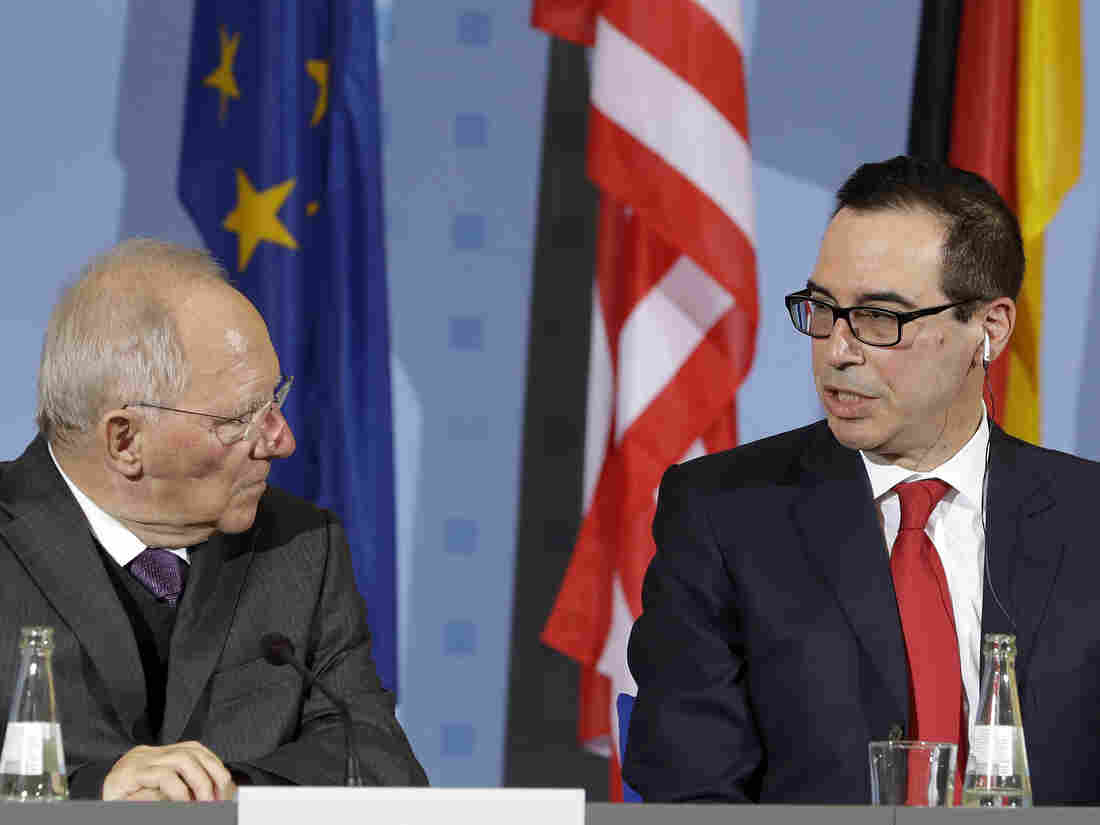
U.S. Treasury Secretary Steven Mnuchin, right, and German Finance Minister Wolfgang Schaeuble, left, address the media during a joint press conference in Berlin, Germany, on Thursday in advance of the weekend’s G20 summit.

Michael Sohn/AP

hide caption

toggle caption

Michael Sohn/AP

At this weekend’s gathering of the Group of 20, the world’s 20 largest economies, the group took a step back from its typically overt pro-free trade agenda, in the wake of pushback from the United States.

Treasury Secretary Steven Mnuchin and Federal Reserve Chair Janet Yellen represented the U.S. in two days of meetings with their counterparts from the world’s 20 largest economies in Baden-Baden, Germany.

“We are working to strengthen the contribution of trade to our economies,” said the statement concluding this year’s meeting. That wording stops short of rejecting protectionism, as the group has done in the past.

In this first G20 summit of the Trump era, there was trepidation among other members, following Trump’s declaration of an “America First” agenda, and his criticism of the trade policies of China, Mexico, and others. As Steve Beckner reports for NPR’s Newscast:

“At past meetings, joint affirmations of free trade have been virtually automatic. Last year, policymakers of the world’s biggest trading nations pledged to ‘reject protectionism.’ But to the consternation of the host Germans and others, such language is conspicuously absent from the G20’s latest statement.”

Germany dropped the no-protectionism pledge early on in the process, the Associated Press reports, to avoid antagonizing the United States delegation. But in the end, the group failed to find a substitute phrase in support of free trade that all could agree on.

In his first international meeting since he was sworn in, Mnuchin said “the historical language was not really relevant.”

“We believe in free trade, we are in one of the largest markets in the world, we are one of the largest trading partners in the world, trade has been good for us, it has been good for other people,” Mnuchin said. “Having said that, we want to re-examine certain agreements.”

The AP reports that Wolfgang Schaeuble, Germany’s finance minister, suggested there had been tension during the two-day meeting. Without mentioning a country by name, he said, “Maybe one or the other important member state needs to get a sense of how international cooperation works.”

The Washington Post reports that Mnuchin quickly became the center of attention at the gathering, with many foreign leaders seeking to meet with him. During those meetings, the Post reports,

“Mnuchin delivered the same message that Trump had made for months, just slightly softer, according to attendees who spoke on the condition of anonymity to reveal internal discussions: The United States would unapologetically work to redraft trade practices in a way that helps American workers. He said trade agreements need to be “free and fair” and balanced. He also said an overhaul of the U.S. tax code was overdue and that the United States would rethink regulations put in place after the Great Recession. …

Two European officials described Mnuchin as friendly but “tough.” They also said the U.S. delegation at the G-20 was routinely checking back with its counterparts in Washington on certain issues, leading some Europeans to wonder with whom they were negotiating, Mnuchin or Trump. But one of the European officials said this was not uncommon for a new administration, which was still formalizing its viewpoint on an array of complicated matters.”

The Group of 20 is comprised of 19 countries plus the European Union. This more casual meeting of finance ministers will be followed by a formal gathering of national leaders in Hamburg, Germany, in July.

You can read the full communiqué from the G20 here, at the German Federal Ministry of Finance.

Let’s block ads! (Why?)


No Image

Customs And Border Protection Outlines Border Wall Requirements

The border fence between the U.S. and Mexico in Hidalgo, Texas.

John Moore/Getty Images

hide caption

toggle caption

John Moore/Getty Images

U.S. Customs and Border Protection is asking for design proposals and prototypes of President Trump’s proposed wall on the U.S.-Mexico border.

Late Friday, the agency released specifics for the first time on how tough the barrier must be. CBP posted online two different options for contractors: one proposal must be for a solid concrete wall, another is for a wall with “a see-through component/capability” that is “operationally advantageous.”

“The wall design shall be physically imposing in height,” the CBP outlines say. The government says its “nominal concept” is for a 30-foot-high wall, but adds that designs as low as 18 feet “may be acceptable.”

The proposal document asks contractors for 30-foot-long prototypes and mock-ups of 10 feet by 10 feet.

A CBP official told NPR’s John Burnett that contractors will have to make mock-ups of their ideas in San Diego. “It’s a way for the agency to identify designs. We’re looking for industry’s designs, to take a fresh look at the wall. We’ll have industry propose and then we’ll down-select.”

The CBP, which is part of the Department of Homeland Security, requires the wall designs to be impossible for humans to climb without a ladder. It wants proposals that will prevent people from tunneling underneath by at least 6 feet underground.

The government outlines the types of things both types of walls have to stand up to: “sledgehammer, car jack, pick axe, chisel, battery operated impact tools, battery operated cutting tools, Oxy/acetylene torch or other similar hand-held tools.”

It has to look good, too. “The north side of wall (i.e. U.S. facing side) shall be aesthetically pleasing in color, anti-climb texture, etc., to be consistent with general surrounding environment,” the CBP says. There’s no mention of the aesthetics on the Mexican side.

More than 400 companies have told the Department of Homeland Security they’re interested in the project, NPR’s Richard Gonzales reported last week. Cost estimates of the wall vary widely: President Trump said it would cost $12 billion; an MIT study said $38 billion.

The deadline for contractors to submit their proposals for the first phase is March 29.

NPR’s John Burnett contributed to this report.

Let’s block ads! (Why?)


No Image

Best of the Week: SXSW Reviews and Interviews, More 'Man of Steel' and 'The Matrix' on the Way and More

The Important News

DC Extended Universe: Matthew Vaughn , Wonder Woman, Free Fire, Megan Leavey, Coco, Early Man, Despicable Me 3 and Smurfs: The Lost Village.

TV Spots:The Flash musical crossover with Supergirl.

Behind the Scenes:Ghost in the Shell visual effects showcase.

Movie Clips: Guardians of the Galaxy Vol. 2.

Movie Pics: A Wrinkle in Time,

Music Videos: Beauty and the Beast violin medley by Lindsey Stirling and “Beauty and the Beast” by Traci Hines and Nick Pitera.

Character Reprisals: Jeff Bridges brought out the Dude for John Goodman’s Walk of Fame honor.

Fan Theories: The cars in Cars aren’t cars and Life is a Venom prequel.

Movie Parodies: How Beauty and the Beast should have ended and Logan animated parody.

Mashups: La La Land meets Logan and Kong: Skull Island.

Easter Eggs: Disney animated features are all connected by Easter eggs.

Remade Trailers: The Belko Experiment in Lego and Wonder Woman in animation.

Remade Movie Scenes: Mariachi version of the Beauty and the Beast dance and The Belko Experiment in claymation.

Supercuts:God and Satan, Ben Stiller says “little,” women cinematographers. and movie characters saying “let’s go home.”

Our Features

SXSW Reports: We listed our favorite movies of SXSW, we posted a brief response and Q&A video from the SXSW premiere of The Disaster Artist and a review of Atomic Blonde‘s awesome action scene.

SXSW Buzz: We collected responses to Baby Driver at SXSW, and responses to Atomic Blonde, Song to Song and The Disaster Artist.

SXSW Interview: Alexandra Shipp and Breanna Hildebrand on Tragedy Girls and their X-Men characters.

Comic Book Movie Guides: We recapped and previewed Thanos’s part in the MCU and detailed what’s going on with The Batman.

Interview: Gareth Edwards on why we’ll never see Rogue One‘s alternate scenes and on why Carrie Fisher didn’t believe her Rogue One cameo.

Horror Movie Guide: We rounded up all the latest horror news and trailers.

Home Viewing: Our guide to everything hitting VOD this week.

and

MORE FROM AROUND THE WEB:

Let’s block ads! (Why?)


No Image

Should The U.S. Government Buy A Drug Company To Save Money?

Gilead Sciences Inc. makes the two leading drugs that can quickly cure hepatitis C infections. But most patients can’t afford the expensive drugs, and states restrict their use among Medicaid patients.

David Paul Morris/Bloomberg via Getty Images

hide caption

toggle caption

David Paul Morris/Bloomberg via Getty Images

David Higginbotham contracted hepatitis C more than 35 years ago. He’d like to rid his body of the virus, but Colorado’s Medicaid program says he’s not sick enough to justify the cost.

And he’s not alone.

Since 2013, when Gilead Sciences Inc. released Sovaldi, the first medication that can reliably cure hepatitis C, health insurers and state Medicaid programs have been coming up with ways to limit access to it and a sister drug, Harvoni, because they’re priced so high — more than $80,000 for a 12-week course of Sovaldi at the outset.

Both drugs are produced by Gilead, and their price has dropped some, as competitors have hit the market, but Higginbotham still hasn’t been able to get the cure.

Gilead isn’t the only company that produces expensive drugs. Prices for prescription medications for various conditions have been rising faster than inflation for years.

President Donald Trump says the pharmaceutical industry is “getting away with murder,” and he’s vowed to do something about it.

So what could he do in the case of hepatitis C medications?

One solution that’s been proposed is to buy the company. Specifically buy Gilead Sciences Inc.

Dr. Peter Bach, the director of health policy and outcomes at Memorial Sloan Kettering Cancer Center in New York, says the U.S. government could save money and treat everyone in the nation who has hepatitis C if it bought Gilead Sciences, rather than just buying Gilead’s products.

Hepatitis C kills more Americans than any other infectious disease, according to the Centers for Disease Control and Prevention, and it leads to a liver transplant more often than any other condition.

A year after Gilead got FDA approval for Sovaldi, it launched Harvoni, — a combination medicine that includes Sovaldi’s key ingredient and a second medication that attacks the hepatitis C virus in a different way. Sovaldi and Harvoni are the first drugs to consistently eradicate the virus, which has infected an estimated 2.7 to 3.3 million people in the U.S.

Bach says that in the three years since the drugs hit the market, only about 600,000 people have been treated — a low number considering there is a cure available.

Gilead Sciences’ Harvoni can cure hepatitis C, but costs tens of thousands of dollars for a course of treatment.

Lloyd Fox/Baltimore Sun/TNS via Getty Images

hide caption

toggle caption

Lloyd Fox/Baltimore Sun/TNS via Getty Images

“We’re doing a pretty poor job right now of finding patients with hepatitis C,” he says.

The slow uptake, Bach says, is because of the drugs’ price. When Harvoni came on the market, it was listed at $94,000 for a course of treatment that cures most patients. The price has since dropped to about half that, but is still out of reach for most people.

Medicaid programs are limiting access and many insurance companies list it as a specialty drug and cover only a percentage of its cost.

“Because nobody can afford Gilead’s prices, there really isn’t much sense in investing to go find these patients and get them into treatment,” Bach says.

He says the U.S.government, however, could cut the cost of treatment by almost two-thirds by buying Gilead on the open market – its market capitalization on March 17 was about $90 billion — and selling off all its assets except the U.S. rights to Sovaldi and Harvoni.

The savings would be three-pronged, he explains. The cost of treatment would decline. The disease would stop spreading. And the number of liver transplants prompted by hepatitis C infections would drop significantly.

“There’s a queue right now for liver transplants, so it will free up those livers for other people who have other diseases that we can’t cure who otherwise will die,” Bach points out.

That would help states like Colorado, for example, which is limiting access to Medicaid patients because the costs of treating everyone at once would be too high. If the state were to treat every Medicaid beneficiary who is diagnosed with hepatitis C, it would cost an additional $500 million.

So to get the drug, Higginbotham has to wait until his liver is more damaged that it is today.

Bach says if the federal government treated hepatitis C as a public health issue, rather than as a Medicaid budget problem, buying Gilead would make sense.

Gilead’s senior vice president, Gregg Alton, says Bach’s idea is thought-provoking. What it really demonstrates, Alton says, is that the system to pay for prescription drugs isn’t equipped to deal with quick, expensive cures.

“Because we have a cure, the costs are paid in a short period of time,” he says. “Our payment systems have a real tough time with that because they’re used to these sorts of long-term, chronic therapies that pay a little bit at a time – but, over time, cost a lot more.”

In other words, it can cost a lot more to treat diabetes or multiple sclerosis over a lifetime than to cure hepatitis C in three months.

From a public health perspective, buying Gilead isn’t a bad idea, says Sara Fisher Ellison, an economics lecturer at MIT.

But that assumption rests on the notion that the government would buy the company’s shares at full price on the open market. That would avert any reaction from drugmakers or other companies who would fear that the government could use its power just to force them to lower prices.

“The reason this proposal could work is that right now the drugs are only serving a fraction of the potential patients,” Fisher Ellison says, “and there’s a big public health benefit to serving all of the patents. That’s something that Gilead doesn’t take into account in its pricing policy, but it’s something that a government does take into account.”

The idea is a long shot of course.

But Higginbotham, who is still waiting in Colorado for his chance to take the hepatitis C drug, sees an opening with Donald Trump in the Oval Office.

“With our present administration,” he says, “a hostile takeover might be just up his alley.”

Let’s block ads! (Why?)


No Image

First Openly Transgender Professional Team Athlete Retires

Harrison Browne, hockey player for the Buffalo Beauts and the first openly transgender athlete, announces his retirement.

Michael Hertzel/National Women’s Hockey League

hide caption

toggle caption

Michael Hertzel/National Women’s Hockey League

To Harrison Browne, hockey has always been a pivotal part of life. He’s been in the rink for the past 15 years and currently plays for the Buffalo Beauts, a professional hockey team in the National Women’s Hockey League.

Last October, Browne came out, saying he identified as male, which made him the first openly transgender professional team sport athlete in the United States.

“I started to feel a really big disconnect between my personal identity and my professional identity,” Browne says. “Whenever I would hear my name announced … I just wanted to align it.”

He had come out privately to his friends and family while in college, and in his second year in the NWHL, he felt comfortable to make the statement publicly. In the months since, he says, the support has been overwhelming.

“My teammates, my coaches and the league did a great job of just treating me like a regular teammate.”

Even though he identifies as male in a women’s league, he sees himself as just an athlete.

“Every time I go to the rink. I’m an athlete,” Browne says. “I don’t think of myself as a woman. I don’t think of my teammates as women. We’re athletes, we’re teammates and we’re friends.”

Harrison Browne shoots during a Buffalo Beauts match.

Troy Parla/National Women’s Hockey League

hide caption

toggle caption

Troy Parla/National Women’s Hockey League

Since coming out, Browne says he has received tweets and other messages of support on social media from fellow transgender athletes, who tell him “they are so thankful that there’s somebody out there that did what they couldn’t,” he says.

“I’m glad that I broke down a wall,” he says. “I’m glad that I was able to help people in need.”

Earlier this week Browne announced his retirement from professional hockey and is looking forward to transitioning after the season is over. Under NWHL rules, players who are transitioning are ineligible once they begin hormone therapy.

“I want to start transitioning and seeing myself in the mirror the way I see on the inside,” Browne says.

Browne’s season could come to an end soon as the Buffalo Beauts take on the New York Riveters in the semi-finals of the Isobel Cup playoffs Friday night. But he’s not thinking about that.

“I don’t think it’s hit yet, but it definitely will hit me once the buzzer goes,” he says.

After the season ends, Browne will continue to work with the NWHL as the leader of the inclusion board. He hopes that going forward he can be an advocate, speak at conferences and help athletes feel included.

Until then, Browne is focused on playing his best hockey, and winning a championship.

Let’s block ads! (Why?)


No Image

Today in Movie Culture: Cosplayer Covers of 'Beauty and the Beast' Songs, Kristen Stewart Trivia and More

Here are a bunch of little bites to satisfy your hunger for movie culture:

Cosplay of the Day:

Violinist Lindsey Stirling dressed up as Belle from Beauty and the Beast and made a music video for her performance of songs from the movie (via Fashionably Geek):

[embedded content]

Recreated Movie Scene of the Day:

If Stirling’s renditions aren’t enough, here’s a mariachi version of “Beauty and the Beast” with a Mexican take on its iconic dance sequence from the movie:

Movie Comparison of the Day:

Speaking of Disney animated features, Couch Tomato shows us 24 reasons why The Little Mermaid is like a cartoon remake of Splash:

[embedded content]

Meme Entry of the Day:

The best parody yet of “BBC Dad” Robert Kelly’s interview interrupted by his kids is this Star Wars remake:

WHO DID THIS ?? ?? pic.twitter.com/t9DXew3F8V

— Collider (@Collider) March 16, 2017

Movie Food of the Day:

Learn how to make a Lego Batman cake from baker Ashlee Marie in this tutorial (via io9):

[embedded content]

Vintage Image of the Day:

With the news that Warner Bros. is “relaunching” The Matrix in some way, here is a classic behind-the-scenes shot of Keanu Reeves and Hugo Weaving shooting the original in 1998:

Actress in the Spotlight:

Learn all about Personal Shopper star Kristen Stewart in this ScreenCrush video filled with biographical trivia:

[embedded content]

Video Essay of the Day:

In anticipation of Alien: Covenant, Mr. Nerdista looks at how Ridley Scott redefined science fiction with the original Alien:

[embedded content]

Movie Scene Comparisons of the Day:

Editor Vugar Efendi shows real recorded events side by side with their cinematic re-creations in this video of mostly biopics, including Jackie and Selma (via Film School Rejects):

[embedded content]

Classic Trailer of the Day:

Today is the 50th anniversary of the American release of Ingmar Bergman’s Persona. Watch the U.S. trailer for the classic below.

[embedded content]

Let’s block ads! (Why?)


No Image

How To Make Farmers Love Cover Crops? Pay Them

Green shoots of cereal rye, a popular cover crop, emerge in a field where corn was recently harvested in Iowa. The grass will go dormant in winter, then resume growing in the spring. Less than three percent of corn fields in the state have cover crops.

Courtesy of Practical Farmers of Iowa

hide caption

toggle caption

Courtesy of Practical Farmers of Iowa

Environmentalists love “cover crops.” These are plants that tolerate cool weather and grow on farm fields after the crops are harvested. They hold the soil in place and are probably the most effective way to keep nutrients infields, rather than polluting nearby streams.

Unfortunately, the average farmer doesn’t love these crops quite so much. The Environmental Working Group, a research and advocacy organization, studied satellite images of the Midwest and found that farmers in Iowa and Illinois had planted cover crops on less than three percent of their corn and soybean fields. Indiana’s farmers did slightly better, with cover crops on about seven percent of cropland.

That’s tiny, compared to what’s needed to dramatically reduce water pollution from farms. Soren Rundquist, one of the authors of the EWG report, tells The Salt that Iowa’s environmental planners want cover crops on at least 60 percent of the state’s corn and soybean acres. Illinois has set a similar goal. The number of acres with cover crops in both states is increasing, Rundquist says, but at current rates these states won’t meet their goals for decades to come.

There is, however, a proven way to get farmers to cover their fields. Pay them a lot of money for it. It’s worked well in one state — Maryland.

In a part of the state known as the Eastern Shore, a heavily agricultural area along the Chesapeake Bay, farmers now plant cover crops on well over 50 percent of all corn fields, says Ken Staver, a scientist at the University of Maryland’s Wye Research and Education Center.

“The whole system is structured to get maximum impact,” says Staver. The state of Maryland pays farmers for a whole range of practices — like cover crops — that cut nitrogen and phosphorus runoff into streams. The more effective the practice in cutting pollution, the more money the farmers get. The biggest payments — up to $90 per acre — go to farmers who plant a cover crop of rye on corn fields early in the fall, and avoid spreading manure as fertilizer on their fields until spring arrives. (Spreading manure in the fall is more convenient for farmers, but it’s also more likely to wash away over the winter.)

A growing cover crop (left) captures soil nutrients that otherwise might wash away from a field with no vegetation.

Courtesy of Practical Farmers of Iowa

hide caption

toggle caption

Courtesy of Practical Farmers of Iowa

In theory, Staver says, farmers shouldn’t need those payments, because a cover crop can pay for itself. It keeps soil healthy and keeps valuable nutrients in the field, so farmers don’t need to spend as much money on fertilizer.

In practice, Staver says, those arguments haven’t changed farmers’ behavior. “We’ve been at this a really long time,” he says. “We tried that, 20 years ago, and it just wasn’t happening.”

Farmers can be reluctant to plant cover crops because it means extra work, especially at crucial times in the fall and spring. Last year, some farmers in Indiana reportedly had trouble killing off their thriving cover crops when it was time to plant corn in those fields.

When Maryland offered farmers about $20 per acre to plant cover crops, some farmers signed up, but not enough of them. It took more generous payments to convince the majority of farmers to get on board.

Staver admits that this may be more feasible for Maryland than for Iowa, because Maryland has a much smaller amount of crop land to protect, compared to its state budget.

But Rundquist, from the EWG, says there’s another way to look at it. Currently, he says, farmers in Iowa get about $10 million each year as incentives to plant cover crops. That’s dwarfed by other federal subsidies that farmers receive; farmers in Iowa got over $1 billion from the federal government in 2015 in the form of subsidies for crop insurance and as compensation for low prices or poor yields.

Rundquist wants the federal government to shift its priorities. “Is [spending more money to promote cover crops] too expensive, considering how much money we spend on agricultural subsidies?” he says.

Let’s block ads! (Why?)


No Image

Head Of USA Gymnastics Resigns Over Group's Sex Abuse Scandal

Steve Penny, president and CEO of USA Gymnastics, welcomes guests and media in Huntsville, Texas, in 2011. Penny resigned Thursday, amid accusations that his organization ignored the sexual abuse of children by adults working in the sport.

Bob Levey/Getty Images for Hilton

hide caption

toggle caption

Bob Levey/Getty Images for Hilton

The president and CEO of USA Gymnastics has resigned, months after an investigative report by The Indianapolis Staralleged that the organization ignored reports of sexual abuse by adults working in the sport, including coaches and a prominent doctor.

Steve Penny, who served as the group’s head for more than a decade, announced his resignation on Thursday.

In a statement, Penny did not apologize or admit any wrongdoing. He said he’s stepping aside “solely to support the best interests of USA Gymnastics.”

“It has been heartbreaking to learn of instances of abuse and it sickens me that young athletes would be exploited in such a manner,” he said.

The Indianapolis Star, which broke the story about allegations of widespread child sex abuse in the U.S. gymnastics world, reports that Penny “has been personally responsible for handling sexual abuse complaints since becoming president in 2005, according to his sworn testimony in a Georgia lawsuit.” It also notes that Penny “has grown the organization financially” in his tenure, and earned more than $600,000 in 2015.

Paul Parilla, the chairman of USA Gymnastics’ board of directors and the interim head of the organization, said the board believes Penny’s resignation “will help USA Gymnastics face its current challenges. … USA Gymnastics and the entire gymnastics community must work together to focus on keeping athletes safe.”

The organization is currently undergoing a review of its practices, in the wake of the explosive report from the Indianapolis Star.

As The Two-Way wrote in December, IndyStar journalists Tim Evans, Mark Alesia and Marisa Kwiatkowski reviewed hundreds of police and court documents and found that over two decades, at least 368 gymnasts alleged they were sexually assaulted or exploited by adults connected to the sport:

“[The journalists] reported that USA Gymnastics had ignored complaints and warnings about predatory coaches, and failed to report allegations to authorities.

“They now conclude that abusive coaches were ‘allowed to move from gym to gym’ — quietly fired from one gym before being hired at another. …

“They say it’s unclear from the records how many accusers and alleged abusers were USA Gymnastics members, ‘because the organization does not disclose that information,’ but that their research reveals widespread abuse across American gymnastics.”

You can read the Indianapolis Star investigation here. One of the reporters, Kwiatkowski, recently spoke with NPR about the pressure on Penny to resign. You can hear that interview here.

Let’s block ads! (Why?)