Articles by admin

No Image

The Reason Behind The Recent Spike In Gas Prices

Motorists are finding that the average price of a gallon of gasoline is 20 cents more than it was a month ago — the highest it’s been in two years. The reasons have a lot to do with Hurricane Harvey.

MICHEL MARTIN, HOST:

We’ll be checking in throughout the hour with people who’ve been affected by this storm in all kinds of ways. And even if you don’t live in the Southeast or have family there, you might be one of them if you plan to hit the road this Labor Day weekend. Motorists are finding that the average price of a gallon of gasoline is 20 cents higher than it was a month ago. It’s the highest it’s been in two years, and the reasons have a lot to do with Hurricane Harvey. NPR’s Jim Zarroli is here to explain this. Jim, thanks so much.

JIM ZARROLI, BYLINE: Hi.

MARTIN: So you were telling us that Harvey is affecting the energy markets profoundly. Why is that?

ZARROLI: Well, the problem is the refineries. I mean, there are a lot of them along the coast of Texas and Louisiana. The biggest refining facility is in Port Arthur, Texas. And it’s not so much that there was damage to these refineries, but when the storm was approaching, some of them had to be shut down. And just because of the way they are technologically – they’re complex facilities – they can’t be sort of restarted on a dime. So we’ve lost, you know, nearly 17 percent of total U.S. refining capacity.

And in the meantime, you’re seeing long lines at gas stations. And some gas stations are even running out of gas altogether. Yesterday, the governor of Texas, Greg Abbott, assured his state that it still has plenty of gasoline and it’s not going to run out. But there are shortages right now.

MARTIN: Now, the refineries are in the Gulf of Mexico. How does that affect the rest of the country?

ZARROLI: The infrastructure in the Gulf serves the rest of the country. I mean, the oil in places like Port Arthur is refined into gasoline that’s used in the Midwest and in the Northeast. There’s also been a problem with pipelines. Some of them have had to be shut down, like the Colonial Pipeline goes from Houston to North Carolina. Part of that had to be shut down. And that just means less gasoline in places like Chicago and New York.

Then also you had, you know, you’ve had less oil being imported because shipping has been interrupted. And when you have this major disruption, oil companies shift production around a lot. That’s another thing. They want to make sure it goes where it’s most needed. So this is really felt all over the place.

MARTIN: So is the government taking any steps to address these supply problems that we’re seeing? Is there anything the government can do?

ZARROLI: The Department of Energy has taken some temporary steps. It’s waived some of the clean air requirements on gasoline. It says that should help get supplies moving faster. It’s also released some oil from the strategic petroleum reserves into a big refinery in Lake Charles, La., that was having some trouble getting the crude it needed. Of course, the company that owns it is going to have to, you know, make up for that later on by returning some oil to the reserves.

MARTIN: So how long before supplies return to normal levels?

ZARROLI: You know, it’s going to be a few weeks, maybe the end of the month. The companies are still assessing how much damage, if any, their facilities have have sustained. We’re starting to see some recovery already. The port of Corpus Christi, you know, has reopened its shipping channel. That means the refineries there can start to get back on line as early as this weekend. But in the meantime, you know, we could see prices going up for a while. We don’t know how much, but they should go up – continue to go up.

MARTIN: That’s NPR’s Jim Zarroli. Jim, thank you.

ZARROLI: You’re welcome.

(SOUNDBITE OF STEVIE RAY VAUGHAN AND DOUBLE TROUBLE’S “TEXAS FLOOD”)

Copyright © 2017 NPR. All rights reserved. Visit our website terms of use and permissions pages at www.npr.org for further information.

NPR transcripts are created on a rush deadline by Verb8tm, Inc., an NPR contractor, and produced using a proprietary transcription process developed with NPR. This text may not be in its final form and may be updated or revised in the future. Accuracy and availability may vary. The authoritative record of NPR’s programming is the audio record.
Let’s block ads! (Why?)


No Image

Saturday Sports: The Astros

NPR’s Scott Simon talks with Howard Bryant of ESPN and ESPN The Magazine about a couple of blockbuster trades and the role of sports in healing traumatized communities.

SCOTT SIMON, HOST:

Time now for sports.

(SOUNDBITE OF MUSIC)

SIMON: Baseball is back in Houston this weekend with a doubleheader today, the Astros versus the Mets. And the Stroh’s may have acquired a game changer, indeed. Howard Bryant of ESPN and ESPN the Magazine joins us. Good morning, Howard.

HOWARD BRYANT: Good morning, Scott. How are you?

SIMON: I’m fine, thanks. As the floodwaters began to recede Thursday, just before midnight, the Astros signed – landed, traded for a six-time All Star Justin Verlander, the great pitcher from the Detroit Tigers. How does this improve their chances in the playoffs and maybe beyond?

BRYANT: Well, it certainly improves them. It’s – when you get a guy like Justin Verlander, I think one of the great things about these deals, especially at this time of the year, is it tells everybody on your team and in your fan base that we’re here to win the World Series. We’re not here to make the playoffs. Obviously, they’ve had a great year. They’ve got the best record in the league for virtually the entire season. The message is that there’s only one outcome for us this year, and that’s to win it all.

And so when you have a guy like Verlander and you’ve got McCullers and you’ve got Keuchel, you’ve got the pitching staff that nobody wants to go through. And it’s a wonderful deal for Houston because, once again, the Astros have been to the World Series once. They lost to the White Sox in 2005. And they were close a couple of years ago – didn’t get there. They lost in the ALCS.

And so right now this is the kind of deal that sports fans love. You want your team to try to win. You care about it. And now the organization is showing that they are doing everything they can to bring you a championship.

SIMON: It’s impossible not to wonder if the Astros are going to play with an extra spark of intensity following Hurricane Harvey. Now is that just romantic nonsense on the part of us fans?

BRYANT: Yeah. You know, Scott it is. And I try at times – I’m conflicted about it quite constantly, to be honest. And I feel like, here we go. The minute the hurricane hit, I thought we were going back to the Katrina narrative or we’re going back to the narrative when the economy crashed in Michigan. You know, Michigan state lets, you know, win it for Michigan or win it for New Orleans. Or – I think that that trivializes what’s really taking place right now.

The Houston Astros in the scope of the devastation there, when you look at those photos, when you see what’s happening and you’re dealing with people whose lives are going to have – it’s going to take months and years to put them back together – it’s insignificant. It means nothing.

On the other hand, there is value in giving people who are dealing with a lot of devastation, a lot of pain, whether it’s in your life personally or whether it’s a national – natural disaster, to give them something that makes them feel good. And baseball does that.

SIMON: We were both in New York in the days after 9/11. I will never forget the tangible electricity of those October games at Yankee Stadium…

BRYANT: Oh, I was there, absolutely.

SIMON: …The cop who sang “God Bless America,” Frank Sinatra’s, you know, recording “New York, New York,” or the team pulling the mayor around the field. I mean, I’m not a Yankees fan, but I sold it each time they won that fall. I like to think that made some small difference.

BRYANT: Well, exactly, you had to feel that. I talked to Joe Torre about this, who was the manager of the Yankees at the time, just a few weeks ago. And he was telling me about after the towers fell, they went to the armory to just be supportive. And they walked in. And I think Joe was there and Willie Randolph. And Dawn Zimmer, Derek Jeter, Bernie Williams were all there.

And Joe walked around. And he thought, this is stupid. I don’t belong here. These people – you know, all the pictures were on the walls trying to find their loved ones. And he said, I don’t belong here. Why are we here?

And then Bernie Williams walked over and said to a woman that, I don’t have anything to say. I don’t know what to say to you. But you look like you need a hug. And he gave her a hug. And everybody then broke – that broke the ice. And everyone came over to the Yankees to see them as their heroes.

And then Joe said, I do realize now that we have a job to do. That this is important to people. And we have to give them something to be happy about within all of this. And it changed his mind about the value of what they could bring to the people of New York.

SIMON: Yeah. And we’ll just note on our way out, a lot of Houston athletes have publicly stepped up in the wake of Hurricane Harvey.

BRYANT: Yeah. J.J. Watt, $15 million he’s raised in a week.

SIMON: Howard Bryant of ESPN, thanks so much for joining us.

BRYANT: Oh, my pleasure.

Copyright © 2017 NPR. All rights reserved. Visit our website terms of use and permissions pages at www.npr.org for further information.

NPR transcripts are created on a rush deadline by Verb8tm, Inc., an NPR contractor, and produced using a proprietary transcription process developed with NPR. This text may not be in its final form and may be updated or revised in the future. Accuracy and availability may vary. The authoritative record of NPR’s programming is the audio record.

Let’s block ads! (Why?)


No Image

In A Houston Emergency Room, It Was A Week Like No Other

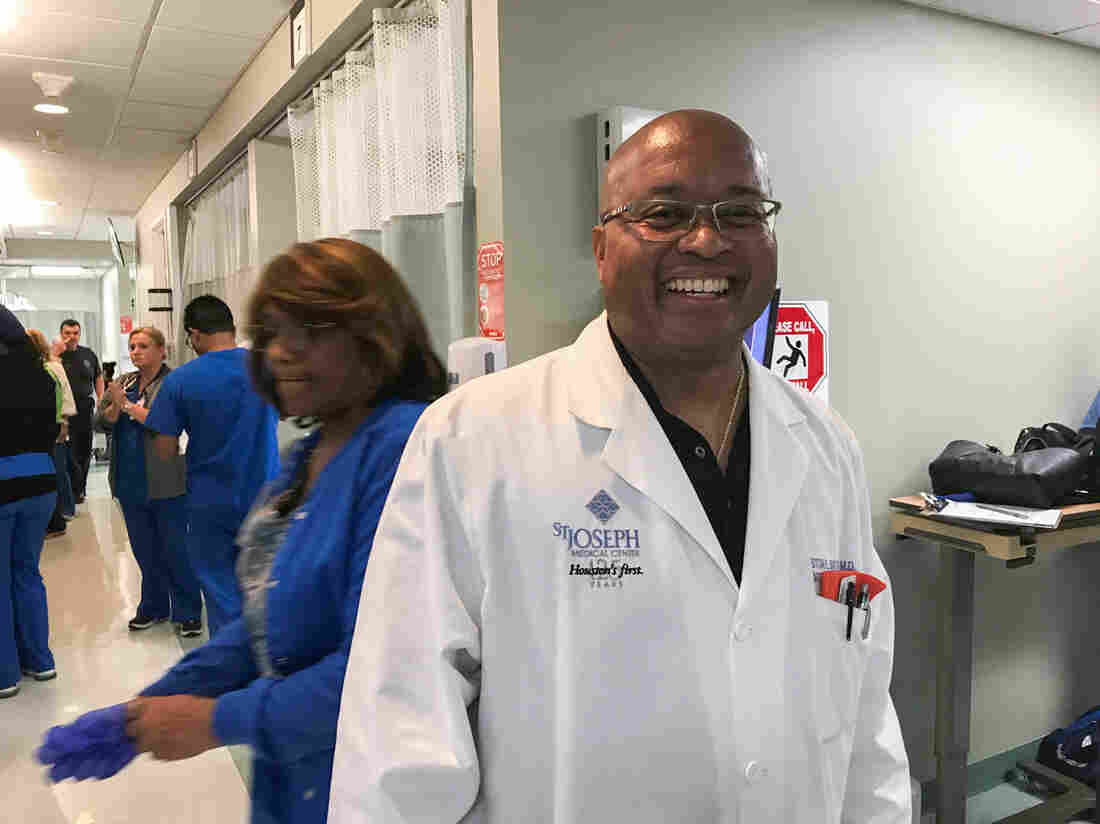
Dr. Winston Watkins, an internist at St. Joseph Medical Center in Houston, volunteered to do a shift in the ER to give his colleagues a break.

Rachel Osier Lindley/KERA

hide caption

toggle caption

Rachel Osier Lindley/KERA

St. Joseph Medical Center is downtown Houston’s only hospital, located just down the street from the convention center where thousands of evacuees have been staying since Harvey hit.

As of Friday, some doctors and nurses have been on the clock for almost a full week.

Trent Tankersley, director of emergency services at St. Joseph Medical Center in downtown Houston, had a very long work week, as did many of his colleagues.

Rachel Osier Lindley/KERA

hide caption

toggle caption

Rachel Osier Lindley/KERA

When you’re working in an ER during a major natural disaster, nothing is routine. Trent Tankersley, director of emergency services at St. Joseph Medical Center, describes one tense situation after another in the hospital this week.

“We had a lady who the only vehicle heavy enough and strong enough to get to her through the floodwaters was a dump truck. She was pregnant. She was in labor. She was brought to the hospital in the dump bed of a dump truck, soaking wet.

“As we were getting her over to the women’s building to get taken care of, we had a trauma come in. Shortly after that, we had a young man [who] came in that was having a stroke.”

Tankersley showed up to work Saturday, and hasn’t had what you’d consider “a break” since.

“Finally got to go home last night for a couple hours and do some laundry and then came right back. So it’s been an interesting five or six days.”

Some staff haven’t been home since before Harvey struck

Kristen Benjamin, an associate chief nursing officer, has been right beside Tankersley.

“I think we’re all working on adrenaline right now. We’re working shift by shift. Some people are doing 15-, 16-hour shifts. We let them go off and sleep. They come back in.”

Kristen Benjamin, associate chief nursing officer at St. Joseph Medical Center, says many employees hadn’t been home to see if their houses were flooded.

Rachel Osier Lindley/KERA

hide caption

toggle caption

Rachel Osier Lindley/KERA

They’ve seen more than 600 patients in the first five days. At times, they saw more patients in a few hours than they usually would in a whole day.

Many staffers have been stuck at the hospital, with no clear path to their homes. As floodwaters recede, their coworkers can finally come back.

“We’re going to start transitioning staff out to get home so that they can check on their homes,” Benjamin says. “Because some of them don’t even know what’s happening at their house right now because they haven’t been home since Friday. So I don’t even really have an idea if their house has been flooded or not.”

His first day working in the ER

Among those staffing the ER are doctors from other departments pitching in, and even medical students, like Diana Johnson. She and her classmates are using a Google spreadsheet to organize shifts to help.

She’s in her third year at Houston’s McGovern Medical school. She’s assisting Dr. Winston Watkins, an internist on his first day in the ER.

“One of the first patients that came in happened to be one of my own patients from my practice, and he came in with his foot hurting,” he says.”So Diana evaluated him and it turns out he has gangrene of his right fourth toe. And so we’re going to admit him to the hospital.”

“Some of them don’t even know what’s happening at their house right now because they haven’t been home since Friday.”

His house is underwater

Nurse Aaron Padron says he’s never seen such a wide range of emotions in the ER.

“A lot of laughter crying yelling, tears,” he says. “People that you work with you think that wouldn’t crack just put their head in their hands and take a second to cry to themselves, or not to themselves, and wipe away the tears and get back to work.”

He’s been working here for most of the last week, except Saturday night.

Aaron Padron, an emergency room nurse, says hospital employees were much more emotional, reflecting the stresses on everyone in the city.

Rachel Osier Lindley/KERA

hide caption

toggle caption

Rachel Osier Lindley/KERA

“I went home on Saturday to sort of rescue my family before the floods got too high for me to get in or out,” he says. “And then I came back Sunday and I’ve been working and sleeping here ever since.”

Neighbors say his house is underwater. He says several others working in the ER saw their homes flooded. In a way, he says, it’s all been a transformational experience.

“I think times of crisis, in times of emergency, in times of stress really have a way to bring people together and create a lot of camaraderie and really can push people to excel at what they do,” he says.

Once reinforcements come in, he’ll be able to rotate off his shift and find out just how much his family lost.

Let’s block ads! (Why?)


No Image

The Week in Movie News: Here's What You Need to Know

Need a quick recap on the past week in movie news? Here are the highlights:

BIG NEWS

Leonardo DiCaprio for The Joker?: With Martin Scorsese possibly producing the Joker origin movie, Warner Bros. is hoping to cast Leonardo DiCaprio as the comic book villain. He wouldn’t be the first Oscar winner to take on the role, that’s for sure. Read more about the project here and here.

GREAT NEWS

Writers Return for Spider-Man: Homecoming Sequel: Rejoining star Tom Holland and probably director Jon Watts, Spider-Man: Homecoming screenwriters Chris McKenna and Erik Sommers are now working with others on the next Spidey installment. You can read all we know about the sequel so far here.

AWESOME TIE-IN

The Hottest New Star Wars Toys: This week, Force Friday II brought tons of cool new Star Wars merchandise to stores, and we’re especially excited about some of the toys based on Star Wars: The Last Jedi. Read more here. And check out a new The Last Jedi photo here.

FESTIVAL BUZZ

Downsizing and The Shape of Water Reviews: Critics are piling on the praise for the latest from Alexander Payne and the new movie from Guillermo del Toro at the start of the fall film festival season. Read what they’re saying here and here.

COOL CULTURE

Blade Runner 2049 Prequel Short:Blade Runner 2049 director Denis Villeneuve presented a new short film this week starring Jared Leto that bridges the original with the sequel. You can watch it here:

[embedded content]

MUST-WATCH TRAILERS

Brawl in Cell Block 99 showcases a bald Vince Vaughn: The first trailer for the prison movie Brawl in Cell Block 99 has arrived, featuring Vince Vaughn beating up a car. A bald Vince Vaughn beating up a car. Watch it below.

[embedded content]

American Assassin looks action packed: The latest trailer for the Dylan O’Brien-led American Assassin gives us some background information and then a load of action. Check it out here:

[embedded content]

and

Let’s block ads! (Why?)


No Image

Hurricane Harvey Sends Gasoline Prices Up

A customer walks out of an Exxon station in Bedford, Texas, Thursday. Refinery shutdowns have sent prices up all over the country.

Tony Gutierrez/AP

hide caption

toggle caption

Tony Gutierrez/AP

Drivers who plan to hit the road over Labor Day weekend will face higher gasoline prices because of the impact of Hurricane Harvey on the nation’s refineries and pipelines.

After several days of heavy rain and flooding, gas prices reached an average of nearly $2.51 a gallon, up 20 cents since two weeks ago and nearly 30 cents since this time last year, although they fell back a bit Friday.

Refineries throughout the Gulf Coast shut down or reduced production a week ago in anticipation of the high winds and heavy flooding from Harvey.

“Hurricane Harvey has significantly impacted the entire Texas gulf coast with the petroleum refining centers of Corpus Christi, Houston, Port Arthur, Beaumont, and Lake Charles, La., either completely shutdown or [having] significantly scaled back operations,” according to a statement released by the Port of Corpus Christi.

As of Thursday afternoon, 10 refineries representing 16.6 percent of daily U.S. refining capacity were shut down, according to the Department of Energy.

The nation’s largest refinery, in Port Arthur, Texas, is expected to be closed for at least two weeks, Reuters reported.

All told about 4.4 million barrels of daily oil production have been suspended.

With less fuel being produced, several major pipelines supplying the Midwest and the East Coast have plans to shut down, or have already done so.

Colonial Pipeline said Thursday it was temporarily suspending lines that originate in Houston and feed the East Coast.

“Deliveries will be intermittent and dependent on terminal and refinery supply,” it said.

With supplies growing tight, the Department of Energy announced it was taking 1,000,000 barrels of crude oil from the nation’s Strategic Petroleum Reserve to send to a Phillips 66 refinery in Lake Charles on an emergency basis. The company will have to replace the crude later.

At a Friday news conference, Texas Gov. Greg Abbott sought to calm fears about fuel shortages. “There’s plenty of gasoline in the state of Texas,” he said. “Don’t worry. We will not run out.”

Bloomberg reported that European refiners are rushing to fill the gap opened by Harvey:

“At least 20 tankers were booked to load European fuels for the U.S. since Harvey made landfall, a rate nearly double the average for August, shipping data compiled by Bloomberg show. Shipbrokers said cargo flows to New York are expected to be the highest since November, when an explosion on Colonial Pipeline cut off supplies.”

The gasoline supply issues could reduce inventories on the East Coast, causing prices to rise further, Zachary Rogers, a refining and oil products analyst at Wood Mackenzie Ltd., told Bloomberg.

Still, conditions are returning to normal around the Port of Corpus Christi, where flooding was minimal. The port’s shipping channel has reopened and refineries in the area are expected to resume production within a few days.

Higher gasoline prices could affect consumer spending nationally, but the impact “should be small and temporary as production and refining come back on line,” according to Ryan Sweet of Moody’s Analytics.

Let’s block ads! (Why?)


No Image

Supreme Court Justice Sonya Sotomayor Visits 'The Judge's Chamber' At Yankee Stadium

U.S. Supreme Court Justice Sonya Sotomayor sat in Yankee Stadium yesterday in a section called “The Judge’s Chamber.” It is named after Yankee baseball player Aaron Judge. Sotomayor is from the Bronx and has been a fan for a long time.

ARI SHAPIRO, HOST:

At Yankee Stadium yesterday, a hometown fan made an appearance to cheer against the Red Sox.

(SOUNDBITE OF ARCHIVED RECORDING)

UNIDENTIFIED ANNOUNCER #1: In the Judge’s Chambers a real big-time judge in the glasses. That is Judge Sonia Sotomayor of the Supreme Court of the United States, born in the Bronx and rooting on Aaron Judge. That is pretty awesome.

SHAPIRO: The Judge’s Chambers is a special cheering section the Yankees set up to honor slugger Aaron Judge.

(SOUNDBITE OF ARCHIVED RECORDING)

UNIDENTIFIED ANNOUNCER #1: There it goes, deep to left, really deep. See you.

UNIDENTIFIED ANNOUNCER #2: Wow.

UNIDENTIFIED ANNOUNCER #1: Oh, my goodness, what a shot by Aaron Judge.

KELLY MCEVERS, HOST:

That was Judge hitting a home run in June that went 496 feet. This summer, his fans started showing up in judge’s robes and white wigs.

SHAPIRO: Then the Yankees took it up a notch by giving out foam gavels and putting up fake wood paneling to make his cheering section look like a courtroom.

(SOUNDBITE OF ARCHIVED RECORDING)

UNIDENTIFIED ANNOUNCER #1: You don’t really see Supreme Court justices smile like that, so that’s a nice – they’re all so serious. Serious things to do.

MCEVERS: In the mid-’90s, Sotomayor became known as the woman who saved baseball. There was a big baseball strike in 1994, and the dispute eventually reached Sotomayor at the U.S. district court in New York. She sided with the players over the owners and forced both sides back to negotiations.

SHAPIRO: At Yankee Stadium yesterday, Justice Sotomayor wore a black robe with the Yankees logo. She returns to the nine-justice lineup in Washington in October. We’ll see if the Yankees are still playing then.

Copyright © 2017 NPR. All rights reserved. Visit our website terms of use and permissions pages at www.npr.org for further information.

NPR transcripts are created on a rush deadline by Verb8tm, Inc., an NPR contractor, and produced using a proprietary transcription process developed with NPR. This text may not be in its final form and may be updated or revised in the future. Accuracy and availability may vary. The authoritative record of NPR’s programming is the audio record.

Let’s block ads! (Why?)


No Image

Today in Movie Culture: 'Blade Runner 2049' Short Film, 'Baby Driver' Opening Scene Breakdown and More

Here are a bunch of little bites to satisfy your hunger for movie culture:

Short Film of the Day:

Get ready for Blade Runner 2049 with this short film starring Jared Leto that connects the original with the upcoming sequel:

[embedded content]

Scene Analysis of the Day:

Thomas Flight breaks down the opening sequence from Edgar Wright’s Baby Driver in his latest video essay:

[embedded content]

Poster Homage of the Day:

This week’s new Stranger Things poster pays tribute to the poster for Firestarter:

Normal in every way but one. Will Eleven have the power…to survive? #StrangerThursdays begins now. pic.twitter.com/hzR20qONQ2

— Stranger Things (@Stranger_Things) August 31, 2017

Supercut of the Day:

See how the movies portray the city of angels in this supercut of Los Angeles in film:

[embedded content]

Vintage Image of the Day:

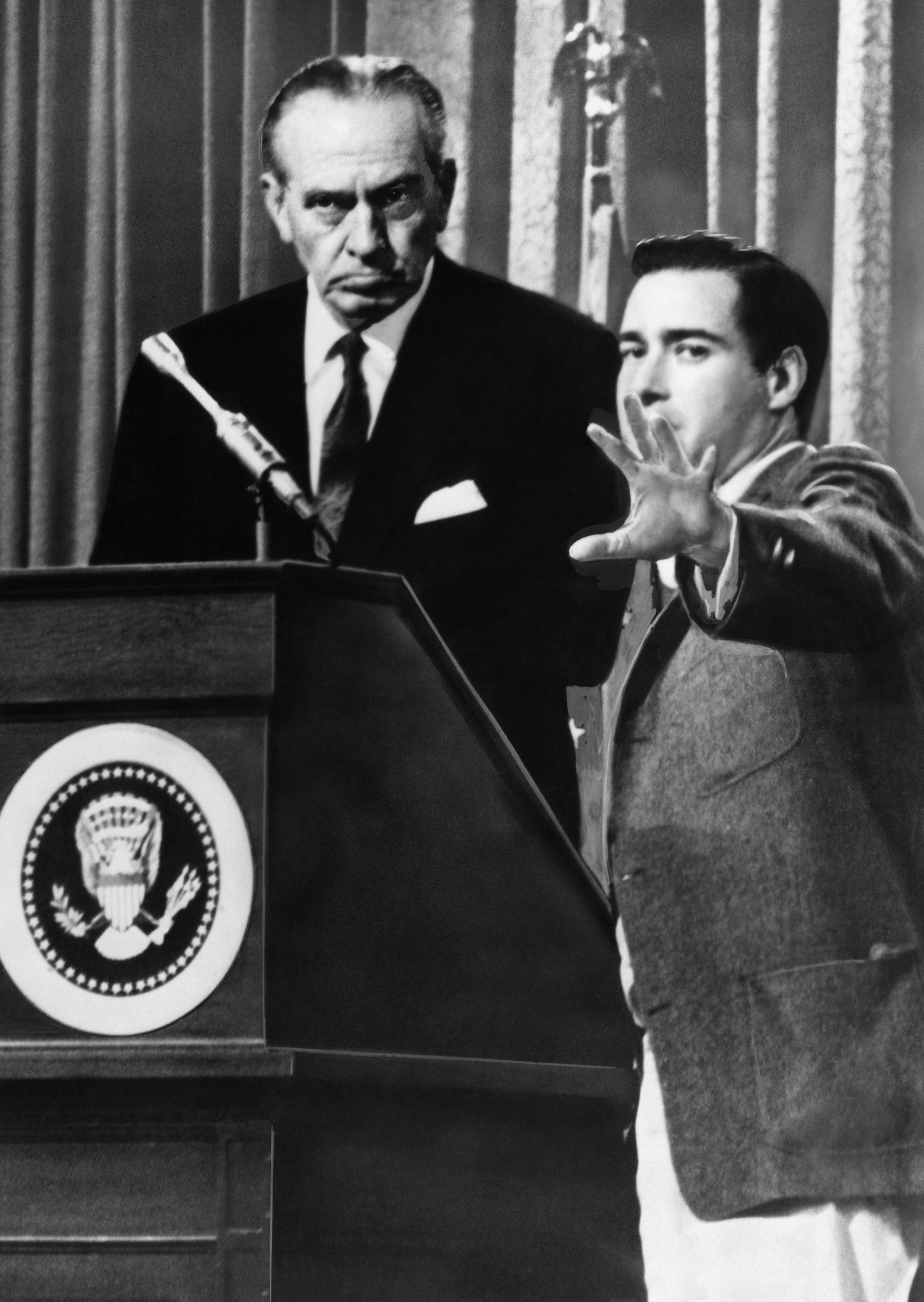
Fredric March, who was born on this day 120 years ago, receives direction from John Frakenheimer on the set of the 1964 film Seven Days in May:

Filmmaker in Focus:

For Talkhouse, Jacob T. Swinney highlights the silent close-ups in the movies of Denis Villeneuve:

[embedded content]

Actor in the Spotlight:

Also by Jacob T. Swinney, this time for Fandor, here’s a video tracking the rise of Steve Carell:

[embedded content]

Cosplay of the Day:

When the real Robert Downey Jr. isn’t available for hospital visits, a cosplaying lookalike Iron Man will do:

The power of cosplay! ?? pic.twitter.com/BNwfIofgIU

— Cosplay Girls (@CosplayGirIs) August 31, 2017

Remixed Movie of the Day:

Eclectic Method took dialogue and sounds from New Jack City and made an appropriately ’90s-sounding dance track:

[embedded content]

Classic Trailer of the Day:

This week is the 70th anniversary of the release of The Bachelor and the Bobby-Soxer. Watch the original trailer for the classic rom-com below.

[embedded content]

and

Let’s block ads! (Why?)


No Image

For Grocery Stores In Texas, It's A Race To Restock Their Shelves

People in Richmond, Texas, line up to gain entrance to a grocery store after it opened for the first time in several days due to Tropical Storm Harvey.

Charlie Riedel/AP

hide caption

toggle caption

Charlie Riedel/AP

Earlier this week, as torrents of rain fell on Houston, Craig Boyan, CEO of the H-E-B supermarket chain, went on a video-taped tour of his company’s emergency operations center in San Antonio, Texas. The company later made the video available online.

It was a revealing look inside a logistical nightmare. Boyan walked through two crowded, windowless rooms, stopping to speak with the people responsible for reopening stores, locating employees (or, as the company calls them, “partners”) to staff those stores, organizing deliveries of water and ice, and figuring out how to line up fresh supplies of milk, eggs and bread despite the city’s waterlogged streets.

One example: H-E-B makes most of its own bread, and its two bread-making plants are located in Corpus Christi and Houston. When the storm hit, “we had to take Corpus down, run the whole company out of Houston,” Boyan explained in the video. When the storm moved on toward Houston, “we had to switch back to Corpus, now we’re on generator power” at that plant. But the company’s supply of fresh bread was never interrupted.

There was a lot more than H-E-B’s own business at stake. Every day without deliveries of food and water could mean hunger for many thousands of people. “One of the things we’re really proud of is being the last to close and the first to open,” Boyan said.

Indeed, H-E-B and other big supermarket chains managed to get stores open and trucks rolling from warehouses at an impressive pace this week.

On Tuesday, at the height of the flooding, Walmart had closed 134 Houston-area storms. By Thursday, only 21 stores remained closed. H-E-B also had reopened almost 90 percent of its stores by then. Of the 20 stores owned by Albertson’s, 16 are now open.

According to Ragan Dickens, a Walmart spokesman, “very few” of the company’s stores actually flooded. The company had to throw out some perishable food, but it was able to reopen any stores that were accessible to trucks and had electrical power.

Dickens says that customers at some locations have been forced to line up outside to prevent overcrowding inside. And some stores remain closed because workers and trucks can’t get to them through flooded roads.

The ability of Houston’s big grocery chains to rebuild their supply chains “is amazing, but not surprising,” says Roni Neff, a professor of Environmental Health and Engineering at Johns Hopkins University. Neff recently co-authored a report on ways that the city of Baltimore could ensure continued food supplies in the face of future disasters, including possible flooding.

“We did a whole set of interviews, and we found that the bigger chains and the bigger businesses had very extensive planning in place” for natural disasters, Neff says.

City governments, on the other hand, don’t always think enough about food supply in their emergency planning, she says. In Baltimore, for instance, “there was an emergency operations center, but nobody [overseeing] food was there.”

Baltimore has now changed that. The city now has a “food resilience coordinator” who is part of emergency planning. “This is something that very few places have done in the past,” Neff says. “I really believe it’s something that everybody should be looking at.”

According to Neff, governments do need to be involved, in addition to supermarkets. “In Houston, as everywhere, the impacts are not equally felt,” she says. “People with lower incomes, people who are elderly, with disabilities, with medically necessary diets, may be particularly hit by this kind of situation, and really have quite severe food security threats to them.” And city governments need to be prepared to get food to these, more vulnerable groups.

In Houston, many supermarket chains, including Walmart, H-E-B, and Albertson’s, have also helped in relief measures. They have delivered truckloads of water and food to large shelters and to food banks, which in turn send food to distribution points in other parts of Houston and nearby areas.

Trucks were only able to reach the central Houston Food Bank starting Wednesday evening. “Now, the wheels are spinning, literally and figuratively,” says Paula Murphy, who handles public communication for the organization.

Seventeen truckloads of non-perishable food and water from Walmart were scheduled to arrive on Thursday, along with three airplane loads of food flown in from Dallas. “As soon as it arrives, it goes out again,” she says. “Our fleet of trucks is out there. The area we can reach is expanding.”

The biggest need, she says, is probably in rural areas outside Dallas, far from any supermarkets, where roads still may be impassable.

Let’s block ads! (Why?)


No Image

For Grocery Stores In Texas, It's A Race To Restock Their Shelves

People in Richmond, Texas, line up to gain entrance to a grocery store after it opened for the first time in several days due to Tropical Storm Harvey.

Charlie Riedel/AP

hide caption

toggle caption

Charlie Riedel/AP

Earlier this week, as torrents of rain fell on Houston, Craig Boyan, CEO of the H-E-B supermarket chain, went on a video-taped tour of his company’s emergency operations center in San Antonio, Texas. The company later made the video available online.

It was a revealing look inside a logistical nightmare. Boyan walked through two crowded, windowless rooms, stopping to speak with the people responsible for reopening stores, locating employees (or, as the company calls them, “partners”) to staff those stores, organizing deliveries of water and ice, and figuring out how to line up fresh supplies of milk, eggs and bread despite the city’s waterlogged streets.

One example: H-E-B makes most of its own bread, and its two bread-making plants are located in Corpus Christi and Houston. When the storm hit, “we had to take Corpus down, run the whole company out of Houston,” Boyan explained in the video. When the storm moved on toward Houston, “we had to switch back to Corpus, now we’re on generator power” at that plant. But the company’s supply of fresh bread was never interrupted.

There was a lot more than H-E-B’s own business at stake. Every day without deliveries of food and water could mean hunger for many thousands of people. “One of the things we’re really proud of is being the last to close and the first to open,” Boyan said.

Indeed, H-E-B and other big supermarket chains managed to get stores open and trucks rolling from warehouses at an impressive pace this week.

On Tuesday, at the height of the flooding, Walmart had closed 134 Houston-area storms. By Thursday, only 21 stores remained closed. H-E-B also had reopened almost 90 percent of its stores by then. Of the 20 stores owned by Albertson’s, 16 are now open.

According to Ragan Dickens, a Walmart spokesman, “very few” of the company’s stores actually flooded. The company had to throw out some perishable food, but it was able to reopen any stores that were accessible to trucks and had electrical power.

Dickens says that customers at some locations have been forced to line up outside to prevent overcrowding inside. And some stores remain closed because workers and trucks can’t get to them through flooded roads.

The ability of Houston’s big grocery chains to rebuild their supply chains “is amazing, but not surprising,” says Roni Neff, a professor of Environmental Health and Engineering at Johns Hopkins University. Neff recently co-authored a report on ways that the city of Baltimore could ensure continued food supplies in the face of future disasters, including possible flooding.

“We did a whole set of interviews, and we found that the bigger chains and the bigger businesses had very extensive planning in place” for natural disasters, Neff says.

City governments, on the other hand, don’t always think enough about food supply in their emergency planning, she says. In Baltimore, for instance, “there was an emergency operations center, but nobody [overseeing] food was there.”

Baltimore has now changed that. The city now has a “food resilience coordinator” who is part of emergency planning. “This is something that very few places have done in the past,” Neff says. “I really believe it’s something that everybody should be looking at.”

According to Neff, governments do need to be involved, in addition to supermarkets. “In Houston, as everywhere, the impacts are not equally felt,” she says. “People with lower incomes, people who are elderly, with disabilities, with medically necessary diets, may be particularly hit by this kind of situation, and really have quite severe food security threats to them.” And city governments need to be prepared to get food to these, more vulnerable groups.

In Houston, many supermarket chains, including Walmart, H-E-B, and Albertson’s, have also helped in relief measures. They have delivered truckloads of water and food to large shelters and to food banks, which in turn send food to distribution points in other parts of Houston and nearby areas.

Trucks were only able to reach the central Houston Food Bank starting Wednesday evening. “Now, the wheels are spinning, literally and figuratively,” says Paula Murphy, who handles public communication for the organization.

Seventeen truckloads of non-perishable food and water from Walmart were scheduled to arrive on Thursday, along with three airplane loads of food flown in from Dallas. “As soon as it arrives, it goes out again,” she says. “Our fleet of trucks is out there. The area we can reach is expanding.”

The biggest need, she says, is probably in rural areas outside Dallas, far from any supermarkets, where roads still may be impassable.

Let’s block ads! (Why?)


No Image

McGregor Fan Poses As Mayweather Guard, Gets Ringside Seat

Oliver Regis was so disappointed in his view — his seat was up in the nosebleed section — that he snuck down into an empty chair in the third row. He posed as part of Mayweather’s security detail.

RACHEL MARTIN, HOST:

Good morning. I’m Rachel Martin. We all know Floyd Mayweather won the big boxing match with Conor McGregor Saturday. But I’d argue there was another victor – a British guy named Oliver Regis. He was so disappointed in his view – his seat was up in a nosebleed section – he snuck down into an empty chair in the third row of the arena posing as part of Mayweather’s security detail. The con was even better because Regis is a McGregor fan with a tattoo on his leg to prove it. It’s MORNING EDITION.

Copyright © 2017 NPR. All rights reserved. Visit our website terms of use and permissions pages at www.npr.org for further information.

NPR transcripts are created on a rush deadline by Verb8tm, Inc., an NPR contractor, and produced using a proprietary transcription process developed with NPR. This text may not be in its final form and may be updated or revised in the future. Accuracy and availability may vary. The authoritative record of NPR’s programming is the audio record.

Let’s block ads! (Why?)