Articles by admin

No Image

President Trump Pivots On Bipartisan Health Care Bill

President Trump said he supports a bipartisan effort that would effectively shore up the Affordable Care Act. But he’s also distanced himself from it. What’s behind the complicated politics at play?

ARI SHAPIRO, HOST:

For more on President Trump’s role in all of this, NPR’s Geoff Bennett joins us now from the White House. Hi, Geoff.

GEOFF BENNETT, BYLINE: Hey, Ari.

SHAPIRO: So as we’ve just heard, this morning the president distanced himself from the bipartisan Alexander-Murray health care deal, saying he can never support bailing out insurance companies. But Geoff, yesterday he seemed to embrace the bill. Walk us through this.

BENNETT: Well, he did. Early yesterday, the president was holding a news conference in the White House Rose Garden with the prime minister of Greece just as news broke on the Hill about this tentative agreement. And when asked about it, the president praised the two senators involved and said he was aware of what they were working on. And he appeared to take partial credit for it.

(SOUNDBITE OF ARCHIVED RECORDING)

PRESIDENT DONALD TRUMP: Yes, we have been involved. And this is a short-term deal because we think ultimately block grants going to the states is going to be the answer. That’s a very good solution.

BENNETT: So you hear him call it a very good solution. But then hours after that yesterday in a speech before the conservative Heritage Foundation, President Trump changed his tone, saying the bill provides, as he put it, bailouts to insurance companies. And then this afternoon, Ari, White House Press Secretary Sarah Huckabee Sanders said the Alexander-Murray bill, while it’s a worthy pursuit, doesn’t go quite far enough.

(SOUNDBITE OF PRESS CONFERENCE)

SARAH HUCKABEE SANDERS: We think that this is a good step in the right direction. This president certainly supports Republicans and Democrats coming to work together. But it’s not a full approach, and we need something to go a little bit further to get on board.

SHAPIRO: Geoff, that’s a quick pivot from hot to cold. What’s going on here?

BENNETT: I think what accounts for this is a Republican Party that doesn’t want to be in what they view as an untenable political position of having to vote to prop up the Affordable Care Act after pledging for seven years to scrap it. So you have groups like FreedomWorks, Heritage Action, the Club for Growth all casting this bill as a betrayal of the Republican promise to repeal and replace Obamacare.

But I’ll tell you. Democrats are really infuriated by what they view as the president’s shifting stance. Senate Minority Leader Chuck Schumer today while speaking with reporters called the president the obstructionist-in-chief for not being able to stick to a position, as Schumer put it. Here he is on the floor of the Senate earlier today.

(SOUNDBITE OF ARCHIVED RECORDING)

CHUCK SCHUMER: He’s totally inconsistent – for it one day, against it the next day. You can’t govern. Mr. President, you cannot govern a country. You cannot keep America great if you don’t know what’s in the bills and don’t have a consistent policy about them.

SHAPIRO: Does this mean it’s the end of the road for this bipartisan health care proposal?

BENNETT: Well, Lamar Alexander told my colleague Sue Davis, who covers the Hill, that he sees the White House pushback as part of the overall legislative process. But I think it’s impossible for Republican lawmakers to support this deal without President Trump’s stated endorsement. There’s just not enough political cover for Republicans to vote for it. And then over in the House, you have House Speaker Paul Ryan saying he wouldn’t even bring such a stabilization bill to the House floor for a vote. So right now, it seems that there aren’t enough votes for it. And without the president’s support, it looks like this bill doesn’t really go very far.

SHAPIRO: So if this bill doesn’t go very far and congressional efforts to repeal and replace the Affordable Care Act have failed, where do things stand?

BENNETT: Well, there are other options facing lawmakers. But again, there’s just – the incentive structure, particularly on the Republican side, just does not exist for the – for Republicans to stand up and to give yes votes for this bill on the floor either in the House or the Senate. So right now we’re really at an impasse.

SHAPIRO: That’s NPR White House correspondent Geoff Bennett telling us about the latest developments on the health care debate. Thanks, Geoff.

BENNETT: You’re welcome.

Copyright © 2017 NPR. All rights reserved. Visit our website terms of use and permissions pages at www.npr.org for further information.

NPR transcripts are created on a rush deadline by Verb8tm, Inc., an NPR contractor, and produced using a proprietary transcription process developed with NPR. This text may not be in its final form and may be updated or revised in the future. Accuracy and availability may vary. The authoritative record of NPR’s programming is the audio record.

Let’s block ads! (Why?)


No Image

Officers Fired After Forcible Removal Of United Airlines Passenger

A United Airlines jet taxis to a gate at O’Hare International Airport in Chicago in June.

Kiichiro Sato/AP

hide caption

toggle caption

Kiichiro Sato/AP

Two security officers who were caught on video in April forcibly removing a passenger from a United Airlines flight in Chicago were fired following the incident that sparked widespread public outrage.

In a report, Chicago’s Office of the Inspector General found that three Chicago Department of Aviation security officers “improperly escalated the incident” and that a sergeant “made misleading statements and deliberately removed material facts from their reports” on the April 9 incident aboard United Express Flight 3411 from Chicago to Louisville, Ky., according to The Associated Press.

Several fellow passengers used their mobile phones to film the incident. Those videos were widely shared on social media and turned into a major public relations debacle for the airline. In them, officers are seen grabbing the passenger — Dr. David Dao — who was selected apparently at random to be removed from the overbooked flight.

As NPR’s Camila Domonoske reported at the time, Dao, 69:

“… was told he had to give up his ticket so a United crew member could take his seat. The man refused: He’s a doctor and said he had patients he had to see.”

“United called security officers, who violently wrenched the man from his seat,bloodying his face, and dragged his limp body down the aisle. The passenger, David Dao, is at a hospital in Chicago recovering from his injuries, member station WFPL reports.”

[embedded content]
YouTube

Dao’s attorney, Thomas Demetrio, said his client sustained a broken nose and lost teeth as he was dragged off the flight. United apologized for the incident and later reached an undisclosed settlement with Dao for his injuries.

Besides the two officers who were fired, two others received short-term suspensions and one of them subsequently resigned, the report says. The names of the four were not released.

Demetrio told the AP on Tuesday that he and his client were not expecting the dismissal of the security officer who is not a sergeant, but said it may resonate with others.

“In firing him, perhaps it will send a clear message to police and airline personnel all over the world that unnecessary violence is not the way to handle passenger matters,” Demetrio told the news agency.

Let’s block ads! (Why?)


No Image

Today in Movie Culture: 'Geostorm' Pranks New York City, Alternate 'Spider-Man: Homecoming' Endings and More

Here are a bunch of little bites to satisfy your hunger for movie culture:

Prank of the Day:

Warner Bros. fooled a bunch of people in New York City with a sudden weather change to promote Geostorm (via Geekologie):

[embedded content]

Alternate Sequel of the Day:

What if Jurassic Park II was much different and starred Bruce Willis along with a returning Samuel L. Jackson? Here’s a fake trailer showing the answer by Rich Williamson:

[embedded content]

Alternate Endings of the Day:

Just in time for today’s home video release, here’s a funny animated look at how Spider-Man: Homecoming should have ended:

[embedded content]

Effects Breakdown of the Day:

Speaking of Spider-Man: Homecoming, Imageworks shares how they animated the title superhero in his new movie:

[embedded content]

Vintage Image of the Day:

Michael McKean, who turns 70 today, in a publicity photo for his role as Mr. Green in 1985’s Clue:

Film Studies Lesson of the Day:

Now You See It looks at the meaning of physical injuries in movies and how it usually also represents something internal:

[embedded content]

Movie Science of the Day:

For Nerdist, Kyle Hill scientifically explains how deflector shields work in the Star Trek movies and TV shows:

[embedded content]

Cosplay of the Day:

If the director of the movie says it’s true, then this is indeed the best Doctor Strange cosplay ever:

Best ever Doctor Strange cosplay by my friend and superfan @AbzJHarding pic.twitter.com/sIA7ZWwiXo

— Scott Derrickson (@scottderrickson) October 17, 2017

Movie Trivia of the Day:

With Halloween coming up, CineFix shares nine things you probably don’t know about the Scream movies:

[embedded content]

Classic Trailer of the Day:

Today is the 20th anniversary of the release of I Know What You Did Last Summer. Watch the original trailer for the classic horror movie below.

[embedded content]

and

Let’s block ads! (Why?)


No Image

NFL And Players Meet, But Punt On Anthem Controversy

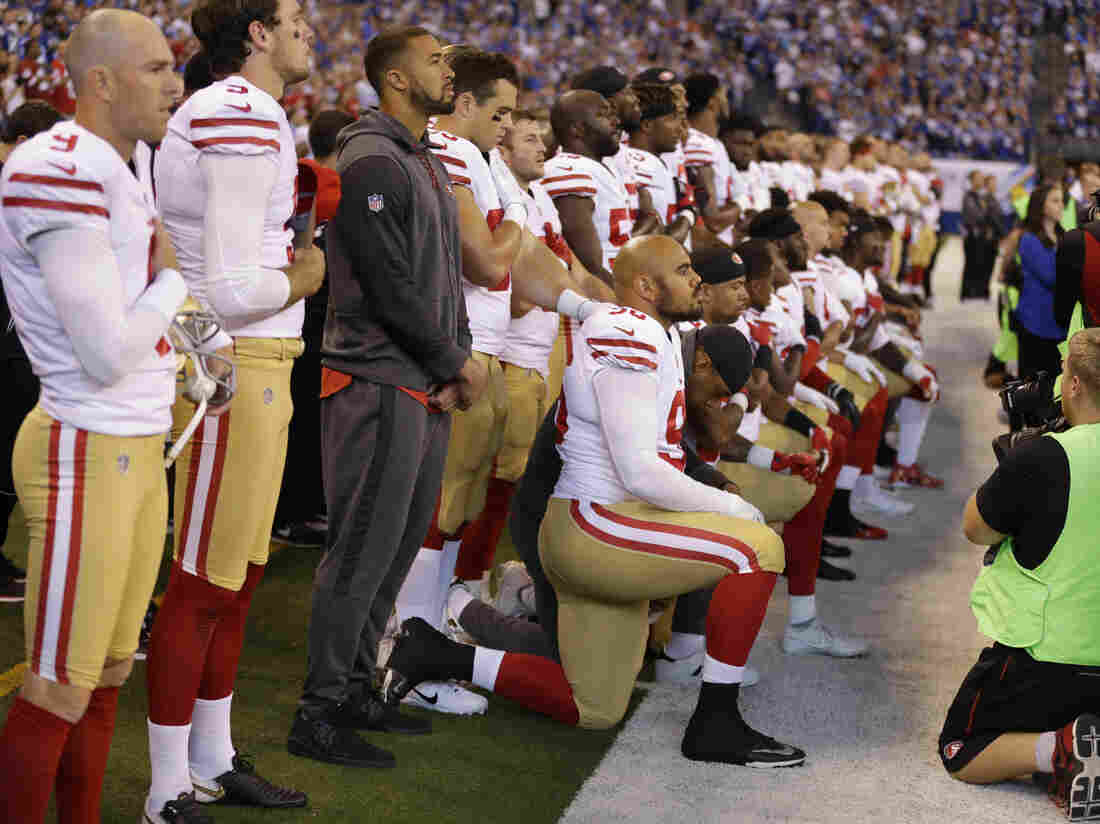
Members of the San Francisco 49ers kneel during the playing of the national anthem before an NFL football game against the Indianapolis Colts, earlier this month.

Michael Conroy/AP

hide caption

toggle caption

Michael Conroy/AP

NFL owners and players met at league headquarters in New York on Tuesday but failed to resolve the contentious issue of national anthem protests.

Eleven owners and 13 players attended the meeting that lasted for several hours and was variously described as “positive” and “constructive,” but didn’t break any new ground on the protests that have seen players take a knee, sit or raise fists during pregame renditions of the national anthem to protest against racial inequality and police shootings of unarmed black men.

NPR’s Tom Goldman tells All Things Considered that there “were hopes Tuesday’s meeting would bring a resolution — players agreeing to stop or curtail the demonstrations, the league and team owners agreeing to address the players’ issues.” However, the meeting ended without that.

“We heard what they had to say and they heard us,” Miami Dolphins owner Stephen Ross said. “It’s open talks and that’s a good thing.”

NFL commissioner Roger Goodell said the league “did not ask” for any change to the policy on the national anthem. That policy says players “should” stand for performance of “The Star-Spangled Banner,” but in the wake of the protests, some have suggested changing that language to “must.”

The NFL Players Association union and the league issued a joint statement, saying the sides came together “to promote positive social change and address inequality in our communities.”

“NFL executives and owners joined NFLPA executives and player leaders to review and discuss plans to utilize our platform to promote equality and effectuate positive change. We agreed that these are common issues and pledged to meet again to continue this work together,” the statement read.

“As we said last week, everyone who is part of our NFL community has a tremendous respect for our country, our flag, our anthem and our military. In the best American tradition, we are coming together to find common ground and commit to the hard work required for positive change,” it continued.

Last week, Commissioner Goodell said in a memo to the teams that the league prefers for players to stand during the anthem.

Philadelphia Eagles safety Malcolm Jenkins, who has been a leading spokesman for the players on this issue, said the discussion covered “everything to do with the state of the NFL now, obviously anthem protests, activism that players have been doing, and how we can move this forward to really amplify players’ voices and amplify these issues and make some long sustainable changes.”

“I’m not sure we’re close to a resolution, but conversations are ongoing,” he added.

Indianapolis Colts defensive back Darius Butler told Sports Illustrated that it was a good dialogue, adding, “it’s not going to be fixed overnight.”

The protests were touched off a year ago when then-San Francisco 49ers Quarterback Colin Kaepernick began taking a knee for the anthem. When President Trump weighed in last month saying owners should “fire” players for such protests, the issue snowballed into a national debate over those who see the matter as one of free speech and others who see it as a lack of respect for the flag and the national anthem.

Kaepernick, who became a free agent this season has remained unsigned. Earlier this week his attorney said he was filing a grievance against the NFL and owners for allegedly conspiring to shut him out of the league over the protests.

Let’s block ads! (Why?)


No Image

Senators Reach Deal To Stabilize ACA Insurance Markets For 2 Years

Sens. Patty Murray, D-Wash., and Lamar Alexander, R-Tenn., say they have a tentative agreement to appropriate the subsidies for the next two years, restore money used to encourage people to sign up for Affordable Care Act health plans, and make it easier for states to design their own alternative health care systems.

Tom Williams/CQ-Roll Cal via Getty Images

hide caption

toggle caption

Tom Williams/CQ-Roll Cal via Getty Images

Updated at 10:25 p.m. ET

Less than a week after President Trump said he is cutting off subsidies to health insurance companies, lawmakers say they have a deal to restore the money and take other actions that could stabilize insurance markets for next year.

Sens. Lamar Alexander, R-Tenn., and Patty Murray, D-Wash., say they have a tentative agreement to appropriate the subsidies for the next two years, restore money used to encourage people to sign up for Affordable Care Act health plans, and make it easier for states to design their own alternative health care systems.

Alexander said the idea is to stabilize the markets in the short term while Congress continues to debate long-term changes to the ACA.

“Over the next two years, I think Americans won’t have to worry about the possibility of being able to buy insurance in the counties where they live,” he said in a conversation with reporters at the Capitol on Tuesday.

He said he spoke with President Trump over the weekend and that Trump said he supports the idea. However, Senate Majority Leader Mitch McConnell, R-Ky., would not commit to bringing the bill up for a vote, as Murray and Alexander seek enough support to ensure it could pass. The bill would need 60 votes to get across the finish line and would require at least a dozen Republicans to take a difficult political step in voting to shore up parts of Obamacare.

In a speech to the Heritage Foundation on tax changes on Tuesday evening, Trump mentioned the tentative deal.

“And I’m pleased the Democrats have finally responded to my call for them to take responsibility for their Obamacare disaster and work with Republicans to provide much-needed relief to the American people. While I commend the bipartisan work done by Senators Alexander and Murray — and I do commend it — I continue to believe Congress must find a solution to the Obamacare mess instead of providing bailouts to insurance companies.”

Earlier, during a news conference with Greek Prime Minister Alexis Tsipras Tuesday in the Rose Garden, Trump declared the Affordable Care Act “virtually dead” but said he supports the Alexander-Murray deal.

“It’s a short-term solution,” Trump said in response to a question about the deal. “The solution will be for about a year or two years and it will get us over this intermediate hump.”

The deal comes just days after the president said he is cutting off reimbursements to insurance companies for discounts they are required by law to give to low-income customers to reduce the burden of copayments and deductibles. They’re known as “cost-sharing reduction” payments.

The deal reached Tuesday, if it becomes law, would restore those payments for at least the next two years.

The agreement, which Murray says has not yet been finalized, would also make it easier for states to get waivers so they can set up alternative health insurance systems and offer a wider variety of insurance policies.

Alexander said those plans would retain the minimum coverage requirements under the ACA but could vary the definition of what is affordable. The deal also allows more people to buy so-called catastrophic plans that cover major illness but pay for less routine care.

“This is a small step,” Alexander said. “I’d like to undersell it rather than oversell it.”

An analysis by Charles Gaba, who runs a website, ACASignups.net, that tracks enrollment and costs of ACA insurance, showed that premiums are set to rise an average of 30 percent next year, with premiums in some states, including Iowa, rising much more.

As premiums rise, consumers who don’t think they need much health care are less likely to buy coverage, leaving sicker people in the market. Because those sicker customers spend a lot of money on care, they drive premiums up even higher. With restoration of the cost-sharing subsidies, those premium increases could be far smaller.

For much of this year, Trump had been threatening to cut off the subsidies. So insurance companies in many states filed paperwork to sell policies on the ACA exchanges next year that included two sets of premiums — one if the cost-sharing payments continued, and another if they were cut off. The deadline to finalize those prices was in late September, however, and it’s not clear companies will be allowed to cut their prices if the Alexander-Murray deal becomes law.

The agreement would also restore $106 million in money to publicize the open enrollment period for ACA health insurance. Trump had cut the budget for ACA outreach by 90 percent earlier this year, a move many advocates said would suppress enrollment.

Lori Lodes, who ran ACA outreach during the Obama administration, said that money will only be effective if it is approved early enough to reach those who need coverage. Open enrollment on the federal exchange begins on Nov. 1 and ends on Dec. 15.

Murray said she and Alexander had had discussions with more than half the Senate about the bill and she believed the plan would get broad support. Alexander said they’ll work to get co-sponsors for the legislation throughout the week so they can bring a bill to McConnell for consideration. McConnell has not said whether he supports the effort.

Let’s block ads! (Why?)


No Image

Today in Movie Culture: Oscar Issac and Eva Green in 'The Addams Family,' a 'Justice League' Parody and More

Here are a bunch of little bites to satisfy your hunger for movie culture:

Fan Casting of the Day:

A lot of people want a new Addams Family movie starring Oscar Isaac and Eva Green, so BossLogic shows us what that could look like:

Been seeing this fan-casting of Oscar Isaac and Eva Green online for a New Addams Family and I love the idea pic.twitter.com/kbeiYSNVdM

— BossLogic (@Bosslogic) October 13, 2017

Movie Parody of the Day:

The Justice League trailer gets a silly animated spoof with this ArtSpear Entertainment video:

[embedded content]

Fan Project of the Day:

A movie fan has created an imaginary road map of “Movieland” with great movies as locations around this world. Watch the Kickstarter trailer for the posters below and get a large glimpse of the map here.

Reworked Movie of the Day:

What if The Book of Henry was made by Wes Anderson? The Royal Ocean Film Society shows why it fails with Colin Trevorrow at the helm instead:

[embedded content]

Vintage Image of the Day:

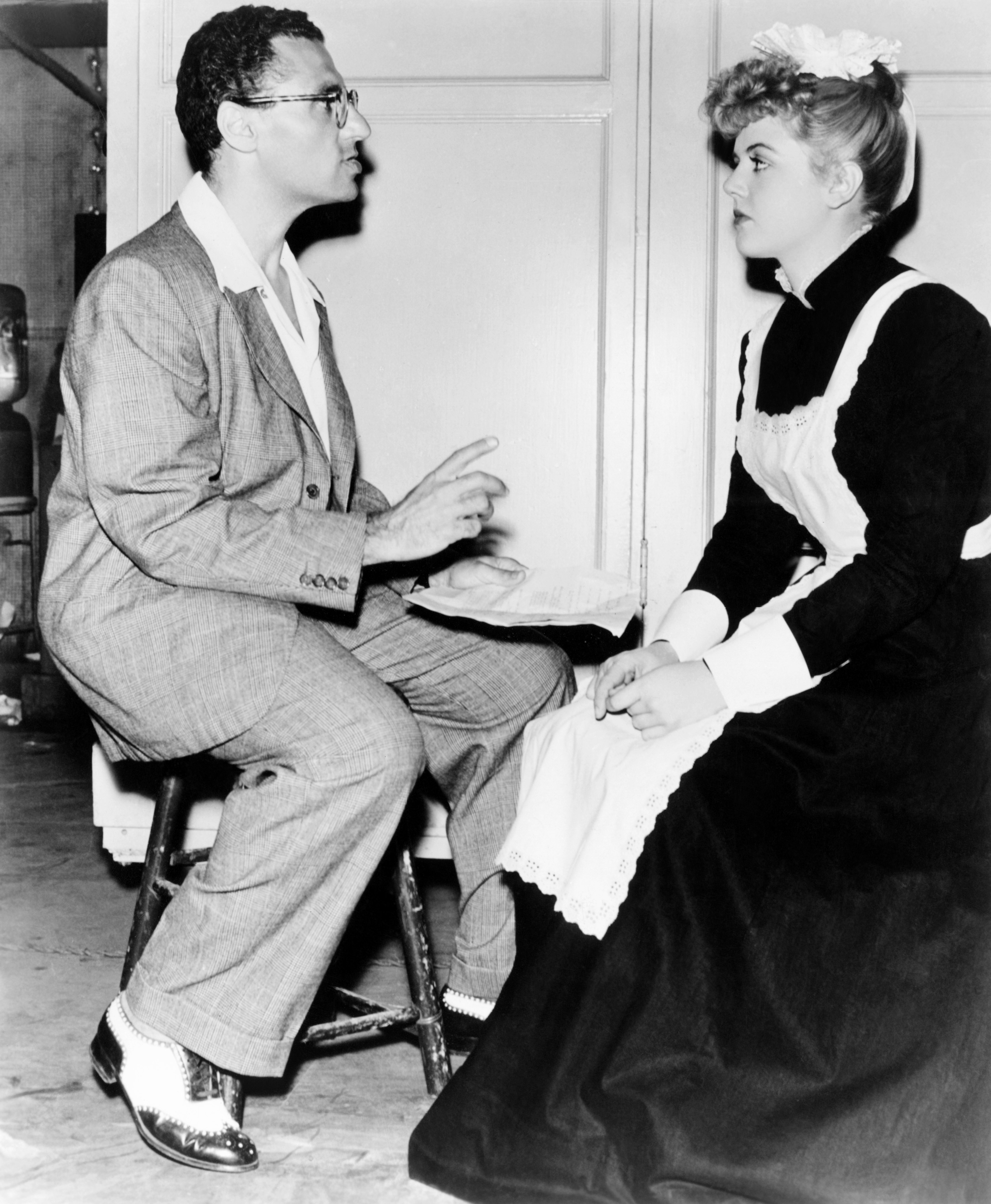
Angela Lansbury, who turns 92 today, with director George Cukor on the set of Gaslight, her Oscar-nominated film debut, in 1943:

Actor in the Spotlight:

For Fandor, Jacob T. Swinney tracks the career of Black Panther and Marshall star Chadwick Boseman:

[embedded content]

Cosplay of the Day:

Speaking of Black Panther, here’s some perfect cosplay posted just in time for the new trailer:

When are we moving to Wakanda? Cos i’m ready tbh! #BlackPanther#BlackPantherSoLitpic.twitter.com/OBVIohpned

— Andrien ?? Twitchcon (@EscoBlades) October 14, 2017

Bad Film Analysis of the Day:

Learn the “hidden meaning” of The Exorcist from an alien in the future with the latest edition of Earthling Cinema:

[embedded content]

Movie Takedown of the Day:

MatPat of The Film Theorists makes a case that The Emoji Movie is not just bad, it’s literally illegal:

[embedded content]

Classic Trailer of the Day:

Today is the 30th anniversary of the release of John Boorman’s Hope and Glory. Watch the original trailer for the Best Picture-nominated World War II drama below.

[embedded content]

and

Let’s block ads! (Why?)


No Image

Rick Pitino Fired As Louisville Basketball Coach Amid Massive Bribery Probe

Rick Pitino, seen during Louisville’s second-round loss in the 2017 NCAA men’s basketball tournament.

Joe Robbins/Getty Images

hide caption

toggle caption

Joe Robbins/Getty Images

The University of Louisville has fired men’s basketball coach Rick Pitino, ending his tenure with the team roughly three weeks after the program was implicated in a federal bribery and fraud investigation. The board of the school’s athletic association voted unanimously during a closed-door meeting Monday to terminate his contract with “just cause.”

During the course of the hourslong meeting, Pitino’s lawyers argued that the coach was unaware of an alleged scheme to secretly funnel cash — in the words of acting U.S. Attorney Joon H. Kim — from “employees of one of the world’s largest sportswear companies … to the families of high school recruits.”

BREAKING- ULAA Board unanimously votes to fire Rick Pitino @whas11pic.twitter.com/VCMrTtkqHF

— Derrick Rose WHAS11 (@WHAS11DRose) October 16, 2017

But university officials remained unconvinced by the lawyers’ argument.

“We listened carefully to what they said, we read carefully everything they gave us,” interim President Gregory Postel told reporters Monday, “but we felt that our initial decision to begin the process of termination for cause was still in the best interest of the university.”

[embedded content]

Pitino had been placed on unpaid leave late last month, when the school put his employment under review.

The decision is the latest episode in a storied — if scandal-plagued — career on the sideline for Pitino. Before he was placed on unpaid leave late last month, Pitino had spent more than a decade and a half with Louisville, where he won a national championship in 2013 — just hours after his induction into the Basketball Hall of Fame.

But that championship was vacated earlier this year, after the NCAA found the program guilty of more wrongdoing: “arranging striptease dances and sex acts for prospects, student-athletes and others.” In addition to losing its records over a span of more than three years, Louisville was placed on probation for another four — and the NCAA called for Pitino to be suspended for several games in the coming season for his alleged failure of oversight.

As ESPN noted last month, other scandals have clouded Pitino’s career, despite successes including a national title for Louisville’s cross-state rival, the University of Kentucky. The network reports his run-ins with the NCAA date back to the very early years of his career with the University of Hawaii.

But it was the FBI probe that helped provide the coup de grace for Pitino’s time with Louisville.

Member station WFPL reported on the alleged illicit payments — which led to arrests at four universities, though not at Louisville:

“In court filings, prosecutors describe two scenarios in which an Adidas staffer secured payments for families of U of L recruits. In one instance, an Adidas employee arranged for $100,000 and ongoing monthly payments allegedly funneled through a third-party company for a high school player, who is currently a freshman athlete at the school.

“That athlete is widely believed to be star recruit Brian Bowen.”

Adidas also announced Monday that it had terminated its deal with Pitino, according to ESPN.

Postel asserted “there isn’t just a single reason” that led the school to fire Pitino.

“There were a number of issues that over time were brought to our attention,” Postel said, “and we simply felt that this was in the best interest of the university to make the decision at this point in time.”

Let’s block ads! (Why?)


No Image

Florida Man Awarded $37,500 After Cops Mistake Glazed Doughnut Crumbs For Meth

A Krispy Kreme doughnut was to blame for a white substance that led to an Orlando man being jailed on drug charges. Results from roadside drug test kits conducted by law enforcement officers can be unreliable.

Joe Raedle/Getty Images

hide caption

toggle caption

Joe Raedle/Getty Images

It sounds like a joke, but, well — keep reading.

In December 2015, 64-year-old Daniel Rushing had just dropped off a friend at chemotherapy and was driving home an older woman from his church who worked at the 7-Eleven and would otherwise walk the 2 miles home.

As Rushing drove away from the convenience store, police pulled him over. The officer said he had been driving 42 miles an hour in a 30 zone and had failed to come to a complete stop before entering the roadway. When Rushing handed over his driver’s license, Officer Shelby Riggs-Hopkins noticed his concealed-weapons permit. Rushing confirmed he had a pistol, and she asked him to step out of the car for her safety.

The officer then asked if police could search his car, and Rushing said sure — if it meant he wouldn’t be ticketed. Rushing watched as the officers, who now numbered four, conducted a very thorough inspection of his car.

Finally, Riggs-Hopkins said to him, “You want to tell me about what we found?”

“There’s nothing to find,” he said, confused.

But Riggs-Hopkins had noticed some crystals on the floorboard of the car, and when officers used a field testing kit, the white substance tested positive for methamphetamine.

Rushing said that was impossible: “I’ve never even smoked a cigarette,” he protested.

The officer showed him the substance in question, and Rushing was aghast.

“That’s glaze from a Krispy Kreme doughnut!” he explained. “I get one every other Wednesday.”

But officers weren’t buying it. Rushing was booked on charges of possessing methamphetamine while armed with a weapon.

As he sat in jail, he asked himself, “Lord, what am I doing here?”

“It was funny,” Rushing says, “because I called my wife to tell her what happened, and the guy next to me waiting for the phone started to laugh. He said, ‘This is crazy. I think you got a real good lawsuit here.’ “

He spent more than 10 hours in jail before being released on bail.

Orlando police sent the evidence it had collected from Rushing’s car to the Florida Department of Law Enforcement for further testing — which determined that just as he’d said, the white crystals were not a controlled substance. (Results did not indicate whether the substance was sweet and delicious.)

All charges against Rushing were dropped.

It would be a funnier story if it hadn’t been so closely replicated in Oviedo, a Florida city northeast of Orlando.

Karlos Cashe was pulled over in March for driving without headlights and arrested by Oviedo police when court records showed that he was out past his court-ordered curfew. Those records were later shown to be out of date and inaccurate, ABC affiliate WFTV reported.

Police saw white dust on the floorboards of Cashe’s car and tested it with a field kit. The substance showed positive for cocaine.

Cashe went to jail for 90 days – 90 days in which he knew that the white substance in his car was simply drywall dust.

“I know for a fact it’s drywall because I’m a handyman,” Cashe told WFTV. “I said that continuously during the arrest stop.”

Police in Orlando and Oviedo, like many other law enforcement agencies, use inexpensive field kits to test for drugs. Orlando’s police use NIK brand narcotic testing kits. A NIK general screening kit, which tests for opiates, meth and other drugs, costs just $18 for a box of 10.

But such roadside test kits are far from foolproof.

A 2016 investigation by ProPublica and The New York Times found that tens of thousands of people are sent to jail each year based on the kits’ results, which often generate false positives:

“Some tests … use a single tube of a chemical called cobalt thiocyanate, which turns blue when it is exposed to cocaine. But cobalt thiocyanate also turns blue when it is exposed to more than 80 other compounds, including methadone, certain acne medications and several common household cleaners. Other tests use three tubes, which the officer can break in a specific order to rule out everything but the drug in question — but if the officer breaks the tubes in the wrong order, that, too, can invalidate the results. The environment can also present problems. Cold weather slows the color development; heat speeds it up, or sometimes prevents a color reaction from taking place at all.”

Data from the state law enforcement lab in Florida found that 21 percent of the evidence recorded by police as methamphetamine was not in fact methamphetamine, and of that, half was not illegal drugs at all, according to the ProPublica investigation: “When we examined the department’s records, they showed that officers, faced with somewhat ambiguous directions on the pouches, had simply misunderstood which colors indicated a positive result.”

Those findings are part of what spurred Rushing to file a lawsuit against the city of Orlando after the charges against him were dropped. Two weeks ago, Rushing says he reached a settlement with the city for $37,500.

“I thought [the lawsuit] was the right thing to do, for what they did to me,” he tells NPR.

An Orlando police spokeswoman says that after the Rushing incident, the department conducted an internal investigation and officers received additional training in using the field kits — but it’s still using the same NIK narcotic test kits.

The Safariland Group, which makes the NIK tests, told ProPublica that it provides all law enforcement agencies with comprehensive field test training manuals, in addition to its instructions, and says its products are not intended for use other than directed.

“These training materials, which outline protocols for use, clearly state that the tests are presumptive aids that serve only as confirmation of probable cause and are not a substitute for laboratory testing,” the company wrote in a statement.

For his part, Rushing bears no ill will toward the city’s police department and says that the arresting officer was “very polite and nice.” He worked alongside the police as a parks department employee for more than 25 years, and his brother is a former Orlando cop.

He says the issue is that the department keeps using the kits, despite the well-documented problems with using them.

“These kits give a false positive 1 out of every 5 times,” he says. “I’m thinking about running for statehouse next year. And if I do, I’d like to get something done about these kits.”

With the lawsuit behind him, Rushing’s next step is getting his record expunged. He says he would like to find more work in security — but it’s been hard to get business with a record showing an arrest for possession of meth while armed.

After the glaze incident, Rushing stopped by his local Krispy Kreme to let the people there know they might be in for a little publicity.

Sometimes they give him a free doughnut.

“But I don’t eat them in the car,” he says, laughing.

Let’s block ads! (Why?)


No Image

Washington Post, 60 Minutes Investigation Finds Bill Helped Fuel Opioid Crisis

NPR’s Kelly McEvers talks to Scott Higham of The Washington Post about the paper’s investigation of drug industry efforts to lobby the Drug Enforcement Administration and Congress to weaken enforcement on opioid abuse.

MARY LOUISE KELLY, HOST:

I’m Mary Louise Kelly in Washington where in the Rose Garden today President Trump had to defend his nominee to lead the White House Office of National Drug Control Policy. That would be the position known as the drug czar.

(SOUNDBITE OF ARCHIVED RECORDING)

PRESIDENT DONALD TRUMP: As far as Tom Marino – so he was a very early supporter of mine – the great state of Pennsylvania. He’s a great guy. I did see the report. We’re going to look into the report. We’re going to take it very seriously.

KELLY: The president referring there to a new report by The Washington Post and “60 Minutes.”

KELLY MCEVERS, HOST:

The investigation found that a bill sponsored by Tom Marino and pushed by the drug industry helped pump more painkillers into parts of the country that were already in the middle of the opioid crisis. Scott Higham helped write the story for The Washington Post.

SCOTT HIGHAM: Say a distributor in Ohio or in Michigan was sending pills downstream to pharmacies in Florida. And one month, that pharmacy was ordering 10,000 pills, and the next month, that pharmacy was ordering a hundred thousand pills. Well, that’s supposed to be reported to the DEA as a suspicious order. And a lot of these companies were not doing that.

MCEVERS: The Drug Enforcement Agency, the DEA, would call that an imminent threat to a local community and freeze drug shipments from the company’s warehouse. Marino’s bill changed that standard to an immediate threat, which doesn’t sound like a big difference, but it is.

HIGHAM: It’s almost impossible to show that a company that is a thousand miles away is posing an immediate threat to a community. Now, they may be able to show that a doctor in your hometown or a pharmacist in your hometown is posing an immediate threat, and they can shut that person down. But the big companies, the distributors and the manufacturers – they’re not going to be able to go after them.

MCEVERS: Co-Sponsors of Marino’s bill say that DEA enforcement was getting in the way of seniors and veterans, people who legitimately needed painkillers. I mean, is that a valid concern?

HIGHAM: Well, you know, you hear that from time to time. I mean, some of this comes from groups that are funded by the industry, but that’s not to diminish that there are people out there who sometimes have trouble getting their medications. But what we’re talking about here is the abuse and sale of hundreds of millions of doses of oxycodone and Vicodin to the black market.

MCEVERS: Yeah.

HIGHAM: And that’s the thing that the DEA was trying to shut down.

MCEVERS: And officials at the DEA opposed these changes for years but eventually backed down. And this bill, you know, in the end sailed through Congress, and President Obama signed it. What happened?

HIGHAM: That’s exactly right, Kelly. We’ve obtained internal memos, emails, other documents from the DEA and from the Justice Department that show that the DEA and the Department of Justice for many years was opposed to this. They had written memos. They had written emails saying this is going to upend our ability to go after these companies. Why are you doing this? And Marino had introduced this legislation in 2014, and the DEA got it killed; and in 2015, and the DEA got it killed.

And then there was a change in leadership. Eric Holder stepped down. Loretta Lynch took over the AG’s office. And then there was a new DEA administrator who came in who said that, I think that we need to work with these people. And there was also enormous amounts of pressure being placed on the DEA by Capitol Hill to pass this bill. And it was at the behest of the pharmaceutical industry. In fact, the bill was written by a pharmaceutical industry attorney who used to be a DEA attorney, one of – a senior DEA attorney. So it’s, you know, the classic kind of revolving door in Washington.

MCEVERS: Wow. And so what’s happened since this bill went into effect?

HIGHAM: So the number of immediate suspension orders has plummeted to zero against major manufacturers and distributors. There have been some immediate suspensions orders filed against smaller companies. But these very big companies, the ones that were backing this bill – they’ve had no actions taken against them at all.

MCEVERS: Senator Claire McCaskill of Missouri said today she will introduce a bill to repeal the Marino law. And Senator Joe Manchin of West Virginia wrote a letter to President Trump asking him to withdraw his nomination of Marino as drug czar. Do you think either of these efforts will go anywhere?

HIGHAM: Well, we’ll see. Not a lot’s happening in Washington these days, as we all know. Our reporting shows that a lot of the members of Congress weren’t really aware what was in this bill and what the import of this bill was because it was just passed by unanimous consent, which means that, you know, there’s no vote. There’s really no debate. They took the word of the leadership that this bill was OK. But you know, we’ll have to wait and see what happens. And as far as Mr. Marino’s tenure, it’s now in the hands of the president.

MCEVERS: Scott Higham of The Washington Post, thanks a lot.

HIGHAM: Thank you, Kelly.

Copyright © 2017 NPR. All rights reserved. Visit our website terms of use and permissions pages at www.npr.org for further information.

NPR transcripts are created on a rush deadline by Verb8tm, Inc., an NPR contractor, and produced using a proprietary transcription process developed with NPR. This text may not be in its final form and may be updated or revised in the future. Accuracy and availability may vary. The authoritative record of NPR’s programming is the audio record.
Let’s block ads! (Why?)


No Image

Kaepernick Files Grievance Saying NFL, Owners Conspired To Shut Him Out

San Francisco 49ers Eric Reid (35) and Colin Kaepernick (7) take a knee during the National Anthem prior to their season opener against the Los Angeles Rams during an NFL football game on Monday, Sept. 12, 2016, in Santa Clara, CA.

Daniel Gluskoter/AP

hide caption

toggle caption

Daniel Gluskoter/AP

Free-agent NFL quarterback Colin Kaepernick has filed a grievance against the NFL and team owners alleging that they colluded to keep him out of the league following his pregame protests during the National Anthem.

Kaepernick, the former San Francisco 49ers quarterback who took a knee during the playing of the national anthem before games last season to protest police treatment of blacks, alleges that the NFL and team owners violated anti-collusion provisions in the league’s collective bargaining agreement with its players.

“If the NFL (as well as all professional sports teams) is to remain a meritocracy, then principled and peaceful protest — which the owners themselves made great theater imitating weeks ago — should not be punished and athletes should not be denied employment based on partisan political provocation by the Executive Branch of our government,” Kaepernick’s attorney, Mark Geragos said in a statement, according to ESPN.

“Such a precedent threatens all patriotic Americans and harkens back to our darkest days as a nation. Protecting all athletes from such collusive conduct is what compelled Mr. Kaepernick to file his grievance,” Geragos said.

ESPN writes:

“Kaepernick is not going through the NFL Players Association but has instead hired Geragos, who has represented several high-profile clients, including Michael Jackson, former NASCAR driver Jeremy Mayfield and musician Chris Brown.”

As NPR’s Tom Goldman reported back in August, when it became clear that Kaepernick would go unsigned by any team, collusion is difficult to prove.

The language of the provision in the collective-bargaining agreement that Kaepernick cites requires “clear and convincing evidence of a violation.”

Even so, Tom explains in a newscast report, “to prove collusion, [Kaepernick] doesn’t have to show every team is conspiring – it can be as few as two teams, or one team and the league agree they want to keep out the former Super Bowl quarterback.”

Let’s block ads! (Why?)