
Articles by admin

No Image

Fallout Between USA Gymnastics And U.S. Olympic Committee Continues

The sentencing of former doctor Larry Nassar has increasingly put pressure on the U.S. Olympic Committee and USA Gymnastics. NPR’s Mary Louise Kelly talks to Juliet Macur of The New York Times about the fallout.

MARY LOUISE KELLY, HOST:

USA Gymnastics says its entire board of directors will resign. This comes after the U.S. Olympic Committee threatened to revoke the organization’s status as a national governing body for the sport of gymnastics. It’s the latest fallout from the Larry Nassar case.

The sentencing of Nassar, the former team doctor, has focused scrutiny on institutions associated with him, including both USA Gymnastics and the U.S. Olympic Committee. Juliet Macur has been writing about all this for The New York Times. Welcome back to the show.

JULIET MACUR: Thank you.

KELLY: What is your reaction to news of the entire board stepping down?

MACUR: It’s about time. The USOC sent a letter just yesterday requesting that the entire board step down and all this reorganization going on with USA Gymnastics. But that letter is probably a year and a half too late.

KELLY: The letter that you mentioned laid out six demands. This demand that the entire board step aside was the first one. What else leapt out at you in terms of what the U.S. Olympic Committee is calling for?

MACUR: They’re calling for the new USAG board to have ethics training, which I thought was interesting, that they might not be trained in ethics already…

KELLY: Yeah.

MACUR: …And also sexual abuse awareness training, which you would figure is necessary for any organization that governs tens of thousands of young people in sports. So the USOC said USA Gymnastics has to go through that training if they want to remain the governing body of the sport of gymnastics.

KELLY: This is the SafeSport training that is supposed to already be in place. Is it working? Is it enough?

MACUR: The problem with this is we don’t know if it’s working or if it’s enough because we’re not sure how many girls or boys or men and women out there have reported to this organization. And we haven’t really heard about any numbers or any information from SafeSport on how successful they’ve been. So that’s the biggest question – is how good is this new organization going to be in tackling these problems that obviously have been a gigantic problem for the USOC and USA Gymnastics?

KELLY: You know, it strikes me that this is a list of demands coming from the U.S. Olympic Committee to USA Gymnastics. Is the Olympic Committee blameless here?

MACUR: Absolutely not. I mean, they would like to think that they are blameless, but I think that we’ll find out exactly how much blame should be placed on them based on all these investigations that have been called for.

KELLY: Yeah. I mean, who are they accountable to, the U.S. Olympic Committee?

MACUR: Well, they would like to think nobody. But they are accountable to Congress. So Congress has asked for an investigation as to how and why this happened both with the USOC and the USA Gymnastics.

KELLY: Yeah. I mean, we should note that this is not the first time that instances, allegations of sexual abuse have come up with Olympic sports, something – you have the swim team and the many coaches who’ve been banned from coaching in that sport.

MACUR: Yeah. I think the biggest takeaway from all of this is just this is not a gymnastics problem. This is a problem that goes on in every single sport in America likely, not necessarily at the level of Larry Nassar. But what the USOC and all these federations can do is take a good look at their regulations and fix them so this doesn’t happen again.

KELLY: Juliet Macur, thank you.

MACUR: Thank you.

KELLY: Juliet Macur – she writes the Sports of the Times column for The New York Times.

Copyright © 2018 NPR. All rights reserved. Visit our website terms of use and permissions pages at www.npr.org for further information.

NPR transcripts are created on a rush deadline by Verb8tm, Inc., an NPR contractor, and produced using a proprietary transcription process developed with NPR. This text may not be in its final form and may be updated or revised in the future. Accuracy and availability may vary. The authoritative record of NPR’s programming is the audio record.

Let’s block ads! (Why?)


No Image

Alexander Wang Discusses Why He's Leaving NYFW And His New Business Model

Fashion designer Alexander Wang recently announced the removal of his collection from New York Fashion Week starting this summer. He shares plans for how he’ll sell and show collections going forward.

MARY LOUISE KELLY, HOST:

If you follow the fashion world, then you know this about designer Alexander Wang. Expect the unexpected. Wang is shaking things up again next month. That would be when New York Fashion Week gets going, and Wang will be there for the last time. He has announced that going forward, he is ditching the traditional New York fashion calendar. Instead, he’s going to host his own shows in June and December, which would traditionally be the off-season for the fashion world.

Alexander Wang is on the line from New York to tell us why. Welcome to the program.

ALEXANDER WANG: Thank you – happy to be here (laughter).

KELLY: We are so glad to have you here. And let me start right there with the obvious question. Why is this going to be your last New York Fashion Week?

WANG: You know, it really goes back to the customer and the consumer. We’ve been really focusing the last couple years on how we can make our process more efficient, simplified and bring our collection with a shorter amount of time to our customer who demands that now and being able to deliver monthly drops that can service our customer better.

KELLY: OK, now you just said a key word – monthly drops. I mean, this has been the challenge of these huge runway shows since the beginning – right? – is that people would go. They would see these beautiful clothes, and then they couldn’t actually get their hands on them for months, right?

WANG: Yeah, so traditionally (laughter), you would, you know, see, you know, our show in either February or September, and you’d have to wait about six months in order to see the product in store. So we are essentially cutting that time in half. By showing in June, the product will already start shipping in early October. So what you see will be a much shortened time frame of being able to get your hands on the product.

KELLY: Is this something particular to New York? Are you still going to do the big shows in Paris and Milan and LA?

WANG: Well, we actually only show in New York, so nothing really changes in terms of the scale or the format of how we show. It’s really just the timing.

KELLY: But you won’t have the crowd that assembles twice a year in New York for Fashion Week if you’re doing it on your own calendar. So what are you losing by walking away from this?

WANG: What are we losing? Well, there’s always a risk of course. You know, I feel that if I’m going to fail, I want to fail big. So you know, when people watch a show now, essentially anyone can – doesn’t really have to go to a show. The editors, the buyers can reference everything from the Internet or social media. So it’s really about creating an experience and how we can communicate our brand DNA to the world.

KELLY: Now, you’re not the only big-name designer to decide to ditch New York Fashion Week. I noticed that Tom Ford and Vera Wang and Tommy Hilfiger and others have all at one point or another decided to skip it. I wonder. I mean, do you all talk amongst yourselves and compare strategies, how this might play out?

WANG: (Laughter) You know, it’s something that we’ve been thinking about for a long time as a brand. You know, we are very grateful to have the support of the CFDA behind us.

KELLY: CFDA is…

WANG: The CFDA is the Council of Fashion Designers America.

KELLY: OK.

WANG: And so they also want to be able to think about how we can start evolving the traditional fashion week and have also mentioned that there might be some other brands that will hopefully follow us into June and December.

KELLY: The window you described – you do a June show, and then you said the clothes would be available in October. Is that right?

WANG: Correct.

KELLY: So that’s still a window of several months. Is your goal to keep narrowing that, to get closer to the kind of see-now, buy-now method of showing high-end designer clothes, haute couture?

WANG: I would say not, not for right now. I think the see-now, buy-now, you know, obviously was a very hot topic, you know, a couple of seasons ago. And I believe that it only works for a certain price point and a certain type of product.

KELLY: Does shortening the lag time between when your clothes are shown, when you do a show and when they’re actually available for purchase – does getting closer to the season change the way you design at all? I mean, you know, it’s that sense of, like, you’re sitting in winter, trying to imagine what you would possibly want to wear in summer. And it’s just so hard to imagine. Do you struggle with that?

WANG: (Laughter) Our life is so hard. No, I’m kidding. You know, that’s one of the things that really feels outdated – is these labels of seasons. Being able to think about the product much more by the month enables us to think a little bit more neutrally about the seasonality of the product.

KELLY: You are known for enjoying and for throwing a good after-party at Fashion Week. Can people still expect those at your off-season shows?

WANG: Of course. Don’t forget about Wangfest (laughter).

KELLY: Wangfest – this was the infamous one last year.

WANG: This was the infamous one last year. I mean, we actually started it a few years ago, and it reincarnates itself every season. So yes, that will definitely be something that will be returning. But you have to expect the unexpected.

KELLY: Thank you very much.

WANG: All right, thank you so much.

KELLY: We’ve been talking with fashion designer Alexander Wang about his decision to make next month’s New York Fashion Week his last.

Copyright © 2018 NPR. All rights reserved. Visit our website terms of use and permissions pages at www.npr.org for further information.

NPR transcripts are created on a rush deadline by Verb8tm, Inc., an NPR contractor, and produced using a proprietary transcription process developed with NPR. This text may not be in its final form and may be updated or revised in the future. Accuracy and availability may vary. The authoritative record of NPR’s programming is the audio record.

Let’s block ads! (Why?)


No Image

Flu Season Rages On, Hitting Baby Boomers Unusually Hard

Loading…

This year’s severe flu season is still pummeling the country from coast to coast. The respiratory illness appears to be unusually bad for baby boomers, federal health officials reported Friday.

While the flu appears to have started to ebb in some parts of the country, such as California, flu activity has remained widespread in 49 states for three weeks in a row. And that’s unusual.

“It’s been a tough flu season so far,” says Dr. Dan Jernigan, director of the influenza division at the Centers for Disease Control and Prevention. “Flu is still happening all over the United States.”

After an early start, the country is about nine weeks into this nasty flu season and could be only about halfway through, Jernigan says.

As a result, the percentage of people seeking medical treatment for the flu and the rates at which they are ending up in the hospital and dying are still rising.

The flu is hitting the 65-and-over age group hardest, but the next-hardest hit is the 50-to-64 age group. Usually, children are the second-hardest hit.

The reason is unclear. Jernigan says it may be because the strains of the flu to which baby boomers were exposed when they were young are different from the strains circulating this year, so they have less immunity.

Children are being affected, though. Seven more pediatric deaths from the flu were reported this week, bringing that total to 37.

And, Jernigan says, the actual number could be twice as high. “It does take time to get [the death numbers] to the systems where they’re collected,” he says. “Sometimes, tragically, children die outside of the hospitals” so there may be a delay in the CDC getting the numbers from coroners of medical examiners.

This year appears to be on track to be as severe as the 2014-15 flu season, when the main strain of flu circulating also was the H3N2 strains, which tends to cause more illnesses and deaths.

About 34 million Americans got the flu in 2014-15, including about 710,000 people who were hospitalized and about 56,000 who died, Jernigan said.

Most people who get the flu do get better. And antiviral drugs can help those who get the sickest.

As in previous weeks, the CDC advises people to get vaccinated, stay home if they are ill and go to the hospitals if symptoms are severe, especially in those who are at high risk: the very young, the very old, pregnant women and those with underlying illnesses.

Schools have closed in some parts of the country. “We know that every year schools close,” said Jernigan, but most of the time they close because students and teachers are sick, not in order to prevent transmission. CDC doesn’t have recommendations along these lines, saying local municipalities are the best to judge.

Let’s block ads! (Why?)


No Image

Today in Movie Culture: 'The Shape of Water' VFX Breakdown, Great Cinematography Explained and More

Here are a bunch of little bites to satisfy your hunger for movie culture:

VFX Breakdown of the Day:

The Shape of Water was not nominated for a visual effects Oscar but you can see the magic that went into creating Amphibian Man in this video from Fox Searchlight:

[embedded content]

Film Studies Lesson of the Day:

The Academy helps us appreciate their Best Cinematography category with this video about the craft (plus this one and this one):

[embedded content]

Cinematographer Showcase:

The work of Rachel Morrison, who just became the first woman nominated for the Oscar for Best Cinematography, is celebrated in the latest Free Cinema Now video essay by Nelson Carvajal:

[embedded content]

Hollywood Custom of the Day:

Slate explores the history of American fantasy movies featuring British accents, even from actors who aren’t British:

[embedded content]

Franchise Guide of the Day:

Revisit the elements of the Pixar’s Toy Story trilogy in alphabetical form with this guide from Screen Rant:

[embedded content]

Vintage Image of the Day:

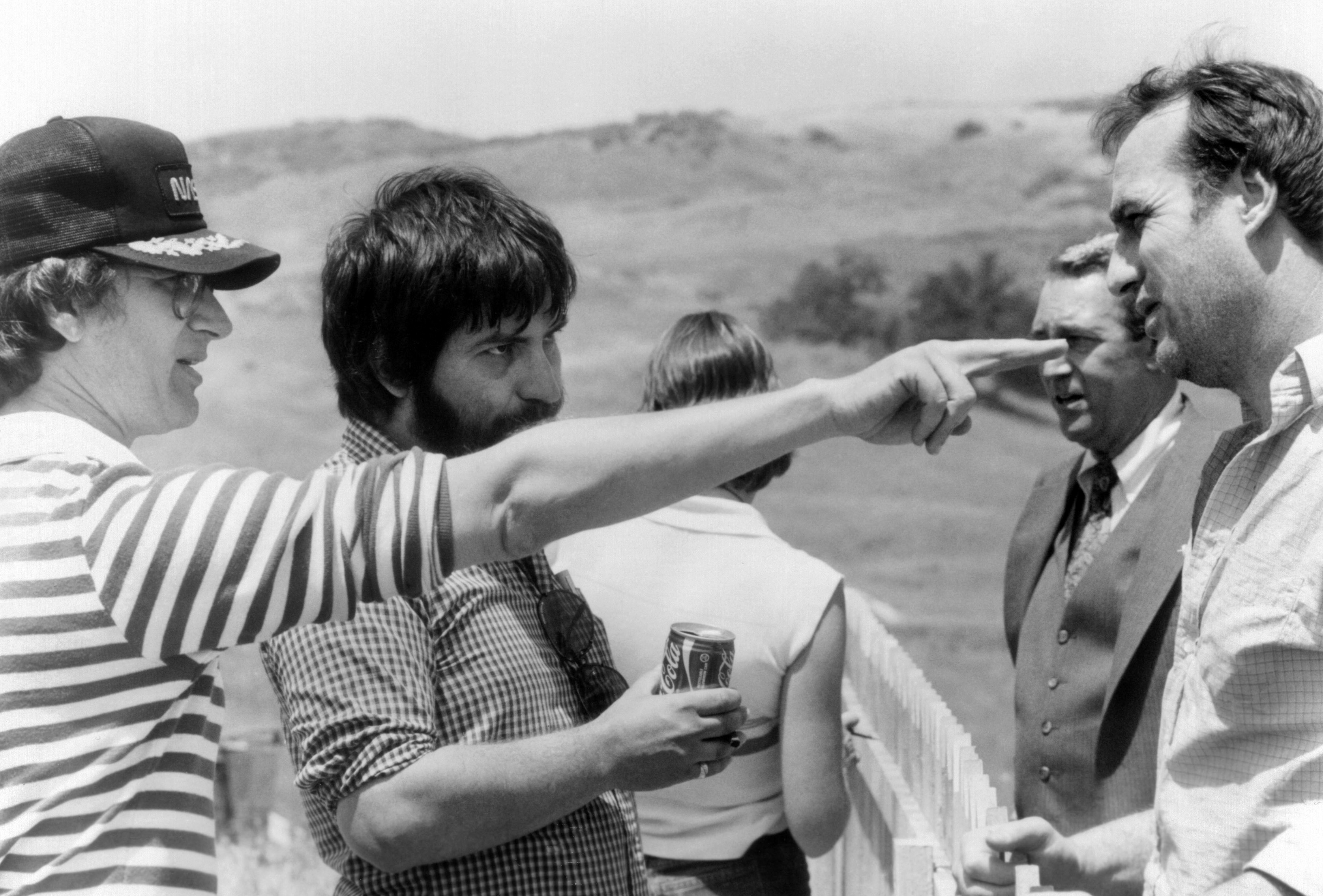
Tobe Hooper, who died last summer, would have turned 75 today. Here he is with producer Steven Spielberg actors Craig T. Nelson and James Karen on the set of Poltergeist in 1981:

Filmmaker in Focus:

Moon Film showcases all of Alfred Hitchcock’s cameos in his own movies in this look at the famous tradition:

[embedded content]

Mashup of the Day:

Dimitreze creates a ’90s hip-hop cinematic universe by mashing the rap biopics Notorious and All Eyez on Me together:

[embedded content]

Cosplay of the Day:

Couples costumes don’t have to be two separate entities, as proven with these Star Wars fans co-cosplaying an AT-AT:

Couples cosplay outfit #WeirdWeddingGiftspic.twitter.com/vl4q3p0I5w

— Ziggy (@mrjafri) January 25, 2018

Classic Trailer of the Day:

Yesterday we shared the trailer for The Maze Runner in anticipation of this week’s new sequel, and now here’s the original trailer for its 2015 follow-up, Maze Runner: The Scorch Trials:

[embedded content]

and

Let’s block ads! (Why?)


No Image

'We Are Them': Jon Balke and Siwan Call For Coexistence On 'Nahnou Houm'

Nahnou Houm isn’t Jon Balke’s first Andalusian experiment: 2009’s Siwan also explored traditional music from the region.

Antonio Baiano for ECM Records/Courtesy of the artist

hide caption

toggle caption

Antonio Baiano for ECM Records/Courtesy of the artist

Al-Andalus was a region of Spain which, after the expansion of the Islamic Empire, was governed by Muslim rulers for nearly eight centuries – from 711 to 1492.

During the first part of that time, followers of Judaism and Christianity were tolerated by most of the Muslim rulers, which encouraged a relative climate of cooperation between scholars of all three faiths. That climate of cooperation produced advances in math, science, art and music that influenced the rest of Europe.

The region’s spirit has inspired contemporary Norwegian pianist and composer Jon Balke — who, with his group Siwan, recently released his second album drawn from those influences, titled Nahnou Houm.

Balke first learned of Al-Andalus when he was commissioned to write music by a Moroccan promoter to celebrate a venue’s 15th anniversary.

“This was how I stumbled upon Gharnati music, which is the Andalusian music that existed in 1400 in Spain and was driven out,” Balke says.

The intellectual and social exchange fostered by its rulers helped make Al-Andalus one of the most culturally rich areas of Europe. But the Christian kingdoms to the north attacked repeatedly, and in 1492, the Spanish crown reclaimed the last vestiges of the region. Muslims and Jews were either forced to convert, killed or expelled. Many sought refuge across the Mediterranean Sea.

“They left Andalucía and went to North Africa, and Tunisia, Morocco and Algeria,” Mona Boutchebak says.

An Algerian classical singer, Boutchebak is the lead vocalist on the new album by Jon Balke and Siwan. She says the culture of what came to be called Andalusia was carried and preserved by the exiles.

Algerian singer Mona Boutchebak gives the traditional music of Al-Andalus a modern voice.

Antonio Baiano for ECM Records/Courtesy of the artist

hide caption

toggle caption

Antonio Baiano for ECM Records/Courtesy of the artist

“It is a mixture between Arabic music [and] Spanish,” Boutchebak says. “Flamenco comes from this music, from this tradition. I’m from this tradition, from the Arab-Andalusian one.”

It’s a tradition that’s still taught in schools — “what we call in Algeria the Arabo-Andalusian schools, where you can learn to sing the Arabo-Andalusian tradition,” Boutchebak explains. “So I went and I said, ‘This is what I want to do.’ I started to sing when I was 11, to learn this tradition.”

Jon Balke has taken this tradition’s poetry and composed his own music around it.

“It’s a framing of the musical project,” Balke says. “It puts the project in a framework that speaks about history and that speaks about a kind of a mentality that, from what you can read, existed in the best parts of this period — a kind of open, liberal practice of tolerance and coexistence.

“These poems, they speak about this kind of attitude, even if they speak about love or rain on the river or mystical experiences. You get the kind of a feeling of a period which was a really booming period in European history.”

[embedded content]
YouTube

At first, Boutchebak resisted the idea of combining her ancient tradition with jazz improvisation and music from the north.

“At the beginning, even for me, it was a little bit hard to imagine baroque music, improvisations, Andalusian music, and me in the middle,” she says. “I was asking myself, ‘What am I going to do?’ At times I felt it like it was so far from me, but it isn’t. We are all the same. The title of the album is ‘We Are Them,’ Nahnou Houm.”

Balke hopes that by trying to recapture a long-gone period of cultural and religious coexistence, his Siwan project can offer an alternative intolerance in the modern world.

“It is possible to coexist,” Balke says. “It is possible to respect even a person who believes something different from you or comes from a totally different background. And even if there are conflicts, it’s possible to solve them in another way than shooting the person.”

Let’s block ads! (Why?)


No Image

Supplies Of Valuable Ginseng Root Dwindling

Ginseng is a prized root in demand for it’s wide use in traditional Chinese medicine. Some of the most valuable ginseng grows wild in Appalachia, but supplies are dwindling.

ARI SHAPIRO, HOST:

The root ginseng is used to treat all kinds of ailments in traditional Chinese medicine. And some of the most valuable ginseng grows wild in Appalachia. Supplies are dwindling. So as Julia DeWitt from our Planet Money podcast reports, a backup plan is taking shape.

JULIA DEWITT, BYLINE: I drove out to the border of West Virginia and Maryland to visit a big-time ginseng dealer named Larry Harding.

There are security cameras pointing in every direction. I wonder if he can see me right now.

At the end of a long gravel road I come to a corrugated tin warehouse.

LARRY HARDING: Oh, I didn’t see you. Come in.

DEWITT: Hi.

Harding shows me into the office of his third-generation ginseng distribution business. It’s like a ginseng museum. There are roots preserved in alcohol, ginseng in glass cases on little red pillows.

HARDING: When I was a little kid, dad, he’d always take us out and take us ginsenging.

DEWITT: Wild ginseng you forage, like how his dad taught Larry to do. That is the most valuable kind, but not dependable.

HARDING: There’s not as much now as there was a while ago.

DEWITT: Foraging and habitat loss, Larry says. The obvious solution to just grow more ginseng hasn’t exactly worked. Ginseng is cultivated in other parts of the country, but it comes out looking totally different than the Appalachian wild stuff, mostly because all the fertilizer big farms use. That ginseng is worth just a tenth of what wild goes for. So Harding and others in the Appalachian ginseng industry are trying a third way. Harding called it wild-simulated ginseng. He plants wild ginseng seeds in the woods, and then 10 or so years later he digs.

HARDING: To look at this root, there’s actually not a dealer in the country that can say this don’t look like wild ginseng.

DEWITT: That’s the hope anyway.

ERIC BURKHART: Ginseng in particular represents a sustainable development crop for people to pursue.

DEWITT: This is Eric Burkhart. He’s a plant scientist who works closely with ginseng growers like Harding to develop the industry. And, yes, he is a booster.

BURKHART: I feel like ginseng can save the world. You know, save Appalachia anyway. And, you know, people’s health can be improved, their pocketbooks, the ecosystems that they’re living in. You know, all these things. And we can build these connections with this trading partner halfway around the world.

DEWITT: There is not a whole lot of research that shows conclusively that wild makes the best medicine. But that doesn’t affect the fact that people value it a lot more. Buyers just go on looks. So if Harding’s sort of wild ginseng can pass the look test, it’s a game changer.

FONG LAM: (Speaking Mandarin).

DEWITT: Fong Lam is a wild ginseng buyer four hours away in Bethlehem, Pa. He makes medication for Chinese medicine practitioners in the U.S. His daughter-in-law – her name’s Catsy – translates.

CATSY: He collects the wild ginseng from different diggers and then he will make into capsules like that.

DEWITT: We do a little test. I hand him the root that Harding gave me. He carefully inspects it with a magnifying glass.

FONG: (Speaking Mandarin).

DEWITT: And he’s not sure if it’s wild or not. But, he says, nope, he wouldn’t buy it.

FONG: (Speaking Mandarin).

DEWITT: Then I bring out another root, a truly wild root that Harding also gave me for reference.

Yeah. So these are…

CATSY: Oh, this better.

DEWITT: Oh, this is better?

CATSY: Much better. Yeah.

DEWITT: Oh, my God.

CATSY: Yeah.

DEWITT: And this root Fong Lam would buy.

FONG: (Speaking Mandarin).

CATSY: So if you have ginseng looking like this, he’s willing to pay 800 per pound.

DEWITT: It’s just part of ginseng that wild can’t be faked easily. But Harding and the ginseng entrepreneurs of Appalachia are going to keep trying to simulate the wild. They have to. For NPR News, I’m Julia DeWitt.

Copyright © 2018 NPR. All rights reserved. Visit our website terms of use and permissions pages at www.npr.org for further information.

NPR transcripts are created on a rush deadline by Verb8tm, Inc., an NPR contractor, and produced using a proprietary transcription process developed with NPR. This text may not be in its final form and may be updated or revised in the future. Accuracy and availability may vary. The authoritative record of NPR’s programming is the audio record.

Let’s block ads! (Why?)


No Image

FDA Panel Gives Qualified Support To Claims For 'Safer' Smoking Device

Philip Morris’ iQOS device heats tobacco but stops short of burning it, an approach the company says reduces exposure to tar and other toxic byproducts of burning cigarettes.

Philip Morris via AP

hide caption

toggle caption

Philip Morris via AP

A tobacco product that its maker claims to be safer than cigarettes won qualified support from a Food and Drug Administration advisory panel Thursday.

The advisers voted 8-1 to support cigarette giant Philip Morris’ claim that its “iQOS” system “significantly reduces your body’s exposure to harmful or potentially harmful chemicals.” The device heats tobacco but doesn’t ignite it.

But on the question of whether that approach translates into a reduction in the risk for tobacco-related diseases, the panel said the tobacco company’s studies didn’t demonstrate that. The vote was eight against, with one abstention.

Similarly, they said Philip Morris hadn’t proved that reducing harmful exposure would necessarily “translate to a measurable and substantial reduction in morbidity and/or mortality.” The vote was 5-2 against, with one abstention.

There was some support for the company’s claims that “switching completely to iQOS presents less risk of harm than continuing to smoke cigarettes.” But the measure failed on a vote of 4-5 against.

The FDA doesn’t have to follow the advisory panel‘s advice but usually does.

During the two-day hearing, the company presented claims that iQOS poses less danger because the device heats tobacco, instead of igniting it, to produce an aerosol that contains 90 percent lower levels of dangerous chemicals than found in cigarette smoke.

If the agency grants the company’s request and approves the product, iQOS would become the first tobacco product authorized by the FDA to be marketed as causing less harm than regular cigarettes.

Advocates and some smoking-cessation counselors urged the committee to endorse the product to make an alternative they consider to be safer available to millions of U.S. smokers. But some anti-smoking advocates question whether the device really is safer and fear it could hook more people on nicotine, including children.

Philip Morris argued the device would be exclusively marketed to smokers and estimates the iQOS could save 90,000 lives over 20 years in the United States.

“IQOS emits toxicants and is not risk-free,” Manuel Peitsch, Philip Morris’ chief scientific officer, said on the opening day of the hearing. “Nevertheless, iQOS emits significantly lower levels of toxicants than regular cigarettes. Switching to iQOS can significantly reduce the risk of disease compared to regular smoking.”

The device could be more appealing to many smokers than electronic cigarettes because the iQOS heats tobacco instead of a liquid containing nicotine. That gives the user more of the taste and experience of regular cigarettes, the company argues.

Critics, however, questioned Philip Morris’s safety claims.

“I think the whole thing is a scam,” said Stanton Glantz, a prominent anti-smoking advocate at the University of California, San Francisco, to NPR before the hearing. “When you look at the actual evidence that Philip Morris has submitted to the FDA, it doesn’t support the claim that these things are any better than cigarettes in terms of health effects in people.”

Glantz noted that the tobacco industry has a long history of selling products that it claimed were safer, such as cigarettes marketed as “light,” “mild” or “low-tar,” that turned out to be just as dangerous.

“What we’re seeing is just a replay of the old light and mild scam,” Glantz said.

One study conducted in Switzerland found that while the iQOS produces many toxic chemicals at lower levels than cigarette smoke, some are higher than the company claims. Philip Morris disputes that research.

Some of the chemicals found are components of smoke, the researchers say. “We found lower concentrations of these compounds; however, we found them. And because we found them, we think this is smoke,” Reto Auer, an assistant professor at the University of Bern in Switzerland who conducted the study, said in an interview before the hearing. “We disagree with the claim that it’s smokeless. People should be aware there are still toxic substances in the iQOS.”

Auer and Glantz’s concerns were echoed by several people who spoke during a public comment period on the second day of the hearing.

The iQOS looks suspiciously similar to the most popular e-cigarettes among children, Matthew Myers, president of the Campaign for Tobacco-Free Kids, told the committee.

“It is high-tech. It is sleek. It is designed in exactly the way that would appeal to young people,” Myers told the committee.

If the iQOS wereapproved, it could hook children and teenagers on nicotine, reversing the progress that has been made to reduce smoking among young people, Myers fears.

But most of the speakers at the hearing urged the committee to recommend approval to give smokers a potentially safer alternative to cigarettes. More than 36 million Americans currently smoke.

“There is no health threat that compares to smoking,” said Hank Campbell, president of the American Council on Science and Health. “Even though we have been opposed to smoking for 40 years, we support these devices.”

“Patients who smoke clearly need more tools to help them quit,” said Jeff Fortenbacher, president and CEO of Access Health in Muskegon, Mich.

In an interview before the hearing, Jonathan Foulds, a professor of public health sciences and psychiatry at Penn State University, agreed.

“I think it’s a step in the right direction for tobacco companies to be developing products that have the probability of being significantly less harmful than conventional cigarettes,” Foulds says.

Philip Morris is already selling iQOS in more than 30 countries and argued there was no evidence it was enticing children to use the product or start smoking. In fact, the company said, cigarette smoking had dropped dramatically since the device was introduced in Japan.

The iQOS consists of several parts. One part is called a “heatstick,” which is made from compressed wads of tobacco. If approved, three versions would be sold: Marlboro HeatSticks, Marlboro Smooth Menthol HeatSticks and Marlboro Fresh Menthol HeatSticks.

The iQOS device is reusable, but the heatsticks are not.

Users would insert a heatstick into a holder that has a blade that penetrates the middle of the tobacco wad. When the user presses a button, the blade heats the tobacco to temperatures only capable of producing an aerosol that contains nicotine, according to the company.

The tobacco never gets hot enough to combust, according to Philip Morris. Burning tobacco produces far greater levels of potential toxic substances than just heating it, the company says. The devices stay on for six minutes or 14 puffs, whichever comes first, before shutting off automatically.

Philip Morris hasn’t said how much the device would cost in the United States. But in Japan, the device sells for about $80, and a pack of heatsticks costs about the same as a pack of cigarettes.

The FDA advisory committee’s recommendation Thursday pertains only to the company’s claims about the safety of the product. Philip Morris would still have to get the FDA to sign off on a separate application to actually sell the devices in the United States for the first time.

The hearing comes after the FDA announced plans to eventually reduce the amount of nicotine in regular cigarettes in the hopes of weaning more Americans off cigarettes. As part of that effort, the FDA has said the agency hopes to offer more alternative sources of nicotine that would be safer than cigarettes.

Separately, the FDA has begun reviewing the safety of electronic cigarettes. Those devices heat fluid containing nicotine to produce a vapor that users inhale. E-cigarettes have become increasingly popular, especially among young people. The growth in use has alarmed many public health experts.

While e-cigarettes may be safer than regular cigarettes, experts say e-cigarettes aren’t completely safe and fear they are hooking a new generation of children on nicotine and acting as a gateway to traditional cigarettes.

Let’s block ads! (Why?)


No Image

Ex-USA Gymnastics Doctor Sentenced; Michigan State President Resigns

A judge sentenced Larry Nassar to 175 years in prison after more than 150 victims spoke at his proceedings. And, the president of Michigan State University, where Nassar also worked, resigned.

STEVE INSKEEP, HOST:

Wednesday was the day of judgment for Larry Nassar. A judge sentenced the former USA Gymnastics doctor to up to 175 years in prison. She said, you’ve done nothing to deserve to walk outside a prison again. The judge allowed statements by many of Nassar’s more than 150 victims, any who wanted to speak.

Wednesday was also a day of accountability for the president of Michigan State University, where Nassar also worked. President Lou Anna Simon resigned. Michigan Radio reporter Kate Wells has been covering this story for more than a year. She’s on the line.

Good morning.

KATE WELLS, BYLINE: Hey, Steve.

INSKEEP: Can you work us through the timeline here? When did victims start reporting crimes by Larry Nassar so far as you know?

WELLS: More than 20 years ago, according to these women and girls. We know that multiple women and girls say they have been talking to their MSU coaches, trainers, staff. We heard from one of them in court this week, Larissa Boyce. She says she told her MSU gymnastics coach that Nassar’s so-called treatments were becoming sexual. This was back in 1997.

(SOUNDBITE OF ARCHIVED RECORDING)

LARISSA BOYCE: I told somebody. I told an adult. Instead of being protected, I was humiliated, I was in trouble and brainwashed into believing that I was the problem.

WELLS: And we know that from an administrative standpoint, this school launched a 2014 Title IX investigation against Nassar. But that investigation ended up clearing Nassar at the time and letting him go back to work, even as a separate MSU Police investigation against Nassar continued for more than a year. And we know that Nassar assaulted more than a dozen girls during that time.

INSKEEP: OK. So Lou Anna Simon was not university president when these reports began coming in. But was…

WELLS: Right.

INSKEEP: …The university president from 2004 onward. When, so far as you know, did she learn how bad this was?

WELLS: During – at least, we know that she heard about the 2014 investigation. And she says she told the school to play it straight. But the anger towards her has really been building over this last year and a half. She has been seen as kind of tone deaf on this. At one point, she told victims that it would have been impossible to stop a determined sexual predator like Nassar. In her resignation letter last night even, she said, as tragedies are politicized, blame is inevitable. As president, it is only natural that I am the focus of this anger.

So victims feel like they’re not really feeling, even now, accountability from MSU.

INSKEEP: Wait a minute. She’s not saying, I’m responsible for what happened, and I have to take ultimate responsibility because I’m the top person. She’s saying, I just want to avoid a political fight.

WELLS: She’s certainly saying, you know, I’m really sorry to victims that this happened. But no, nothing in terms of – look, we could have done this better, and we really messed this up.

INSKEEP: Does Michigan State University face further investigation?

WELLS: Definitely. MSU is now under open investigations by the NCAA, the state attorney general, and they’re facing more than a hundred civil lawsuits in court.

INSKEEP: Kate, thanks very much.

WELLS: Thanks, Steve.

INSKEEP: Kate Wells of Michigan Radio.

(SOUNDBITE OF VETIVER’S “STRANGER STILL”)

Copyright © 2018 NPR. All rights reserved. Visit our website terms of use and permissions pages at www.npr.org for further information.

NPR transcripts are created on a rush deadline by Verb8tm, Inc., an NPR contractor, and produced using a proprietary transcription process developed with NPR. This text may not be in its final form and may be updated or revised in the future. Accuracy and availability may vary. The authoritative record of NPR’s programming is the audio record.

Let’s block ads! (Why?)


No Image

North Korean Women's Hockey Players Arrive To Begin Olympic Training With South

North Korean female hockey players arrive at the Inter-Korean Transit Office in Paju, South Korea, on Thursday.

AP

hide caption

toggle caption

AP

Twelve members of the North Korean women’s ice hockey team have crossed the heavily fortified border to begin training with their South Korean counterparts ahead of next month’s Olympics in Pyeongchang.

Wearing red, white and blue team parkas emblazoned with the North Korean flag and “DPR Korea” on their backs, the women arrived on Thursday after the rival countries agreed to field a joint team at the games for the first-time ever.

South Korea’s Yonhap news agency, quoting the South’s unification ministry, says that an eight-member delegation from the North’s sports ministry was also arriving on Thursday.

The joint team will march under a unification flag at the Olympics’ opening ceremony. NPR’s Bill Chappell says, “South Korea’s athletes have previously marched alongside their North Korean counterparts at several Olympics, including the 2000 and 2004 Summer Olympics in Sydney and Athens, respectively, as well as the 2006 Winter Olympics in Turin.”

On Saturday, the International Olympic Committee (IOC) agreed to allow the 12 North Korean players to join South Korea’s 23-member team. However, the move has been met with criticism because it will mean less time on the ice for the South’s players.

Sarah Murray, the South Korean team coach, said Monday that it was a “tough situation to have our team used for political purposes.” She conceded, however, “it’s kind of something that’s bigger than ourselves right now.”

As NPR’s Elise Hu reported earlier this week, many South Koreans have also expressed their dismay with joining Pyongyang in the games, reporting, “In Seoul, protesters Monday set fire to the North Korean flag and a photo of Kim Jong Un. The South Korean president’s approval rating has dropped in recent days as well.”

In a gesture that seemed certain to be received with even more skepticism, North Korea’s state media called for “all Koreans at home and abroad” to make a “breakthrough” for unification of the divided peninsula without outside interference. It said military drills with “outside forces” as being unhelpful – an apparent reference to joint U.S.-South Korea war games that have raised the ire of Pyongyang in the past.

KCNA said Koreans should “promote contact, travel, cooperation between North and South Korea” and that Pyongyang would “smash” any efforts by outside forces to block reunification.

The breakthrough over the Olympics came after North Korean leader Kim Jong Un said in his New Year’s address that he would be open to it. At North-South talks that followed, the two sides reached agreement on the joint team, as well as the reinstatement of a hotline between the two sides and other dialogue aimed at easing tensions.

Let’s block ads! (Why?)


No Image

Today in Movie Culture: 2018 Oscar Nominees Supercut, 'Maze Runner: The Death Cure' in Lego and More

Here are a bunch of little bites to satisfy your hunger for movie culture:

Supercut of the Day:

You saw the list of contenders yesterday, now watch highlights from the honored movies in Cineplex’s 2018 Oscar nominees supercut:

[embedded content]

Alternate Movie Posters of the Day:

In honor of their Oscar nominations, Get Out and Three Billboards Outside Ebbing, Missouri got some cool For Your Consideration posters by artist Matt Needle:

Here are two of my #ForYourConsideration#Oscar#Posters (next up #LadyBird) #GetOut#ThreeBillboardshttps://t.co/gawfBrgRJF@TheAcademy@TheFilmStage@TheCinegogue@OnePerfectShot@RealEOC@mubi@PosterPosse@PosterSpy@altmovieposters@brokehorrorfan@slashfilm@cinemateaserpic.twitter.com/sSf6HwVQqW

— Matt Needle (@needledesign) January 24, 2018

Cinematographer Showcase of the Day:

In honor of Roger Deakins receiving his 14th Oscar nomination, the Toronto International Film Festival made a video highlighting all his nominated work and what each movie lost the Best Cinematography award to:

[embedded content]

Fan Theory of the Day:

Just as Pixar announced the cast of Incredibles 2 this week, MatPat of Film Theory considers which one of The Incredibles is the most incredible:

[embedded content]

Vintage Image of the Day:

Sharon Tate, who would have turned 75 today if she hadn’t been murdered by the Manson Family, gets a lift from co-star Tony Curtis while director Alexander Mackendrick falls out of the way on the set of the 1967 movie Don’t Make Waves:

Filmmaker in Focus:

The British Film Institute presents Ingmar Bergman’s influence on pop culture in this video by filmmaker Nic Wassell:

[embedded content]

Cosplay of the Day:

Black Panther co-star Lupita Nyong’o is sharing cosplay inspired by the movie starting with this adorable photo:

Welcome to #WakandaWednesday! Leading up to the film’s premiere, I will be showcasing YOUR #BlackPanther cosplay every Wednesday. First up is the Children of Wakanda! They might have more swagger in the costumes than @ChadwickBoseman and I do… #Regram#MarvelHeauxpic.twitter.com/kCGyEzFYlE

— Lupita Nyong’o (@Lupita_Nyongo) January 24, 2018

Remade Trailer of the Day:

In honor of Maze Runner: The Death Cure finally arriving this weekend, Huxley Berg Studios redid its trailer in Lego:

[embedded content]

Movie Comparison of the Day:

Also in honor of the new movie, Couch Tomato shows us 24 reasons why the last installment, Maze Runner: The Scorch Trials, is basically the same movie as I Am Legend:

[embedded content]

Classic Trailer of the Day:

Speaking of the Maze Runner movies, now is a good time to revisit the intriguing original trailer for the first movie, 2014’s The Maze Runner:

[embedded content]

and

Let’s block ads! (Why?)