
Hospitals See Growing Numbers Of Kids And Teens At Risk For Suicide

Teens are visiting the hospital with thoughts of suicide more frequently.
arabianEye/Getty Images
hide caption
toggle caption
arabianEye/Getty Images
The number of kids who struggle with thoughts of suicide – or attempt to kill themselves – is rising. New research, published Wednesday in Pediatrics finds children ages 5-17 visited children’s hospitals for suicidal thoughts or attempts about twice as often in 2015 as in 2008.
The study found kids of all ages are affected though increases were greatest for older adolescents.
Lead author Gregory Plemmons, a pediatrician and researcher at Vanderbilt University in Nashville, Tenn., says the study results confirmed what he’d been seeing at the hospital.
He says he hopes clinicians and families take note. “The number one thing to take home is that it’s important to talk about this and important to ask about it,” he says.
The findings line up with past data showing a steady increase in teen suicide over the past decade. The Centers for Disease Control and Prevention reported last year that a drop in adolescent suicide in the 1990s and early 2000s reversed course in 2008, though it’s not yet reached peak levels seen in the 1980s. It’s not clear what has contributed to the increase, but the study noted the 2008 financial crisis may be one factor among others.
Plemmons and his co-researchers examined 2008-2015 billing data from a database of 49 children’s hospitals across the U.S. They included all emergency department encounters, stays for observation and inpatient hospitalizations at those hospitals, but did not include community hospitals.
The researchers turned up 115,856 visits for suicidal ideation or attempts, during the seven-year period. Such visits represented 0.7 percent of total children’s hospital visits in 2008 but by 2015 had increased to 1.8 percent of all visits. More than half the visits required at least one night of hospitalization, and nearly 1 in 7 required intensive care.
Older teens were more likely to end up in the hospital and had the greater increase in hospital visits. About half of suicide-related hospital visits for the time studied were from teens ages 15-17, but 12- to 14-year-olds closely trailed them, making up 37 percent of visits. Children ages 5-11 made up the remaining 13 percent.
One of the study’s most striking findings was a seasonal trend in hospital visits. Throughout the years, visits peaked in mid-fall and mid-spring and fell to the lowest point in the summer. “We knew there was an association with school seasons, but actually seeing that mapped out was surprising,” says Plemmons. It suggests a link with school pressures.
“It really speaks to the stress and the strain at school,” says Dr. Robert Dicker, associate director of Child & Adolescent Psychiatry at Zucker Hillside Hospital in Glen Oaks, New York. “Kids appear to be under much more academic success to achieve and their perception of falling short.”
Dicker, who was not involved in the study, also noted possible influences from the media, particularly social media.
Plemmons also drew attention to social media’s influence. “You’re becoming more disconnected and not having relationships with real people, and at the same time you’re being fed a false distortion of what reality is, where everything looks great on screen,” he says.
Cyberbullying and sexting he adds, could also be risk factors. “These kids have to deal with pressures that we didn’t deal with.”
Other possible contributors noted in the study included earlier puberty in girls, since reaching puberty is a risk factor for suicide. Girls made up two-thirds of the hospital visits in the study period.
But none of these possibilities is definitive.
“This type of study is very good at revealing trends but cannot address causality,” says Dr. Laurel Williams, chief of psychiatry at Texas Children’s Hospital in Houston, Texas. Despite being the third leading cause of death in adolescents, suicide is still relatively rare, making it harder to study causes, she says.
But it is important to screen for depression and anxiety, she says. Her institution also uses validated screening tools to screen adolescents and is exploring tele-consultation strategies to help pediatricians manage cases if they feel underprepared or uncomfortable.
“We know there are a lot of patients still out there who have clinical depression who are not accessing care,” Plemmons says, adding that it’s important for adults to identify resources in their area for struggling teens. Parents can start with their child’s primary care doctor.
But the most important first step is one anyone can take.
“The current best method for identifying risk is to ask,” Williams says. “Asking a young person how they are feeling, not just how they are doing, is essential. We need to give young people the time and space to talk about how they are feeling. This involves developing closer relationships over time, not something you can scramble at the last minute or only in moments of crisis.”
Plemmons also emphasized the importance of talking to adolescents about the issue.
“There’s still a huge stigma and anything you can do to destigmatize it helps,” he says, adding that a fear still exists among some pediatricians and parents that discussing suicide may suggest it to adolescents.
“We know from literature that that’s not the case,” Plemmons says. “Talking about it can sometimes help reduce the risk.”
If you or someone you know may be considering suicide, contact the National Suicide Prevention Lifeline at 1-800-273-8255 (En Español: 1-888-628-9454; Deaf and Hard of Hearing: 1-800-799-4889) or the Crisis Text Line by texting 741741.
States Eye New Revenues After Supreme Court Backs Legal Sports Betting

People watch coverage of the NCAA college basketball tournament at the Westgate SuperBook on March 15 in Las Vegas. Several states are expected to allow sports gaming after Monday’s Supreme Court ruling.
John Locher/AP
hide caption
toggle caption
John Locher/AP
Now that the Supreme Court says it’s OK, states are free to legalize betting on sports if they want to. As a once under-the-table economy moves into the open, it creates some large business opportunities — and the potential for millions in new tax revenues.
But first comes the nitty-gritty part: writing the rules for how sports fans can bet on their favorite games — the legal age, where people can bet, licensing requirements, software standards for mobile apps, and money laundering safeguards.
“We also have to establish what the tax structure will be,” says New Jersey Assemblyman John Burzichelli. “That’s very important. We’re actually in our budget cycle now.”
He says the tax rate is still being negotiated, but will be between 8 percent and 15 percent of revenue after winnings are paid out. He says New Jersey can get these rules written in about four weeks.
This puts the state neck and neck with Delaware and Mississippi. Close behind them — and just in time for football season — are Pennsylvania, West Virginia and Connecticut. These are all states with an established gaming industry, all trying to be the first to take legal sports bets.
“Markets of this size don’t just come into being on a regular basis,” says Chris Grove, a gaming analyst for the research firm Eilers & Krejcik.
He expects 32 states to eventually allow sports gaming, worth roughly $6 billion annually. But, he says, that may not come so easily.
“There’s an existing black market. It’s entrenched. It’s attractive. It offers a number of advantages that regulated betting sites will never be able to offer: the lack of having to fill out tax forms and have your winnings reported, the ability to bet on credit,” Grove says.
But new entrants into the gaming industry don’t expect much competition from the black market.
“I think most people would prefer to do things in a legal manner if given the option,” says Jason Robins, CEO of the daily fantasy sports company DraftKings.
He compares illegal sports betting to the pirating of music. Most people shifted to legal products when streaming services came along. He contends something similar will happen in sports gambling.
Some analysts warn that profit margins might not be as plush as investors hope. A lot depends on how heavily sports betting is taxed.
And on top of taxes, there’s what professional sport leagues want.
After years of fighting against sports betting, the NFL, Major League Baseball and other leagues have changed their approach. Over the last few months they’ve been going state to state, lobbying aggressively for a special fee to pay for policing against cheating, like an athlete intentionally throwing a game.
In New Jersey, leagues tried to get a fee between 2 percent and 3 percent of gross wagers. But lawmakers balked.
“They’re not paying that in Nevada and their not paying that to the illegal sportsbooks.” Burzichelli says. “That’s a nonstarter as far as I’m concerned.”
In statements Monday, the major sport leagues said they will be looking to Congress for a “regulatory framework” to protect the “integrity” of their games.
U.S. Rep. Frank Pallone of New Jersey is sponsoring one bill, which would establish a legal framework for consumer protections and give the Federal Trade Commission some oversight. But he acknowledges it’s not getting passed anytime soon.
States Eye New Revenues After Supreme Court Backs Legal Sports Betting
People watch coverage of the NCAA college basketball tournament at the Westgate SuperBook on March 15 in Las Vegas. Several states are expected to allow sports gaming after Monday’s Supreme Court ruling.
John Locher/AP
hide caption
toggle caption
John Locher/AP
Now that the Supreme Court says it’s OK, states are free to legalize betting on sports if they want to. As a once under-the-table economy moves into the open, it creates some large business opportunities — and the potential for millions in new tax revenues.
But first comes the nitty-gritty part: writing the rules for how sports fans can bet on their favorite games — the legal age, where people can bet, licensing requirements, software standards for mobile apps, and money laundering safeguards.
“We also have to establish what the tax structure will be,” says New Jersey Assemblyman John Burzichelli. “That’s very important. We’re actually in our budget cycle now.”
He says the tax rate is still being negotiated, but will be between 8 percent and 15 percent of revenue after winnings are paid out. He says New Jersey can get these rules written in about four weeks.
This puts the state neck and neck with Delaware and Mississippi. Close behind them — and just in time for football season — are Pennsylvania, West Virginia and Connecticut. These are all states with an established gaming industry, all trying to be the first to take legal sports bets.
“Markets of this size don’t just come into being on a regular basis,” says Chris Grove, a gaming analyst for the research firm Eilers & Krejcik.
He expects 32 states to eventually allow sports gaming, worth roughly $6 billion annually. But, he says, that may not come so easily.
“There’s an existing black market. It’s entrenched. It’s attractive. It offers a number of advantages that regulated betting sites will never be able to offer: the lack of having to fill out tax forms and have your winnings reported, the ability to bet on credit,” Grove says.
But new entrants into the gaming industry don’t expect much competition from the black market.
“I think most people would prefer to do things in a legal manner if given the option,” says Jason Robins, CEO of the daily fantasy sports company DraftKings.
He compares illegal sports betting to the pirating of music. Most people shifted to legal products when streaming services came along. He contends something similar will happen in sports gambling.
Some analysts warn that profit margins might not be as plush as investors hope. A lot depends on how heavily sports betting is taxed.
And on top of taxes, there’s what professional sport leagues want.
After years of fighting against sports betting, the NFL, Major League Baseball and other leagues have changed their approach. Over the last few months they’ve been going state to state, lobbying aggressively for a special fee to pay for policing against cheating, like an athlete intentionally throwing a game.
In New Jersey, leagues tried to get a fee between 2 percent and 3 percent of gross wagers. But lawmakers balked.
“They’re not paying that in Nevada and their not paying that to the illegal sportsbooks.” Burzichelli says. “That’s a nonstarter as far as I’m concerned.”
In statements Monday, the major sport leagues said they will be looking to Congress for a “regulatory framework” to protect the “integrity” of their games.
U.S. Rep. Frank Pallone of New Jersey is sponsoring one bill, which would establish a legal framework for consumer protections and give the Federal Trade Commission some oversight. But he acknowledges it’s not getting passed anytime soon.
Today in Movie Culture: Old Han Solo Meets Young Han Solo, the Tech of 'Black Panther' and More
Here are a bunch of little bites to satisfy your hunger for movie culture:
Surprise Meeting of the Day:
Old Han Solo Harrison Ford surprised new/young Han Solo Alden Ehrenreich during an interview with Entertainment Tonight promoting Solo: A Star Wars Story:
[embedded content]
Movie Science of the Day:
For Vanity Fair, actress Letitia Wright, who plays genius science Shuri in Black Panther, breaks down the tech we see in the movie:
[embedded content]
Cosplay of the Day:
Speaking of Marvel characters, apparently Avengers: Infinity War villain Thanos was apprehended in Canada:
The @TorontoPolice do what the @Avengers couldn’t do, stop #Thanos #jobwelldone #WeAreHiring #JoinUs #torontopolice #jobs #TheAvengersInfinityWar pic.twitter.com/9DUHGmLmL0
— PCPapadopoulos (@PCPappy) May 13, 2018
Classic Movie Clip of the Day:
Margot Kidder, who passed away at age 69, was best known for playing Lois Lane so perfectly in four Superman movies, including Superman IV: The Quest for Peace seen below.
[embedded content]
Video Essay of the Day:
In this video essay, editor Richard J. Moir looks at the significance of hands in the movie Let the Right One In:
[embedded content]
Vintage Image of the Day:
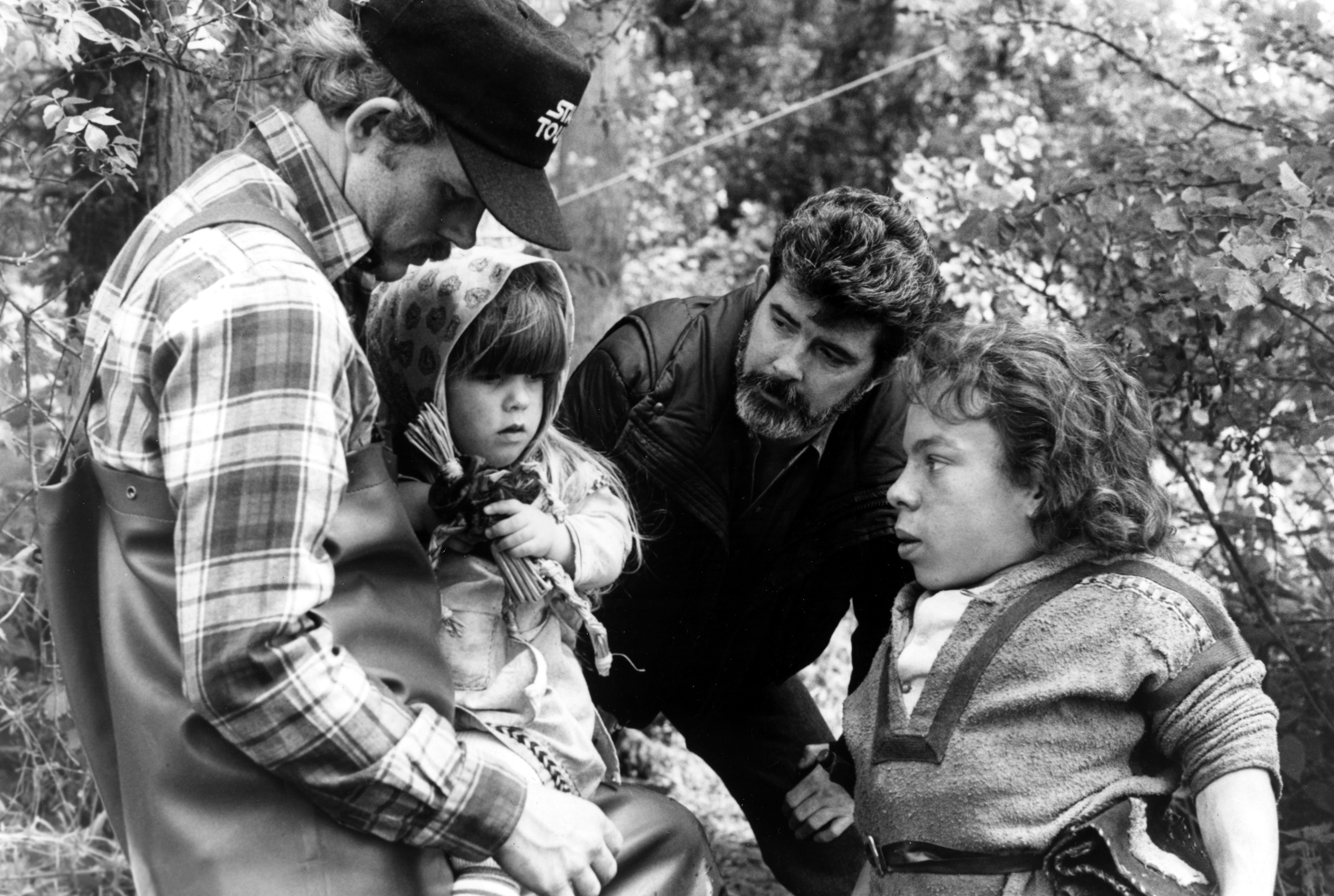
George Lucas, who turns 74 today, with director Ron Howard, star Warwick Davis and young Dawn Downing on the set of the Lucas-produced Willow (which may be getting sequel) in 1987:
Filmmaker in Focus:
In honor of the 50th anniversary of 2001: A Space Odyssey this year, IMDb looks at the directorial trademarks of Stanley Kubrick:
[embedded content]
Actor in the Spotlight:
Also at IMDb, the latest No Small Parts looks at the TV and movie career of Riley Keough, star of the upcoming Under the Silver Lake:
[embedded content]
Movie Comparison of the Day:
Dimitreze compares scenes from the biopic LBJ with footage of the real Lyndon B. Johnson and John F. Kennedy side by side:
[embedded content]
Classic Trailer of the Day:
This week is the 60th anniversary of Vincente Minnelli’s Gigi. Watch the original trailer for the classic musical below.
[embedded content]
and
Trump Administration Doubles Worksite Investigations To Combat Illegal Immigration

U.S. Immigration and Customs Enforcement agents gather before serving a employment audit notice at a 7-Eleven convenience store in Los Angeles in January.
Chris Carlson/AP
hide caption
toggle caption
Chris Carlson/AP
The Trump administration announced Monday that it has dramatically increased the number of worksite investigations and audits to make sure that American businesses do not employ people who are in the U.S. illegally.
Immigration officials say they have launched more than 3,500 worksite investigations, already doubling the number of cases compared to the previous fiscal year. Similarly, 2,282 employer audits were conducted between Oct. 1 and May 4 (with five months remaining in FY18). Over the course of last fiscal year, only 1,360 audits were launched.
“An audit is a review of business records,” said Immigration and Customs Enforcement spokesperson Danielle Bennet. “An investigation can include an audit and is conducted because of suspicion that the law in being violated and can result in criminal charges and/or civil fines.”
A 1986 federal law requires employers to verify that their employees are legally authorized to work here. Employers have to document the eligibility of their hires using Form I-9.
In a statement, U.S. Immigration and Customs Enforcement said it is working to ensure that American businesses maintain “a culture of compliance.”
“Our worksite enforcement strategy continues to focus on the criminal prosecution of employers who knowingly break the law, and the use of I-9 audits and civil fines to encourage compliance with the law,” said Acting Executive Associate Director for Homeland Security Investigations, Derek N. Benner. “HSI’s worksite enforcement investigators help combat worker exploitation, illegal wages, child labor and other illegal practices.”
Thus far, 594 employers have been arrested for criminal violations of the immigration law, that’s four times the number of arrests last fiscal year.
According to the Associated Press, ICE plans to ramp up its audit campaign this summer.
“Derek Benner, head of ICE’s Homeland Security Investigations unit, told The Associated Press that another nationwide wave of audits planned this summer would push the total ‘well over’ 5,000 by Sept 30. ICE audits peaked at 3,127 in 2013.
“The agency has developed a plan to open as many as 15,000 audits a year, subject to funding and support for the plan from other areas of the administration, Benner said.
“The proposal calls for creation of an Employer Compliance Inspection Center to perform employer audits at a single location instead of at regional offices around the country, Benner said. Electronically scanning the documents will help flag suspicious activity, and the most egregious cases will be farmed out to regional offices for more investigation. Audit notices will be served electronically or by certified mail, instead of in person.”
The ICE statement says that in FY17, “businesses were ordered to pay $97.6 million in judicial forfeitures, fines and restitution, and $7.8 million in civil fines.”
Trump Administration's 3 Biggest Ideas For Lowering Drug Prices

Health and Human Services Secretary Alex Azar talked Friday about the administration’s plans to lower drug prices as President Trump looked on in the White House Rose Garden.
Chip Somodevilla/Getty Images
hide caption
toggle caption
Chip Somodevilla/Getty Images
Health and Human Services Secretary Alex Azar has this pen. It’s not all that remarkable looking, but he held it up multiple times Monday at a briefing with reporters.
“This pen,” he said, “has a lot of power.”
And he said he is prepared to use it.
Azar was making the point that in the area of drug prices, the head of HHS — which runs the Medicare and Medicaid programs and buys about $130 billion in prescription drugs each year — can make a lot of changes in the pharmaceutical market. And he doesn’t need congressional approval to do it.
He’s got plans to use that pen to change the way Medicare and Medicaid pay for medications and how the Food and Drug Administration goes about approving drugs for marketing.
Lots of the ideas are wonky and esoteric, but analysts say some could make a big difference over the long term.
Here are three of the big ideas Azar laid out Monday, three days after President Trump unveiled a blueprint to lower the cost of prescription drugs that was criticized for being light on substance.
1. Restructure the way pharmacy benefit managers deal with drugmakers
Azar’s most ambitious initiative would ban pharmacy benefit managers — the companies that administer prescription drug plans for insurance companies or employers – from negotiating discounts with drugmakers as a percentage of list prices.
Today PBMs, such as CVS Caremark or Express Scripts, make deals in the form of rebates. Pharmaceutical companies offer something like 30 percent off the list price of their drugs if the PBM places the medicines in a favorable spot on their preferred drug lists. When prices go up, PBMs often make more money as rebates grow.
“They’re taking money from both sides,” Azar said. “They’ve built into their system a regime where they get more money when the list price goes up.”
Azar said he intends to force PBMs to write contracts based on a set price for drugs, rather than a percentage-based rebate. And, he said, he’s looking to ban them from making any money at all from pharmaceutical companies. Instead, the companies would earn money only from the fees paid by the insurance companies or employers who hire them.
“This is nothing short of the complete and fundamental restructuring of over $400 billion of the U.S. economy,” he said.
David Mitchell, founder of the advocacy group Patients for Affordable Drugs, approves of the idea. “If they could do away with the rebates and have transparent net prices, I think that’s an enormous step forward,” he said.
But Express Scripts spokesman Brian Henry takes issue with targeting PBMs. “The root cause is the pharmaceutical companies who set these prices,” he said. “We are the ones who help drive down the costs. We drive competition.”
2. Change the way Medicare pays for some expensive drugs
Azar says he wants to simplify the way Medicare pays for many drugs by moving some expensive medications that are administered in doctors’ offices — like cancer drugs — into the standard Medicare prescription drug program.
Many of those expensive drugs are paid for through Medicare Part B. It’s a system in which doctors buy the drugs and get paid a percentage of their cost to administer them to patients. Under this system, the government pays the full list price and doctors make more money when they prescribe more expensive drugs.
Azar said he wants to move some of the most expensive of those drugs to the Part D program, which is administered by private health insurance companies that negotiate discounts with drug companies.
“This move from B to D gives us the power to negotiate against drug companies,” he said.
But analysts caution it could lead to higher out-of-pocket costs and less choice for patients.
“Moving drugs from Part B to Part D could get the prices of some drugs down by allowing insurers to bargain with drugmakers, but it would likely come with more restrictions on which drugs are covered,” said Larry Levitt, vice president of the Kaiser Family Foundation. “Some Part B drugs — many of which are infusions like chemotherapy — don’t have competitors, so negotiation may not help much.”
3. Make prices more transparent
The Centers for Medicare and Medicaid Services will release new versions of its Medicare and Medicaid drug price dashboards on Tuesday that HHS says will have more detail on how much the programs are paying for the medications they buy.
And on top of that, Azar says he is looking at whether he can require drug companies to include the price of their products in those television ads that already include seemingly endless lists of scary side effects.
Mitchell and Levitt both doubt that drug companies can be shamed into lowering prices and losing profit.
“It’s not going to lower drug prices,” Mitchell says. “But it would probably help for patients to know that the drug they’re getting costs $100,000.”
And finally, he wants to get rid of what he calls a “gag rule” in some PBM contracts that forbid pharmacists to tell patients they can get their drug cheaper by going outside their insurance plan.
“Note that there are a number of proposals they are suggesting that are controversial and will result in pitched battles,” says Rodney Whitlock, vice president of health policy at ML Strategies, a lobbying firm. “That said, they sure are talking a good game and should be given deference that action will approach rhetoric.”
Azar, who came to HHS after a stint as president of the U.S. operations of the pharmaceutical giant Eli Lilly, opened his talk by dispensing with the industry’s long-embraced argument that high prices are necessary to pay for research into future cures.
“I’ve been a drug company executive. I know the tired talking points: the idea that if one penny disappears from pharma profit margins, American innovation will grind to a halt,” Azar said. “I’m not interested in hearing those talking points anymore.”
Casino Owner Discusses Supreme Court Ruling On Sports Betting

The Supreme Court has given the green light on sports betting, but will that really change the industry? NPR’s Mary Louise Kelly speaks with Ed Sutor, CEO and President of Dover Downs Casino and Hotel in Dover, Delaware about the decision.
MARY LOUISE KELLY, HOST:
Now to Delaware, a state hoping to be one of the first to take advantage of this ruling. Delaware Governor John Carney says full-scale sports gaming could be available at Delaware casinos by the end of next month. Dover Downs Casino and Hotel in Dover, Del., bet that this day would come. Ed Sutor is Dover Downs CEO and president, and he joins me now. Hey there.
ED SUTOR: How are you?
KELLY: I’m well, thank you. It does indeed sound as though you were betting the Supreme Court would rule this way, having built a sportsbook already.
SUTOR: Yes. We’ve anticipated this for quite a while. Ten years ago, when we built our sportsbook, we thought we could do anything – bet on basketball, baseball, college. But in a very narrow decision, the District Court in Philadelphia said we could only bet on parlay bets. That’s meaning you had to bet on at least three games, only on the NFL.
KELLY: Right. This was this loophole in – on the Delaware state books, that you could bet in this limited way on NFL games.
SUTOR: Exactly.
KELLY: And the Supreme Court ruling today means you can come in and bet on any sport you want. How good is this going to be for business for you? How much do you stand to gain?
SUTOR: Well, just to give you some perspective, in Nevada, which has been betting on sports for well over 50 years, sports-betting revenue only equals about 2 percent of their gaming revenue. I know this bill has caused a lot of excitement. There’s high expectations. But truth be told, it’s still going to be only a small part of our business. The good thing is we already have our sportsbooks.
KELLY: And what does that mean? For people who aren’t in the habit of placing sports bets, in part because it hasn’t been legal in most states until now, what does that mean, that you already have a sportsbook in place?
SUTOR: Well, it’s a separate facility that has big TV screens and then boards that produce all the games and the odds and the projected outcomes, all up on big electronic scoreboards. It also happens to be where we do our simulcast betting on horse racing. We are a racetrack. We do do harness racing six months out of the year. So we have it set up to do sports betting as well as horse-racing bets both here and around the country. So it’s been active.
KELLY: I want to ask you just how welcome this additional income may be. And I asked that in New Jersey, where racetrack owners have talked about how they run their racetracks at a deficit, that they really need this income from sports betting in order to allow them to continue to operate. Is that the case in Delaware?
SUTOR: Yes, it is. What they expect is perhaps not as much revenue from the actual sports betting as getting additional attendance at their facility. That’s one thing that sports betting does too.
KELLY: Oh. It just gets people in the door.
SUTOR: Yeah, especially for the Final Four or the March Madness or the Super Bowl. And while they’re here, they do other activities. So I think that it’s not unusual for the tracks in New Jersey, as well as other tracks throughout the country, that they want anything they can get to drive more business to their facility.
KELLY: Any downside at all to today’s ruling from where you sit?
SUTOR: For me, the only thing is that I had an exclusive here in Delaware for the past 10 years. Now – you know, 40 percent of my business came from out of state. Now those states are going to have their own sports betting, so I have to overcome that additional competition.
KELLY: So people in New Jersey might stay in New Jersey to place their bets.
SUTOR: You got it, kid. You got it. But overall, are we happy to get it? Yes. Is it going to be a windfall? Absolutely not. But we’re still happy to have it.
KELLY: Ed Sutor. He’s CEO of Dover Downs Casino and Hotel in Delaware. Thanks so much for speaking with us.
SUTOR: My pleasure.
(SOUNDBITE OF THE BETA BAND’S “B+A”)
Copyright © 2018 NPR. All rights reserved. Visit our website terms of use and permissions pages at www.npr.org for further information.
NPR transcripts are created on a rush deadline by Verb8tm, Inc., an NPR contractor, and produced using a proprietary transcription process developed with NPR. This text may not be in its final form and may be updated or revised in the future. Accuracy and availability may vary. The authoritative record of NPR’s programming is the audio record.
82 Women Walk Cannes Red Carpet In Protest
Women gathered on the red carpet at the Cannes Film Festival to bring attention to gender inequality in the film industry. NPR’s Lakshmi Singh speaks with one of the demonstrators Melissa Silverstein.
LAKSHMI SINGH, HOST:
We’d like to introduce you to the number 82, an especially significant number at this year’s Cannes Film Festival because 82 is the number of female directors who’ve been selected to compete at Cannes – 82 compared with more than 1600 male directors selected since Cannes started in 1946.
So yesterday, 82 women from the film industry walked the red carpet in solidarity to make a statement about gender inequality in their respective fields. The demonstration featured speeches and appearances by Hollywood stars, including Kristen Stewart, Cate Blanchett and Salma Hayek.
Melissa Silverstein was also among the demonstrators. She’s the founder of the initiative Women and Hollywood, a website and blog that advocates for gender diversity in the global film industry. Melissa joins us here today. and Melissa, thank you for joining us.
MELISSA SILVERSTEIN: Happy to be here.
SINGH: So describe the scene yesterday on the red carpet. What was it like, Melissa?
SILVERSTEIN: It was one of those moments that’s kind of surreal that when you’re in it, you don’t realize how monumental it is. And then, you know, a couple of hours later, you’re like, wow, that was just amazing. And it’s really historical for the Cannes Film Festival because it has had such a problem with dealing with women and gender. And so for them to stand up with the French women of the 50/50 by 2020 coalition and to say we are going to make a statement here that we are going to be better in the future is quite meaningful.
SINGH: Why do this at the Cannes Film Festival? It seems it’s a much more systematic problem, as you know, about who is making movies, who gets financed, which movies are approved. I mean, it’s much broader than Cannes Film Festival. Why was staging this demonstration, this expression of solidarity so important to do at Cannes at this time?
SILVERSTEIN: Well, from my understanding, Cannes has the worst numbers. And so what the French women wanted to do – and all of us wanted to do and have been doing for many years – is to say that this is unacceptable, and we are holding you accountable, and you need to figure out a way to have more transparency about how you pick the films, that we will no longer accept this false narrative that there are not enough women at the top of the business to compete against the men.
SINGH: Tell me about some of the demands that this group was making. What are some of the immediate steps that can be taken, you believe, in this industry?
SILVERSTEIN: I think the first thing is you hire women. The studies have shown that once you have women in positions of power and leadership, firstly, the stories change. There are more women in the stories. And also, the people working behind the scenes changes. So when you add women – you add inclusion and diversity – it’s just the way that women operate in the world, having been kind of marginalized for so many years. And really, one of the biggest issues is the access to opportunity for women of color.
SINGH: That was Melissa Silverstein, founder of the initiative Women and Hollywood. She joins us from Cannes Film Festival.
Melissa, thank you so much for spending time with us.
SILVERSTEIN: Thanks, Lakshmi.
Copyright © 2018 NPR. All rights reserved. Visit our website terms of use and permissions pages at www.npr.org for further information.
NPR transcripts are created on a rush deadline by Verb8tm, Inc., an NPR contractor, and produced using a proprietary transcription process developed with NPR. This text may not be in its final form and may be updated or revised in the future. Accuracy and availability may vary. The authoritative record of NPR’s programming is the audio record.
'Heroic, But He's No Hero': Revisiting Football Great Jim Brown

Jim Brown, a star running back for the Cleveland Browns in the late 1950s and early 1960s, is the subject of a new biography by The Nation sports editor Dave Zirin.
Hulton Archive/Getty Images
hide caption
toggle caption
Hulton Archive/Getty Images
Many consider the running back Jim Brown the greatest American football player ever. But he’s known as much more than an athlete — he’s an activist, an actor, a thinker and a man with an alleged history of violence against women.
Here’s how he’s described in the opening paragraph of Dave Zirin’s new biography, Jim Brown: Last Man Standing.
Football is the closest thing we have in this country to a national religion, albeit a religion built on a foundation of crippled apostles and disposable martyrs. In this brutal church, Jim Brown is the closest thing to a warrior Saint.
Zirin, sports correspondent for The Nation, spoke to NPR about this complicated figure, who is now 82 years old.
“I think it’s important that when we look at these icons of the past, that we look at them not as these kinds of immortals,” Zirin says. “Because if we do that, when we deify people, the problem with that is then there’s nothing to learn from them or their lives. It’s a story of somebody who is very flawed, but somebody who also did heroic things. As Howard Bryant, the great sportswriter, said, he said: Jim Brown is heroic, but he’s no hero. And I think that’s the best way to look at his life.”
Interview Highlights
On why he chose Jim Brown as a subject, and why now
There’s a discussion happening right now — not just in the world of sports, but I think nationally — about masculinity, and about what it means to be a man, what it means to be a real man. And I think we are assessing some of what we’ve been taught. And I think Jim Brown, for the last 50 years, has been this kind of icon of the old way of looking at manhood: somebody who defined his manhood by not showing a great deal of emotion; by playing in the National Football League and never missing a game for injury, and being lauded for that; as being somebody who stepped inside the black power movement and was an icon; as someone who stepped into Hollywood, and was thought that he could be the black John Wayne and participated in the blaxploitation era, which was a very hyper-masculinized form of cinema at the time; and as somebody who stepped to the terrain of the gang battles in Los Angeles in the 1980s, and did a tremendous amount of activism to try to bring warring gangs together and bring peace to the streets of South Central Los Angeles. And all of these landscapes he did with this resolute focus on teaching people of what it means to be a “real man.” And one of the things I try to argue in the book, and this connects with the discussions which are happening right now about masculinity, is whether or not that discussion of manhood is positive or negative. And so I also look in the book about Jim Brown’s history with women, which is the dark side, if you will, of this discussion about masculinity — particularly the issue of violence against women.
On where Jim Brown grew up, and how it influenced his particular type of activism
Well, it’s a fascinating story, because Jim Brown was raised by women on St. Simons Island, which is off the coast of Georgia. And St. Simons was a place that was built on self-sufficiency because the ground was so rough that when enslaved people were brought from Africa, their communities were largely left alone. And this, I think, made a mark on Jim Brown throughout his younger years, of this idea of not being an integrationist, not being someone who supported the goals of Dr. Martin Luther King [Jr.], of being someone who more was on the side of: How do we, as black Americans, build our own institutions of power and self-sufficiency? …

Retired NFL greats Jim Brown (left) and Ray Lewis address the media after meeting with then-President-elect Donald Trump at Trump Tower in New York in late 2016.
Timothy A. Clary/AFP/Getty Images
hide caption
toggle caption
Timothy A. Clary/AFP/Getty Images
And this is something I think we forget historically, is that there was a black freedom struggle in this country, but there was a left wing and right wing to that freedom struggle. It’s not like everybody believed in marching, or everybody believed in the Montgomery bus boycott, sit-ins. There was a wide variety of thinking about how black liberation could be achieved. And Jim Brown was, you could argue, on the conservative wing of that camp. And I think it connects to why Jim Brown today is a supporter of Donald Trump … and why he supported Richard Nixon in 1968, as did other figures of that era like the singer James Brown and Sammy Davis Jr. Like, there was black support for Richard Nixon in 1968, and it was built around this idea of economic self-sufficiency.
On Jim Brown’s stance about Colin Kaepernick and modern sports protests
It’s fascinating to me, because Jim Brown said just the other week, on the NFL Network, that if he was the general manager of a team, he would not sign Colin Kaepernick. Last year he walked into the locker room of the Cleveland Browns — the team that of course made Jim Brown famous — and he told players who had been kneeling that they needed to cut it out. And so Jim Brown is really acting as an agent of [NFL] ownership in these cases. …
See, this is what I’m trying to argue with this book, because a lot of people in the sports world were shocked when he said these things, saying: How could Jim Brown, this icon of the black freedom struggle, how could he possibly bury Colin Kaepernick in this way? How can he possibly go into the locker room and tell players to stand up and shut up during the national anthem? And part of what I’m arguing is that: No, these have always been his politics. He’s always had this strain of conservatism in his politics that black people do not achieve advancement through the politics of protest, but through the politics of earning as much money as possible, and trying to get out of the capitalist system whatever they can for the purposes of building economic self-sufficiency. And protest is an impediment to that in the mind of Jim Brown. And those have always been his politics.
What I find so interesting is that his stature on the field, I think, blinded people to what his politics were. I’ll tell you an example of this that I find so interesting, is I scoured the black press in 1968 for when Jim Brown endorsed Richard Nixon, and there are scathing editorials against other black celebrities who were endorsing Nixon, and you could not find a bad word about Jim Brown.
On the history of accusations against Jim Brown of violence against women
It’s a series of accusations that go from the 1960s through the 1990s, and without a conviction. … The repeated accusations and descriptions lead you to look at this as a situation where Jim Brown, at times in his life, definitely saw women as part of the problem, as something that would bring down the black family if they asserted themselves too much in the context of his life. And the accusations against Jim Brown are horrific, and they should be viewed as horrific. But it’s important to say that when they took place, that’s not how they were viewed — they were viewed with a nudge and a wink. And so part of what I’m writing this book is getting us to reassess those times and say: The time of nudging and winking and violence against women has to end — it has to go into the graveyard of history.
Sarah Handel and Viet Le produced and edited this story for broadcast. Patrick Jarenwattananon adapted it for the Web.
New Orleans Pressured To Reconsider Permit For Power Plant Backed By Paid Actors
In New Orleans, activists who spoke in favor of a proposed gas plant turned out to be paid actors. Environmentalists are calling on the city council to reconsider its approval of a plant permit.
LAKSHMI SINGH, HOST:
In New Orleans, a contentious debate over a proposed power plant was not what it seemed. It came out this past week that the company building the gas plant paid actors to attend city council meetings. Now some are calling on the council to reconsider its overwhelming approval of the project.
Tegan Wendland of member station WWNO has our story.
TEGAN WENDLAND, BYLINE: The New Orleans City Council held several heated public meetings before approving the plant proposed by Entergy New Orleans Corp., a regulated monopoly that operates the city’s electric grid. This spring, they heard from people like Johnny Rock.
(SOUNDBITE OF ARCHIVED RECORDING)
JOHNNY ROCK: I decided to stay and help fight and bring the city back to a thriving city. I am for the power plant. I believe it’ll improve the economy, create jobs.
WENDLAND: It turns out Rock, who’s been in movies with Jim Carrey and Jack Black, was paid $200 to read that script. He’s just one of about 100 people paid to support the new power plant at public meetings. That’s according to an investigation by The Lens, a local nonprofit news organization.
SYLVIA SCINEAUX RICHARD: Oh, I was floored. I was floored.
WENDLAND: Sylvia Scineaux Richard is the president of a New Orleans East neighborhood association and has lived here for more than 30 years, just a few miles from where the new plant is to be built. She was at the meetings to speak against the plant and saw some of the actors but had no idea they were getting paid.
RICHARD: I could not believe. I just – I couldn’t imagine that someone would go to that extent to sway opinion.
WENDLAND: The meetings were so packed with apparent supporters that many opponents couldn’t even get in the room. And that’s a problem, says Monique Harden, a lawyer for the Deep South Center for Environmental Justice. The group is suing the city over the plant, which is slated for a neighborhood that’s largely African-American and Vietnamese.
(SOUNDBITE OF ARCHIVED RECORDING)
MONIQUE HARDEN: We had huge concerns with the gas plant application because it would continue the pattern of environmental racism and injustice in Louisiana, and it would release pollution that is scientifically known to cause premature deaths, cancers, respiratory damage.
WENDLAND: The opposition at city council meetings was overshadowed by the support, much of which was artificial. That’s troubling for council president Jason Williams, and his concerns extend beyond this one debate.
(SOUNDBITE OF ARCHIVED RECORDING)
JASON WILLIAMS: This could have happened before. It’s certainly very possible that people are going to try to do it again.
WENDLAND: He wants new rules to at least identify paid speakers at public meetings. But some First Amendment advocates worry that attempts to prevent this kind of deception could unintentionally create barriers for true public comment. Entergy declined an interview request. In a statement, it says it hired a PR firm, which in turn hired Crowds on Demand, a Los Angeles-based company that provides just that. Entergy says it didn’t know they hired the actors and has severed ties with the groups. But council member Williams worries about the broader implications.
(SOUNDBITE OF ARCHIVED RECORDING)
WILLIAMS: Are we living at a time when corporate America has figured out a way to co-opt grass-roots organizing, which is something that this country has been founded on?
WENDLAND: Scineaux Richard drives down a gravel road to where Entergy plans to build the new power plant. Behind a big fence, workers are driving heavy equipment around, leveling the dirt lot.
RICHARD: I guess they’re working a clearing the ground for the new plant. It’s heartbreaking.
WENDLAND: Even as city council and the public try to make sense of what just happened, the company appears full steam ahead on the new plant.
For NPR News, I’m Tegan Wendland in New Orleans.
Copyright © 2018 NPR. All rights reserved. Visit our website terms of use and permissions pages at www.npr.org for further information.
NPR transcripts are created on a rush deadline by Verb8tm, Inc., an NPR contractor, and produced using a proprietary transcription process developed with NPR. This text may not be in its final form and may be updated or revised in the future. Accuracy and availability may vary. The authoritative record of NPR’s programming is the audio record.
