Sports

No Image

49ers Quarterback Sits Out National Anthem To Protest Oppression Of Minorities

Quarterback Colin Kaepernick of the San Francisco 49ers throws a pass against the Green Bay Packers in the first half of their preseason football game on Friday in Santa Clara, California. Thearon W. Henderson/Getty Images hide caption

toggle caption Thearon W. Henderson/Getty Images

As players rose to stand for the national anthem at the 49ers-Packers game on Friday night, 49ers’ quarterback Colin Kaepernick pointedly remained seated.

His gesture was to protest the treatment of African Americans and minorities in the United States, as he told NFL.com after the game. Kaepernick has remained sitting during the anthem “in at least one other preseason game,” according to the site.

“I am not going to stand up to show pride in a flag for a country that oppresses black people and people of color,” Kaepernick said, according to NFL.com. “To me, this is bigger than football and it would be selfish on my part to look the other way. There are bodies in the street and people getting paid leave and getting away with murder.”

He told NFL.com that he did not notify the team in advance. “I am not looking for approval. I have to stand up for people that are oppressed. … If they take football away, my endorsements from me, I know that I stood up for what is right,” Kaepernick said. NFL.com reports that Kaepernick recently “decided to be more active and involved in rights for black people.”

In a statement carried by NFL.com, the 49ers said they recognize his right to remain seated:

“The national anthem is and always will be a special part of the pre-game ceremony. It is an opportunity to honor our country and reflect on the great liberties we are afforded as its citizens. In respecting such American principles as freedom of religion and freedom of expression, we recognize the right of an individual to choose and participate, or not, in our celebration of the national anthem.”

On his Twitter page, Kaepernick has recently focused on Black Lives Matter, police violence and civil rights issues.

Kaepernick’s protest has drawn comparisons to a similar gesture 20 years ago from Denver Nuggets guard Mahmoud Abdul-Rauf, which generated a major controversy. He was suspended for one game and ultimately agreed to stand with his head bowed in prayer, as SB Nation reported.

The gesture has also ignited debate and is currently trending on Twitter. It has sharply divided fellow NFL players.

For example, Miami Dolphins running back Arian Foster wrote, “the flag represents freedom. the freedom to choose to stand or not. that’s what makes this country beautiful.” Later, he wrote, “protest is imperative for change. it invokes the conversation.”

the flag represents freedom. the freedom to choose to stand or not. that’s what makes this country beautiful. … https://t.co/Ev5D9ACe78

— Feeno (@ArianFoster) August 27, 2016

Taking a different view, former Denver Broncos offensive tackle Tyler Polombus wrote, “Activists changed USA for better but have to associate Nat Anthem w/ military that die for ur right to protest. Stand up. Find another way.”

Activists changed USA for better but have to associate Nat Anthem w/ military that die for ur right to protest. Stand up. Find another way

— Tyler Polumbus (@Tyler_Polumbus) August 27, 2016

Here’s more discussion about Kaepernick’s protest:

Texts coming in from coaches, players, front office execs from around league on Kap. So far every player backs him. No coach/exec does.

— mike freeman (@mikefreemanNFL) August 27, 2016

Wow the amount of people who agree with sitting during the national anthem is truly disturbing! we wonder why our country is in the toilet?!

— AUBREY HUFF (@aubrey_huff) August 27, 2016

Bad decision by @Kaepernick7 but bc of the men/women who died for that flag, he has the liberty to disrespect them #betterwaystogetattention

— Mitch Harris (@Mitch_Harris2) August 27, 2016

Kaep is using his platform & brand to make a compelling & polarizing point, which is his right, even if it’s met with ire!#idontagree

— Tiki Barber (@TikiBarber) August 27, 2016

The easy thing to do is to make fun of Kap and his play. How about trying to understand where he’s coming from….but that would be too hard

— Adrian Clayborn (@AJaClay) August 27, 2016

Let’s block ads! (Why?)


No Image

Brazilian Police Charge Ryan Lochte With Making A False Report

U.S. swimmer Ryan Lochte attends a news conference on Aug. 12 in Rio de Janeiro. Matt Hazlett/Getty Images hide caption

toggle caption Matt Hazlett/Getty Images

The saga of the swimmer and the robbery-that-wasn’t continues: Ryan Lochte has been charged with filing a false police report.

Brazilian police say Lochte and the International Olympics Committee’s ethics commission will both be informed of the charges, NPR’s Lulu Garcia-Navarro reports.

The charge carries a penalty of up to 18 months in prison and Lochte could be tried in absentia, Lulu says. She notes that the U.S. has an extradition treaty with Brazil but that it’s unlikely Lochte would be sent there if convicted.

As we’ve reported, Lochte told his mother, police and the press that he and three other U.S. swimmers were robbed at gunpoint earlier this month after thieves posing as police stopped the taxi they were traveling in.

That turned out to be, well, not what happened.

“There was no robbery,” Rio de Janeiro Civil Police Chief Fernando Veloso said. Video showed the swimmers stopping at a gas station, as NPR reported:

“Referring to that video, Veloso says multiple witnesses have described a scene in which the swimmers vandalized the bathroom, were asked to pay for it, and got testy. He added that the video supports that version of events.

“The police did confirm one element that’s common to all versions of the events that transpired around 6 a.m. local time this past Sunday: that the group of U.S. swimmers had a gun pointed at them. But instead of a robbery, it seems that the guns were wielded by security guards who kept the swimmers from leaving.

“Contrary to some earlier reports, the police say there was no physical violence between the swimmers and workers at the gas station who reportedly wouldn’t let the Americans leave without paying for damages.”

NPR’s Greg Myre reflected on the “silly story” last week, writing, “Lots of teenagers don’t give their moms the straight story about what happened on a Saturday night. But Lochte is 32.”

He “has badly tarnished one of the great Olympic careers of all time,” Greg notes. “After his remarkable career, he is likely to be best remembered for a bit of late-night mischief that he then turned into an international incident.”

Let’s block ads! (Why?)


No Image

A Happy Ending For An Australian Ultramarathoner And Chinese Stray Dog

They’ve known each other for only a few months, but this love story between an Australian ultramarathoner and a Chinese stray dog has seen extraordinary highs and lows.

As Dion Leonard raced last March, a little brown dog started following him for miles across the Gobi Desert. The two quickly fell for each other and he named her Gobi. “When she came into camp she followed me straight into my tent, laid down next to me and that was that – a bond had been developed,” Leonard said in a blog post from the race.

Gobi kept him company during four of the six stages in the grueling 155-mile race, “showing unique strength and stamina,” as Leonard wrote.

Some fantastic images from @4Deserts #gobimarch as we enjoy a rest day before the final push tomorrow! pic.twitter.com/Pgjjy6ypFr

— Dion Leonard (@Oh_Yes_Please) June 24, 2016

“I didn’t [adopt her], Gobi seemed to adopt me!” Leonard said. “The dog was more famous than anyone in the race. She was in everyone’s blogs and emails and was all over the race photos making her the star of the race.”

Soon, Leonard was making plans to bring Gobi to his home in Scotland. As he explained, the process would take about four months for medical checks and quarantine. She was being cared for in the city of Urumqi, awaiting transfer to Beijing for the quarantine process.

But then, alarming news: “[W]e received a phone call that Gobi has been missing in Urumqi, China for a number of days and she has still not been found,” Leonard wrote. A frantic search ensued. Leonard flew in from Edinburgh, and he said he went at least 34 hours without sleep, looking for his beloved pup.

[embedded content]

In Urumqi and nearby rural villages, Leonard and the search team canvassed residents and hung up fliers in search of the lost canine. To find her would be “nothing short of a miracle,” Leonard tweeted. There were numerous sightings that turned out not to be the real Gobi.

Search for Gobi continues. hard to know where to look in a large city, small group of volunteers & so many dogs pic.twitter.com/5qfKQlawv9

— Dion Leonard (@Oh_Yes_Please) August 22, 2016

As The Washington Post explained, “Urumqi is a huge city of 3 million people, and he feared the dog could even have run back into the countryside that surrounds it, where people speak the Uighur language, don’t use social media and were unlikely to even be aware of the campaign.”

“It’s a bit of a goose chase; we’re trying our best to remain positive,” he said in a video posted on his Twitter feed.

Further adding to Leonard’s worries: As we saw in the race, “she is quite a good runner so it’s just hoping she hasn’t run too far,” he tweeted.

But then something miraculous happened. As the Post reported, a Chinese man called and said he and “his son had seen a small stray dog in a local park while walking his own dog. They had brought her home and thought she could be the one.”

We are so happy to be together again! ??? @WaaUltra pic.twitter.com/DySpVovohP

— Dion Leonard (@Oh_Yes_Please) August 25, 2016

Turns out the helpful stranger was right. “She came running over towards me, she basically ran round my legs, jumped up on me,” Leonard told BBC Radio 5 live. “It was love again at immediate sight so it was just an amazing feeling and I’m just so grateful for all the help that’s been put into finding her over here.”

These images, posted by Leonard immediately after the reunion, show how joyful the pair is:

We bloody well found her!!! pic.twitter.com/tIw5fEIDIg

— Dion Leonard (@Oh_Yes_Please) August 24, 2016

Dion struck a more serious tone about the ups and downs of the search to the BBC. “It’s been really difficult to remain positive in front of everyone else, and I’ve been getting back to my room very late at night and falling into a bit of a heap to be honest. I just realized that every day slipping by was another day that we weren’t going to find her before I had to go back to the U.K.”

He concluded: “This day is one of the best days of my life.”

Let’s block ads! (Why?)


No Image

NBC Declares Rio A 'Media' Success, Though TV Ratings Were Down

NBC’s Bob Costas interviews the gold-medal winning U.S. gymnastics team in Rio on Aug. 9: Madison Kocian (from left), Laurie Hernandez, Gabby Douglas, Aly Raisman, Simone Biles. NBC broadcast more than 6,000 hours from the games on various platforms, but TV ratings were down from the 2012 London Games. NBC/NBCU Photo Bank via Getty Images hide caption

toggle caption NBC/NBCU Photo Bank via Getty Images

NBC had decidedly mixed results when it comes to ratings for its 17 days of coverage from the Summer Olympics in Rio.

According to figures released Monday, NBC drew an average total audience of 25.4 million viewers on its broadcast network in prime time, or 198 million people overall on TV.

Combine figures from broadcast, cable and online and the tally jumps to 27.5 million; enough to boost viewership for NBC programs like the Today show and NBC Nightly News while also bringing victories over network and cable TV competitors.

But those numbers weren’t nearly as good as the ratings four years ago from the London Games, which drew an average 31.1 million viewers in prime time, according to an NBC release. Back then, the 2012 games were touted as the most watched TV event in U.S. history.

In fact, the average 27.5 million viewers drawn by the Rio Games were the first time the total audience went down from a previous Olympics since the contests in Sydney back in 2000, according to figures provided by NBC.

NBC tried to put a better spin on the ratings in its press release for the Rio Games, calling the Rio Olympics the most successful media event in history. That’s because NBC this year broadcast 6,755 hours of programming on broadcast networks, online and over its NBC Sports app.

“Our planning production and presentation of the Rio games … is the most impressive undertaking I’ve seen in the media world,” NBC Sports Group Chairman Mark Lazarus said in the release. “This is the most ambitious task in the media business, and our team … all deserve a gold medal.”

Multiple platforms

The NBC release is careful to note that the 2012 Olympics didn’t feature live events online and on cable channels at the same time as the network’s prime-time coverage. That situation was a first for this year’s games, which meant NBC might have been competing with itself for viewers of live events on its many different platforms.

It is possible that online viewing had an impact on TV ratings. NBC says a total of 100 million unique users accessed the digital coverage for the Rio Games, a 29 percent increase from the London Games.

The NBC Sports app even provided notification messages to smartphones and tablets alerting users when important games were about to start. But NBC’s release also says 95 percent of prime-time viewers watched the games on the network, indicating online use still had a tiny impact on the most important viewership.

As usual, NBC racked up lots of complaints for its coverage, including barbs about the number of commercials. Social media ensured that even casual viewers knew how many events turned out before they were broadcast.

And the dominance of superstar athletes like Jamaican sprinter Usain Bolt and American swimmer Michael Phelps created a string of near-certain victories that could have removed some of the suspense.

Whatever the reason, this year’s Olympics failed to deliver ratings in the way NBC had hoped, raising questions about whether viewers still see the games as appointment television.

Given that NBC has paid billions to air the games through to 2032, this might be a serious problem indeed over time.

Let’s block ads! (Why?)


No Image

After Second Gold, Boxer Claressa Shields Looks Ahead To What's Next

Boxer Claressa Shields holds her gold medals from the 2012 and 2016 Olympic Games during the medal ceremony on Sunday. She is the first U.S. boxer to win consecutive Olympic gold medals.

Boxer Claressa Shields holds her gold medals from the 2012 and 2016 Olympic Games during the medal ceremony on Sunday. She is the first U.S. boxer to win consecutive Olympic gold medals. Alex Livesey/Getty Images hide caption

toggle caption Alex Livesey/Getty Images

One of the last medals awarded at the Rio Olympics went to a 21-year-old middleweight boxer from Flint, Mich.: Claressa Shields.

It was gold. With that Sunday victory, Shields became the first U.S. boxer ever to win back-to-back gold medals.

On the podium, after the medal was slipped around her neck, she reached into her pocket, pulled out her gold medal from the 2012 London Games and draped that one over her head, too.

Later, she explained, “People didn’t give me my recognition for doing it one time. So I was like, you know what? When I get on the podium, I’m gonna put on both, so people will always remember and never forget that I’m the first American boxer to win two Olympic gold medals” in consecutive games.

In the final match in Rio, Shields faced Nouchka Fontijn of the Netherlands. They’d met in the ring before: Just a few months ago, Shields had beaten Fontijn to win her second straight world championship in Astana, Kazakhstan.

In Rio, just before the fight, Shields paced in her corner, coiled with energy, staring Fontijn down. She wore knee socks that said “Superman,” with the superhero’s shield peeking out over the top of her boxing shoes.

And Shields proved invincible. Fontijn is taller, but Shields was faster and stronger. She slipped artfully under Fontijn’s swings, bobbing her head and feinting.

She pummeled Fontijn with sharp jabs and punches, taunting her at one point to bring it on.

USA's Claressa Shields (left) fights against Netherlands' Nouchka Fontijn at the Rio 2016 Olympic Games.

USA’s Claressa Shields (left) fights against Netherlands’ Nouchka Fontijn at the Rio 2016 Olympic Games. Yuri Cortez/AFP/Getty Images hide caption

toggle caption Yuri Cortez/AFP/Getty Images

After the match, she recalled, “Coach Billy [Walsh] yelled out, ‘Fake to the right, hit her with the right,’ so fake right-right. Soon as he said it, not even a second later, I threw it and I knocked her across the ring!”

In the end, after four rounds, the judges were unanimous and Shields knew it. She danced joyfully even before the referee raised her hand in victory. She dropped down on one knee in thanks and turned a cartwheel in the ring.

Then she grabbed an American flag from her father, Clarence Shields, who was sitting ringside, and ran a victory lap around the arena, the flag flying behind her like a superhero’s cape.

Shields has come a long way from her tough childhood in Flint, and boxing has been her salvation. Her father was in prison until she was 9. Her mother was an alcoholic, and the kids would often go hungry. Shields has spoken about being sexually abused as a child.

She reflected on that troubled past in a news conference right after her Olympic medal ceremony. “I have been through a lot in my life,” she said, “but I want to inspire people, and I want to give people just a little bit of hope. Because I remember when I was one of those kids who didn’t have any hope. And just when I got just a little bit, look how far I’ve been able to come!”

When I spoke with Shields later, she admitted that the night before the final, she had a moment of panic. “I was like, ‘Can you actually do this?'” she said. “It had me questioning myself for a minute, and then I was like, ‘Of course you can.’ I had to make that decision last night: if I had to out-bang her, had to out-box her, had to out-think her, I can do all three. So what’s the problem?”

No problem.

Shields’ record is now an astounding 77 wins, one loss. She will leave Rio with a $25,000 gold medal bonus from the U.S. Olympic Committee, and she has a plan: She won’t be going back to live in the city of Flint, where crime rates are high and the economy is a shambles.

“I still love my hometown, and I’m still gonna be involved in my hometown,” she told me, “but I just can’t live there.”

Instead, she said, “Florida will be where I live. Every time I go to Florida, I have this overwhelming feeling that I’m happy every day. I wake up in the morning wanting to train and run at 3, 4 o’clock in the morning, every day. I can get out and do that and be safe doing it.”

When Shields went home from the London Olympics four years ago, even though she was a gold medal champion, endorsements didn’t follow.

There was no Wheaties box. No deal with Nike. She was advised to stop boasting about how she likes to beat people up.

Claressa Shields of the United States (right) celebrates victory over Nouchka Fontijn of the Netherlands on Sunday.

Claressa Shields of the United States (right) celebrates victory over Nouchka Fontijn of the Netherlands on Sunday. Alex Livesey/Getty Images hide caption

toggle caption Alex Livesey/Getty Images

“They had this weird definition of what a strong woman was. For some reason, that definition was pretty, non-sweaty and not as muscular. And one, I’m very pretty. I think I’m fine! I’m gorgeous!” she told me with a grin.

“But the fact of it is,” she continued, “when [I’m] boxing, I look so strong and I’m punching so hard and I’m punching so fast, and [I] make people feel intimidated. I think that now people are starting to embrace that. The definition of a strong woman is Laila Ali. Lucia Rijker. Serena Williams. Claressa Shields.”

She’s not worried about getting endorsements this time around, “cause everybody wants a tough, strong woman in their life!”

Boxing promoters were watching this strong woman here in Rio. It’s possible they’ll make her an offer to turn pro. Universal Pictures has bought the rights to make a feature film based on her life story.

“Hopefully, I’m a household name now,” Shields said, “which I don’t doubt!”

Right now, the two-time Olympic champion wants to go home to Flint to see her family. Then she’ll get back in the ring to start training for whatever comes next.

Let’s block ads! (Why?)


No Image

Rio Dances: Closing Ceremony For The 2016 Summer Olympics

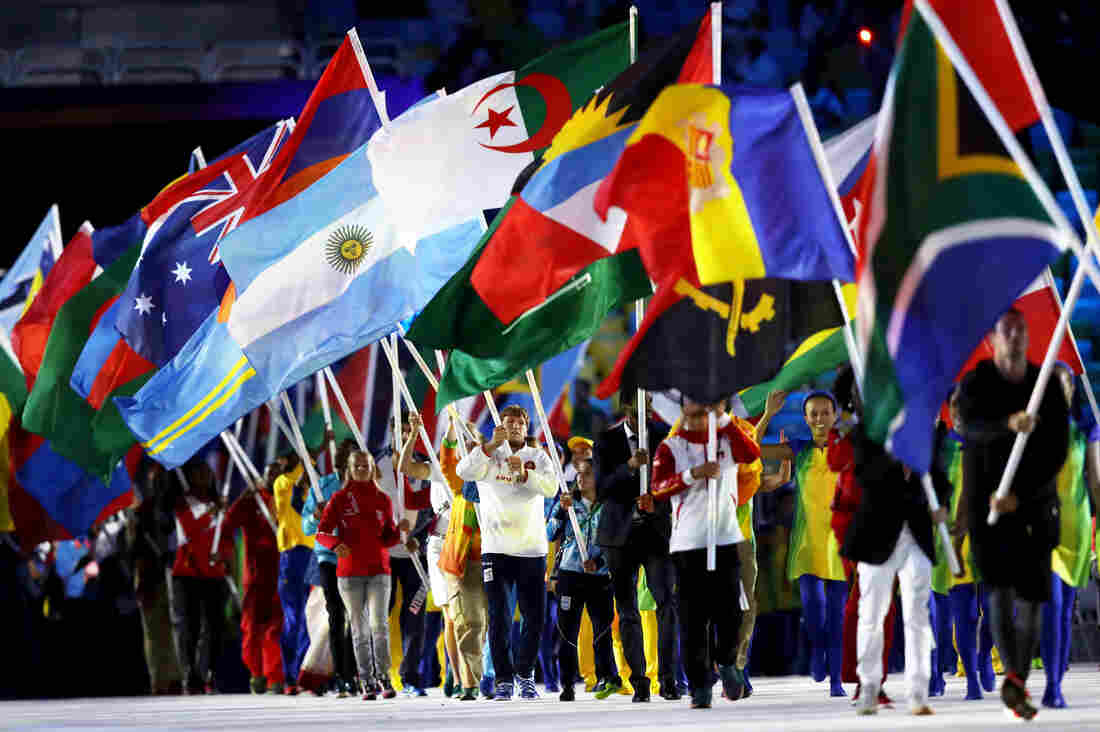
Athletes walk during the "Heroes of the Games" segment during the Closing Ceremony of the Rio 2016 Olympic Games at Maracana Stadium on Sunday in Rio de Janeiro, Brazil.

Athletes walk during the “Heroes of the Games” segment during the Closing Ceremony of the Rio 2016 Olympic Games at Maracana Stadium on Sunday in Rio de Janeiro, Brazil. Ezra Shaw/Getty Images hide caption

toggle caption Ezra Shaw/Getty Images

Rio 2016 organizers are dropping the curtain on the Summer Games, Sunday after hosting the world’s elite athletes who’ve competed for 306 medals over the past 19 days here in Rio de Janeiro.

The closing ceremony starts at 8 p.m. local time, which is one hour ahead of Eastern Time. Because of NBC’s time delay, it’s airing at 8 p.m. ET and progressively later across the U.S.

We’re updating this post with scenes from the event, so please refresh to see what’s happening in Rio. We got a late start due to technical issues, so we’re filling in some blanks from the official guide to the ceremony.

The opening ceremony began with a countdown, similar to the one we saw in the opening ceremony. After that, performers evoked the colors we’ve seen all during these games — inflections on Brazil’s blue, green, and yellow flag — to form a welcoming array of Rio landmarks.

The Games have been criticized for empty seats, but the stadium is packed on Sunday night.

The Games have been criticized for empty seats, but the stadium is packed on Sunday night. Ed Jones/AFP/Getty Images hide caption

toggle caption Ed Jones/AFP/Getty Images

Later in the show, a segment evoked the expanse of time that the opening show also got at, with cave-paintings displayed on Maracana Stadium’s floor in a a meditation on archeology.

The effect was very pretty — but the crowd loved what came in the show’s second half. One segment, cartoon characters such as Mario ran around — and then, inexplicably and yet wondrously, shot a drill bit through the Earth and out the other side. They created a tunnel that links Tokyo (hosts of the 2020 Games) and Rio, with a green pipe-like entrance protruding from Rio.

And here in Rio, the tunnel’s green entrance the magically appeared on the floor of Maracana — and out popped Japan’s Prime Minister Shinzo Abe. Or at least that’s what we’re told. It’s one of those “Wait, what… I love it!” moments that Olympic ceremonies pull off at their best.

Japan's Prime Minister Shinzo Abe appears during the closing ceremony.

Japan’s Prime Minister Shinzo Abe appears during the closing ceremony. David Ramos/Getty Images hide caption

toggle caption David Ramos/Getty Images

Another winning segment came earlier, when Grupo Corpo, a contemporary dance troupe from the Brazilian state of Minas Gerais, put on part of “Parabelo,” one of its shows, at the ceremony. But then the dancers gave way to “clay people,” and the performance drew roars of approval as the crowd bopped along to Luiz Gonzaga’s forró song “Asa Branca.”

The closing ceremonies must always include speeches, and that happened often tonight. There were also national anthems — of Brazil, of Greece, of Japan, and of Kenya (during a medal ceremony for marathon).

Dancers wave flags ushering in excitement for the 2020 Summer Olympics which will be held in Tokyo.

Dancers wave flags ushering in excitement for the 2020 Summer Olympics which will be held in Tokyo. Martin Bernetti/AFP/Getty Images hide caption

toggle caption Martin Bernetti/AFP/Getty Images

At the end of the show came a tribute to a personal favorite of ours: the genius landscape designer and artist Roberto Burle Marx, famous for his organic, wavy shapes (he created Copacabana’s iconic sidewalk tile pattern). Trained in Europe, Marx was a champion of Brazil’s native plants and its rainforests. In this segment, the music is “Chovendo na Roseira,” in a version by Tom Jobim.

The flame was then extinguished, in a graceful official end to these games.

And then, after a thoughtful pause — and because Rio knows how to party — the drums kicked in, and six six samba singers belted out “Cidade Maravilhosa” (Marvelous City) — a Carnival march that is Rio’s anthem. In the stadium, row upon row of people stood and danced, singing along.

Dancers pay tribute to landscape designer and artist Roberto Burle Marx, who created Copacabana's iconic sidewalk tile pattern.

Dancers pay tribute to landscape designer and artist Roberto Burle Marx, who created Copacabana’s iconic sidewalk tile pattern. Cameron Spencer/Getty Images hide caption

toggle caption Cameron Spencer/Getty Images

Was it then over? Not yet: A sound truck appeared, along with 12 carnival queens, and athletes who competed in these games poured out of

While these games have been criticized for not having full seats, Maracana was packed last night with people who watched Brazil’s men’s soccer team win gold. And tonight, it’s full of people who came out to enjoy the unique spectacle the Olympics brings.

Music — seen by many as the backbone of Brazil’s culture — is woven throughout this ceremony, from old classics and traditional music to new pop sounds from around the country. The audience clearly agrees with the choices the show’s music programmers have made. Brazilian music has many anthems, standards that everyone can sing, and tonight we’re hearing strains of familiar music reworked in new ways.

Singer Mariene de Castro performs in front of the Olympic flame before it was extinguished.

Singer Mariene de Castro performs in front of the Olympic flame before it was extinguished. Alexander Hassenstein/Getty Images hide caption

toggle caption Alexander Hassenstein/Getty Images

At the start of the show, a choir of 27 children entered, looking like little twinkling stars. With singers representing Brazil’s 26 states (and the Federal District), they performed Brazil’s national anthem.

We’ll note that after a travel delay, we arrived at Maracana Stadium later than we wanted — it’s a rainy, dreary evening in Rio. But the show must go on — even in an open-air stadium. Tonight, Maracana’s halls are darkened to highlight the light show and the Olympic flame.

Confetti falls as singers and dancers perform during the closing ceremony on Sunday.

Confetti falls as singers and dancers perform during the closing ceremony on Sunday. David Ramos/Getty Images hide caption

toggle caption David Ramos/Getty Images

At the end of an Olympics, talk always turns to their legacy – and instead of one, these games could be said to have many: First and foremost, there’s the drama, grace, and excellence displayed by more than 11,000 athletes.

Then there are the games’ effects on Rio – its people, its infrastructure, and it standing. What will become of the buildings erected to host this global event? And will the Paralympic Games, which have faced huge budget problems here in Rio, go smoothly?

Spectators dance as fireworks light up the sky during the closing ceremony of the Rio 2016 Olympic Games on Sunday.

Spectators dance as fireworks light up the sky during the closing ceremony of the Rio 2016 Olympic Games on Sunday. Fabrice Coffrini/AFP/Getty Images hide caption

toggle caption Fabrice Coffrini/AFP/Getty Images

The impact of the Olympics on the city’s future is tied to its impact on Brazil – whose economy was bustling when Rio won the right to host these games eight years ago but which was continually forced to rebalance its budget for the Olympics and Paralympics, making cuts that sometimes gave a ramshackle air to the proceedings.

And then, we come to the members of the U.S. swim team who failed to distinguish themselves repeatedly in an episode that eventually led U.S. Olympic Committee President Scott Blackmun to apologize “to our hosts in Rio and the people of Brazil for this distracting ordeal.”

Let’s block ads! (Why?)


No Image

Ryan Lochte To NBC's Matt Lauer On Rio Incident: 'I Was Immature'

U.S. Swimmer Ryan Lochte sits down with NBC’s Today show host Matt Lauer in an exclusive interview Saturday night to address the “robbery,” at a gas station that Rio police later discredited as a fabricated story. NBC News/YouTube hide caption

toggle caption NBC News/YouTube

In portions of a full interview with NBC’s Matt Lauer Saturday night, U.S. swimmer Ryan Lochte attempted to clarify his role in the early morning episode at a Rio de Janeiro gas station last weekend.

One day after apologizing on social media, Ryan Lochte appeared remorseful and emotional, sporting a fresh comb over instead of his silver hair as he took “full responsibility” for his exaggerated version of the events and his “immature behavior.”

Lochte,32, initially said that he and three of his teammates — James Feigen, Gunnar Bentz and Jack Conger — were victims of a robbery, held at gunpoint by armed men posing as police after a night of celebrating.

His claims were later refuted by Brazilian police, who cited surveillance video and witness testimonies. Rio’s Civil Police said Thursday, “There was no robbery.”

This video below is a portion of a news segment originally broadcast on Brazil’s O Globo, commenting on the incident involving U.S. swimmers at a gas station, as captured on surveillance video.
[embedded content]

Lauer pressed Lochte on why he maintained his statement to police and to the media, including NBC, that they were “victims.”

Lochte could not pointedly answer that question, but admitted, “I over-exaggerated that story.”

“I can’t answer that. ‘Cause I was intoxicated. All I know is that there was a gun was pointed at us and we were demanded to give money,” Lochte responded. “Whether you call it a robbery, whether you call it extortion, or us paying just for the damages, like, we don’t know. All we know is that there was a gun pointed in our direction, and we were demanded to give money.”

The 12-time Olympic medalist got particularly teary-eyed when responding how he felt being back in the U.S., while Brazil police interrogated his teammates.

“I let my team down,” Lochte said.

In his questions, Matt Lauer sidestepped some key details about that night’s events. He didn’t directly ask about the damage done by Lochte, according to Rio police, who called the swimmers “vandals,” nor did Lochte touch on that key point as to why he pulled down what he referred to as framed metal advertisement.

The Today show host also didn’t ask why Lochte went to the police to report the false story in the first place, but questions along these lines may come in the full interview, set to air on Monday.

Let’s block ads! (Why?)


No Image

'It's Weird': Tyson Gay On Latest Drama Over U.S. Men's Relay Race

Men's 4x100m relay teammates Tyson Gay, Justin Gatlin and Michael Rodgers react after being disqualified from the race at the Olympic Stadium in Rio de Janeiro Friday.

Men’s 4x100m relay teammates Tyson Gay, Justin Gatlin and Michael Rodgers react after being disqualified from the race at the Olympic Stadium in Rio de Janeiro Friday. Pedro Ugarte/AFP/Getty Images hide caption

toggle caption Pedro Ugarte/AFP/Getty Images

It’s a story that might sound familiar: A promising U.S. men’s 4x100m relay team was disqualified from a marquee race because of a bad baton exchange. Team member Tyson Gay calls it both weird and bad luck.

In fact, in a post-race interview that lasted less than 3 minutes, Gay used the word “weird” no less than seven times to describe how this race went for the Americans.

In the initial results, Jamaica won the race at Rio’s Olympic Stadium, followed by Japan and the U.S. — but after the teams finished their victory lap and were about to speak to the media, the Americans were shocked to see a “DQ” tag had been placed next to their ranking.

Officials “ruled that one of their baton exchanges was outside the legal zone,” as Greg wrote in his initial post about the race.

The U.S. team of Mike Rodgers, Justin Gatlin, Gay and Trayvon Bromell had turned in a time of 37.62 seconds, .35 seconds behind Jamaica’s winning time of 37.27. But that result didn’t stand.

After the race, Gray told reporters he was shocked by the outcome, which USA Track and Field has now appealed (a result may come by the morning).

If it stands, the disqualification will echo (and likely drown out) the men’s nightmare in the Beijing 2008 Summer Games, when they dropped the baton and didn’t reach the final.

But the team’s troubles extend past that. The U.S. squad’s silver medal finish in the London 2012 Olympics was voided last year, over the doping suspensions that have hit both Gay and Gatlin. And tonight Gay recalled another disqualification, in 2009, he said, for a bad handoff. Then there was last year’s world championship, where a horrible baton exchange slowed the Americans.

Here’s Gay talking about the latest setback:

“It has to be the worst luck for this country ever. It’s always something weird; stupid; simple — mistakes that always cost us. And I don’t understand. We had great sticks in practice, great chemistry, great everything, and then something so simple. I can’t think of nothing else to say but bad luck. I mean, it’s, weird. “

Gay said that officials told the team that Justin Gatlin received the baton too early, resulting in a disqualification. He added that it was similar to one they’d incurred in 2009 — but that in this case, the runners involved in the exchange believe it was clean.

With the Americans’ result now thrown out, Canada gets the bronze medal, Gay said, adding, “It’s so weird, man.”

We don’t mean to poke fun at Gay — if anything, his repeated use of the word “weird” is the perfect illustration of the current status of a team that’s seen dropped batons and other problems, but one that had seemingly gotten past those issues.

He added, “I mean, I couldn’t even shed a tear, I was so shocked. It was so shocking to the point where I couldn’t even cry. Because it’s almost to the point of like, ‘Damn, bad luck again.’

“You know? It’s weird. I don’t get it. It’s… I don’t get it.”

“We always have bad luck,” Gay said.

He spoke to the media shortly before Team USA filed a appeal of the disqualification — but Gay was sure that step would be taken.

Let’s block ads! (Why?)


No Image

'We Apologize' To Rio And Brazil, U.S. Olympic Committee Chief Says

Announcing that two swimmers have now flown out of a Rio airport after being detained by police, U.S. Olympic Committee CEO Scott Blackmun is apologizing for how the pair and two other swimmers behaved in Brazil.

“The behavior of these athletes is not acceptable,” Blackmun said, referring to swimmers Ryan Lochte, James Feigen, Gunnar Bentz and Jack Conger.

Bentz and Conger – who were taken off a plane at Tom Jobim International Airport Wednesday and whose passports were seized by police who wanted answers about a reported robbery – gave statements to the authorities and have now been allowed to leave Rio, Blackmun said late Thursday.

Saying that the U.S.O.C. had worked with the U.S. Consulate in Rio to coordinate the swimmers’ release, Blackmun said:

“On behalf of the United States Olympic Committee, we apologize to our hosts in Rio and the people of Brazil for this distracting ordeal in the midst of what should rightly be a celebration of excellence.”

Blackmun said that while U.S. officials haven’t seen the formal statements made by Bentz and Conger, who were with swimming star Ryan Lochte last weekend when Lochte claimed they were robbed at gunpoint after a late-night party, he understands that Bentz and Conger’s account matches what Rio police said earlier Thursday: that the robbery story was a fabrication.

Here’s the version of events Blackmun relayed:

“As we understand it, the four athletes (Bentz, Conger, [James] Feigen and Ryan Lochte) left France House early in the morning of August 14 in a taxi headed to the Olympic Village. They stopped at a gas station to use the restroom, where one of the athletes committed an act of vandalism. An argument ensued between the athletes and two armed gas station security staff, who displayed their weapons, ordered the athletes from their vehicle and demanded the athletes provide a monetary payment. Once the security officials received money from the athletes, the athletes were allowed to leave.”

That account is similar to what the chief of Rio’s Civil Police laid out Thursday, when he said, “There was no robbery.”

USA Swimming Executive Director Chuck Wielgus issued his own statement tonight, in which he said, “The last five days have been difficult for our USA Swimming and United States Olympic families.”

Saying that he doesn’t condone the conduct or judgment of the athletes, Wielgus added, “That this is drawing attention away from Team USA’s incredible accomplishments in the water and by other athletes across the Olympic Games is upsetting. The athletes and their remarkable stories should be the focus.”

Saying that the athletes’ behavior runs contrary to the values of Team USA, Blackmun said, “We will further review the matter, and any potential consequences for the athletes, when we return to the United States.”

Let’s block ads! (Why?)


No Image

Rio Police Remove U.S. Swimmers From Flight To Ask About Reported Robbery

U.S. swimmers Jack Conger, left, and Gunnar Bentz.

U.S. swimmers Jack Conger, left, and Gunnar Bentz. John Amis/AP, Tom Pennington/Getty Images hide caption

toggle caption John Amis/AP, Tom Pennington/Getty Images

Gunnar Bentz and Jack Conger, American swimmers who were with Ryan Lochte last weekend when their group reportedly suffered a robbery, were pulled off their flight home from Rio’s Summer Olympics Wednesday by police seeking answers about the reported robbery.

Bentz and Conger have now been released, U.S. officials say — but the two athletes are going to keep talking with police in Rio. They were detained hours after officers attempted to seize the passports of both Lochte and another swimmer: Jimmy Feigen, whose whereabouts remain a matter of speculation, but who U.S. officials now say is also cooperating with police in Rio.

Police stopped Bentz and Conger at Rio’s Tom Jobim International Airport, taking them off their flight back home in order to question them.

Early Thursday, U.S. Olympic Committee spokesman Patrick Sandusky released the following statement:

“Jack Conger and Gunnar Bentz were detained Wednesday night shortly before their flight was scheduled to depart from Rio. They were released by local authorities with the understanding that they would continue their discussions about the incident on Thursday. James Feigen is also communicating with local authorities and intends to make further statements regarding the incident on Thursday as well. We will continue to provide updated information as it is appropriate.”

The newspaper O Globo reports that Bentz, 20, and Conger, 21, were taken to the Galeão civil police station – which, like the airport, is on Governador Island.

It’s the latest development in a strange case that has left many puzzled — and has led to accusations in Brazil that the American swimmers fabricated their account.

News of the two Americans’ questioning comes more than 12 hours after police visited the Athletes Village Wednesday morning, in an attempt to speak with Lochte and another swimmer, James Feigen, about the account that they had given police under oath. But Lochte had already left for the U.S., and his attorney told NPR earlier today that he had not received any official requests to speak wih the decorated Olympic swimmer.

A central question right now regards the whereabouts of Feigen, 26; earlier today, we saw reports that he, like Lochte, had returned back home in the U.S. But tonight, we’re seeing reports that Feigen may have checked in for the same flight as Bentz and Conger but was not detained by police.

On Sunday, the swimmers described being robbed after a late-night party, with Lochte saying armed men took his wallet. But the story has raised questions here in Brazil, particularly after surveillance video emerged that purportedly shows the athletes returning to the Athletes Village on the morning in question, still in possession of their cellphones, watches, and other items that are often targeted by thieves.

The video, which was first published by The Daily Mail, also seems to show the athletes in a relaxed mood, with Lochte swinging his credential at one of his friends.

Bentz and Conger were part of the team that won a gold medal in the 4x200m freestyle relay; they raced in the earlier heats that put the team into the final. Both of them are in college: Bentz attends the University of Georgia and Conger the University of Texas.

Feigen swam in the 4x100m freestyle relay; he lives in Charlotte, N.C., according to his official Olympics biography.

Let’s block ads! (Why?)