
Sports

No Image

Vin Scully, 88, Will Retire Soon As LA Dodgers' Announcer

One of the greatest sports play-by-play announcers of all times, Vin Scully, is set to retire after 67 years calling plays for the Los Angeles Dodgers. He talks to David Greene about his career.

DAVID GREENE, HOST:

You are about to hear one of the most famous voices in America. Vin Scully has been the play-by-play announcer for the Dodgers for 67 years. When he started, the Dodgers played baseball in Brooklyn. They moved to Los Angeles in 1958. Scully’s voice, as baseball fans know, is like no other, and the memorable moments are countless.

(SOUNDBITE OF ARCHIVED RECORDING)

VIN SCULLY: And look who’s coming up.

GREENE: This was 1988, World Series, Game 1. Injured Dodgers slugger Kirk Gibson limps to the plate.

(SOUNDBITE OF ARCHIVED RECORDING)

SCULLY: High fly ball into right field – she is gone.

GREENE: Gibson’s ninth inning home run helped send the underdog Dodgers to a championship over the Oakland A’s. Vin Scully – he’s now 88 years old, and he is going to be calling his final Dodgers game in a couple weeks. When I reached him by phone, he talked about, well, this sound that you’re hearing.

(CHEERING)

GREENE: This drew him to sports in 1935. He was 8 years old. He would crawl under his family’s four-legged radio to listen to college football, waiting for the roar of the crowd.

SCULLY: When that roar would come, it was like water coming out of a shower head. It would just seem to pour all over me, and I would get goose bumps. And originally, I thought, gee, I would love to be there.

GREENE: Well, this is an amazing thing because you often hear about your belief in the art of silence and sometimes just as a broadcaster stepping back and allowing the roar of that crowd to just sit there with all of us. And I guess I now understand why listening to you talk about that.

SCULLY: Yes. In fact, it’s just come to me second nature. I would try to call the play as accurately and quickly as possible, and then I would shut up and sit there listening to the roar. And for a brief moment, I was 8 years old again, you know.

GREENE: Well, you know, one moment when you really let the roar of that crowd stand – 1974 and Henry Hank Aaron breaking Babe Ruth’s home run record. I mean, can you take me to that moment?

SCULLY: It was an incredible moment. In fact, it was the most important home run I’ve ever called.

(SOUNDBITE OF ARCHIVED RECORDING)

SCULLY: One ball and no strikes, Aaron waiting, the outfield deep and straightaway – fastball, it’s a high fly to the deep left center field. Buster goes back to the fence. It is gone.

(CHEERING)

SCULLY: The first thing I did was shut up because that place went bananas, and his family was coming out onto the field, and firecrackers were going off. So there were no words for me to express at all. And I got up from the table and went to the back of the room and let them roar.

(CHEERING)

SCULLY: And I think I poured a little glass of water and took a sip. And all of a sudden, while I was standing there, luxuriating with the roar of the crowd, it suddenly hit me. And that minute or however long shut up gave me that thought, which I then expressed.

(SOUNDBITE OF ARCHIVED RECORDING)

SCULLY: What a marvelous moment for baseball. What a marvelous moment for Atlanta and the state of Georgia. What a marvelous moment for the country and the world…

That a black man in the Deep South was being honored for breaking the record of a white icon.

(SOUNDBITE OF ARCHIVED RECORDING)

SCULLY: The record of an all-time baseball idol. And it is a great moment for all of us and particularly for Henry Aaron.

That really, through the grace of God, summed up the moment I think very well.

GREENE: It sure did. And, you know, I wondered if you, thinking that that could happen, had written some of those notes down…

SCULLY: Oh, no.

GREENE: …Because it was so poetic – no.

SCULLY: In all honesty, David, I have never, ever prepared to say something about an event that might occur because I might be so interested in displaying my pearls of wisdom that I might do it prematurely, and it doesn’t work. So that would be terrifying. So no, it was a very honest moment for me completely.

GREENE: You know, your final game is going to be calling a Dodgers-Giants game, you know, once rival franchises in New York now transplanted like you to California. How special is that?

SCULLY: It’s extremely special, David. And if you don’t mind, I’ll tell you one little story.

GREENE: Please.

SCULLY: I was about not quite 9 years old, and it was 1936. It was – the World Series was on, and it was October the 2. And I was walking home from school, and I went by a Chinese laundry, and there was the line score of that World Series game. And I stopped to look at it, and the score was 18 to 4 in favor of the Yankees. And my first reaction as a child was, oh, the poor Giants. And because of that, I became A, a baseball nut and two, a rabid Giants fan. Well, it makes it kind of interesting my last game will be a Giants-Dodgers game in San Francisco, October the 2, 2016.

GREENE: Yeah.

SCULLY: It will be exactly 80 years to the day when I first discovered baseball.

GREENE: That’s amazing. Being a rabid Giants fan as a youngster, are you pulling for the Giants even though you’re a – you’re the Dodgers broadcaster?

SCULLY: No. In all honesty, once you become a professional, number one, you’re no longer a fan. I don’t root for the Dodgers really. I just try to do the game as best I can. And the winning and the losing will take care of itself.

GREENE: Why retire now? How did you know this was the moment?

SCULLY: Well, you know, in November, I’m going to be 89, and I’ve been able to do just about everything that I ever wanted to do. I didn’t feel that it would be right that I would try to continue broadcasting when I’m going to be 90 – God willing – next year. And then I also thought that I’ve had so many yesterdays, I’m not sure how many tomorrows I’m going to have. I have a wife I adore, 16 grandchildren, three great-grandchildren. So the only reason that I would want to do baseball would be for some selfish reason, and I don’t want to do that. So no, I will spend my tomorrows where I should be – with my family.

GREENE: Vin Scully, real pleasure and honor talking to you, and enjoy these final games you’ll be calling and just thank you – thank you so much.

SCULLY: Thank you very much, David.

(SOUNDBITE OF UNIDENTIFIED SONG)

UNIDENTIFIED SINGERS: (Singing) Your Dodger blue, your Dodger blue (ph).

GREENE: Dodger Blue. Vin Scully has been the voice of the LA Dodgers – well, they were the Brooklyn Dodgers when he started. He’s been doing it for an astonishing 67 seasons.

Copyright © 2016 NPR. All rights reserved. Visit our website terms of use and permissions pages at www.npr.org for further information.

NPR transcripts are created on a rush deadline by Verb8tm, Inc., an NPR contractor, and produced using a proprietary transcription process developed with NPR. This text may not be in its final form and may be updated or revised in the future. Accuracy and availability may vary. The authoritative record of NPR’s programming is the audio record.

Let’s block ads! (Why?)


No Image

After Switching To Judo, Blind U.S. Paralympian Wins Bronze In Rio

The Paralympics wrap up on Sunday. NPR’s Rachel Martin speaks with blind athlete Dartanyon Crockett who won a bronze medal in Rio in Judo.

RACHEL MARTIN, HOST:

The Paralympics wrap up today. We’ve been following one young athlete. His name is Dartanyon Crockett. He’s a blind wrestler who switched sports to judo for the Paralympics. We interviewed him before he went to Rio. Dartanyon is now back in the States with a bronze medal around his neck. He won his first bronze in the 2012 London Games. We caught up with him via Skype.

DARTANYON CROCKETT: Being a two-time medalist – one, being a medalist is incredible in itself, but being able to do it twice back-to-back is amazing.

MARTIN: Dartanyon said this medal is even more meaningful than his first because of who he had to beat to win it.

CROCKETT: It was against an opponent – his name’s Sam Ingram from Great Britain. He’s actually the one who beat me in London. He’s been beating me for, like, this entire four years. Every other time I went against him, I lost to him. And then finally to be able to pull out a win where it really counted was just pretty incredible.

MARTIN: Before he even won the match, Dartanyon had decided that he will compete again in four years.

CROCKETT: Because of my excitement and my love of the sport, I made a decision the day before I competed – decided that I’m definitely going to go for another four years.

MARTIN: Even before you won this most recent bronze, you knew that you were going to go for it in Tokyo again.

CROCKETT: Yeah.

MARTIN: Dartanyon Crockett – he won a bronze medal in judo at the Rio Paralympics. Some sad news from the games today to add – Paralympian Bahman Golbarnezhad of Iran died while competing in a cycling road race. Following a crash on the course, Golbarnezhad suffered cardiac arrest while being rushed to the hospital. He’ll be honored with a moment of silence at tonight’s closing ceremony. He was 48 years old.

Copyright © 2016 NPR. All rights reserved. Visit our website terms of use and permissions pages at www.npr.org for further information.

NPR transcripts are created on a rush deadline by Verb8tm, Inc., an NPR contractor, and produced using a proprietary transcription process developed with NPR. This text may not be in its final form and may be updated or revised in the future. Accuracy and availability may vary. The authoritative record of NPR’s programming is the audio record.
Let’s block ads! (Why?)


No Image

Penn State Under Fire For Planned Tribute To Joe Paterno

Pennsylvania State University is receiving intense criticism for its planned tribute to former football coach, Joe Paterno. Critics say Paterno failed to prevent or adequately report Jerry Sandusky’s repeated sexual abuse of children. Penn State fired Paterno in 2011, after Sandusky’s abuse came to light.

KELLY MCEVERS, HOST:

Penn State University is being criticized for its decision to honor its former football coach, Joe Paterno, during a game on Saturday. The school’s tribute is for the 50th anniversary of Paterno’s first game as Penn State head coach.

AUDIE CORNISH, HOST:

The university fired Joe Paterno back in 2011. This was after a grand jury indicted Jerry Sandusky for sexually abusing children over decades. Sandusky had been a defensive coordinator for the football team.

MCEVERS: Paterno has been faulted for not adequately reporting Sandusky’s crimes. And before Paterno died in 2012, he said he wished he had done more. But there’s an ongoing fight over the former coach’s legacy.

CORNISH: We asked Erin McCarthy about tomorrow’s commemoration. She’s a senior at Penn State and an intern at The Philadelphia Inquirer, covering Penn State football.

ERIN MCCARTHY: On Saturday, there’s going to be a focus, it seems, on the players that he impacted. That was their pretty much exact phrasing in that statement from the athletic director, Sandy Barbour. And the co-captains of the 1966 team will participate in the coin toss and different types of video presentations and clips of that game throughout the game tomorrow.

MCEVERS: Charlie Thompson is a reporter for The Patriot-News in Harrisburg. He says the decision to hold the commemoration has a lot to do with pressure from people who went to Penn State and feel like Paterno was made into a scapegoat.

CHARLIE THOMPSON: There have been surveys that suggest that more than 90 percent of Penn State alumni believe that it is time and it is fitting for the university to honor Paterno and his contributions to Penn State.

CORNISH: Among current students, opinion is mixed. A Daily Collegian editorial condemned the planned commemoration and said Paterno is, quote, “no longer a community hero.”

MCEVERS: But senior Erin McCarthy says, you can still find a lot of fans around state college, too.

MCCARTHY: You know, you walk around downtown, and a lot of stores have cut outs of Joe Paterno, Joe Paterno wall hangings and shirts. And it’s a part of the culture here that, despite what happened in 2011, doesn’t seem to have gone away.

CORNISH: The events of 2011 haven’t gone away, either. Former University officials are still facing charges related to the Sandusky case.

MCEVERS: A victim advocate who worked with survivors of Sandusky’s abuse talked to Yahoo News and called tomorrow’s commemoration incredibly insensitive.

Copyright © 2016 NPR. All rights reserved. Visit our website terms of use and permissions pages at www.npr.org for further information.

NPR transcripts are created on a rush deadline by Verb8tm, Inc., an NPR contractor, and produced using a proprietary transcription process developed with NPR. This text may not be in its final form and may be updated or revised in the future. Accuracy and availability may vary. The authoritative record of NPR’s programming is the audio record.

Let’s block ads! (Why?)


No Image

Radio Play-By-Play Announcer Describes Game Disruption

Kevin Harlan of Westwood One was broadcasting during Monday Night Football when someone ran onto the field. Harlan described him as a “goofball in a hat” and more. Police eventually tacked the man.

(SOUNDBITE OF MUSIC)

STEVE INSKEEP, HOST:

Good morning. I’m Steve Inskeep. Years ago, I worked as a radio sportscaster and admired those who did it well. Westwood One’s Kevin Harlan did on Monday when a pro football game was disrupted.

(SOUNDBITE OF RADIO BROADCAST)

KEVIN HARLAN: Hey, somebody has run out on the field – some goofball in a hat and a red shirt. Now he takes off the shirt. He’s running down the middle by the 50. He’s at the 30. He’s bare-chested and banging his chest. Now he runs the opposite way.

INSKEEP: TV didn’t show the action, but Harlan gave the facts until police tackled the man. It’s MORNING EDITION.

Copyright © 2016 NPR. All rights reserved. Visit our website terms of use and permissions pages at www.npr.org for further information.

NPR transcripts are created on a rush deadline by Verb8tm, Inc., an NPR contractor, and produced using a proprietary transcription process developed with NPR. This text may not be in its final form and may be updated or revised in the future. Accuracy and availability may vary. The authoritative record of NPR’s programming is the audio record.

Let’s block ads! (Why?)


No Image

NFL Pledges Another $100 Million For Study Of Head Injuries, Safety In Football

“While we can never completely eliminate the risk of injury, we are always striving to make the game safer,” NFL Commissioner Roger Goodell says. Bob Leverone/AP hide caption

toggle caption Bob Leverone/AP

Saying it wants to make football safer for current and future athletes, the NFL is pledging to spend $100 million for “independent medical research and engineering advancements.” A main goal will be to prevent and treat head injuries.

Announcing the pledge Wednesday, NFL Commissioner Roger Goodell said it is in addition to the $100 million the league already committed toward medical research of brain injuries and chronic traumatic encephalopathy, the progressive degenerative disease that has been found in football players.

The $100 million figure represents 1 percent of the roughly $10 billion in annual income that the league and its teams have been reported to make — including back in 2014, when an outside tax counsel for the NFL named that figure in an interview with NPR.

While he laid out new elements of a plan to make football safer, Goodell also acknowledged the game’s physical nature:

“Our game, of course, is a contact sport. Fans love to see the action on the field, including the big hits. While we can never completely eliminate the risk of injury, we are always striving to make the game safer — for our professional athletes down to young athletes first learning how to play.”

The new program comes as the league has dealt both with injuries on the field and with a large lawsuit by former players that was settled back in April for $1 billion. It requires the NFL to make different payments to players who have sustained varying levels of debilitating injury.

And in March, an NFL executive made waves for becoming the first league official to publicly state that football has been linked to chronic traumatic encephalopathy.

Announcing the new program, dubbed Play Smart, Play Safe, Goodell mentioned that the NFL had recently hired a full-time chief medical officer to coordinate best practices and information between the medical staff of teams and the NFL and the NFL Players Association.

In addition, Goodell said, the NFL is “establishing an independent, scientific advisory board comprising leading doctors, scientists and clinicians to engage in a clear process to identify and support the most compelling proposals for scientific research into concussions, head injuries and their long-term effects.”

Goodell also noted that one result of the increased emphasis on preventing head injuries is that “there may be an increase in reported concussions, as happened last season.”

While no one wants concussion numbers to rise, he said, the increase in self-reporting, screening and data collection will make preventive measures more reliable in the long run.

“This is an important culture change for all of us,” Goodell said.

Let’s block ads! (Why?)


No Image

North Carolina GOP Blasts NCAA's Decision To Pull Championships

The NCAA penalized the state of North Carolina for its new law that removed some protections for lesbian, gay, bisexual and transgender people. The NCAA pulled tournament games out of the state for the next academic year.

AUDIE CORNISH, HOST:

There’s been a ton of reaction in North Carolina after the NCAA yanked all post-season tournaments out of the state. The college governing board is relocating a series of sporting events due to a controversial state law known as House Bill 2. It limits protections for the lesbian, gay, bisexual and transgender community. Jeff Tiberii of member station WUNC reports on the latest economic blow to North Carolina since the law took effect.

JEFF TIBERII, BYLINE: College basketball is ingrained in the culture down here. Many adults can recall teachers rolling televisions into classrooms to watch March Madness games during their childhood. It seems just about everyone has a passionate interest.

(SOUNDBITE OF ARCHIVED RECORDING)

WOODY DURHAM: It’s all over. The Tar Heels are the Atlantic Coast Conference champions. Carolina has beaten Duke.

TIBERII: Now for the first time since 1985, no post-season collegiate men’s basketball will take place in North Carolina.

HENRI FOURRIER: A kick in the gut.

TIBERII: That’s Henri Fourrier. He’s president of the Greensboro Area Convention and Visitors Bureau.

FOURRIER: Think we all knew this was coming, but somehow I found myself in denial and hopeful that it wasn’t going to happen.

TIBERII: What good economically has come out of House Bill 2?

FOURRIER: Nothing that I can put my arms around.

TIBERII: According to the Visitors Bureau, the removal of these games is an economic loss of $14-and-a-half million adding to a growing statewide tally in excess of several hundred million dollars. Greensboro Mayor Nancy Vaughan says it goes beyond money.

NANCY VAUGHAN: Marketing like that when you see these events on television – you can’t buy that type of advertising. It is a source of pride to our community. It is part of our culture, and it would be a shame for that to be taken away for the next few years.

TIBERII: The NCAA has kept sports championships out of states before. It had a long ban on events being held in South Carolina because the Confederate flag used to fly on the state capitol grounds. The NCAA cited the discriminatory nature of House Bill 2 which requires people to use the bathroom corresponding to the sex listed on their birth certificate as to why it relocated all post-season events from North Carolina in the next year.

The NCAA and Governor Pat McCrory did not return phone calls for comment, but in a statement, Governor McCrory said this is an issue for the courts to decide, not the NCAA.

Republican Lieutenant Governor Dan Forest defended the law today. He says the economic impact is a concern, but the bigger issues are safety and partisan bickering which the NCAA shouldn’t be involved in.

(SOUNDBITE OF ARCHIVED RECORDING)

DAN FOREST: So this is kind of the way politics works, you know? If it wasn’t this, it would be another issue. So certainly the frustration, if there is any, would be on getting the truth out.

TIBERII: Since the law took effect, several businesses, including Pay-Pal, have scaled back large expansion plans. Bruce Springsteen canceled a concert, and the NBA took its All-Star Game to New Orleans. Now the Atlantic Coast Conference has to decide if it will hold future tournaments in its home state. And for many in this basketball-crazed region, the loss of college hoops could sting the most. For NPR News, I’m Jeff Tiberii in Durham, N.C.

Copyright © 2016 NPR. All rights reserved. Visit our website terms of use and permissions pages at www.npr.org for further information.

NPR transcripts are created on a rush deadline by Verb8tm, Inc., an NPR contractor, and produced using a proprietary transcription process developed with NPR. This text may not be in its final form and may be updated or revised in the future. Accuracy and availability may vary. The authoritative record of NPR’s programming is the audio record.

Let’s block ads! (Why?)


No Image

NCAA Pulls 7 Championship Events From North Carolina, Citing Transgender Law

An official, photographers, cheerleaders and others wait for play to resume during an NCAA Men’s Basketball Tournament second-round game between the Butler Bulldogs and the Virginia Cavaliers in March in Raleigh, N.C. This coming spring the Road to the Final Four won’t go through North Carolina, as the NCAA has decided to move three games out of Greensboro. Grant Halverson/Getty Images hide caption

toggle caption Grant Halverson/Getty Images

The NCAA announced Monday evening that it would relocate seven championship sporting events out of North Carolina during this school year, citing the state’s HB2 law limiting civil rights protections for LGBT individuals, WUNC’s Dave DeWitt reports.

The events moving out of state include first and second rounds of the Division I Men’s Basketball Championship — part of the Road to the Final Four — originally slated to be in Greensboro, DeWitt reports.

In a press release, the Board emphasized that “NCAA championships and events must promote an inclusive atmosphere for all college athletes, coaches, administrators and fans. Current North Carolina state laws make it challenging to guarantee that host communities can help deliver on that commitment if NCAA events remained in the state.”

The state Republican party countered late Monday with a scathing press release written by spokeswoman Kami Mueller.

“This is so absurd it’s almost comical. I genuinely look forward to the NCAA merging all men’s and women’s teams together as singular unisex teams. Under the NCAA’s logic, colleges should make cheerleaders and football players share bathrooms, showers and hotel rooms. This decision is an assault to female athletes across the nation.”

HB2 earlier cost the state the 2017 NBA All-Star game, DeWitt notes. The law limits anti-discrimination protections for LGBT individuals and requires transgender people to use public bathrooms that match the sex listed on their birth certificates, rather than the gender with which they identify.

Equality NC executive director Chris Sgro writes in a press release that “it has become clear that the shadow HB2 has cast on North Carolina is hurting our economy, our reputation and our people every day.”

Let’s block ads! (Why?)


No Image

Stan Wawrinka Beats Defending U.S. Open Champion Novak Djokovic

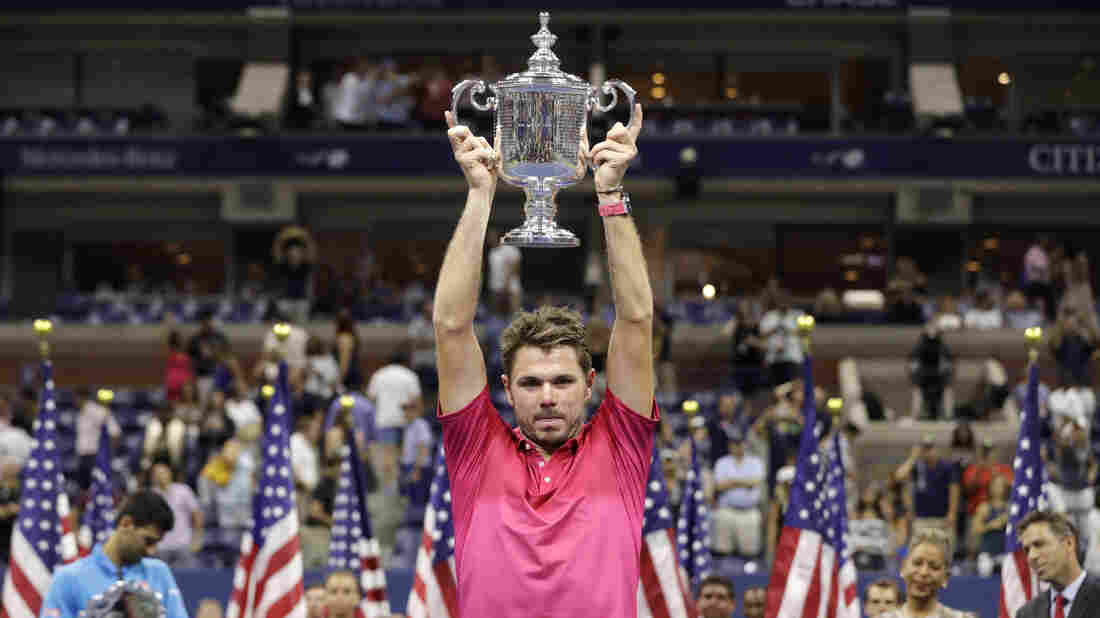
Stan Wawrinka, of Switzerland, holds up the championship trophy after beating Novak Djokovic, of Serbia, to win the men’s singles final of the U.S. Open tennis tournament on Sunday in New York. Darron Cummings/AP hide caption

toggle caption Darron Cummings/AP

Mere minutes before heading out to face Novak Djokovic in the U.S. Open final in New York, Stan Wawrinka met in the locker room with his coach and felt as nervous as he ever had. Wawrinka was shaking. Started to cry, even.

Why?

“I don’t want to lose the final in a Grand Slam, that simple. That’s the only reason,” he explained later. “The feeling of: You don’t want to lose. I don’t want to come to the court and lose a final. So close, so far.”

Once he was on the court, and got over some shaky play at the very start, Wawrinka’s game and mindset were strong as can be, as they always seems to be these days when the stakes are highest. Repeatedly pointing his right index finger to his temple, the gesture he uses when showing his mettle, Wawrinka surprisingly wore down No. 1 Djokovic and beat the defending champion 6-7 (1), 6-4, 7-5, 6-3 for his first U.S. Open title and third Grand Slam trophy overall.

“He was the better player. He was tougher mentally,” said Djokovic, offering two of the highest compliments a tennis player can receive from the talented Serb. “He knew what to do.”

The 31-year-old Wawrinka is the oldest U.S. Open men’s champion since Ken Rosewall was 35 in 1970. He entered Sunday having spent almost exactly twice as much time on court during the tournament — about 18 hours vs. about 9 hours — as Djokovic, who benefited from injuries to three opponents that withdrew before or during matches.

“Honestly, after the match, I was completely empty,” the third-seeded Wawrinka said. “I put everything on the court. Not only today, but the past two weeks.”

By breaking in the final game of the second and third sets, and by saving 14 of 17 break points he faced, Wawrinka already had gained the upper hand by the time Djokovic clutched at his left leg and grimaced after missing a forehand while getting broken early in the fourth.

Djokovic was granted the unusual chance to have a medical timeout at a time other than a changeover. He removed both shoes and socks so a trainer could help with bleeding toes. Wawrinka complained about the 6-minute break, and Djokovic looked over and apologized. Later, Djokovic started limping and received more treatment.

“We played almost 4 hours,” said Djokovic, “and I think I can speak in the name of Stan, as well: We both felt it.”

Wawrinka has won only five of 24 career meetings against Djokovic, but has now beaten the 12-time major champion on the way to each of his own Grand Slam titles, including in the 2014 Australian Open quarterfinals and 2015 French Open final.

Before this matchup, Djokovic praised Wawrinka as “a big-match player,” and, boy, is he ever. Wasn’t always, though: Playing in the shadow of his far-more-accomplished Swiss countryman and good pal, Roger Federer, Wawrinka needed until his 35th appearance at a major, at age 28, just to get to the semifinals for the first time.

But look at Wawrinka now.

He has won 11 consecutive tournament finals.

He is 3-0 in Grand Slam finals, beating the No. 1-ranked player each time. Take that trio of highest-stakes matches out of the equation, and Wawrinka is 0-19 in all other matches against the top man.

And he did it Sunday by coming back against Djokovic, whose French Open title in June completed a career Grand Slam and made him only the third man — and first in nearly a half-century — to win four consecutive major tournaments.

Djokovic had been 51-0 in U.S. Open matches when taking the first set. This time, though, the thick-chested Wawrinka eventually began bullying Djokovic from the baseline, not only with his best-in-the-game one-handed backhand, but off both wings.

“He likes to occasionally whack the ball quite hard, and I don’t think that Novak likes that,” said Wawrinka’s coach, Magnus Norman. “Stan is maybe one of the few guys who can really hit through Novak if he has a good day.”

As Wawrinka placed one stinging shot after another right on a line, Djokovic looked up at coach Boris Becker while gesticulating with his hands and muttering. He went from appearing locked-in at the outset to completely drained in every way.

On one point, Wawrinka delivered a shot so hard it knocked the racket from Djokovic’s grasp and against a wall behind the baseline.

After smacking a forehand winner to end a 20-stroke exchange near the end of the second set, Wawrinka pointed to his temple. Did it again after a forehand passing shot drew an errant volley for a break early in the third.

And so on.

Wawrinka nearly was gone before the end of the U.S. Open’s first week, one point from losing in the third round against 64th-ranked Dan Evans. Sunday’s victory made Wawrinka the first man to win the tournament after saving a match point since — yes, that’s right — Djokovic in 2011.

“You’re a great champion, a great person. Because of you, I am where I am today,” Wawrinka told Djokovic, a close friend, afterward. “We know each other (for) many, many years, and I had the chance to practice many times with him and to play him on a big stage.”

With that Djokovic, threw his left arm around Wawrinka’s shoulders, knowing which of the two was more up to the task on this day.

Let’s block ads! (Why?)


No Image

Angelique Kerber Beats Karolina Pliskova To Win Her First U.S. Open Title

Angelique Kerber, of Germany, returns a shot to Karolina Pliskova, of the Czech Republic, during the women’s singles final of the U.S. Open tennis tournament, Saturday, in New York. Darron Cummings/AP hide caption

toggle caption Darron Cummings/AP

Early in what would become a tight test of a U.S. Open final, Angelique Kerber sprinted forward to somehow reach a drop shot and scoop a down-the-line winner to a corner.

The Arthur Ashe Stadium crowd roared, and Kerber celebrated by raising her right hand and wagging her index finger in the air, as if to remind opponent Karolina Pliskova — and everyone else — “I’m No. 1!”

Yes, she is. And a two-time Grand Slam champion, too.

Kerber won her first U.S. Open title and the second major trophy of her out-of-nowhere breakthrough season, taking five of the last six games to beat a fading Pliskova 6-3, 4-6, 6-4 on Saturday.

“It means a lot to me. When I was a kid, I was always dreaming to one day be the No. 1 player in the world, to win Grand Slams,” said Kerber, a 28-year-old German who will move up one spot from No. 2 and replace Serena Williams atop the WTA rankings on Monday. “I mean, all the dreams came true this year, and I’m just trying to enjoy every moment on court and also off court.”

Never a Grand Slam finalist before 2016, Kerber beat Williams for the Australian Open title in January, then lost to her in the Wimbledon final in July.

On Saturday, the No. 2-seeded Kerber trailed by a break at 3-1 in the third set before coming back against Pliskova, a 24-year-old Czech who was seeded 10th and hadn’t been past the third round at a major until this tournament.

“For sure,” Kerber told Pliskova during the trophy ceremony, “you have a great future.”

The present could not be brighter for the left-handed Kerber, the first woman from Germany to win the U.S. Open — and to get to No. 1 — since her idol and mentor, Steffi Graf.

It was Pliskova who guaranteed Kerber’s ascension in the rankings by beating Williams in the semifinals, ending her record-tying 186-week stay at the top, which began in February 2013.

Kerber, who collected $3.5 million in prize money Saturday, lost to Pliskova the last time they met, just three weeks ago in the final of a hard-court tournament in Cincinnati.

But at the outset of this final, it was Kerber who was in charge. Her defense is exemplary, scrambling along the baseline to put her racket on seemingly every ball, crouching so low that her knees would come close to scraping the ground.

As she does against most opponents, Kerber would make Pliskova swing two, three, four extra times to try to end a point. And Pliskova was troubled by that in the early going, making 17 unforced errors in the first set alone, 14 more than Kerber. By the conclusion of the 2-hour, 7-minute final, Pliskova totaled 47 unforced errors, 30 more than Kerber.

“I was really trying to (stay) in the moment,” Kerber said, “trying to play my game, being aggressive.”

Kerber won the toss and elected to receive, perhaps for two reasons: Her serve is the biggest question mark in her otherwise solid game, and it made sense to force Pliskova to deal with an early test of nerves. Either way, the decision worked: Pliskova double-faulted on the match’s first point and got broken right from the get-go.

There were plenty of lengthy exchanges in that first set, and Kerber tended to get the better of them, winning 9 of 14 points that lasted at least 10 strokes.

But Pliskova hung in there. And after frittering away her first four break points of the match, she converted her fifth with a lob-volley winner that curled over Kerber and alit right by the baseline. Suddenly up 4-3 in the set, Pliskova turned to her coach up in the stands and yelled, pumping her fists.

Now it was a match, filled with terrific points, tense moments and plenty of emotion. Pliskova served out the second set — the only one dropped by Kerber all tournament — and spiked a ball. Kerber got broken early in the third and bounced her racket off the court. Moments later, she trailed 3-1.

But this was Kerber’s turn to show some mettle, breaking back to 3-all and again to end it. She dropped on her back after the last point, then climbed into the stands to begin the celebration with her coach and others.

“She really proved she’s the world No. 1,” Pliskova told the fans. Then she addressed Kerber directly, saying: “It was a great match, and I’m very honored to play with you.”

Let’s block ads! (Why?)


No Image

Serena Williams Loses Chance To Break Grand Slam Record

On Monday, Sports Illustrated senior writer Jon Wertheim said the U.S. Open was Serena Williams’ to lose, and on Thursday night, she did. He tells NPR’s Audie Cornish what happened Thursday when she lost not just her match, but her chance to surpass Steffi Graf for the most Grand Slam singles titles.

Transcript

AUDIE CORNISH, HOST:

After she won Wimbledon in July, it seemed like Serena Williams was poised to break Steffi Graf’s long-standing record of winning 22 grand slam singles titles. But after a surprising loss last night at the U.S. Open, Williams will have to wait for another chance. It’s just the latest drama in an exciting U.S. Open. The men’s title is up for grabs this weekend as well. Jon Wertheim of Sports Illustrated is at the U.S. Open in New York City. Welcome back, Jon.

JON WERTHEIM: Thank you. Pleasure to be here.

CORNISH: So what exactly happened with Serena Williams? What’s the explanation here?

WERTHEIM: My four-letter explanation – T-I-M-E. Serena turns 35 later this month. And she looked like someone in their mid-30s about to leave the 18-to-34 demographic last night. She had a very exciting match on Wednesday night, but it was a three-set match that I think depleted her a little bit. And she came back on Thursday with less than 24 hours rest and looked like a spent player. She ran into a powerful opponent. This player – Karolina Pliskova – had beaten Venus earlier in the tournament. But I do think last night was really more about Serena being far from her best. She had some injuries and her timing was flat. She had 18 aces in her previous match, only five last night. And basically she looked, sadly, mortal.

CORNISH: Well, settle down here because she’s been number one for – what? – like, 186 weeks? I mean, it’s not like she’s playing poorly.

WERTHEIM: No, that’s what’s been interesting about this

WERTHEIM: Serena’s kept her number one ranking up through this tournament. She reached the finals of the first three majors. She won Wimbledon. She reached the semifinals here. So part of what’s interesting about her year is that this hasn’t been – she hasn’t fallen off a cliff. This hasn’t been a dramatic drop off. She’s just had a hard time closing matches late in the tournament, which is completely new for her.

I mean, it used to be if she got to this stage in an event you may as well start engraving her name. You had to – the book was you had to get to Serena early, and nobody’s really done that this year. And yet she’s had a hard time closing, which is something we’ve never seen from her before.

CORNISH: Well, tomorrow in the finals it’s Karolina Pliskova and who? Tell me what this setup is going to be.

WERTHEIM: She is facing Angie Kerber, a German player who is the player who will now take over the number one ranking from Serena. I think the casual fan will see this and think, oh, and how in the world is Serena not number one? But Kerber’s having this fantastic year. She actually beat Serena in the Australian Open final, lost to her in the Wimbledon final. She was a silver medalist. She plays sort of subtle, tactical tennis. She moves very well. This number one ranking is very well deserved.

But again, I think the big takeaway from this story is a year ago, Serena was trying to win the Grand Slam, all four majors in the year, and she came up just a little bit short. This year, it was not nearly as decorated a year. She only won one major and lost at three others, including the U.S. Open, obviously.

CORNISH: I want to talk about the men now. Of the so-called big four, you had Roger Federer sitting out due to injury, Rafael Nadal and Andy Murray both upset earlier in the tournament. So who’s left? What’s going on?

WERTHEIM: Novak Djokovic will have to carry the banner of the big four. This is – just to give you an idea of how their excellence has been such a dominating theme – this is the first tournament in more than six years at which at least two of them hasn’t been represented in the final four of a tournament. So Djokovic will have to represent the big four. He is the defending champion, the number one ranked player, the number one seed.

But there are three outsiders who have crashed the party and again, as with Serena, I wonder if time isn’t our theme here. Rafael Nadal is now north of 30. Roger Federer is 35. And I – sadly maybe this transition is just inevitable, time doing its thing.

CORNISH: That’s Jon Wertheim, executive editor of Sports Illustrated, talking to us from the U.S. Open in New York. Thanks so much.

WERTHEIM: Anytime, Audie.

Copyright © 2016 NPR. All rights reserved. Visit our website terms of use and permissions pages at www.npr.org for further information.

NPR transcripts are created on a rush deadline by Verb8tm, Inc., an NPR contractor, and produced using a proprietary transcription process developed with NPR. This text may not be in its final form and may be updated or revised in the future. Accuracy and availability may vary. The authoritative record of NPR’s programming is the audio record.

Let’s block ads! (Why?)