Business

No Image

In Google's Vision Of The Future, Computing Is Immersive

Dan Howley tries out the Google Daydream View virtual-reality headset and controller on Oct. 4, 2016, following a product event in San Francisco. This week, Google announced plans for stand-alone VR goggles that won’t need to be attached to a PC or smartphone.

Eric Risberg/AP

hide caption

toggle caption

Eric Risberg/AP

Google offered a glimpse of how it sees the future at its annual developer’s conference this week. And it involves a lot of blending between the virtual and the real worlds using augmented and virtual reality. Google is calling that blend immersive computing.

Clay Bavor, who heads up Google’s AR and VR division, says it’s all part of a future where the virtual and real worlds blur.

“Virtual reality can make you really feel transported somewhere else,” Bavor says. “Augmented reality can bring kind of digital information into your environment and make it really seem as if it’s there in the real world.”

When it comes to virtual reality other companies like Facebook’s Oculus Rift, Sony VR, and HTC Vive have aimed for the expensive high end. But Google has actually reached more people with its $15 Cardboard viewer that attaches to smartphones. This week it announced plans for a more advanced VR headset.

Google will be the first major company to release stand-alone VR goggles. “Unlike systems that you have to connect to a PC or where you take your smartphone and insert it into a VR headset, everything you need for VR is contained right in the headset itself,” Bavor says.

Google is partnering with HTC and Lenovo to make the headset.

New #Daydream standalone headsets from partners like @htcvive won’t require a phone or PC. #io17pic.twitter.com/7TpYPJGEdU

— Google (@Google) May 17, 2017

Google is also beefing up its augmented reality technology. First, there’s Google Lens. The technology pulls together Google’s search technology and lays it over photos from the real world. You can point your camera at a flower and the search engine will identify it for you. Point the camera at a book and it will give you reviews and information about the author. Google Lens will initially be available through Google Assistant and Google Photos.

Google also announced what it’s calling Visual Positioning Service or VPS. Bavor says imagine going to a large store. “You go to Lowe’s and you need to find this very specific bolt. You can pull up the Lowe’s app — do a search for it and then your phone will walk you step by step to the exact aisle and shelf where that bolt is,” he says.

Bavor says this technology may also be especially useful to the blind. But, it won’t initially be widely available. It will be incorporated into a new ASUS smartphone.

There’s a lot of competition among the big tech companies to advance these immersive technologies — Facebook, Microsoft and Sony are competitors and analysts say Apple is likely to jump into the fray.

But Google has some advantages, says Greg Sterling, a contributing editor at Search Engine Land. “Because it’s got hardware, it’s got a massive consumer audience and brand and it’s got all this data and software expertise. And really none of the other players have all those pieces,” he says.

Google is adding both AR and VR capabilities to its Chrome browser. You’ll be able to switch between VR experiences quickly and of course use Google’s database to identify items in the real world. For example, you could point your augmented reality-enabled phone at a restaurant and review would pop up on the screen from Google search.

But not all of Google’s efforts may be destined to succeed. Take that stand-alone VR headset. Google’s new VR goggles might not appeal to either high-end VR fans or the low-end Google Cardboard fans.

Brian Blau, an analyst at Gartner, says the high-end users will spend money for the power of an Oculus Rift and the low-end market may not want to spend much at all. Google says its headset might cost the same as an Oculus Rift, but will be cheaper because you don’t have to buy a high-end computer too. That could be too much, Blau says.

“Because you really have to want to be an extended VR user, if you will, if you’re going to invest more than $500 into one of these systems,” he says.

And Google has had previous failures with augmented reality. Google Glass was a flop with consumers because the company didn’t think through the privacy implications.

Google’s VR headset will be out the end of this year and so will new augmented reality-capable smartphones. There’s still no word on price.

Let’s block ads! (Why?)


No Image

Episode 772: Small Change

Technology changes.

Giordano Poloni/Getty Images/Ikon Images

hide caption

toggle caption

Giordano Poloni/Getty Images/Ikon Images

Here is a thing we hear approximately every day: The world is changing faster than ever before. Robert Gordon doesn’t buy it.

He’s an economist who has spent decades studying technological change and economic growth in America. He argues that, contrary to popular belief, the world is not changing faster than ever before. In fact, it’s not even changing as fast as it was 100 years ago.

He recently made this argument in a book called The Rise and Fall of American Growth. In the New York Times, Paul Krugman called it a “magisterial combination of deep technological history, vivid portraits of daily life… and careful economic analysis.”

On today’s show, we talk to Gordon. His argument has profound implications for everything from how the next generation will live to whether robots really are about to take our jobs.

Music: “Burning In Me,” “Feels So Good” and “Nerd Disco.” Find us: Twitter/ Facebook.

Subscribe to our show on Apple Podcasts or PocketCast.

Let’s block ads! (Why?)


No Image

U.S. Treasury Department Imposes Sanctions on Venezuelan Supreme Court

A protester demonstrates against the Venezuelan government outside the Organization of American States during a special meeting in April. The Trump administration has imposed economic sanctions on members of the country’s Supreme Court.

Jose Luis Magana/AP

hide caption

toggle caption

Jose Luis Magana/AP

The U.S. Treasury Department is freezing the assets of eight members of Venezuela’s Supreme Court of Justice as a result of rulings that the U.S. says have usurped the power of that country’s democratically elected National Assembly.

The sanctions were announced in a statement by Treasury Secretary Steven Mnuchin:

“The Venezuelan people are suffering from a collapsing economy brought about by their government’s mismanagement and corruption. Members of the country’s Supreme Court of Justice have exacerbated the situation by consistently interfering with the legislative branch’s authority. By imposing these targeted sanctions, the United States is supporting the Venezuelan people in their efforts to protect and advance democratic governance in their country.”

As reported in the Two-Way, the economic and political crisis in Venezuela has sparked weeks of unrest.

In March, the Venezuelan Supreme Court temporarily dissolved the National Assembly and assumed the powers of the legislature. The high court is dominated by loyalists of President Nicolas Maduro.

That action, which was later reversed in the face of international criticism and street protests, was one of a half-dozen rulings by the court that U.S. officials say “interfere with or limit the National Assembly’s authority.”

Among those sanctioned is Maikel Jose Moreno Perez, president of the Supreme Court. His assets within U.S. jurisdiction and those of seven other justices have been frozen and U.S. citizens are prohibited from doing business with them.

The announcement came not long after President Trump addressed the Venezuelan crisis in remarks at the White House with Colombian President Juan Manuel Santos.

“When you look at the oil reserves that they have, when you look at the potential wealth that Venezuela has, you sort of have to wonder, why is that happening? How is that possible? But it’s been unbelievably poorly run for a long period of time. And hopefully that will change,” said Trump.

This is not the first time the Trump administration has imposed sanctions on Venezuelan leaders. In February, the target was Vice President Tareck El Aissami, whom U.S. officials accuse of being involved in international drug trafficking.

Let’s block ads! (Why?)


No Image

Dow Industrials Drop On Worries Over Political Turmoil In Washington

The Dow Jones industrial average and other stock indexes fell sharply Wednesday, as investors worried about political turmoil in Washington.

Richard Drew/AP

hide caption

toggle caption

Richard Drew/AP

Washington politics spilled over into the financial markets Wednesday, as the week’s turmoil — including questions over what President Trump said to former FBI Director James Comey before firing him — has put the administration’s pro-business legislative agenda in question, most notably the president’s proposed tax cuts.

The Dow Jones industrial average fell 372 points, or 1.78 percent. The tech-heavy Nasdaq composite was down 2.57 percent, and the S&P 500 down 1.82 percent.

Congress, it appears, will be tied up in investigations instead of passing legislation, says Aron Szapiro, director of policy research at the investment analysis firm Morningstar.

“All these things take time, and these investigations are going to eat up a lot of it,” he says. (After Szapiro made his comments, a fresh investigation was initiated, with the Justice Department appointing former FBI Director Robert Mueller as a special counsel.)

Szapiro shies away from saying that political turmoil is the main reason investors sought the relative safe havens of gold and bonds today. And, he argues, politics has always been unpredictable, and a tax overhaul — even without scandal — would have been a difficult feat for the administration to pull off.

“There are tough choices, there are difficult conversations, and there is just a lot of work that has to go into it,” he says.

The surprise victory of Trump in November had ushered in a long market rally that sent the Dow and other stock indexes into record-high territory. Bank stocks in particular rallied, as did the stocks of industrial companies, on pledges of rolling back financial regulations and big boosts in infrastructure spending. Those sectors were particularly hard-hit Wednesday.

“I don’t think it’s a surprise that financials and industrials are getting harder today than most, but the sell-off today is really across the board,” says David Kretzmann, an analyst with the personal finance firm Motley Fool. He, too, says he advises investors to look at the long game and think of the underlying business dynamics for companies — and those things don’t change because of a scandal.

Even with the day’s losses, Kretzmann says, investors are enjoying a bull market.

“We’re just back to where we were at the end of April. So it’s not like the sky is falling; no one was worried about the world ending in April, so you have to keep things in perspective,” he says. “The S&P 500 is still up 5 percent for the year. It’s up over 15 percent for the past year.”

He says he is advising clients to diversify their stock portfolios, to balance out the political volatility and ride out any scandal that might befall Washington.

Let’s block ads! (Why?)


No Image

Female Broadcaster Set To Make NFL History

Announcer Beth Mowins walks on the field before a 2015 NFL preseason football game between the Oakland Raiders and the St. Louis Rams in Oakland, Calif.

Ben Margot/AP

hide caption

toggle caption

Ben Margot/AP

Play-by-play announcer Beth Mowins is set to become the first-ever female broadcaster to call an NFL game televised nationally.

A commentator for ESPN since 1994, she’ll call the Los Angeles Chargers vs. Denver Broncos game in ESPN’s opening Monday Night Football doubleheader on Sept. 11. Former Buffalo Bills and New York Jets head coach Rex Ryan will join her.

“Beth has been an important voice in our college sports coverage and she has experience calling NFL preseason games. She deserves this opportunity,” Stephanie Druley, ESPN events and studio production senior vice president, said in a statement. “ESPN is committed to putting talented women in high-profile positions and we look forward to Beth and Rex’s call of this game on our MNF opening night.”

Mowins “typically does play-by-play at the college level for women’s sports, but has plenty of experience calling college football games,” writes SBNation. She has also called Oakland Raiders preseason games since 2015, and recently signed a multiyear extension with ESPN.

“This is an amazing opportunity and I look forward to working with Rex and our entire ESPN team. As lifelong fans of the NFL Monday Night Football franchise, we want to bring the same passion to the broadcast as our predecessors have all done,” Mowins said in a statement.

She is not the first woman to call an NFL regular season game. That was Gayle Sierens, who in 1987 called a regional NBC broadcast of a Seahawks-Chiefs game.

Sierens received “generally good reviews” and was offered a six-game contract for the following season, according to The New York Times.

But she told the newspaper that “the management at her local NBC station did not want her to call more games the next season. They made it clear that she had a choice: work for NBC, essentially part time, or continue as a full-time news anchor.” Sierens chose the latter, and had a long and successful career as a news anchor at WFLA-TV in Tampa.

Thirty years then passed before ESPN announced Mowins’ assignment.

Why did it take three decades? As Sports Illustrated wrote last year:

“Between all of the NFL rightsholders—CBS, ESPN, Fox, NBC, and the NFL Network—there are around 20 spots for play-by-play broadcasters every year. Given a woman has never ascended to even one of the lower-level teams on the networks with multiple broadcast teams (such as CBS and Fox), the implicit message to women who want to enter sports broadcasting is that this job is not for you.”

49ers radio announcer Kate Scott told the magazine that there’s “no pipeline” for women who want to be play-by-play announcers, because there have been so few examples, despite a larger number of women working as sideline reporters.

Sierens called Mowins the “perfect person to carry the torch” in an interview with the New York Daily News. Here’s more:

“This is a woman who is as prepared as anyone, so much more prepared than I was to wear that crown as the first. She is the real deal. There’s no publicity stunt, this is not something somebody’s doing for ratings. They’re doing this because she knows her stuff inside out, and she will be fabulous when she does this game.”

Let’s block ads! (Why?)


No Image

Looking Into Trump Campaign's Russia Ties, Investigators Follow The Money

The now-closed Trump Taj Mahal casino resort in Atlantic City, N.J., was repeatedly cited by federal officials for having inadequate money-laundering controls.

Jewel Samad/AFP/Getty Images

hide caption

toggle caption

Jewel Samad/AFP/Getty Images

Investigators looking into the Trump campaign’s ties to Russia will be able to pursue leads by tapping into a huge database of suspicious financial transactions maintained by the federal government.

Under the Bank Secrecy Act, financial institutions operating in the U.S. are supposed to inform the Treasury Department’s Financial Crimes Enforcement Network, or FinCEN, when they see transactions that indicate possible money laundering, such as all-cash purchases of expensive real estate.

Senate investigators indicated last week that they would be using the database to begin tracking the financial activities of some of President Trump’s associates.

“Congress has kind of shifted the focus here to the money, and they’re trying to see if there’s a money trail that could link and identify different participants,” says Jimmy Gurulé, a law professor at the University of Notre Dame and a former Treasury Department official.

“It goes to the old adage of ‘follow the money.’ If there was collusion between the Russians and members of the Trump campaign, was it for free or was there some exchange of moneys or payments from foreign governments?” he adds.

Trump made much of his fortune in real estate and gaming, two industries that have been notorious venues for money laundering.

The Trump Taj Mahal in Atlantic City, which opened in 1990 and closed in 2016, was repeatedly cited for having inadequate money-laundering controls, not an unusual charge in the gaming business.

FinCEN fined the casino $10 million in 2015, although Trump had long before declared bankruptcy and had little real involvement in the property.

In more recent years, FinCEN has focused on the real estate business, looking for unusual purchases of properties that indicate money laundering is taking place.

For drug dealers and corrupt government officials, there’s often no better way to conceal their funds from regulators and tax collectors than by buying high-end properties in places such as New York, Miami and San Francisco, says Mark Hays, who heads the anti-money-laundering campaign at the nonprofit Global Witness.

“These make for attractive landing pads, if, say, you’re a suspicious person wanted for criminal activity in your home country and you actually need a place to cool your jets,” Hays says.

Such purchases can be easily hidden by using shell corporations and secret bank accounts, making it harder for regulators to track them, he notes.

“You make the purchase [and the] real estate person says, ‘Who owns this company?’ It’s so-and-so LLC. ‘Well, who owns that?’ That’s not on the record. No one knows that,” Hays says.

That makes connecting the dots in money-laundering investigations more difficult. Still, FinCEN’s records of suspicious activities could provide Senate investigators with real investigative leads, Gurulé says.

“If I was involved with some criminal wrongdoing related to this investigation, this would make me very nervous,” he says.

Let’s block ads! (Why?)


No Image

Automakers Feeling Squeeze From Investors Despite Strong Sales

Hyundai Motor Co. vehicles sit on display for sale on the lot of in the Van Nuys neighborhood of Los Angeles, California, U.S.

Patrick T. Fallon/Bloomberg via Getty Images

hide caption

toggle caption

Patrick T. Fallon/Bloomberg via Getty Images

After seven years of growth, the auto market is seeing weakness.

In April, sales were off by 4.7 percent. That’s despite the continued robust sales of highly profitable SUVs and trucks. That’s no big deal for an industry that just got off of two record seasons, but not so for investors.

The pain is being felt across the auto world.

This week, Ford CEO Mark Fields took heat for the company’s stagnant share price at the company’s annual meeting. While the company is the number one seller of trucks and SUVs, investors have been upset over the stock price given the market.

Bill Ford Jr., the executive chairman of his namesake’s company, tried to reassure shareholders, according to The Detroit News.

“We’re as frustrated as you are by the stock price,” said Ford Jr. “Most of (the Ford family’s) net worth is tied up in the company, and stock price matters a lot to us. We’re frustrated, but our business is performing well. We’re making investments both for today and for tomorrow, and I believe that’s the right thing to do.”

Ford has spent billions investing in new technology to prepare for the advent of autonomous vehicles, along with most of its top rivals. Michelle Krebs with AutoTrader says the industry is feeling the squeeze as it tries to anticipate change.

The problem, Krebs says, is that carmakers like Ford “have to continue to operate the current business, and set the company up for the future by making some investments, but who knows when the pay day will come.”

The problems go beyond Ford

Volkswagen continues to be under investigation. Most recently, the company came under fire for payments to a labor union leader. And the company appears to be on the verge of another round of layoffs as VW tries to overcome years of scandal and billions in settlement payouts.

Executives at global giant Toyota are predicting a profit decline for the second year in a row.

“In an environment where sales are stagnating, it’s tough that we need to invest in areas which won’t generate profits due to paradigm shifts,” said Akio Toyoda, the company’s president last week.

Toyota has been hurt, in part, as it shifts to build more trucks and SUVs, as well as invest in billions in artificial intelligence and other technology in preparation for autonomous vehicles.

General Motors is facing a challenge by activist investor David Einhorn, the founder of Greenlight Capital. Einhorn, a major GM shareholder, has complained about the company’s performance. He’s proposing to split the company’s common stock:

“GM’s shares are barely trading above their 2010 IPO price despite an equity bull market, and there is a significant gap between the intrinsic value of GM and its stock price. Accordingly, GM has failed to create much long-term shareholder value. GM can fix this!”

The criticism from Einhorn discounts that GM has been consistently profitable, partly because of the billions the company has been bringing in selling highly profitable pickup trucks. GM’s CEO Mary Barra has been praised by the industry despite the apparent weakness of her company’s shares. Joann Muller of Forbes writes of Barra on the company’s stock price:

“GM shares don’t show it — they’re stuck at 2010’s post-bankruptcy IPO level — but General Motors is a different company under Barra. Gone are the empty promises and arrogant bluster. With Barra at the helm, there’s a quiet confidence that if GM just sticks to its plan, good will eventually come. It’s a classic case of under-promising and over-delivering, as in the first quarter, when GM soundly beat Wall Street’s expectations with a 33% jump in net income.”

Why all the shade from Wall Street? While truck profits are the present, autonomous or self driving car profits are somewhere in the future.

“This has happened before”, says AutoTrader’s Krebs. “There’s always been the question of profits now or investing in the future. But what happens when Apple, or Tesla upends the industry.”

She says when, or if, that happens, who was profitable this quarter will seem quaint.

Let’s block ads! (Why?)


No Image

Can't Pay Your Student Loans? The Government May Come After Your House

Graduate cap weight pulls a student down a mountain.

James Yang for NPR

On Adriene McNally’s 49th birthday in January, she heard a knock on the door of her modest row-home in Northeast Philadelphia.

She was being served.

“They actually paid someone to come out and serve me papers on a Saturday afternoon,” she says.

The papers were from a government lawsuit that represents something more than just an unwelcome birthday gift — it’s an example of a program the federal government has brought to 19 cities around the country including Brooklyn, Detroit, Miami and Philadelphia: suing to recover unpaid student loans, like the ones McNally owes.

Every day, 3,000 people default on their federal student loans — and those lack of payments amount to an unpaid bill of $137 billion for the federal government. For decades, the government has tried to get borrowers to pay up by hiring debt collection agencies to call and send letters. But now the government is trying this new lawsuit strategy.

McNally filed for bankruptcy in 2006 and cleared out all her creditors — except for student loans, which are nearly impossible to get rid of in bankruptcy. As she and many others have found out, it’s not easy escaping federal student loan debt.

“Your whole body heats up with frustration,” McNally says. “I’m so frustrated over all this. It’s been so many years that they’ve been sending me mail and threatening me on the phone.”

In the last two years, more than 3,300 student loan borrowers have been sued after defaulting, according to the Department of Justice. In nearly every one of those suits, the borrower loses and the government wins.

What does the government win? A lien on the borrower’s assets — meaning that the debt is now attached to his or her most valuable belongings, like a home.

Jennifer Schultz, an attorney with Community Legal Services of Philadelphia, says that a lien traps a person, like house-handcuffs.

“I describe a lien as a kind of marker on the house,” Schultz says. “Any time a person tries to do a transaction involving their house — a new mortgage, a refinance, or if they try to sell it — they’re going to be expected to clear up any debt that’s attached to that house.”

The government has long been able to garnish wages, take income tax returns and divert Social Security and disability benefits. But targeting property is a way of applying even more pressure to get former students to pay up.

“It’s to try to awaken the avoider from their slumber,” says Drew Salaman, a debt-collection attorney in Philadelphia.

Salaman doesn’t work with student loans, but he’s familiar with debt avoidance. He says some of the borrowers are playing “catch me if you can.” These lawsuits ensure that people take responsibility for their debts.

“After all,” he says, “if we don’t have systems in place to recover debts, how can credit be extended?”

The end result of these suits — the liens — can be seriously threatening to borrowers. For many it’s a matter of housing preservation, says Joanna Darcus, an attorney on the student loan team at the National Consumer Law Center.

“For folks already living on the margins financially, the fear of losing that house can be palatable,” Darcus says.

Once a lien is in place, the government can force the sale of a former student’s home. That’s “exceedingly rare,” officials say, but it does sometimes happen.

The federal lawsuit program is expected to keep expanding, and with more than 8 million people currently behind on their federal student loans, it doesn’t look like the private firms will run out of work any time soon.

Let’s block ads! (Why?)


No Image

Episode 771: When India's Cash Disappeared, Part Two

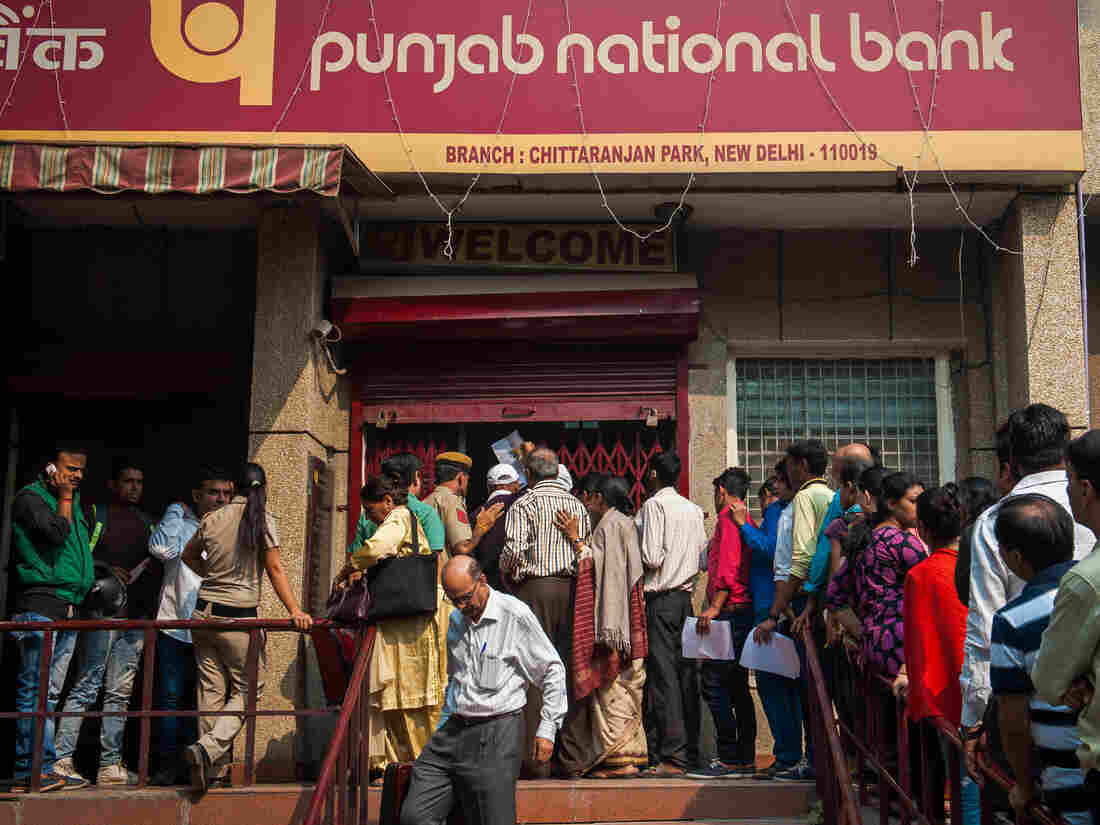
People line up outside a bank to exchange old currency notes with new ones on November 10, 2016 in New Delhi India.

Shams Qari/Barcroft Media via Getty Images

hide caption

toggle caption

Shams Qari/Barcroft Media via Getty Images

This part two of a two part series. Listen to part one here.

A couple of years ago, a mechanical engineer met with Narendra Modi, who would later become India’s Prime Minister. The engineer proposed a bold and radical idea that he said would completely change the Indian economy. The idea is called demonetization, and it happened six months ago. The government suddenly declared most of the paper money in circulation worthless. Citizens had a short time to turn in their stashes of cash for new bills. It was an effort to flush out corruption, get people to join the banking system and in the process, help the poor of India.

In part one of this two-part series, we met the man behind demonetization, the engineer, Anil Bokil. Now in part two, we ask, did demonetization work?

Modi had three problems he wanted to solve if the country relied less on cash:

  • Corruption. Without cash, it’s harder to hide money from the taxman. It’s also harder to ask for a bribe or run a black market business.
  • Businesses could be more competitive and grow faster by using banks and electronic payments.
  • More people would have to use banks, and not keep all their life savings in a drawer. This would keep their money safer.
  • Indian farmers talk beneath a fig tree. Since people couldn't use cash, many farmers couldn't sell their crops.

    Indian farmers talk beneath a fig tree. Since people couldn’t use cash, many farmers couldn’t sell their crops.

    Stacey Vanek Smith/NPR

  • Empty apartment buildings loom tall in the New Delhi suburbs. High rises like these are where most of India's black money is stored.

    Empty apartment buildings loom tall in the New Delhi suburbs. High rises like these are where most of India’s black money is stored.

    Stacey Vanek Smith/NPR

  • Gurdeep Sagoo had missed the deadline to exchange his mother's bills. His mom was in a coma at the time. But the bank said it was too late to exchange it. And there went his mom's life savings.

    Gurdeep Sagoo had missed the deadline to exchange his mother’s bills. His mom was in a coma at the time. But the bank said it was too late to exchange it. And there went his mom’s life savings.

    Stacey Vanek Smith/NPR

1 of 3

But, suddenly removing most of the cash in an economy, is very messy. It hurt. Demonetization has affected different people in a variety of a ways. We talked with farmers who don’t trust credit cards, small shop owners who had to find new ways to sell their goods, and high tech companies trying to cash in.

Today on the show, we evaluate Modi’s demonetization plan … report card style. How did this shock to a cash-dependent economy play out for a country of a billion people?

Music: “Cheeky Tongues,” “Yada Yada,” and “Miss You.” Find us: Twitter/ Facebook.

Subscribe to our show on Apple Podcasts or PocketCast.

Let’s block ads! (Why?)


No Image

Convicted Coal Mine CEO Is Taking His Case To The U.S. Supreme Court

A plaque memorializes 29 miners killed in a 2010 explosion at a Massey Energy mine in West Virginia. Former Massey CEO Don Blankenship wants the U.S. Supreme Court to overturn his conviction on charges of willfully violating mine safety and health standards.

John Raby/AP

hide caption

toggle caption

John Raby/AP

Former Massey Energy CEO Don Blankenship is marking his release from federal custody with an appeal for vindication by the U.S. Supreme Court.

Blankenship served a one-year federal prison sentence after being convicted of conspiracy to violate federal mine safety laws. The charges stemmed from the disaster at a Massey Energy mine in West Virginia in 2010 that left 29 coal miners dead.

“We never give up,” says Blankenship attorney William Taylor, who notified the 4th Circuit Court of Appeals on Thursday that Blankenship will petition the U.S. Supreme Court to review the case.

In his first two days of freedom, Blankenship has posted a blizzard of tweets declaring his innocence and blaming the Upper Big Branch mine disaster on federal regulators and what he says was a natural inundation of natural gas.

Multiple investigations blamed the explosion that ripped through the mine on inadequate safety protections, including excessive explosive coal dust, inadequate ventilation and worn out equipment. Federal prosecutors cited Blankenship’s micromanagement and obsessive focus on coal production in the conspiracy trial that resulted in his conviction and imprisonment. The charges were based on safety practices at Massey Energy and Upper Big Branch but were not directly related to the deadly explosion.

Blankenship’s conviction was upheld by the federal appeals court. Taylor argued that the jury instructions during Blankenship’s trial were unfair, pinning conviction on “reckless disregard” of mine safety laws rather than intent to violate the law.

As Ken Ward, Jr., reported in the Charleston Gazette-Mail, the defense argued on appeal that “the government fully exploited these novel willfulness instructions to obtain a conviction for not doing enough concerning safety rather than for intending to violate the law.”

Taylor is confident the Supreme Court will take the case. “It’s a pretty clear issue,” he says. “We’re either right or wrong about that.”

Taylor also insists that the timing of the Supreme Court petition notice “has nothing to do with [Blankenship’s] incarceration status,” even though it was filed the day after Blankenship’s release, and as Blankenship took to Twitter with a spirited defense.

Let’s block ads! (Why?)