Business

No Image

For Grocery Stores In Texas, It's A Race To Restock Their Shelves

People in Richmond, Texas, line up to gain entrance to a grocery store after it opened for the first time in several days due to Tropical Storm Harvey.

Charlie Riedel/AP

hide caption

toggle caption

Charlie Riedel/AP

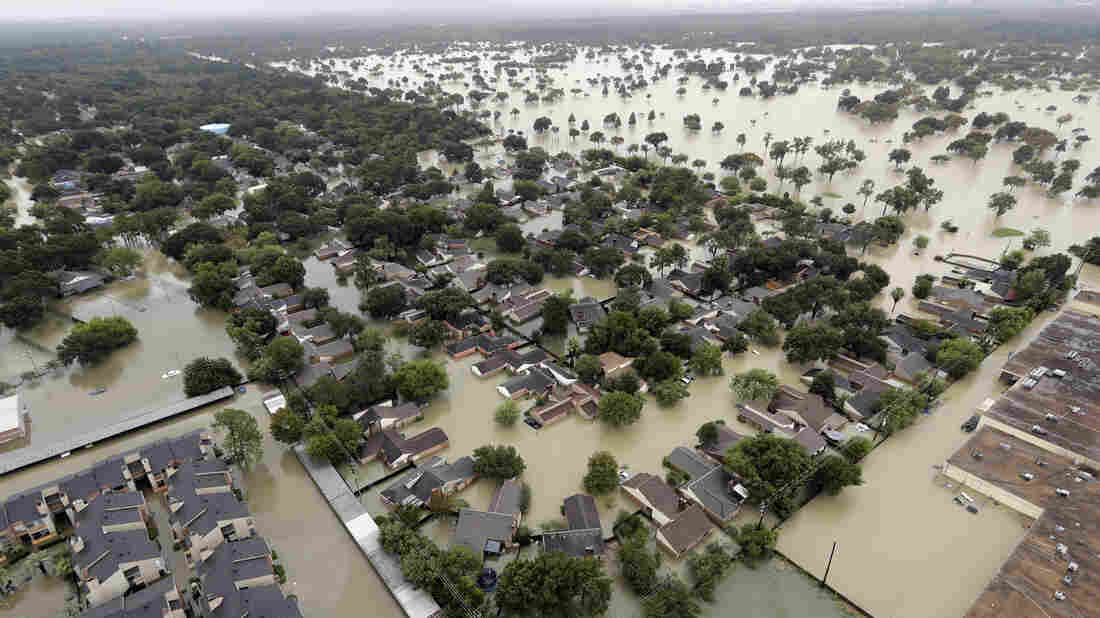
Earlier this week, as torrents of rain fell on Houston, Craig Boyan, CEO of the H-E-B supermarket chain, went on a video-taped tour of his company’s emergency operations center in San Antonio, Texas. The company later made the video available online.

It was a revealing look inside a logistical nightmare. Boyan walked through two crowded, windowless rooms, stopping to speak with the people responsible for reopening stores, locating employees (or, as the company calls them, “partners”) to staff those stores, organizing deliveries of water and ice, and figuring out how to line up fresh supplies of milk, eggs and bread despite the city’s waterlogged streets.

One example: H-E-B makes most of its own bread, and its two bread-making plants are located in Corpus Christi and Houston. When the storm hit, “we had to take Corpus down, run the whole company out of Houston,” Boyan explained in the video. When the storm moved on toward Houston, “we had to switch back to Corpus, now we’re on generator power” at that plant. But the company’s supply of fresh bread was never interrupted.

There was a lot more than H-E-B’s own business at stake. Every day without deliveries of food and water could mean hunger for many thousands of people. “One of the things we’re really proud of is being the last to close and the first to open,” Boyan said.

Indeed, H-E-B and other big supermarket chains managed to get stores open and trucks rolling from warehouses at an impressive pace this week.

On Tuesday, at the height of the flooding, Walmart had closed 134 Houston-area storms. By Thursday, only 21 stores remained closed. H-E-B also had reopened almost 90 percent of its stores by then. Of the 20 stores owned by Albertson’s, 16 are now open.

According to Ragan Dickens, a Walmart spokesman, “very few” of the company’s stores actually flooded. The company had to throw out some perishable food, but it was able to reopen any stores that were accessible to trucks and had electrical power.

Dickens says that customers at some locations have been forced to line up outside to prevent overcrowding inside. And some stores remain closed because workers and trucks can’t get to them through flooded roads.

The ability of Houston’s big grocery chains to rebuild their supply chains “is amazing, but not surprising,” says Roni Neff, a professor of Environmental Health and Engineering at Johns Hopkins University. Neff recently co-authored a report on ways that the city of Baltimore could ensure continued food supplies in the face of future disasters, including possible flooding.

“We did a whole set of interviews, and we found that the bigger chains and the bigger businesses had very extensive planning in place” for natural disasters, Neff says.

City governments, on the other hand, don’t always think enough about food supply in their emergency planning, she says. In Baltimore, for instance, “there was an emergency operations center, but nobody [overseeing] food was there.”

Baltimore has now changed that. The city now has a “food resilience coordinator” who is part of emergency planning. “This is something that very few places have done in the past,” Neff says. “I really believe it’s something that everybody should be looking at.”

According to Neff, governments do need to be involved, in addition to supermarkets. “In Houston, as everywhere, the impacts are not equally felt,” she says. “People with lower incomes, people who are elderly, with disabilities, with medically necessary diets, may be particularly hit by this kind of situation, and really have quite severe food security threats to them.” And city governments need to be prepared to get food to these, more vulnerable groups.

In Houston, many supermarket chains, including Walmart, H-E-B, and Albertson’s, have also helped in relief measures. They have delivered truckloads of water and food to large shelters and to food banks, which in turn send food to distribution points in other parts of Houston and nearby areas.

Trucks were only able to reach the central Houston Food Bank starting Wednesday evening. “Now, the wheels are spinning, literally and figuratively,” says Paula Murphy, who handles public communication for the organization.

Seventeen truckloads of non-perishable food and water from Walmart were scheduled to arrive on Thursday, along with three airplane loads of food flown in from Dallas. “As soon as it arrives, it goes out again,” she says. “Our fleet of trucks is out there. The area we can reach is expanding.”

The biggest need, she says, is probably in rural areas outside Dallas, far from any supermarkets, where roads still may be impassable.

Let’s block ads! (Why?)


No Image

FACT CHECK: 4 Claims From Trump's Tax Speech

President Trump pitches tax overhaul at an event at the Loren Cook Co. in Springfield, Mo., on Wednesday.

Jim Watson/AFP/Getty Images

hide caption

toggle caption

Jim Watson/AFP/Getty Images

President Trump pitched a tax overhaul package on Wednesday in a speech that was heavy on politicking and light on the particulars.

Trump’s tax policy ideas are still sketchy — when pitched in April, they amounted to one page of bullet points. In his Wednesday remarks, he didn’t add much more detail beyond the broad strokes, saying he wants lower rates for the middle class, a simpler tax code, lower corporate rates and for companies to “bring back [their] money” from overseas to the U.S.

In his speech in Springfield, Mo., though, he said a few things that were misleading or could use more context. Here are four fact checks:

1. Economic growth rate

“We just announced that we hit 3 percent in GDP. Just came out. And on a yearly basis, as you know, the last administration during an eight-year period never hit 3 percent. So we’re really on our way.”

He’s right that on Wednesday, the Commerce Department announced that the economy grew at a 3 percent rate in the second quarter. This was an upward revision from a previously announced 2.6 percent (and will still be revised again).

But he is making it sound as if growth during his administration is already appreciably faster than it was during the Obama administration. That’s not true. Quarterly GDP growth during the Obama presidency did hit 3 percent several times.

There’s a technicality here, though: Trump used the phrase “on a yearly basis.” If he’s talking about calendar years, he’s right, but barely. According to Commerce Department data, annual GDP growth during Obama’s presidency hit a high of 2.9 percent in 2015 — so, just shy of 3 percent. But then, if he is measuring any given 12-month period, he’s not right; year-over-year GDP growth was at times over 3 percent during the Obama presidency.

Either way, that 3 percent rate he pulled out is how annual growth would look ifgrowth from the second quarter were to hold for a full year. Reporting the GDP rate in this annual way makes it easier to show whether growth was faster in, say, this quarter than it was in prior years. But once again, it still has that hypothetical aspect to it.

And that leads to a more important point here: Many economists believe that sustained 3 percent growth, like Trump says he can help create, is unlikely. The Committee for a Responsible Federal Budget earlier this year tried to game out how that kind of GDP growth could happen. Its outlook was not rosy.

“By our estimates, returning capital growth, productivity growth, and prime-age labor force participation to where they were in the 1990s would result in 2.9-percent growth,” they wrote. And getting to those levels, they added, would be “an unlikely scenario given recent trends.”

In other words, while Trump is celebrating this one quarter of growth, seeing it quarter after quarter after quarter would be a surprise.

2. Comparing U.S. growth with other countries’

“You look at other countries and you look at what their GDP is, they’re unhappy when it’s 7, 8, 9. And I speak to them, leaders of the countries — ‘How are you doing?’ ‘Not well. Not well.’ ‘Why?’ ‘GDP is down to 7 percent.’ And I’m saying, ‘We were hitting 1 percent just a number of months ago.’ “

We can’t fact-check Trump here in the strictest sense (that is, we don’t really know what these other leaders are telling him), but we can check the assumption that we can compare the U.S.’s growth rate with other countries’. The answer: It doesn’t work like that.

“The countries that are growing at 7 percent are emerging market economies like China or India or other emerging market economies,” said Nick Lardy, senior fellow at the Peterson Institute for International Economics.

He explained that these countries have what some economists call a “latecomer advantage” — an additional lift that comes from starting out behind other countries. For example, he pointed to China, which has grown quickly in part because of foreign firms coming in and setting up shop there. So when Volkswagen sets up a plant in China, it’s bringing in processes and technologies from the outside.

“They can do joint ventures or have foreign firms come in, they can license technology, they can improve labor productivity,” he explained.

This is what helps a country like China or India have an economic growth rate of around 7 percent.

3. A “simple” tax code

“We need a tax code that is simple, fair and easy to understand. And that means getting rid of loopholes and complexity that primarily benefit the wealthiest Americans and special interests. Our last major tax rewrite was 31 years ago. It eliminated dozens of loopholes and special interest tax rates, reduced the number of tax brackets from 15 to two, and lowered tax rates for individuals and businesses. Since then, tax laws have tripled in size.”

The Reagan tax plan, approved by Congress in 1986, did cut back on loopholes, and it did cut the number of brackets down to two.

But there’s one important point buried in here, and it’s that bit about the number of tax brackets and setting rates. Trump said he wants to make the tax code “simple, fair, and easy to understand.” Brackets and rates are not what make the tax code byzantine (“fair” is subjective, and we’re staying out of that here).

“It’s a very mild form of simplification,” said William Gale, co-director of the Urban-Brookings Tax Policy Center at the Brookings Institution, a liberal-leaning Washington think tank, in an interview with NPR in 2015. “The real complication in the system is in the tax base, not in the rate structure. Figuring out how you calculate capital gains or figuring out whether you’re eligible for the [earned income tax credit for lower-income Americans], given the child rules — once you’ve got that, then you just plug in the rates.”

The brackets-simplicity argument is one Americans are bound to hear more as Congress debates a tax code overhaul; politicians try to draw this connection often. But slicing down deductions — and potentially upsetting some groups of voters — could be a tougher sell.

4. The corporate tax rate

“Today we are still taxing our businesses at 35 percent. And it’s way more than that. And think of it — in some cases way above 40 percent when you include state and local taxes in various states. The United States is now behind France, behind Germany, behind Canada, Ireland, Japan, Mexico, South Korea and many other nations also.”

The top federal corporate tax rate is indeed 35 percent, and in some states, corporate tax rates can push that rate higher. In Iowa, the top corporate rate is 12 percent, and in five other states plus the District of Columbia, the rate is 9 percent or higher, according to the right-leaning Tax Foundation. (One could quibble with “way higher,” then, but in general, Trump is right on this.)

That’s what puts the U.S. “behind” other countries, in Trump’s estimation. Except what matters is the effective tax rate. Deductions and credits help bring U.S. companies’ tax rates below what they would otherwise pay. The effective tax rate for U.S. corporations is only around 18.6 percent, which is on the high end compared with other advanced economies but not unusually high — it’s a few percentage points below Japan, a few above Germany, and right in line with the U.K.

And those tax rates vary widely from firm to firm: A recent report found that out of 258 profitable Fortune 500 companies, 39 percent paid zero corporate taxes in at least one year between 2008 and 2015.

Loading…

Let’s block ads! (Why?)


No Image

Keep It Simple And Stay Open: The Waffle House Storm Menu

This view of Tropical Storm Harvey flooding in Houston on Tuesday shows why even the storm-hardy Waffle House had to close two of its restaurants in the city.

David J. Phillip/AP

hide caption

toggle caption

David J. Phillip/AP

The massive flooding in the Houston area has brought much of the city’s commercial life to a halt. For those venturing out it can be hard to find a place to eat. The Houston Chronicle posted a list of bars and restaurants that are open in the aftermath of Harvey. It’s not a big list. There are some cafes and diners serving up meals, but most of the locations are McDonald’s or Waffle House restaurants.

Waffle House, the 247 comfort-food chain, is notable for keeping the doors open when hurricanes and natural disasters strike. The Federal Emergency Management Agency even measures the severity of a storm’s damage by something called the Waffle House Index. When a Waffle House restaurant shuts down, it’s really bad. “Waffle House stays on when the wind’s blowing — they never close,” Philip Strouse, FEMA’s private sector liaison, told Yahoo Finance last year.

Well, Harvey’s storm surges have been so severe that two Waffle House locations in the Houston area have indeed closed — one owing to flooding and one because nearby roads are impassable, said Pat Warner, Waffle House director of external affairs. But 30 Waffle House restaurants in Houston remain open, serving up hot meals and giving people a place to congregate and charge their cellphones.

Because Waffle House tells customers it never closes, the company feels a special obligation to stay open under the most severe weather conditions. That means a lot of planning and storm logistics. In the case of Harvey, Waffle House “jump teams,” restaurant managers from Ohio, Tennessee and Georgia, headed to Houston to keep the grills going — in some cases doing the shifts of storm-stranded local employees.

“We go to a limited menu,” said Warner, meaning fewer choices for breakfast, lunch and dinner. “That makes it easier for our production teams and for our supplier.” Fortunately, power and water have been available at the Houston-area restaurants. But every restaurant has a “Waffle House storm playbook” with protocols for how to keep operating if the electricity and running water go out. Without natural gas, however, Waffle House is cooked. The restaurants need gas to keep the grills running.

Warner says keeping everything as simple as possible helps Waffle House stay on track during a crisis.

“To be honest, we just cook bacon and eggs. But sometimes you need bacon and eggs.”

Let’s block ads! (Why?)


No Image

Economic Impact of Harvey Could Be Felt Nationwide Before It's Over

The damage to Houston’s economy from Harvey’s torrential rainfall will be by one estimate more than $30 billion, a staggering sum.

Joe Raedle/Getty Images

hide caption

toggle caption

Joe Raedle/Getty Images

Bill Gilmer remembers spending the night listening to the winds of Hurricane Ike tear through his suburban Houston neighborhood in September 2008. He also recalls waking up the next morning to hear something completely different.

“The first sound I heard was chainsaws, and I looked out and all my neighbors were out there clearing the streets, clearing their yards, cleaning up their yards,” says Gilmer, who directs the Institute for Regional Forecasting at the University of Houston’s C.T. Bauer College of Business.

Houston residents have survived big hurricanes before and know how to pitch in and help each other recover, Gilmer says. But the drenching rainfall that has followed Hurricane Harvey, flooding streets all over the country’s fifth-largest metropolitan area, is out of scale with anything the city has seen before, he says.

Chuck Watson, who studies the economic impact of natural disasters for Enki Holdings, says the cost to the economy from the flooding is likely to be $30 billion. That’s because of the rain.

“If Harvey were just a hurricane, it would have only caused $4 or $5 billion worth of damage. As a tropical storm phase, it’s actually producing five times that much damage,” Watson says.

About a third of Houston’s economy is directly tied to the oil and gas industry. But the region is also home to non-energy companies, both small manufacturers and large corporations such as KBR, Waste Management and the food service giant Sysco.

Many of those companies have shut down in Harvey’s wake, as have several hospitals, both major airports and the Port Of Houston.

“You’ve got the fifth-largest economy in the United States basically sitting at a dead stop for three or four days,” Gilmer says.

Gilmer says the economy will be able to make up for lost time once the flood waters recede, but the physical damage to the city will be much harder to recover from.

“In Houston you’re going to have street signs, traffic lights, traffic signals, road damage, culverts, a tremendous amount of public infrastructure damage, and of course, there’s no insurance. That just comes right out of the taxpayers,” Watson says.

It’s not clear yet how many homes have been destroyed yet, but right now Watson estimates the cost of repairing residential properties will be about $12 billion.

Most of that damage won’t be covered by insurance, because homeowners’ policies typically don’t cover flooding. While coverage is available through a federal program, most people never bother to get it, says Loretta Worters, spokesperson for the Insurance Information Institute.

Watson also worries about something else.

Some of Houston’s oil refineries are closed right now for a simple logistical reason: Streets are flooded and their employees can’t get to them.

Loading…

The refineries aren’t seriously damaged, however — at least so far.

But the continued rain could end up flooding some of them, and if that happens there aren’t enough companies with the kind of specialized knowledge to repair them.

“Then you’re talking about gasoline shortages and longer term price hikes, and that’s going to have a ripple effect through the whole economy,” Watson says.

Investors are thinking about that too. At one point Monday, gasoline futures were up as much as five percent.

Let’s block ads! (Why?)


No Image

Uber Picks New CEO, Expedia's Dara Khosrowshahi

Dara Khosrowshahi, chief executive officer of Expedia, has been chosen to lead Uber, as it seeks to overcome a string of recent scandals.

Drew Angerer/Getty Images

hide caption

toggle caption

Drew Angerer/Getty Images

Uber has appointed Expedia CEO Dara Khosrowshahi to be its new chief executive, a source familiar to the ride-sharing company tells NPR.

Khosrowshahi has been at the travel company Expedia for more than a decade, reports NPR’s Aarti Shahani. He steps into the role at a tumultuous time, as Uber seeks to fill a leadership vacuum. Co-founder Travis Kalanick resigned under pressure in June, though he remains on the company’s board.

Khosrowshahi emerged as a top candidate among two other contenders: Former General Electric CEO Jeffrey Immelt and Hewlett Packard Enterprise CEO Meg Whitman.

Immelt withdrew earlier Sunday, he said on Twitter. The New York Times reports, “it became clear that he did not enough have support, said two people familiar with the process.”

The Times adds, “the board had been leaning toward” Whitman, the other remaining candidate, their sources said. “But matters changed over the course of Sunday afternoon and the board decided on Mr. Khosrowshahi.”

After several media outlets reported the CEO pick on Sunday night, Recode cited sources close to the other remaining candidate, who said Whitman “has not been informed of any choice nor had the board agreed to some the the things she was asking for to take the job.”

“Whitman was asking for a number of things, including less involvement of ousted CEO Travis Kalanick and more control over the board,” adds Recode.

Let’s block ads! (Why?)


No Image

Advertising Giant WPP Faces Slow Growth As Companies Cut Ad Spending

The world’s largest advertising company, WPP, is sometimes viewed as a bellwether for the health of the global economy. This week, it jolted the ad and media industries when it slashed the forecast for its own growth this year. WPP has blamed the unexpectedly steep decline in ad spending by some of the most influential consumer goods companies.

ARI SHAPIRO, HOST:

WPP is the world’s largest advertising company. It’s sometimes called an economic bellwether because it works with huge corporations like Procter & Gamble, Ford and Nestle. NPR’s Alina Selyukh reports that the British ad company is facing some surprisingly bad news.

ALINA SELYUKH, BYLINE: In the advertising world, WPP is a behemoth. It owns hundreds of ad agencies. Think classic Madison Avenue. Their clients are the who’s who of the Fortune Global 500. They sell all kinds of things – shampoo, mayonnaise, cars. And this reach has made WPP something of a proxy for the health of the world’s largest corporations.

BRIAN WIESER: They have some of the most insightful earnings releases of any – certainly any company I cover.

SELYUKH: Brian Wieser is a senior analyst at equity research company Pivotal.

WIESER: They have the most diverse assortment of marketers as clients across many different industries. And so they will have a better read certainly on the large marketers’ and large companies’ spending habits than anyone else.

SELYUKH: And this week, this read on ad spending habits was particularly pessimistic. Going into 2017, WPP was reasonably optimistic about revenue growth this year. Now the advertising powerhouse says it may not see any growth at all.

(SOUNDBITE OF ARCHIVED RECORDING)

MARTIN SORRELL: We started the year really around 3 percent. Then we moved down to 2 percent. And now we’re talking between 0 and 1 percent.

SELYUKH: That’s the CEO, Sir Martin Sorrell. He’s often described as the most powerful man in advertising. And this week on the earnings webcast, he blamed the decline in ad spending on cutbacks by the big consumer goods companies.

(SOUNDBITE OF ARCHIVED RECORDING)

SORRELL: The three key factors here were a trifecta of digital disruption, zero-based budgeting and activist investors.

SELYUKH: OK, to peel that back in the simplest terms, he’s saying the Internet is shaking up advertising, companies are cutting costs, and some shareholders are pushing for better profits. But let’s dig in a bit into the digital disruption.

(SOUNDBITE OF ARCHIVED RECORDING)

UNIDENTIFIED MAN: Gillette, the best a man can get.

SELYUKH: Take Procter & Gamble. They own huge brands like Gillette, Febreze, Crest, Pampers. And P&G has been slashing ad spending, especially calling out digital ads, saying they want real humans, not fake Internet bots, seeing their ads. And they don’t want their ads next to, quote, “objectionable content.” But more fundamentally, the stalwarts in consumer goods have been facing competition from Internet-powered newcomers.

WIESER: It is maybe best described as Gillette losing share to Dollar Shave Club.

SELYUKH: That’s a startup that sells razors, now a part of Unilever.

WIESER: And in every category, you could probably find a similar example.

SELYUKH: The new online rivals think differently about advertising – maybe talk to consumers directly or pay a YouTube star to plug your brand. That means the advertising giants like WPP are themselves rethinking how they work. And some analysts say maybe they aren’t good economic bellwethers after all. Alina Selyukh, NPR News.

Copyright © 2017 NPR. All rights reserved. Visit our website terms of use and permissions pages at www.npr.org for further information.

NPR transcripts are created on a rush deadline by Verb8tm, Inc., an NPR contractor, and produced using a proprietary transcription process developed with NPR. This text may not be in its final form and may be updated or revised in the future. Accuracy and availability may vary. The authoritative record of NPR’s programming is the audio record.

Let’s block ads! (Why?)


No Image

America's Credit Rating On The Line As Debt Ceiling Deadline Approaches

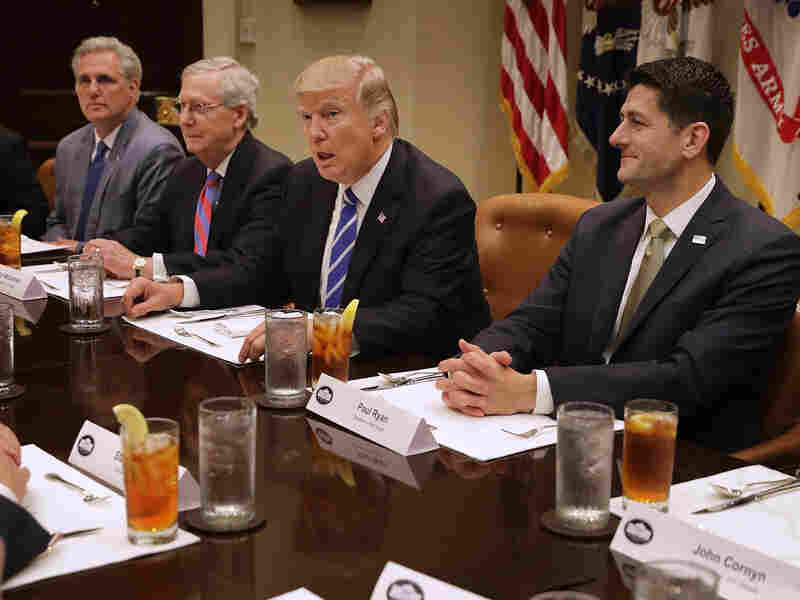
President Trump meets with Senate Majority Leader Mitch McConnell and House Speaker Paul Ryan during a budget discussion in March.

Chip Somodevilla/Getty Images

hide caption

toggle caption

Chip Somodevilla/Getty Images

With the federal government getting closer to running out of cash to cover all bills on time, companies that evaluate bonds are having to consider how to rate America’s creditworthiness.

And their job didn’t get any easier on Thursday when President Trump continued his attacks on congressional leaders over their failure to raise the federal debt ceiling.

Other U.S. officials have been trying reassure the financial markets that no default is imminent.

But in a morning tweet, Trump blamed the two top Republicans in Congress — House Speaker Paul Ryan and Senate Majority Leader Mitch McConnell — for not attaching the debt-ceiling legislation to a popular bill on veterans’ benefits. Whether that legislative strategy would have worked cannot be known. Further, attaching the debt ceiling to the veterans bill could have endangered one of the few legislative achievements Congress could claim in the midst of the GOP health care failure.

In any case, Congress now has just a few more weeks to raise the debt ceiling, which would enable the government to continue borrowing enough cash to pay all of its bills on time. If it doesn’t do so, the government will have to prioritize which of its bills it will pay. That would have enormous consequences in the financial markets.

…didn’t do it so now we have a big deal with Dems holding them up (as usual) on Debt Ceiling approval. Could have been so easy-now a mess!

— Donald J. Trump (@realDonaldTrump) August 24, 2017

Ryan and McConnell have tried to send a message that a debt default is highly unlikely.

“We will pass legislation to make sure we pay our debts and we will not hit the debt ceiling. We’ll do this before the debt ceiling,” Ryan said during a visit to a Boeing plant in Washington state Thursday. “There are many different options in front of us on how we achieve that.”

Treasury Secretary Steve Mnuchin has offered similar assurances.

“We’re going to get the debt ceiling passed,” Mnuchin said Monday at an event in Louisville, Ky. “Everybody understands this is not a Republican issue; this is not a Democrat issue. We need to be able to pay our debts.”

But Trump’s attacks on Ryan and McConnell have raised questions about whether the passage of debt-ceiling legislation will be as smooth as congressional leaders hope.

Under President Barack Obama, the White House and Congress often engaged in brinksmanship over whether to raise the debt ceiling, but they always managed to do so at the last minute.

“Clearly we’ve had dozens of occasions when the debt limit has been raised in the past, and we don’t expect this time to be any different,” says Charles Seville, senior director at Fitch Ratings.

This time, however, the stakes are higher, said Richard Bernstein, former chief investment strategist at Merrill Lynch, in an interview with Politico:

“Not passing a debt limit hike in time would have an even greater impact on financial markets because when we did this in the past you had a Democrat in the White House and Republicans controlling Congress and people could basically understand the political aspects of what was going on. There was a mating dance and a conclusion.

“This time it’s Republican versus Republican. I don’t know how anyone can interpret that. Is this some kind of mating dance again? Or is it some more critical failure of government? I don’t know how to answer that. There is a potential for more volatility this time around than there might have been in the past.”

Bernstein believes Congress will ultimately vote to raise the debt ceiling.

Moody’s Investors Service said Thursday it would consider stripping the United States of its top rating if it were to default on bondholders, but not if it merely skipped paying some of its nondebt obligations.

But Fitch Ratings took a tougher stand, warning that even a debt-ceiling standoff, short of a bond default, could cause it to reassess the credit rating of U.S. Treasury debt. That’s because it would raise questions about the ability of the U.S. political system to get its house in order, Seville said.

“One thing that we have in the back of our minds is how the U.S. deals with its fiscal challenges and whether the policymaking process works,” he added.

Let’s block ads! (Why?)


No Image

Justice Department Narrows Request For Visitor Logs To Inauguration Protest Website

The Department of Justice has narrowed the scope of a warrant it served to web hosting company DreamHost. The government has demanded information about DisruptJ20.org, a website used to organize protests in Washington, D.C., during the Inauguration in January.

Spencer Platt/Getty Images

hide caption

toggle caption

Spencer Platt/Getty Images

The Justice Department is dropping the most controversial part of its demand for records relating to a website used to coordinate protests during the presidential inauguration.

In court filings submitted yesterday, ahead of a hearing Thursday in D.C. Superior Court, the government suggests modifications to the warrant it attained for files from web hosting company DreamHost, which hosted the website DisruptJ20.org.

The change in scope was made “in light of factual revelations since July,” the filings state.

“The government has no interest in records relating to the 1.3 million IP addresses that are mentioned in DreamHost’s numerous press releases and Opposition brief,” according to the filings, which were submitted by Assistant U.S. Attorneys Jennifer Kerkhoff and John Borchert.

The Justice Department goes on to say:

“The government values and respects the First Amendment right of all Americans to participate in peaceful political protests and to read protected political expression online. This Warrant has nothing to do with that right. The Warrant is focused on evidence of the planning coordination and participation in a criminal act – that is, a premeditated riot. The First Amendment does not protect violent, criminal conduct such as this.”

Last week, DreamHost revealed that the Justice Department had delivered it a warrant asking for “all files” related to DisruptJ20.org, a site the government says was used to organize a riot in downtown Washington, D.C., during the Inauguration. The Justice Department is pursing felony riot charges against nearly 200 people; 19 others have already pleaded guilty.

“This is a tremendous win for DreamHost, its users and the public,” DreamHost counsel Raymond Aghaian said in a statement to NPR. “There remains, unfortunately, other privacy and First and Fourth Amendment issues with the search warrant, which we will address in a separate filing and at the hearing Thursday morning.”

The DreamHost matter is complex, and not only because it involves Constitutional issues as well as a lot of technical jargon for all parties to wade through.

Among the “particular things to be seized” from DreamHost in the original warrant: HTML, CSS, JavaScript, image files, or other files; HTTP request and error logs; SSH, FTP, or Telnet logs; MySQL, PostgreSQL, or other databases related to the website.

As New York Times reporter Charlie Savage pointed out, Judge Ronald Wertheim, who granted the warrant, is in his eighties. He has been retired since 1992 but still hears cases occasionally.

A different judge, Robert Morin, will oversee tomorrow’s hearing.

One of the challenges of criminal investigations involving electronic evidence, the government said, “is that some of the evidence – particularly the full scope of the evidence – will be hidden from the government’s view unless and until the government obtains a court order or search warrant.”

In its brief, the Justice Department says it simply didn’t realize the depth of the information that DreamHost has, which includes” visitor data maintained by DreamHost that extends beyond the government’s singular locus in this case of investigating the planning, organization, and participation in the January 20, 2017 riot.”

But in earlier filings, the government had been indifferent to DreamHost’s objections, when it explained the extent of its data holdings.

DreamHost attorney Raymond Aghaian told the Justice Department in a July 21 email that the warrant for “all files” related to Disruptj20.org “seems overbroad,” and would include “the IP addresses of over 1,000,000 visitors to the website.”

In a motion filed a week later, the government said Aghaian’s concern about the warrant’s breadth was “simply not a sufficient basis for DreamHost to refuse to comply with the warrant.”

Mark Rumold, senior staff attorney at Electronic Frontier Foundation, which is advising DreamHost, says the government’s new, narrower warrant is an improvement — but problems remain.

“The new warrant excludes most visitor logs from the demand, and it also withdraws the demand for unpublished content, like draft blog posts and photos,” Rumold says in an email to NPR. “This was a sensible response on DOJ’s part—both legally and politically.”

“But the new warrant is not without its flaws,” he adds. “Most critically, DOJ is still investigating a website that was dedicated to organizing and planning political dissent and protest. That kind of activity — whether online or off — is the cornerstone of the First Amendment, and DOJ’s ongoing investigation should be cause for alarm to anyone, no matter your political party or beliefs.”

DreamHost’s counsel provided NPR with the document below, showing the modifications to the warrant.

[embedded content]

Let’s block ads! (Why?)


No Image

Dakota Access Pipeline Owner Sues Greenpeace For 'Criminal Activity'

Greenpeace activists hang a banner from the rafters at a bank shareholders’ meeting earlier this year in Zurich, calling for it to “STOP DIRTY PIPELINE DEALS!” Also on the banner are hashtags supporting Dakota Access Pipeline protesters.

Michael Buholzer/AFP/Getty Images

hide caption

toggle caption

Michael Buholzer/AFP/Getty Images

The developer behind the Dakota Access Pipeline, which for months drew thousands of protesters, has sued Greenpeace and several other environmental groups for their role in delaying the pipeline’s construction. In the racketeering lawsuit it filed in federal court Tuesday, Energy Transfer Partners alleges these groups inflicted “billions of dollars in damage” with their “criminal activity and campaigns of misinformation” against the pipeline.

Greenpeace led a “network of putative not-for-profits and rogue eco-terrorist groups” — including Earth First! and BankTrack, who are also defendants — which disseminated false claims about the pipeline’s impact on the environment and the Standing Rock Sioux tribe’s sacred sites, alleges the lawsuit.

Energy Transfer says the environmental groups, which together it refers to as “the Enterprise,” engaged in racketeering and defamation that ended up increasing the cost of construction by at least $300 million. But the developer — represented by a law firm whose managing partner is Marc Kasowitz, President Trump’s personal attorney — notes the “full extent of damage” must be determined at trial with a jury.

“This is the second consecutive year Donald Trump’s go-to attorneys at the Kasowitz law firm have filed a meritless lawsuit against Greenpeace,” Greenpeace USA General Counsel Tom Wetterer responded in a statement, referring to a similar 2016 lawsuit filed against Greenpeace by Resolute Forest Products.

“It is yet another classic ‘Strategic Lawsuit Against Public Participation’ (SLAPP), not designed to seek justice, but to silence free speech through expensive, time-consuming litigation,” Wetterer added. “This has now become a pattern of harassment by corporate bullies, with Trump’s attorneys leading the way.”

Crude oil began flowing through the $3.8 billion pipeline earlier this summer, roughly half a year after the project was originally intended to be finished. While the pipeline stretches more than 1,000 miles, most of the controversy over its construction focused on its path across the Missouri River in North Dakota, near the Standing Rock Sioux tribe’s reservation.

As NPR’s Camila Domonoske noted, the tribe “argued the route would threaten the tribe’s water sources and sacred sites,” even winning a halt to construction — but only briefly. The decision to deny a permit for the proposed route, which was handed down in the closing months of the Obama administration, was quickly reversed after President Trump entered office.

Energy Partners argues that throughout this fight, the environmental groups it’s suing sought to undermine a legal project with their “calculated and thoroughly irresponsible attacks.”

“They caused enormous harm to our company and to people and property along the pipeline’s route, wreaking havoc in those states,” Energy Transfer spokesperson Vicki Granado said Tuesday. “We have an obligation to our shareholders, partners, stakeholders and all those negatively impacted by the violence and destruction intentionally incited by the defendants to draw a line.”

Let’s block ads! (Why?)


No Image

List Of Charities Shunning Trump's Mar-A-Lago Resort Keeps Growing

President Trump's Mar-a-Lago estate in Palm Beach, Fla., in April 2017.

Alex Brandon/AP

The list of charities and nonprofits that have canceled fundraising events at Mar-a-Lago continues to grow. At least 20 groups now have pulled out of galas that had been scheduled for President Trump’s country club in Palm Beach, Fla.

In announcing the cancellations, many of the groups cited the controversy surrounding Trump’s recent comments that “both sides were to blame” for the violence that occurred during a white supremacists’ rally in Charlottesville, Va.

The withdrawals from Mar-a-Lago began last week when several well-known national charities, including the Cleveland Clinic, American Red Cross and Susan G. Komen, announced they would be finding new venues for their events.

The Red Cross’s statement reflected the typical reasons cited. It said it provides “assistance without discrimination to all people in need, regardless of nationality, race, religious beliefs, or political opinions.” And because of that mission, its association with the president’s country club “has increasingly become a source of controversy and pain for many of our volunteers, employees and supporters.”

This week, cancellations are still rolling in as more charities — both nationally known and local Palm Beach causes — turn away from the club.

The Palm Beach Daily News, a newspaper that closely tracks the social calendar in the wealthy enclave, reports that the list includes the Palm Beach Zoo, the Preservation Foundation of Palm Beach and an important arts venue, the Kravis Center.

It also includes a local animal welfare group, Big Dog Ranch Rescue. Its March luncheon will now be held at the group’s facility, more than 15 miles from Palm Beach. Big Dog Ranch Rescue’s decision came as a surprise to some, because one of the chairwomen for the event is the president’s daughter-in-law Lara Trump.

Let’s block ads! (Why?)