Business

No Image

Small Breweries And Distilleries Are Winning With The New Tax Plan

Small breweries and distilleries will receive a big tax break under the new tax plan. NPR’s Ari Shapiro speaks with Lynne Weaver of Three Weavers Brewing Company.

ARI SHAPIRO, HOST:

Now we’re going to hear about another industry that benefits from this new tax law. Small craft breweries get a big tax cut. Lynne Weaver is the founder of Three Weavers Brewery in the Los Angeles area. Coincidentally, she also has a background in tax policy. She joins us now from the brewery. Welcome to the program.

LYNNE WEAVER: Thank you for having me.

SHAPIRO: Describe the change and how you’ll be taxed under this new law.

WEAVER: The excise tax is based on a per-barrel production. So it’s whatever we package and send out of our brewery. We pay $7 per barrel of beer. It ends up making up close to 15 to 20, sometimes even 25 percent of our total cost of our beer. So the reduction in that tax is going to be greatly beneficial to us because it reduces our overall cost of goods.

SHAPIRO: Reduction from $7 a barrel to about what?

WEAVER: The new reduction is down to $3.50 a barrel.

SHAPIRO: And that’s only for breweries that produce less than a certain amount of beer. So the big brewers don’t get as big of a cut, right?

WEAVER: That is correct.

SHAPIRO: So if the excise tax is basically cut in half for you, how much money will that mean for you in a typical year?

WEAVER: Next year when it’s actually going to take place, our goal is to produce 10,000 barrels, so it’s going to be quite a bit of money for us. It’s going to be close to $21,000. That’s a part-time person. It allows us to hire somebody else. It helps quite a bit.

SHAPIRO: You say it’s enough money to hire a part-time person. Is that what you plan to do with the money?

WEAVER: Yeah. I think that for most small breweries, the area in which is the most fluid in needing capital is really in labor. Once you buy equipment, the equipment is pretty much what it is. You have the capital outlay. But to fill those tanks requires a person to be able to brew.

I think a lot of craft breweries have to stretch their staff because they just don’t have the funds available to be able to bring on somebody else to alleviate the workload. But having, like, the additional funds from the excise tax reduction will allow us to be able to bring somebody else in.

SHAPIRO: Some people are critical of lawmakers choosing specific industries to benefit, choosing winners and losers. Obviously you have the advantage of being a winner here, but do you have any hesitation about certain industries getting a boost and other industries not?

WEAVER: Well, to be totally honest, the craft beer industry hasn’t had a boost in a very long period of time. If you look at how long the excise tax has been around for, there has never been a change. It’s always been at $7 a barrel for beer. So if anything, the craft beer industry has been at a disadvantage with this excise tax.

SHAPIRO: You say the craft beer industry has not had much relief lately, and yet it’s done very well. Five years ago, there were about 2,000 craft brewers in the U.S. Last year, there were 5,000. It doesn’t sound like an industry that needs a lot of tax relief.

WEAVER: Well, that’s skewed. So the vast majority of the breweries that are opening today or even are open are probably 3,000 barrels or less in production and really service a very small community. So you can’t really look at it in the sense of how many breweries are opening because it doesn’t necessarily mean that all of them are yet profitable. So if anything, those smaller breweries really do need this tax break just to be able to continue supporting their communities, creating those jobs.

SHAPIRO: One principle of taxation is that you should have higher taxes on things that you want people to do less. That’s why there are cigarette taxes and some places have soda taxes. By that rationale, could somebody argue that beer makers should be taxed more, not less?

WEAVER: We’re talking now about vices – essentially vices and the excise tax or luxury taxes, right? Well, one of the things about craft beer – it’s not just about beer. It’s about what we provide within our communities, the job creation – all of those things. So if those are tied to what somebody considers a vice, then, you know, it’s like, you’ve got to kind of balance those two items. And really, I really believe that it negates the negative side as long as we are always responsible.

SHAPIRO: Lynne Weaver is the founder of Three Weavers Brewery in Southern California. Thanks so much for joining us.

WEAVER: I appreciate it. Thank you.

(SOUNDBITE OF VAMPIRE WEEKEND SONG, “OXFORD COMMA”)

Copyright © 2017 NPR. All rights reserved. Visit our website terms of use and permissions pages at www.npr.org for further information.

NPR transcripts are created on a rush deadline by Verb8tm, Inc., an NPR contractor, and produced using a proprietary transcription process developed with NPR. This text may not be in its final form and may be updated or revised in the future. Accuracy and availability may vary. The authoritative record of NPR’s programming is the audio record.

Let’s block ads! (Why?)


No Image

12 Dead After Crash Of Tourist Bus Headed For Mayan Ruins In Mexico

Police and paramedics at the scene of a tourist bus crash in eastern Mexico Tuesday. Most of the passengers on board were had arrived aboard cruise ships and were going to view Mayan ruins.

Manuel Jesus Ortega Canche/AFP/Getty Images

hide caption

toggle caption

Manuel Jesus Ortega Canche/AFP/Getty Images

A tour bus destined for Mayan ruins in eastern Mexico flipped over on a two-lane highway early Tuesday, leaving a dozen people dead and many more injured. Among them are some Americans.

In a statement from government officials in the Mexican state of Quintana Roo, where the accident occurred, report there were 12 passengers killed including one girl under 18, and 18 were injured. There were 31 passengers traveling on the bus.

The statement offered no information about what caused the crash.

A U.S. Embassy spokesman in Mexico City said officials were en route to the scene of the accident, about 100 miles from Tulum. But he could not confirm the number of Americans involved in the deadly incident. The official added that those in need of medical attention had been transferred to several nearby hospitals.

The embassy expected to “have eyes on the ground before the end of the day,” according to the spokesman.

Embassy officials issued a statement expressing condolences “to all those affected by this tragedy.”

It said, “We are in contact with local authorities and are working with them to determine if there were U.S. citizens on board. We will continue to monitor the situation.”

We’ve seen reports of an accident involving a bus contracted by Royal Caribbean in Quintana Roo, Mexico. We express our condolences to all those affected. We are working with local authorities to determine if there were U.S. citizens on board.

— Embajada EU en Mex (@USEmbassyMEX) December 19, 2017

Nearly all the passengers aboard the bus were also passengers on two Royal Caribbean cruises — the Celebrity Equinox and Serenade of the Seas — which set off from Miami. The cruise ship company contracted the local tour bus that was headed out on a day-long adventure to ancient Mayan ruins in Chacchoben.

Royal Caribbean’s corporate offices expressed their sadness over Twitter calling the loss of life “heartbreaking” and assured readers the company was assisting with medical care and transportation.

The news from Costa Maya about a bus accident involving #CelebrityEquinox & #SerenadeoftheSeas guests is heartbreaking. Our hearts go out to all those involved. We are doing all we can to care for our guests, including assisting with medical care and transportation.

— RCLcorp (@RCLcorp) December 19, 2017

Our 27 guests were on a bus tour to the Chacchoben Ruins. We are working with the local authorities to learn more about the accident. We are doing all we can to help our guests.

— RCLcorp (@RCLcorp) December 19, 2017

The company also said it had little information about the details of the accident. “Our 27 guests were on a bus tour to the Chacchoben Ruins. We are working with the local authorities to learn more about the accident. We are doing all we can to help our guests.”

Photos and video taken in the aftermath of the accident show the bus on its side, pushed up against a thick brush of trees. Beach towels and bottles of water are strewn across the road.

Costa Maya Mahahual, the bus company involved, told the AP in a statement that in addition to the tourists, a guide and driver were also aboard the bus.

Let’s block ads! (Why?)


No Image

Never Go To Vegas, And Other Unspoken Rules Of Being An A-Lister

Researcher Elizabeth Currid-Halkett says celebrity can be boiled down to a simple formula.

Caiaimage/Sam Edwards/Getty Images/Caiaimage

hide caption

toggle caption

Caiaimage/Sam Edwards/Getty Images/Caiaimage

All social classes have unspoken rules.

From A-list celebrities to teachers, doctors, lawyers, and journalists — there are social norms that govern our decisions, whether we realize it or not.

Researcher Elizabeth Currid-Halkett studies social networks, and has observed certain patterns across swaths of American culture. In her book Starstruck: The Business of Celebrity, she looks at the super elite: the celebrities who populate the Hollywood Hills and the tabloids in our grocery stores. She makes a distinction between fame and celebrity.

“Fame is simply people knowing who you are,” she says. “The sheer number of people who know who someone is, is very different from a public being fixated upon someone.” For example, we all know who Bill Gates is — but we aren’t all wondering what Bill Gates ate for breakfast today, the way we might wonder that about Beyoncé, or Barack Obama, or Jennifer Aniston.

This week on Hidden Brain, we look at the invisible qualities that all celebrities have in common, and how our interest in them builds because of cues we get from one another. Later in the episode, we look at another elite group: the yoga-loving, Whole Foods-shopping, highly-educated group that Elizabeth Currid-Halkett calls The Aspirational Class.

Hidden Brain is hosted by Shankar Vedantam and produced by Maggie Penman, Jennifer Schmidt, Rhaina Cohen, Parth Shah, and Renee Klahr. Our supervising producer is Tara Boyle. You can also follow us on Twitter @hiddenbrain, and listen for Hidden Brain stories each week on your local public radio station.

Let’s block ads! (Why?)


No Image

Airport Power Restored In Atlanta But Thousands Are Stranded

Passengers wait after the lights went out at Hartfield-Jackson Atlanta International Airport on Sunday. Many travelers were stuck in grounded planes for hours.

Branden Camp/AP

hide caption

toggle caption

Branden Camp/AP

Updated 12:55 a.m. ET Monday

People traveling through Atlanta’s Hartsfield-Jackson International Airport struggled to get home Sunday after a power outage there forced hundreds of flight cancellations.

Officials announced that power had been fully restored to the airport shortly after midnight.

The power went out early Sunday afternoon and hundreds of flights at the world’s busiest airport ended up canceled. Many travelers were stuck in grounded planes for hours.

Power is back ON in Atrium and Concourses T, A and B!

— Atlanta Airport (@ATLairport) December 18, 2017

Shortly after 10 p.m., Atlanta Mayor Kasim Reed tweeted that all passengers “have been safely de-planed.”

Power was restored in some sections of the airport after 11 p.m.

Others, like Stephen Mack, were stranded in crowded terminals, Johnny Kauffman of member station WABE reported.

“We are all hungry, tired, frustrated,” Mack said.

After 10.5 hour-long international flight departing at 4:55 am ET, we now approach hour 5 on the tarmac at Atlanta. No food. But everyone is holding it together. pic.twitter.com/tcPkvGtdP9

— Ellen L. Carmichael (@ellencarmichael) December 18, 2017

According to airport officials, Georgia Power said the outage was tied to a fire that caused extensive damage to an underground electrical facility.

Delta Air Lines said about 900 of its flights were canceled Sunday and about 300 flights will be canceled Monday. Southwest Airlines cancelled all of its flights in and out of Atlanta. And the effects were felt at other airports around the country.

In Atlanta, traffic backed up around the airport, and people walked miles to their hotels. The City of Atlanta tweeted it would provide shuttles to the Georgia International Convention Center “for anyone who needs a place to stay for the night.”

Dr. Martha Brewer, an OB-GYN from Atlanta, and her wife were scheduled to fly to New York’s JFK Airport to catch a flight to Barcelona. When they arrived at the Atlanta airport just after 2 p.m., Brewer said, “somebody was screaming at us that the power was out.”

They made their way into a darkened terminal. “There were a ton of people in there and it was very dark except for a few emergency lights,” Brewer said. “People were standing in line. Nothing was going on. There were no Delta people. Nobody was telling anybody anything.

“We found out what was going on by calling a relative to see if anything was on TV or to look on the Internet,” Brewer said.

Finally, after waiting at the airport for about 90 minutes, they called a friend and asked her to hire an Uber to pick them up. After arriving back home, Brewer said the couple rebooked their flight to Barcelona for Monday.

They ended up taking an Amtrak train to New York.

Let’s block ads! (Why?)


No Image

Brexit Is One Step Closer As EU Agrees To Talk About U.K. Trade

European Union leaders have agreed to discuss the process by which the U.K. will leave the EU. The talks focus on the trade relationship Britain will have with the EU in the future. Guest host Ray Suarez speaks with NPR’s Frank Langfitt about whether Brexit has entered a point of no return.

RAY SUAREZ, HOST:

Last year, the United Kingdom kicked off an era of uncertainty in the Western world when it voted to leave the European Union. Yesterday, the U.K. took a major step forward on the road to Brexit when European leaders agreed to talks with the U.K. on a new trading relationship with the EU. To make sense of yesterday’s decision and how it fits with the turbulent last year and a half, we turn to NPR’s Frank Langfitt, who’s just returned to his post in London from Brussels, the headquarters city of the European Union. Hi, Frank.

FRANK LANGFITT, BYLINE: Hey, Ray.

SUAREZ: Why does the agreement to have trade talks matter so much?

LANGFITT: Well, one thing, it sort of tells the U.K. is continuing to move forward towards leaving the EU. This is continuing to go ahead. But, you know, if you look at the – kind of the big picture, it’s symbolic of changes that really started in the summer of 2016. And a big change has happened since then. You remember that Brexit vote? It was a big shock. Stocks dropped around the world. And one reason was seeing the U.K. actually walk away from something that it had helped build – this sort of Western post-World-War-II architecture for peace and prosperity in Europe. And seeing it walk away, really, and saying basically, you know, we’re better off on our own, that really rattled people here and elsewhere.

And then you had these right-wing populists in France and the Netherlands, they were pushing to leave the EU. And there was this fear in Brussels that, you know, this 28-nation trading bloc was actually going to fall apart and risk a lot more instability in this part of the world.

SUAREZ: I’ve been in Britain a couple of times since the vote and talked to people at each time who felt that there was still a chance that it might not happen. How does the decision look today and has it entered a sort of point of no return?

LANGFITT: Well, that’s a great question. I mean, first, it’s not going well at all. You know, U.K. Prime Minister Theresa May is much weaker than she was. So Brexit has ended up really kind of tearing up politics here. In terms of a point of no return, that’s an excellent question. There is a sense here that if they tried to do it, people would be so upset because this came out of a referendum, and they would feel that this was denying the democratic will of the people here in the United Kingdom.

On the other hand, you talk to people in the EU, they might welcome them back if they changed their mind. But they only have so much time. You know, this is all going to run out. They have to leave in March of 2019. But everybody’s going to be watching it very closely. And I think key to it also will be the economics of the United Kingdom, which has been suffering since the Brexit decision.

SUAREZ: Now to state the obvious, but it’s never a bad idea. The U.S. is not a member of the EU. Why should Americans be paying attention to Brexit? Does it mean anything on this side of the Atlantic?

LANGFITT: I think it does in a way that people wouldn’t necessarily imagine, and that’s that Brexit is weakening America’s closest ally abroad. You remember, you know, we fought a war with the Brits. We speak the same language, have these shared values. And with President Trump looking inward himself, you know, the U.S. influence is declining worldwide as well as this very important power of ours. Then if you look more broadly, you’ve got a more aggressive China, a more assertive Russia. And there is a sense that one thing the West doesn’t need right now is fragmentation.

SUAREZ: Once the British have managed to extricate themselves from the EU, will they be looking to make a deal with the United States?

LANGFITT: They do. And, you know, it’s really interesting. Theresa May keeps saying, oh, this is going to bail us out. We’re going to do really well with a deal with the U.S. The fact of the matter is trade barriers are already very low with the U.S. And you’re – she’s also going to be dealing with Donald Trump who’s not known for giving, you know, sweetheart deals to people. He crafts himself as a very, very tough negotiator. So the idea that the U.S. economy is going to really help out Britain, I think most people here – certainly, economists think that’s not very likely.

SUAREZ: That’s NPR’s Frank Langfitt in London. Thanks a lot, Frank.

LANGFITT: Happy to do it, Ray.

(SOUNDBITE OF ADAM BEN EZRA’S “CAN’T STOP RUNNING”)

Copyright © 2017 NPR. All rights reserved. Visit our website terms of use and permissions pages at www.npr.org for further information.

NPR transcripts are created on a rush deadline by Verb8tm, Inc., an NPR contractor, and produced using a proprietary transcription process developed with NPR. This text may not be in its final form and may be updated or revised in the future. Accuracy and availability may vary. The authoritative record of NPR’s programming is the audio record.

Let’s block ads! (Why?)


No Image

CHART: How The New Version Of The Republican Tax Bill Would Affect You

On Friday evening, congressional Republicans released the final version of their tax overhaul plan.

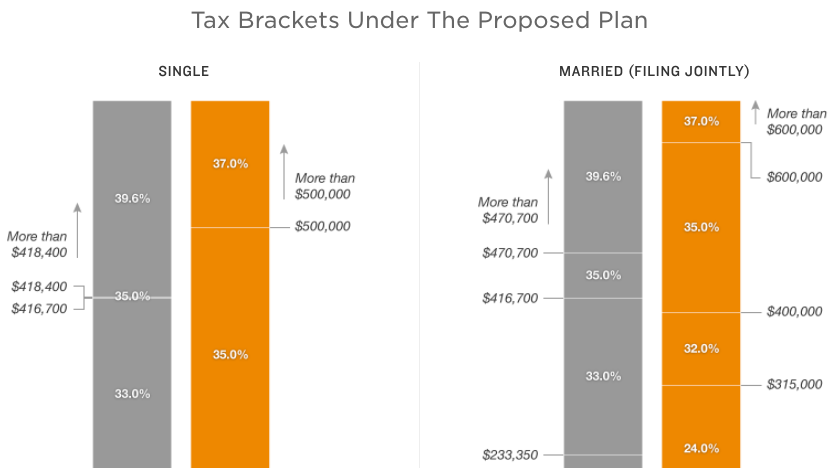
The new bill looks a lot like earlier versions from the House and Senate, with minor modifications — for example, it lowers the corporate tax rate from 35 to 21 percent, as opposed to the 20 percent in both the House and Senate bills. In other cases, it finds the middle ground between the two chambers’ previous bills — it limits taxpayers to deducting the interest on new mortgages up to $750,000, as opposed to $500,000 in the House bill and $1 million in the Senate bill, which is also the amount set under current law.

Below are two charts showing how individual filers could be affected if this bill is passed and signed into law.

The bar chart shows how the proposed tax brackets look, compared with the brackets under current law. The top rate would fall to 37 percent from 39.6 percent, and fewer households would pay that top rate.

The table below that chart spells out how different provisions in the tax code would affect different groups of Americans.

Loading…

Loading…

Let’s block ads! (Why?)


No Image

The Most Important Economic Indicator That Everyone Ignored

This week on All Things Considered, we’re sharing a series of “Highly Specific Superlatives.” Cardiff Garcia from NPR’s podcast The Indicator talks about the most important economic indicator in 2017 that everyone ignored: global trade.

KELLY MCEVERS, HOST:

There are a few economic indicators that got a lot of play this year – the unemployment rate, the GDP the Dow. Now we’re going to talk about another economic indicator as part of our series Highly Specific Superlatives, in which we nerd out about the best, the worst, the least, the most of 2017. NPR’s Cardiff Garcia co-hosts NPR’s newest podcast The Indicator. It’s about the big ideas behind business news. And he is with us now. Hey.

CARDIFF GARCIA, BYLINE: Hi, Kelly.

MCEVERS: So hit me. What is your highly specific superlative from 2017?

GARCIA: My highly specific and also highly nerdy superlative is the most ignored indicator that actually says a lot about the economy – the global economy. It’s the pace of growth in global trade, the pace of growth in how much we buy and sell goods and services across borders to and from other countries.

MCEVERS: OK, global trade, yeah.

GARCIA: Yep.

MCEVERS: Tell me about it. Like, what’s – give me a little snapshot of what that indicator tells us.

GARCIA: I love this indicator. And the snapshot is that it’s growing a lot. The IMF projects that by the end of this year it will have grown 4.2 percent. That is a big acceleration on last year. And I think what I love most about this superlative is that it contrasts so starkly with the headlines that we’ve seen all year about the world turning inward and about protectionism and about countries becoming more self-reliant. I love that this just kind of goes so starkly against that narrative.

MCEVERS: Well, yeah so – OK, explain that because, I mean, you know, I think a lot of people think, like, we’re pulling out of trade deals. We’re tightening borders. We’ve you know, scrapped deals like the Trans-Pacific Partnership and threatened to tear up NAFTA and all of that stuff. So, like, how does this square with all that?

GARCIA: Yeah. So I guess the simple answer here is that so far at least, there’s been more talk than action. So yeah, we’ve threatened to pull out of NAFTA, but NAFTA is still in place. We did leave the Trans-Pacific Partnership, but keep in mind that the other 11 countries are still going ahead. And so what we’ve learned is also that the U.S. isn’t the only country that matters here, that this is global trade, not just U.S. trade with everybody else – and so…

MCEVERS: Right.

GARCIA: …More talk than action. And also, we’re learning that maybe the U.S. isn’t the only place that that counts here.

MCEVERS: OK. How do we want to think about this going forward?

GARCIA: Yeah. I mean, this is a – it’s a complicated narrative. If you think about it, it’s not like right now if you make a product in another country and then you send it to a country to be bought and sold, that that’s the way things still work. That’s sort of the old world, right? Now the way it works is that as a product gets made, it passes through a bunch of different countries, and each country has a process or a factory that adds a component or a new way of making it by the time it gets to its final destination to be sold.

And so even if you make it hard to do business with, say, Mexico, well, OK then, the factory and that process just shifts somewhere else. It’s like this big supply chain gets redirected. And so what we’re seeing now is that it’s just really, really hard to deconstruct that process. The world is very closely integrated, and it’s not easy for any one or two places to just turn that away.

MCEVERS: NPR’s Cardiff Garcia co-hosts The Indicator. It’s a podcast about the big ideas behind business news. Thanks a lot.

GARCIA: Thanks, Kelly.

Copyright © 2017 NPR. All rights reserved. Visit our website terms of use and permissions pages at www.npr.org for further information.

NPR transcripts are created on a rush deadline by Verb8tm, Inc., an NPR contractor, and produced using a proprietary transcription process developed with NPR. This text may not be in its final form and may be updated or revised in the future. Accuracy and availability may vary. The authoritative record of NPR’s programming is the audio record.
Let’s block ads! (Why?)


No Image

Episode 812: High Rise, Low Returns

Ivanka Trump, Donald Trump, Eric Trump and Donald Trump Jr. stand before the rendering of the under-construction Trump SoHo Hotel Condominium in September 2007.

Jennifer Altman/Bloomberg

Trump SoHo is a high rise in lower Manhattan, part hotel, part condos; it’s 46 stories tall, all slick grey glass. Conflicts, from zoning battles to accusations of fraud, have followed the project since it was announced during a 2006 episode of The Apprentice.

According to reports by Bloomberg News, Trump SoHo has attracted the interest of Department of Justice special counsel Robert Mueller, who is investigating possible ties between Trump’s 2016 presidential campaign and Russian officials.

To build Trump Soho, the Trump Organization worked with a company called Bayrock, founded by the wealthy Soviet-born financier Tevfik Arif, who, among other things, owned a chromium plant in Kazakhstan. Questions also surround another major player in the project, Felix Sater, who has a criminal history that includes stabbing a man during a bar fight, and pleading guilty to a securities fraud scheme that involved the mafia.

Find us: Twitter/ Facebook/Instagram

Subscribe to our show on Apple Podcasts, PocketCasts and NPR One.

Let’s block ads! (Why?)


No Image

Are $40 Toll Roads The Future?

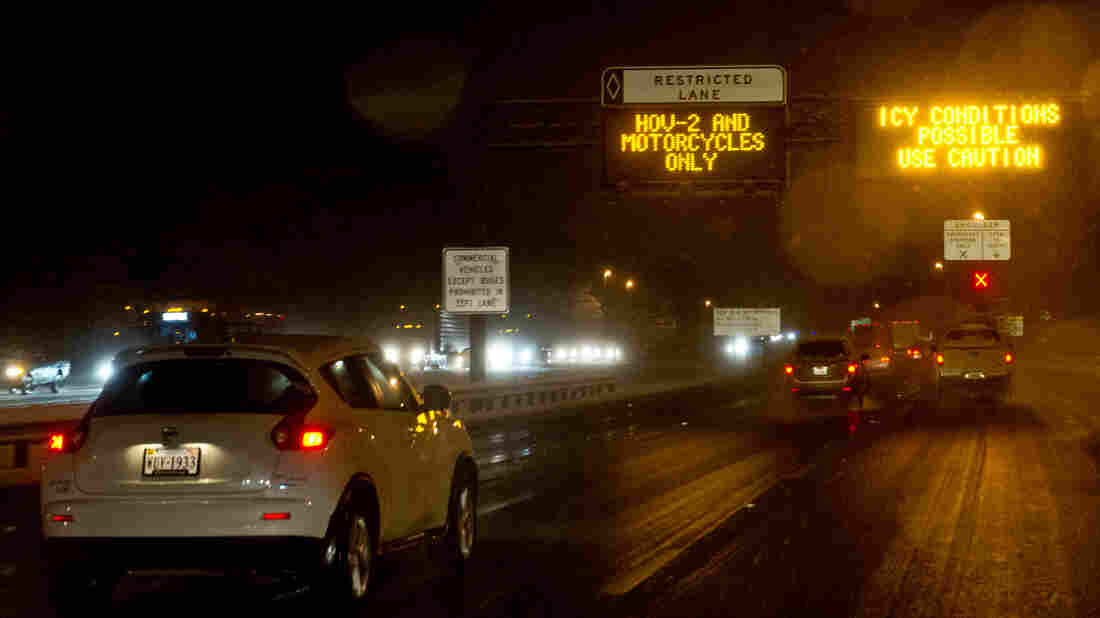
Signs warn drivers of icy road conditions on Interstate 66 in Fairfax County, Va., in March 2014. The state’s Department of Transportation recently added rush hour tolls to the road, using dynamic pricing, which continuously adjusts the cost based on congestion.

Karen Bleier/AFP/Getty Images

hide caption

toggle caption

Karen Bleier/AFP/Getty Images

How much would you pay to avoid traffic jams on your daily commute? $10? $20? How about $40?

That’s how much a tollway in the Virginia suburbs of Washington, D.C., charged for a short time last week. Outraged commuters call it highway robbery.

But transportation officials say the high-priced toll is less about money and more about changing commuter behavior and reducing congestion, and commuters all across the country might soon see more tolls in the future.

The 10-mile stretch of Interstate 66 from the Northern Virginia suburbs into the District of Columbia is like no other road in the country. It was built in the early 1980s for carpools and buses to use during rush hour. Over the years, officials have opened it up to hybrids and a few other exemptions, and in recent years, scofflaw single drivers violating the high-occupancy-vehicle-only law helped choke the road with gridlock.

So Virginia’s Department of Transportation is trying something controversial: ending free rides for hybrids, expanding the restricted hours and allowing solo drivers on for a price. And oh, what a high price it is.

When merging onto I-66 inside the Beltway one recent morning from Leesburg Pike in Falls Church, Uber driver Alfred Hewton looks up at the sign showing the price of the toll.

“Eleven dollars [to] Washington, D.C. $11.”

That’s $11 to drive just 10 miles, so Hewton is relieved that for him today, it’s free.

“If we have two or more people, we don’t have to pay. If you’re driving by yourself, it will cost you that much.”

Actually, it can cost quite a bit more for solo commuters because under dynamic pricing, the cost varies, changing every six minutes based on demand and to keep traffic flowing at a minimum of 45 miles an hour. On Dec. 4, the toll topped $34 for a short period of time, and the following day, the toll hit $40.

That’s enough to make any driver spit out his coffee.

“I think it’s outrageous. It’s actually an abuse of power, as far as I’m concerned,” says Alan Bechara, who lives in suburban Chantilly, Va.

“Why do we need to pay $40 for a public road, to use a public road? We funded this road; we paid for it,” he adds. “I’m a Virginia resident for 38 years. I can assure you my tax dollars funded this road.”

Mary Jaber says she understands the need for a modest toll.

“You know, maybe $5, I mean, just something more reasonable,” Jaber says. “But a daily commute of $40 plus is extraordinary; it’s extreme.”

Transportation officials say that’s actually the whole idea.

“What the toll is saying is, ‘We don’t want you to use it.’ I personally wouldn’t pay that toll,” says Virginia Transportation Secretary Aubrey Layne.

“We are definitely trying to change behavior because we have limited resources,” Layne adds. “We don’t have the money nor the political will to continue to build highways.”

Layne says heavily congested areas such as Washington, D.C., and its suburbs cannot build their way out of gridlock. So the idea behind opening up the I-66 carpool lanes to solo drivers for a high price is to actually persuade more people to carpool, to take public transportation, or to commute during off-peak hours when there is no charge.

And those who want to, he says, can spend the money to avoid congestion.

“This is a choice. No one is forced to pay this toll. And as a matter of fact, if you put someone else in your car, you never have to pay anything.”

Layne says the high prices of $34.50 last Monday and $40 on Tuesday were only charged for six minutes each, and no more than 28 drivers paid that $40 toll. Morning tolls averaged $10.25 over the first four days, and the round-trip toll price averaged $12 to $17 over the first week. Before the toll lanes opened, officials had predicted round-trip tolls would average $17 a day.

Then-Del. Bob Marshall, R-Prince William, holds a sign as he talks to the media at the Capitol in Richmond, Va., on Feb. 10, 2016, after the governor announced an agreement on an expansion plan for Interstate 66 in Northern Virginia.

Steve Helber/AP

hide caption

toggle caption

Steve Helber/AP

And because this wasn’t even a legal option for solo drivers during rush hour before last week, Layne says there’s been only a little spillover effect clogging other roads with drivers trying to avoid the high tolls, though some drivers complain about more congestion at entry points where commuters are trying to decide whether to get on and pay.

While the peak prices are among the nation’s highest tolls ever charged, some see them as a sign of things to come.

“You definitely are going to see much more tolling both for general purposes, and you’re going to see tolling like the price-managed lanes on I-66 to alleviate congestion,” says Pat Jones, executive director of the International Bridge, Tunnel and Turnpike Association, which represents toll facility owners and operators. Jones says there are already 40 toll facilities in 11 states, including California, Texas and Washington, using dynamic pricing, and many more under consideration across the country. Most tollways with dynamic pricing don’t have a cap or a maximum price, but they sometimes have a minimum price and averages. On Southern California’s I-91, in Orange and Riverside counties, the tolls can reach as high as $25.05.

“I think in fact we are underpaying; we’ve underpriced the highway system and evidence of that is the congestion that we see in our urban areas,” Jones says.

But many Northern Virginia commuters are not convinced, especially those who say carpooling and public transportation are not realistic options for them.

Jaber doesn’t use I-66 and believes “it’s a very unjust system. I think there are a lot of people … that are not going to use it as a reflection of obviously cost and budgeting.”

Urd Milbury, who commutes to and from her job at the Norweigan Embassy, hasn’t taken I-66 yet “and I probably won’t because of the prices. It could be extremely expensive at times, which is probably exactly when I want to go to work.”

Milbury agrees with those who call the high toll prices outrageous and thinks it will be a hardship for some families.

“You’ve got the cost of your car, you’ve got the gas, you’ve got two rounds of tolls,” she says. “It’s not sustainable.”

Meghan Jackson says she and her family “dance around” using the I-66 tollway, taking alternative routes or the Metro subway into the city. “I’m not sure if this fix will really reduce traffic in any way and I’m not really sure if its really of service to those of us living in Northern Virginia who have to get into the city.”

But with the federal highway trust fund failing to keep up with needs, and with very little new transportation funding likely coming from Washington anytime soon, tolls increasingly are becoming a go-to source for transportation funding. Commuters trying to avoid traffic jams may need to keep one hand on the wheel, and the other on their wallet.

Let’s block ads! (Why?)


No Image

Congressional Republicans Hope To Pass Tax Overhaul Bill By Dec. 25

Congressional Republicans are working to merge House and Senate versions of a GOP tax bill. They’re hoping to reach their first major legislative milestone by Christmas.

ROBERT SIEGEL, HOST:

There is furious work going on behind the scenes on Capitol Hill so that Republicans can meet their goal of passing a final tax bill before Christmas. The House and Senate passed separate measures over the last few weeks. Members of both chambers will meet formally in a conference committee later this week to hammer out a final bill.

But a lot of that negotiation is well underway, and NPR congressional reporter Kelsey Snell has been keeping watch on Capitol Hill, where she joins us now. Hi.

KELSEY SNELL, BYLINE: Hi there.

SIEGEL: How close are we to seeing a final tax bill?

SNELL: Republicans I talked to say they are very close, but there is a lot still up in the air. They’ve been working behind closed doors all weekend to try to hash out these differences. The goal is to resolve any issues before they formally meet later this week. But there are a lot of fixes that need to be done.

SIEGEL: Yeah, in order to get the Senate bill passed, there were a lot of deals cut with individual Senators. Ron Johnson of Wisconsin wanted benefits for small businesses. Susan Collins of Maine wanted money to shore up the health care market. Are any of those concessions at risk as all this gets negotiated or renegotiated between the House and the Senate?

SNELL: Yeah. There were actually three main agreements during that last-minute haggling. And as of now, they all appear pretty solid. First we talked about Johnson and the small businesses. They really wanted to make sure that there were better breaks for small businesses to keep them better in line with corporations. Those kinds of protections have lots of support in both the House and Senate, but the two bills disagree on the best way to structure those benefits. So it’s unclear right now which side will prevail.

The second one, the deal with Lisa Murkowski of Alaska which involved oil and gas exploration in the ANWR, which is the Arctic National Wildlife Refuge – that also seems pretty solid. She is on that conference committee, and so is Congressman Don Young of Alaska. So they’ll have a lot of power.

And last, there’s Maine Senator Susan Collins. She says she’s confident in an agreement she reached with Senate Majority Leader Mitch McConnell to vote on funding to help the Affordable Care Act exchanges. Here she is speaking to CBS’ “Face The Nation.”

(SOUNDBITE OF TV SHOW, “FACE THE NATION”)

SUSAN COLLINS: I’ve talked to the president three times about this issue. And once again, I have no reason to believe that that commitment will not be kept. After all, who wants to see health insurance premiums become more unaffordable than they already are for individuals who are buying insurance, say, in the individual market?

SNELL: So there’s a lot to take in here, but Collins hasn’t fully committed to voting for the tax legislation. But it does seem clear that the health care measures will likely be part of the year-end spending bill that also needs to get done in the next two weeks.

SIEGEL: Now, it’s been said that the – most of the benefits in the tax bill would go to businesses. Would that change as they’re making these fixes this week?

SNELL: Actually from what I’m hearing, the bill could get better for some businesses. According to my reporting, a major issue, though, is how to handle a parallel minimum tax system for businesses. Companies have been pushing really hard to see that that is repealed. But it was kept in the Senate bill. Getting rid of it could cost hundreds of billions of dollars, and cost is incredibly important here. There are also some more esoteric issues like clearing up a potential conflict with the World Trade Organization. But all that is being worked out right now.

SIEGEL: And the middle-class tax cuts Republicans have promised – will those change?

SNELL: So first and foremost, the focus is still on lowering rates and doubling the standard deduction. But there’s a lot of talk about those state and local taxes that we’ve been hearing about. One option being discussed would be to let people deduct up to $10,000 of any state and local taxes they pay, not just the property deduction that’s allowed under the Senate bill.

SIEGEL: Well, NPR’s Kelsey Snell at the Capitol, thanks.

SNELL: Thank you.

(SOUNDBITE OF RATATAT’S “NOSTRAND”)

Copyright © 2017 NPR. All rights reserved. Visit our website terms of use and permissions pages at www.npr.org for further information.

NPR transcripts are created on a rush deadline by Verb8tm, Inc., an NPR contractor, and produced using a proprietary transcription process developed with NPR. This text may not be in its final form and may be updated or revised in the future. Accuracy and availability may vary. The authoritative record of NPR’s programming is the audio record.

Let’s block ads! (Why?)