
Lawsuits Mount As Apple Manages Fallout From Revelation Of Slowed iPhones

Owners of iPhones from several states sued Apple Inc. for not disclosing sooner that it issued software updates deliberately slowing older-model phones so aging batteries lasted longer.
Eric Risberg/AP
hide caption
toggle caption
Eric Risberg/AP
Apple had a message for its customers this past week: “We apologize.”
Customers have been angry ever since the company confirmed its software updates slow down older iPhones with aging batteries. Apple says it did that to prevent those iPhones from shutting down unexpectedly.
While this apology might help on the public relations front, the legal issues are another matter.
Apple is facing a number of lawsuits over the issue from iPhone owners in states including California, New York and Illinois. There’s also a lawsuit from customers in Israel and one from a French consumer rights group.
Broadly, the lawsuits cover contract law claims — saying that Apple harmed something the consumer owned and wasn’t transparent about it — as well as consumer protection violations.
“You changed my phone in a harmful way [and] didn’t tell me you were doing that,” Rory Van Loo tells NPR’s Lauren Frayer. Van Loo is a law professor at Boston University who focuses on technology and regulation.
The claims allege that the deception may have caused consumers to buy a new phone when instead they could have just bought a new battery. For the plaintiffs to succeed in the fraud claims, they will need to prove that Apple intended to promote new phone sales by slowing down old phone sales.
“For all claims [plaintiffs] will need to prove some kind of harm,” Van Loo says. “They’re going to need to show that Apple intentionally withheld information about slowing down the phones” and that customers would have made a different decision.
Though these lawsuits face a bit of an uphill battle, Van Loo says Apple should be nervous.
“For one, Apple has lost a number of cases across the country on some similar arguments in recent years,” he says.
In a lawsuit first filed in 2015, iPhone 4s users claimed they were forced to download an update that made their phones buggy and unusable. Apple tried to get that case thrown out, but last month a judge ruled against the company.
Apple’s argument, and one that they Van Loo says they may use again, is that users are told in the fine print of software updates that “things may go wrong.”
“Apple is not going to be protected by what they put in the fine print,” he says. “You have to be very specific about what you say in the fine print, and as far as I’m aware, it didn’t anywhere say, ‘We may slow down your phones with our updates.’ “
After the battery issue came to light, Apple apologized to customers and said it would offer discounts to replace old batteries. The company also said new features are rolling out “that give users more visibility into the health of their iPhone’s battery, so they can see for themselves if its condition is affecting performance.”
While good news for future customers and in the court of public opinion, Van Loo says it doesn’t free them from the potential legal liability.
Apple’s apology “is not going to protect them from what they did last month and last year,” he says.
Despite the criticism and lawsuits, Apple’s explanation and response to the battery concerns does not include any indication that older phones using old batteries will stop slowing down.
Apple Issues Apology After Admitting To Slowing Down Older iPhones

Apple is doing damage control after iPhone owners expressed outrage when the company admitted to intentionally slowing down older phones to preserve battery life. NPR’s Ari Shapiro talks with Will Oremus, who is covering the story for Slate, now that Apple has put out an unsigned apology.
ARI SHAPIRO, HOST:
Apple is doing some damage control. iPhone owners were furious when the company admitted that it intentionally slowed down older phones to preserve battery life, Apple said. Some users filed class-action lawsuits. Now the company has put out an unsigned apology. Will Oremus is covering the story for Slate and joins us now. Hi there.
WILL OREMUS: Thanks for having me.
SHAPIRO: Apple says it is trying to clarify a misunderstanding by releasing this statement. What is the company actually telling customers?
OREMUS: There had been these rumors going around for a long time that Apple was intentionally slowing down older iPhones each time it came out with a new one in order to get people to buy the new phone. Now, Apple assures everyone this is not what was happening, but it was discovered that Apple was in fact slowing down older iPhones for a different reason.
As their batteries degraded, the phone was unexpectedly shutting down. And so to keep that from happening, they put in place a software mechanism that limited the processor speed. They didn’t tell people they were doing that. Now that’s what they’re apologizing for.
SHAPIRO: So part of the apology includes an announcement that they are going to lower the price on a new battery from 79 to $29, at least for a little while. People were pretty outraged about this initial revelation. There are at least a dozen class-action lawsuits. Do you think this is likely to satisfy angry users?
OREMUS: You know, I think it is going to cause a bit of a dent to Apple’s reputation in some quarters. The people who are familiar with the technical details and people who are longtime loyal Apple customers are likely to forgive the company, especially with this apology and the discount on new batteries. It really does seem like this was an error of communication and not the nefarious scheme that the conspiracy theorists had in mind.
SHAPIRO: If this is damaging Apple’s reputation, it does not seem to be reflected in holiday sales. According to the analytics website Flurry, which looked at the activation of new devices, about 44 percent of those new devices were iPhones or iPads. Only about a quarter of the new devices were Samsung, which is Apple’s biggest rival.
OREMUS: Yeah, Apple has some leeway here. I mean, they can make a mistake like this and get away with it because they command such loyalty from their consumers. It also doesn’t hurt that their chief rival, Samsung, underwent a much worse PR problem recently with its exploding phones.
SHAPIRO: (Laughter) Right. I guess if you have to choose a dying battery or an exploding phone, you’ll go with a dying battery (laughter).
OREMUS: That’s right (laughter). And in fact, Apple does say that the effects whereby they’ve slowed down the processors on older phones has addressed the unexpected shutdown issue, at least.
SHAPIRO: You’ve written that Apple’s big mistake was not slowing down old phones but hiding the fact for so long. Explain what you mean.
OREMUS: Apple has this entrenched culture of secrecy. I used to live with a couple of Apple engineers who were dating each other, and they couldn’t even talk to each other about what they were doing. This kind of secrecy extends to Apple’s communications with the public. They prefer to give information via these carefully stage-managed launch events that we’ve all come to anticipate. Now, in this case, I think it backfired because it set the stage for the types of rumors that went around, and Apple’s refusal to address them earlier allowed these conspiracy theories to flourish. I think Apple has itself to blame for that.
SHAPIRO: Will Oremus is the senior technology writer for Slate and co-host of the podcast “If Then,” speaking with us on Skype. Thanks so much for joining us.
OREMUS: Thanks, Ari.
Copyright © 2017 NPR. All rights reserved. Visit our website terms of use and permissions pages at www.npr.org for further information.
NPR transcripts are created on a rush deadline by Verb8tm, Inc., an NPR contractor, and produced using a proprietary transcription process developed with NPR. This text may not be in its final form and may be updated or revised in the future. Accuracy and availability may vary. The authoritative record of NPR’s programming is the audio record.
In Houston, Thousands Remain Displaced As Harvey Recovery Continues

Damaged furniture and personal belongings sit in front of a flooded home in September in Richwood, Texas. Several months after Hurricane Harvey hit southern Texas, residents are still navigating the long recovery process.
Justin Sullivan/Getty Images
hide caption
toggle caption
Justin Sullivan/Getty Images
Recovery efforts are ongoing in Houston from nearly $200 billion worth of damage caused by Hurricane Harvey in late August.
More than 100,000 homes were damaged in historic flooding, and thousands of residents are still living in hotels and rental housing while they wait for insurance checks.
Alma Roberts, who told Here & Now‘s Meghna Chakrabarti in October that her home of 14 years flooded for the third time in the storm, says she and her family are still renting an Airbnb. Nearly 11,300 families were still living in hotel rooms funded by the Federal Emergency Management Agency as of Dec. 15, according to The Texas Tribune.
Roberts says they plan to rebuild and expected the estimated six- to nine-month rebuilding process to begin soon. She tells Here & Now‘s Jeremy Hobson that she is concerned about the city’s infrastructure overall.
“I’m concerned about what’s the city doing. What’s going to happen the next time we have really bad weather and if it rains a lot?” Roberts says.
Even though Roberts had flood insurance, she says her family will still have to borrow some money to cover the cost of rebuilding. Nearly four out of five homes damaged in Harvey’s flooding were not covered by flood insurance, according to the Consumer Federation of America.
Houston’s chief recovery officer, Marvin Odum, the former head of Shell Oil Co. who helped the company recover in New Orleans after Hurricane Katrina, told Marketplace this week that Houston is essentially two cities right now: the part that was open for business two weeks after the storm and the areas that are still struggling to recover.
“The danger is that what gets lost in that picture are the vast number of people and pockets and neighborhoods that have been severely impacted by the storm,” he says. “And that’s where we need to maintain the focus of this recovery and that’s where we need to maintain a certain amount of public awareness as well so that we recognize there’s still a tremendous amount to be done.”
Earlier this month, Houston Mayor Sylvester Turner made a desperate plea for Congress to approve $61 billion in federal disaster assistance. So far, the state has received $11 billion in federal aid, which is significantly less than the $115 billion allocated after Hurricane Katrina and the $56 billion after Hurricane Sandy.
“Literally, there are thousands of people living in homes that need to be remediated,” Turner said. “And there are thousands of people who are still living in hotels. And the question is, where do they go when FEMA says, ‘No more’?”
Before the holiday break, the House passed an $81 billion disaster relief bill for Texas, Florida, California and Puerto Rico, but the Senate is not expected to consider the bill until next year. Odum says federal money is needed to prepare the city for future disasters.
“To do the same thing we’ve done before — which is just repair structures, put people back in their homes and basically sit there and wait for the next flood when it starts all over again — is absolutely untenable,” he told NPR in an interview this month. “Allocating the money now for the flood mitigation activities so that you can make these neighborhoods resilient, prevent the floodwaters from coming into the houses and then not have to pay for this kind of repair three years down the road makes perfect sense.”
Roberts says her family expects to spend an estimated $24,000 in rent while they wait for their home to be rebuilt. While they could find a cheaper option than Airbnb, Roberts says her family of five needs the amenities offered because they lost everything.
“Even if we found a place that was less expensive, we don’t have trash cans. We don’t have anything,” she says. “And this place did come with a bunch of fresh clean towels, blankets, sheets, you know, things that you take for granted. So for us to go and spend more time right now just didn’t make sense, especially when we’re trying to really count our pennies now to rebuild.”
New York Vineyard Takes A Risk On Ice Wine For A Sweet Reward

Making ice wine requires the grape to be picked and pressed at below-freezing temperatures, like in this vineyard in southern Germany. So, only a few places in the world — mainly Canada and Germany — produce it. But now, vineyards in frigid parts of the U.S., are making their own ice wine, giving Americans a chance to buy domestically produced bottles.
Patrick Seeger/AFP/Getty Images
hide caption
toggle caption
Patrick Seeger/AFP/Getty Images
There are few regions in the world where you can make true “ice wine,” a sweet, dessert-style vintage. You need warm summers to grow quality grapes. But the fruit must be picked and pressed when it’s well below freezing. So you need frigid winters.
Most of the ice wine in the U.S. is imported from Canada or Germany. But a growing number of wineries in places like upstate New York, Michigan, and Pennsylvania have started making their own, giving American consumers the option of buying domestically produced bottles.

The frozen grapes are collected, then pressed outside while they’re still frozen. It’s risky waiting so long to harvest – a wind storm can destroy the whole crop. But the reward is 375ml bottles that fetch $50 and up.
David Sommerstein
hide caption
toggle caption
David Sommerstein
Coyote Moon vineyards, a family-owned winery in Clayton, N.Y., just a few miles from the Canadian border, began making ice wine last year. As an arctic front settled on the vineyards recently, creating the perfect harvesting conditions, they harvested their grapes for next year’s vintage.
It was three degrees Fahrenheit when the winery’s crew trudged out to 30 rows of vines dedicated to ice wine. It was so cold that the snow was squeaking underfoot. The temperature dropped to zero just as the sun peaked over the horizon. The vines were cast in orange. And the snow glowed blue.
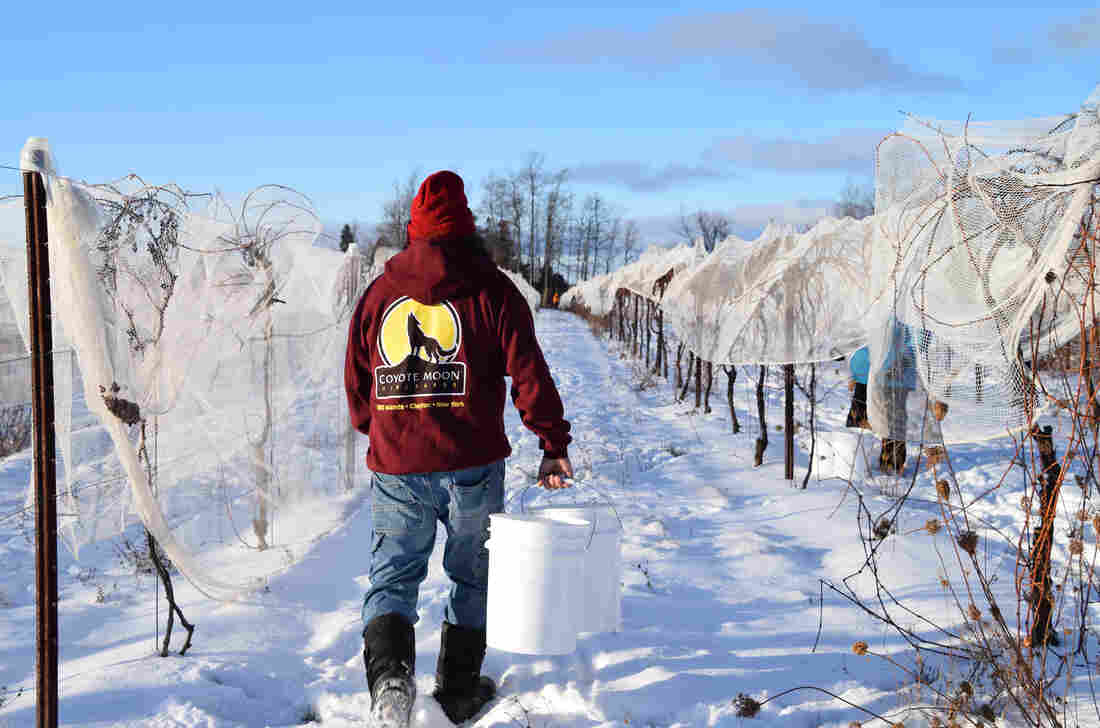
Robert Heyman, a Coyote Moon, employee, returns to the vines to fill his bucket with frozen grapes. The vineyard grows two cold climate varietals for ice wine: frontenac (red) and frontenac gris (white).
David Sommerstein
hide caption
toggle caption
David Sommerstein
“All of our grapes are covered with netting,” says the winery’s marketer, Christine Shanley, her eyelashes caked with ice. “So you can look through the nets and you see all your friends, bundled up, shivering, picking the clusters.”
Robert Heyman, a man with a burly beard and a red wool hat works fast along one row. The grapes look almost black, brittle and abandoned. He cracks bunches off the vine with his bare hands and drops them into a bucket. “Ah, it’s nothing compared to ice fishing,” he says, chortling. “No brain, no pain.”
The vineyard has grown two kinds of grapes for ice wine this year, both cold climate varietals: frontenac (red) and frontenac gris (white). This is only their second winter making the product for mass distribution. It’s the first for frontenac gris, so there’s still some experimenting involved.
“We’re letting these grapes essentially turn into raisins,” says co-owner Tony Randazzo.
The chemistry behind ice wine involves letting the water in the grape crystallize in the cold, leaving the sugars to concentrate and mature. “We’re taking the best of the best of that kind of sweet goodness that’s left, and turning that into wine,” says Randazzo.“That’s really where the magic happens.”
Ice wine is believed to have started in Germany in the 1700s, when winemakers had to make the best of a frozen harvest. But Canada has become the world’s leader today. In the United States, ice wine is made throughout upstate New York, as well as parts of Michigan.
Coyote Moon follows Canada’s strict standards. Winemakers have to harvest and press the grapes below 17.6 degrees Fahrenheit, and there are precise guidelines for alcohol and sugar content.
Founder and patriarch Phil Randazzo rumbles up in a tractor to haul a vat of grapes to the outdoor press. There are plenty of imitators who use coolers instead of nature, he says. “A lot of guys will take and freeze their grapes, and that’s just not the real deal. They taste different.”
He cautions against alternative language on bottles, like ‘iced wine’ or ‘frozen wine.’ “It’s got to be called ‘ice wine,'” he adds.
There are big risks to leaving tons of grapes just hanging on the vine long after the traditional late summer harvest. A wind storm can blow away the whole crop. Adequate cold may not come for months. Last year’s warm winter delayed the harvest until February.
But the reward is 375ml bottles that fetch $50 and up, and a sweet, fruity, almost creamy taste. “It’s soothing down your throat when you drink it,” says Lori Randazzo. “The texture in your mouth is pleasant, not syrupy, but coating, wonderful. It sticks with you a little.”
But on this day, there will be no tasting. Ice wine requires patience. After pressing, the juice will ferment and age for a year, just about when it’s time to brave the cold and harvest next year’s frozen crop.
The bottles with last year’s Frontenac harvest are just about to come in from the manufacturer, meaning Coyote Moon’s ice wine will soon be ready for sweet sipping.
Library Of Congress Will No Longer Archive Every Tweet
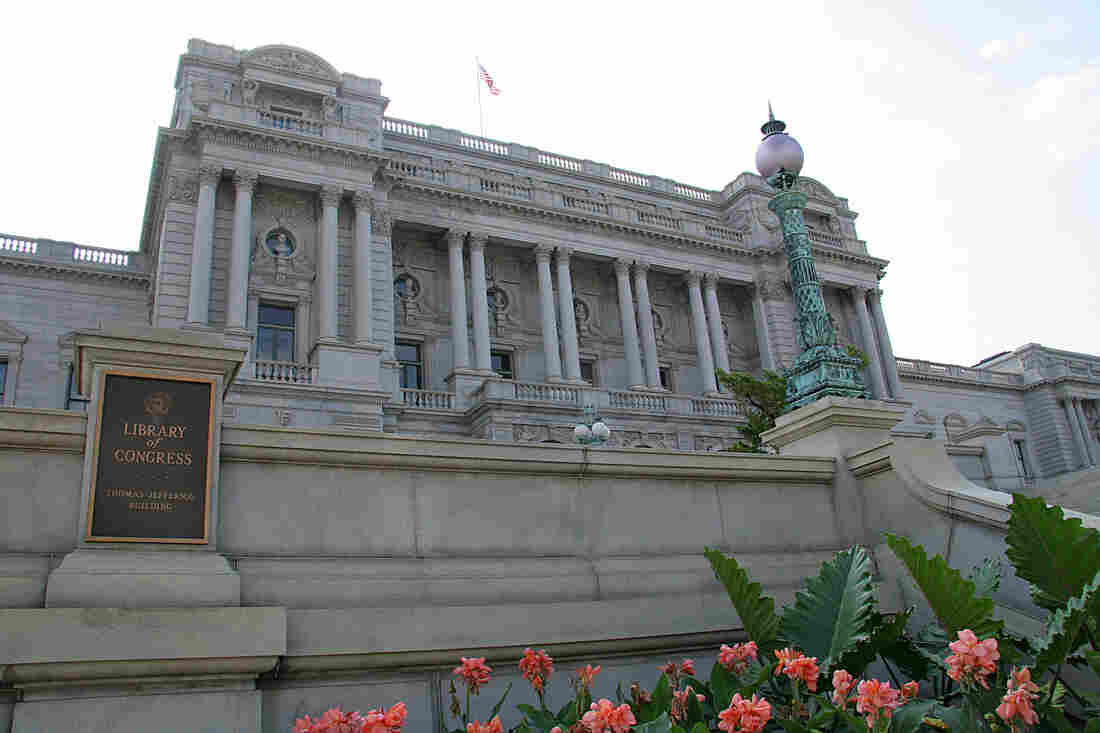
The Library of Congress said on Tuesday that it will no longer archive every public tweet. Instead it will collect them “on a very selective basis.”
Karen Bleier/AFP/Getty Images
hide caption
toggle caption
Karen Bleier/AFP/Getty Images
Since 2010, Library of Congress has been archiving every single public tweet: Yours, ours, the president’s.
But today, the institution announced it will no longer archive every one of our status updates, opinion threads, and “big if true“s. As of Jan. 1, the library will only acquire tweets “on a very selective basis.”
The library says it began archiving tweets “for the same reason it collects other materials – to acquire and preserve a record of knowledge and creativity for Congress and the American people.” The archive stretches back to Twitter’s beginning, in 2006.
But as anyone who’s been following along can attest, Twitter and the way it’s used has changed since then. First and foremost from a collection perspective: the sheer number of tweets.
“The volume of tweets and related transactions has evolved and increased dramatically since the initial agreement was signed,” the library explains in a white paper accompanying the announcement.
The library doesn’t say how many tweets it has in its collection now, but in 2013, it said it had already amassed 170 billion tweets, at a rate of half a billion tweets a day.
Tweets can now be longer, too: This fall, Twitter rolled out 280-character tweets to most users across the platform.
Another issue: Twitter only gives the library the text of tweets – not images, videos, or linked content. “Tweets now are often more visual than textual, limiting the value of text-only collecting,” the library says.
The library also has to figure out how to effectively manage deleted tweets, which aren’t part of the archive.
The institution says it will continue to preserve its collection of tweets from the platform’s first 12 years, but indicates that it has yet to figure out exactly how to make the archive public.
Researchers and archivists were delighted when the archive was first announced.
“This is an entirely new addition to the historical record, the second-by-second history of ordinary people,” Fred R. Shapiro, associate librarian and lecturer at the Yale Law School, toldThe New York Times in 2010.
But from the start, the project struck some of us as a little perplexing: You guys know what Twitter’s like, right? You really want ALL the tweets?
With this change, the library is acknowledging that, no, it doesn’t want all the tweets.
“Given the unknown direction of social media when the gift was first planned, the Library made an exception for public tweets,” it explains in the white paper. “With social media now established, the Library is bringing its collecting practice more in line with its collection policies,” which are generally not comprehensive.
So what tweets will be archived going forward? It’s a little unclear, but the library says it will collect tweets that are “thematic and event-based, including events such as elections, or themes of ongoing national interest, e.g. public policy.” Which sounds more like Twitter’s Moments feature.
Going forward, the library says it will focus on preserving the enormous collection of tweets that it has already amassed: a sort of oral history of the social media era.
“The Twitter Archive may prove to be one of this generation’s most significant legacies to future generations,” the library says. “Future generations will learn much about this rich period in our history, the information flows, and social and political forces that help define the current generation.”
Remembering That Must-Have Toy From Past Christmases
Every year, there are certain toys that whip the whole country into a frenzy. Morning Edition look back at some of the most coveted toys on Christmas wish lists in years’ past.
DAVID GREENE, HOST:
It is Christmas, and few things make kids scream and shout like Santa Claus and the promise of gifts. But children are not the only ones who get worked up. We all know that. Every year there are certain toys that whip the entire country into a frenzy.
NOEL KING, HOST:
And so this Christmas Day we thought we’d look back at some of the most memorable gift crazes of years past.
(SOUNDBITE OF ARCHIVED RECORDING)
UNIDENTIFIED ACTOR #1: (As Elmo, laughter) I’m getting tickled.
GREENE: Oh, no.
KING: You know that laugh. That’s Tickle Me Elmo, the giggling, red fuzzball that took the country by storm in ’96. Elmo impressively managed to frustrate both parents who couldn’t get one for their kid and also parents who did and then had to hear that laugh for hours on end.
GREENE: Well, if you remember that laugh, here is another iconic talker.
(SOUNDBITE OF ARCHIVED RECORDING)
UNIDENTIFIED ACTOR #2: (As Furby) I’m very happy.
GREENE: Furby – remember Furby, the Christmas craze from 1998? Talked, winked, purred. Well, Furby has actually grown up in nearly 20 years since its release. Now there is even a Bluetooth version.
KING: And this next toy has never had any blue teeth, but a few people did get black eyes trying to get their hands on one.
(SOUNDBITE OF ARCHIVED RECORDING)
UNIDENTIFIED REPORTER: When the doors opened at this Wilkes-Barre, Pa., store, the pushing and shoving began. One woman was knocked to the floor and suffered a broken leg.
KING: What was that all about? Cabbage Patch Kids.
GREENE: What is wrong with us?
(LAUGHTER)
GREENE: So depending on your kid’s taste in movies, you might be waking up to this sound this morning.
(SOUNDBITE OF PORG CHIRPING)
GREENE: That is a porg. It is one of those cuddly aliens from the new “Star Wars” movie. They are among the best-selling stuffed animals on Amazon this Christmas, and they are adorable.
Copyright © 2017 NPR. All rights reserved. Visit our website terms of use and permissions pages at www.npr.org for further information.
NPR transcripts are created on a rush deadline by Verb8tm, Inc., an NPR contractor, and produced using a proprietary transcription process developed with NPR. This text may not be in its final form and may be updated or revised in the future. Accuracy and availability may vary. The authoritative record of NPR’s programming is the audio record.
Facebook, Twitter Issue Policy Changes To Manage Fake News And Hate Speech
Facebook and Twitter update their platforms in order to better manage the amount of misinformation and hate speech that show up on people’s news feeds. Kerry Flynn, a reporter at Mashable, speaks with NPR guest host Ray Suarez on what to make of these changes and whether they’ll be effective.
RAY SUAREZ, HOST:
With billions of people spending billions of hours on social media today, the ability for Facebook and Twitter to control fake news and hate speech continues to be a challenge. But this past week, these major platforms announced new ways to prevent misinformation and violent rants from landing in people’s news feeds.
Here to speak with us is Kerry Flynn, a reporter from Mashable covering the story. Kerry, welcome to the program.
KERRY FLYNN: Thanks for having me on.
SUAREZ: Well, this is hardly the first time Facebook and Twitter have tried to manage these challenges. What’s different about these new updates?
FLYNN: So with Facebook, we’re starting to see them crack down on fake news. They’ve noticed that they’re spreading what’s misinformation. With Twitter, for a long time, they, again, have let anyone join the network. That means that those people on there could be violent people, these people who actually want to incite violence and spread their message out there. And that doesn’t make other people feel welcomed. And therefore, maybe it drives those people away from the platform.
SUAREZ: Give us an idea what it will look like. Let’s say you go to your Facebook feed – what would a fake news story that comes from a shop in Russia or from a boiler room somewhere in the Balkans look like? Will it look the same? Will it have some sort of warning?
FLYNN: One way that Facebook tried to address this – and this was only about a year ago – is add these, what they called, quote, unquote, “disputed” flags. But what Facebook admitted this week is while they tried that for a year, these red flag icons weren’t actually doing that job.
One important note, they said – there were four reasons why they decided to get rid of that program. And one of them is that red actually can enforce a message – as in, I’m reading something, and I’ll remember it more ’cause there is a red label next to it. That’s clearly not what they would want for someone to hope if they’re reading something that’s fake news.
And instead, what they’re pushing for is something called related articles. So maybe when you see what has become a fake news story, below that is going to be anywhere from two to three other Facebook posts that are about that same type of topic. So in the end, hopefully you’re understanding what the right narrative of that story is.
SUAREZ: Now you noted at the very beginning that Twitter and Facebook are taking different approaches. What is Twitter trying to do in the area of hate speech?
FLYNN: Yeah, Twitter is trying to deal with that, too. But they don’t do it as much. And really, their stance there is that if there’s a fake news story out there, maybe more people will retweet it and say this is wrong. And they’re hoping that more people see that.
What they are really trying to do is make sure that those people – whether they’re saying something is right or wrong – are not having people who promote and incite violence, whether they do that on platform or off platform.
SUAREZ: So Kerry, in the final analysis, aren’t the two platforms taking two very different approaches? While Facebook is adding more context to get any individual consumer to read more, think harder, take more onboard, Twitter’s just taking content out. It’s censoring it and saying – sorry, can’t say that on our place.
FLYNN: It’s an important point for sure, yes. Facebook isn’t necessarily taking down particular users or particular pieces of content, no. Like, if there is a fake news story, it can still be shared. But with that if you do not buy their (ph) standards either on or off the platform, you can be out. And for a lot of people, that’s what’s really scary about Twitter right now is they don’t really know whether they’re out because these processes are slowly rolling out. And even Twitter said perhaps they’ll make mistakes.
SUAREZ: Kerry Flynn has been covering efforts to police content on social media platforms for Mashable, where she’s a reporter.
Thanks a lot for talking to us.
FLYNN: Thanks for having me on.
Copyright © 2017 NPR. All rights reserved. Visit our website terms of use and permissions pages at www.npr.org for further information.
NPR transcripts are created on a rush deadline by Verb8tm, Inc., an NPR contractor, and produced using a proprietary transcription process developed with NPR. This text may not be in its final form and may be updated or revised in the future. Accuracy and availability may vary. The authoritative record of NPR’s programming is the audio record.
Barbershop Talks The Republican Tax Bill And Basketball
Guest host Ray Suarez talks to Mary Kate Cary, Kevin Blackistone and Paul Butler about end of year news.
RAY SUAREZ, HOST:
Now it’s time for the Barbershop, where we talk to a group of interesting people about what’s in the news and what’s on their minds. Sitting in the chairs for a shapeup this week, we have Mary Kate Cary. She’s a former speechwriter for the first President George Bush, now a senior fellow at the University of Virginia’s Miller Center. She joins us in our Washington studios. Thanks for being here.
MARY KATE CARY: Thanks for having me.
SUAREZ: Next, Kevin Blackistone – he’s a professor of journalism at the University of Maryland and a columnist at The Washington Post. He’s with us here in Washington. Welcome, Kevin.
KEVIN BLACKISTONE: Thank you much.
SUAREZ: And finally, Paul Butler – he’s a professor of law at Georgetown University but joins us this week from our studios in New York. Paul, welcome.
PAUL BUTLER: What’s up, Ray? Woof-woof.
SUAREZ: All right. First up this week, the Republican tax plan. And I think we can call it the Republican tax plan because it had zero support from Senate Democrats. Mary Kate Cary, that’s not common, isn’t it? Is it reworking an entire tax system without support from the other party?
CARY: You’re right, Ray, that is not common. And when it’s been done in the past, it was months and months of work for sweeping bipartisan legislation. And I think most Republicans believe that bipartisan would have been better. But I think they’re going to take what they can get here. As a fiscal conservative, I wish that it was not adding to our deficit. But I do think that simplifying the tax code was long overdue and that the current tax code – not simple, not fair and not promoting economic growth – was a sort of unacceptable status quo for most people. So I think that’s why they moved ahead without the Democratic vote.
SUAREZ: Is it really that much simpler? Aren’t you going to need an accountant this spring?
CARY: Well, supposedly, we can all do our taxes on the back of a postcard now. I’m dying to see it. The IRS is going to issue new withholding numbers in February to employers. And that’s when I think people will start seeing the difference in their paychecks. And just in the last 48 hours, we’ve seen the number of companies that have started issuing bonuses and raising the minimum wage to $15 for their workers is pretty remarkable. Wells Fargo – 400 million to local communities. So I think it’s already having effects. So we’ll see if the postcards arrive, and we can all do our taxes on one piece of paper. That’d be great.
SUAREZ: What people make of this, I guess, is a crystal-ball moment. There’s really no way to know until it’s really here. A University of Chicago survey of economists found pretty wide skepticism about the tax bill’s effects on the GDP. Of 38 economists surveyed – and, you know, they’re nobody’s liberals at the economics department of the University of Chicago – only one thought U.S. GDP would be substantially higher a decade from now than under the status quo, before the tax bill was changed. Is this a kind of legislative victory that the Republicans will need going into the 2018 midterms? Or is it a kind of short-term success that will depend, really, on how the two parties talk to their followers about what this all means? Paul Butler, What do you think?
BUTLER: This is about hood robbing – robbing the poor to give to the superrich. Who does that? Republicans do. And that’s why Paul Ryan and Mitch McConnell were grinning from ear to ear. This is a redistribution of wealth to millionaires. But that’s pretty much why the Republican Party exists. It’s not good for anybody outside the 1 percent. But watch, for most white people, that’s not going to matter. Every Republican candidate for the last 50 years has gotten the majority of the white vote. And if Trump runs for re-election in 2020, he will too, despite this plunder disguised as a tax bill that he just aided and abetted.
SUAREZ: Now, come on. A moment ago, Mary Kate was talking about actual tangible things that corporations are doing. In a couple of weeks, people will start to get paychecks that may have an extra 20 bucks, 30 bucks or if they get paid monthly, as much as 150 bucks more in them. That’s not something that’s for real?
BUTLER: Well, Mary Kate was also saying that supposedly we’re going to be able to do our tax bill or our tax – pay our taxes on the back of an envelope. That’s not going to happen. Any idea that this helps anybody but the top 1 percent is a beautiful twisted fantasy.
SUAREZ: Kevin Blackistone, what’s your thoughts?
BLACKISTONE: Well, I look at it as a bribe. Before I covered sports, I actually used to cover economics in the great state of Texas. And one thing that jumps out to me about this is that these corporations, like AT&T, are getting a lot of credit for giving bonuses to so many of their employees in the wake of the passage of this tax bill. But AT&T, like so many corporations in America for a number of years now, have been sitting on record coffers and despite that, have not increased hiring, have not increased wages and have, to a large extent, if they are manufacturing, have left their manufacturing overseas. So I see this as being a hoodwink on the American public. And much like what the Trump administration just threatened to do at the U.N. over the Jerusalem declaration, they are trying to bully this issue, in this particular case, with the American public.
SUAREZ: Kevin, I want to change topics but stay with you. A new basketball league is in the offing – the Junior Basketball Association proposed by Big Baller CEO LaVar Ball. Explain what the JBA is and how this proposal came about.
BLACKISTONE: Well, LaVar Ball was the most audacious man in sports for 2017. He has three sons who are prodigious basketball talents, the oldest of whom is in the NBA, the youngest of whom should be in high school but is being home-schooled somewhere, maybe now in Lithuania. And he is proposing to put together a league for high school graduates who do not want to be part of the college system in order to become professionals.
And so what he is proposing to do is to pay them a salary of maybe a $100,000 a year to play in this league that he’s putting together. And there are no requirements that say that you have to be a year removed from high school before you can accept this paycheck, which is the case with the NBA’s most minor league, now called the G League.
And, you know, I applaud his audacity. And I applaud the idea because what he’s really doing is putting another spotlight on this multibillion-dollar college athletic industry that is in dire need of a more equitable way of dividing the revenues that it has with the labor that – off of which it gets all that revenue.
SUAREZ: And, Paul Butler, may it be tearing the veil of virtue off of the NCAA? The JBA says it’s going to pay its players, as was mentioned, as much as a $100,000 a year. Could this be a viable alternative to college for talented high school students who might not otherwise want to deal with the more restrictive rules of the NCAA?
BUTLER: No, man, as a university professor, I sure hope not. So what’s the problem? I think the problem is college students, who in this case are mainly young black men, creating millions of dollars in wealth and not reaping the benefits of their labor. There’s a name for that. It’s called capitalism. It’s how the economy works or doesn’t work for black people.
This actually reminds me of the debate this week between Ta-Nehisi Coates and Cornel West – with West saying it’s not just about racism; it’s also about economic exploitation. So black people get hit with a double whammy. But I don’t think, Ray, the answer is for workers to simply change masters – to go from the NCAA to LaVar Ball. I think there has to be a long-term solution that’s more about getting the NCAA to share the wealth.
SUAREZ: Let me jump in there because, right now, if you buy a kid a steak dinner, he loses his eligibility and you get in trouble, too. Meanwhile, the coach for state university is making a couple of million dollars a year – sneaker deals, Coca-Cola deals, festooning the arena, which is also a multi-million-dollar project. The only kid who’s not making any money, not even getting the cost of a steak dinner – the one who creates the entertainment that makes all of that money rule.
BUTLER: I feel you, Ray. I also think, though, that a college education is incredibly important. It’s something that many of these young men should aspire to. And if going to college to ultimately play in the NBA is their incentive, I guess I’m OK with that.
SUAREZ: Mary Kate Cary, some quick thoughts?
CARY: Yeah, I’m in favor of it. College isn’t for everyone. And for those who want college, you know, people like – we were talking about Malcolm Brogdon before we came out – got his masters while playing at UVA and is now with the Milwaukee Bucks. For guys like that, it works. And for those who want to go straight to the pros, there should be an option for them, too. Minor league baseball has not killed the NCAA baseball program, so why couldn’t this work if he can get the money to do it and pull it off?
SUAREZ: We have a little time left before we part to talk about who’s been naughty and who’s been nice. And I want to go around the panel. First, who’s getting a lump of coal in their stocking, Kevin Blackistone?
BLACKISTONE: Well, I’ve got to give a lump of coal to Jerry Jones and Bob McNair and those NFL owners who dared to thwart the constitutional rights of NFL players who decided to follow Colin Kaepernick in protesting. I would give a lump of coal to the coach of the Mississippi State women’s basketball team which, after a fabulous upset of UConn in the NCAA women’s semifinal – stopping UConn’s 111-game winning streak – then decided to play yo-yo with his star point guard in the championship game. She didn’t get enough minutes. She didn’t get a chance to score and cost them.
SUAREZ: Mary Kate, quickly.
CARY: Quickly. I’m taking Harvey Weinstein off the table because what he did was so far beyond naughty that it would be disrespectful to the women.
SUAREZ: He doesn’t even get coal.
CARY: He’s just gone. Right.
SUAREZ: And Paul Butler?
BUTLER: The random airline employees who make me take my carry-on luggage and try to fit it into that little compartment, which it never fits…
SUAREZ: Oh, wow. That’s a very specific lump of coal.
CARY: Wow.
SUAREZ: That was Mary Kate Cary, a senior fellow at the University of Virginia’s Miller Center, Kevin Blackistone, University of Maryland professor of journalism, and Paul Butler, professor of law at Georgetown. Thank you, everyone. Happy holidays to you all.
CARY: Thanks for having us.
BLACKISTONE: Same to you.
BUTLER: Merry Christmas.
Copyright © 2017 NPR. All rights reserved. Visit our website terms of use and permissions pages at www.npr.org for further information.
NPR transcripts are created on a rush deadline by Verb8tm, Inc., an NPR contractor, and produced using a proprietary transcription process developed with NPR. This text may not be in its final form and may be updated or revised in the future. Accuracy and availability may vary. The authoritative record of NPR’s programming is the audio record.
How Airfare Is Changing

Our own Stacey Vanek Smith had to pay through the nose to fly home for Christmas. And not just because it was Christmas — her ticket was way more expensive than usual.
As we say in the news business: Stacey is not alone. Airfare dynamics have changed a ton in the past few years.
On today’s show: Why it’s getting cheaper to fly to some types of cities and more expensive to fly to others. Also: Why Stacey will probably get a better deal next year.
Music by Drop Electric. Find us: Twitter/ Facebook.
Subscribe to our show on Apple Podcasts, PocketCasts and NPR One.
Philadelphia Horse-Drawn Carriage Company Shuts Down After Abuse Allegations

A tour guide on a horse-drawn carriage points outside of Independence Hall in Philadelphia in 2007. One of the city’s two horse-drawn carriage companies is closing down and transferring its animals to the city.
George Widman/AP
hide caption
toggle caption
George Widman/AP
A horse-drawn carriage company in Philadelphia is shutting down at the behest of city officials, after inspectors found the company was violating building codes and animal welfare laws.
The Philadelphia Carriage Co.’s horses will be handed over to the city and ultimately sent to a sanctuary, The Associated Press reports. The company’s closure means one company continues to offer horse-drawn carriage tours in the historic section of the city.
The city has spent six months attempting to get control of the horses, the AP writes.
The agreement was finalized on Thursday, The Philadelphia Inquirerreports. In June, building and animal welfare inspectors found problems with the company’s stable — for one thing, a lot previously used to give the horses exercise and fresh air had been used to build condos, and the stables no longer had access to mandated amounts of outdoor space.
Inspectors also determined “that the stable was poorly ventilated and dirty, that stalls were far too small, and that horses often appeared malnourished, and were found lying in feces and urine,” the Inquirer reports.
Company lawyer Barry Penn told the newspaper there was no malice involved, notes the Inquirer: “Penn described Philadelphia Carriage Co. owner Han Hee Yoo as well-meaning but perhaps over her head. ‘She’s been operating since 1977, so it’s been a long time. And since her husband died in 2009, she’s been running it herself, and it’s not been easy. She’s done her best,’ he said. ‘I think [the settlement is] a good solution for everybody.’ “
The stables are 100 years old, Metro Philly reports, and possible changes like expanding stalls or adding more room would have been physically difficult to do in the space.
Meanwhile, animal rights activists in Philadelphia have spent years advocating for horse-drawn carriage rides to be banned altogether. As Metro Philly noted last month, their crusade is larger than just one company:
“Erin Donnelly, who leads ‘Ban Horse-Drawn Carriages Philly,’ a group known for their silent protests of all carriage-drawn horse tours at Independence Mall, said victory would only come when ‘the doors shut and the horses are transported to a sanctuary.’
” ‘These horses deserve better,’ Donnelly said. ‘They deserve to be on a farm like other horses and not on streets with motor vehicles, breathing in toxic fumes, and working in extreme weather conditions. … We need to continue to educate the public with regards to other compassionate ways to see the city of Philadelphia that do not use animals as a means of transportation.’ “
Similar protests have been held in other cities where horse-drawn carriages are a tourist draw.
In New York City and Chicago, for instance, activists have sought bans on carriage rides, citing both horse welfare and human safety.
Supporters of horse-drawn carriage rides have pushed back strongly on the suggestion that horse-drawn carriages are inherently cruel.
The Horseman’s Council of Illinois, in a recent letter to the editor of the Chicago Sun-Times, responded to an anti-carriage-ride proposal. First it noted its bona fides as “the state expert on all issues regarding the horse.”
“The horse-drawn carriage trade is highly regulated, and the animals that work it are well cared for,” the group wrote. “Their working conditions are not physically or psychologically taxing for a horse. Repeated inspections of the horses and their stables have yielded no humane issues. The safety record of horse drawn carriages in Chicago is exemplary; pedestrians assume far greater risk walking the streets of the city than do these horses. For horses, as for humans, w-o-r-k is not a four-letter word and it does not equate to cruelty.”
While some opponents of the industry have pushed for a complete ban on the practice, calling it inherently cruel, that’s not the case for all critics of horse-drawn carriage operators.
One high-profile group in New York has recently shifted its strategy and began emphasizing reforms of the carriage ride industry. PETA, in protests over the summer, focused on pushing operators to follow regulations. And in Chicago, too, some protesters have focused on enforcing existing laws rather than calling for a ban.
