Business

No Image

Qualcomm Spends Big Money To Get In The Car (Chip) Business

Chip-maker Qualcomm said Thursday it is buying NXP Semiconductors in a deal valued at approximately $38.1 billion. Gregory Bull/AP hide caption

toggle caption

Gregory Bull/AP

Smartphone chip maker Qualcomm Inc. has agreed to buy NXP Semiconductors for $38 billion. The agreement allows Qualcomm, which makes chips for Apple and Android, to become the top seller of semiconductors for the car business.

Qualcomm’s core business is in processors and wireless chips for smartphones. The deal allows the San Diego-based company to reduce its dependence on smartphones, a huge business that has reached a plateau.

NXP is the largest maker of semiconductors for the auto industry.

Qualcomm earns more than half of its profits from licensing its wireless patents to the makers of smartphones.

Fortune magazine reports that Wall Street was enthusiastic about the deal.

“Qualcomm doesn’t just diversify its offerings. The two companies appear to have complementary strengths, thus making important product lines, like chips for self-driving cars and connected devices, more appealing in the growing market for the Internet of Things. And after Qualcomm lost some modem chip business in the popular iPhone 7 to Intel, the acquisition could boost its iPhone share thanks to NXP sensor and payment chips Apple AAPL -0.57% uses.

“The two companies announced on Thursday that Qualcomm would offer NXP investors $110 a share in a tender offer to be funded with cash and about $11 billion of borrowing. The deal isn’t expected to close until late next year, as semiconductor combinations often face lengthy regulatory reviews. The transaction must be reviewed by regulators in nine jurisdictions, the companies said. That largely explains why shares of NXP were trading at about a 9% discount to the offer price on Thursday morning.”

Gary Bradshaw, an investor with Hodges Capital Management, says, “When I’m driving my Toyota Camry hybrid, and I start veering into the other lane, and the car starts beeping, all that’s my NXP.” Bradshaw says the deal is an obvious one for Qualcomm, especially in anticipation of self-driving cars. “Will all the trucks be driverless, in five years? I don’t know but, they will have chips.”

In a statement, Qualcomm’s CEO Steve Mollenkopf said that by combining the two companies, “we will be even better positioned to empower customers and consumers to realize all the benefits of the intelligently connected world.”

Bradshaw says the deal gives Qualcomm a foothold as the “Internet of things” — products such as refrigerators and toasters getting connected to the Web — becomes a reality. “There’s a lot of differentiation between the two companies. They’ll mesh together,” says Bradshaw. The company said it expected to clear regulatory hurdles because of the complementary nature of the two businesses. The Wall Street Journal reports the move is not without risk.

Article continues after sponsorship

“Buying NXP will turn the company into a factory operator for the first time. NXP, which became a bigger manufacturer through the purchase last year of Freescale Semiconductor, owns seven factories in five countries that turn silicon wafers into chips. Besides those plants, known as fabs, NXP operates seven facilities that package and test chips before they are sold.”

Qualcomm pioneered what the semiconductor industry calls the “fabless” business model. The company’s popular wireless chips, used in the smartphones of Apple Inc. and others, are mostly manufactured by Taiwan Semiconductor Manufacturing Co. and firms that build products to order for chip designers.

Bradshaw says Qualcomm has been sitting on a lot of cash in foreign banks and buying NXP, a Netherlands-based company, allows Qualcomm to spend some of its excess cash. Qualcomm’s stock reached an all-time high during trading on announcement of the deal.

Let’s block ads! (Why?)


No Image

Tesla Surprise: It's A Profit

The exterior of the new Tesla flagship facility in San Francisco. Tesla attributes its recent profitability in part to the opening of new stores. Justin Sullivan/Getty Images hide caption

toggle caption

Justin Sullivan/Getty Images

Tesla surprised Wall Street Wednesday by posting a profit of nearly $22 million for the third quarter. It’s a surprise because it’s only the second time in the company’s history that it has posted a quarterly profit.

Tesla attributes its newfound profitability to new product launches, increased store efficiency and new store openings. At the same time the company says its investment in self-driving hardware and other product enhancements position Tesla to gain market share.

“We’ve got a chance of being profitable,” said Tesla’s CEO Elon Musk about next quarter on the company’s earnings call. The last time Tesla posted a profit was in the first quarter of 2013.

“That remains to be seen,” says Michelle Krebs, senior analyst for Autotrader, about Tesla’s future profitability. Krebs says the company was able to keep costs in check while focusing on meeting production targets. She adds: “Finally, Tesla has achieved a milestone that investors long awaited — a profitable quarter and a surprise one at that.”

The profitable quarter comes at a particularly good time for Tesla, according to Krebs. Next month, the Tesla board votes on the controversial merger with SolarCity Corp. Musk is the chairman of Solar City, the maker and installer of solar panels, a company founded by his cousins.

In addition to the merger, Tesla is building its “gigafactory” which would be the largest battery factory in the world. The company sees energy storage and production as a key to growth as outlined in a letter to investors.

“Our energy storage products are gaining increased market acceptance, firmly establishing Tesla as a leader in energy storage solutions, and surpassing our competitors in the breadth and scope of our offerings across residential, commercial, and utility-scale storage markets. At the same time, we continue to lay the foundation for future growth. Gigafactory construction and Model 3 development both remain on plan to support volume Model 3 production and deliveries in the second half of 2017.”

Tesla says its activity in the battery realm didn’t keep it from achieving its internal goals. Musk told reporters the company is on track to build the Tesla Model 3, an affordable electric car. The company has set a goal of selling 500,000 vehicles by 2018. Currently, according to Musk, Tesla is building 2,000 vehicles a week. Tesla said earlier this month that it delivered 24,500 vehicles, a 70 percent increase from the same time last year. Tim Higgins of the Wall Street Journal reports on CEO’s plan for expansion.

“Tesla needs about $2.5 billion through the end of 2017 for the Model 3 roll out and the completion of a huge battery factory in Nevada, according to Brian Johnson, an automotive analyst at Barclays.

“The improved results also could help Mr. Musk make the case that he can handle merging Tesla with SolarCity Corp., which could require additional cash. The combined companies ultimately may need to raise $12.5 billion for spending through 2018, according to Oppenheimer & Co. Tesla and SolarCity shareholders are scheduled to vote on a merger Nov. 17.”

“Tesla badly needed this positive outcome after 13 quarters of unprofitable results to reassure investors,” says Rebecca Lindland of Kelley Blue Book. Lindland says keeping the Model 3 on schedule could be a precursor to even better days ahead. “If they do not,” she warns, “then this could be that sunny day that often precedes a perfect storm.”

Let’s block ads! (Why?)


No Image

Volkswagen Agrees To $14.7 Billion Settlement In Emissions Cheating Scandal

Nearly 500,000 dirty diesel vehicles could be taken off the roads under a settlement approved by a judge in the Volkswagen emissions cheating scandal. VW has agreed to pay up to $14.7 billion to resolve claims from consumers and the U.S. government. Customers will be compensated under a VW buyback program, and the company will also pay to offset the pollution caused by the rigged diesel vehicles.

ROBERT SIEGEL, HOST:

A federal judge has approved a nearly $15 billion settlement between the carmaker Volkswagen and the U.S. government and consumers. Just over a year ago, VW admitted it installed software on its diesel vehicles that cheated on emissions tests. The company says it will begin buying back vehicles from customers next month. And it will pay to offset pollution caused by its dirty cars. NPR’s Sonari Glinton reports.

SONARI GLINTON, BYLINE: To understand Volkswagen’s diesel settlement, you need to know that the company was intent on becoming the world’s No. 1 car brand. One of the ways to do that – capture the American market with diesel. Karl Brauer is with Kelley Blue Book.

KARL BRAUER: Really the heart of his problem was an extremely demanding management, you know, team that wanted something that really wasn’t possible. But the pressure to deliver was so high that those below them kind of felt they had to do something, even if it wasn’t necessarily the right thing, to keep management happy.

JAMES KOHM: Well, the lesson is don’t cheat, that (laughter) if you cheat, you’ll be caught. And the cost will be significant.

GLINTON: James Kohm is the associate director of enforcement at the Federal Trade Commission. He says VW is not out of the woods. It still has to settle on its 3-liter diesels. The EPA is still suing for civil penalties under the Clean Air Act. There are still cases pending in Europe. And he says…

KOHM: So at the end of this process, it is hard to see how Volkswagen would have any incentive to repeat this process that has been disastrous for them.

GLINTON: Customers get the value of the car before the scandal was announced plus money for the hassle. The company also settled with dealers in the U.S. David Uhlmann is law professor at the University of Michigan. He notes the speed that VW has settled this case – just over a year.

DAVID UHLMANN: Volkswagen paid top dollar to resolve the consumer claims. But what they got by paying top dollar was the ability to start moving beyond this crisis.

GLINTON: And they need to get this behind them because it is such a competitive and fast-changing market.

LAURA MACCLEERY: We’re absolutely on the brink of a major shift in how consumer products will work in general.

GLINTON: Laura MacCleery is with Consumer Union, the consumer advocacy group that started Consumer Reports. She says as products become more complex and cars start driving themselves, software matters.

MACCLEERY: Transparency around that is actually a matter of life and death. And so we need trust in auto makers and other product manufacturers now, more than ever. And we need to make sure that regulators aren’t caught unawares or, you know, deceived.

GLINTON: And a shout-out to my high school English teacher Mr. Kizelevicus for teaching me about irony ’cause I’m pretty sure this is it. Remember at the top of this story, I said that VW wanted to be the No. 1 car company in the world? Well, Karl Brauer with Kelley Blue Book says this year, it likely will be.

BRAUER: You can have a major issue in the U.S. market. But if you’ve got success in a market like China, it more than counteracts it. And you still end up as a global leader in terms of automotive sales and revenue.

GLINTON: Volkswagen says it will begin buying back diesel vehicles in mid-November. It comes out with a new SUV on Thursday. Sonari Glinton, NPR News.

Copyright © 2016 NPR. All rights reserved. Visit our website terms of use and permissions pages at www.npr.org for further information.

NPR transcripts are created on a rush deadline by Verb8tm, Inc., an NPR contractor, and produced using a proprietary transcription process developed with NPR. This text may not be in its final form and may be updated or revised in the future. Accuracy and availability may vary. The authoritative record of NPR’s programming is the audio record.

Let’s block ads! (Why?)


No Image

Buick Up, Honda And Subaru Down, Says Consumer Reports

A Buick Avista concept car is exhibited in Beijing in April. Buick, which sells a large percentage of its cars in China, is No. 3 in Consumer Reports‘ latest reliability rankings. Andy Wong/AP hide caption

toggle caption

Andy Wong/AP

Buick, a subsidiary of General Motors, has become the first domestic brand in more than three decades to earn one of the highest ratings for reliability from Consumer Reports. Results from the Consumer Reports Annual Brand Reliability Survey were released in Detroit Monday.

Lexus, owned by Toyota, was the top brand. Toyota itself came in second, followed by Buick. The company ranks cars and car brands based on its survey of more than a half-million car owners.

Buick

“Yes, really, Buick,” says Jake Fisher, who runs Consumer Report‘s auto testing lab in Connecticut. Fisher tells NPR that Buick has been making reliable cars for quite a while, and he says the brand continues to improve. According to Fisher, what sets Buick apart from the other GM brands is that it has a small number of models and doesn’t make large trucks or SUVs, which have been a problem for GM.

This year Buick sold more than 1 million vehicles through September, according to GM. Buick is a near-luxury brand and skews older in the U.S., but the company’s sales are overwhelmingly dominated by China, which is the largest market for Buick. China accounted for nearly 40 percent of GM’s global sales.

Consumer Reports has been criticized in Detroit for being too enamored of Japanese carmakers. The Japanese brands all finished in the top 15 of 29 brands surveyed. “Anyone who’s not doing well with our ratings thinks that the system might be rigged against them,” says Fisher. “This is data. These are real situations. This is cars breaking down. This is not opinion. This is not what people think about their cars. It doesn’t matter if you’re from an automaker called Honda or Buick. Each car needs to be reliable.”

Honda And Subaru

If Buick was a surprise, it wasn’t the only one. “The Honda Civic, this year with a redesign and a lot of changes, has really fallen way down,” Fisher says. That was one of many surprising results in the survey. All of the Asian nameplates scored among the top half of the 29 brands tested. They accounted for seven of the top 10 spots. What Fisher found “absolutely surprising” was Honda. The company fell two spots, barely holding on to its slot in the top 10. “This is the first time really in history that we did not recommend a Honda Civic because of reliability problems,” Fisher says.

Despite a decade of double digit sales growth, Subaru fell out of the top 10. Fisher says that’s in part because of problems with its midsize sedan as well as quality issues with the Subaru Outback.

Tesla And Technology

Automobiles are safer than they’ve ever been and in many ways more reliable, according to Fisher. He says reliability remains just as important a factor. “Certainly cars are lasting longer. It’s not uncommon to have a car that goes 100,000 or 200,000 miles. But today’s cars have [different problems than] they did five or 10 years ago,” he says.

From Consumer Reports:

  • Tesla‘s Model S has improved to average reliability, which now makes the electric car one of our recommended models. But its new Model X SUV has been plagued with malfunctions, including its complex Falcon-wing doors. Both vehicles can be upgraded to include Tesla’s optional semi-autonomous Autopilot software, which can allow the car to maintain lane position, speed, and following distances on its own.
  • “Consumer Reports has serious concerns about how some automakers, including Tesla, have designed, deployed, and marketed semi-autonomous technology. We believe automakers need to clearly communicate what these systems can and cannot do. To that end, we have identified models in our ratings that offer semi-autonomous features.”

“We’re seeing problems with in-car electronics that we didn’t see five or 10 years ago,” says Fisher. He says that as the car companies introduce new technologies “often to make cars better to drive or better to live with, sometimes they add reliability problems, reliability headaches.”

Fisher uses Tesla as an example of a company that pushes the envelope and puts the latest technology in its cars. “It’s going to be a problem,” Fisher says, pointing out that “the Model X is one of the least reliable cars on our survey. And there’s a lot of possibly needless complexity in that car which is otherwise a quite simple power train. I mean, electric cars should be reliable,” Fisher says. He says all of the technology, including autopilot, is what’s pulling Tesla’s rating down.

Fisher says as some companies race to use the newest technology, whether it’s proven or not, other companies prefer more of a methodical, slow rollout. He says Toyota and Lexus, which won the top prizes, tend not to put the absolute latest and greatest technology in their vehicles. “Some people say [Toyota is] a bit boring, but there’s a reason they are. Because they’re a little bit slower at rolling out that technology.” Fisher says Toyota’s dominance in terms of reliability “kind of proves their point.”

Let’s block ads! (Why?)


No Image

The Next Generation Of Local, Low-Power FM Stations Expands In Urban Areas

The next wave of low power FM stations is coming on the air. Initially restricted to rural areas because of interference concerns, nearly 2,000 new stations have been approved — many in urban areas.

RACHEL MARTIN, HOST:

Radio has gotten bigger and bigger over the last few years. Back in 1996, a change in the law allowed a few large media giants to buy up hundreds of radio stations. Local shows were replaced with nationally syndicated programs. In an effort to increase local programming, The Federal Communications Commission introduced low power FM back in 2000, mostly in rural areas. Now the FCC has expanded that program to urban markets. Allyson McCabe reports.

ALLYSON MCCABE, BYLINE: If you tune into WQRZ-LP in Hancock County, Miss., you might hear letters from the mailbag, notices about lost pets or the daily weather report.

(SOUNDBITE OF ARCHIVED RECORDING)

UNIDENTIFIED WOMAN #1: It’s 8:02. It’s 86 degrees outside and it feels like 95. Yuck.

BRICE PHILLIPS: We provide the public a service – the most local information you can get.

MCCABE: So says WQRZ-LP’s founder, Brice Phillips. Stations like his were created in response to the increasing consolidation of the radio industry, says Peter Doyle, head of the FCC’s audio division.

PETER DOYLE: There was a loss of localism, a homogenization in radio broadcasting. And a low-powered FM service might provide a counterbalance that could serve niche and underserved communities.

MCCABE: These stations were initially called microradio. And like WQRZ, they were authorized to operate at up to 100 watts.

DOYLE: To give you a sense of contrast, our most powerful FM stations are authorized to operate with 100,000 watts.

MCCABE: Nevertheless, those big stations and NPR were concerned about signal interference from the LPFMs, so they were mostly restricted to rural areas where the dial was less crowded. After conducting studies, the FCC decided to expand their reach six years ago to urban communities. The commission received close to 3,000 applications. It approved construction permits for more than 1,900 new stations, many in cities, where Doyle says their potential reach is considerable.

DOYLE: In major markets, low power stations have the opportunity to serve tens or hundreds of thousands of people.

MCCABE: As with the first wave, new LPFMs this must be a local, non-profit and non-commercial. Some plan to offer faith-based programming, others educational or community affair shows. And some will be geared towards local music and arts.

(SOUNDBITE OF ARCHIVED RECORDING)

UNIDENTIFIED MAN #1: And welcome to another installment of “Transient Descent” here on ARTxFM Louisville.

MCCABE: ARTxFM launched in 2012 as an experimental pop-up station at a Louisville, Ky. arts festival. Then it went online. This year, the station went on air as WXOX-LP on Valentine’s Day, and hundreds came out to its studio to celebrate.

(SOUNDBITE OF ARCHIVED RECORDING)

UNIDENTIFIED WOMAN #2: We are officially on the Dallas domains, and you guys are here to celebrate it with us. Thank you so much.

MCCABE: But getting on air has been more than a collective labor of love. WXOX’s founder, Sharon Scott, say it’s also required significant financial investment.

SHARON SCOTT: I think a lot of people have this idea, like, you apply for a license and you get a license and then you just flip the switch and you’re on air. And that is absolutely (laughter) not the case. I wish that it was. But there are so many different expenses, you know, from rent to utilities, music licensing fees, legal fees, you know, insurance.

MCCABE: Community radio activists like to say that the equipment needed to get a new LPFM up and running often costs less than $10,000, but costs are far greater in major markets, even for established internet stations like the Chicago Independent Radio Project, which goes by the acronym CHIRP.

(SOUNDBITE OF ARCHIVED RECORDING)

UNIDENTIFIED MAN #2: Chirpradio.org. All-local music there, of course, because this is the local six-pack.

MCCABE: CHIRP has been live-streaming a mix of local and independent music since 2010 thanks to nearly 250 volunteers. But founder Shawn Campbell says it’s still struggling to get on the air.

SHAWN CAMPBELL: Because there had never been low power FMs built in big cities before, we probably underestimated some of the costs. Our costs ultimately will be close to $100,000 to set this up.

MCCABE: From the time they’re granted construction permits, LPFMs have 18 months to get on the air, says the FCC’s Peter Doyle.

DOYLE: About 775 of these have already completed construction, but our experience has been not all stations make the finish line.

MCCABE: So far, more than 100 have surrendered those permits and more than 500 have requested extensions. Nevertheless, Doyle says revitalizing the public airwaves remains a high priority even in the digital age.

DOYLE: There is a special place for radio in the media ecosystem, and that’s a different place than internet radio.

MCCABE: A good example of that place is back in Hancock County, Miss. When Hurricane Katrina made landfall, tiny WQRZ was the area’s only local 24-hour emergency information provider, says the station’s founder, Brice Phillips.

PHILLIPS: As I learned since 2005, if you have infrastructure damage, there’s no cellphones. There might not be any phone lines or the internet. But hey, a 1.5-volt battery and an FM radio, and you have the local emergency information you need. low power FM covers the whole gap.

MCCABE: And with luck, money and a lot of work, it’ll be there to do the same for urban communities. For NPR News, I’m Allyson McCabe.

Copyright © 2016 NPR. All rights reserved. Visit our website terms of use and permissions pages at www.npr.org for further information.

NPR transcripts are created on a rush deadline by Verb8tm, Inc., an NPR contractor, and produced using a proprietary transcription process developed with NPR. This text may not be in its final form and may be updated or revised in the future. Accuracy and availability may vary. The authoritative record of NPR’s programming is the audio record.

Let’s block ads! (Why?)


No Image

TIMELINE: AT&T's Merger With Time Warner Follows Decades Of Industry Deals

AT&T’s $85.4-billion bid to buy Time Warner is now official, facing what’s expected to be a tough regulatory review, given the reach and impact of the telecom and the media behemoths.

The deal is a large one for both spaces, though each has seen a fair amount of reshuffling in the power rankings over the years. (In fact, both AT&T and Time Warner are themselves results of consolidation and spin-offs.)

The latest in this year’s leadup was Verizon’s bid to buy Yahoo to combine its Internet assets with the telco’s earlier purchase of AOL. It’s a race to reach as many users — and advertisers — with as much content as possible.

Below is a condensed history.

1877

AT&T’s ancestor is born as Bell Telephone Company. Note quite a decade later, the American Telephone and Telegraph Company was formed as a subsidiary to create a long-distance network.

1923

Time magazine debuts on March 3.

Four Warner brothers establish Warner Brothers Pictures, which in 1969 becomes a subsidiary of Warner Communications, created when Kinney National Services buys what by then is Warner Brothers-Seven Arts Inc.

1984

The monopoly Bell System, aka Ma Bell, splits up into eight companies, dubbed Baby Bells, after the Justice Department pursues an antitrust case. Decades later, parts of those companies were eventually subsumed by modern-day AT&T, Verizon and CenturyLink.

1989

AT&T is buying Time Warner in a massive merger that would create a mammoth media and telecom company. Richard Levine/Corbis/Getty Images hide caption

toggle caption

Richard Levine/Corbis/Getty Images

Time Inc. and Warner Communications announce a merger to create Time Warner Inc., described by The New York Times as the “largest media and entertainment conglomerate in the world” and valued at more than $15 billion.

1995

Time Warner and Turner Broadcasting System announce a $7.5-billion merger, uniting brands including CNN, Time magazine, Warner Brothers and the Cartoon Network.

The Walt Disney Company says it will buy Capital Cities/ABC Inc. for $19 billion, creating what The New York Times once again describes as ” the world’s most powerful media and entertainment company.”

2000

AOL announces its plan to buy Time Warner for more than $160 billion, at the peak of the dot-com boom.

2004

Comcast drops its bid to buy Disney for $54 billion after a rebuff.

2005

SBC Corporation — formerly known as one of the Baby Bells, Southwestern Bell Corporation — acquires AT&T for more than $16 billion, creating the telecom company we now know under that brand.

2008

Time Warner spins off its cable unit, which becomes Time Warner Cable.

2009

Time Warner spins off AOL, marking the end of what goes down in history as one of the most disastrous mergers.

2011

Comcast receives regulatory approval for its $30-billion bid to buy a majority stake in NBC Universal. Comcast completely took over NBC Universal in 2013, when GE divested its stake.

AT&T gives up on its $39-billion attempt to buy T-Mobile after the Justice Department and the Federal Communications Commission stage forceful opposition to the union of the No. 2 and No. 4 wireless carriers.

2013

Time Warner spins off its Time Inc magazine division.

2014

Verizon buys out Vodafone’s stake in Verizon Wireless for $130 billion, gaining full ownership of the nation’s largest wireless carrier.

Time Warner spurns a bid from Twenty-First Century Fox, reported at $80 billion.

2015

Comcast abandons its $45-billion bid to buy Time Warner Cable after the FCC opposes the merger over concerns of creating a cable operator and Internet provider with too much control over what Americans watch and do online.

Verizon buys AOL for $4.4 billion.

AT&T gets government approval to buy satellite TV company DirecTV for $48.5 billion, creating one of the largest pay-TV providers to compete with Comcast.

2016

The FCC and DOJ approve the $88-billion merger of Charter Communications with Time Warner Cable and a smaller rival Bright House Networks, creating the second-largest broadband provider and the third-largest video provider.

Comcast buys DreamWorks Animation for $3.8 billion to compete against Disney.

Time Warner buys a 10-percent stake in Hulu for $583 million.

Verizon and Yahoo announce a $4.8-billion merger that would give Verizon ownership of Yahoo’s Internet assets.

AT&T says it will acquire Time Warner for $85.4-billion.

Let’s block ads! (Why?)


No Image

Episode 731: How Venezuela Imploded

People queue to buy basic food and household items outside a supermarket in Caracas.

Federico Parrra/AFP/Getty Images

Things are pretty bad right now in Venezuela. Grocery stores don’t have enough food. Hospitals don’t have basic supplies, like gauze. Child mortality is spiking. Businesses are shuttering.

It’s one of the epic economic collapses of our time. And it was totally avoidable.

Venezuela used to be a relatively rich country. It has just about all the economic advantages a country could ask for: beautiful beaches and mountains ready for tourism, fertile land good for farming, an educated population, and oil, lots and lots of oil.

During the boom years, the Venezuelan government made some choices that add up to an economic time bomb.

Venezuela didn’t save its oil money. It used it to subsidize goods and services for the people, but in some unusual ways. Another choice: instead of making stuff at home, Venezuela imported almost everything it could. The government also kept tight control on the exchange rate between Venezuelan bolivars and U.S. dollars.

As long as the price of oil was high, there weren’t serious problems. Then oil prices came down.

Today on the show, we have an economic horror story about a country that made all the wrong decisions with its oil money. It’s a window into the fundamental way that money works and how when you try to control it, you can lose everything.

Music: “Deserted” and “Faded Dreams.”Find us: Twitter/ Facebook.

Let’s block ads! (Why?)


No Image

Lawmakers Question Price Hikes For Leukemia Drug

Sen. Bernie Sanders, I-Vt., left, and Rep. Elijah Cummings, D-Md., are pictured in Washington last year. Sanders and Cummings are demanding information from a drug company that repeatedly has raised prices on a leukemia drug. Susan Walsh/AP hide caption

toggle caption

Susan Walsh/AP

Another pharmaceutical company is coming under fire for boosting the price of one of its drugs. Two lawmakers are demanding to know the justification for a more than $80,000 price hike for a year’s supply of a drug that treats leukemia patients.

As NPR’s Alison Kodjak reports:

“The drug is called Iclusig and it was approved in 2012 to treat a subset of patients with chronic myeloid leukemia.

“Sen. Bernie Sanders, I-Vt., and Rep. Elijah Cummings, D-Md., sent a letter to Ariad Pharmaceuticals asking it to explain the medication’s $200,000 price tag.

“The two lawmakers say the company boosted the price repeatedly and at the same time cut the dose, effectively raising the costs even more.

“In the letter, the lawmakers demanded details about the company’s profits and any programs it offers to cut patient costs.”

Sanders recently has taken up the fight against escalating drugs costs and Cummings is senior Democrat on the House Oversight and Government Reform Committee.

The Associated Press reports:

“According to data from Truven Health Analytics, the list price for a year’s supply of Iclusig tablets has increased from $114,960 in 2012 to $198,732 in October 2016.”

During that period, says the AP, the drug Iclusig was linked to life-threatening blood clots. Ariad took the drug off the market temporarily, then re-introduced it in late 2013 with added warnings and recommended it for a small subset of patients with chronic myeloid leukemia.

Ariad’s price hike was first reported earlier this month by The Street.

“Ariad says the price hikes are justified because Iclusig ‘addresses an area of high unmet medical need in an ultra-orphan patient population of around 1,000-2,000 patients per year.’ “

As we have reported, Mylan Pharmaceuticals faced criticism this year over the price of EpiPen, which is used to treat allergic reactions, as did Turing Pharmaceuticals last year for the cost of Daraprim, which treats a deadly parasitic infection.

Let’s block ads! (Why?)


No Image

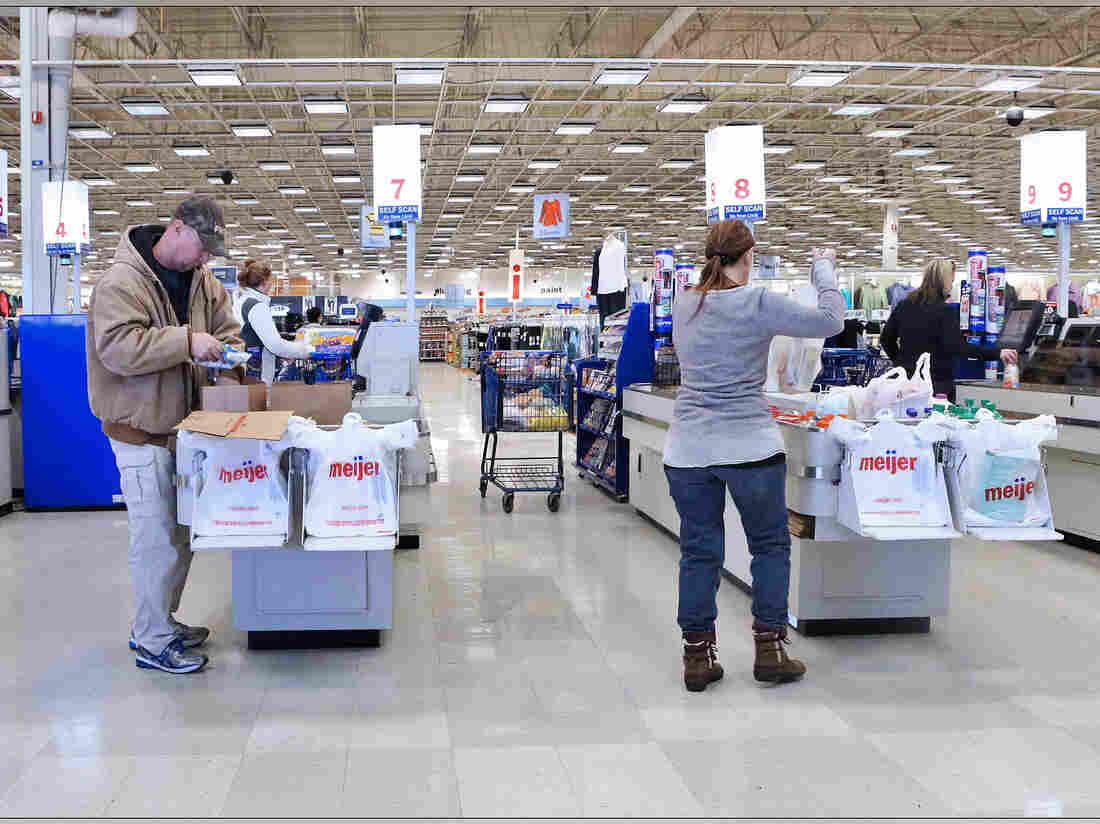
Episode 730: Self Checkout

Self-checkout machines

Howard Schneider was a doctor treating psychiatric patients in the ER when he decided to transform the grocery store experience. He set out to invent the self checkout machine.

Some parts of the design were pretty straightforward, like reading barcodes and taking payments. Other things, it turned out, were not so easy. Like figuring out when people are stealing. Schneider solves these problems. Or at least makes a machine that’s good enough to use. In 1992, he eventually convinces a grocery store to install the machines. The result? Angry shoppers.

Now, hundreds of thousands of grocery stores all around the world use self-checkout machines. But customers are still frustrated.

Today on the show, how a doctor created the first self-checkout machine in his spare time. Also: why does grocery store checkout still suck?

Music: “Remember The First Time” and “Wandering Around.” Find us: Twitter/Facebook

Let’s block ads! (Why?)


No Image

Call For Action From A Survivor Of Trafficking (Yes, It Happens To Men)

Ronny Marty, who’s from the Dominican Republic, came to the U.S. with the promise of a job. He ended up living in a tiny apartment with three men, with most of his earnings going back to his employer. Ben de la Cruz/NPR hide caption

toggle caption

Ben de la Cruz/NPR

The U.S Advisory Council on Human Trafficking issued its first-ever report on Tuesday. This group was founded last year when President Obama appointed 11 people, all of whom are survivors of human trafficking themselves, to run the council.

This council is the first organization of its kind that allows survivors to directly recommend policy to government agencies. The first report offers 15 recommendations on five topics, ranging from seeking and allocating grant funding for survivor services to training law enforcement agents to recognize the signs of human trafficking.

We spoke to Ronny Marty, a victim of labor trafficking who came to the U.S. from the Dominican Republic in 2009. Though today he’s an activist against human trafficking and a member of the advisory council, back then, he just wanted the hotel job he’d been promised.

What did you find when you got to the U.S.?

Everything changed. It was nothing they promised me. I was supposed to work in a hotel, but they said they only had jobs in a DVD manufacturing company. I didn’t have any other options, because I had borrowed so much money to pay the $4,000 I needed to come here.

[The five of us working together] were making so little money because of all the deductions. They were deducting for visa extensions, housing, transportation to move us from Kansas City to Huntsville. They put three of us in a one-bedroom apartment with three tiny beds and made us each pay the employer $300 a month. But the employer was only paying $400 a month for the apartment. They told us if we left, they would call immigration and we’d be sent back home. They told us we needed them to extend our work visas to stay legally. They told us they knew where our families lived and they’d go after them.

How did you escape that situation?

Once the employer stopped paying rent I had to talk to the landlord, because I was the only one of us who spoke English. She looked at my pay stubs and knew that something was wrong, [because of the deductions] so she got me to talk to the local newspaper. Then, that helped us [move and] find other jobs in Biloxi, Mississippi. In Biloxi, we talked to [federal Immigration and Customs Enforcement] agents. They put us in touch with NGOs [nongovernmental organizations] that gave us food, housing, everything we needed. Everything started going for the better.

My story is kind of odd compared to most of the cases because everything worked out pretty good at the end. I got the services that I needed at the time that I needed them. Most of the survivors I talk to now had a much worse time. No one would help them and they were very scared to ask for help. That’s why we’re so glad survivors are part of this report because we know about how bad this can be.

How is this report different because it was written by survivors?

Our involvement is essential in this movement to end human trafficking. We went through the tough time. We have the expertise, because of our time in the field, you could say. So with that role, we can help. The government, NGOs, any organization that wants to really fight human trafficking should be asking survivors. We know, for example, why people don’t report their experiences with human trafficking, because they’re scared of the police and their trafficker told them they’re going after their families if they report.

What recommendations do you have for law enforcement?

We need agencies to understand what a survivor goes through to report their case, so the agencies can approach the survivors properly. It’s how you can make a case successful or not. It’s all about trust, because the trafficker has probably told them that the police are just going to take your information and kick you out.

At the point that I went to see [U.S. Immigration and Customs Enforcement], I didn’t trust anyone but I had nothing to lose so I went. [ICE agent] Julie Gray was so kind and professional that I started believing in people again. In 2014, when I came to my first survivor forum, I was in shock when I heard all the survivors and what they went through with the police.

Most people associate human trafficking with women and girls, but clearly, men are affected as well. Does that get enough attention?

This is a problem I face when I go to do a training or talk about human trafficking. People talk mainly just about sex trafficking, because that’s the idea that people have. But that’s why it’s important to bring the message and make them understand that the problem includes child slavery, forced labor, migrant labor. It can happen to anyone.

This report focuses mostly on how government agencies can address human trafficking. Can everyday people help?

Learn as much as you can about the signs. If they have the information, if they know what it is, if they know how to identify human trafficking, they can report it. If you don’t know what you’re looking for, it could be right next to you and you don’t know it. When my landlord saw that something was going on with me and my pay stub, she was the first person who started helping me. That changed everything.

Now, your recommendations go to the President’s Interagency Task Force to Monitor and Combat Trafficking in Persons. What do you hope will come of this report?

This report is like a victory for us, just to get it out there. It’s the first step and now we’re going to be following up with the agencies to make sure that things are happening. We want to collaborate and follow up to help make these goals achievable before the 2017 report.

Let’s block ads! (Why?)