
Business

No Image

What's Hot On Netflix? A Startup Aims To Track Ratings In The Streaming Age

A screen shows a Netflix series, The Killing. Stephane de Sakutin/AFP/Getty Images hide caption

toggle caption

Stephane de Sakutin/AFP/Getty Images

For decades, one company has pretty much had the monopoly on TV ratings: Nielsen. But, the way people watch TV is changing. A lot of fans are streaming shows from the Internet — not watching on cable TV.

Old-fashioned Nielsen ratings wouldn’t show the habits of a family like Kevin Seal’s.

“We do not follow the appointment viewing, wait-for-the-show-to-come-on-at-a-given-time schedule,” says Seal, who lives in San Francisco with his wife and six-year-old son. “We watch a lot of Netflix programming — recently Black Mirror was the one that we devoured in its entirety.”

The failure of Nielsen to reveal data about the habits of family’s like the Seals has opened the way for a startup called Symphony, which is tracking TV watching in all its forms.

It is actually easier to track what people stream over the Internet. But Amazon and Netflix don’t release those numbers. Those companies say the numbers aren’t important because they don’t sell ads — they sell subscriptions. As long as people can find shows they want to watch they will keep subscribing.

Article continues after sponsorship

But media researcher Bill Harvey says for the people who actually produce the programming the number of viewers remains very important. The producers of a show like Black Mirror are at a disadvantage in price negotiations with Amazon or Netflix. “The price paid by a distributor to a program source is less, based on the assumption that the audience is smaller,” Harvey says.

And he says the companies that make the programming for TV also don’t look as good in the eyes of Wall Street. Harvey says that, according to Nielsen’s measurement system, overall TV viewership is down. But if you were really to measure how much TV is being watch on streaming, that may turn out to be false.

“Younger people are doing less and less of the old-fashioned TV viewing and much more of the newfangled TV viewing that Nielsen isn’t measuring,” Harvey says.

Symphony has developed a tracking system that uses a smartphone app, which so far is on the phones of more than 15,000 people. It works a little like Shazam, the app that can detect which song is playing. Symphony runs in the background all the time and participants promise to have their phone on and with them when they view. Charles Buchwalter, CEO of Symphony, says each TV program has a code that the app can identify from the audio.

I’m a fan of the sci-fi show Humans, which I watch on Amazon. If I had the app on my phone, Symphony would know I was a viewer, Buchwalter says. “The app knows that this is the audio code that Laura’s listening to,” he says, “and then we are matching that to a reference database of all programs out there and it says Laura is watching Humans.”

I usually watch Humans on my iPad, and Symphony knows that too. That’s very important information to NBC Universal, which uses Symphony, says Alan Wurtzel, NBC’s senior vice president of research.

“Folks have migrated to watching a great deal of video content on non-Nielsen-measured devices, like smartphones, like tablets,” he says. “And when you reaggregate all those numbers they basically come right back to where they’ve always been.”

Wurtzel says people are watching as much TV as ever, though he doesn’t have enough data to prove it.

NPR’s TV critic Eric Deggans says there’s some evidence that Nielsen may be setting itself up to publicly track non-traditional TV viewing. He notes that earlier this year Nielsen revealed that it has been collecting some data on streaming-only shows from Netflix including Orange is the New Black.

“But they’re only sharing that information with select clients,” he says. “So it’s hard for journalists and critics and the public to know exactly who’s watching what.”

And while this information is important to the producers of TV, Deggans says viewers like to know about it too. “If a bunch of other people are watching a show you might want to check it out,” he says.

Ultimately, Deggans says, TV producers have a stake in seeing a company like Symphony succeed. Nielsen has been a monopoly in the world of TV ratings. “If Nielsen is the only place that gives you the ratings … then they can charge you as much as they can charge you,” Deggans adds.

But Symphony might give producers a little negotiating power. And if Symphony’s technology turns out to be accurate, it may also put pressure on Nielsen to do a better job tracking how Americans are engaging in their decades-old pastime of watching TV.
Let’s block ads! (Why?)


No Image

VW Chairman Now Included In German Prosecutor's Volkswagen Emissions Probe

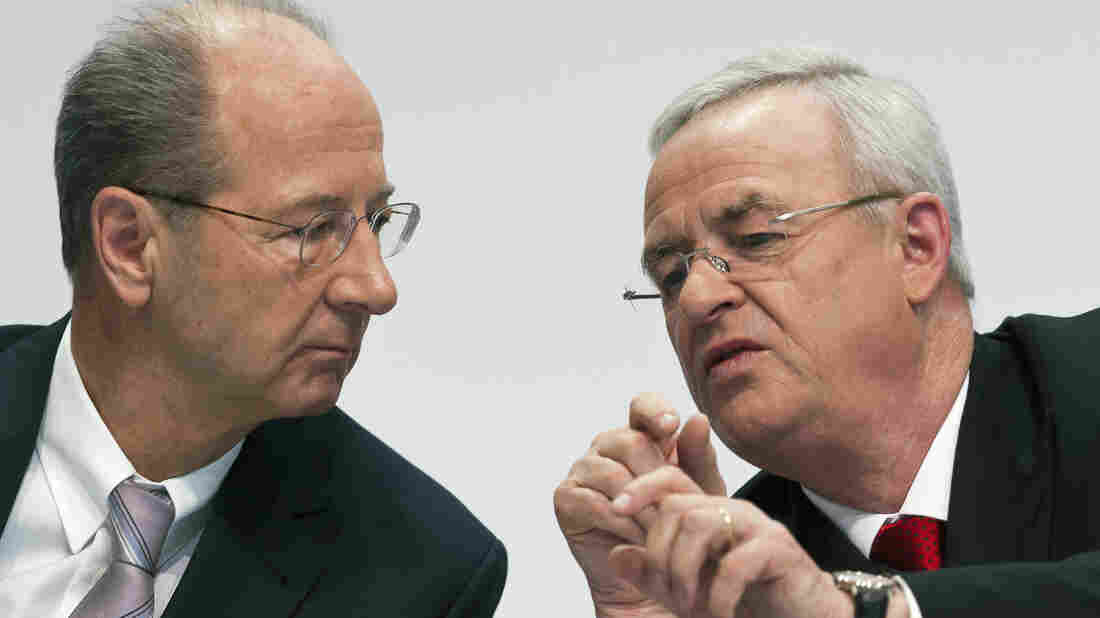
VW Chairman Hans Dieter Pötsch, left, seen here with his predecessor Martin Winterkorn, has been at Volkswagen since 2003. ullstein bild/ullstein bild via Getty Images hide caption

toggle caption

ullstein bild/ullstein bild via Getty Images

The public prosecutor’s office looking into Volkswagen’s diesel emissions scandal in Germany has widened the investigation to include Chairman Hans Dieter Pötsch, who was VW’s chief financial officer when its cars were built to fool emissions tests.

The news comes more than one year after Pötsch was named chairman; last December, he acknowledged that the emissions cheating had stemmed from a “chain of errors” in the company rather than from the actions of a group of rogue engineers.

Pötsch was Volkswagen’s chief financial officer from 2003 to 2015 — a period that encapsulates the company’s development of cheating devices that could fool U.S. emissions tests on diesel engines. The Environmental Protection Agency’s list of affected model years runs from 2009 to 2015.

Volkswagen announced the new development Sunday, saying that despite the Braunschweig public prosecutor’s move, the company “reaffirms its belief that the Volkswagen Board of Management duly fulfilled its disclosure obligation under German capital markets law.”

NPR thanks our sponsors

Let’s block ads! (Why?)


No Image

Firearms Industry Soars Amid Election-Year Angst, Shattering Records

Rifles for sale at a gun shop in Merrimack, N.H. In California, gun shop owner David Strickroth says he’s been selling six or seven guns a day. Dominick Reuter/AFP/Getty Images hide caption

toggle caption

Dominick Reuter/AFP/Getty Images

David Strickroth does steady business at High Impact Tactical Firearms in Upland, Calif. It’s a small shop, as gun shops go, with several dozen firearms hanging on the olive green walls and sitting in a glass display case below. He typically sells one or two guns a day.

Recently, though, things have picked up: “Now I’m selling six or seven a day,” Strickroth says.

The reason? Strickroth uses the word “panic,” but describes it more as angst that gun owners and would-be owners are feeling over the rhetoric of the presidential election, the prospect of a Hillary Clinton presidency and the potential for more regulation in California — a state that already has some of the strictest gun laws in the country.

“Doesn’t matter what side somebody’s on,” Strickroth says. “It’s just that what’s said [during the election] generates an angst in people that makes folks either feel ‘I’ve got to get rid of this’ or ‘I’ve got to go get me one.’ “

That angst is not just limited to the Golden State, though.

The FBI processed more than 2.3 million background checks nationally last month — those background checks being the best available proxy for gun sale numbers. That was the most ever for the month of October and an increase of more than 350,000 background checks compared to the same month last year.

Gun shops around the country are seeing record sales. Others are offering pre-election sales. Major gun manufacturers Smith & Wesson and Sturm, Ruger & Co. are reporting huge jumps in earnings. In its earnings report, Sturm, Ruger & Co. wrote that the “stronger-than-normal industry demand during the summer [was] likely bolstered by the political campaigns for the November elections.”

Article continues after sponsorship

As large as the recent surge in gun sales is, the trend is not new. Gun and ammunition sales jumped sharply after both of the last presidential elections, fueled by fears that an Obama presidency would lead to restricted access to firearms. Sales have also jumped following mass shootings and moments when gun control rises to the top of the national conversation.

October marked the 18th month in a row that the number of FBI background checks set a monthly record, putting 2016 on track to shatter the previous annual record.

Sales and angst have ramped up in recent weeks as the election grows closer.

The National Rifle Association has spent more than $26 million on advertising promoting Republican nominee Donald Trump and warning against Clinton, according to The Wall Street Journal. Most of those ads have been directed at swaying voters’ opinions in battleground states like North Carolina, Nevada and Ohio. One of the more recent ads shows a woman reaching for a gun case during a break-in, only to have it disappear.

“Hillary Clinton could take away her right to self-defense,” a voice in the ad says. “And with Supreme Court justices, Hillary can. Don’t let Hillary leave you protected with nothing but a phone.”

Clinton, for her part, has denied those accusations repeatedly on the campaign trail.

Her campaign has promised to expand background checks for gun sales; to keep guns from the hands of violent criminals, domestic abusers and the severely mentally ill; and to oppose the gun lobby. She has also promised to address gun deaths. But Clinton has refuted claims that she would do away with the Second Amendment.

“I respect the Second Amendment,” Clinton said in the last presidential debate. “I also believe there’s an individual right to bear arms. That is not in conflict with reasonable, common-sense regulation.”

Strickroth, the California gun store owner, says that many people are not convinced. He hears from gun owners and enthusiasts who are afraid that they’ll lose their right to own certain types of firearms if Clinton becomes president.

Personally, he doesn’t believe that will happen. Strickroth is no fan of Clinton and won’t be voting for her on Tuesday, but he says that any restrictions on people’s Second Amendment rights will “eventually [get] to the court and the court will say, ‘No, you can’t do that,’ ” he says.

He references the uproar and fear that followed the 1968 Gun Control Act and the last two presidential elections and gestures around his gun shop. “I’m still here,” he says.

Let’s block ads! (Why?)


No Image

Episode 733: A Trunk Full of Truffles

Truffles on a scale

Dan Pashman/WNYC

Truffles are one of the most expensive, sought-after foods on earth. Frankly, we don’t get it. They’re a fungus that smells like dirty socks.

We wanted to understand what all the fuss is about. Enter Ian Purkayastha, a baby-faced connoisseur known as Truffle Boy. He’s has been completely obsessed with truffles since he was 15. Growing up, he foraged for mushrooms in the forests of Arkansas. Now he sells truffles to the fanciest restaurants in New York City.

Ian takes us to some of the best kitchens in Manhattan on his quest to sell $20,000 worth of truffles out of the trunk of his car. It is a race against time: the truffles lose value with every passing minute. Meanwhile, Ian has to deal with traffic, parking cops, penny-pinching chefs and black market smugglers.

Truffles can’t be cultivated like other crops, so the supply can’t increase to meet the demand. That means truffle dealing — and truffle smuggling — are a high stakes hustle.

Today on the show we follow Ian through back alleys and curbside deals with some of best chefs in New York to find out why people are willing to pay so much for a fungus that smells like old socks. Plus, we hear the science behind why people just can’t get enough of them.

Article continues after sponsorship

Music: “Back From The Dead” and “Soul Toucher.” Find us: Twitter/Facebook.

Let’s block ads! (Why?)


No Image

Administration Gives Electric Car Charging Grid A Boost

The Los Angeles Police Department’s fleet of BMW i3 electric cars. Several companies, cities and states announced plans to establish national grid for EVs. Nick Ut/AP hide caption

toggle caption

Nick Ut/AP

When electric cars began to take hold in the U.S. market — a small hold — the big concern was range anxiety: the fear that your vehicle doesn’t have the fuel to get to your destination.

It’s easy to forget how vast and complex the existing infrastructure for gas vehicles is. Not having that convenience is a problem the sellers and proponents of electric vehicles been working to change.

Now, the Obama administration says it will significantly expand the nation’s infrastructure for electric vehicles. The U.S. Department of Transportation is establishing 48 national electric vehicle charging corridors. Those vehicle routes dotted with charging stations are intended to cover 25,000 miles of highway in 35 states.

Here’a a summary of the electric-car initiatives from the administration’s announcement:

“For the first time, the United State Department of Transportation (DOT) is establishing 48 national electric vehicle charging corridors on our highways, these newly designated electric vehicle routes cover nearly 25,000 miles, in 35 states.

“28 states, utilities, vehicle manufactures, and change organizations are committing to accelerate the deployment of electric vehicle charging infrastructure on the DOT’s corridors;

“24 state and local governments are committing to partner with the Administration and increase the procurement of electric vehicles in their fleets;

“The United States Department of Energy (DOE) is conducting two studies to evaluate the optimal national electric vehicle charging deployment scenarios, including along DOT’s designated fueling corridors;

“38 new businesses, non-profits, universities, and utilities are signing on to DOE’s Workplace Charging Challenge and committing to provide EV charging access for their workforce.”

The administration is sprinting to do everything it can think of to accelerate the move to clean energy, according to Roland Hwang, director of the energy and transportation program at the Natural Resources Defense Council.

“This is a better mousetrap when it comes to the environment. This is the future of clean transportation technology. We need this to get off of fossil fuel,” Hwang says of the White House announcement.

Article continues after sponsorship

The idea is to add thousands of electric charging stations around the country. In addition, states and local governments signed up to increase electric vehicles in their fleets.

The administration points to the example of California pledging to buy 150 zero-emissions vehicles (electric or fuel cell). It will also provide charging at a minimum of 5 percent of the state-owned parking places by 2020.

This all comes as consumers are turning away from sedans and moving toward SUVs and pickups. David Shepardson of Reuters looks at the problem of slow electric adoption by consumers.

“In August 2008, Obama set a goal of getting 1 million plug-in electric vehicles on the roads by 2015. Only about 520,000 electric cars have been sold in the United States since 2008, out of about 250 million cars and trucks on U.S. roads.

“The White House has repeatedly tried to boost EV sales, including hiking the EV tax credit and converting it to a point-of-sale rebate, but the proposals have yet to pass Congress.

“Electric vehicle infrastructure will also get a boost from Volkswagen AG’s diesel emissions settlement. The German automaker must spend $2 billion over 10 years to improve infrastructure and other efforts to advance zero emission vehicles.”

Hwang says while electric cars have failed to take hold in the U.S., that’s not the case in Europe or China. He points out that the biggest seller of electric passenger vehicles is not Tesla but the Chinese company BYD.

Hwang says now that all those places moving in the same direction, “it almost forces the auto industry to make significant investments in the technology, just to keep up.” He says a byproduct of the emissions scandal at Volkswagen is that company is now investing significantly in electric vehicles. “Their biggest pathway to the future is now electric,” Hwang says, because the biggest market for electric cars is China. He says right now, China is what the industry has to follow.

Let’s block ads! (Why?)


No Image

Episode 413: Our Fake Candidate Meets The People

Planet Money's fake presidential candidate

Lam Thuy Vo/NPR

Note: This episode originally aired in October 2012. Listen to part one of this series here.

As you heard last week, we’ve been creating a fake presidential candidate based on the best ideas economics has to offer, a dream candidate too perfect to exist in reality. We came up with a platform, with the help of a panel of economists. We hashed out the disagreement among the panel. We brought in political consultants who laughed at us, but also gave us some great messaging ideas.

Today, we take it to the people — or, at least, a focus group. We find out whether these economically sound ideas can get anyone’s vote. We even create a couple real ads for our fake candidate that you get to hear. Give a listen and tell us, would you vote for us?

For More: Watch the ad about ending the mortgage-interest tax deduction, and the ad about legalizing marijuana.

Music: “The American,” “Ever Brighter,” and “Brand New Morning.” Find us: Twitter/ Facebook.

NPR thanks our sponsors

Let’s block ads! (Why?)


No Image

As Scandal Cools, What Next For Volkswagen?

The 2018 Volkswagen Atlas is displayed at an unveiling event, in Santa Monica, Calif. Jae C. Hong/AP hide caption

toggle caption

Jae C. Hong/AP

Near the entrance to Santa Monica pier stood a circle of Volkswagen Golfs, each with a driver. The purpose was to ferry attendees of a weeknight car unveiling to their own vehicles somewhere in the vast oceanfront parking lot. Perfectly framed by the pier’s roller coaster in the background is the Volkswagen Atlas. If you want the company’s answer to a year of scandal, this is it: what VW calls a mid-size SUV that has three rows that seat seven passengers.

The party for the launch of VW’s new SUV came just days after a judge agreed to the largest settlement in the history of the Federal Trade Commission. Despite the most recent controversy, the party was a cross between a Silicon Valley product launch and a Hollywood premiere.

On the perimeter, vintage VW buses stood in as photo booths. Caricature artists, hired for the event, turned engineers into jocks, and reporters into superheroes. You’d almost forget Volkswagen is a company going through a crisis. Renting out a tourist attraction for a day and flying executives from around the globe for a weeknight party show how intent VW is to turning the page and how much money they can spend doing it.

Article continues after sponsorship

Classic Volkswagen Microbus and Beetle vehicles are featured at a show where Volkswagen unveiled a new mid-size SUV. Dan Steinberg/AP Images for Volkswagen of America hide caption

toggle caption

Dan Steinberg/AP Images for Volkswagen of America

Dieselgate, as you might call it, has shaken the company for over a year. Put as simply as possible: VW engineers installed software in the company’s diesel vehicles which made them appear to be performing within regulations when tested.

That set off investigations here and around the globe. Just two days before this party, a federal judge had agreed to a settlement between V.W. and the government, reimbursing owners for the cost of their cars plus $5,000 to $10,000 depending on the vehicle. Now, ahead of the U.S. car show season and the end-of-the-year sales push, Volkswagen is trying to move on.

How does Volkswagen convince consumers to return after this year? “We did not make this one a diesel,” joked Mattias Erb, Volkswagen’s chief engineer. Erb stood next to the Volkswagen Atlas, which executives take pains to note will be built in the U.S. at the company’s Chattanooga plant.

(Interestingly, VW’s first SUV was part of a trade war that effectively closed the U.S. market to foreign-made trucks.)

“We are focusing on the engineering, the performance … the things we are known for. That is how we convince customers. We are getting back to our roots,” says Erb.

The SUV was shown in a color reminiscent of a yellow school bus. Brandy Schaffels, chief editor of AskPatty.com, a car advice site for women, says the vehicle succeeds at distinguishing itself from competitors. “They’ve done a good job of getting the existing Volkswagen DNA into it. It looks like a Volkswagen,” she says. Schaffels says with more and more consumers opting for SUVs, especially upscale consumers, VW saw a new SUV as a must.

“If you don’t give them the type of vehicle they want they’ll buy it from your competitor,” she says. “When they’re going down the freeway, people aren’t going to confuse it with [a Ford] Explorer.”

“They’re late to the party,” says Michelle Krebs, senior analyst with Autotrader. While the diesel scandal raged, a change happened in the car industry. SUV sales overtook sedan sales. Volkswagen only offers two SUVs under its Volkswagen badge and sales for both the Tiguan and Touareg (the two VW-brand SUVs available in the U.S.) are anemic. Krebs says “Better late than never and the mid-size [SUV] is where the growth is because millennials are starting families and opting for bigger utes.” Krebs says.

“The public has a short attention span for scandals like this,” says Mark Takahashi with Edmunds. He says the public is distracted from the emissions controversy by other news. Takahashi notes the rebound in sales for companies such as Toyota and General Motors after their recent scandals involving deaths.

Whether consumers do have a short attention span is irrelevant when it comes to regulators. The EPA is still suing VW for civil penalties under the Clean Air Act. There are still cases pending in Europe. The Justice Department has an ongoing investigation. Dan Becker, with the Center for Auto Safety, says one of the biggest hurdles Volkswagen has to face is how it will make the diesels that are on the road meet regulatory standards. “It isn’t entirely clear that VW knows how to fix it,” says Becker, “they know how to perpetrate a fraud. But they don’t know how to fix the problems they created.”

Becker says the financial cost of the diesel cheat is enough to deter Volkswagen and other carmakers from doing something like it in the near future: “Every one of those other automakers gets the lesson that they can’t perpetuate this kind of fraud. They can’t pollute too much, or they will be severely punished.” He adds that $15 billion in fines is not a slap on the wrist.

Volkswagen announced its October results for the U.S. Tuesday and sales were down 18.5 percent for the VW brand and 9.5 percent for the company overall.

Volkswagen is expected to slog through the rest of the year with sales down in the U.S. But if current trends keep going, despite slack U.S. sales, Karl Brauer, executive publisher of Cox Media, says VW will likely be the top global brand. “I think what you see here is the impact of the global economy that we all live in now,” Brauer says.

A company can have an issue in one market or even multiple markets, Brauer says, but can mitigate that problem with its performance in other markets. Volkswagen, despite slipping in the U.S., remains dominant in China and elsewhere. “If there is another lesson that comes out of this it’s … we are not the big dog anymore,” he says. If you are having success in China or India, Brauer says “the U.S., not that it doesn’t matter anymore, but it doesn’t have nearly the impact on you as a global automaker as it would have once upon a time.”

Let’s block ads! (Why?)


No Image

Peter Thiel Stands Out In Silicon Valley For Support Of Donald Trump

While much of Silicon Valley has supported Hillary Clinton, billionaire investor Peter Thiel is backing Donald Trump. “We’re voting for Trump because we judge the leadership of our country to have failed,” Thiel says. Bloomberg via Getty Images hide caption

toggle caption

Bloomberg via Getty Images

Silicon Valley is a politically liberal place — and that is reflected in where people are sending their money this election season. Ninety-five percent of contributions from tech employees to the presidential campaigns have gone to Hillary Clinton, according to Crowdpac, a group that tracks political donations.

But one well-known outlier has caused a lot of friction in the Valley.

Peter Thiel is part of what many people in the Valley call “the PayPal mafia,” a group of investors who got very rich by helping to fund PayPal. Thiel was also an early investor in Facebook and he continues to fund startups. In the left-leaning Silicon Valley, he’s a self-identified Libertarian who supported Rand Paul.

Thiel’s outside-the-box thinking is part of what many thought made him a smart investor. Then he came out in support of Donald Trump, and that was a bridge too far for some.

Ellen Pao, who runs Project Include, an organization aimed at diversity, stopped working with the startup incubator Y Combinator because Thiel is a part-time partner. Facebook CEO Mark Zuckerberg faced calls to get Thiel off of his board, though he has refused.

Rachel Payne, a serial entrepreneur who is currently the CEO of FEM Inc., supports those who want to cut off Thiel because Trump is no ordinary candidate. “[Trump] is inciting what I like to call thrashers — violent opposition to the gains that are being made by the formerly dispossessed or the minority populations that are finally gaining rights,” she says.

Thiel once lamented the negative impact of women getting the vote and wrote that democracy and freedom are not compatible in a blog post for the libertarian Cato Institute. In a book he co-authored in 1999, Thiel said a “multicultural rape charge may indicate nothing more than a belated regret.”

Article continues after sponsorship

Thiel has since walked back on his comments about the vote and they were updated on the blog post. He also apologized for being insensitive about rape.

But, Payne says, if you have someone like Thiel involved in a startup incubator like Y Combinator it can discourage participants.

“So if you have a challenge of getting more women in tech, for example, and attracting more women as startup founders, if women believe that he is hostile to them they wouldn’t be inclined to go there,” she says.

On Monday at the National Press Club in Washington, D.C., Thiel defended his position. “It’s not a lack of judgment that leads Americans to vote for Trump,” he said. “We’re voting for Trump because we judge the leadership of our country to have failed.”

It’s failed, Thiel said, by getting the U.S. into major costly conflicts around the world and by allowing bubbles that seriously harm the economy. Thiel went on to criticize Hillary Clinton for her hawkishness and took aim at those in Silicon Valley who have made Trump supporters feel unwelcome.

“Many people have learned to keep quiet if they dissent from the coastal bubble,” Thiel said. “Louder voices have sent a message that they do not intend to tolerate the views of one half of the country.”

And while many still don’t agree with Thiel, they see no reason to kick him off a board or refuse to work with him. “I definitely have my own strong opinions about Trump,” says Minnie Ingersoll, a founder and chief operating officer of Shift, a company that uses the Internet to help people get the best prices for their used car. “But I don’t believe that we should say that we wouldn’t have someone on our board who we disagree with politically.”

Ingersoll says supporting Trump may be the minority view in Silicon Valley, but all opinions should be welcome. “There are 300 people who work at Shift,” she says. “And some of them are going to support Trump and I need to find a way to make sure that they feel comfortable having a different opinion than I do. We still need to respect one another and respect differences of opinions.”

Thiel says his political views haven’t cost him financially or cost him any business relationships. In the end, it may be money, not politics, that matters most in Silicon Valley.

Let’s block ads! (Why?)


No Image

Will Self-Driving Trucks, Now A Reality, Unseat Truck Drivers?

NPR’s Scott Simon speaks with New York Times technology columnist Farhad Manjoo about self-driving trucks — and whether we’re ready for their arrival.

SCOTT SIMON, HOST:

For all the talk about self-driving cars, it was a self-driving truck that may drive us a little faster into the future. This week, a big rig, carrying 2,000 cases of Budweiser beer, made a shipment in Colorado with no driver at the wheel. Anheuser-Busch calls it the world’s first commercial delivery by a self-driving truck. Farhad Manjoo is a technology columnist for The New York Times, and he’s also been in a driver-free truck. Thanks very much for being with us.

FARHAD MANJOO: Hey, good to be here.

SIMON: What’s it like to be in one of these trucks?

MANJOO: Well, surprisingly normal. The trucks so far – the ones that they’re running so far – have a driver sitting at the seat, then he flips a button and the truck just kind of takes over. It’s basically like looking at someone flip on cruise control, except here, you know, when the driver took his hands off the wheel, the wheel kept turning as the road moved ahead.

SIMON: I mean this question utterly seriously because I gather there were some tweets about it this week. We’re talking about a beer truck delivery. Is it possible that some fraternity at the University of Wisconsin could hack into a beer truck and (laughter) get it delivered to their frat house instead of the market?

MANJOO: You know, this is one of the concerns with both self-driving trucks, self-driving cars and generally more of our kind of national infrastructure becoming digital, becoming automated. You know, this is one of the questions I think looming over the whole sector is the security both from hacking but also from mishap, you know, just sort of inadvertent bugs in the system that could cause it, you know, real problems in the real world.

SIMON: And will this ultimately throw human truck drivers out of business?

MANJOO: This company Otto, which Uber recently purchased, they argue that the human truck driver, at least in the foreseeable future, in the next, perhaps, 10 to 20 years, the human truck driver won’t be completely eliminated from the truck. So on residential streets, on other streets where it’s both more difficult to drive a truck, the human truck driver might still be necessary at that point. And the truck driver does other things like unload the vehicle, perhaps, fill out the paperwork, you know, do a lot of white-collar type work in the cab.

Their sort of vision for this is that if you get this technology in your truck, you can make your truck twice as efficient and your job perhaps slightly easier. Now of course, this is the – they’re making the technology so they’re sort of putting the best face on this. Truck drivers I spoke to weren’t as enthusiastic about this whole proposition.

So I would say that there are both sort of technological changes here but also social changes. And those social dynamics – the idea of a truck driving down the road and no one is in it might be so alien to people that we might – it might take a very long time before we’re comfortable with that.

SIMON: Well, but – let me point out, Mr. Manjoo, people used to be that way about elevators. We think nothing of it now in the tallest buildings in the world.

MANJOO: It’s true. I mean, it’s hard to – I think I’ve been in one elevator that had an operator. So it’s possible we’ll be that way with trucks and cars at some point. My own feeling is that it’s probably going to be at least 20 years until that happens, perhaps longer.

SIMON: Farhad Manjoo is technology columnist at The New York Times. Thanks for being with us.

MANJOO: Thanks so much.

Copyright © 2016 NPR. All rights reserved. Visit our website terms of use and permissions pages at www.npr.org for further information.

NPR transcripts are created on a rush deadline by Verb8tm, Inc., an NPR contractor, and produced using a proprietary transcription process developed with NPR. This text may not be in its final form and may be updated or revised in the future. Accuracy and availability may vary. The authoritative record of NPR’s programming is the audio record.

Otto developed technology to allow big-rig trucks to drive themselves. Uber, another transportation company working on self-driving technology, acquired Otto in August. Tony Avelar/AP hide caption

toggle caption

Tony Avelar/AP

Self-driving cars have been getting a lot of attention lately: Uber’s self-driving taxis in Pittsburgh, Tesla’s semi-autonomous Model S and the driverless Google rides that look like a cross between a Cozy Coupe and a golf cart. But quietly and without much fanfare, researchers and entrepreneurs are working on self-driving trucks — big rigs, tractor trailers.

Trucker Rusty Todd has heard a bit about them. He paused to consider a future of self-driving trucks while taking a break at a truck stop in Jessup, Md. “Well then, I’m going to be without a job,” Todd said with a laugh.

He’s joking. Kinda, sorta. Todd’s not worried about losing his job to a robot driver anytime soon. But he said what he’s hearing about self-driving trucks makes him a bit nervous.

” ‘Cause not all systems are perfect. I mean not all computers are perfect,” Todd said. “They’re doing it with the cars, yeah, I can agree with that ’cause a car doesn’t weigh as much as these things do. These things are heavy.”

Todd’s right that self-driving cars can be seen here and there, but the big shift to self-driving vehicles may happen first on America’s interstates, in big rigs, not in fancy electric cars.

“It could likely be that it would happen en masse faster in trucks than it would in cars,” says Alain Kornhauser.

Kornhauser, who heads the Autonomous Vehicle Engineering program at Princeton University, says long-haul trucks are well suited for self-driving technology. Trucks log most of their miles on highways, where the lanes are well marked, where the roadways are smooth and where there are no pedestrians, no bicyclists and no kids playing ball.

Article continues after sponsorship

Don Burnette, senior staff engineer at Otto, checks the software on a computer in the back of the self-driving, big-rig truck. Self-driving trucks could make the lives of truckers safer and less stressful. Tony Avelar/AP hide caption

toggle caption

Tony Avelar/AP

“The self-driving is easy,” Kornhauser says.

Kornhauser says he expects to see plenty of self-driving trucks within a decade. But he points out that self-driving doesn’t mean driverless. It’s likely a trucker will still be in the cab, probably in the driver’s seat, ready to take control if something goes wrong. He thinks this change will make the lives of truckers safer and less stressful.

“They can have all sorts of screens in front of them to do whatever things they need to do,” Kornhauser said. “And instead of being stuck in some cubicle in some building with no windows to look out, they have a perfect view of the world as they’re traveling down the road.”

Kornhauser is optimistic about the future of self-driving trucks, which makes sense since he has a company that’s working on automation for trucks. His company, along with others working to develop this technology, are sending the same message to truckers: The jobs will be less dangerous and won’t go away.

As the technology improves and expands for self-driving cars, Alain Kornhauser says that does not mean the trucks will be driverless. It’s likely a trucker will still sit in the driver’s seat ready to take control should something go wrong. Tim Boyle/Getty Images hide caption

toggle caption

Tim Boyle/Getty Images

That’s the foreseeable future, but eventually, the technology that makes them safer could make truckers’ jobs obsolete.

Fred Rush has been a trucker for two years and he’s enjoying life on the road.

During a trip hauling a load of yogurt from Tucumcari, N.M., to Allentown, Pa., Rush, 30, spoke with NPR. He said he likes the job because he gets to travel a lot — something he didn’t do much before.

“I’ve seen every state now,” he said. “Every time I finish a load I have no idea where I’m going next. It keeps things different.”

Rush is watching the automation of driving with mixed emotions.

“I’m all for it. It’d save lives, it’d save pollution. Wouldn’t be a lot of wasted time, but it would suck,” Rush said. “I really think I’m probably one of the last generations of truckers. I don’t think it will be around for my kids or my grandkids, but fun to try it while it’s still here.”

And just in case the driverless future arrives sooner than expected, Rush said he’s thinking about a plan B. Maybe something in computers, like information technology. Those jobs are safe, right?

Let’s block ads! (Why?)


No Image

Episode 732: Bad Form, Wells Fargo

In the banking industry essentially "U5" is a report card from all of your former employers, like a permanent record.

Cultura RF/Getty Images

A couple of weeks ago, we did a show about the massive scandal at Wells Fargo bank. How good employees were pushed to do bad things. Like opening up bank accounts that customers never asked for.

After the show aired, we talked to ex-employees who said, you know: The fraud, that’s only half the story. Many of them said that after they left Wells Fargo they were surprised by how hard it was to get another job in banking. They’d apply, get to the interview, it’d go great. And then suddenly, silence and rejection. Like something was tripping them up over and over again right before they could get a new job. Some of them just gave up on banking all together.

What was happening had everything to do with a little-known form called a “U5.” This is a form in the banking industry that’s essentially a report card from all of your former employers, like a permanent record.

The ex-employees we talked to say they pushed back against the crazy sales culture at Wells Fargo. In retribution, they say, the bank marked them with a scarlet letter that is badly damaging their careers.

Article continues after sponsorship

Today on the show, we continue our investigation into Wells Fargo. And we go deep into this mysterious document, the U5. We’ll find out the well-meaning origins from someone who helped create the system. And we look into how Wells Fargo branded their workers with it. Plus, how hard it’s been for bankers to fight back.

Music: “Stars Above” and “Goldbrick.” Find us: Twitter/ Facebook.

Let’s block ads! (Why?)