
U.S. Cities Skeptical Of FDA Warnings Against Medicine Imports From Canadian Firm

The Food and Drug Administration suggests consumers who get prescription drugs mailed to them via CanaRx are at risk of getting mislabeled or counterfeit drugs. But consumer watchdog groups say the FDA has supplied no evidence that’s happened.
Hero Images/Getty Images
hide caption
toggle caption
Hero Images/Getty Images
Cities and local governments in several states say they will continue to use a Canadian company to offer employees prescription drugs at a highly reduced price, even though officials from the U.S. Food and Drug Administration have raised safety concerns about the practice.
The municipalities use CanaRx, which connects their employees with brick-and-mortar pharmacies in Canada, Great Britain and Australia to fill prescriptions.
In a letter sent last week to CanaRx, the FDA said the company has sent “unapproved” and “misbranded” drugs to U.S. consumers, jeopardizing patient safety.
The FDA also urged consumers not to use any medicines from CanaRx, which works with about 500 cities, counties, school districts and private employers in the United States to arrange drug purchases. Some of these employers started using the service as far back as 2004.
Prices of drugs from overseas pharmacies can be as much as 70 percent lower than what people pay in the U.S. because the costs are regulated by the foreign governments.
FDA officials would not explain why they waited more than a decade to act. They acknowledged the agency had no reports of anyone harmed by drugs received through CanaRx.
The FDA made its warning as Congress and the Trump administration look into ways to lower drug prices. Last month, Florida Republican Gov. Ron DeSantis said he has President Donald Trump’s backing to start a program to begin importing drugs from Canada for state residents.
After DeSantis’ comments, White House officials stressed that any such plan must get state and federal approvals.
The FDA says that in most cases importing drugs for personal use is illegal, although it very rarely has tried to stop Americans from bringing drugs across the Canadian border. It has not stopped retail stores in Florida that have helped consumers buy drugs from Canada since 2003. Nine storefronts were raided by FDA officials in 2017, although the FDA has allowed them to continue operating.
Schenectady County in New York, which has worked with CanaRx since 2004, defended its relationship and has no immediate plans to end it, according to Chris Gardner, the county attorney. “We will wait to see how this plays out, but right now it’s status quo,” Gardner says.
He says CanaRx, which is headquartered in Windsor, Ontario, helped the county save $500,000 on drug costs in 2018. About 25 percent of the county’s 1,200 workers use the program and get their drugs with no out-of-pocket costs. If they use American pharmacies, they generally have a copayment.
“This is a good program, and on the merits it looks lawful, and they are not doing the terrible things that the FDA is suggesting,” Gardner says.
CanaRx officials deny they have been breaking any laws or putting Americans’ health at risk. They say they are not an online pharmacy but a broker between U.S. employees and brick-and-mortar pharmacies in Canada, Australia and Great Britain. People can buy drugs via CanaRx only with a prescription from their doctor.
The company says it has no plans to stop distributing drugs.
“The FDA’s characterizations of the CanaRx business model and operating protocols are completely wrong,” says Joseph Morris, a Chicago-based lawyer for the company. “It is not possible to place an order via any CanaRx website; the websites are informational only.”
Morris says the FDA notice has prompted calls from many municipalities; but so far all say they plan to stick with the company.
The FDA warning says online pharmacies that purport to sell drugs from Canada, Britain and Australia may actually get their drugs from other countries, which would increase the risk consumers are dealing with counterfeit drugs.
CanaRx says that “it contracts with government-licensed physicians, pharmacists and pharmacies in Canada, the United Kingdom, and Australia … to supply brand name medications, packaged and sealed by the original manufacturer, for direct delivery to all participants.”
Gabriel Levitt is president of pharmacychecker.com, an independent website for U.S. consumers that verifies international pharmacies offering drugs online. He notes that the FDA’s warning letter offered no evidence CanaRx has distributed any counterfeit drugs since it began business almost 20 years ago.
Columbia County, N.Y., has been using CanaRx for about a decade and says the savings allows it to offer employees drugs with no out-of-pocket costs, instead of requiring them to pay as much as a $40 copay in local pharmacies.
“This is bull,” Stephen Acciani, an insurance broker who works with the county, says of the FDA crackdown. “They are not selling unsafe medications.” His recommendation would be for the county, which has more than 600 employees on its health plan, to continue using CanaRx.
Acciani notes that employees receive the medicine through the mail in its original packaging from the manufacturer.
“It will give some clients pause,” says Kate Sharry, a benefits consultant to the city of Fall River, Mass., and more than 100 other municipalities in the state. “How can you not pay attention to this from the FDA?” But she expects the local governments to stay with CanaRx.
Federal health officials under both Republican and Democratic administrations have blocked efforts to legalize importing medication, saying it’s too risky.
“Sometimes a bargain is too expensive,” says Peter Pitts, a former FDA associate commissioner (from 2000 to 2004)who is now president of the Center for Medicine in the Public Interest, a New York-based nonprofit that receives some of its funding from drugmakers.
Pitts, who applauds the FDA action, says it’s difficult for consumers to know when their pills from foreign pharmacies don’t have the correct potency or ingredients. He says doctors may also not realize a patient’s problem stems from issues with the medicine. Instead, the physicians may just change the medication’s dosage. He says it is not safe for Americans to buy drugs that are imported through foreign pharmacies.
Levitt says CanaRx is one of the safest ways for Americans to get drugs from legitimate pharmacies in Canada and other industrialized counties.
The FDA is likely trying to intimidate CanaRx and its clients in local government, Levitt says.
“My biggest fear is they will scare consumers, [who then] won’t take their very safe and effective medications because they hear about this bogus warning,” says Levitt.
“The FDA’s action,” he says, “which appears to try and make those programs look unsafe and sinister, seems to have a political and public relations purpose — one that is perfectly allied with the lobbying agenda of drug companies.”
Levitt points to testimony FDA Commissioner Scott Gottlieb gave to a House subcommittee last week — just a day before the CanaRx warning, and ahead of his announcement that he will be leaving the FDA next month.
When asked about importing Canadian drugs, Gottlieb did not mention CanaRx, but did say that people going to a “brick and mortar” pharmacy in Canada “are getting a safe and effective drug. I have confidence in the Canadian drug regulatory system.” He added that his concerns are with online pharmacies.
The Pharmaceutical Research and Manufacturers of America, the industry trade and lobbying group, has cheered the FDA action but denies it had any role in it, says spokeswoman Nicole Longo.
“PhRMA supports the FDA’s efforts to crack down on organizations that are circumventing its robust safety and efficacy requirements,” Longo says. “Drug importation schemes expose Americans to potentially unsafe, counterfeit or adulterated medicines.”
Kaiser Health News is a nonprofit news service and editorially independent program of the Kaiser Family Foundation that is not affiliated with Kaiser Permanente.
Trade War And Peace

Today, the U.S. confirmed it will hold off on a new round of tariffs on imports from China that was supposed to be put in place this month. There’s also word that President Donald Trump and Chinese President Xi Jinping are getting close to completing a trade deal, which would mean both countries getting rid of many of the tariffs and trade restrictions that have been put in place. Today on the show, Stacey talks to Chad Bown of the Peterson Institute for International Economics about the trade war with China and asks, ‘Is a trade truce on the horizon?’
Music by Drop Electric. Find us: Twitter/ Facebook.
Subscribe to our show on Apple Podcasts, PocketCasts and NPR One.
How Much Is Today's HIV Research Centered Around The Search For A Cure?

For the second time ever, a man’s HIV infection has been sent into remission. NPR’s Mary Louise Kelly talks with Rowena Johnston, director of research for the Foundation for AIDS Research.
MARY LOUISE KELLY, HOST:
Today a big announcement about HIV/AIDS – a second man’s HIV infection is in remission. This is being hailed as a milestone in the search for a cure, which prompts a question. Decades into the epidemic with drugs available that prevent HIV infection and can treat it, how relevant is the search for a cure? We’re going to put that question to Rowena Johnston. She is in Seattle for the conference where this news was announced today. She’s the vice president and director of research for the Foundation for AIDS Research – amfAR. And she joined us from member station KUOW.
Rowena Johnston, welcome.
ROWENA JOHNSTON: Thank you very much.
KELLY: So I want to mention that your group amfAR funded the research, which is published today in the journal “Nature.” Talk to me about this specific case and why it’s a breakthrough. This has to do with a man with HIV and cancer who got a stem cell transplant.
JOHNSTON: That’s right. We’re referring to this man as the London patient. He was living in London and was living with HIV and developed cancer. And his cancer was not responding to normal treatments. And so he became a candidate for a stem cell transplant. And his physicians were really quite smart. And they decided to look for a donor who also had a CCR5-delta 32 mutation.
KELLY: OK.
JOHNSTON: And this mutation is quite rare, but people who have this mutation are highly resistant to HIV infection. And so by using cells from this donor, they were replacing the London patient’s immune system with the immune system of a person who’s highly resistant to HIV in a situation that was very closely similar to the Berlin patient, who we now do believe was cured.
KELLY: Between these two patients was – I believe it’s a dozen years. And doctors had, of course, tried to replicate the results in those intervening years. And the virus kept coming back. Do we know why it was successful with this new patient, with this London patient?
JOHNSTON: You’re right that there had been attempts to recapitulate what had happened in the Berlin patient. In some cases, the transplant recipients were getting donor cells from a person who did not have that CCR5-delta 32 genetic mutation. So it’s beginning to look like having donors that have that mutation is a key element to this successful outcome. So it’s really having the similarities and the differences between these cases and being able to compare them is where we’re going to learn the valuable lessons to move us forward.
KELLY: Just to be clear, the London patient was dealing with a very specific health situation. In other words, the breakthrough that is being reported today does not mean that a widespread, universal cure is within immediate reach. Is that right?
JOHNSTON: That’s right. Stem cell transplant is only appropriate for people who are living with a cancer of the immune system. So this intervention itself is not the way in which we are going to cure people living with HIV across the world. What this intervention is going to help us understand, though, is which are the critical components that we can learn from and put together so that we can develop some different type of cure that is appropriate everywhere that people are living with HIV.
KELLY: So let me circle you back to the question I posed at the outset, which is we – now decades into this grappling with HIV and AIDS, there are drugs which help prevent infection, which help people who are living with HIV infection manage it and live successful, long lives at this point. Why is it so important to find a cure?
JOHNSTON: A person living with HIV today needs to take their antiretroviral therapy every single day of their lives for the rest of their lives. And that becomes very burdensome both from an economic perspective and also, perhaps, from the perspective of their own health. And when you’re taking antiretroviral therapy every day, you’re reminded every day that you have this virus for which you are stigmatized.
And so having a cure for HIV relieves a lot of these burdens. And if we can cure this infection, that’s going to encourage people to get tested for HIV because there’s going to be that sense of optimism that they don’t have to live with this virus for the rest of their lives.
KELLY: Rowena Johnston – she is research director for amfAR. That’s the Foundation for AIDS Research. Thanks for your time.
JOHNSTON: Thank you very much.
Copyright © 2019 NPR. All rights reserved. Visit our website terms of use and permissions pages at www.npr.org for further information.
NPR transcripts are created on a rush deadline by Verb8tm, Inc., an NPR contractor, and produced using a proprietary transcription process developed with NPR. This text may not be in its final form and may be updated or revised in the future. Accuracy and availability may vary. The authoritative record of NPR’s programming is the audio record.
Anonymous Mega Millions Lottery Winner Claims $1.5B Jackpot In South Carolina

The KC Mart in Simpsonville, S.C., after it was announced the winning $1.5 billion Mega Millions lottery ticket was purchased there in October 2018.
Jeffrey Collins/AP
hide caption
toggle caption
Jeffrey Collins/AP
Someone in South Carolina claimed the $1.5 billion jackpot from the Mega Millions lottery held in October 2018, ending the mystery of whether anyone would ever come forward to say they had won.
The winner, who has elected to remain anonymous, chose the one-time payment cash option, making their prize worth nearly $878,000,000. It is the largest jackpot payout to a single winner in U. S. history, according to a statement by South Carolina Education Lottery Commission.
“We are delighted that the winner is a South Carolinian and has come forward to claim this remarkable prize,” said Hogan Brown, the commission’s executive director.
South Carolina is one in only a handful of states that allows lottery winners to keep their identities secret. The others are Delaware, Georgia, Kansas, Maryland, North Dakota, Ohio and Texas.
As the Associated Press reports, until now there was a great deal of speculation about why the winner had not yet claimed the prize, ranging from suspicions that he or she was a fugitive from the law, dead, or tied up in litigation.
The winner has retained the representation of New York law firm Rivkin Radler.
The winning numbers, by the way, were 5,28,62,65, 70 and the mega number 5. They were selected by a Quick Pick.
Governments Struggle To Find A Way To Pay Retirement Pension Bills
There’s a growing fiscal crisis hitting cities, counties and states across the U.S. It’s all about generous retiree health benefits that historically haven’t been fully funded.
MICHELE MARTIN, HOST:
Across the United States, there is a growing problem for current and retired government employees. It has to do with retiree packages known as other postemployment benefits. They’ve been around for decades, but they are often chronically underfunded. And now with the retirement of more baby boomers, it’s time to pay up. Houston Public Media’s Andrew Schneider reports on how one city is trying to head off a financial crisis.
ANDREW SCHNEIDER, BYLINE: Any city council meeting can be boring, especially when it’s about finances. But in Houston, those meetings and what they’re wrestling with have forced people to sit up and take notice.
DAVID BERGER: Our initial $2.4 billion liability has been mentioned, but we projected it out over the next 30 years, and it became $9 billion.
SCHNEIDER: David Berger of Segal Consulting talked about the bleak financial outlook for Houston, the nation’s fourth largest city. He says that $9 billion projected shortfall is a real problem.
BERGER: That would increase far faster than your revenues, your tax revenues. And so that kind of highlights the need for, not only a current solution, but a longer term. What can we do to control the longer term costs as well?
SCHNEIDER: Houston is far from alone. The Center for Retirement Research at Boston College has been looking at this issue. In 2016, it found that cities counties and states collectively are short more than $860 billion.
ALICIA MUNNELL: The problem is nationwide. The seriousness of the problem varies a lot.
SCHNEIDER: Alicia Munnell is the center’s director. Historically, governments have always underfunded pensions and retiree benefits. But it’s not been until the last few years that federal accounting rules forced them to admit the shortfalls. And Munnell says some states are really struggling.
MUNNELL: I’m not going to surprise you very much. Illinois, Connecticut, New Jersey, those are the plans where you see the most serious shortfalls and where you have, you know, high debt service and high retiree health care costs as well.
SCHNEIDER: In terms of local governments, she points to counties in California and cities like Chicago and Detroit. And then there’s Houston. It’s proposing some drastic measures to keep retiree benefits from mushrooming into another crisis. Councilman Dave Martin says they’re looking into eliminating some spousal subsidies depending on longevity.
DAVE MARTIN: We have some retirees that are marrying younger men and women – for instance, a 50-year-old man marries a 30-year-old woman or a 50-year-old woman marries a 30-year-old man. The obligation in the retirement goes with the younger spouse.
SCHNEIDER: Houston officials are worried that some of these changes, which include no postretirement health coverage for new employees, could make it more difficult to attract workers to the city. Bill Fulton directs the Kinder Institute for Urban Research at Rice University. Fulton says unfunded retiree benefits could lead to the same problems for cities that had unfunded pensions.
BILL FULTON: Where we’ve seen bankruptcies so far have been purely a pension problem. That was the problem in Detroit. I do think that we – there will be – I can’t say which ones – but I do think probably some jurisdictions will be at similar financial risk as postemployment benefits become a bigger issue and become more expensive.
SCHNEIDER: It’s a painful choice to make because when the benefits get more expensive, something else in the budget doesn’t get funded. The Houston City Council is expected to vote on the proposal to overhaul retiree benefits soon. For NPR News, I’m Andrew Schneider in Houston.
(SOUNDBITE OF HYPNOTIC BRASS ENSEMBLE’S “BALLICKI BONE”)
Copyright © 2019 NPR. All rights reserved. Visit our website terms of use and permissions pages at www.npr.org for further information.
NPR transcripts are created on a rush deadline by Verb8tm, Inc., an NPR contractor, and produced using a proprietary transcription process developed with NPR. This text may not be in its final form and may be updated or revised in the future. Accuracy and availability may vary. The authoritative record of NPR’s programming is the audio record.
For The Few Who Heat Homes With Coal, It's Still King

John Ord of Susquehanna, Pa., loads 40-pound bags of anthracite coal into his car. He’s among the fewer than 130,000 households left in the United States that burn coal to heat their homes.
Jeff Brady/NPR
hide caption
toggle caption
Jeff Brady/NPR
Every few weeks, John Ord does something unusual for most people living in 2019 — he stops by a local hardware store in rural northeastern Pennsylvania to buy coal to heat his home.
He recently spent about $56 to buy 400 pounds of coal. That will keep his 2,400-square-foot house a toasty 70 to 72 degrees for a couple of weeks.
“This is the whole glamorous part, right here,” says Ord, as he loads 40-pound bags of Pennsylvania anthracite coal into the back of his white station wagon.
When he gets home, Ord lugs the coal down to his basement, where he rips open a bag, lifts it chest high and loads it into a hopper on the back of his coal-burning stove.
It’s a lot more work than most Americans with gas or electric heat go through to keep their homes warm. They can just set a thermostat and forget it. But Ord says this is actually less work than the wood stove he replaced last fall.
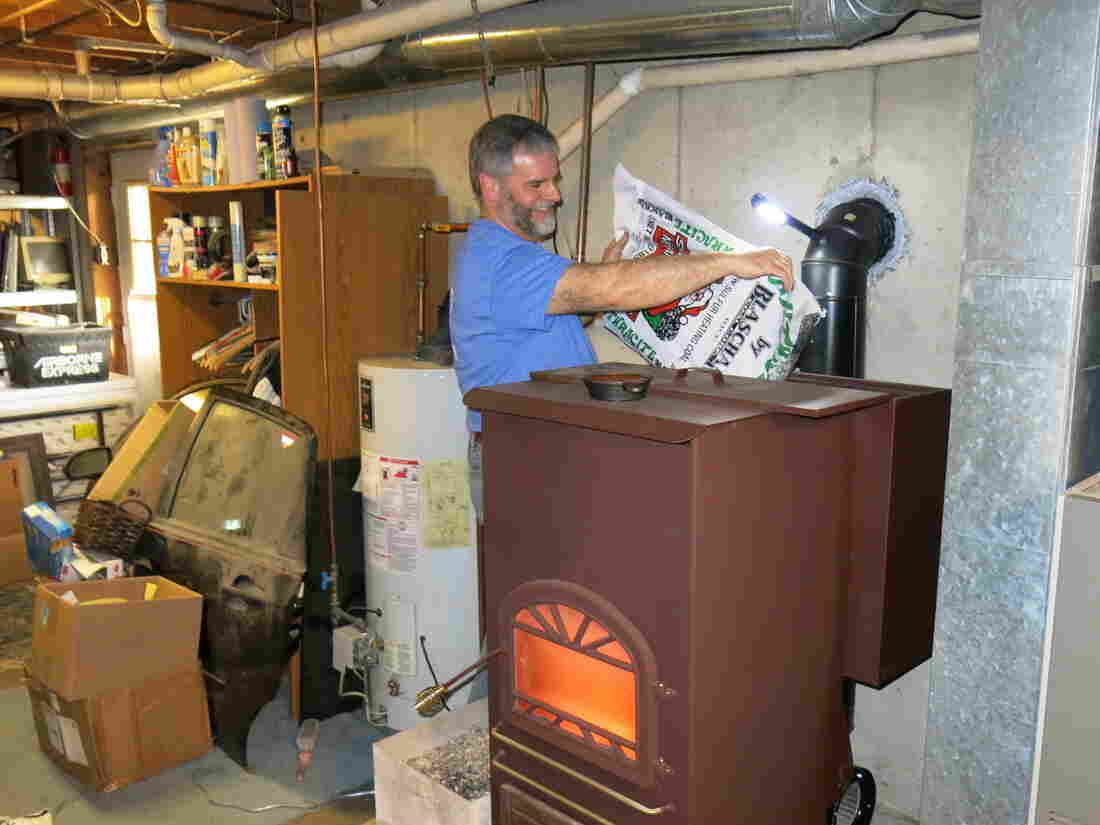
Ord loads a hopper on the back of his coal-burning stove. He says 400 pounds of coal will keep his 2,400-square-foot house between 70 and 72 degrees for a couple of weeks in the winter.
Jeff Brady/NPR
hide caption
toggle caption
Jeff Brady/NPR
“Between cutting it [wood], stacking it, letting it season, moving it into the space where you need to access it and then loading the stove,” Ord says, wood requires a lot more handling.
Ord’s coal-burning stove burns 24 hours a day when it’s cold. He likes the constant heat it gives off and says it’s cheaper than his other options — oil and electric.
While most power plants around the United States burn bituminous coal, northeastern Pennsylvania is very proud of its anthracite coal, which is shinier and harder than you might expect. Ord says it burns cleaner too.

Anthracite coal is mined in northeastern Pennsylvania. About 63,000 households in the state burn coal for heat.
Jeff Brady/NPR
hide caption
toggle caption
Jeff Brady/NPR
To demonstrate this, he goes outside and points up to a white chimney. “No smoke at all. There’s no smell to it,” says Ord.
But burning anthracite coal does emit more carbon dioxide per unit of heat than just about any other fuel, according to the Energy Information Administration. That makes it a contributor to climate change.
Anthracite backers point out that it has less sulfur than bituminous coal, but environmentalists say cleaner does not mean clean.
“It still emits quite a bit of dangerous sulfur dioxide, as well as heavy metals such as lead, arsenic, and mercury,” says Tom Schuster with the Sierra Club’s Beyond Coal campaign. He says anyone concerned about their contribution to climate change should avoid burning coal for heat.
Those in the anthracite coal business counter that the industry is so small that it’s not a big contributor to greenhouse gas emissions.
“If you want to look at the major CO2 producers in the world, it’s not us,” says Matt Atkinson, co-owner of Leisure Line Stove Company in Berwick, Pa. “And even if we quadrupled our current sales, it still wouldn’t be a problem.”
Seeking a new generation of customers
There was a time when coal was king in the home-heating business. In 1940, more than half of U.S. homes burned coal, according to the Census Bureau. It was a big business and such a part of the culture that coal company ads were heard regularly on the radio.
Listen to a 1953 Blue Coal radio advertisement here:
(Credit: Pennsylvania Historical and Museum Commission/Pennsylvania Anthracite Heritage Museum)
After decades of decline, fewer than 130,000 households use coal for heat today. Half of them are in Pennsylvania, and the state’s coal industry wants to boost that. It has a plan to attract more customers.
Atkinson is among those leading the campaign. He bought Leisure Line with a business partner in 2009 and says he got into the coal stove business after experiencing a friend’s stove.

Matt Atkinson, co-owner of Leisure Line Stove Company, in the firm’s Berwick, Pa., factory. His company hopes to encourage more people to switch to burning anthracite coal to heat their homes.
Jeff Brady/NPR
hide caption
toggle caption
Jeff Brady/NPR
“When I opened the door, I felt this warmth that I had never felt before. … And I was hooked instantly,” says Atkinson. Talk to coal-heat advocates in Pennsylvania, and you’ll hear this repeatedly — that there’s no heat as intense as coal heat.
It’s clear that many people in northeastern Pennsylvania, the heart of anthracite coal country, have an emotional attachment to this fossil fuel.
“You have people here that their great-great-grandfathers were miners. Their grandfathers were miners. It’s a family of mining,” says Andrew Meyers, sales manager for Blaschak Coal Corp. His company also is leading the campaign to attract new customers.
“It’s mostly about growing market share within the home-heating industry,” says Atkinson. He hopes to attract a new generation of customers with the message that they can save money on heating their home if they choose coal.

Kelly Brown stands in front of a pile of coal. Her family’s business, F.M. Brown’s Sons, has sold coal for nearly a century.
Jeff Brady/NPR
hide caption
toggle caption
Jeff Brady/NPR
In Reading, Pa., Kelly Brown welcomes the campaign. Her family’s business, F.M. Brown’s Sons, has sold coal for nearly a century and is one of the few to survive the industry’s decline.
“In this general area, there was probably about 50 coal companies. Slowly, one by one, they started closing up,” says Brown. Now her company is the only one left in Berks County.
She says the industry has improved its environmental record over the years. Pennsylvania was the first state to pass an act to address abandoned-mine reclamation, and today coal companies like to tout their work in this area.
Given Pennsylvania’s abundant coal reserves and a bigger focus on improving coal’s environmental record, Brown hopes the industry will stage a comeback. “I might not see it in my lifetime, but I think things will turn around,” she says.
So far the trend is not moving in Brown’s favor. Even in Pennsylvania, the number of households using coal for heat continues a steady decline.
Jon Champion On Calling Play-By-Play Soccer
Lulu Garcia-Navarro speaks with renowned British soccer commentator Jon Champion, who is joining ESPN as the new play-by-play voice for Major League Soccer.
LULU GARCIA-NAVARRO, HOST:
For almost two decades, Jon Champion has called the play-by-play on some of the most watched soccer games in the world.
(SOUNDBITE OF ARCHIVED RECORDING)
JON CHAMPION: Trying to run Georginio, making a great job of it. Solo away. What a fabulous goal lighting up Wembley.
GARCIA-NAVARRO: From the Premier League to FIFA games to the World Cup and Olympic Games. Now Champion is taking his family and moving across the pond to the U.S. to cover Major League Soccer for ESPN and, as he puts it, to live the American dream. Jon Champion, welcome to WEEKEND EDITION and to the United States (laughter).
CHAMPION: Thank you so much. It’s lovely to be here.
GARCIA-NAVARRO: What brings you to our shores?
CHAMPION: I think a challenge and an opportunity to have an adventure, both on a personal and a professional level. So as you rightly pointed out, I’ve been commentating on soccer matches for 34 years now. I started when I was at university as a teenager. But you do get to a stage where you’re recognizing that you’re covering an event or a storyline for the fifth, sixth, seventh, maybe eighth time. And I just got to the stage where, in 2014, ESPN hired me to cover the World Cup in Brazil. And off the back of that, the suggestion was made that maybe I’d like to consider, at some point, coming and making my home here and commentating full time on American soccer rather than European or, specifically, British soccer. And that was the gestation, really, of an idea that took four years to grow into a fully fledged offer to come in and work here full time.
GARCIA-NAVARRO: Do you have to remind yourself to call it soccer, though?
CHAMPION: I do at the moment. I do and…
GARCIA-NAVARRO: (Laughter) I can just imagine, I’m afraid, you slipping up because, obviously, the rest of the world does not call it soccer.
CHAMPION: No, no, no. It is football around the rest of the world, and I’m in the midst of the penalty or PK debate. What do I call a penalty kick?
GARCIA-NAVARRO: (Laughter).
CHAMPION: So I’m somewhere betwixt and between. I’m mid-Atlantic at the moment.
GARCIA-NAVARRO: (Laughter) All right. U.S. soccer is gaining in popularity, but it is definitely not at the level of the Premier League or other leagues around the world. You’ll be calling matches for a sport that is not watched by everyone, as it was back home. How do you feel about that? What is your plan to bring soccer to everyone’s living room?
CHAMPION: Well, I’m not sure…
GARCIA-NAVARRO: You’re responsible for this alone, by the way.
CHAMPION: Personally?
GARCIA-NAVARRO: Yes, absolutely.
CHAMPION: Oh, that is…
GARCIA-NAVARRO: I’m going to put it all on you.
(LAUGHTER)
CHAMPION: I mean, I’m fortunate in that my voice is associated with big, worldwide soccer events. So if my voice becomes associated with big, American soccer events, there is a school of thought that that helps to add a certain validity to the occasion and to the broadcast. Now, whether that’s the case is probably not for me to say, but that is the suggestion and the theory behind this.
GARCIA-NAVARRO: But why do you think it hasn’t really caught on here in America the same way? Because kids do it. You have soccer clubs all over the United States. Kids grow up playing soccer. And then, it kind of just stops.
CHAMPION: Yeah. It does at the moment, or it has done up until this point. And it is the most played sport in that age group. For teenagers, soccer is the No. 1 participation event. And, gradually, that is translating into a greater interest in the professional game of soccer in this country. So one of the attractions of this job coming now, for me, is that if you look at the context of league soccer in this country, it began, effectively, in 1996. So this is season number 24 that begins over this weekend. If you translate that into the English game, league soccer there started in 1888. So, in the same terms, we’re in 1911 now, here in America. So…
GARCIA-NAVARRO: We’re a young country in many ways (laughter).
CHAMPION: Yeah. But it means that it is an evolution. And, obviously, the American game is at a very early stage of that evolution. But I think the graph shows that the acceleration in interest in the game – it’s gathering pace. It’s quite attractive to come and be a little part of trying to tell the story of a growth of a sport that’s conquered the world with one exception, and we’re sitting right in the middle of that exception. And I’d love to play a very, very small role and be a close observer of the breakthrough of soccer. I’m not suggesting that it’s going to displace the NFL, but it is capable of nibbling at the heels, perhaps, of baseball and of ice hockey, certainly. It’s very exciting to be at the stage of one’s career where one’s been lucky enough to do most things, but this is an unconquered frontier.
GARCIA-NAVARRO: Jon Champion, longtime British soccer commentator and now ESPN’s lead announcer for Major League Soccer, thank you very much.
CHAMPION: It’s been a great joy. Thank you.
Copyright © 2019 NPR. All rights reserved. Visit our website terms of use and permissions pages at www.npr.org for further information.
NPR transcripts are created on a rush deadline by Verb8tm, Inc., an NPR contractor, and produced using a proprietary transcription process developed with NPR. This text may not be in its final form and may be updated or revised in the future. Accuracy and availability may vary. The authoritative record of NPR’s programming is the audio record.
Underdiagnosed Male Eating Disorders Are Becoming Increasingly Identified

NPR’s Michel Martin talks with journalist Soledad O’Brien about her recent reporting on eating disorders among male athletes.
MICHEL MARTIN, HOST:
We want to talk now about eating disorders. After years of education by the medical community and advocacy by activists and sufferers, many now understand the threat this disorder poses for young women. But, increasingly, it’s been identified among young men, especially young male athletes. Journalist Soledad O’Brien explored this for the HBO program “Real Sports With Bryant Gumbel.” It premiered on Tuesday, and Soledad is with us now from our bureau in New York. Soledad O’Brien, thank you so much for joining us.
SOLEDAD O’BRIEN: It’s my pleasure. Thanks for having me.
MARTIN: So let me play a clip from your conversation with Logan Davis, a hockey player who was obsessed over getting into peak shape. Here it is.
(SOUNDBITE OF TV SHOW, “REAL SPORTS WITH BRYANT GUMBEL”)
LOGAN DAVIS: There were days where I’d eat, like, 500 calories in a day.
O’BRIEN: Did you lose weight?
DAVIS: Close to 30 pounds in a summer.
O’BRIEN: And what was the reaction from your teammates and your coaches?
DAVIS: If anything, it was, like, lauded.
MARTIN: Soledad, you reported that a third of eating disorder patients are men, but we often don’t hear about that. Why is that?
O’BRIEN: I think, first of all, it’s just something that’s not really talked about. And that’s really an estimate, a third, because it’s a disease that people just don’t come clean about, if you will. I think there’s a lot of shame, a lot of stigma about it. And, also, when you look at the definition for many about what an eating disorder is, a lot of the men who suffer and are dealing with their eating disorders would say the first thing that they would see would be, well, step one, usually, you’ll lose your period. So they would say, well, clearly, this is not for me. This is not an issue I have.
Most of them had no idea. It was a complete surprise and shock to them that they, in fact, had an eating disorder, even though I think people outside of them and in their families and their friends would say, well, clearly, you do. We interviewed a young man who traveled with a chicken breast in his pocket to dinners because he was so anxious about a restaurant not having food that he could eat. And I said to him, like, at that point, when you’re pulling a chicken breast out of your pocket, did you think, I clearly have an issue? He said, I thought I was just more dedicated than everybody else.
MARTIN: Your reporting makes the point that some of the very things that make people successful as athletes are the very things that make people successful at maintaining these disorders.
O’BRIEN: Yeah, discipline, wanting it more, being focused and I think also having your coaches and your teammates prodding you, cheering for you, encouraging you along, even though, in many cases, the disordered eating was terrible. They were being cheered because of the results that people would see. And I think society, too, saying, wow, that person is dedicated and more dedicated than everybody else. They want it more.
MARTIN: You know, where society often encourages women to be thin and applauds them for being thin so they see – they sort of get the idea that that’s what the ideal is. But you also make the point that this society sort of encourages boys and men to be muscular and bulked up. So the question that I have is like, how does that work, that these young men are still getting the idea that these really unhealthy eating habits is somehow desirable? Did you get a sense of – like, how did that work?
O’BRIEN: Yeah, I think it’s a pathway, you know? So I think, at first, the idea is that there is an ideal body that is going to make you – all these young men that we’re talking about are elite athletes. They are the best of the best in their sport at the level where they are. And so step one is what you’re doing isn’t enough, that your body could be even better. And it doesn’t actually necessarily even correlate with winning more or being more powerful or swimming faster or being a better cyclist. It’s just there’s an ideal look and ideal shape, and you’re not it yet.
MARTIN: You know, you had a really interesting point in the piece about how the Internet can play into exacerbating these eating disorders. You talked about how some of the experts in the field call this bro science. So the two questions I have is is this more common. Do you think that these eating disorders among men is getting more common in part because people can transmit this information to each other, and it goes viral? Or is it just that we’re more aware of this now?
O’BRIEN: Bro science refers to sort of this fake science. I mean, the people have this philosophy that they turn into – here’s what I use to lose weight. Here’s what I do to build muscle. And it’s not scientific at all, but it ends up being posted on social media.
So I think as, obviously, social media grows and takes off, for young people, it becomes a platform to get information from and access to people who are giving them often really, really bad advice and wrong advice about their bodies. All of the young men we spoke to talked about the power of Instagram and literally wanting to show off their bodies or feeling ashamed of their bodies because how they would look on social media.
MARTIN: I wonder what kind of reaction you’re getting to it so far. It was also really striking to hear just how – even in a culture where you think people should know about this, how many of the young men talked about how coaches, teammates would pinch their bellies and, you know, basically make them feel bad about their weight. And I just wonder what kind of reaction you’re getting. Are you hearing from people like that? Are you wondering if people are thinking about – particularly, people who are in leadership positions are responding to this?
O’BRIEN: Yeah. I think a lot of the people in leadership positions and certainly where Dr. Quatromoni at Boston University, an expert who works with athletes who have eating disorders, would say there’s a lot of thought about how to think about nutrition. I was surprised at how little a lot of these elite athletes understood about nutrition. They were thinking in terms of I’m fat, I’m thin but not in terms of what do I need, nutritionally, to make my body most effective so I win.
That was a big surprise to me. And so a lot of colleges are really rethinking how they deal with their students so that you don’t have to have an issue like an eating disorder either go unnoticed or even just exist at all because a student is being pinched by a coach who thinks they’re being helpful but who ultimately is not.
MARTIN: That’s journalist Soledad O’Brien. Her piece on eating disorders among male athletes aired on “Real Sports With Bryant Gumbel,” and it’s available now on HBO. Soledad, thanks so much for talking to us.
O’BRIEN: It’s my pleasure. Thanks for having me.
Copyright © 2019 NPR. All rights reserved. Visit our website terms of use and permissions pages at www.npr.org for further information.
NPR transcripts are created on a rush deadline by Verb8tm, Inc., an NPR contractor, and produced using a proprietary transcription process developed with NPR. This text may not be in its final form and may be updated or revised in the future. Accuracy and availability may vary. The authoritative record of NPR’s programming is the audio record.
Voices Of Trapped Miners Fall Silent In Indonesia As Rescuers Race To Save Them

Rescuers stand at the entrance of a collapsed mine in Sulawesi, Indonesia, on Thursday. The shouting of trapped miners ceased on Saturday.
AP
hide caption
toggle caption
AP
The desperate shouts for help from gold miners who have been trapped for days under debris on the Indonesian island of Sulawesi have fallen silent, an official said Saturday.
The illegal mine collapsed on Tuesday in Bolaang Mongondow, after soil shifted in the sloping, green terrain and wooden support beams at the site suddenly broke.
Eight miners have died and 20 have been rescued, according to The Associated Press. About three dozen people are thought to still be trapped.
“Since yesterday, we have heard no more voices from inside,” said local disaster official Abdul Muin Paputungan, according to the AP. “On this fourth day, the signs of life faded away.”
Paputungan added that rescuers will still try to save the miners, “even though at the moment, it seems like a miracle if they can survive.”
Some have already lost hope.
“There is no hope for survivors,” said a spokesperson at the National Search and Rescue Agency, according to CNN.
The father of one trapped miner told Agence France-Presse earlier in the week that he had been talking with his son beneath the rubble.
“He asked for water because he was thirsty,” Amrin Simbala said. “Later in the afternoon, no more voices could be heard.”
More than 200 people have been working to rescue the trapped workers, using ropes, spades and their fingers in an attempt to carve out spaces in the ground. They were able to give food and water to some of the miners, but officials have expressed fear that oxygen is running out in some areas of the pit.
Miners who made it out were taken away on makeshift stretchers.
One survivor was pulled out of the debris after his leg was caught underneath a fallen rock. Medical personnel amputated the leg and he died from blood loss, according to AFP.
Authorities have hesitated to bring in more people and to use heavy machinery for fear of causing new landslides, Paputungan said. An excavator reportedly began to hollow out ground on Friday morning after relatives approved the plan.
For an archipelago rich with minerals, a number of illegal mines pockmark Indonesia’s landscape.
A World Bank report from 2000 detailed how traditional and small-scale mining persisted in the country despite the government’s awareness of environmental damage, either because of a lack of will or a lack of ability to halt the practice.
In one part of the country, West Java, some 26,000 people were working in illegal gold mines — a 500 percent increase in three years, the World Bank said.
In North Sulawesi, corruption prevented the closure of illegal mines, according to the report. The Ministry of Forestry mounted a campaign to crack down on illegal gold mining, but local police did not enforce government orders. Three months later, the same number of mines were operating.
In more recent years, authorities have raided unlicensed mines. Law enforcement arrested people on suspicion of trading illegally mined gold in 2016. After the arrest, the police station was set on fire in apparent retaliation, the AFP reported.
Locals are often lured into the business because they lack job opportunities.
“This is all I can do to earn a living,” a miner identified only as Iwan told AFP.
But illegal mines leave them vulnerable to hazardous work conditions.
Agus Budianto, a landslide expert at the Indonesia-based Center for Volcanology and Geological Hazard Mitigation, told CNN that local construction techniques of unlicensed mines don’t involve feasibility studies.
He said that on Tuesday, the supports for the shaft’s entrance caved under pressure from the soil, closing the miners’ exit path.
“This is not a landslide disaster, but it is caused by human activity itself,” he said.
Relatives of the trapped miners were gathering at the rescue site, offering to join the search and hoping for good news.
Texas Sharpens Aim At Surprise Medical Bills In Bipartisan Proposal

The proposed legislation aims to reduce patients’ costs by beefing up a Texas Department of Insurance program that scrutinizes surprise balance bills greater than $500 from any emergency health care provider.
Kameleon007/Getty Images
hide caption
toggle caption
Kameleon007/Getty Images
A bipartisan group of Texas lawmakers announced plans this week to address surprise medical bills in a way they believe would ease the burden on patients in the state.
During a news conference Thursday, state Sen. Kelly Hancock, a Republican from suburban Fort Worth, announced he had filed a bill in the Texas Legislature aimed at preventing medical providers from, among other things, balance billing patients — charging patients the difference between what the health care provider and the medical insurer think a medical service or procedure is worth. State Rep. Trey Martinez Fischer, a Democrat from San Antonio, is filing a similar bill in the House.
If passed, the legislation would force medical providers and health insurers to mediate payment disputes before they send bills to patients. Hancock said the point of SB 1264 is to take “the burden off of patients.”
“[It] takes it off of their plates completely,” Hancock said.
He highlighted the case of Drew Calver, a public school teacher in Austin whose six-figure hospital bill after a heart attack was featured in a “Bill of the Month” investigation last summer by NPR, Kaiser Health News and KUT, NPR’s member station in Austin. Hancock noted Calver’s bill was reduced after the media attention but said it shouldn’t take such attention for a patient to get a reasonable bill.
Under this legislation, both sides of the payment dispute would settle their issues through an existing balance bill mediation program. The Texas Department of Insurance program has been successful in lowering medical bills across the state.
The legislation would beef up the program, which addresses surprise balance bills greater than $500 from all emergency providers — including free-standing emergency departments and all out-of-network providers working at a network facility.
“This is designed to apply in situations where patients don’t have any choice which facility they go to or which physician is involved in their care,” Hancock said.
Historically, the Insurance Department’s mediation program had many loopholes, and few consumers qualified for help. It was expanded in 2017, though, and more patients have been filing complaints.
For example, in 2014, the department was asked to mediate 686 medical bills. During the 2018 fiscal year, it received 4,445 bills.
Hancock said the program, so far, has saved Texas patients $30 million.
Still, consumer advocates argue, the system works only when patients know mediation is an option.
Stacey Pogue, a senior policy analyst with the Center for Public Policy Priorities, said patients don’t always know help is available, or they find the process intimidating.
“The instructions for how to do it are on your medical bill and your explanation of benefits — the most indecipherable documents you are going to get,” she told KUT earlier this year.
She and others have argued Texas should adopt a program similar to those in other states like New York, California and Florida, whose systems are more consumer-friendly.
Martinez Fischer said it’s time Texas officials stepped in to help patients who are caught in the middle of disputes between medical providers and health insurers. “It has been an industry issue for a few years, I grant you that — the health plans and the providers fighting over their business interests,” he said. “And I respect that. But 10 years later, it is a consumer issue.”
Among other things, Hancock’s bill would allow people with federally regulated, self-funded health plans to opt into the state’s mediation program. According to Hancock, those plans make up about 40 percent of Texas’ insurance market, but those consumers are currently not able to take part in the program.
Hancock said this should provide relief to consumers while federal lawmakers weigh their own efforts to address surprise medical bills.
“Texas will send a loud and clear signal to D.C. that similar consumer protections need to be passed at the federal level,” Hancock said. “Until then, Texas … [is] committed to doing something about it.”
U.S. Rep. Lloyd Doggett, a Democrat who represents Austin in Congress, said he is encouraged by Texas’ efforts but called federal protections “essential.”
“Only approval in Congress of legislation like my End Surprise Billing Act can both protect those who work for large employers with self-funded, federally regulated ERISA plans and assure that patients across America are not forced to pay the price for conflicts between insurers and health care providers,” Doggett said in a written statement.
This story is part of NPR’s reporting partnership with KUT and Kaiser Health News, an editorially independent news service of the Kaiser Family Foundation. You can follow Ashley Lopez on Twitter: @AshLopezRadio
