
Cancer Leads Athlete To Tough Choice

BrittLee Bowman competes during a recent cyclecross race. She was diagnosed with breast cancer and faced a decision on how to treat it.
Courtesy of Dan Chabanov
hide caption
toggle caption
Courtesy of Dan Chabanov
BrittLee Bowman had a huge decision to make as she lined up at an elite cyclocross race. Cyclocross is a sport that throws obstacles at you, from sand pits to staircases to knee high barriers. And this one, alongside the Hudson River in Queens, N.Y. was no different.
Bowman pedaled. People cheered. And if you saw her that day… you probably had no idea what she was wrestling with. That decision she had to make: Do I have both my breasts removed?
It all started with a tiny lump. “Sometime in October I just you know was touching my boob and felt a lump,” she says. “It was about the size of a pea.”
She immediately called her mom, Sara Bowman. Her mom says she was probably more concerned than her daughter, but she didn’t let on.
Bowman made an appointment with her doctor. And the doctor thought it was best to do an ultrasound. And the ultrasound showed another lump. Two total. And that led to a biopsy. And the biopsy led to waiting.
“I’m telling you,” she says. “In my mind, I did not have cancer.”
So Bowman went on with her life. She was out shopping when she got the call.
“You have breast cancer,” she says the doctor told her. “And I was like, ‘Wait. What!?'”
The doctor clarified her statement, telling Bowman the result came back positive. She had stage one multifocal invasive ductal carcinoma, ductal carcinoma in situ, and lobular carcinoma in situ all in her left breast. Her right was unaffected. She called her mom.
“I don’t even remember what I said,” Sara Bowman says. “I was just trembling.”
For BrittLee, the cancer diagnosis just didn’t make sense.

Rachel Rubino and Bowman at a recent cyclecross event. “A lot of people in my family have had cancer,” Rubino says. “My mom passed away of breast cancer when I was 22. So for me it hits this really deep place. You know? It’s like being a woman and being an athlete. This can happen to any of us.”
Courtesy of Dan Chabanov
hide caption
toggle caption
Courtesy of Dan Chabanov
“You can exercise everyday of the week for an hour-and-a-half — except on Sundays, you need a rest day. Be pescatarian for six years. Eat lots of fruits and vegetables all the time. Drink green juice all the time. You know, you can be pretty healthy and live an active lifestyle and still get cancer,” she says. “It sucks.”
Bowman started researching her particular cancer: medical journals and anything she could get her hands on. Meanwhile, there were more tests. Her doctor gave her options: lumpectomy, single mastectomy, or double mastectomy.
“So basically, if I chose double mastectomy and then take care of everything right now then I hopefully will not have a recurrence of this cancer,” she says.
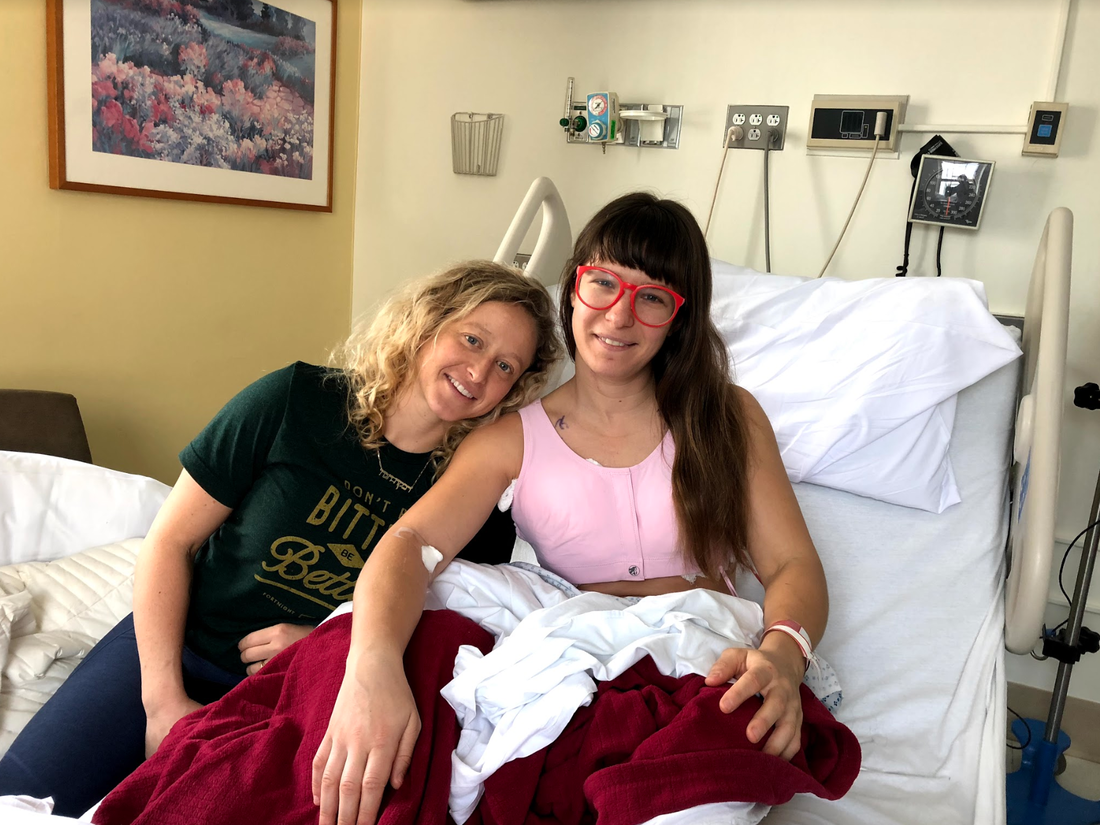
Becca Schepps visits Bowman in the hospital.
Courtesy of BrittLee Bowman
hide caption
toggle caption
Courtesy of BrittLee Bowman
Thirty-four and single, she wanted the option to have kids. Some treatments impact fertility. Then there were a host of other concerns, including how it could impact her athletic career, and also, how she looked at her body.
“I’ve always been a very comfortable person with my body… And I know that a lot of women struggle with their bodies and don’t love them,” she says. “And so I had this fear that the surgery would change that about me. It wasn’t totally the fear of it changing my body, it’s like more about like the fear of it changing how I felt about my body.”
She continued to research and read. But sometimes journals feel impersonal.
So she looked up #doublemastectomy on Instagram. “And they’re posting everything. They’re showing: This is what it looks like right after surgery. This is what it looks like when you have a bad reconstruction that you’re sad about and that makes you want to get surgery again. This is what it looks like when you’re happy that your surgery went well. This is what it looks like when you have radiation. And so just finding that on Instagram was actually really helpful for me to see other women my general age going through this experience.”
View this post on InstagramA post shared by BrittLee Bowman (@bbrittlee) on Dec 14, 2018 at 3:32pm PST
She soon had her surgery date. But still hadn’t decided which surgery to get.
“It was the thing I thought about every moment.”
All that was going through her head when she entered that cyclocross race in Queens.
***
That day, Bowman powered through the course, battling for second place with rider Rachel Rubino. The two are competitors and also friends.
“Hey, I’ve been thinking about you so much all week, Rubino told her as they raced. “I love you so much.”

Rachel Rubino finished in second place and Bowman took third in the Rainey Park race.
Eric Lee Bowman
hide caption
toggle caption
By the last lap, Rubino was in second and Bowman had third place wrapped up. They’d get to stand on the podium together. It meant a lot for Bowman. But it meant a lot for Rubino, too.
“A lot of people in my family have had cancer,” Rubino says. “My mom passed away of breast cancer when I was 22. So for me it hits this really deep place. You know? It’s like being a woman and being an athlete. This can happen to any of us.”
***
Days after the race, Bowman made her decision. She’d have surgery to remove both her breasts. On the day of the appointment she went to the hospital with family and a friend.
“It was just a long wait a long wait in there …” says Sarah Bowman.
Finally, it was time.
“So they they placed the I.V. in my arm while I was in the holding area with my family,” says Bowman. “And they walked me down a hallway. And there was an elevator. And I was with the nurse. And I had to say bye to my family. So I go into this elevator. The doors close. And I was like in the elevator with the nurse and I was just crying. … It’s just scary. You know you don’t want to have to do that, but you’re trying to fix the problem.”
She walked into the operating room in her gown, past a table of surgical tools. She climbed onto the table. And she stared into silver lamp lights.
***
Three weeks after her surgery, she was still healing and feeling hopeful about racing again.
“I got on my bike on a 28-degree day here in New York City. And I rode laps in Central Park,” she says.
Athletes are like that: Tough. But Bowman is quick point out that she only had stage one. She’s young. There’s a lot of women dealing with far worse. That said, there’s still radiation ahead, healing from reconstructive surgery, and five to 10 years of tamoxifen to ward off a recurrence.
“I’m like did I survive yet? I don’t know. Do I still have cancer? I’m a little unclear on that right now. Maybe I do still have cancer? Or maybe maybe it was all cut out of me? I’m not quite sure,” she says.
You can see the wear on Bowman’s face, but also the resolve. She’ll wake up. Roll out of bed. Do her treatment. Get on with her life.
Jaslynn Gallegos On Being A Woman In Wrestling

NPR’s Scott Simon talks with high school wrestler Jaslynn Gallegos of Brighton, Colo. A male wrestler refused to face off against her at a state championship.
SCOTT SIMON, HOST:
A high school wrestler named Brendan Johnston refused to compete against two opponents and forfeited those matches at the Colorado State Wrestling Championship last month. Those two opponents, Angel Rios and Jaslynn Gallegos, are women. Brendan Johnston told reporters he wasn’t comfortable wrestling with women. Jaslynn Gallegos went on to win in fifth place in that tournament. She is a senior at Skyview High School and joins us now from Brighton, Colo. Ms. Gallegos, thanks so much for being with us.
JASLYNN GALLEGOS: Yeah. No problem.
SIMON: First, congratulations.
JASLYNN: Thank you.
SIMON: How did you feel when Brendan Johnston declined to compete against you?
JASLYNN: Well, one of my things is I just want to be a wrestler, not necessarily defined as a girl wrestler. So it kind of hurt me a little bit because, you know, I just want to be this wrestler. And my gender is holding me back.
SIMON: Brendan Johnston told reporters, quote, “I don’t want to treat a young lady like that on the mat or off the mat and not to disrespect the heart or the effort that she’s put in. That’s not what I want to do.” Do you accept that?
JASLYNN: Yeah, I mean, everybody has their own beliefs. But at the same time, it’s not just black and white. Like, you can’t really change what somebody believes. Like, for me, I believe that I’m just a wrestler. And he believes that you’re not just a wrestler. You know, you’re a female wrestler.
SIMON: Now, let me ask. You know what’s going on in this country and around the world. Can you see in this day and age why a young man just may not want to put himself in the position of applying force on a woman or pressing against her even if it’s in a public athletic competition?
JASLYNN: You know, I feel like that whole situation is something that the wrestling community has gone past, especially, like, since I’ve wrestled hundreds of guys. Like, that’s not an issue here, you know? It’s kind of unheard of in the wrestling community for a girl to say something happened during a match.
It’s wrestling, and I think we all understand that it’s a very physical sport. You’re literally fighting someone to put them to their back. It’s – you’re not thinking about anything else at the time because you’re trying to win a match. For me, when I wrestle, it’s literally all muscle memory because I practice my shots and my stand-ups and my sit-outs and my pinning combination so often I don’t even have to think when I wrestle.
SIMON: Anything you’d like to say to boys who might be reluctant to wrestle you?
JASLYNN: You know, just wrestle me. You know, you might get pinned. You might win by one or two points. You might even pin me. But I’m definitely worth giving a match to, you know?
SIMON: And I gather your brothers are wrestlers, too, right?
JASLYNN: Yes. My older brother, he wrestled his whole life, as well – qualified for state. And then my two little brothers, they are currently wrestling.
SIMON: Bet you can beat them.
JASLYNN: Oh, yeah, definitely – both of…
SIMON: (Laughter).
JASLYNN: …Them at the same time.
SIMON: (Laughter) I gather you started wrestling when you were 5.
JASLYNN: Yes. I did.
SIMON: Well, so you’ve been at it a while. Anything you would like to tell young women who want to wrestle?
JASLYNN: You know, just like anything, there’s going to be points where it gets really hard, and you don’t know if you can do it. But, you know, if you push yourself and just keep going, especially if you love it, it’s worth it in the end to just keep on doing it.
SIMON: Jaslynn Gallegos, a wrestler at Skyview High School in Thornton, Colo., thanks so much for being with us.
JASLYNN: Yeah. No problem.
(SOUNDBITE OF VETIVER SONG, “BACKWARDS SLOWLY”)
Copyright © 2019 NPR. All rights reserved. Visit our website terms of use and permissions pages at www.npr.org for further information.
NPR transcripts are created on a rush deadline by Verb8tm, Inc., an NPR contractor, and produced using a proprietary transcription process developed with NPR. This text may not be in its final form and may be updated or revised in the future. Accuracy and availability may vary. The authoritative record of NPR’s programming is the audio record.
Unvaccinated Boy, 6, Spent 57 Days In The Hospital With Tetanus

A nurse holds a tetanus, diphtheria and whooping cough vaccine in 2016. Physician Judith Guzman-Cottrill tells NPR that she has met many families who hesitate to give their children vaccines.
Lucy Nicholson/Reuters
hide caption
toggle caption
Lucy Nicholson/Reuters
A new report published by the Centers for Disease Control and Prevention details the harrowing story of a child in Oregon who contracted tetanus because he wasn’t vaccinated.
The boy was playing outside on a farm in 2017 when he cut his forehead. Six days later, he started having symptoms: a clenched jaw, muscle spasms and involuntary arching of his neck and back. When he started struggling to breathe, his parents realized he needed help and called for emergency medical services.
Doctors diagnosed the 6-year-old boy with tetanus and administered a dose of the vaccine, but it took 57 days in a hospital, including 47 days in intensive care, to restore his health.
“It was difficult to take care of him, to watch him suffer,” says Judith Guzman-Cottrill, a pediatric infectious-disease physician who co-authored the article in the CDC’s online journal Morbidity and Mortality Weekly Report.
At first, he asked for water but couldn’t open his mouth. The boy had to spend weeks in a dark room on a respirator. He was able to walk 20 feet, with help, after 50 days.
At a time when preventable outbreaks are making headlines in the United States, Guzman-Cottrill tells NPR that she has met many families who hesitate to give their children vaccines.
“These days, there are so many different places parents can go to for vaccine-related education and advice that many families struggle with knowing who to believe.”
The Internet and social media have made it harder for people to distinguish fact from fiction, she says.
The boy’s infection marked the first pediatric case of tetanus in the state of Oregon in more than 30 years, according to the researchers.
After allowing the first dose of vaccine, the parents refused a second dose for their son, despite doctors giving them information about the advantages of being immunized against tetanus. “I did provide education about the benefits of all pediatric vaccinations and that was also refused,” Guzman-Cottrill says.
The report of his illness comes after outbreaks of measles occurred this winter in the Pacific Northwest. Measles is also preventable with a vaccination.
The rise in measles cases, spurred by the anti-vaccination movement, is pushing authorities to address the issue.
On Tuesday, 18-year-old Ethan Lindenberger told lawmakers that his mother prevented him from getting immunizations because her Facebook feed turned her into an anti-vaxxer.
Facebook itself announced Thursday that it is using vaccine hoaxes identified by the World Health Organization, the CDC and other global organizations to address inaccurate information plaguing the site.
“As a parent myself, I understand that parents are trying to make the best decision for their child,” Guzman-Cottrill says.
“This illness could have been prevented with five doses of the tetanus vaccine, for $150,” she adds. Instead, the ordeal cost $811,929.
In One Pennsylvania County, Economic Woes Impact Political Leanings
Labor uncertainty in Erie County, Pa. — a county that narrowly flipped for Donald Trump in 2016 — may now be impacting how voters in the region feel about the president.
AUDIE CORNISH, HOST:
One of the keys to President Trump’s success in the 2016 election was his campaign promise to bring back American manufacturing jobs. This week, some 1,700 union members at a manufacturing plant in northwest Pennsylvania were on picket lines in a labor dispute with their employer. NPR’s Don Gonyea was there. He spoke with them about the president, the economy and the 2020 presidential race.
UNIDENTIFIED PROTESTER: (Over loudspeaker) What do we want?
UNIDENTIFIED PROTESTERS: Fair contract.
UNIDENTIFIED PROTESTER: (Over loudspeaker) When do we want it?
UNIDENTIFIED PROTESTERS: Now.
DON GONYEA, BYLINE: This demonstration took place this week outside of Pittsburgh at the headquarters of Wabtec Cooperation. Many of the picketers with the Union of Electrical Workers came by bus two hours from Erie, Pa., where they had been on strike for more than a week. The issue – a concessionary contract that would include lower wages for new hires.
UNIDENTIFIED PROTESTERS: (Unintelligible) is a union town. Stand up, stand down. Erie is a union town. Stand up, stand down.
GONYEA: The strike has since ended as negotiations continue, but it’s where I talk with union member Sharon Ruperto.
Can I ask who you voted for for president?
SHARON RUPERTO: Trump.
GONYEA: You voted for Trump.
RUPERTO: Yes.
GONYEA: Are you still on board with Trump?
RUPERTO: Yes, I am.
GONYEA: Trump narrowly won Erie County, Pa., a place that had gone twice by wide margins for Barack Obama. Trump’s win there and statewide in Pennsylvania was helped by votes from white working-class voters, many of them union members. Ruperto drives a forklift at the plant and says she’s an Obama voter who switched to Trump. She thinks Democrats have moved too far to the left, and she doesn’t know why union leaders are so quick to vilify Trump.
RUPERTO: Trump hasn’t said anything about a union. I have not heard him try to break unions. They keep saying he’s against unions, but I’ve never seen him go after a union.
GONYEA: The unemployment rate in Erie County has improved by two points since Trump took office. It’s now 4.7 percent. But while the president pledged to bring back manufacturing, the share of the local workforce represented by manufacturing jobs continues to decline. That and the strike add to the anxiety of workers like 55-year-old Ron Dombkowski.
RON DOMBKOWSKI: I can show you pictures of me at the Trump rallies because I was a Trump supporter, a big Donald Trump supporter because I wanted to keep jobs in America.
GONYEA: Today, he sees pressure to cut wages at his own plant. He sees the big GM Lordstown assembly plant nearby in Ohio closing. He sees his son, even with a college degree, struggling to make a decent wage. I asked him about Trump.
You’re kind of soft-spoken when you’re talking about him, and is it disappointment with him?
DOMBKOWSKI: Well, I’m also a veteran, so I like what he wants to do, you know, for people in the armed forces and for veterans. So, I mean, yeah, there’s still things I like about Donald Trump, but I think he’s letting the American worker down.
GONYEA: Donald Trump no longer has his vote. Sixty-year-old union member Dale Meyer was also at the protest.
DALE MEYER: Yeah. I mean, there are some of us that do agree with Trump, and there’s a lot of people that don’t agree with Trump.
GONYEA: OK. So you voted for Trump.
MEYER: I did. I did.
GONYEA: Are you still with him?
MEYER: I’m not against him, but I would be with him…
GONYEA: But he is far from gung-ho and says he’s not sure how he’ll vote in 2020. Scott Slawson is president of the Union of Electrical Workers in Erie. It’s a union that endorsed Bernie Sanders in 2016. Slawson says Democrats better have learned this lesson – never to take votes for granted.
SCOTT SLAWSON: Back in 2016, Donald Trump took this county. And I think one of the fatal mistakes that was made was the Democrats just simply overlooked this county.
GONYEA: As for union members who voted Trump, Slawson says they’ve always made up their own minds. Slawson says there are signs of renewed union activism nationally. He points to all the teachers’ strikes we’re seeing. That, he says, is an opportunity, but you still have to do the work to convert it into votes in Erie, Pa., or anywhere. Don Gonyea, NPR News.
Copyright © 2019 NPR. All rights reserved. Visit our website terms of use and permissions pages at www.npr.org for further information.
NPR transcripts are created on a rush deadline by Verb8tm, Inc., an NPR contractor, and produced using a proprietary transcription process developed with NPR. This text may not be in its final form and may be updated or revised in the future. Accuracy and availability may vary. The authoritative record of NPR’s programming is the audio record.
More Female Athletes Freeze Out Figure Skating In Favor Of Ice Hockey
More girls are taking to the ice — not as figure skaters — but as hockey players. NPR’s Ari Shapiro talks with The Wall Street Journal’s Anne Marie Chaker about her report on girls in ice hockey.
ARI SHAPIRO, HOST:
More girls are taking the ice – not as figure skaters, but as hockey players.
JULIETTE CHAKER BRAVIN: It’s fun to skate and to get the puck.
CLEMENTINE PARKER: I like going fast and…
JULIETTE: So do I.
CLEMENTINE: …Chasing the puck.
JULIETTE: So do I.
SHAPIRO: That’s Juliette Chaker Bravin and her teammate Clementine Parker. They are both 8, and you won’t catch either of them on the ice in sparkly leotards.
CLEMENTINE: I don’t want to do figure skating because there’s music involved, and it’s hard to do with music.
JULIETTE: Yeah. You get all distracted.
CLEMENTINE: You don’t wear pads. And if you fall, it will hurt.
JULIETTE: Would you rather play a game or twirl and dance? I would rather play a game.
SHAPIRO: Well, Anne Marie Chaker is hockey coach to Clementine, coach and mom to Juliette, and she’s a reporter for The Wall Street Journal who wrote a piece this week titled, “For Many Girls, Figure Skating Loses Its Edge To Hockey.” Anne Marie, thanks for coming in.
ANNE MARIE CHAKER: Thank you so much.
SHAPIRO: So we should say you are not a neutral party here. You are a former competitive figure skater-turned-hockey coach. So you have a bit of an angle on this.
CHAKER: Yeah. So I grew up just a total rink rat. In the ’80s and ’90s, figure skating was super cool, and I just – I loved the 6 a.m. practices, I loved the music, all of it. And it was very – the lines were very clearly drawn. It was, like, the girls were over at this sheet of ice doing the figure skating, and the boys were over here stinking up the place doing the hockey.
SHAPIRO: (Laughter). And today?
CHAKER: Today, there’s a lot of girls playing hockey. The figure skating ice, there’s maybe two or three girls on the ice, but not much more than that.
SHAPIRO: You dug into the numbers for your Wall Street Journal story. How fast is this growing?
CHAKER: It kind of started to take off 1998, when the women debuted at the Olympics. And then in the early 2000s, the numbers started to really soar. When I looked at the USA hockey data, I was really surprised to see, like, in the last 10 years, the growth has really skyrocketed, like, 50 percent.
SHAPIRO: I think a lot of people think of it as a very violent sport where people get injured. And, like, to take a puck to the face, that doesn’t deter these girls at all.
CHAKER: It doesn’t. And, you know, watching them and coaching them has been so interesting because at the beginning of the season, it’s the boys that dominate everything. There’s, like, 60 to 80 boys on the ice. And the girls, there’s maybe six to 10 of them. They kind of seek each other out.
SHAPIRO: So these are co-ed teams.
CHAKER: They’re co-ed teams. And then something happens. We have this all-girls tournament in February, and it’s the first time that they see other teams of all girls. And it’s, like, the power of seeing other female hockey players just like them, they feel like this belongs to them.
SHAPIRO: How much of this is connected to the success of female role models in ice hockey and the kind of absence of super high-profile figure skaters who are dominating the conversation?
CHAKER: I think it’s huge. You know, when the women’s Olympic ice hockey team won…
(SOUNDBITE OF ARCHIVED RECORDING)
UNIDENTIFIED SPORTSCASTER: She has stopped. United States wins gold.
CHAKER: …I mean, Kendall Coyne competed for the first time at the All-Stars in the fastest skater event.
(SOUNDBITE OF ARCHIVED RECORDING)
UNIDENTIFIED SPORTSCASTER: An outstanding job by Kendall Coyne. Watch the feet move there. The angles are…
CHAKER: Those are eye-opening moments that answer the question, I think, for a lot of girls, like, can we do this? Yes. We can totally do this, and this is what it looks like.
SHAPIRO: This is such a recent trend. Has there been a moment on the ice that has just shocked you, seeing little girls do something that you had not seen them do before?
CHAKER: My girls, I was trying to explain to them the idea of aggression. You know, little girls are taught to be polite, to be good. And I was trying to get them to understand that that all flies out the window in hockey. Do we know what aggressive means? And I was trying to – and when we came back from that tournament, my daughter, who had kind of been afraid of the puck, just turned into this beast. And I was so proud of her.
SHAPIRO: (Laughter).
CHAKER: She had scored her first goal, and there was just, like, a little cocky swagger. Like, it was hers now. It was…
SHAPIRO: Permission to really go for it.
CHAKER: Yeah. Yeah, yeah.
SHAPIRO: Anne Marie Chaker, thank you so much.
CHAKER: Oh, my God. This was so fun. Thank you.
SHAPIRO: She is life and arts writer for The Wall Street Journal and a hockey mom and coach.
Copyright © 2019 NPR. All rights reserved. Visit our website terms of use and permissions pages at www.npr.org for further information.
NPR transcripts are created on a rush deadline by Verb8tm, Inc., an NPR contractor, and produced using a proprietary transcription process developed with NPR. This text may not be in its final form and may be updated or revised in the future. Accuracy and availability may vary. The authoritative record of NPR’s programming is the audio record.
Why Have 21 Horses Died At A California Racetrack Since December?

Santa Anita Park, shown here in 2012, has halted races and training to try to determine what is causing the horse deaths.
Frederic J. Brown /AFP/Getty Images
hide caption
toggle caption
Frederic J. Brown /AFP/Getty Images
Since the start of the racing season in late December, a shocking 21 horses have died at the famed Santa Anita Park racetrack in southern California.
It’s horrified the racing world and experts say there’s no clear answer as to why this is happening.
Santa Anita’s owners, The Stronach Group, announced on Tuesday that it was halting racing and training at the park in order to test the main track – a picturesque spot tucked next to the San Gabriel Mountains where the champion racehorse Seabiscuit won big.
“The safety, health and welfare of the horses and jockeys is our top priority,” Tim Ritvo, chief operating officer of the Stronach Group, said in a statement. “While we are confident further testing will confirm the soundness of the track, the decision to close is the right thing to do at this time.”
That same day, a filly named Lets Light The Way was injured and euthanized while training on the main track, as the equestrian publication Blood Horse reported.
“I loved that filly. I bought her at the sale—liked the way she walked,” trainer Ron McAnally told the publication. “I wanted to cry when we had to put her down.”
Like many, McAnally thinks bad recent weather contributed to the filly’s death. Southern California has been experiencing heavy rain this winter, which has the potential to impact the conditions of the track’s surface.
But experts aren’t sure that’s the problem here. Mick Peterson from the University of Kentucky conducted ground radar testing on the track, and he spoke with NPR’s Here & Now earlier this week about why the track is seeing death rates at twice the rate of the previous year.
“What we see in horse racing always is, the challenge at any track is unusual weather,” he says. But he hasn’t yet found anything unusual about the track conditions. “We’re looking at every option we can to begin to understand what’s happening,” he said. “This is not what we do as a sport.”
Santa Anita Park has expanded its testing now, bringing in its former track superintendent Dennis Moore. According to the track’s owners, he’ll use a machine that can approximate a horse running at a full gallop, to see how it impacts the surface.
“There’s no obvious answer. So every question is being asked: Is it the surface? Is it the horses that are running on the surface?” Rick Baedeker, the executive director of the California Horse Racing Board, told NPR’s All Things Considered. They’re also questioning factors such as the type of training the horses receive, he says.
Baedeker says he’s never seen anything like this. “It’s a nightmare for everybody involved in racing,” he says. The board is also seeking answers by carrying out a necropsy on every horse that died.
Particularly perplexing is the sheer diversity of the horses that have died, as Rick Arthur, chief equine veterinarian from the CHRB, told the Los Angeles Times.
“They are all over the place, from Battle Of Midway, a well-seasoned horse, to a first-time starter,” Arthur said. “They are from 19 different trainers. There is nothing that links them together.”
And, he says that we may never fully know why this is happening. “If you expect a definitive answer, I wouldn’t expect that,” Arthur told the Times. “We can hope that it identifies strategies that can make racing safer. It’s not just the track. It’s not just the horse. It’s the whole schedule. The training program. The racing program. Everything.”
The deaths have drawn outrage from PETA, which has called for a criminal investigation into the matter.
Baedeker says these deaths are coming at a time when the racing business has, over the last few years, taken steps to try to reduce racetrack deaths.
“People involved in racing, whether they’re fans or whether they’re owners or trainers, the common thread is the affection for the race horse — whether you enjoy watching them or taking care of them,” he says. “The current situation does not reflect the whole story.”
The NFL's Historical Focus On Size Of Players May Be Changing
NPR’s Audie Cornish talks with The Athletic’s Lindsay Jones about Kyler Murray and the evolving viewpoint within the NFL on sizing up NFL quarterbacks.
AUDIE CORNISH, HOST:
The NFL draft may not be till next month, but the debate about who will be picked first is heating up. Oklahoma quarterback and reigning Heisman Trophy winner Kyler Murray is currently considered the favorite, despite his undersized body frame. Coming in at a slim 5-foot-10, Murray isn’t your typical NFL quarterback. The league is known for prizing height for the QB. And here he is at the NFL combine talking about his size.
(SOUNDBITE OF ARCHIVED RECORDING)
KYLER MURRAY: I’ve never been the biggest guy on the field. I’m always the smallest guy in the field. You know, I’ve said it multiple times, you know, I feel like I’m the most impactful guy on the field and the best player on the field at all times.
CORNISH: Here to talk more is Lindsay Jones, writer for the website The Athletic. Welcome to the program.
LINDSAY JONES: Thanks for having me.
CORNISH: So what makes Kyler Murray so intriguing to take with the first pick?
JONES: Well, he is such a dynamic, unique athlete. And like you mentioned in his interview at the NFL combine, he is the best athlete on the field at almost every time. And that’s what we saw his final year at Oklahoma when he won the Heisman is that he is just such a dynamic, unique athlete. And a lot of coaches – the innovative coaches especially – look at him and think that he can do things that no other quarterback in the league could possibly do.
CORNISH: What are the concerns about size?
JONES: With smaller quarterbacks, they just have difficulty with their vision and their sight lines and how they can see around the field when all of the other men are so big. So that’s certainly the concern with the height. And if he had come in at 5-foot-9, even 5-foot-9 and 7/8 as opposed to just over 5-foot-10, that would have been a deal breaker for almost every NFL team, I think.
So the fact that he was 5’10”, while, you know, that quarter half an inch might not seem like a big deal to the rest of us, it’s a very big deal in the NFL. The other concern about his size is that when he was in college, he played at under 200 pounds. And it’s very difficult for a quarterback and the pounding that they take – especially when they’re running and on the move – the hits that they’re going to be taking from defensive linemen who are 250, 275, 300 pounds.
So it’s a big question of, how much weight can he hold comfortably while still being that dynamic athlete – and if he can hold up to the type of pounding that he will take once he’s in the NFL.
CORNISH: Do you get the sense that teams have evolved in their thinking in that they’re willing to take on a guy Murray’s size?
JONES: Some have. I don’t think that is something that is league-wide. There are some coaches and general managers who are very stuck in their ways about what they think a quarterback should look like from a height and weight perspective.
But we are starting to see some of these changes. Baker Mayfield, who was the No. 1 pick in last year’s draft, is only 6-foot-1. And we were having these same sort of discussions about Baker Mayfield’s size. He was tremendously successful as a rookie last year.
And then Russell Wilson, the quarterback from the Seattle Seahawks, who is also 5-foot-10 – he has really changed a lot of the ways that we look at quarterbacks and think about how successful a shorter quarterback can be.
CORNISH: One more thing. Kyler Murray also played baseball, right? Can you talk about his decision to choose going pro with the NFL?
JONES: Yes. This has been a lot of drama over the last several months because even his last year at Oklahoma, he said repeatedly that he was committed to playing pro baseball. He was drafted last year by the Oakland A’s with the assumption that he would play his last year at Oklahoma, and then he would go to play baseball. But he had this tremendous final season where he won the Heisman Trophy.
And this momentum started building that not only could he be a viable NFL quarterback, but he could be a high first round pick. He decided that this is where he wanted to go. You can look short term versus long term, the amount of money, you know.
I think he’s looking at it – I would rather play football. My career earnings over the course of 15 years might not be quite as high as a max baseball contract, but this is certainly something that he wants to do and will be financially viable for him.
CORNISH: That’s Lindsay Jones, NFL writer for the website The Athletic. Lindsay, thanks for the update.
JONES: Thanks for having me.
Copyright © 2019 NPR. All rights reserved. Visit our website terms of use and permissions pages at www.npr.org for further information.
NPR transcripts are created on a rush deadline by Verb8tm, Inc., an NPR contractor, and produced using a proprietary transcription process developed with NPR. This text may not be in its final form and may be updated or revised in the future. Accuracy and availability may vary. The authoritative record of NPR’s programming is the audio record.
Some 'Cheaper' Health Plans Have Surprising Costs

One health insurance startup charges patients extra for procedures not covered by their basic health plan. The out-of-pocket cost for a tonsillectomy and adenoidectomy might range from $900 to $3,000 extra, while a lumbar spine fusion could range from $5,000 to $10,000.
Frederic Cirou/PhotoAlto/Getty Images
hide caption
toggle caption
Frederic Cirou/PhotoAlto/Getty Images
One health plan from a well-known insurer promises lower premiums — but warns that consumers may need to file their own claims and negotiate over charges from hospitals and doctors. Another does away with annual deductibles — but requires policyholders to pay extra if they need certain surgeries and procedures.
Both are among the latest efforts in a seemingly endless quest by employers, consumers and insurers for an elusive goal: less expensive coverage.
Premiums for many of these plans, which are sold outside the exchanges set up under Affordable Care Act, tend to be 15 to 30 percent lower than conventional offerings, but they put a larger burden on consumers to be savvy shoppers. The offerings tap into a common underlying frustration.
“Traditional health plans have not been able to stem high cost increases, so people are tearing down the model and trying something different,” said Jeff Levin-Scherz, health management practice leader for benefit consultants Willis Towers Watson.
Not everyone is eligible for a subsidy to defray the cost of an ACA plan, and that has led some people to experiment with new ways to pay their medical expenses. Those experiments include short-term policies or alternatives like Christian-sharing ministries — which are not insurance at all, but rather cooperatives through which members pay one another’s bills.
Now some insurers — such as Blue Cross Blue Shield of North Carolina and a Minnesota startup called Bind Benefits, which is partnering with UnitedHealth Group — are coming up with their own novel offerings.
Insurers say the two new types of plans meet the ACA’s rules, although they interpret those rules in new ways. For example, the new policies avoid the federal law’s rule limiting consumers’ annual in-network limit on out-of-pocket costs. One policy manages that by having no network — patients are free to find providers on their own. And the other skirts the issue by calling additional charges “premiums.” Under ACA rules, premiums don’t count toward the out-of-pocket maximum.
But each plan could leave patients with huge costs in a system in which it is extremely difficult for a patient to be a smart shopper — in part, because they have little negotiating power against big hospital systems and partly because illness is often urgent and unanticipated.
If these alternative plans prompt doctors and hospitals to lower prices, “then that is worth taking a closer look,” says Sabrina Corlette, a research professor at Georgetown University’s Health Policy Institute. “But if it’s simply another flavor of shifting more risk to employees, I don’t think in the long term, that’s going to bend the cost curve.”
Balancing freedom, control and responsibility
The North Carolina Blue Cross Blue Shield “My Choice” policies aim to change the way doctors and hospitals are paid by limiting reimbursement for services to 40 percent above what Medicare would pay. The plan has no specific network of doctors and hospitals.
This approach “puts you in control to see the doctor you want,” the insurer says on its website. The plan is available to individuals who buy their own insurance and to small businesses with one to 50 employees. It’s aimed at consumers who cannot afford ACA plans, says Austin Vevurka, a spokesman for the insurer. The policies are not sold on the ACA’s insurance marketplace, but can be purchased off-exchange from brokers.
With that freedom, however, consumers also have the responsibility to shop around for providers who will accept that amount of reimbursement for their services. Consumers who don’t shop — or can’t because their medical need is an emergency — may get “balance-billed” by providers who are unsatisfied with the flat amount the plan pays.
“There’s an incentive to comparison-shop to find a provider who accepts the benefit,” says Vevurka.
The cost of balance bills range widely but could be thousands of dollars in the case of hospital care. Consumer exposure to balance bills is not capped by the ACA for out-of-network care.
“There are a lot of people for whom a plan like this would present financial risk,” says Levin-Scherz.
In theory, though, paying 40 percent above Medicare rates could help drive down costs over time if enough providers accept those payments. That’s because hospitals currently get about double Medicare rates through their negotiations with insurers.
“It’s a bold move,” says Mark Hall, director of the health law and policy program at Wake Forest University in North Carolina. Still, he says, it’s “not an optimal way” because patients generally don’t want to negotiate with their doctor on prices.
“But it’s an innovative way to put matters into the hands of patients as consumers,” Hall says. “Let them deal directly with providers who insist on charging more than 140 percent of Medicare.”
Blue Cross spokesman Vevurka says My Choice has telephone advisers to help patients find providers and offer tips on how to negotiate a balance bill. He would not disclose enrollment numbers for My Choice, which launched Jan. 1, nor would he say how many providers have indicated they will accept the plan’s payment levels.
Still, the idea — based on what is sometimes called “reference pricing” or “Medicare plus” — is gaining attention. Under that method, hospitals are paid a rate based on what Medicare pays, plus an additional percentage to allow them a modest profit.
North Carolina’s state treasurer, for example, hopes to put state workers into such a pricing plan by next year, offering to pay 177 percent of Medicare. The plan has ignited a firestorm of opposition from hospitals in the state.
Montana recently got its hospitals to agree to such a plan for state workers, paying 234 percent of Medicare, on average.
Partly because of concerns about balance-billing, employers aren’t rushing to buy into Medicare-plus pricing just yet, says Jeff Long, a health care actuary at Lockton Companies, a benefit consultancy.
Wider adoption, however, could spell its end.
Hospitals might agree to participate in a few such programs, but “if there’s more takeup on this, I see hospitals possibly starting to fight back,” Long says.
What about the bind?
Minnesota startup Bind Benefits eliminates annual deductibles in its “on-demand” plans sold to employers that are opting to self-insure their workers’ health costs. Rather than deductibles, patients pay flat-dollar copayments for a core set of medical services, from doctor visits to prescription drugs.
In some ways, it’s simpler: There is no need to spend through the deductible before coverage kicks in or wonder what 20 percent of the cost of a doctor visit or surgery would be.
But not all services are included.
Patients who discover during the year that they need any of about 30 common procedures outlined in the plan, including several types of back surgery, knee arthroscopy or coronary artery bypass, must “add in” coverage, spread out over time in deductions from their paychecks.
“People are used to that concept, to buy what they need,” said Bind CEO Tony Miller. “When I need more, I buy more.”
According to a company spokeswoman, the add-in costs vary by market, procedure and provider. On the lower end, the cost for tonsillectomy and adenoidectomy ranges from $900 to $3,000, while lumbar spine fusion could range from $5,000 to $10,000.
To set those additional premiums, Bind analyzes how much doctors and facilities are paid, along with some quality measures from several sources, including UnitedHealth. The add-in premiums paid by patients vary depending on whether they choose lower-cost providers or more expensive ones.
The ACA’s 2019 out-of-pocket maximums — $7,900 for an individual or $15,800 for a family — don’t include premium costs.
The Cumberland School District in Wisconsin switched from a traditional plan, which it purchased from an insurer for about $1.7 million last year, to Bind. Six months in, according to the school district’s superintendent, Barry Rose, the plan is working well.
Right off the bat, he says, the district saved about $200,000. More savings could come over the year if workers choose lower-cost alternatives for the “add-in” services.
“They can become better consumers because they can see exactly what they’re paying for care,” Rose says.
Levin-Scherz at Willis Towers says the idea behind Bind is intriguing but raises some concerns for employers.
What happens, he asks, if a worker has an add-in surgery, owes several thousand dollars, then changes jobs before paying all the premiums for that add-in coverage? “Will the employee be sent a bill after leaving?” he wonders.
A Bind spokeswoman says the former employee would not pay the remaining premiums in that case. Instead, the employer would be stuck with the bill.
Kaiser Health News is a nonprofit news service and editorially independent program of the Kaiser Family Foundation. KHN is not affiliated with Kaiser Permanente.
FDA Says It Found Asbestos In Makeup At Claire's

Claire’s stores, such as this one in New York, are a common sight in U.S. malls. The company says its “products are safe” and disputes the FDA’s findings, saying they “show significant errors.”
Seth Wenig/AP
hide caption
toggle caption
Seth Wenig/AP
U.S. regulators say several makeup products from Claire’s stores tested positive for asbestos, a mineral that has been linked to deadly cancers.
The Food and Drug Administration tested makeup from Claire’s and the retailer Justice, both of which market their products to young girls and teens. In a statement Tuesday, the agency reported that it found that three product samples from Claire’s and one from Justice contained the substance, and it released a safety alert about the products.
Claire’s says that “out of an abundance of caution,” it has removed the three products — eye shadows, compact powder and contour powder — from stores and is “also removing any remaining talc based cosmetic products.” Talc is a substance that sometimes contains asbestos and has been linked to lung cancer in miners.
But Claire’s says its “products are safe” and disputes the test results, saying they “show significant errors.” The retailer says the tests “have mischaracterized fibers in the products as asbestos.”
Claire’s, which sells jewelry and accessories and pierces ears, is a common sight at shopping malls, with more than 2,400 locations in North America and Europe as of last August.
The FDA said the Justice product, a shimmer powder, had already been recalled from the market in 2017.
Other independent testers dispute Claire’s claim that these products are safe. The U.S. PIRG Education Fund, a consumer advocacy group, released results last March that said its testing showed that the same three Claire’s products contained asbestos.
Asbestos is believed to cause mesothelioma, a type of cancer affecting the lining of the chest and abdomen, and is linked to an increased risk of other forms of cancer and lung disease.
In its statement, the FDA called for more expansive authority to regulate cosmetics, saying the law about its role has not been updated since it first entered into force in 1938.
“The current law does not require cosmetics to be reviewed and approved by the FDA prior to being sold to American consumers,” it said, adding that total responsibility for the safety of these products now rests with the companies that make them.
“To be clear, there are currently no legal requirements for any cosmetic manufacturer marketing products to American consumers to test their products for safety,” the FDA said. For example, the agency says that in this case, it did not have the authority to force Claire’s to pull the potentially dangerous products off store shelves.
It says it wants to work with Congress to “modernize” the way cosmetics are regulated in the United States.
This isn’t the first time testers say they have found traces of asbestos in Claire’s products. The Dutch government said last year that it found asbestos in two products, following the release of the U.S. PIRG report. In response, Claire’s insisted that the products are safe and questioned the testing methodology.
Another company has also come under recent scrutiny over the risk of asbestos contamination. “Johnson & Johnson had known for decades about the risk of asbestos contamination in its popular baby powder and other talc-based body powders, but tried to keep negative information from reaching the public,” the New York Times reports. “The company received subpoenas for more information last month from the Securities and Exchange Commission and the Justice Department.”
Sports Stadium Shrinkage Is A Trend. Who's To Blame For Attendance Drop?
Some baseball teams, the Tampa Bay Rays for example, have torn out seats because of a drop in attendance. Teams have explanations for stadium shrinkage, but commentator Mike Pesca has his own ideas.
STEVE INSKEEP, HOST:
Attending a major league baseball game is expensive. Bringing the whole family can be almost impossible for some, so many people don’t. Although some teams, like the Yankees, still attract big crowds, the Tampa Bay Rays are acknowledging a new reality. Having priced many fans out of the park, they’ve torn out many of the seats. Commentator Mike Pesca sees a trend.
(SOUNDBITE OF SONG, “TAKE ME OUT TO THE BALLGAME”)
MIKE PESCA, BYLINE: “Take Me Out To The Ballgame” was written 101 years ago, and most of the sentiment still stands. You can still buy peanuts and Cracker Jack. It’s still one, two, three strikes, you’re out. The only update might be the line, take me out with the crowd. Sixty-seven million fans attended a regular season baseball game last year, but those numbers were down from the year before. And some of that is, actually, by design, as in the design of ballparks. The seating capacity of stadia across American sports – not just baseball – is shrinking. The Tampa Bay Rays will be playing for about 26,000 fans maximum. That’s 5,000 fewer seats than they have now. The Las Vegas Raiders will soon debut in a stadium that will be among the three most compact in the game. All 16 major league teams that have moved in the past 20 years are playing in tighter confines than they once did.
The reason for this shrinkage, the leagues will tell you, is that televised sport has beaten the live experience. As the TVs got better, the traffic got worse, I guess. And the couch beckoned. I just got back from Disney World. Disney movies are clearly cheaper and easier to get to than the live experience. And yet millions more people flock to the Magic Kingdom than did 10 years ago. There is an “Avatar” ride that had a wait time of – let me check the app. It’s on an app now – three hours, five minutes. But with baseball and football, there is so little attention paid to the experience in the park. How about good Wi-Fi or some milling-about zones and food that challenges our collective delusion that Dodger Dogs aren’t inferior, cylindrical foodstuffs? We have been gaslit about Fenway Franks.
Then there’s the gouging. The New York Jets will charge you 40 to $50 for parking. And when you enter the stadium, you have to watch the New York Jets. Owners can continue to shrink their stadiums and their ambitions or they can start rewarding fans who literally give their teams the home field advantage as something other than chickens to be plucked or geese to be fattened before slaughter. Don’t the fans have enough experience with slaughter, especially when we’re talking about fans of the Jets, Rays and Raiders?
(SOUNDBITE OF BILLY JOEL’S “TAKE ME OUT TO THE BALLGAME”)
INSKEEP: (Singing) Take me out…
No, I’m not going to do that. Commentator Mike Pesca hosts the Slate podcast The Gist, which is still very affordable and welcomes new fans. He also wrote the book “Upon Further Review.”
Copyright © 2019 NPR. All rights reserved. Visit our website terms of use and permissions pages at www.npr.org for further information.
NPR transcripts are created on a rush deadline by Verb8tm, Inc., an NPR contractor, and produced using a proprietary transcription process developed with NPR. This text may not be in its final form and may be updated or revised in the future. Accuracy and availability may vary. The authoritative record of NPR’s programming is the audio record.
