
New CBS News President Aims To Make Mark On Network With Staff Shake-Up

Susan Zirinsky, president of CBS News, hosts the CBS News and Politico 2019 White House Correspondents’ Dinner Pre-Party at the Washington Hilton in April.
Shannon Finney/Getty Images
hide caption
toggle caption
Shannon Finney/Getty Images
CBS News is expected to announce a major shake-up in the lineup of its flagship shows on Monday morning.
In what would represent the most significant changes under new CBS News President Susan Zirinsky, the network would be dropping chief evening anchor Jeff Glor in favor of one of Zirinsky’s morning stars, Norah O’Donnell, and rebuilding the morning show around CBS’s Gayle King.
CBS News would not comment on the changes, which have been the subject of media speculation and coverage in recent days, but a person knowledgeable with the plans confirmed them to NPR.
The moves stem from shrinking ratings for both CBS This Morning and the CBS Evening News, alongside reverberations of sexual harassment revelations that have rocked the news division.
Under the revamp, King will remain co-host of CBS This Morning, where Zirinsky plans for her to be joined by Anthony Mason, currently a correspondent and host of CBS’s Saturday morning news show, and correspondent Tony Dokoupil.

Gayle King and Norah O’Donnell attend The Hollywood Reporter‘s Most Powerful People In Media last April.
Sylvain Gaboury/Patrick McMullan via Getty Image
hide caption
toggle caption
Sylvain Gaboury/Patrick McMullan via Getty Image
Meanwhile, O’Donnell, the network’s former top White House correspondent, is slated to leave King’s side as co-host of CBS This Morning, to replace Glor on the CBS Evening News. Glor has been at the job for less than a year and a half.
John Dickerson, a highly regarded political reporter who was previously host of CBS’s Face The Nation, is expected to switch from co-hosting CBS This Morning to become a correspondent on the prestigious Sunday night news magazine 60 Minutes, which generates huge revenues for CBS with its high ratings.
CBS, the network of Eric Sevareid, Edward R. Murrow, and Walter Cronkite, has a proud tradition in the news business. CBS This Morning and the CBS Evening News enjoyed something of a comeback with a renewed focus on hard news under Zirinsky’s predecessors. Yet both started to sag and remain perennially third-rated shows behind major broadcasters ABC and NBC.
Back in 2012, Charlie Rose’s appointment to co-host of CBS This Morning breathed new life into the program, and the unlikely combination with King and O’Donnell yielded a lively chemistry.
But Rose’s career collapsed under scrutiny in fall 2017 as numerous women came forward in articles in The Washington Post and The New Yorker, among other outlets, to make accusations of sexual harassment. Scandals also knocked out former 60 Minutes executive producer and CBS News chairman Jeff Fager and CBS CEO and Chairman Les Moonves.
In the aftermath of those scandals, CBS in January named Zirinsky as head of the news division, replacing David Rhodes. Zirinsky, the first woman to head CBS News, came to the position after serving as senior executive producer of the true-crime-driven news magazine 48 Hours.
Before that, she held significant roles at almost every element throughout the news division. She was a producer of CBS Evening News and has led the network’s coverage of the White House.
Known as a tough leader who inspires loyalty, Zirinsky also inspired the lead character of the 1987 movie Broadcast News, played by Holly Hunter.
As CNN reported in January, staffers were largely excited about Zirinsky’s step into the leadership role. King celebrated Zirinsky on This Morning as the right person to take over the post. “I feel that she is somebody who can right the ship,” King said. “Because she gets us. She knows us. And by us I mean this organization.”
NPR’s Emma Bowman contributed to this report.
Olympic Runner Who Once Competed Against Caster Semenya Weighs In On Testosterone Ruling

NPR’s Lulu Garcia-Navarro talks to Madeleine Pape, who once competed against Caster Semenya, about the issue of female runners with unusually high levels of testosterone.
LULU GARCIA-NAVARRO, HOST:
Caster Semenya won what may be her last 800-meter race this past Friday in Doha. Her dominance in the event may be at an end because of new regulations that come into effect Wednesday. The new rules ban women like Semenya, with naturally occurring high levels of testosterone, from running certain events in the women’s competition unless they take medicine to reduce those levels. When asked whether she would submit to the new regulations, Semenya replied, hell no.
Madeleine Pape was an Olympic runner for Australia who once competed against Semenya. She’s now a Ph.D. candidate in sociology at the University of Wisconsin-Madison. And she told us about when she competed against Semenya in 2009 at the IAAF World Championships in Berlin.
MADELEINE PAPE: I lost to Semenya, amongst other people in the heats. And I was, after that, very quick to join the chorus of voices around me that were beginning to accuse Semenya of having an unfair advantage. And that really reached fever points on the evening of the final, when the IAAF, who’s our governing body in track and field, announced publicly that they were going to be conducting investigations into Semenya’s biological sex. So that really set the tone for how people then proceeded to talk about her.
And for me, you know, I guess I wasn’t really encountering any alternative points of view. That was the single point of view that was being voiced around me at the time. So I certainly fell in the camp of jumping on the bandwagon and repeating the things that were being said around me.
GARCIA-NAVARRO: And how did you come to change your mind?
PAPE: Yeah, that was a – it was quite a long journey, actually. About a year after those World Championships, I sustained a career-ending injury, and I decided to move to the United States to start a Ph.D. in sociology.
And I happened to chance upon this topic and the very vast literature that’s been written about it from the point of view of women’s sports advocates who have examined at length the very many scientific and ethical dilemmas that surround the exclusion of women who have high testosterone.
Initially, I was very confronted by this discovery. And it really was over time that my own view shifted. And I would say that something that was really critical in that process was meeting women who had high testosterone, becoming friends with women with high testosterone and thinking about how they were personally impacted by these kinds of practices in sport.
GARCIA-NAVARRO: This is a story, of course, about regulating women with naturally high testosterone levels. But it’s also important to remember that this is also a story about one particular athlete and one particular woman, Caster Semenya. There is the issue of her sex in this, but there’s also the issue of her race in this. Do you think that plays a factor in your view?
PAPE: To be honest, I think those concerns are fair. I mean, I think there are questions to be answered about why Caster Semenya, in particular, has attracted this level of scrutiny and this level of determination on the part of the IAAF to exclude her from competing because when we compare her margin over her competitors to other successful athletes of this era, they enjoyed greater margins over their competitors. And yet, for some reason, we fixated on Caster Semenya as the athlete whose margin of victory has become problematic for us.
So I think it’s a complicated issue, but I think it is very fair to be asking why women of color from the global south and from sub-Saharan Africa, in particular, are overrepresented amongst the women who’ve been accused of having an unfair advantage.
GARCIA-NAVARRO: And there is, of course, the issue of her sexuality. Semenya is a lesbian.
PAPE: You know, when we think about why Semenya, and why have her performances, in particular, raised the ire of a number of people, you have to wonder whether sexuality plays into it. I mean, she’s openly a lesbian. She is – I would describe her as nonconforming in terms of her gender presentation.
And I think the sport of track and field, as much as I love this sport, and, you know, it’s the No. 1 love in my life, I think we have a little way to go still when it comes to accepting both diverse gender identities, and also abandoning our ideas about heterosexuality.
GARCIA-NAVARRO: The words fair and unfair get thrown around a lot in this conversation. What do people actually mean when they call something fair?
PAPE: I think really what underlies a lot of people’s motivations in this, you know, no matter which point of view you adhere to, people really want to see women’s sport get stronger and be valued.
And so what I look to for inspiration, really, on this topic is the leadership that we’ve seen from women’s sports organizations, like the Women’s Sports Foundation here in the U.S., also the International Working Group on Women and Sport, activists like Billie Jean King, who have spoken out in support of Caster Semenya and who see Semenya’s presence as a good thing for women’s sport.
So I follow their lead in saying that, you know, women’s sport will benefit from Semenya being a part of it, and we have room to include her here.
GARCIA-NAVARRO: That was Madeleine Pape. She was an Olympic runner for Australia who once competed against Caster Semenya. Thank you so very much.
PAPE: Thanks so much for having me
(SOUNDBITE OF MUSIC)
Copyright © 2019 NPR. All rights reserved. Visit our website terms of use and permissions pages at www.npr.org for further information.
NPR transcripts are created on a rush deadline by Verb8tm, Inc., an NPR contractor, and produced using a proprietary transcription process developed with NPR. This text may not be in its final form and may be updated or revised in the future. Accuracy and availability may vary. The authoritative record of NPR’s programming is the audio record.
Country House, A 65-1 Long Shot, Wins Kentucky Derby After Historic Disqualification

Flavien Prat rides Country House to victory during the 145th running of the Kentucky Derby.
Matt Slocum/AP
hide caption
toggle caption
Matt Slocum/AP
Updated at 9:05 p.m. ET
In a stunning and historic Kentucky Derby upset, the horse that crossed the finish line first was not the one that was declared the winner.
Maximum Security, the favorite entering the race and the only undefeated horse in the field, outpaced the competition on the muddy track at Churchill Downs and appeared to have won the 145th Kentucky Derby with a time of 2:03.93.
Then an objection was lodged. For several tense minutes in Louisville, some 150,000 people in rain-soaked ponchos and fancy hats waited for a verdict.
About 20 minutes after the race ended, the race’s stewards announced that Maximum Security had been disqualified for impeding the path of at least one other horse in the race. The decision handed the victory to Country House, which started the race at 65-1 odds, and a first-time win to Hall of Fame trainer Bill Mott.
It’s the first time a horse has been disqualified for interference in the history of the race. The result also ended a six-year streak of favorites winning the derby.
Code of Honor finished second (13-1) and Tacitus (5-1), also trained by Mott, took third.
An explanation of Maximum Security’s #KyDerby disqualification. pic.twitter.com/vf8AN4qvD2
— Kentucky Derby (@KentuckyDerby) May 4, 2019
“It’s amazing,” Country House’s jockey Flavien Prat, told NBC Sports after the result was announced. “I really kind of lost my momentum around the turn, so I thought that I was going to win, but it cost me, actually.”
At a press conference after the event, Mott said he was happy with the way his horse and jockey performed.
“As far as the win goes, it’s actually bittersweet,” he said. “I’d be lying if I said it was any different.”
He acknowledged that the stewards had to make a challenging decision but said the disqualification was warranted because of Maximum Security’s impact on other horses.
Maximum Security’s trainer, Jason Servis, and the horse’s jockey, Luis Saez, had already begun to celebrate what they believed were their first Derby victories before the stewards began reviewing the objection.
Mott said he expected that the controversy surrounding the incident would reverberate for a long time. “I wouldn’t be surprised if this race shows up on TV over and over and over a year from now,” he said.
It was also a bittersweet victory for co-owner Maury Shields, whose husband, Joseph “Jerry” Shields, died last year. The prominent thoroughbred owner-breeder had served on several racing boards and was a founding member of the National Thoroughbred Association, according to the horse racing website the Paulick Report.
Only one other horse has been disqualified after finishing first in the race. Dancer’s Image, who ran in the 1968 Derby, was disqualified years later for a failed drug test.
Maximum Security was the race favorite heading into the Run for the Roses, with odds at 4-1 by the evening.
A light drizzle, which followed hours of overcast but dry skies, turned into heavier rain just in time for the race and drenched the main track. Shortly before the race began, the track was downgraded from fast to sloppy.
Last year, several inches of rain also made for a sloppy track. Justify, the favorite, took home that victory.
How High Medical Bills Can Take A Toll On Both Patients And The Nurses Who Care For Them
NPR’s Scott Simon speaks with Hilary Valdez, a nurse who wrote in after our last Bill of the Month story. She tells us about how high medical bills can affect nurses’ relationships with patients.
SCOTT SIMON, HOST:
NPR’s recently run stories about high medical bills and people who struggle to pay them in our Bill of the Month series in collaboration with Kaiser Health News. After our most recent story, we heard from a nurse who says high bills affect her relationship with patients, and perhaps their care.
Hilary Valdez is a cardiac nurse at a hospital in Colorado Springs, Colo. She joins us now. Ms. Valdez, thanks so much for being with us.
HILARY VALDEZ: Thank you for having me.
SIMON: As you see it, what are the effect of high bills on some of your patients as you deal with them?
VALDEZ: Well, initially, I wrote in because I was frustrated. These stories aren’t sensationalized. And because of these crushing bills, the public has become, I think, less trusting of health care providers. And so I wanted to speak from the perspective of nurses and other clinicians who work directly with the patients because we hear their frustrations the loudest.
I had a patient who had a heart attack. And he called me from the hall. He was sweating and short of breath, and his chest pain had returned. And protocol dictated that I get the 12-lead EKG machine. And as I was placing the leads on his chest, he looked at me almost suspiciously and asked me what that was going to cost.
And that was a teaching moment for me because I think of that machine the same way I think of a blood pressure cuff or a stethoscope. It’s a way for us to assess our patients. And it shocked me that in this situation that could have been life-threatening, he was mostly concerned about his bill.
SIMON: Has it happened that your – I don’t know – you’re about to take care of someone, doing one of the amazing things that nurses do, and a patient looks up and says, wait; I don’t know if I can pay for that?
VALDEZ: It has. And patients have the right to autonomy and transparency. And it’s important that we help them navigate the system so they can be more comfortable making their health care decisions. And nurses – you know, patients need to utilize us. And we advocate so much for them. They need to think of nurses as multitools. We have the doctors’ ears and the social workers, case managers, pharmacists. And patients, I think, need to be aware that we can help get them resources that they might not know exist.
SIMON: From your perspective, what worries you the most about health care in this country?
VALDEZ: Oh, I don’t quite have the answer to that. My concern, though, is that patients become fearful of seeking health care. And not all situations require hospitalization, but when someone puts off a nagging pain for years and years because they think they might lose their home, they end up in a lot worse of a situation than if they had sought help earlier.
SIMON: Yeah. I have been told that you have to struggle with some of these questions in your own personal life, too.
VALDEZ: Yes, I have a chronic illness, actually – epilepsy. And since I was a child, I have dealt with hospitalizations and diagnostic tests and, more recently, even surgery. And the medications that I have to keep me seizure-free so I can work – they’re expensive and have become more so. If I wasn’t in a dual-income household, I don’t think I would be able to make those payments.
SIMON: So you’re a nurse with a chronic condition, and you’re not certain you can afford the medication you need to keep you going.
VALDEZ: No. And I have great health benefits, too. But, in fact, benefits change, sometimes from year to year, and a medication that I would get at a certain price from a certain pharmacy might change with next year’s benefits. So it’s hard for me to navigate, even as someone who, I think, does have health care literacy.
SIMON: Hilary Valdez is a cardiac nurse at a hospital in Colorado Springs. Thank you so much for being with us.
VALDEZ: Well, thank you for having me.
Copyright © 2019 NPR. All rights reserved. Visit our website terms of use and permissions pages at www.npr.org for further information.
NPR transcripts are created on a rush deadline by Verb8tm, Inc., an NPR contractor, and produced using a proprietary transcription process developed with NPR. This text may not be in its final form and may be updated or revised in the future. Accuracy and availability may vary. The authoritative record of NPR’s programming is the audio record.
Kentucky Derby Jockeys Look For New Ways To Shave Off Time
The Kentucky Derby is fast. Really fast. The famed horse race is often won by fractions of a second. This has owners, trainers and jockeys looking for any way they can cut time.
AILSA CHANG, HOST:
Tomorrow marks the 145th Run for the Roses, better known as the Kentucky Derby and often referred to as the fastest two minutes in sports. In past years, the race has been won by less than a second. While there’s plenty of debate over the impact of performance-enhancing drugs, Ashlie Stevens of member station WFPL in Louisville wondered – what are some other ways jockeys, owners and trainers shave seconds off race time?
ASHLIE STEVENS, BYLINE: In the days leading up to the Kentucky Derby, horses and their trainers parade through the paddock on their way to and from the track for practice runs.
(SOUNDBITE OF HORSE TROTTING)
A. STEVENS: For now, the horses are moving at a pretty slow pace.
(SOUNDBITE OF HORSE WHINNYING)
A. STEVENS: But on Saturday, that won’t be the case. These horses are 1,000-pound elite athletes. And this race is just as competitive as any marathon or Olympic swim. Since its start in 1875, there are numerous examples of the derby being won by a fraction of a second. Which made me wonder – has anyone ever shaved their racehorse to get a better time, like how some human endurance athletes shave excess body hair to eliminate drag?
CHRIS GOODLETT: To my knowledge, there’s never been hair shaved off a horse to save seconds.
A. STEVENS: That’s Chris Goodlett, the chief curator at the Kentucky Derby Museum.
GOODLETT: I don’t know if it’s written rule – maybe because of the absurdity – but my guess would be it would be frowned upon.
A. STEVENS: Goodlett says, ultimately, the Jockey Club, the governing body of professional horse racing, probably wouldn’t approve of a bald horse. They can get sunburns, and owners are prevented from making any major alterations to a horse’s appearance – though there are plenty of other modifications trainers and jockeys have made for faster runs, such as using lighter horseshoes. Gary Stevens is a retired three-time Kentucky Derby-winning jockey.
GARY STEVENS: They’re not steel shoes. They are aluminum. And they are very, very lightweight. And they have toe grips on the front and grips on the rear end as well.
A. STEVENS: Stevens also says jockeys’ colorful shirts have undergone some aerodynamic updates since the 1980s. The silks now fit much tighter, like what bicyclists wear.
TERESA ESTES: The aero fits tighter to the body, so you don’t have it flapping in the wind when the horse is running.
A. STEVENS: That’s Teresa Estes. She and her business partner run Triple Crown Silks in Winchester, Ky. They are designing silks for three Derby hopefuls this year. Estes says many racehorse owners now want something more tailored to the jockeys’ bodies to reduce drag.
ESTES: In the satins, you can’t do that because there’s no stretch to it.
A. STEVENS: More of their clients are shifting away from those traditional race day materials to more aerodynamic fabrics.
Even with all the improvements, jockey Gary Stevens says a large part of the Kentucky Derby is still the luck of the draw, specifically the draw for post positions, or which gate the horses get to start out of. The worst one is closest to the inside rail.
G. STEVENS: And the one hole is dreaded in the Kentucky Derby because if you don’t break well – if you don’t get a good start, it’s like a giant wave of 19 other horses trying to get over close to the rail to safe ground going into that first turn.
A. STEVENS: And even with a good post position, sleeker clothing and lighter gear, Chris Goodlett of the Kentucky Derby Museum says there’s one more thing to try.
GOODLETT: Trainers will all joke with us that if you want more seconds – you want to do a little bit better in the race, you need to buy a faster horse.
A. STEVENS: While having the fastest horse is really the only sure bet for winning the Derby, that won’t keep trainers and jockeys from trotting out new tricks to increase speed.
For NPR News, I’m Ashlie Stevens in Louisville.
(SOUNDBITE OF PARQUET COURTS’ “WIDE AWAKE”)
Copyright © 2019 NPR. All rights reserved. Visit our website terms of use and permissions pages at www.npr.org for further information.
NPR transcripts are created on a rush deadline by Verb8tm, Inc., an NPR contractor, and produced using a proprietary transcription process developed with NPR. This text may not be in its final form and may be updated or revised in the future. Accuracy and availability may vary. The authoritative record of NPR’s programming is the audio record.
The U.S. Gained 263,000 Jobs In April, Showing A Healthy Economy
The U.S. gained 263,000 jobs in April, exceeding expectations and providing fresh evidence that the economy is in good health. The unemployment rate tumbled to 3.6%, the lowest in nearly 50 years.
AILSA CHANG, HOST:
New numbers came out today showing unemployment last month fell to 3.6%. Or as President Trump put it…
(SOUNDBITE OF ARCHIVED RECORDING)
PRESIDENT DONALD TRUMP: The economy is unbelievable.
CHANG: It is certainly good news for a White House that’s been on the defensive for weeks because of the Mueller report.
AUDIE CORNISH, HOST:
Meanwhile, a host of Democratic candidates are crisscrossing the country saying they’re the ones who will fight for the middle class.
(SOUNDBITE OF MEDIA MONTAGE)
JOE BIDEN: The country wasn’t built by Wall Street bankers, CEOs and hedge fund managers.
(CHEERING)
BERNIE SANDERS: Many people watching this program are working two or three jobs just to pay the bills.
KAMALA HARRIS: Middle-class working families in America today are losing.
CORNISH: We’re going to get to the politics of all this in a moment. But first, NPR’s Jim Zarroli is going to take us back to the time when this was the hottest new tune.
(SOUNDBITE OF SONG, “EVERYDAY PEOPLE”)
SLY AND THE FAMILY STONE: (Singing) I am everyday people.
CORNISH: Jim, an unexpected start to my economic interview…
(LAUGHTER)
CORNISH: …Why are we playing this song?
JIM ZARROLI, BYLINE: ‘Cause the unemployment rate in April was groovy. It was 3.6%. That’s the lowest it’s been since December 1969. There were 263,000 jobs created during the month, so the job market is now as good as it was when Neil Armstrong walked on the moon. I spoke to Austan Goolsbee, who chaired the Council of Economic Advisers under President Obama. He says you can’t really compare the job market today to the job market 50 years ago. The labor force is different. We have a lot more retirees today, a lot more women in the workforce.
AUSTAN GOOLSBEE: So it can be hard to compare across decades. But however you want to measure it, it’s still very low. And the job market has been strongly improving for many years now, and it has continued. And that’s great.
CORNISH: At the same time, it was just a few months ago when it seemed like the economy was slowing down, right? I mean…
ZARROLI: Yeah.
CORNISH: …The stock market fell towards the end of last year. Does this jobs report, the April jobs report, mean things are better than they appeared?
ZARROLI: I think it probably means that concerns were kind of overblown. I mean, there have been two big issues – economic issues to worry about. One is that the impact of last year’s big tax cuts has been fading. You know, they stimulated a lot of short-term spending, and then they kind of petered out. The other big problem was a slowdown in Europe and Asia, which sooner or later affects the U.S. economy.
So if you talk to most economists now, they will say those are still problems. The growth rate is slowing. It was 3.2% in the first quarter of this year, probably down to about 2% now. But it is not slowing as much as we thought.
CORNISH: People also used to talk about wages a lot. Now that the unemployment rate is falling, is there evidence that that’s affecting how much workers get paid?
ZARROLI: Yeah, there actually is. I mean, this has been an issue for a while. The unemployment rate has been kind of creeping lower for, like, a decade. But that didn’t really seem to be affecting people’s wages, and a lot of economists didn’t know what to make of that. You know, if workers were becoming scarce, why weren’t employers paying more?
We are now finally starting to see pay rising. Average hourly earnings are up about 3.2%, which is higher than the rate of inflation, which means, you know, overall, average workers are finally starting to come out ahead. And that includes people at the lower end of the pay scale. I spoke with economist Ben Herzon at Macroeconomic Advisers, and here’s what he said.
BEN HERZON: The big picture there is that labor markets have tightened, and so businesses don’t have a choice but to raise wages at the rates that we’ve seen to attract the labor that they need.
CORNISH: Before I let you go, any red flags in this jobs report?
ZARROLI: Yeah. We saw the unemployment rate fall to 3.6%, which is very low. Now, there are two ways unemployment falls. One is more people get hired; the other is people stop looking for work. And these numbers tell us that the latter happened. The rate of what we call labor force participation fell. People fell out of the labor force. This is kind of at odds with the very good numbers that we saw otherwise. Economist Austan Goolsbee says it may be something of an aberration.
GOOLSBEE: So let’s hope that that was just a blip. But that’s at least a tiny bit of caution light in what is otherwise, as they say, a nice, fat, juicy jobs number report.
ZARROLI: So this is just something – the labor force participation rate is something that’s worth looking at in the months to come.
CORNISH: That’s NPR’s Jim Zarroli. Thank you.
ZARROLI: You’re welcome.
Copyright © 2019 NPR. All rights reserved. Visit our website terms of use and permissions pages at www.npr.org for further information.
NPR transcripts are created on a rush deadline by Verb8tm, Inc., an NPR contractor, and produced using a proprietary transcription process developed with NPR. This text may not be in its final form and may be updated or revised in the future. Accuracy and availability may vary. The authoritative record of NPR’s programming is the audio record.
Employees Start To Feel The Squeeze Of High-Deductible Health Plans
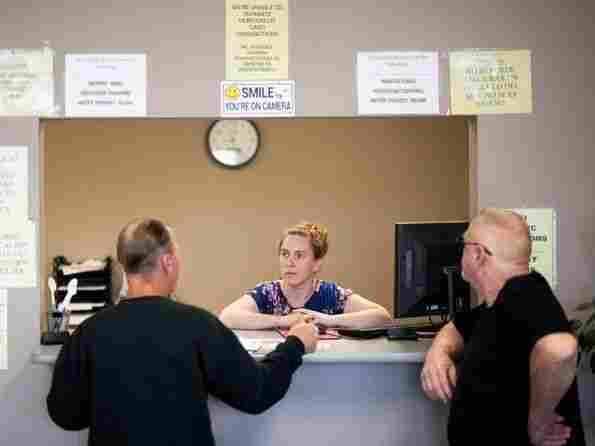
Clarisa Corber at work at a Topeka, Kan., insurance agency. Corber and her husband — who have three kids, a health plan and $15,000 in medical debt — were profiled in a recent Los Angeles Times investigation into the effects of high-deductible health plans.
Nick Krug/Los Angeles Times
hide caption
toggle caption
Nick Krug/Los Angeles Times
Workers with a steady paycheck already know that wages have been stubbornly slow to rise. Meanwhile, those who get health insurance through a job have seen their deductibles shoot up. In fact, says Noam Levey, a health care reporter for the Los Angeles Times, deductibles have, on average, quadrupled over the last dozen years. As a result, even some people who have health insurance are having trouble affording medical care. We talked with Levey about his latest reporting into how the issue is affecting workers and their families.
Interview Highlights
On why he decided to embark on this project:
We’ve spent so much time fighting about Obamacare over the last 10 years and talking about the uninsured that I think we lost sight of this quiet revolution that’s happened with health coverage for the tens of millions of Americans who have coverage through an employer. These are the people who’ve seen deductibles rise astronomically — rising four times in the last dozen years from about $350 on average to $1,350 on average. In some cases, people are seeing $4,000, $5,000, even $6,000 deductibles that they have to pay out of their own pocket before their health insurance kicks in. Needless to say, many, many Americans can’t afford those kinds of bills.
On what he heard in talking to people:
We heard some really heartbreaking stories. So we did a nationwide poll with the Kaiser Family Foundation as part of this project. One of the things that we found was that half of Americans who get job-based coverage say they or an immediate family member in the last year have put off going to the doctor, not filled the prescription or delayed some other kind of medical care because of concern about cost. We found one in five had depleted their savings to pay a medical bill in the last year and one in six reported that they have had to make some kind of difficult sacrifice in order to pay a medical bill.
Some of them were really gut wrenching. We talked to a 27-year-old chef in western Virginia trying to start a family with his young wife. His wife had a miscarriage. They got such huge medical bills he had to take two extra jobs and was working from 5 a.m. until 11 p.m. some days.
These are people with health insurance. This used to be something we heard about all the time for people who didn’t have health insurance, but in many cases these are middle-class people making $75,000 or $100,000 a year. But if they get a $5,000 or $6,000 medical bill — a family of four, kids in school — it’s hard for a lot of people to come up with that kind of money.
On what’s coming next in his reporting
We’re going to be looking particularly at how these high deductibles are problematic for people who have serious medical conditions — diabetes, heart disease, even cancer. One of the things we found particularly troubling is that these people who should be going to the doctor, even they are cutting back on their treatment.
We’re going to be looking at how these high-deductible plans are exacerbating inequality at a time when this is a major issue for Americans about who’s getting the gains in our economy. If you’re living paycheck to paycheck and you get sick, it’s really tough for that group of people.
One of the other things that’s amazing, and I know NPR has looked a little bit at this, is that the growth of online charities and crowdfunding sources like GoFundMe is being driven in large part by people seeking to pay medical bills. And one of the amazing things about those people is that many of them have health insurance.
Noam Levey reports for the Los Angeles Times and can be found on Twitter: @NoamLevey.
New Rule Allows Religious Workers To Refuse Abortion Services
NPR’s Audie Cornish talks with Mary Ziegler, law professor at Florida State University, about a new federal rule that protects religious health care workers from performing abortion-related services.
AUDIE CORNISH, HOST:
We want to look more closely now at what this ruling means for women who may need abortions. We’re joined by Mary Ziegler. She’s a law professor at Florida State University and author of the book “Beyond Abortion: Roe v. Wade And The Fight For Privacy.” Welcome to the program.
MARY ZIEGLER: Thanks for having me.
CORNISH: When it comes to abortion services, who will be impacted the most by this new ruling?
ZIEGLER: It’s hard to say, but I think primarily women who are in smaller communities that rely on one or two providers for their care – those people are often going to be in a position, for example, to not have alternatives if a Catholic institution or another religious institution turn them down.
CORNISH: If a person is refused treatment, can you talk about some of the other options?
ZIEGLER: Well, it really depends on the community you’re in. So, as is often the case with abortion care, women who are poorer or in rural communities, for example, are going to have a harder time seeking an alternative without it becoming prohibitively inconvenient in terms of either a commute or the cost of money involved in getting a hotel, whereas women in bigger areas are likely – more urban areas, that is – are much more likely to have a variety of options for their care and be able to look elsewhere if a religious institution refuses their request.
CORNISH: Some abortion rights advocates say personal beliefs, religious or otherwise, shouldn’t determine the health care a patient receives. The National Women’s Law Center, for one, says that they’re going to fight this. Are there grounds for a lawsuit?
ZIEGLER: There certainly are grounds for a lawsuit. Obviously, as a starting point, we’re dealing with a Supreme Court that’s been remade by both Presidents George W. Bush and Donald Trump, so I think any – we’re talking now realistically – right? – about a court that is expected to overturn Roe v. Wade in substance, if not in name. So a challenge here, I think, would be a longshot.
And if we’re talking about burdens on abortion per se, there’s what you might see kind of as a circuit breaker here – that is to say, there are private individuals who are denying care. It’s not just the government. And in the past, the Supreme Court has been less receptive to constitutional arguments about abortion when the government isn’t the only one to blame for women’s lack of access. So it might be kind of a longshot for a variety of reasons.
CORNISH: To that point, I think some people would ask – look, if a person has a deep moral objection to abortion, is there really a better solution than just letting them opt out, right? Like, should they have to participate in something that goes against their beliefs?
ZIEGLER: Yeah. I think the controversy with the Trump-era regulations – and really, where we’ve been with the controversy about conscience since the George W. Bush era – in part is, how directly involved do you need to be before we worry about your conscientious objections? So going way back to the 1970s, we’ve always cared about conscientious objections, but over time, you see religious conservatives pressing a kind of broader and broader definition of complicity or involvement.
And so, for example, if you look at the Trump regulations, they say that if you’re scheduling an abortion or you’re preparing a room for an abortion, that that would be considered something that you could object to instead of just actually performing an abortion. So I think the challenge is to strike the right balance between access to care on the one hand and protection of religious objections on the other. And clearly, the Trump administration is expanding religious protections pretty dramatically and, obviously, at the expense of access to care.
CORNISH: You know, the Department of Health and Human Services, the Office of Civil Rights – they have a new division – right? – of Conscience and Religious Freedom. So, in a way, could people see this coming?
ZIEGLER: Yeah, absolutely. I think that religious freedom has been one of the Trump administration’s kind of signature initiatives in terms of solidifying his support among certainly conservative evangelicals and other believers who’ve been one of his sort of main constituencies. They’re among his strongest supporters, even when his poll numbers have generally been low.
CORNISH: That’s Mary Ziegler of Florida State University. Thank you for speaking with us.
ZIEGLER: Thanks so much for having me.
Copyright © 2019 NPR. All rights reserved. Visit our website terms of use and permissions pages at www.npr.org for further information.
NPR transcripts are created on a rush deadline by Verb8tm, Inc., an NPR contractor, and produced using a proprietary transcription process developed with NPR. This text may not be in its final form and may be updated or revised in the future. Accuracy and availability may vary. The authoritative record of NPR’s programming is the audio record.
200 Female Pro Hockey Players Lay Down Their Sticks Demanding Better Conditions

More than 200 of the top female hockey players have decided they will not play professionally in North America next season. They are calling for a sustainable league with better resources. Pictured are Hilary Knight (left) with Kelly Pannek, playing with the U.S. national team last month in Finland. Both signed on to the boycott.
Jussi Nukari/AP
hide caption
toggle caption
Jussi Nukari/AP
Decrying the sorry state of salary and support for women’s hockey, around 200 female players announced Thursday they won’t play the game at the professional level across North America, until they get a league with “the resources that professional hockey demands and deserves.”
“We cannot make a sustainable living playing in the current state of the professional game,” said the statement several players posted to their social media accounts. “Having no health insurance and making as low as two thousand dollars a season means players can’t adequately train and prepare to play at the highest level.”
We may represent different teams, leagues and countries but collectively we stand as one. #ForTheGame pic.twitter.com/O9MOOL8YOt
— Hilary Knight (@HilaryKnight) May 2, 2019
By contrast on the men’s side, Forbes says the top ten players of the 2018-2019 season each brought home multi-million dollar paychecks from the NHL, with lucrative endorsement deals topping them off.
On Wednesday, the Canadian Women’s Hockey League officially discontinued operations, citing an economically unstable business model, leaving the National Women’s Hockey League the sole remaining professional league in North America.
The NWHL had been hoping to fold in players from the Canadian league and said Thursday, despite the boycott, it still plans to proceed with season five in October with its five teams.
As a concession to players, the league announced it is “offering increased salaries and a 50-50 revenue [split] from league-level sponsorships and media rights deals,” adding it remains open to communicating with players about their concerns.
Among those participating in the boycott are Hilary Knight and Kendall Coyne Schofield, who helped propel the U.S. Women’s National Team to win gold at the 2018 Olympic Winter Games in South Korea, as well as Canadian national team goalie Shannon Szabados.
“Obviously we want to be on the ice, but I think that kind of speaks volumes to how critical it is,” Szabados, who played for the NWHL’s Buffalo Beauts, told The Associated Press. “It’s over 200 of us that kind of want to stop being pulled in 10 different directions and kind of get all our resources under one roof.”
After they announced the boycott, words of support for the players came pouring in.
Female athletes deserve to live the life they envisioned as kids: playing the sport they love, and making a living doing it. I stand with all female athletes in their pursuit of equal pay and a sustainable future. #ForTheGame #OneVoice https://t.co/hLY9HgcIJa
— Billie Jean King (@BillieJeanKing) May 2, 2019
“Female athletes deserve to live the life they envisioned as kids: playing the sport they love, and making a living doing it,” tweeted Billie Jean King, the onetime world’s top-ranked women’s tennis player.
Mary-Kay Messier, vice president of global marketing for ice hockey equipment manufacturer Bauer, called on the NHL to step in. “In order to develop a long-term viable women’s professional hockey league, the NHL must be in an ownership position,” she said in a statement.
The NHL has provided limited funding to the women’s teams, but has so far resisted calls to do more. The players designed Thursday’s announcement, in part, to compel the NHL to act, reports ESPN.
But in a statement emailed to NPR, the NHL says, while it supports the objectives of both the NWHL and the female players, it is not in a rush to make any move. “We will need some time to better understand what the full picture and implications look like,” Deputy Commissioner Bill Daly said.
Commissioner Gary Bettman told the AP that the NHL still wants the NWHL to “make a go of it,” and does not want to interfere at this time, although that could change if “there turns out to be a void.”
But the players say the void is already there and they will not pick up their sticks again until it is addressed.
Opioid Executive John Kapoor Found Guilty In Landmark Bribery Case

Insys Therapeutics founder John Kapoor departs federal court in Boston earlier this year.
Steven Senne/AP
hide caption
toggle caption
Steven Senne/AP
Updated 5:30 p.m. ET
A jury in Boston has found onetime billionaire and drug company executive John Kapoor and his four co-defendants guilty of a racketeering conspiracy. The verdict came Wednesday after 15 days of deliberation.
The federal government accused Kapoor, the founder of Insys Therapeutics, and his co-defendants of running a nationwide bribery scheme. Between 2012 and 2015, Insys allegedly paid doctors to prescribe its potent opioid medication and then lied to insurance companies to ensure that the expensive fentanyl-based painkiller would be covered.
Kapoor is among the highest-ranking pharmaceutical executives to face trial amid a national opioid epidemic. By pursuing this case, the federal government was seen as sending a message that it is holding drug companies accountable for their role in the epidemic.
The guilty verdict could strengthen the cases against other pharmaceutical executives implicated in the opioid crisis.
“Today’s convictions mark the first successful prosecution of top pharmaceutical executives for crimes related to the illicit marketing and prescribing of opioids,” U.S. Attorney Andrew E. Lelling said in a statement. “Just as we would street-level drug dealers, we will hold pharmaceutical executives responsible for fueling the opioid epidemic by recklessly and illegally distributing these drugs, especially while conspiring to commit racketeering along the way.”
“This is a landmark prosecution that vindicated the public’s interest in staunching the flow of opioids into our homes and streets,” he continued.
Brad Bailey, a criminal defense attorney in Boston and a former federal prosecutor, who has been following this case, said the 10-week trial represented a rare instance in which the federal government used criminal charges to go after corporate executives.
“That’s always unusual. That’s always an attention grabber,” said Bailey. “The big issue is the use of racketeering charges, which had been originally designed to go after the Mafia.” By charging Kapoor and his co-defendants with racketeering, Bailey said, the federal government was essentially saying that the practices at Insys Therapeutics resembled organized crime.
While the criminal charges set this case apart, the schemes detailed in this trial mirror the aggressive tactics that other pharmaceutical companies have allegedly used to push the sale of opioids.
Bribes and lies, or an unknowing executive?
Calling 39 witnesses, federal prosecutors argued that Kapoor was motivated by money and willing to put patients’ lives at stake to improve his bottom line. They depicted Insys Therapeutics as a struggling company under intense pressure from Kapoor to succeed.
Prosecutors outlined a two-step approach that Insys followed to boost sales of its opioid painkiller, Subsys: first, bribe doctors and, then, lie to insurance companies.
Insys allegedly targeted doctors with a track record of liberally prescribing opioids, inviting them to participate in a “speakers program.” According to the government, doctors were paid handsomely even if nobody showed up for the lectures, but only if the doctors wrote a lot of prescriptions for Subsys. Often, prosecutors say, this meant patients who didn’t need the medication were prescribed it anyway.
Insys then allegedly set up a call center where drug company employees pretended to be from doctor’s offices. Jurors heard phone calls in which Insys employees made up diagnoses to ensure that insurance companies covered Subsys, which can cost tens of thousands of dollars a month.
The defense attorneys for Kapoor and his four co-defendants called only a handful of witnesses. One was a patient who vouched for Subsys, saying it significantly reduced his pain after a car accident. The defense also emphasized Kapoor’s personal story, arguing that he was motivated to create Subsys only after seeing his now-deceased wife struggle with severe pain.
However, the crux of the defense’s argument was that Kapoor was unaware of the illegal schemes. They blamed several former employees, in particular Alec Burlakoff, the former vice president of sales at Insys. Burlakoff and several other former Insys executives pleaded guilty and testified for the prosecution in the hopes of getting a more lenient sentence. The defense emphasized Burlakoff’s history of lying and his hatred of Kapoor, which was captured on tape by federal investigators.
In closing arguments, defense attorneys highlighted contradictions in the testimony of several star government witnesses.
While Kapoor has been on trial in Boston’s federal courthouse, the company he founded has been facing financial troubles and management turmoil. Arizona-based Insys Therapeutics said in a statement that “there is substantial risk surrounding our ability to continue … primarily due to mounting legal costs and uncertain legal settlement exposures.”
Last year, the pharmaceutical company agreed to pay at least $150 million to end a Justice Department investigation into the bribery and kickback scheme. The insurance company Aetna, as well as patients, shareholders and state attorneys general, have also sued Insys.
On April 15, Insys replaced its CEO, Saeed Motahari, with the company’s chief financial officer, Andrew Long. Since their high point in 2015, Insys shares have tumbled. Bloomberg News reported that shares had fallen 90 percent.
Bailey, the former federal prosecutor, says other pharmaceutical companies may see Insys’ woes as a cautionary tale. However, some worry that the trial didn’t strike at the root of the opioid crisis.
Leo Beletsky, a professor of law and health sciences at Northeastern University, says, “A lot of what pharmaceutical companies did in the context of the opioid crisis that we are dealing with now was not, in fact, illegal. It was maybe unethical, but it was not illegal.”
While bribing doctors to write prescriptions and fabricating diagnoses is illegal, paying physicians to promote products to their peers is a common practice in the pharmaceutical industry. Off-label prescribing is also legal and common, although sales representatives are not technically supposed to advocate for off-label uses of a medication.
Beletsky says by focusing on individuals and their illegal schemes, this trial overlooked broader issues, such as drug companies legally spending billions of dollars to maximize the use of their medications.
For Beletsky, the answer lies in regulation. “We need to think much more deeply about how we regulate the pharmaceutical industry and how we prevent these kinds of practices from occurring in the first place,” says Beletsky.
However, experts say, there are currently no major legislative efforts to regulate the pharmaceutical industry. For now, the pushback against marketing strategies that allegedly fueled the opioid crisis remains in the courts.
