
Articles by admin

No Image

Greek Historian: History Shows 'There Is Always An End To All Problems'

4:38

Download

NPR’s Melissa Block follows up with Michael Iliakis, a Greek man who finished up a doctorate in ancient history four years ago and was desperately trying to find a job as a college professor.

Transcript

MELISSA BLOCK, HOST:

Four years ago on this program, I talked with a Greek man named Michael Iliakis who lives in Athens. It was a time of economic free fall in Greece, one of many to come, and we wanted to hear from a Greek citizen about what the future looked like from his perspective. When we spoke back in 2011, Iliakis had just gotten his PhD in ancient history. He’d been sending out a blizzard of job applications and getting nothing but rejections.

(SOUNDBITE OF ARCHIVED BROADCAST)

MICHAEL ILIAKIS: I’ve actually lost count. It should be somewhere between 40 and 80.

BLOCK: And he told me that at age 35, he was embarrassed to still be living at home with his parents.

ILIAKIS: This is rather distressing because I had to return home because I couldn’t afford staying alone. And it’s not what I expected my life to be at this age.

BLOCK: At 35.

ILIAKIS: Yes.

BLOCK: And Michael, are you married?

ILIAKIS: I’m trying to (laughter). I have a very good relationship that is heading that direction, but it’s impossible to say when we’ll get married because there isn’t financial stability, meaning that we don’t have two salaries to pay the cost of a married life.

BLOCK: I wonder how all of this shapes how you think about the future, the woman you’d like to marry and potentially the children that you would want to have.

ILIAKIS: Actually, my future, now, is on hold until I, you know, I get that first job. And I’ll pick it up from there. There is nothing that I can do about that right now but keep sending applications, going to interviews and just hoping for the best.

BLOCK: So four years later, is Michael Iliakis still hoping for the best? Well, since this is my last week hosting ALL THINGS CONSIDERED, I figured I’d check in with him one more time.

Hello. Is that Michael?

ILIAKIS: Yes.

BLOCK: Michael, yasou – good to hear your voice again. How are you?

ILIAKIS: I’m fine.

BLOCK: I keep wondering, Michael, if you ever got married.

ILIAKIS: Well, no. That relationship was one of the casualties of the financial crisis.

BLOCK: Really – what happened?

ILIAKIS: I mean, it’s – it was extremely difficult to plan about anything with having limited money and both living with our parents. So when she got the chance for something better, she left – simple as that.

BLOCK: I’m sorry to hear that.

ILIAKIS: It’s, you know, it’s old history by now.

BLOCK: Michael, are you still living in your parents’ home?

ILIAKIS: No. I’m away 11 months now.

BLOCK: Have you been able to find any steady work over these last four years?

ILIAKIS: No. I’ve been going from job to job, nothing more than two months, and there was always a significant gap between them.

BLOCK: When you think back to the first time you and I talked back in 2011, Michael, think about where Greece was then, where you were then, you said you were hoping for the best. What do you think about what’s happened since, and are you still hoping for the best?

ILIAKIS: I’m saying life is becoming more and more complicated. It’s a sense that you feel pressure from all sides, and whenever you try to make one step forward, you are forced to take three or four steps back.

BLOCK: How do you deal with that pressure? What still gives you pleasure in your life?

ILIAKIS: Well, I can say that I’m one of the lucky ones because my profession is such that I will go to the library, open a book, start doing research, and eventually, I will forget what’s happening around me and focus on the scientific problem.

BLOCK: So maybe looking through books of ancient history puts things in a bit of perspective, maybe.

ILIAKIS: Oh, yes. As a historian, you can see that there is always an end to all problems. That is, this is a situation that is happening now. For better or worse, we are living it, but eventually, it will stop at some point. I don’t know if it’s going to be 10, 15, 20 or 30 years from now.

BLOCK: It sounds like you’re taking the long view.

ILIAKIS: Yes. Well, I’m an ancient historian. A century means nothing to me.

BLOCK: (Laughter). Well, Michael Iliakis, I do wish you all the best, and thanks again for talking with us.

ILIAKIS: Thank you.

BLOCK: That’s Michael Iliakis speaking with us from Athens.

Copyright © 2015 NPR. All rights reserved. Visit our website terms of use and permissions pages at www.npr.org for further information.

NPR transcripts are created on a rush deadline by a contractor for NPR, and accuracy and availability may vary. This text may not be in its final form and may be updated or revised in the future. Please be aware that the authoritative record of NPR’s programming is the audio.

This entry passed through the Full-Text RSS service – if this is your content and you’re reading it on someone else’s site, please read the FAQ at fivefilters.org/content-only/faq.php#publishers.


No Image

MLB Home Teams Make History By Going 15-0

1:50

Download

On Tuesday, for the first time in Major League Baseball history, all 15 home teams won.

Transcript

ROBERT SIEGEL, HOST:

Finally this hour, a little bit of baseball history.

(SOUNDBITE OF ARCHIVED RECORDING)

UNIDENTIFIED MAN #1: McFarland deals down the line.

UNIDENTIFIED MAN #2: Fair ball.

UNIDENTIFIED MAN #1: Oh, it’s fair ball.

UNIDENTIFIED MAN #2: Game over. Mariners win it 6 to 5. Austin Jackson with a game-winner.

SIEGEL: Late last night, the Seattle Mariners beat the Baltimore Orioles at home in the final at-bat.

MELISSA BLOCK, HOST:

OK, you’re saying to yourself that sounds exciting for Mariners fans, but why do I care about an inconsequential game between two baseball teams having mediocre seasons? Good question. Well, that win marked the first time in baseball history that all 15 home teams won on the same day.

SIEGEL: Now, legions of baseball historians and hard-core fans absolutely live for the game’s random stats and bits of historical trivia.

BLOCK: And it’s rare that a first-time ever event happens without someone knowing ahead of time.

SIEGEL: But Jacob Pomrenke, web editor for the Society for American Baseball Research, says almost nobody realized a 15-for-15 home team sweep had never happened before until it happened yesterday.

JACOB POMRENKE: They hadn’t even been thinking about it. You know, this was something that just kind of wow, you know? I would’ve assumed that this would’ve happened, you know, a long time ago. And this would’ve been the third or the fifth time that this had happened.

BLOCK: Pomrenke says days like yesterday are why fans like him love the game.

POMRENKE: When you go to again you never know what you’re going to see. And you can go to a game on a Tuesday night in August and see something that’s never been done in, you know, nearly 150 years in baseball history.

SIEGEL: And if you’re hoping that maybe this will happen again soon, you should know the likelihood is just one in nearly 33,000.

BLOCK: And that’s more inconsequential baseball than even the biggest fan should ever have to live through.

Copyright © 2015 NPR. All rights reserved. Visit our website terms of use and permissions pages at www.npr.org for further information.

NPR transcripts are created on a rush deadline by a contractor for NPR, and accuracy and availability may vary. This text may not be in its final form and may be updated or revised in the future. Please be aware that the authoritative record of NPR’s programming is the audio.

This entry passed through the Full-Text RSS service – if this is your content and you’re reading it on someone else’s site, please read the FAQ at fivefilters.org/content-only/faq.php#publishers.


No Image

'Defunding' Planned Parenthood Is Easier Promised Than Done

Republican presidential candidates (from left) Donald Trump, Jeb Bush, Mike Huckabee, Ted Cruz and Rand Paul during the Republican presidential debate in Cleveland on Aug.6.

Republican presidential candidates (from left) Donald Trump, Jeb Bush, Mike Huckabee, Ted Cruz and Rand Paul during the Republican presidential debate in Cleveland on Aug.6. Andrew Harnik/AP hide caption

itoggle caption Andrew Harnik/AP

The undercover videos purporting to show officials of Planned Parenthood bargaining over the sale of fetal tissue have made the promise to defund the organization one of the most popular refrains of Republicans running for president.

It’s actually a much easier promise to make than to fulfill. But that’s not slowing down the candidates.

“There is no reason in the world to have Planned Parenthood other than abortion,” Sen. Rand Paul, R-Ky., has said. “We should stop all funding for Planned Parenthood.”

Carly Fiorina, former CEO of Hewlett-Packard, echoed many of her fellow candidates by vowing that “we should shut down the government” rather than allow further funding of the organization. Many Republicans — though far from all — have been advocating for a fight this fall over the funding of Planned Parenthood, when it comes time to keep the federal government operating.

Candidates that are or were governors have gone even further — saying they have already eliminated funding for the organization in their states.

“I defunded Planned Parenthood more than four years ago, long before any of these videos came out,” said Gov. Scott Walker, R-Wis., in the recent Fox News debate.

“As governor of Florida I defunded Planned Parenthood,” said Jeb Bush at the same debate; he served as governor from 1999 to 2007. “I created a culture of life in our state.”

But did they really? That depends on how you define the word “defund.”

Both Walker and Bush (along with Gov. Chris Christie in New Jersey and former Gov. Rick Perry in Texas) did reduce state funding for the organization, mostly by cutting off long-standing grants earmarked for family planning programs. (With few exceptions, funds for family planning may not be used for abortion.)

But while the cuts forced the closure of some Planned Parenthood clinics, all four states still have a number of Planned Parenthood clinics operating within their borders — in some cases still collecting state funds as well as federal money.

That’s largely because of a requirement in the Medicaid program, from which Planned Parenthood gets most of its government funding. Medicaid funding is shared between the federal government and the states, although the federal government pays 90 percent of the cost of family planning services.

“There’s a requirement in the [Medicaid] statute for free choice of providers,” said Cindy Mann, who recently stepped down as head of the federal Medicaid program and is now with the law firm Manatt, Phelps & Phillips. “The only way you can limit the provider is to establish that they’re not, in fact, qualified as a Medicaid provider.”

Federal courts have agreed. In 2011, when Planned Parenthood was also in the headlines, Indiana passed a law barring Medicaid funding to any entity that also performed abortions, even if those abortions were performed with nonpublic funds. A federal appeals court ultimately blocked that part of the law because it interfered with the Medicaid law’s “freedom of choice” requirements.

“Although Indiana has broad authority to exclude unqualified providers from its Medicaid program, the state does not have plenary authority to exclude a class of providers for any reason — more particularly for a reason unrelated to provider qualifications,” wrote Appeals Court Judge Diane Sykes in the majority opinion. Sykes was appointed by President George W. Bush.

Congress, of course, could defund Planned Parenthood by changing that requirement in Medicaid law.

But Medicaid experts say recent announcements by the Republican governors of Louisiana and Alabama that they are also attempting to evict Planned Parenthood from the Medicaid program in their states are unlikely to become reality.

Louisiana Gov. Bobby Jindal, who is running for president, said in the debate for the second tier of candidates last week that “we just, earlier this week, kicked them out of Medicaid in Louisiana.” None of the Planned Parenthood clinics in the state perform abortions.

In Alabama, Gov. Robert Bentley notified Planned Parenthood last week that he would be ending their contract with the state to serve Medicaid patients. “I respect human life and do not want Alabama to be associated with an organization that does not,” he said.

Neither of those actions is likely to succeed, said Sara Rosenbaum, a law professor and Medicaid specialist at George Washington University.

“This is a right for beneficiaries going back to the original statute,” she said, referring to the ability of patients to choose their health care provider. She added, however, that governors wishing to take such steps for political gain “have nothing to lose,” because it is now up to the providers to sue.

Planned Parenthood has not said yet whether it will challenge the Alabama or Louisiana actions in court.

One way GOP governors have managed to cut Planned Parenthood funding is by dropping out of an optional Medicaid program that provides federal funding to pay for family planning services for women who don’t otherwise qualify for Medicaid but who still have low incomes (usually under twice the federal poverty level, or about $23,500).

That’s how Texas partly defunded Planned Parenthood in 2011. When Medicaid officials said the state’s new law barring funding of organizations that also do abortions violated the federal free-choice-of-provider requirement, Texas was actually expelled from the expanded family planning program — and lost its federal funding. The state instead created its own program with (substantially less) state-only money. Planned Parenthood had been providing just under half of the services for the entire program, so excluding the organization meant women in Texas had trouble getting family planning services.

According to the Texas Policy Evaluation Project, which is studying the impact of the changes, by 2013 the reductions caused 82 clinics (not all of them run by Planned Parenthood) to close or stop providing family planning services. Plus, the cuts prompted other clinics to limit the types of services they provide, and forced women seeking care to pay a bigger share of the cost.

This entry passed through the Full-Text RSS service – if this is your content and you’re reading it on someone else’s site, please read the FAQ at fivefilters.org/content-only/faq.php#publishers.

No Image

Today in Movie Culture: Roger Moore as 007 in 'Spectre,' Heath Ledger's Joker Journal and More

Here are a bunch of little bites to satisfy your hunger for movie culture:

Movie Recasting of the Day:

We’ve seen a mashup recasting Pierce Brosnan in the Spectre trailer, now it’s Roger Moore‘s turn (via /Film):

[embedded content]

Movie Takedown of the Day:

In honor of Straight Outta Compton coming out this week, Honest Trailers slams the Eminem movie 8 Mile:

[embedded content]

Production Diary of the Day:

From the 2012 documentary Too Young to Die, Heath Ledger‘s father offers a glimpse at the actor’s journal used while preparing for his role as The Joker in The Dark Knight (via Legion of Leia):

[embedded content]

Classic Cartoon of the Day:

Today is the 65th anniversary of the theatrical release of the animated short Popeye Makes a Movie, in which Popeye makes a movie. Watch it in full here:

[embedded content]

Star Wars of the Day:

One of the most clever fan-made food items based on the Star Wars movies is a tauntaun cookie with candy guts that you can tear out of its belly. But now you need a candy Luke Skywalker to stuff into the vacancy (via Neatorama).

Supercut of the Day:

If you like Arnold Schwarzenegger movies just for the explosions, all you need is this video (via Devour):

[embedded content]

Filmmaker in Focus:

Supercut master Jacob T. Swinney presents all of Spike Lee‘s head-on (usually fourth-wall-breaking) shots in three minutes for Press Play:

Movie Trivia of the Day:

In honor of another stoner comedy coming out (American Ultra), CineFix lists seven things you probably don’t know about Dazed and Confused:

[embedded content]

Video Essay of the Day:

Now You See It explores sexual, particularly phallic, symbolism in film, featuring parts of Alien, A Clockwork Orange and more:

[embedded content]

Classic Trailer of the Day:

10 years ago today, Judd Apatow premiered his feature debut, The 40-Year-Old Virgin, in Hollywood. Watch the original trailer, which doesn’t make it seem nearly as funny as it really is, below.

[embedded content]

Send tips or follow us via Twitter:

and

This entry passed through the Full-Text RSS service – if this is your content and you’re reading it on someone else’s site, please read the FAQ at fivefilters.org/content-only/faq.php#publishers.


No Image

China Cut Its Currency — And Touched Your Life. Here's How

You may not pay in Chinese yuan notes, but a drop in their value affects your spending power.

You may not pay in Chinese yuan notes, but a drop in their value affects your spending power. Mark Ralston/AFP/Getty Images hide caption

itoggle caption Mark Ralston/AFP/Getty Images

When China suddenly cut the value of its currency Tuesday, investors everywhere were caught off guard.

And they didn’t like it. They sent both stock and commodity prices much lower. Even interest rates fell.

Now maybe you are wondering: Huh? What does this China move mean for me?

Before we get to that, let’s first run through what happened on the other side of the world:

— China’s government wants to reverse an economic slowdown there. So it decided that to boost growth, it had to take steps to lower export prices and attract foreign customers.

— That meant cutting the value of its currency, the yuan, by nearly 2 percent.

— So now China can, in effect, offer its goods at a discount in the global marketplace, gaining an advantage over competitors, including U.S. manufacturers.

That triggered a lot of fears, including these:

— Investors worry that China’s unexpected move tells us that the country’s economy is even weaker than they thought. If it is weaker, then China might start pulling back on purchases of goods and services from other countries.

— U.S. manufacturers fear that other central banks might follow China’s lead and devalue their currencies too. U.S. exports already are down this year, so tougher competition would be unwelcome here.

— Economists don’t like currency or trade wars that distort free markets. And political anger in Washington is rising. Many lawmakers already had been calling for measures to penalize currency “manipulators.” Sen. Chuck Grassley, R-Iowa, said in a statement that China’s latest currency move means “it’s past the time to do something about it.”

Those fears roiled markets:

— Stock prices took a big hit, with the Dow Jones industrial average falling to 17,403, down 212 points. The S&P 500 index tumbled 20 points to 2,084. European stocks fell too, down by 1.6 percent.

— Commodity prices got slammed because a lot of investors figure that China will be buying less of everything. So oil and metal prices fell especially hard, but so did corn, wheat and lumber.

— Interest rates slipped on U.S. Treasuries because investors wanted to put their money somewhere safe. When investors are eager to own Treasuries, then the U.S. government can offer lower rates. So the yield on the 10-year Treasury note fell to a two-month low of 2.13 percent.

What does all of this mean for your wallet?

Here are some upsides:

— U.S. consumers got good news on oil prices, which fell to a six-year low of $43.28 per barrel. That pretty much guarantees bargains at the pump this fall. Many experts say gas could be averaging less than $2 a gallon by winter.

— All sorts of commodity prices fell, so that should beat back inflation. For example, if copper and lumber cost less, then builders can hold down prices for new homes.

— Those lower commodity prices might encourage the Federal Reserve to hold off on raising interest rates this fall. If Chinese imports are cheaper, and gas is lower and food prices are restrained, then the risk of inflation is down, so why raise rates?

Here are some downsides:

— Tumbling commodity prices may sound good if you are a consumer, but not if you are a miner or a farmer or an oil field worker. Lower prices could mean lower profits and more layoffs.

— If you’re a saver, you may feel like you just can’t win. Interest rates are down on your bank savings, and the stock in your 401(k) retirement account is down too.

— If you are a U.S. manufacturer who must compete with China, you too may feel like the deck is stacked against you.

It’s not easy sorting out whether on balance, China’s move will hurt or help you because it depends on whether you mostly consume commodities or produce them — and whether you mostly save money or borrow it.

But in any case, a decision made by a few officials in China reached into your wallet on Tuesday. Small world.

This entry passed through the Full-Text RSS service – if this is your content and you’re reading it on someone else’s site, please read the FAQ at fivefilters.org/content-only/faq.php#publishers.


No Image

Jets Quarterback Geno Smith 'Sucker-Punched' By Teammate, Left With Broken Jaw

New York Jets quarterback Geno Smith will have surgery after a teammate broke his jaw in a locker room altercation Tuesday.

New York Jets quarterback Geno Smith will have surgery after a teammate broke his jaw in a locker room altercation Tuesday. Seth Wenig/AP hide caption

itoggle caption Seth Wenig/AP

New York Jets quarterback Geno Smith will miss a lot of playing time after being “sucker-punched” by a teammate Tuesday. The fracas left him with two fractures in his jaw.

IK Enemkpali, a reserve linebacker who threw the punch, was promptly released by the team. Head coach Todd Bowles told reporters the altercation “had nothing to do with football.”

“It was something very childish. He got cold-cocked, sucker-punched, whatever you want to call it, in the jaw. He has a broken jaw, fractured jaw, it requires some surgery.”

Smith, who is the process of trying to resurrect his career with the Jets, will miss six to 10 weeks with the injury.

Smith took to Instagram vowing, “ILL BE BACK!

A photo posted by Geno Smith III (@genosmith7) on Aug 11, 2015 at 11:03am PDT

Jets fans — no strangers to heartbreak — are likely to take this incident pretty hard, especially because Smith was reportedly having a strong training camp.

As NFL.com reports:

Jets fans are used to calamity happening to their team at the quarterback position, but this is a new one. Smith was one [of] our candidates to improve this season as a starter, largely because of how well he fits in offensive coordinator Chan Gailey’s system.”

Summer skirmishes are nothing new in NFL training camps, though the severity of this injury to arguably the team’s most important position is remarkable. The altercation comes one day after Carolina Panthers quarterback Cam Newton got into a scuffle with a teammate during practice.

This entry passed through the Full-Text RSS service – if this is your content and you’re reading it on someone else’s site, please read the FAQ at fivefilters.org/content-only/faq.php#publishers.


No Image

Doctor Recalls Facing Cadavers, Mortality In Gross Anatomy Lab

5:45

Download

Eleven years ago, NPR’s Melissa Block followed a group of first-year medical students in one gross anatomy lab as they confronted cadavers and mortality. She checks back in with one of those students.

Transcript

MELISSA BLOCK, HOST:

This is my last week hosting this program. I’m going to take some time off and come back as a roving correspondent doing long-form reporting and profiles of fascinating people. This week, I’m going to check in on a few of the other fascinating people I’ve interviewed over these past 12 years, some of the stories that have stuck with me the most.

(SOUNDBITE OF ARCHIVED BROADCAST)

UNIDENTIFIED MAN: You can see muscle here. See that? That’s muscle.

UNIDENTIFIED WOMAN: Oh, look at that. Look how you can see it. Oh…

BLOCK: Eleven years ago, I spent time with a class of first-year medical students at the University of Maryland in Baltimore. It was their first day in gross anatomy lab, their first day dissecting a cadaver. I wanted to hear what they were discovering about the body, about sickness and mortality. When I met with the students again at the end of the year, we talked about what they’d learned from their body donors. Here’s Ally Parnes from 2005.

(SOUNDBITE OF ARCHIVED BROADCAST)

ALLY PARNES: Our cadaver had obviously put up a strong fight to stay alive. He had melanoma that had metastasized and there were tumors all over his body. That was really difficult for us because we went through the process of his dying. What I learned is how precious life is how, much suffering people will actually put up with just to stay alive and just to stay here a little bit longer. I just remember thinking that I’ll see patients and how important it is to remember that our will to fight is really enormous and it’s a precious gift that we try to hold onto.

BLOCK: That’s Ally Parnes, then a first-year medical student, now a doctor. I’ve stayed in occasional touch with Ally over the years. She’s now a radiologist specializing in breast imaging, and she joins me now to catch us up on what and how she’s doing.

Ally, welcome back to the program.

PARNES: Thanks so much for having me, Melissa.

BLOCK: I do wonder how often you think about your experience in that gross anatomy lab, that man, the cadaver, you came to know so well.

PARNES: I do actually, from time to time, think about him. I actually think it was interesting just listening. I didn’t remember having said that, but, the fact that life is precious and people will really struggle to hold onto it as long as they can – I tell my patients, you’re stronger than you think you are, and it’s amazing what the human spirit can overcome.

BLOCK: Its interesting Ally ’cause you have also written about your experience as a breast cancer survivor yourself. You were diagnosed really early, right? You were, what, 40?

PARNES: Yes, the walking poster child for mammography, as it turns out. And a complete coincidence. People ask me, did you go into breast imaging because you were diagnosed with breast cancer? No, it was a couple months before I was going to start my breast imaging fellowship that I myself was diagnosed through a mammogram and subsequent biopsy.

BLOCK: So seeing medicine from a whole different perspective – obviously, as a patient, as well as a doctor.

PARNES: Yes. You know, I won’t say I’m happy I got cancer…

BLOCK: I wouldn’t expect you to.

PARNES: … (Laughter) But I do think it can be incredibly helpful in how I interact with patients. I saw a patient once who – you could just see it in her eyes that she felt all alone and very scared. At that moment, I did tell her that I knew what she was going through because I had been there. And I watched a transition instantly with her. And it was quite powerful to be able to help someone, kind of reach out my hand and have her kind of walk along with me through what she had to get through that day in terms of a biopsy. So there’ve been a lot of experiences that have been, I guess, richer. There’s a lot more depth to some of the experiences I’ve had.

BLOCK: How is your health, Ally?

PARNES: Oh, thank you, I am very fortunate to say my health is excellent. My oncologist says, I consider you cured. The fact that I was able to find it early was huge for me.

BLOCK: Well, I’m glad to hear you’re doing well.

PARNES: Melissa?

BLOCK: Yes?

PARNES: Can I share, like, a couple things?

BLOCK: Sure.

PARNES: I don’t think I ever told anyone this, but, from that anatomy lab, I remember we got to the part where we had to dissect the breast. And it hit me – that is just, it feels so wrong because here is this person, we’re just lopping off this part of her body that was so personal to her because it was part of her femininity, part of her intimacy, and – maybe, if she had had children – fed her babies with this one piece of her body that we were just cutting off and bringing across the room. I remember thinking about that when I had a choice of doing a lumpectomy and prophylactic mastectomies. I ended up deciding to do bilateral prophylactic mastectomies. And I actually think it was helpful for me to have had that experience because I was able to truly understand what I was getting myself into.

BLOCK: Wow. I’m sure it didn’t make it any easier.

PARNES: No. It’s not the right choice for everyone by any stretch, but it was the right decision for me for sure.

BLOCK: Ally, thanks again so much. I really appreciate you talking to us.

PARNES: Thanks so much, Melissa. It was great to talk to you.

BLOCK: Dr. Ally Parnes was a medical student when I first interviewed her 11 years ago. Now she’s a radiologist.

Copyright © 2015 NPR. All rights reserved. Visit our website terms of use and permissions pages at www.npr.org for further information.

NPR transcripts are created on a rush deadline by a contractor for NPR, and accuracy and availability may vary. This text may not be in its final form and may be updated or revised in the future. Please be aware that the authoritative record of NPR’s programming is the audio.

This entry passed through the Full-Text RSS service – if this is your content and you’re reading it on someone else’s site, please read the FAQ at fivefilters.org/content-only/faq.php#publishers.


No Image

Today in Movie Culture: 'Guardians of the Galaxy' Origins, New 'Howard the Duck' Trailer and More

Here are a bunch of little bites to satisfy your hunger for movie culture:

Character Origin of the Day:

Wonder what happened after young Peter Quill was abducted by a spaceship at the beginning of Guardians of the Galaxy? Below is part of an animated look at Quill/Star-Lord‘s origin story via the upcoming cartoon series. See the second part plus an animated origin for Groot at Geek Tyrant.

[embedded content]

Fake Trailer of the Day:

Speaking of characters who appear in Guardians of the Galaxy, Vulture made a trailer for a modern MCU-based reboot of Howard the Duck:

[embedded content]

Movie Meme of the Day:

The “Straight Outta ____ ” promotional meme for Straight Outta Compton is being employed for some great movie-related gags. Here are two favorites:

Straight Outta John Hurt #Alien thanks to Niel McGuggon pic.twitter.com/EVWHKADeV9

— Phil Edwards (@Live_for_Films) August 8, 2015

pic.twitter.com/vrxv91dzgx

— Ali Arikan (@aliarikan) August 8, 2015

Music Video of the Day:

It’s not a random pairing for Paul Thomas Anderson to direct the music video for Joanna Newsom‘s new single, “Sapokanikan,” which you can watch below, as she recently co-starred in his movie Inherent Vice (via The Playlist).

[embedded content]

Vintage Image of the Day:

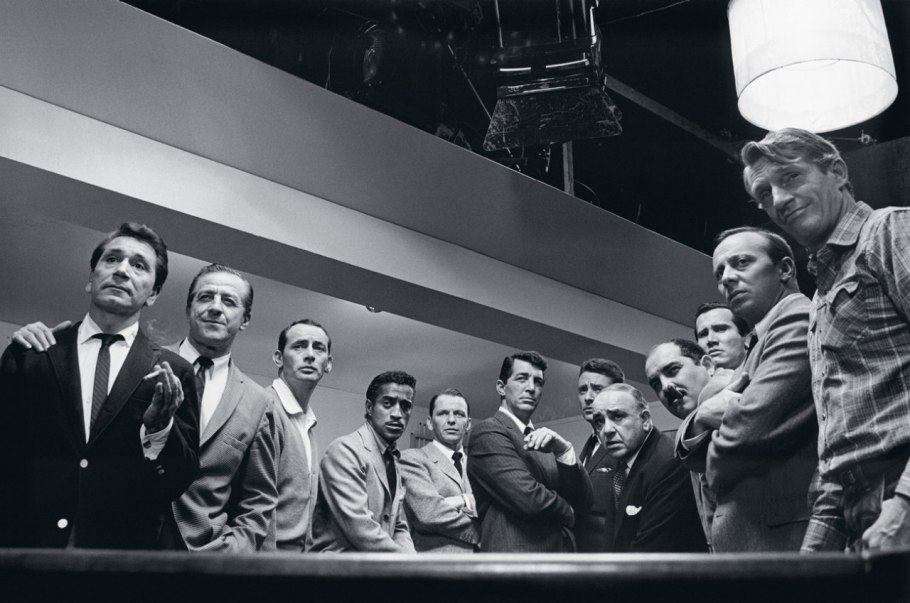
Twelve men are lined up for this behind-the-scenes look at the original Ocean’s 11, starring Frank Sinatra and the rest of the Rat Pack. Who can name the guy who isn’t part of the titular bunch?

Cosplay of the Day:

Snow White the assassin needs no assistance from any manly hunters (via KamiKame):

Fan Art of the Day:

If you like badass versions of Disney Princesses, check out Tess Fowler’s post-apocalypse take on all the ladies of Disny animated features. See individual character designs at Fashionably Geek.

Movie Truth of the Day:

The 1993 documentary Flyin’ Cut Sleeves is about NYC gangs in the ’70s and a story that seems to have inspired the plot of The Warriors. Watch the film in full below and learn more at Dangerous Minds.

[embedded content]

Filmmaker Parody of the Day:

You could add fake explosions to any home movie and say it’s directed by Michael Bay and voila instant filmmaker parody. But this one in particular made me laugh a little too much:

Two Dogs In The Garden – directed by Michael Bay pic.twitter.com/hoh5xRuzEp

— The Poke (@ThePoke) August 9, 2015

Classic Trailer of the Day:

On this day in 1950, Billy Wilder‘s masterpiece Sunset Blvd. had its world premiere at Radio City Music Hall in New York City. Watch the original trailer below.

[embedded content]

Send tips or follow us via Twitter:

and

This entry passed through the Full-Text RSS service – if this is your content and you’re reading it on someone else’s site, please read the FAQ at fivefilters.org/content-only/faq.php#publishers.


No Image

Runner Nick Symmonds Out Of World Championships In Sponsorship Dispute

Nick Symmonds will not be going to the world championships with the U.S. team in Beijing this month.

Nick Symmonds will not be going to the world championships with the U.S. team in Beijing this month. Christian Petersen/Getty Images hide caption

itoggle caption Christian Petersen/Getty Images

Nick Symmonds, an American middistance runner, won’t be competing in the world championships in Beijing this month.

Symmonds, who is a U.S. National champion and has competed in the Olympic Games, failed to sign a terms and conditions agreement with USA Track & Field that is necessary to be part of the team. He has a personal sponsorship deal with Brooks Running, while the American world championships team is sponsored by Nike.

He posted this photo of the USATF letter he received to his Instagram account:

After receiving the letter that said he had to wear either Nike or nonbranded apparel, Symmonds posted again on his Instagram, asking that the team contract be rewritten, because he wouldn’t sign it with the sponsorship requirements.

Because he wouldn’t agree to wear Nike, the team replaced him, writes ESPN:

” ‘Two years’ worth of work to try to win another medal for my country are now down the drain,’ Symmonds said. ‘Is it frustrating? Of course. But no part of me regrets doing this.’

“Symmonds decided to take a stand in order to push for more rights for his fellow athletes, believing they should be rewarded with a bigger piece of the pie.”

USATF said that it respects his decision but that the Statement of Conditions has been in place for years and that “athletes and agents are familiar with the provisions of the document, which include requirements pertaining to athlete conduct as goodwill ambassadors for the United States, proper handling of the American flag, wearing the designated Team uniform at official Team functions, attendance at official Team practices, meetings and other events, commitment to train and report fit to compete, and following doping rules.”

It adds that it has no restrictions on “athlete footwear, eyewear or watches.”

This entry passed through the Full-Text RSS service – if this is your content and you’re reading it on someone else’s site, please read the FAQ at fivefilters.org/content-only/faq.php#publishers.


No Image

Runner Nick Symmonds Out Of World Championships In Sponsorship Dispute

Nick Symmonds will not be going to the world championships with the U.S. team in Beijing this month.

Nick Symmonds will not be going to the world championships with the U.S. team in Beijing this month. Christian Petersen/Getty Images hide caption

itoggle caption Christian Petersen/Getty Images

Nick Symmonds, an American middistance runner, won’t be competing in the world championships in Beijing this month.

Symmonds, who is a U.S. National champion and has competed in the Olympic Games, failed to sign a terms and conditions agreement with USA Track & Field that is necessary to be part of the team. He has a personal sponsorship deal with Brooks Running, while the American world championships team is sponsored by Nike.

He posted this photo of the USATF letter he received to his Instagram account:

After receiving the letter that said he had to wear either Nike or nonbranded apparel, Symmonds posted again on his Instagram, asking that the team contract be rewritten, because he wouldn’t sign it with the sponsorship requirements.

Because he wouldn’t agree to wear Nike, the team replaced him, writes ESPN:

” ‘Two years’ worth of work to try to win another medal for my country are now down the drain,’ Symmonds said. ‘Is it frustrating? Of course. But no part of me regrets doing this.’

“Symmonds decided to take a stand in order to push for more rights for his fellow athletes, believing they should be rewarded with a bigger piece of the pie.”

USATF said that it respects his decision but that the Statement of Conditions has been in place for years and that “athletes and agents are familiar with the provisions of the document, which include requirements pertaining to athlete conduct as goodwill ambassadors for the United States, proper handling of the American flag, wearing the designated Team uniform at official Team functions, attendance at official Team practices, meetings and other events, commitment to train and report fit to compete, and following doping rules.”

It adds that it has no restrictions on “athlete footwear, eyewear or watches.”

This entry passed through the Full-Text RSS service – if this is your content and you’re reading it on someone else’s site, please read the FAQ at fivefilters.org/content-only/faq.php#publishers.