Articles by admin

No Image

Latitudes: The Music You Must Hear In August

Senegalese drum master Doudou N'Diaye Rose performing in Dakar in April 2013.

Senegalese drum master Doudou N’Diaye Rose performing in Dakar in April 2013. Seyllou/AFP/Getty Images hide caption

itoggle caption Seyllou/AFP/Getty Images

We are sad to note the passing of Senegalese drum master Doudou N’Diaye Rose, who died in Dakar Aug. 19 at age 85. Named a “living human treasure” by UNESCO in 2006, Rose played with such American and British artists as Miles Davis, Dizzy Gillespie, Peter Gabriel and the Rolling Stones. But more importantly, Rose sustained and nurtured local percussion traditions, particularly on the tall drum called the sabar. Our colleague Ofeibea Quist-Arcton, who is based in Dakar, has a longer appreciation. The joy Rose took in performing, and in sculpting large-scale performances, is palpable. Here’s a brief film the French site Mondomix made about him in 2009 in Fes, Morocco.

[embedded content]
Mondomix YouTube

Speaking of Senegal, but going to a much more meditative end of the spectrum, the kora player Seckou Keita has a really lovely new solo album called 22 Strings. (In many parts of West Africa, this plucked instrument has only 21 strings, but in northern Guinea and southern Senegal, where Keita is from, the instrument has one more.) Here’s a very beautiful piece from this album called “Mikhi Nathan Mu-Toma” (The Invisible Man), which Keita wrote about his father, who was absent from his life from the time he was very young.

[embedded content]
Seckou Keita YouTube

If you want to hear a really great Sinaloense brass band, your best bet these days might be to head to … Brooklyn. That’s where the Banda de los Muertos is based, and it’s helmed by two unlikely gents. Oscar Noriega is a jazz saxophonist and clarinetist best known as a sideman for folks like Lee Konitz and Paul Motian. Jacob Garchik is a trombonist whose work spans arranging for the Kronos Quartet to founding what he calls an “atheist gospel trombone choir.” In any case, their Mexican group masterfully performs a playful mix of traditional banda tunes and original songs.

[embedded content]
Valeria Trucchia-Noriega YouTube

Love to dance? The beat comes fast and hard on “Nachan Farrate” (Dance With Full Power), a Punjabi-flavored “item number” from the Bollywood summer movie All Is Well. Despite terrible reviews for the film — with its “indefensible” plot and “cliche gridlock” that “gets things wrong on so many levels” — “Nachan Farrate” is a total earworm of a tune, featuring singers Kanika Kapoor and the Meet Bros duo (and Sonakshi Sinha as the item girl).

[embedded content]
T-Series YouTube

Finally: one more African tune for your Labor Day cookout. It’s the lighthearted “Sweet Fanta Diallo (Adieu Soleil),” one of the biggest hits of this summer across West Africa and France. It’s from Magic System, a group from Ivory Coast that specializes in zouglou, a local genre that brings in elements of other styles, especially Caribbean ones like zouk and soca. (Don’t miss their even bigger 2014 summer song, “Magic in the Air,” with Moroccan singer Chawki.) Magic System’s “Sweet Fanta Diallo” is a cover of a song written by Alpha Blondy, another artist from Ivory Coast.

[embedded content]
Magic System YouTube

This entry passed through the Full-Text RSS service – if this is your content and you’re reading it on someone else’s site, please read the FAQ at fivefilters.org/content-only/faq.php#publishers.


No Image

College Sports Scandals Loom Over The Launch Of Football Season

3:11

Download

Mike Pesca of Slate’s podcast The Gist helps NPR’s Rachel Martin assess the damage to college football inflicted by a string of scandals at universities around the country.

Transcript

RACHEL MARTIN, HOST:

It is time now for sports. And while college football players are focusing on the upcoming season, there is a cloud over some college football programs. A player at Baylor University, who was convicted of sexual assault, had apparently been allowed to transfer from Boise State despite a history of violent behavior. And the athletic department at Auburn University and coaches at Virginia Tech are in hot water. Mike Pesca is here to talk about what’s going on.

Hey, Mike.

MIKE PESCA, BYLINE: Hello.

MARTIN: Let’s start with Auburn. Football officials are apparently upset because the school wants to end a particular degree program. Do tell.

PESCA: Public administration – not that popular among Auburn’s undergrads, one percent of the students enroll. But among football players, it’s more than 50 percent. So this is a major that was considered to be on the chopping block. Schools don’t have unlimited funds. And an internal review says that the major does not quote, “contribute a great deal to the department,” meaning the political science department’s education mission.

But as I said, it’s a great major for these football players. And the athletic department said, if the major’s eliminated, the success rate for our student athletes will likely decline. So let us say pressure was brought to bear or at least a proposal from the football team and the athletic department will give you the funds to keep the program going. The program has been kept going. I have to credit The Wall Street Journal for a lot of this reporting. But it just gets to the tension between football and academics and what’s driving what. We also saw Rutgers’ head coach getting in touch with a 5,000 dollar adjunct professor saying, hey could we do anything to boost this players grades? It happens a lot.

MARTIN: So also Virginia Tech apparently is fining athletes if they don’t go to practice? I mean, that’s crazy.

PESCA: Yeah, so well, there is this proposal and it was reported on and then the coach in Cincinnati said, hey, good idea. So you have to realize student athletes don’t get paid. There is a stipend, newly instituted this year, of about 3,000 dollars. To make up the gap between what scholarships are and how much the cost is. So for the first time ever, student athletes – football players, say – can put a few thousand dollars towards buying a pizza, let’s say, but not if you, say, miss breakfast at VA Tech because that’s a $10 fine. If you miss a treatment, it’s a $20 fine. An unsportsmanlike conduct in a game is a $100 fine. I sometimes – I hope not glibly call it indentured servitude, but this is exactly what happened during the days of indentured servitude. There were fines and fees for just going about your life. This is likely a NCAA violation. It looks like Virginia Tech is backing off that plan.

MARTIN: OK, real quick – isolated incidents, bigger problems?

PESCA: That’s the question. And we’ve seen this behavior in, say, the NFL. I always say no one’s proved that it’s greater in the NFL than in society at large. But college football has a bit of a rot, and maybe I’m being kind by saying a bit. They make so many – millions of dollars off these players, who are not paid. You’re just going to see twisting themselves in knots to qualify them academically or try to get money however they can. It’s systemic I think.

MARTIN: NPR’s – The Slate’s Mike Pesca. Thanks, Mike.

PESCA: You’re welcome.

Copyright © 2015 NPR. All rights reserved. Visit our website terms of use and permissions pages at www.npr.org for further information.

NPR transcripts are created on a rush deadline by a contractor for NPR, and accuracy and availability may vary. This text may not be in its final form and may be updated or revised in the future. Please be aware that the authoritative record of NPR’s programming is the audio.

This entry passed through the Full-Text RSS service – if this is your content and you’re reading it on someone else’s site, please read the FAQ at fivefilters.org/content-only/faq.php#publishers.


No Image

The Bloody Mary Meat Straw: An All-American Story

This Bloody Mary served at the Nationals Park in D.C. came with a meat straw, which infuses each sip with an umami flavor. Ben Hirko first came up with the concept while tending bar one snowy night in 2009. The straws have become a hit.
3:33

Download

This Bloody Mary served at the Nationals Park in D.C. came with a meat straw, which infuses each sip with an umami flavor. Ben Hirko first came up with the concept while tending bar one snowy night in 2009. The straws have become a hit. Tamara Keith/NPR hide caption

itoggle caption Tamara Keith/NPR

This is a story of American ingenuity and entrepreneurship. It is the story of the meat straw. Yes, you read that right.

“It is a straw made out of pork,” explains Ben Hirko of Coralville, Iowa, the man behind Benny’s Original Meat Straws.

It’s a half-inch in diameter, the same length as a standard plastic straw. And it has a hole running down the middle of it, through which you’re meant to slurp up Bloody Marys.

Like many good stories, this one involves a snowstorm — and maybe one beer too many. Back in February 2009, Hirko was tending bar, and there was only one couple there to drink, so as the snow piled up outside, he poured himself a beer. The bar didn’t serve food, but the couple brought a bunch of meat sticks to snack on.

“After a few beers, I reached over and grabbed one of the snack sticks,” says Hirko. “And I was like, ‘You know, this would make an amazing Bloody Mary garnish.’ It just had great flavor.”

But there was a problem: Only the bottom of the meat stick was soaking up the spicy tomato juice and vodka.

“And so I grabbed a plastic straw out of one of the dispensers, and I grabbed a new stick from them. And I literally started digging a hole in it and eating the meat out of it until I got all the way through,” says Hirko, recounting the moment his meat straw concept was born.

And right there, Hirko had created his first prototype.

“I held it up to the guy that was there,” Hirko says. “And I looked him in the eye, right through the hole, and I said, ‘That’s awesome.’ And he looked at me and said, ‘Yes, it is.’ “

Now, if you are thinking, “Does America really need meat straws?,” you’re not alone. Even Hirko’s father had doubts. “He didn’t really say it, but he looked at me like, ‘You know you have a family to support now, don’t you?’ ” Hirko recalls.

But it turns out, Bloody Mary meat straws actually can support a family. For Hirko, the big break came when he got a call from the Detroit Lions football team, which serves a Hail Mary Bloody Mary drink.

“We serve it in a plastic mason jar,” says Joe Nader, executive chef for Levy Restaurants at Ford Field, home of the Detroit Lions. He oversees food service at the stadium. “So it’s a pretty good-sized portion, and it’s got a bunch of other garnish with it. The meat straw is kind of the piece de resistance.”

Last year, the Lions sold 30,000 Bloody Marys with meat straw garnishes. The meat straws are also sold in grocery stores and bars, and on the Benny’s website.

And the hankering for meat straws has spread. At a recent Washington National’s baseball game in D.C., meat straws were prominently displayed at a “make-your-own-Bloody-Mary” bar in one of the luxury lounges.

Jonathan Stahl, executive director of ballpark operations and fan experience for the Nationals, demonstrates a meat straw in action, using it to stir horseradish into the Bloody Mary mix.

“As you can see, it comes straight through the meat straw,” says Stahl, taking a gulp to demonstrate. “There you go.”

The straw infuses each sip with a hint of meaty, umami flavor. And by the time imbibers have finished guzzling the drink, the meat straw is well-soaked in Bloody Mary and ready for snacking. Stahl says they’ve been a hit.

“We couldn’t get them one time, and so people were asking where the meat straws were,” says Stahl. “We never have a Bloody Mary bar unless we have the meat straws available now.”

Nat’s fan Bill Foster sits on a patio overlooking the ballpark, testing out a meat straw Bloody Mary. He isn’t convinced this product is really answering a great need.

“Sometimes, as Steve Jobs pointed out, we don’t know what we needed until he put it together, so maybe enough people will think we need this,” says Foster. “I don’t know. I doubt if I’ll be in that crew, but maybe others will.”

The Steve Jobs of meat straws, Ben Hirko, recently sold his company to a larger firm with better distribution channels, but he stayed on. So now he can spend all his time convincing people that meat straws are the answer to a problem they didn’t know they had.

This entry passed through the Full-Text RSS service – if this is your content and you’re reading it on someone else’s site, please read the FAQ at fivefilters.org/content-only/faq.php#publishers.


No Image

With Futures Tied To Mining, Some Montana Towns Seek New Ways To Get By

3:57

Download

Mining moves in boom-and-bust cycles. It’s busting right now as metals prices are the lowest they’ve been in years. In states like Montana, that means small mining towns are looking for other options.

Transcript

ARUN RATH, HOST:

Mining for metals like copper, gold and platinum has long been a story of boom and bust, and it’s busting in the U.S. right now. Metals prices are the lowest they’ve been in years. In states like Montana, that means small towns with their futures tied to mining are looking for other options. Montana Public Radio’s Eric Whitney reports they’re hard to find.

ERIC WHITNEY, BYLINE: Buddy Hanrahan runs a one-man computer services business in White Sulphur Springs, Mont., population 900.

BUDDY HANRAHAN: Bring ’em over. They can come down…

WHITNEY: Hanrahan’s also president of the local chamber of commerce. He’s trying to stay on good terms with other local businesses. So when I ask him how the local economy’s doing…

HANRAHAN: Oh boy, I’ve got to be careful what I say just ’cause I don’t want to offend – steady, level, but at a very low level.

WHITNEY: Way lower than when Hanrahan was in high school. Back then, White Sulphur Springs still had three thriving timber mills. But when federal forest management policies changed in the ’90s, the mills closed, and two-thirds of the town’s residents moved away. That’s why Hanrahan and a lot of other Main Street businesses here now have signs in their windows saying they support opening a new copper mine nearby.

HANRAHAN: Any industry right now is an improvement. I mean, agriculture’s great, and tourism is great, but it’s – it’s tough. It’s a hard road to hoe when you just have that.

WHITNEY: When a Canadian mining company set up a storefront here about four years ago, copper prices were up, and prospects looked good for it to open the mine and create about 200 good-paying jobs. Kim Deal, who’s been here 41 years, would love to see that happen.

KIM DEAL: I moved away after I graduated out of high school, was gone for nine years, and I come back. It’s home.

WHITNEY: Deal spent 31 years tending bar in White Sulphur Springs because she says it’s one of the few steady jobs available here. But she just bought a property management business and is hoping something will come along so her family can stay, too.

DEAL: There’s just nothing here for people to do. There’s no work. You know, and it’s sad when your kids don’t have the option to graduate and say, oh, you know, I’m going to stay at home for the summer and work, or, you know, I don’t want to go to college so I want to get a job, and they can’t do that here. There’s nothing here for them to do that with.

RATH: The proposed copper mine is near the Smith River, one of Montana’s most prized boating and fishing experiences. Environmental groups are trying to stop the mine, but a pretty effective barrier right now could be that the price of copper is only about half of what it was in 2011. K.C. Chang, an economist with the financial research firm IHS Global Insight, says that’s mostly because of China’s economy. It’s shifting away from the rapid industrialization that caused a spike in prices for raw materials.

K.C. CHANG: That shift towards a market that’s more driven by their domestic consumer means that there’s going to be an overall lower copper demand in terms of the global picture.

WHITNEY: A weak forecast for rising copper prices means hopes for another natural resources boom in towns like White Sulphur Springs are fading.

HANRAHAN: Yeah, that three screens really does people in sometimes.

WHITNEY: Back in Buddy Hanrahan’s computer shop, he says local leaders have no choice but to keep looking for other economic options.

HANRAHAN: The mine is a possibility. It may never happen. So we’re just rolling the way things need to roll to survive, not necessarily depending on the mine. It’d be great if it happened, but we’re not going to rely on it.

WHITNEY: Right now, Hanrahan thinks his town’s best hope still lies underground – but not in copper ore. Federal subsidies helped lay fiber-optic Internet cable to White Sulphur Springs, and Hanrahan’s trying to lure some telecommuters who want to be surrounded by the great outdoors. For NPR News, I’m Eric Whitney in Missoula.

(SOUNDBITE OF SONG, “MINING ALL DAY LONG”)

MIRACLE OF SOUND: (Singing) And I feel good ’cause I’ve been mining all day long. Hey, hey, hey, I’ve been mining all day long. I feel…

Copyright © 2015 NPR. All rights reserved. Visit our website terms of use and permissions pages at www.npr.org for further information.

NPR transcripts are created on a rush deadline by a contractor for NPR, and accuracy and availability may vary. This text may not be in its final form and may be updated or revised in the future. Please be aware that the authoritative record of NPR’s programming is the audio.

This entry passed through the Full-Text RSS service – if this is your content and you’re reading it on someone else’s site, please read the FAQ at fivefilters.org/content-only/faq.php#publishers.


No Image

U.S. Open Starts Monday, Basketball Says Goodbye To Darryl Dawkins

3:24

Download

NPR’s Scott Simon talks to Howard Bryant of ESPN about the U.S. Open, the legendary Darryl Dawkins, and, yes, a little baseball.

Transcript

SCOTT SIMON, HOST:

Now it’s time for sports.

(SOUNDBITE OF MUSIC)

SIMON: Is there any more room on Serena Williams’s mantle for another trophy? The U.S. Open starts Monday, start dusting. And remember the man who shattered glass in a basketball court, Howard Bryant of espn.com and ESPN The Magazine joins us now from the studios of New England Public Radio. Howard, thanks so much for being with us.

HOWARD BRYANT: Good morning, Scott.

SIMON: Tickets for the U.S. Open women’s final sold out this week before the men’s tickets.

BRYANT: For the first time ever.

SIMON: You can see why, can’t you?

BRYANT: Well, absolutely. You look at the most compelling – Serena Williams is the most compelling athlete in sports today. She’s the most compelling tennis player – male or female. You look at the history that she’s going for to win 22 Grand Slams to tie Steffi Graf.

And it’s not just those numbers either, it’s the fact that the way she wins and the few times that she loses, it’s the most compelling thing to watch right now. And it’s not also – it’s that and I also – when I look at Serena, you also see a lot of anguish, the stress of winning, the stress of playing. It’s one of the beauties of her and Rafa Nadal and a few other athletes. LeBron James is like that to a lesser extent as well where they actually let you know how hard it is to win and how much strain they go through instead of acting as though – as ballplayers have to – that nothing affects them, that they’re unbeatable. They have to believe it. But Serena shows it on her face, and I just love watching this. If she gets this Grand Slam, it’s going to be one of the most fun things to watch. I’m looking forward to going.

SIMON: I got to note she’s piling up the hardware at an age when a lot of previous champions have retired.

BRYANT: Well, exactly. And to do this in your 30s is not something that tennis players do. You have to remember these players turn pro when they’re 13, 14 years old, so she’s been playing 20 years. And most players are gone before they turn 30, never mind winning Grand Slams.

SIMON: Moving to baseball – intense races for the post season, but the team that spent, I think as much money as Iran’s nuclear program to try and get the best pitching staff on paper, the Washington Nationals, are close to falling off the table. What happened?

BRYANT: They are. Well, this is what happens when you’ve got all these expectations to win, and they’re only a game over .500. They might not even make the playoffs. I think it’s going to cost Matt Williams his job most likely, and I go back to when they were getting cute trying to win a few years ago when they limited Stephen Strasburg – you can’t be cavalier with these opportunities to win. They don’t happen that often, and if they don’t make the playoffs this year, it’s going to be quite a fall for a team that everybody thought coming out of the winter meetings that they were going to steamroll. Who knew that they’d be behind the Mets? They’re nine games out of a playoff spot right now, and it’s really not that hard to make the playoffs in baseball anymore.

SIMON: Let’s take a moment to remember Darryl Dawkins, the man who was to the dunk what Dizzy Gillespie was to bebop. He died this week of a heart attack, only 58.

BRYANT: Very, very sad story, and we talk about statistics in baseball so much and statistics in basketball and data, data, data – but Darryl Dawkins made basketball fun. He was one of those people that made you watch for who he was – incredible talent, incredible character, but most of all one of the reasons why you actually turn on the TV – incredible athlete.

SIMON: ESPN’s Howard Bryant. Thanks so much, Howard.

BRYANT: Thank you.

Copyright © 2015 NPR. All rights reserved. Visit our website terms of use and permissions pages at www.npr.org for further information.

NPR transcripts are created on a rush deadline by a contractor for NPR, and accuracy and availability may vary. This text may not be in its final form and may be updated or revised in the future. Please be aware that the authoritative record of NPR’s programming is the audio.

This entry passed through the Full-Text RSS service – if this is your content and you’re reading it on someone else’s site, please read the FAQ at fivefilters.org/content-only/faq.php#publishers.


No Image

Best of the Week: New 'Star Wars: The Force Awakens' Teaser, 'Doctor Strange' Gets Another Great Actor and More

The Important News

Star Wars Updates: dropped a new Star Wars: The Force Awakens teaser. New images and info surfaced about the Force Awakens villain Kylo Ren. More The Force Awakens images and rumors and toy details also arrived online.

First Look: Michael Fassbender in Assassin’s Creed. New Captain America: Civil War concept art.

Casting Net: Mads Mikkelsen might play the villain in Doctor Strange. Lea Seydoux might play the female lead in Gambit. Robert Pattinson is heading to space. Anne Hathaway is heading to space to fight zombies. Haley Bennett will star in The Girl on the Train. Jennifer Lawrence and Amy Schumer will co-star in a movie they write together. Jason Mitchell joined Kong: Skull Island.

Franchise Fever: Vin Diesel will begin filming xXx 3 in December. Max Landis pitched an idea for American Ultra 2. Superman may not get his own movie for a while. Borderlands is the next video game to attempt a movie franchise.

New Directors/New Films: M. Night Shyamalan will make another movie with Joaquin Phoenix.

Remake Report: The next Blade movie could be about his daughter.

Box Office: Straight Outta Compton still reigned in US theaters. Terminator Genisys opened big in China.

The Videos and Geek Stuff

New Movie Trailers: Ashby, Baskin, Love the Coopers, The Iron Giant re-release, Campus Code, Kill Your Friends and When Animals Dream.

Watch: The cast of Star Trek Beyond honors Leonard Nimoy.

See: A G-rated animated remake of Fight Club.

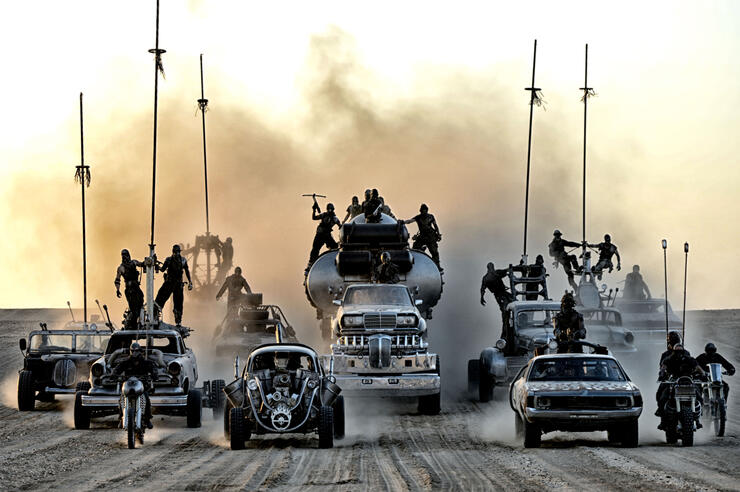
Watch: A remake of the Suicide Trailer with Toy Story footage. And an Empire Strikes Back trailer in the Force Awakens trailer style. And an honest trailer for Mad Max: Fury Road. And a silent film trailer for Mad Max: Fury Road. And a homemade Batman v Superman: Dawn of Justice trailer.

See: Evidence that Daniel is the true villain of The Karate Kid. And evidence that Harry Potter is the true villain of his series.

Learn: Which Hollywood movies Quentin Tarantino wishes he made and more.

See: How breaking the fourth wall is used in movies.

Check Out: Google’s new movie review aggregator.

Watch: A quick cut of Blade Runner.

See: What James Spader looked like in his Avenger: Age of Ultron performance capture suit.

Watch: Key & Peele imagines what the Gremlins 2 writers room was like.

See: The Star Trek fan film that costs more than most real movies.

Watch: Neil deGrasse Tyson stars in a new viral video for The Martian.

See: This week’s best new movie posters.

Our Features

Summer Movie Recap: The best action of this summer’s blockbusters.

Video Game Movie Guide: Franchises Nintendo might soon turn into movies.

Classic Movie Guide: Celebrating the 15th anniversary of Bring It On.

Sci-fi TV Series Guide: Why you need to be watching The 100.

Comic Book Movie Guid: Does Superman need his own movie?

Home Viewing: Here’s our guide to everything hitting VOD this week. And here’s our guide to everything hitting DVD this week.

and

MORE FROM AROUND THE WEB:

This entry passed through the Full-Text RSS service – if this is your content and you’re reading it on someone else’s site, please read the FAQ at fivefilters.org/content-only/faq.php#publishers.


No Image

NHL Hall-Of-Fame Coach Al Arbour Dies At Age 82

Al Arbour, the longtime coach of the New York Islanders, led the team to four Stanley Cup titles.

Al Arbour, the longtime coach of the New York Islanders, led the team to four Stanley Cup titles. Jim McIsaac/Getty Images hide caption

itoggle caption Jim McIsaac/Getty Images

Al Arbour, who set an NHL record by coaching 1,500 games, has died at age 81. As the head coach of the New York Islanders, he led the team to four Stanley Cup championships in 19 seasons. He also won four NHL titles as a player.

“Al will always be remembered as one of, if not the, greatest coaches ever to stand behind a bench in the history of the National Hockey League,” Islanders President and General Manager Garth Snow said, as the team announced Arbour’s death Friday.

“Arbour was being treated for Parkinson’s disease and dementia near his home in Sarasota, Fla.,” NHL.com reports.

When he retired in 1994, Arbour had logged 1,499 games as a coach. He made it an even 1,500 in 2007, when the Islanders brought him back to coach one game. An inductee of the NHL Hall of Fame, Arbour won 782 games as a coach — second all-time to Scotty Bowman (1,244 wins).

During his playing days, Arbour, a defenseman, was on Stanley Cup-winning teams for the Detroit Red Wings (1954), Chicago Blackhawks (1961), and the Toronto Maple Leafs (1962 and ’64).

Born in Sudbury, Canada, Arbour became a coach after playing in the NHL and other pro leagues for parts of three decades. He spent three years as the head coach of the St. Louis Blues, moving into that role directly after playing there.

In 1973, Arbour became the head coach of the Islanders, a young team that he eventually turned into a perennial contender.

From The New York Times:

“With General Manager Bill Torrey supplying the future Hall of Famers Denis Potvin on defense, Bryan Trottier, Mike Bossy and Clark Gillies at forward and Billy Smith in goal, Arbour coached the Islanders to the league championship from 1980 to 1983. The Islanders became the second franchise in N.H.L. history to win four consecutive Stanley Cup titles, the Montreal Canadiens having captured five straight Cups from 1956 to 1960 and four straight in the seasons before the Islanders’ streak.”

Arbour is survived by his wife, Claire, and children Joann, Jay, Julie and Janice.

This entry passed through the Full-Text RSS service – if this is your content and you’re reading it on someone else’s site, please read the FAQ at fivefilters.org/content-only/faq.php#publishers.


No Image

On Wall Street: Not Much Fun, But It Sure Was Interesting

There was good news along with the bad at the New York Stock Exchange this week.

There was good news along with the bad at the New York Stock Exchange this week. Richard Drew/AP hide caption

itoggle caption Richard Drew/AP

This week on Wall Street, investors experienced thrills, chills, tears and giggles as their investments plunged, soared, dropped, rose, dipped, moved sideways — and then ended about where they started.

On Friday, the Dow Jones industrial average inched down 12 points to 16,643 for the day, ending a bit higher than last Friday’s 16,459 close.

So if you just got back from spending a week on a tiny desert island with no smartphone, you might look at the Dow’s close and think it was a pretty tame week.

You would be very, very wrong.

This was one of the most volatile weeks in years for markets all over the world. Stocks, commodities and currencies whipsawed up and down as investors tried to make sense of conflicting economic news. On one side of the seesaw, there was terrible news out of China, suggesting that manufacturing there was slowing much more than economists had thought.

If China, the world’s second-largest economy, really is slowing dramatically, then it will be buying far fewer commodities, like coal, copper, iron ore and so on. Reduced demand would beat down the developing countries that produce many commodities, and that in turn would slow the whole global economy and hurt a lot of currencies.

So panic selling broke out everywhere on Monday morning — in Asia, Europe and the U.S.

But wait.

On the other end of the seesaw, the U.S. economy started moving up. A revision of the second-quarter gross domestic product turned up evidence of much stronger growth. And other reports showed durable-goods orders and consumer spending rose in July. Personal income was up too.

So through the week, the global investing narrative kept shifting from a scary story about China to a cheery one about the United States.

Also contributing to the ups and downs were conflicting rumors about whether the Federal Reserve would raise interest rates next month. All of this caused big stock-price swings, often within the same hour.

There’s a measure of market shifts, based on S&P 500 options. It’s called the CBOE Volatility Index, or VIX, and it rose 5.5 percent to 27.53 on Friday. That was well above its 10-year average of about 20 for the sixth straight session.

As the week’s dust settled, the winners were the U.S. and European markets, which both rose a bit. But Chinese stocks, as measured by the Shanghai Composite, had lost nearly 8 percent for the week.

If you want quiet, steady growth in your retirement savings, then you might want to close your eyes and brace yourself: Analysts are saying the volatility will continue, at least until the Federal Reserve’s intentions are clear.

Those coming market swings may have negative effects on the broader economy.

As measured by the University of Michigan Consumer Sentiment Index, Americans’ confidence is starting to falter, dropping 1.2 points to 91.9 this month, a report showed Friday.

Americans are becoming “more pessimistic in their economic and financial outlook due to the volatility in equity markets and worries over the financial issues in China and Greece,” IHS Global Insight economist Chris Christopher said in his analysis.

“If the U.S. stock markets stabilize, consumer sentiment is likely to respond to fundamentals — lower energy prices, improved job prospects, a housing market that is gaining traction, and modest consumer price inflation. Looking ahead, we expect consumer confidence to rebound in the coming months, if and only if, financial markets cooperate,” he wrote.

This entry passed through the Full-Text RSS service – if this is your content and you’re reading it on someone else’s site, please read the FAQ at fivefilters.org/content-only/faq.php#publishers.


No Image

First Watch: Rodrigo Amarante, 'I'm Ready'

August 28, 201512:00 PM ET

On this week’s All Songs Considered we play a new song from Brazilian Rodrigo Amarante. The song is the backdrop to the opening sequence to a new Netflix original series called Narcos, which rolls out today. It’s based on the life of drug lord Pablo Escobar and the Medellín Cartel.

This week Rodrigo Amarante has also released a new video for the song “I’m Ready,” from his last album, Cavalo, one of my top three records of 2014. The video is a single shot of Rodrigo performing the song in the cavernous Cisterna de Marvão in Portugal. It’s a romantic and wistful introduction to a very talented and singular musician.

This entry passed through the Full-Text RSS service – if this is your content and you’re reading it on someone else’s site, please read the FAQ at fivefilters.org/content-only/faq.php#publishers.


No Image

Poll Finds Most Women Believe Mammograms Should Be Done Annually

Most women 40 and older believe they should have mammograms every year to screen for breast cancer, the latest NPR-Truven Health Analytics health poll finds.

The finding is at odds with current recommendations by the U.S. Preventive Services Task Force that women with typical risks for breast cancer have screening mammograms every two years starting at age 50 and until they turn 75.

The decision about mammograms for women in their 40s is a personal one. The task force found a small net benefit for biennial screening of women ages 40 to 49. The guidelines say women should take into account their health situation as well as their views on the benefits of early cancer detection and potential harms, such as unnecessary biopsies and surgery.

The USPSTF said there wasn’t enough evidence about the benefits from mammograms for women age 75 and up to make a recommendation.

The task force is working on an update to the mammography guidelines, which have sparked controversy since they were last revised in 2009. The thrust of the draft advice is pretty much the same as it has been, but there’s more nuanced discussion of the benefits and potential harms for women in their 40s.

The NPR-Truven Health poll found almost two-thirds of women ages 50 to 74 believe that they should have a mammogram annually. For women 40 to 49, the number drops to 56 percent. For women under 40, about 45 percent believe they should have a mammogram every year. Overall, 57 percent of women believe an annual mammogram is appropriate.

“The Task Force is happy to see that women are making informed decisions with their doctor about breast cancer screening and continue to have access to mammography screening,” Dr. Kirsten Bibbins-Domingo, vice chair of the USPSTF, told Shots in a statement emailed after she reviewed the poll’s findings. “Mammograms are an important tool in helping women avoid deaths from breast cancer. The value of mammography screening increases with age, with women ages 50 to 74 benefitting most from screening. In this age group, the evidence indicates that women get the best balance of benefits to harms when screening is done every 2 years.”

She added, “The decision to start regular mammography screening for women in their forties should be an individual one that women make in consultation with their doctors and after consideration of their health history, preferences, and how they value the potential benefits and harms of screening.”

The task force’s advice is influential, but its guidelines aren’t the only ones around. The American Cancer Society, for instance, recommends that women 40 and older “have a mammogram every year and should continue to do so for as long as they are in good health.”

After reviewing the poll’s findings, Dr. Michael Taylor, Truven’s chief medical officer, told Shots: “There needs to be more education about the problem of false positives. If you do mammography every year starting at 40, you’re going to find a lot of things that don’t matter.” There may be benefits for some women, but many will also be subjected to unnecessary biopsies and surgeries, he said. “We don’t think enough about the harms of interventions” triggered by mammography, he said.

As for the belief that annual mammograms are best, Dr. A. Mark Fendrick, a professor of internal medicine at the University of Michigan Medical School, says, “It’s much much harder to take away something that you’re already doing than it is to start a behavior from time zero.”

“More isn’t always better,” Fendrick says about screening tests, including mammograms. But there are some people with family histories of disease or who have specific genetic risk factors who should be screened more often, he says.

Overall, 48 percent of respondents were aware that the Affordable Care Act requires insurers to cover mammograms without any out-of-pocket costs.

The NPR-Truven Health Analytics Health Poll on mammograms was conducted in June. More than 3,000 women across the country were interviewed. The margin for error is plus or minus 1.8 percentage points. You can find the questions and full results of the latest poll here. For previous polls, click here.

This entry passed through the Full-Text RSS service – if this is your content and you’re reading it on someone else’s site, please read the FAQ at fivefilters.org/content-only/faq.php#publishers.