
Articles by admin

No Image

Experimental Drug Provides New Approach To Fighting Alzheimer's

2:07

Download

A new experimental drug is designed to slow down Alzheimer’s by protecting brain cells from toxins associated with the disease. That’s a different approach from other Alzheimer’s drugs, which have tried to eliminate those toxins.

Transcript

ROBERT SIEGEL, HOST:

Efforts to treat Alzheimer’s disease have so far been disappointing. Researchers are now trying a different approach. They’re using an experimental drug designed to protect the brain from the damage caused by Alzheimer’s. NPR’s Jon Hamilton explains.

JON HAMILTON, BYLINE: The hallmarks of Alzheimer’s are plaques and tangles in the brain made up of toxic proteins. And so far, most efforts to treat the disease have focused on eliminating these proteins. But Lon Schneider at the University of Southern California says that approach may be too narrow.

LON SCHNEIDER: Alzheimer’s being a complex disease in which multiple processes are involved suggests that there need to be multiple interventions.

HAMILTON: Schneider sees potential in an experimental drug. It works not by eliminating toxic proteins, but by helping neurons survive despite exposure to these proteins.

SCHNEIDER: This drug serves as a neuroprotectant and prevents further neuronal loss.

HAMILTON: The drug, owned by Toyama Chemical Company in Japan is called T-817MA, and Schneider, who has consulted for Toyama, says it worked well in rodents with a form of Alzheimer’s.

SCHNEIDER: Compared to the animals that did not receive medication, there was far less loss of neurons.

HAMILTON: Now, researchers are preparing to study the drug in 450 people in the early stages of Alzheimer’s. Finding that many participants is a challenge, so researchers are using a video to help get the word out. It lets people know whether they might qualify to participate in the study, which is called NOBLE.

(SOUNDBITE OF VIDEO)

UNIDENTIFIED WOMAN #1: The NOBLE study will evaluate an investigational drug specifically for people with mild-to-moderate Alzheimer’s designed to protect the brain against neuron loss in order to suppress the progression of disease.

HAMILTON: Schneider says the NOBLE study is likely to finish enrolling patients in the next few weeks and will take about a year to complete.

SCHNEIDER: Were looking at a year timeline outcome, rather than six months or 18 months because we feel that we can detect a meaningful change within that period of time.

HAMILTON: Researchers are hoping that Alzheimer’s patients who get the drug will show less mental decline than those who receive a placebo. Jon Hamilton, NPR News.

Copyright © 2015 NPR. All rights reserved. Visit our website terms of use and permissions pages at www.npr.org for further information.

NPR transcripts are created on a rush deadline by a contractor for NPR, and accuracy and availability may vary. This text may not be in its final form and may be updated or revised in the future. Please be aware that the authoritative record of NPR’s programming is the audio.

This entry passed through the Full-Text RSS service – if this is your content and you’re reading it on someone else’s site, please read the FAQ at fivefilters.org/content-only/faq.php#publishers.



No Image

Mixed Jobs Report Adds Uncertainty To Fed Interest Rate Debate

2:38

Download

The August jobs report boosted uncertainty about the Federal Reserve plan to raise interest rates. Employers added 173,000 jobs — fewer than expected — but the unemployment rate fell to 5.1 percent.

Transcript

RACHEL MARTIN, HOST:

There is a certain level of anticipation each month before the Labor Department issues the U.S. jobs report. Today, the world was definitely watching. Maybe it could help answer a big question – is the Federal Reserve about to raise interest rates? The U.S. gained 173,000 jobs in August – fewer than expected. But the unemployment rate fell to 5.1 percent – a mixed report. So, as NPR’s Chris Arnold explains, that big question – it’s still looming out there.

CHRIS ARNOLD, BYLINE: The U.S. economy is at a historic crossroads. Never before has the Federal Reserve set interest rates this low and certainly not for this long. It did that to boost the badly damaged economy. And, now we’ve seen the longest stretch of job growth ever – 13 million jobs over 66 straight months. So that sounds great, but wages are still stagnant and several million people of working age still don’t have jobs. So the question now is, is the economy strong enough to walk on its own two feet?

LISA LYNCH: The Federal Reserve would like to get to a place where it feels more normal. To have rates this low for so long doesn’t feel normal.

ARNOLD: That’s Lisa Lynch, interim president of Brandeis University and a former Labor Department economist. She knows that keeping rates too low for too long can cause problems – bubbles in the housing market or the stock market. Still, for her part, Lynch thinks that the Fed should wait a little longer before scaling back the life support. So she says when the Fed meets later in September…

LYNCH: If I was sitting in that room, it would be a tough call, but I would err on the side of delaying until later in the year to ensure that there’s nothing that the Federal Reserve does that scuppers the current recovery.

ARNOLD: There are some economic storm clouds, too. Worry about a slowdown in China has been sending stocks sharply lower around the world. The Dow is down about 12 percent from its peak. Randall Kroszner is a former governor of the Federal Reserve Board. We reached him today in the lobby of the Central Bank of Ireland.

RANDALL KROSZNER: One of the key debates at the Fed meeting coming up is going to be the impact of China. Is this something that is really just within China and will not have dramatic spillover effects or is this something that’s going to set and train much bigger issues where they’re going to have to make a decision and unlimited data in less than a couple of weeks.

ARNOLD: For his part, Kroszner thinks the U.S. economy is looking strong enough and unemployment low enough that the Fed will start to remove the life support and raise interest rates at its next meeting. Chris Arnold, NPR News.

Copyright © 2015 NPR. All rights reserved. Visit our website terms of use and permissions pages at www.npr.org for further information.

NPR transcripts are created on a rush deadline by a contractor for NPR, and accuracy and availability may vary. This text may not be in its final form and may be updated or revised in the future. Please be aware that the authoritative record of NPR’s programming is the audio.

This entry passed through the Full-Text RSS service – if this is your content and you’re reading it on someone else’s site, please read the FAQ at fivefilters.org/content-only/faq.php#publishers.


No Image

Drone Crash At U.S. Open; New York City Teacher Arrested

Police officers stand beside the remains of a drone that crashed into an empty section of seats at the U.S. Open on Thursday.

Police officers stand beside the remains of a drone that crashed into an empty section of seats at the U.S. Open on Thursday. Kathy Willens/AP hide caption

itoggle caption Kathy Willens/AP

A New York City teacher was arrested today after allegedly crashing a drone into the stands during the U.S. Open tennis tournament Thursday night.

Citing police, The Associated Press reports that 26-year-old Daniel Verley has been charged with “reckless endangerment and operating a drone in a New York City public park outside of prescribed area.”

During a second-round match between Italy’s Flavia Pennetta and Monica Niculescu of Romania, the black, shoebox-sized drone flew over the court at Louis Armstrong Stadium and then crashed into empty seats and broke apart. The match was stopped briefly while police officers examined the drone.

The No. 26-seeded Pennetta called the incident “a little bit scary,” saying she initially thought it might have been a bomb, according to the AP.

“With everything going on in the world … I thought, ‘OK, it’s over.’ That’s how things happen,” she said.

A New York City Department of Education spokesman told NPR that Verley has been a science teacher at the Academy of Innovative Technology in Brooklyn since 2013. The department will monitor the criminal case closely and take any disciplinary action based on the information from the case.

Aviation attorney Guy Haggard of the Florida law firm GrayRobinson said the drone crash could have been caused by a loss of control or a system failure.

“Anything mechanical can break,” he told NPR.

As drone use for commercial and recreational purposes becomes more prevalent, there have been calls for more stringent regulations to be put in place. Haggard, however, says the laws already on the books are sufficient.

“I think they are very reasonable right now. Stay away from airports, stay over property that you have permission to fly over,” he said. “The FAA already has a regulation that you cant fly an aircraft recklessly to endanger other people.”

The Federal Aviation Administration says drones meet the legal definition for aircraft. In 2011, it fined a man $10,000 for using a small drone to film a commercial at the University of Virginia.

This entry passed through the Full-Text RSS service – if this is your content and you’re reading it on someone else’s site, please read the FAQ at fivefilters.org/content-only/faq.php#publishers.


No Image

August Jobless Data To Influence Fed's Decision On Hiking Interest Rates

Federal Reserve Vice Chairman Stanley Fischer, speaks during a Board of Governors of the Federal Reserve System meeting in July.

Federal Reserve Vice Chairman Stanley Fischer, speaks during a Board of Governors of the Federal Reserve System meeting in July. Manuel Balce Ceneta/AP hide caption

itoggle caption Manuel Balce Ceneta/AP

There’s a special significance to the monthly jobs report that will be released Friday morning. It could tip the balance for the Federal Reserve. Policymakers are weighing whether to raise the Fed’s official interest rates later this month. It’s something the Fed hasn’t done since before the Great Recession.

Surveys of economists are predicting that job growth in August will be right around the current trend of about 220,000 new jobs a month, and they think the unemployment rate will tick down a notch to 5.2 percent.

Megan Greene, chief economist at Manulife Asset Management, says that sounds about right. But she says she doesn’t think that will necessarily convince the Fed to raise rates later this month. She says the reason to hike rates is to head off inflation, and there’s no inflation in sight.

Greene believes that’s because U.S. wage growth has stagnated as U.S. workers compete with an oversupply of cheap labor around the globe.

“As long as there is this oversupply of cheap labor, we’re not going to see wages start to push up in the U.S. really, and as long as wages aren’t pushing up, inflation isn’t pushing up,” Greene says.

If wage increases are meager, workers don’t have enough disposable income to compete for goods and inflate the price of things like houses or furniture or restaurant meals.

But the vice chairman of the Federal Reserve Board of Governors, Stanley Fischer said last week that if the Fed waits until it actually sees inflation, it will be too late. And many economists argue it’s time for the Fed to act. They point to strong auto sales, growth in construction spending, an unemployment rate heading toward 5 percent and solid growth numbers in the spring.

But Greene isn’t convinced. “The labor market is very slowly improving but I don’t think it justifies a rate hike. Particularly when you consider all the risks, externally, and that includes China and volatility coming from China, but also don’t forget the Greeks are going back to the polls on September 20th,” she says.

That’s just three days after the Fed meeting. Greene says there’s a good chance the Greek outcome could spark more financial uncertainty. That would add more volatility to global financial markets still recovering from their convulsions over the slowdown in China’s growth. Greene says the U.S. economy could suffer negative impacts as a result, so the Fed should remain cautious.

This entry passed through the Full-Text RSS service – if this is your content and you’re reading it on someone else’s site, please read the FAQ at fivefilters.org/content-only/faq.php#publishers.


No Image

Today in Movie Culture: The Science of 'The Matrix,' Martin Scorsese in Focus and More

Here are a bunch of little bites to satisfy your hunger for movie culture:

Movie Science of the Day:

Speaking of Keanu Reeves, for Nerdist Kyle Hill looks into the plausibility of The Matrix, specifically how humans serve as batteries for the title virtual world:

[embedded content]

Movie Parody of the Day:

Your kids have to learn about sexual pleasure sometime, right? Cookie Monster stars in Sesame Street‘s take on When Harry Met Sally, and they do go there with a parody of the “I’ll have what she’s having” bit:

[embedded content]

Filmmaker in Focus:

Filmscalpel spotlights close-ups on eyes in Martin Scorsese movies:

[embedded content]

Online Film School:

Learn what a Dutch Angle is from Fandor Keyrame and this illustrative montage of shots from famous movies:

[embedded content]

Cosplay of the Day:

One woman made herself up to look like Batman, The Joker and Harley Quinn, all new Suicide Squad versions (via KamiKame):

Film Festival Trailer of the Day:

It’s not enough that the programming for this year’s Beyond Fest is amazing, but they had to go and dub a scene from The Shining that makes it all sound even more exciting/terrifying:

[embedded content]

Film Festival Contest of the Day:

Fantastic Fest is crowd-sourcing its bumpers again, this time holding a contest where you remake a scene from your favorite movie, but cast only kids as the characters. Here’s one based on Paul Thomas Anderson‘s Magnolia. Warning NSFW language.

[embedded content]

Supercut of the Day:

We’ve seen enough supercuts of villains lately, so it’s time for the heroes to get their spotlight (via Geek Tyrant):

[embedded content]

Classic Trailer of the Day:

This weekend marks the 15th anniversary of the premiere of Christopher Nolan‘s Memento at the Venice Film Festival. Celebrate the occasion by watching the innovative thriller’s original trailer below.

[embedded content]

Send tips or follow us via Twitter:

and

This entry passed through the Full-Text RSS service – if this is your content and you’re reading it on someone else’s site, please read the FAQ at fivefilters.org/content-only/faq.php#publishers.


No Image

Professional Soccer Sets Welcoming Tone For Refugees In Germany

Supporters of FC Bayern Munich celebrate the club's 25th Bundesliga title in Munich on May 24, 2015.

Supporters of FC Bayern Munich celebrate the club’s 25th Bundesliga title in Munich on May 24, 2015. CHRISTOF STACHE/AFP/Getty Images hide caption

itoggle caption CHRISTOF STACHE/AFP/Getty Images

Football giant FC Bayern Munich today pledged to help refugees in Germany. In a statement it announced plans to donate 1 million euros from a friendly match to support refugee projects and to establish a “training camp” for refugee youth in which participants will train at FC Bayern, take German language classes and be provided with meals and football jerseys.

The statement read in part:

“Germany is currently experiencing its greatest influx of refugees for many decades. This presents a special challenge to the state and society. FC Bayern München will play an active part in meeting the challenge and, working closely with the city of Munich and state of Bavaria, contribute financial, material and practical help.”

In the midst of a migration crisis, European countries are straining to integrate refugees into their societies, and none more so than Germany. The German government has welcomed more middle eastern and north African refugees in recent years than any other country, and as we reported earlier this week, there has been political push-back and an increase in xenophobic attitudes.

But Bundesliga, Germany’s professional soccer league, is helping to roll out the welcome mats.

Last week, fans hung banners from the stands in stadiums across the country that read “Welcome Refugees.” Borussia Dortmund, the club currently atop the league’s standings, even invited 220 refugees to a match, according to The Telegraph.

Amazing, inspiring scenes at Germany’s football grounds this weekend. “Refugees welcome”
Via @markito0171 pic.twitter.com/Fm4s9nDRJ0

— paulkirby (@paul1kirby) August 30, 2015

While professional sports teams around the world often engage in charity work, they usually opt for non-controversial initiatives that can win the support of all fans. FC Bayern Munich’s move is a rare example of a global franchise wading into a politically and emotionally charged discussion.

These symbolic and practical moves come at a time when people desperate for stability and safety continue to take risky, often deadly routes to reach European countries, undeterred by recent migrant deaths.

Meanwhile, Germany is struggling to come to terms with just how many more refugees it can accept, and Chancellor Angela Merkel is working to implement a refugee sharing system that would lighten the burden for Germany.

This entry passed through the Full-Text RSS service – if this is your content and you’re reading it on someone else’s site, please read the FAQ at fivefilters.org/content-only/faq.php#publishers.


No Image

Most Health Savings Account Owners Stick With Conservative Options

How people allocate the money in their health savings accounts affects the likely growth rate of the balance.

How people allocate the money in their health savings accounts affects the likely growth rate of the balance. Leigh Wells/Ikon Images/Corbis hide caption

itoggle caption Leigh Wells/Ikon Images/Corbis

Only a tiny fraction of the growing number of people with health savings accounts invests the money in their accounts in the financial markets, a recent study finds. The vast majority leave their contributions in savings accounts instead where the money may earn lower returns.

People who have had their health savings accounts open longer are more likely to invest their contributions, suggesting that there’s a learning curve in grasping how the accounts work and how to use them, says Paul Fronstin, director of the Health Research and Education Program at the Employee Benefit Research Institute and the study’s author.

Forty-seven percent of HSAs with investments were opened between 2005 and 2008. In 2014, just 5 percent of HSAs that were opened had investments.

Since they were introduced in 2004, health savings accounts have offered people with high-deductible health plans that meet certain criteria a way to set aside money tax-free to cover medical expenses. HSA contributions are deposited pretax, grow tax-free and aren’t taxed when distributed if they’re used for qualified medical expenses.

Because of the tax advantages, saving for health care expense in retirement using an HSA may be a better option than using a 401(k) or other retirement savings account for that purpose, say advocates. If an HSA is offered through an employer, both the employer and employee can contribute to the accounts, and the money belongs to the individual if he leaves his job.

This year, plans that link to HSAs must have a deductible of at least $1,300 for single coverage and $2,600 for family coverage, among other requirements.

About two-thirds of health savings accounts offer individuals the ability to use an investment option, says Eric Remjeske, president of Devenir, an investment adviser for health savings accounts.

Yet few consumers are taking advantage of the investment options.

The EBRI study found that 6.4 percent of people with HSAs invested their health savings account contributions in mutual funds or other financial vehicles. The remainder left the contributions in savings accounts, where their money isn’t at risk from market fluctuations. The study examined 2014 data from 2.9 million health savings accounts with $5 billion in assets, covering about 20 percent of the HSA market.

The study didn’t explore why consumers made their HSA choices. However, Fronstin says that in addition to being unfamiliar with how health savings accounts can be used, there may be other roadblocks that discourage people from investing their HSA contributions.

A minimum savings account balance may be required before people can move funds into an investment account, and fees may be charged on the investment account.

And even though people can liquidate their investments at any time generally without penalty, “people may not want to tie up their HSA money in an investment account when they may need it to cover a medical expense,” says Fronstin.

Fronstin is planning to do research to determine how many people use their health savings accounts primarily as an investment or retirement savings vehicle rather than for current medical expenses.

People with investment accounts didn’t refrain from using their HSA for medical expenses, however. Average annual distributions for medical claims were $1,777 for HSAs with investments and $1,293 for those without.

You can contact Kaiser Health News to send comments or ideas for future coverage concerning health insurance.

This entry passed through the Full-Text RSS service – if this is your content and you’re reading it on someone else’s site, please read the FAQ at fivefilters.org/content-only/faq.php#publishers.


No Image

Today in Movie Culture: 'Captain America: Civil War' Posters, 'Back to the Future' in 1.21 Seconds and More

Here are a bunch of little bites to satisfy your hunger for movie culture:

Fan Build of the Day:

Have a ghost that needs busting? The DIY Prop Shop tells us how to make a Ghostbusters ghost trap:

[embedded content]

Fan Made Posters of the Day:

BossLogic designed two posters for Captain America: Civil War, including the one with Iron Man being punched by Captain America below. See the other, depicting Iron Man smashing through Captain America’s shield at Live for Films.

Abridged Movie of the Day:

Finally catch up with the entire Back to the Future trilogy in only 1.21 minutes (via Devour):

[embedded content]

Vintage Image of the Day:

Lucille Ball and Katharine Hepburn with their Stage Door director, Gregory La Cava, in 1937. Cate Blanchett has already portrayed Hepburn in The Aviator and is now set to star in a Ball biopic, so maybe one day she can also play La Cava.

Movie Parody of the Day:

It’s not the most timely of targets, but here’s a cute Sesame Street parody of Clash of the Titans starring Cookie Monster:

[embedded content]

Classic Cartoon of the Day:

Porky Pig and Daffy Duck star in a violent game show parody in The Ducksters, a Merrie Melodies animated short directed by Chuck Jones that hit theaters 65 years ago today. Watch it in full below.

[embedded content]

Cosplay of the Day:

It appears Jabba the Hutt got his hands on some Disney Princesses for this mashup of Star Wars and Frozen, Beauty and the Beast, Mulan and Pocahontas. See individual portraits at Live for Films.

Movie Countdown of the Day:

Cinefix ranks the 10 best movie villains of all time, which going by current fan discourse trends will probaby be redone tomorrow as the 10 best movie heroes:

[embedded content]

Filmmaker in Focus:

Filmscalpel highlights the color red in the movies of Martin Scorsese (via Cinematic Montage Creators):

[embedded content]

Classic Trailer of the Day:

This week marks the 10th anniversary of the Venice Film Festival debut of Capote, which would go on to earn Philip Seymour Hoffman an Oscar for Best Actor in addition to being nominated for Best Picture. Watch the original trailer for the biopic below.

[embedded content]

Send tips or follow us via Twitter:

and

This entry passed through the Full-Text RSS service – if this is your content and you’re reading it on someone else’s site, please read the FAQ at fivefilters.org/content-only/faq.php#publishers.


No Image

First Listen: Petite Noir, 'La Vie Est Belle/Life Is Beautiful'

Petite Noir's debut album, La Vie Est Belle/Life Is Beautiful, comes out Sept. 11.
47:59

Petite Noir’s debut album, La Vie Est Belle/Life Is Beautiful, comes out Sept. 11. Travys Owen/Courtesy of the artist hide caption

itoggle caption Travys Owen/Courtesy of the artist

Yannick Ilunga, the South African musician who records under the name Petite Noir, was born to a Congolese father and an Angolan mother; as a young child, he was relocated to Cape Town by his parents when the situation in Democratic Republic of Congo deteriorated. But listen to “Freedom,” from Ilunga’s vigorous debut, La Vie Est Belle, and African music doesn’t spring to mind. As the horns and drums grow in volume and gather steam, Ilunga’s assured voice starts to soar at the shout of “Freedom!” and he sounds for all the world like a hybrid of Tears For Fears’ Roland Orzabal and Duran Duran‘s Simon Le Bon.

“Freedom comes when you least expect it,” Petite Noir sings, and he exhibits an exhilarating sense of such autonomy on La Vie Est Belle. Already championed by the likes of Yasiin Bey (formerly known as Mos Def) and Solange Knowles (who featured him on her Saint Heron compilation), and following in the footsteps of fellow Cape Town artist Spoek Mathambo, Ilunga is that bright new star from South Africa that no longer needs to be sonically tethered to his roots to gather notice in rock and electronic-music circles. With its heady blend of ’80s new wave and anthemic ’00s rock, Petite Noir’s debut thrills.

“Just Breathe” shows off Ilunga’s deep voice, stretching it into a plea, while in the title track, he has his croon flutter up toward a fragile falsetto as he sings of a stolen past and heartbreak. In “Chest,” he makes it as angelic and gossamer as Antony Hegarty‘s. Elsewhere, Ilunga’s beguiling voice can bring to mind Bryan Ferry, Depeche Mode, Roland Gift from Fine Young Cannibals, and Ian Curtis. But that doesn’t mean he only mines the ’80s for his references. Amid the bright, lilting beat of “MDR,” he exhales audibly before singing, “‘Cause you’re the one that I want … you’re the one that I need,” a sly little reference to Grease.

While Petite Noir’s debut features nods to early-’80s new romanticism (and that aforementioned musical), Ilunga still draws on Afrobeat and South African house music when he needs to. “Intro Noirwave,” the instrumental that opens the album, layers thrilling polyrhythms atop birdcalls and distant shouts as a snare roll builds up and then fades away. In “Colour” and “Seventeen (Stay),” Ilunga has the tracks ride a relaxed yet tricky rhythm reminiscent of what Tony Allen used to tap out behind Fela Kuti in the ’70s. But in the latter track, he’s not content to just have the groove remain steady. The song bursts out at the chorus and then, about four minutes in, Ilunga has the drums drop out entirely to let shimmering ambience ripple in their wake. The sound reflects the cover art itself, with Ilunga seeming to float away from the confines of gravity. “I will shine,” he sings as affirmation. On La Vie Est Belle, Petite Noir does, brightly.

First Listen: Petite Noir, ‘La Vie Est Belle/Life Is Beautiful’

Cover for La Vie Est Belle

Intro Noirwave

  • Artist: Petite Noir
  • From: La Vie Est Belle
  • Add to Playlist
  • Embed
    Embed <iframe src="https://www.npr.org/player/embed/436304494/436362649" width="100%" height="290" frameborder="0" scrolling="no">
  • Purchase Music

Best

  • Artist: Petite Noir
  • From: La Vie Est Belle
  • Add to Playlist
  • Embed
    Embed <iframe src="https://www.npr.org/player/embed/436304494/436362718" width="100%" height="290" frameborder="0" scrolling="no">
  • Purchase Music

Freedom

  • Artist: Petite Noir
  • From: La Vie Est Belle
  • Add to Playlist
  • Embed
    Embed <iframe src="https://www.npr.org/player/embed/436304494/436362807" width="100%" height="290" frameborder="0" scrolling="no">
  • Purchase Music

Just Breathe

  • Artist: Petite Noir
  • From: La Vie Est Belle
  • Add to Playlist
  • Embed
    Embed <iframe src="https://www.npr.org/player/embed/436304494/436362865" width="100%" height="290" frameborder="0" scrolling="no">
  • Purchase Music

MDR

  • Artist: Petite Noir
  • From: La Vie Est Belle
  • Add to Playlist
  • Embed
    Embed <iframe src="https://www.npr.org/player/embed/436304494/436362948" width="100%" height="290" frameborder="0" scrolling="no">
  • Purchase Music

Colour

  • Artist: Petite Noir
  • From: La Vie Est Belle
  • Add to Playlist
  • Embed
    Embed <iframe src="https://www.npr.org/player/embed/436304494/436362956" width="100%" height="290" frameborder="0" scrolling="no">
  • Purchase Music

Down

  • Artist: Petite Noir
  • From: La Vie Est Belle
  • Add to Playlist
  • Embed
    Embed <iframe src="https://www.npr.org/player/embed/436304494/436363213" width="100%" height="290" frameborder="0" scrolling="no">
  • Purchase Music

Inside

  • Artist: Petite Noir
  • From: La Vie Est Belle
  • Add to Playlist
  • Embed
    Embed <iframe src="https://www.npr.org/player/embed/436304494/436363223" width="100%" height="290" frameborder="0" scrolling="no">
  • Purchase Music

Chess

  • Artist: Petite Noir
  • From: La Vie Est Belle
  • Add to Playlist
  • Embed
    Embed <iframe src="https://www.npr.org/player/embed/436304494/436363695" width="100%" height="290" frameborder="0" scrolling="no">
  • Purchase Music

This entry passed through the Full-Text RSS service – if this is your content and you’re reading it on someone else’s site, please read the FAQ at fivefilters.org/content-only/faq.php#publishers.

No Image

Illinois House Leaders Override Governor's Veto On Heroin Addiction Bill

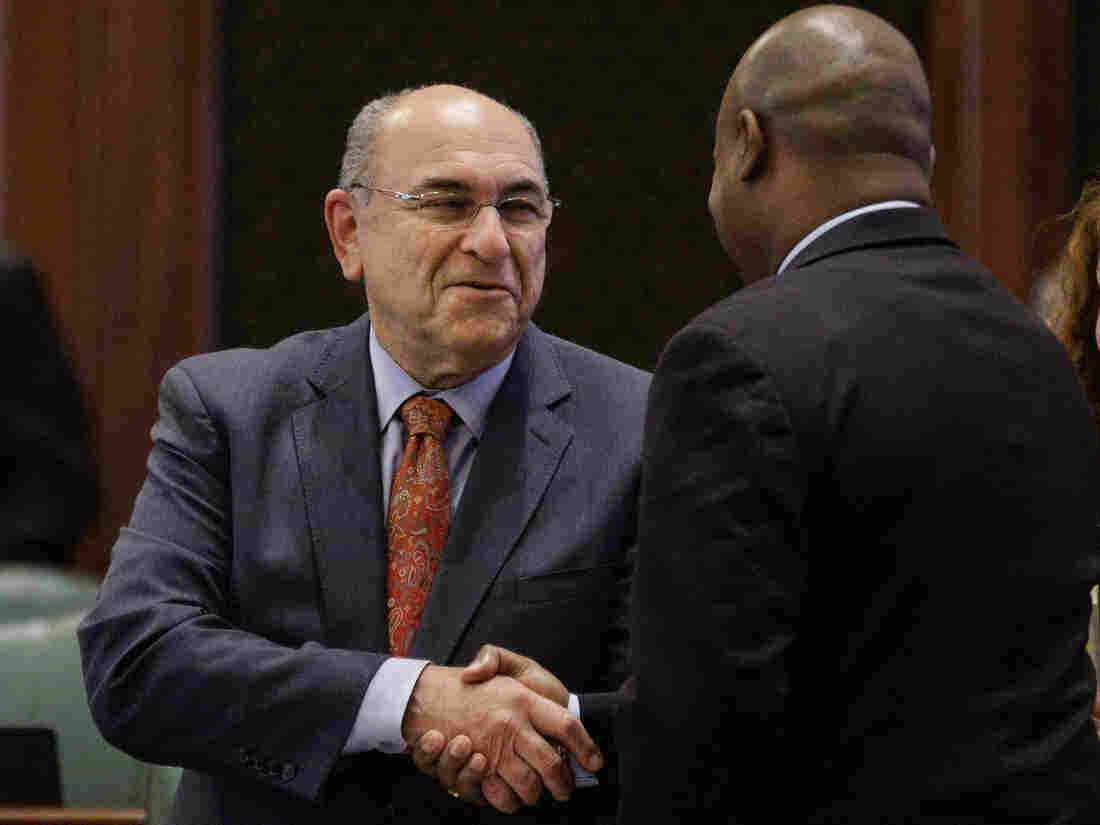
Illinois Rep. Louis Lang, D-Skokie speaks with colleagues on the House floor after the passage of a veto override on his heroin bill at the Illinois State Capitol in Springfield.

Illinois Rep. Louis Lang, D-Skokie speaks with colleagues on the House floor after the passage of a veto override on his heroin bill at the Illinois State Capitol in Springfield. Seth Perlman/AP hide caption

itoggle caption Seth Perlman/AP

Illinois lawmakers set aside their bitter partisan bickering Wednesday to override Republican Gov. Bruce Rauner’s partial veto of bill addressing the state’s heroin crisis.

Illinois has one of the highest rates of heroin overdose deaths in the country, and the Chicago area has led the nation in the number of emergency room visits related to heroin. And as we’ve recently reported, the heroin crisis has been growing worse as state funding for treatment programs has been cut.

The comprehensive Heroin Crisis Act would, among other things, allow the state’s Medicaid program to fully cover heroin addiction treatment.

Illinois is one of the few states that doesn’t allow Medicaid to pay for Methadone and other medication-assisted treatments. Methadone is one of a few drugs that can curb heroin cravings and treat painful withdrawal symptoms. Such medication is considered critical in helping users of heroin or other opioids overcome their addiction.

“It’s a monster, you know,” 47-year old Myron Boyd says of his heroin addiction. “It’s something that I wouldn’t wish on anyone.”

He says Medication-assisted treatment at the PEER Services treatment center in the Chicago suburb of Evanston is a vital part of Boyd’s recovery. “I feel like I’m privileged to be here,” Boyd says. “It’s been a lifesaver for me.”

The Illinois Consortium on Drug Policy estimates about 80% of those needing treatment for heroin or other opioid addictions don’t have health insurance to cover the cost of treatment. By extending Medicaid coverage to opioid addiction treatment, the federal government would have picked up much of the cost in Illinois.

But with the state in a deep budget crisis, Governor Rauner stripped out the measure to save money, as we reported last week.

Supporters call the veto shortsighted, arguing that every dollar spent on treatment saves 12 dollars in state prison, court and emergency room costs.

“In our zeal to save money, we must not forget about human life,” said State Rep. Lou Lang (D-Skokie), the chief sponsor of the Heroin Crisis Act.

Lang urged his fellow legislators Wednesday to override the governor’s veto. “Illinois is ground zero for heroin crisis in America. We’ve had more heroin deaths than any state in the nation.”

The Illinois house debate on the override measure, though brief, was emotional.

“Since this bill was passed just a few short months ago, I have attended two funerals of 25-year-olds who lost their lives to the heroin epidemic,” says State Rep. Kathleen Willis (D-Addison).

One of the funerals was of a constituent in her suburban Chicago hometown, she says, and the other was of a cousin who lived downstate. “There is not enough money that we can spend to save money,” Willis added. “It is impossible to put a price tag on it.”

Most members of the governor’s own party agree.

“Watching another kid left and right dying, overdosing over heroin, sickens me,” says Illinois House Republican Leader Jim Durkin of suburban Westchester. “It brings tears to many of our eyes and we have to do everything within our power to stop this and reverse this before it gets even more pervasive.”

As Amanda Vinicky of Illinois Public Radio reported, many drug treatment providers and advocates had feared the legislation addressing the heroin crisis would be another casualty of the bitter budget battle between Republican governor Rauner and powerful Illinois House Speaker Michael Madigan.

But the Illinois House voted 105-5 to override the governor’s veto.

“Finally people will get the treatment that they so desperately need,” says Kathie Kane-Willis, director of the Illinois Consortium on Drug Policy. “This legislation can be a model for the nation and I hope it will be.”

The override effort now moves to the Illinois Senate.

This entry passed through the Full-Text RSS service – if this is your content and you’re reading it on someone else’s site, please read the FAQ at fivefilters.org/content-only/faq.php#publishers.