
Articles by admin

No Image

What To Do With California's Mentally Ill Defendants?

Mentally ill prisoners too impaired to stand trial are supposed to be transferred to state mental hospitals for treatment within two or three months. But more than 300 in California are languishing in county jails because hospitals don't have the beds.

Mentally ill prisoners too impaired to stand trial are supposed to be transferred to state mental hospitals for treatment within two or three months. But more than 300 in California are languishing in county jails because hospitals don’t have the beds. Christian Schmidt/Corbis hide caption

itoggle caption Christian Schmidt/Corbis

In 2010, Rodney Bock was arrested for carrying a loaded gun into a restaurant in Yuba City, Calif., north of Sacramento. Bock had severe mental illness and was later found incompetent to stand trial. He was released on bail, but was rearrested after he failed to appear at a court hearing.

Bock, 56, was placed in the Sutter County jail, awaiting transfer to a state hospital. While there, he began suffering hallucinations. After more than two weeks in jail, Bock hanged himself.

Mentally ill defendants like Bock, who are declared incompetent to stand trial, are supposed to be transferred to state mental hospitals for treatment within two or three months. But more than 300 of them throughout California are languishing in county jails because there’s simply no bed space.

Bock’s daughters are now plaintiffs in a lawsuit filed by the American Civil Liberties Union, charging two state agencies, including the Department of State Hospitals, with denying mentally ill inmates their right to due process — and the treatment they need.

“Jail is simply too dangerous a place for these most vulnerable defendants,” said Micaela Davis, lead attorney in the lawsuit. “We have inmates that are waiting eight, nine months and sometimes over a year before being transferred to a facility for treatment.”

California’s new state budget includes more than $17 million to add beds for defendants declared incompetent to stand trial. But not everyone agrees that’s the best approach.

Stephen Manley is a mental health court judge in Santa Clara County. His court helps defendants struggling with severe mental illnesses, including bipolar disorder or schizophrenia, find alternatives to incarceration.

Manley doesn’t want more psychiatric hospital beds; he wants to reserve state hospitals for the most violent defendants.

We send far too many people to state hospitals who do not pose a risk to public safety,” he says, “because we don’t work with them to figure out if there isn’t a local alternative.”

Manley believes the psychiatric hospitals are already overcrowded — and understaffed. “As long as we keep overcrowding the hospitals, all we do is feed the fire,” he says, referring to violence within the hospitals.

Last year alone, there were more than 1,800 physical assaults at Napa State Hospital, a psychiatric institution in the heart of Northern California’s wine country. More than 80 percent of the patients there have been referred by the criminal justice system, and hospital officials say patients who are there to have their sanity restored for trial inflict the most serious injuries.

Ryan Navarre, with the organization representing Napa Hospital police, says that even officers are at risk. He recalls one patient specifically who put rocks into his socks and then spun them around “violently,” he says.

Throughout California, state psychiatric hospitals are working to find a balance between treatment and security for patients and staff.

Meanwhile, Manley thinks the best solution for nonviolent offenders is to create more community-based treatment facilities.

“If we add another 500 beds – and people — to a state hospital, all we do is make the problem worse,” he says.

But funding is already inadequate for mental health treatment. And creating more community-based programs raises new challenges — including resistance from neighbors who don’t really want to live near facilities whose clients are mentally ill criminal defendants.

This post was produced by KQED’s State of Health blog.

This entry passed through the Full-Text RSS service – if this is your content and you’re reading it on someone else’s site, please read the FAQ at fivefilters.org/content-only/faq.php#publishers.



No Image

Songs We Love: Buika Feat. Jason Mraz, 'Carry Your Own Weight'

Buika's new album, Vivir Sin Miedo, is available now.
4:11

Buika’s new album, Vivir Sin Miedo, is available now. JaviRojo/Courtesy of the artist hide caption

itoggle caption JaviRojo/Courtesy of the artist

Maria Concepción Balboa Buika, the vocalist known simply as Buika has an extraordinary voice. It’s based in flamenco, which she heard as a child on the Spanish island of Mallorca. But layered on top of that are a whole range of popular influences including jazz and R&B (she was once a Tina Turner impersonator in Las Vegas).

Buika has been gathering up new fans with every release since her first internationally released album in 2005. The album she dedicated to Mexican ranchera singer Chavela Vargas (2009’s El Último Trago, recorded with the Cuban pianist, Chucho Valdés) was a high-water mark, a mix of artistic interpretation and unbridled passion that almost made her a star. Yet after hearing her newest album Vivir Sin Miedo, I don’t think stardom is what is on her mind: she is obviously far more concerned about using her voice to explore an ever-expanding range of genres and styles.

The album features instrumentation that I would more expect from a singer like Cassandra Wilson, with Buika’s voice now floating amidst shimmering electric guitars and bluesy organ swirls. She is singing flawlessly in English, and of course there are now hints of hip-hop, not unexpected since she is of a generation that grew up with the music.

[embedded content]
YouTube

As “Carry Your Own Weight” make clear, Buika has also attracted some high profile admirers — in this case, Jason Mraz. Check out the video, then download the album and welcome to the amazing world of music that is Buika.

Vivir Sin Miedo is out now on Warner Music Latina.

This entry passed through the Full-Text RSS service – if this is your content and you’re reading it on someone else’s site, please read the FAQ at fivefilters.org/content-only/faq.php#publishers.


No Image

Today in Movie Culture: Homemade 'Star Wars: The Force Awakens' Trailer, Vin Diesel Plays 'Dungeons & Dragons' and More

Here are a bunch of little bites to satisfy your hunger for movie culture:

Dream Car of the Day:

Since all we’re talking about this week is Star Wars and Back to the Future, this Millennium Falcon car resembling a DeLorean designed by Robert Kovacs is the most fitting fan art right now (via DeviantArt):

Trailer Remake of the Day:

In between watching the new trailer for Star Wars: The Force Awakens again and again, check out this sweded version of the first teaser for the upcoming sequel:

[embedded content]

Movie Mashup of the Day:

Also Star Wars related, here’s a mashup of Darth Vader and Maleficent from Sleeping Beauty (and Maleficent) by James Zapata (via DeviantArt):

Alternate Poster of the Day:

If Lucasfilm wanted to go a little darker for its Star Wars: The Force Awakens poster, they couldn’t have gone wrong with this work by Christopher Shy (via Live for Films):

Supercut of the Day:

Okay, one more Star Wars thing, here’s a supercut of all the amputations, most made by lightsaber, from the first six movies (via Live for Films):

[embedded content]

Vintage Image of the Day:

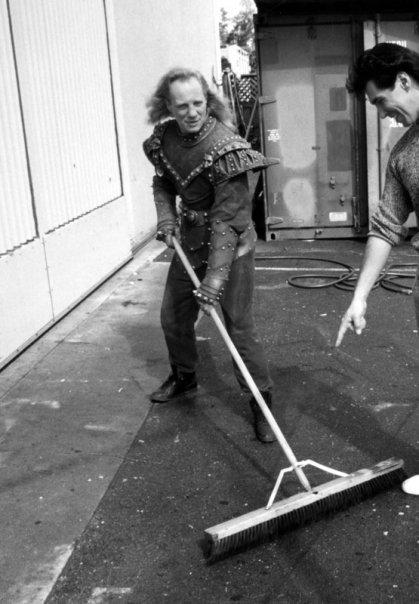
Wilhelm von Homburg, in his Vigo costume, was also apparently the janitor for the Ghostbusters II set (via Filmmaker IQ):

Movie Trivia of the Day:

Speaking of Ghostbusters, here are seven things you probably don’t know about the paranormal blockbuster:

[embedded content]

Movie Tie-in of the Day:

Vin Diesel is a huge Dungeons & Dragons geek, so Nerdist and Dungeon Master Matthew Mercer from Geek & Sundry arranged a game involving Diesel’s character from The Last Witch Hunter. Watch the lengthy tie-in below (via ComingSoon.net).

[embedded content]

Halloween Costume Idea of the Day:

Want to go as the Terminator from Terminator Genisys for Halloween this year? Get some makeup tips from Lisa Love, who was head of makeup on the movie, with the tutorial below:

[embedded content]

Classic Trailer of the Day:

Today is the 20th anniversary of the release of Kevin Smith‘s sophomore effort, Mallrats. Watch the original trailer for the movie, which featured a Stan Lee cameo before it was cool, below.

[embedded content]

Send tips or follow us via Twitter:

and

This entry passed through the Full-Text RSS service – if this is your content and you’re reading it on someone else’s site, please read the FAQ at fivefilters.org/content-only/faq.php#publishers.


No Image

Former Louisville Players, Recruits Say Assistant Coach Paid For Dorm 'Sex Parties'

Louisville Head Coach Rick Pitino has urged his former assistant coach Andre McGee to tell the truth about alleged dorm room sex parties.

Louisville Head Coach Rick Pitino has urged his former assistant coach Andre McGee to tell the truth about alleged dorm room sex parties. Maddie Meyer/Getty Images hide caption

itoggle caption Maddie Meyer/Getty Images

Earlier this month a self-described former escort named Katina Powell published a book, Breaking Cardinal Rules, that alleges a former Louisville assistant coach, Andre McGee, paid her to provide strippers at dorm room parties for basketball players and recruits from 2010-2014. Though the allegations generated enough buzz to trigger an internal investigation at Louisville, they were largely uncorroborated.

That is, until this morning when ESPN’s investigative arm, Outside the Lines, aired a report in which five former Louisville basketball players and recruits said they had attended dorm room parties where strippers — hired by McGee — were present. McGee also paid strippers extra to have sex with basketball players and recruits, according to the report.

A former recruit described the parties to Outside the Lines: “I knew they weren’t college girls. It was crazy. It was like I was in a strip club.”

ESPN’s reporting is based on an extensive interview with 42-year-old Powell, five former players and recruits (all of whom requested anonymity), and documents:

“Outside the Lines reviewed Powell’s journals, text messages and phone records and independently confirmed that text messages sent to Powell to arrange the parties came from McGee’s cellphone. Further, Outside the Lines has independently confirmed a wire transfer of $200 from McGee to Powell on one occasion.”

“I couldn’t make this up if I wanted to,” Powell, who said she felt like part of the Louisville basketball recruiting team, told ESPN. “I have no reason, or have the need, to lie on anyone. Everything I’m saying is 100 percent the truth.”

Powell said she had sex with one Louisville recruit, as well as some of the parents and guardians who accompanied the players on their university visits.

Outside the lines also spoke with two of Powell’s daughters, both of whom worked as dancers for their mother. They said they had also been paid to have sex with Louisville recruits, naming Russ Smith and Montrezl Harrell.

Harrell did not speak to ESPN for the report, but denied any involvement in a previous interview with the Houston Chronicle:

“Somebody told me my name was in there,” Harrell, now a rookie with the Houston Rockets, said. “It goes without saying, I don’t know anything about it. I didn’t too much stay at the dorm. I stayed off campus. I had a girlfriend off campus.”

Head Coach Rick Pitino has also denied knowing anything about the parties. In an interview with Yahoo! Sports, on Tuesday Pitino called for McGee to come forward and tell the truth about what transpired.

“The NCAA has asked me not to say anything on this matter and I will abide by it,” Pitino said. “But I will say one thing: there’s only one person who can speak on this matter, and that’s Andre McGee. He owes it to his teammates, coaches and the university to tell the truth. The truth has got to come out, and it can’t just be to the NCAA. He’s the only one with any answers.”

This entry passed through the Full-Text RSS service – if this is your content and you’re reading it on someone else’s site, please read the FAQ at fivefilters.org/content-only/faq.php#publishers.


No Image

New Guidelines Reflect Knowledge On Positives, Risks Of Mammograms

4:21

Download

NPR’s Audie Cornish talks with Kenny Lin, associate professor of family medicine at Georgetown University School of Medicine, about what the new mammogram guidelines mean on an individual level.

Transcript

AUDIE CORNISH, HOST:

Now, for women out there, we know that you have a lot of questions – what does this mean for me? Should I or shouldn’t I get a yearly mammogram? Well, to help us sort through some of the confusion, we’ve called on Dr. Kenny Lin. He’s associate professor of family medicine at Georgetown University’s School of Medicine. Welcome to the program.

KENNY LIN: Nice to be here.

CORNISH: So we heard in our report that the American Cancer Society still wants every women to talk to her doctor to figure out what makes the most sense. How do you interpret all this?

LIN: So I think what you’ve just said is probably the best way to describe it, that women should be talking to their doctors about mammography. It shouldn’t be automatic. It shouldn’t be reflexive. It shouldn’t be like the experience of many of my friends who are in their early 40s and they show up at their doctors and they get a slip and they say go get your mammogram. We instead should be raising the topic saying, look, we have this test. It could prevent you from either dying or having a serious illness from breast cancer. But it’s not perfect. It has, you know, many harms as well, including false positives, diagnosis of a breast cancer that may not ultimately be true cancer but something that we might have to act on. So it’s basically, I think, best viewed as an invitation to both patients and physicians to have that conversation if they haven’t been having it before.

CORNISH: There have been several studies that have shown that doctors really don’t talk all that much about the risks of cancer screenings. They don’t give numbers for how many people actually do benefit from the screenings. Do you think these guidelines will change that?

LIN: I hope they do. Now in defense of those doctors, it is a challenging conversation. There are a lot of numbers. There’s a lot of uncertainty about some of the numbers. I think that it can be helpful to present patients with either a handout or some sort of visual aid where you can show what the numbers really are for the benefits and the harms. And it’s something that I’ve been doing, but I think a lot of doctors haven’t been doing that and I’m hoping the new guidelines encourage them to because I think it’s really difficult to have this conversation without something to look at to really visually illustrate those numbers.

CORNISH: If your doctor doesn’t really initiate this discussion, what kinds of questions should you ask, right? I mean, this kind of relies on women thinking of their own family history, race or whatever and somehow divining risk factors. I mean, what should patients be thinking about?

LIN: Well, so the guideline that the ACS released was a guideline for average risk women who are defined as not having one of the breast cancer genes or not having a family history where you have several family members with breast cancer or a single member at a young age. So the rest of women are kind of lumped into this average risk category. And certainly there are things that may not be accounted for in risk assessment tools that may be important to someone. So I think a patient should go to their doctor and say, look, this is – you know, this is how I feel about mammography. This is, you know, my experience with cancer, my family history. Perhaps they don’t like having to go for repeated tests. You know, I’m worried about false positives. I think they should also ask their doctor, well, you know, what are really downsides to this test? I mean, that’s really I think the first question, you know, the doctors are always – we always volunteer the upsides but I think you have to ask specifically what are the downsides. And hopefully that will spark a conversation if your doctor seems otherwise inclined to gloss over it.

CORNISH: Well, what do you say to women who today are are frustrated, maybe even angry or upset, right, women who have had, like, annual mammograms for many years who’ve gone ahead with procedures that turned out to be unnecessary? I mean, was that a waste?

LIN: Well, it’s probably not a large consolation, but, you know, unfortunately in science this is kind of the way that things progress. We do the best we can with the information we have at a given time. And the same thing sort of happened for prostate cancer screening in men. It used to be something that you started at age 50, you do it every year, and now there’s organizations that say you don’t do it at all, or if you do it, you have to be aware of the downsides. So it’s something where it – I understand it can be frustrating to patients. But the greater error I think is to cling to an old guideline to say, well, we’re going to dig in our heels and keep starting at age 40 and doing it every year and ignore the new guideline because that would be, I think, a worse mistake. Look, we have to operate with the knowledge that we have. And I think the ACS has very comprehensively summarized what we know about mammography at the present time and their guidelines reflect that knowledge.

CORNISH: Kenny Lin is an associate professor of family medicine at Georgetown University’s School of Medicine. Dr. Lin, thanks so much for speaking with us.

LIN: You’re welcome.

Copyright © 2015 NPR. All rights reserved. Visit our website terms of use and permissions pages at www.npr.org for further information.

NPR transcripts are created on a rush deadline by a contractor for NPR, and accuracy and availability may vary. This text may not be in its final form and may be updated or revised in the future. Please be aware that the authoritative record of NPR’s programming is the audio.

This entry passed through the Full-Text RSS service – if this is your content and you’re reading it on someone else’s site, please read the FAQ at fivefilters.org/content-only/faq.php#publishers.


No Image

Can Beck's Be Labeled 'German' If It's Brewed In St. Louis? No, Judge Agrees

A judge has approved the settlement terms of a lawsuit over the way Anheuser-Busch labels its U.S.-made, German-style Beck's beer.
1:57

Download

A judge has approved the settlement terms of a lawsuit over the way Anheuser-Busch labels its U.S.-made, German-style Beck’s beer. Braca Nadezdic Fotografix/iStockphoto hide caption

itoggle caption Braca Nadezdic Fotografix/iStockphoto

Anheuser-Busch, the company behind both Budweiser and Beck’s, has agreed to settle a class-action lawsuit. The plaintiffs claim the megabrewer misled customers by trumping up Beck’s German roots and insinuating that it was an imported beer.

Now, for more than 100 years, Beck’s has been brewed in Germany. But in 2002, the company was bought up by big international brewers, eventually becoming part of Anheuser-Busch InBev, based in Belgium.

And, since 2012, Beck’s has also been made in St. Louis, which is definitely not in Germany. Which means the Beck’s you buy in the U.S. is definitely not an import.

But, the lawsuit claims, that didn’t stop Anheuser-Busch from charging import prices.

On Tuesday, a judge gave final approval to the settlement terms. Anheuser-Busch referred us to a June statement that reads in part, “AB brews Beck’s to the highest quality standards and is proud to employ the finest American brewmasters to produce Becks for the U.S. market.”

And if you bought Beck’s in the past few years and kept the receipts, you could get a partial refund: 50 cents back for every six-pack, up to $50 total.

In case you were wondering, $50 can buy you a couple of cases of Beck’s.

This entry passed through the Full-Text RSS service – if this is your content and you’re reading it on someone else’s site, please read the FAQ at fivefilters.org/content-only/faq.php#publishers.



No Image

'Star Wars: The Force Awakens' Trailer: Watch It Now

The new trailer for Star Wars: The Force Awakens is here — come and watch it.

[embedded content]

What’s so brilliant about these trailers so far is that they’re essentially showing us different angles of the same scenes, revealing little bits of info each time without showing much of the movie at all.

For the latest trailer, it’s really all about the voices. We hear Rey speak, we hear Finn speak and we hear Kylo Ren speak, all for the first time. Each line reveals a little something about the character — one’s a loner, one wants to fight for a cause and one wants to finish what someone else started.

And when it comes to Han, Luke and Leia, well here’s the big moment for all you old-schoolers.

What else did we learn?

Most badass moment? Yup, Kylo Ren and his troops lookin’ all mean and nasty in the pouring rain. Hands down.

We know Kylo Ren will fight without his mask on at some point.

And don’t you love how they’ve slowly revealed that one scene three separate ways. Each time we see it, there’s something new about it.

And we also know that Han and Chewbacca will be causing trouble, seen here in a scene where it looks like they’ve been captured.

Plus we now know that being captured by the First Order ain’t fun at all. Check out Kylo Ren torturing Oscar Isaac’s Poe Dameron something fierce.

On a lighter note, how cool is it to see Rey and Finn hangin’ on the Millennium Falcon for the first time?

And that Poe Dameron and Finn have a bit of a Han and Luke friendship going on.

What do you think of the trailer? Tell us your favorite moments.

This entry passed through the Full-Text RSS service – if this is your content and you’re reading it on someone else’s site, please read the FAQ at fivefilters.org/content-only/faq.php#publishers.

No Image

Oscar Pistorius Released From Jail

Oscar Pistorius was found guilty of culpable homicide, which is equivalent to manslaughter, in the 2013 shooting death of his girlfriend. After less than a year in jail, he was released to house arrest.

Oscar Pistorius was found guilty of culpable homicide, which is equivalent to manslaughter, in the 2013 shooting death of his girlfriend. After less than a year in jail, he was released to house arrest. Themba Hadebe/AP hide caption

itoggle caption Themba Hadebe/AP

South African sprinter Oscar Pistorius has been released from prison nearly a year after he was jailed for killing his girlfriend in 2013.

He will spend the remainder of his five-year sentence under house arrest.

NPR’s Ofeibea Quist-Arcton reports for the Newscast unit:

“Oscar Pistorius’s release on parole a day earlier than expected, under cover of darkness, means he’s now under what South Africa calls correctional supervision – at his uncle’s house in Pretoria, South Africa.

“Pistorius was convicted of the culpable homicide of his girlfriend Reeva Steenkamp, who he shot through a locked bathroom door on Valentine’s day in 2013. The athlete, who sprints on prosthetic legs, says he mistook her for an intruder. Prosecutors are seeking to have the manslaughter conviction converted to murder, which would carry a lengthy sentence and see Pistorius return to prison. South Africa’s Supreme Court of Appeal is due to hear the case in two weeks.”

As we previously reported, “Pistorius said he fired his gun because he wrongly believed a burglar had broken into their Pretoria home.” Prosecutors, however, maintain he shot Steenkamp during an argument.

A lawyer for the Steenkamps told South African media that Pistorius’ release does not affect their lives.

“Reeva is still not coming back. Whether Mr. Pistorius remains incarcerated or whether he is released, Reeva isn’t coming back so it doesn’t make a difference to them,” Koen said.

Pistorius, nicknamed “blade runner” for the carbon fiber prostheses that he uses during competition, attained global fame during the 2012 London Summer Olympics when he competed against able-bodied athletes and even qualified for the semifinal in the 400-meter race.

This entry passed through the Full-Text RSS service – if this is your content and you’re reading it on someone else’s site, please read the FAQ at fivefilters.org/content-only/faq.php#publishers.


No Image

What's Funny About The Business of Monkeys Picking Coconuts?

On Thailand's Samui Island, a macaque picks coconuts from a tree top. Captive monkeys are trained to help harvest coconuts on the island's plantations.

On Thailand’s Samui Island, a macaque picks coconuts from a tree top. Captive monkeys are trained to help harvest coconuts on the island’s plantations. Christophe Boisvieux/Corbis hide caption

itoggle caption Christophe Boisvieux/Corbis

If you’ve consumed coconut oil or coconut meat lately, there’s a reasonable chance it was imported from Thailand. And if it was, there’s an even better chance the farmer who grew that coconut had a monkey fetch it from a tall tree.

Thailand has been raising and training pigtailed macaques to pick coconuts for around 400 years. Coconut farmers in Sri Lanka, Malaysia, India and other countries in the region sometimes rely on monkeys, too.

Why monkeys? Turns out a male monkey can collect an average of 1,600 coconuts per day and a female can get 600, while a human can only collect around 80 per day. It’s also safer for a scampering, height-savvy monkey to pluck and drop the fruit from the trees — up to 80 feet tall — than a human, according to the National Primate Research Center at the University of Wisconsin, Madison.

We weren’t aware that monkeys were key to the Asian coconut industry — until Animal Place, a farm sanctuary in Grass Valley, Calif., contacted us in early October claiming that monkeys are being “exploited” on coconut plantations there. “Animal-aware people are increasingly avoiding coconut products that come from monkey slavery,” the group, which advocates a vegan diet, said.

[embedded content]
YouTube

While Animal Place says it has not actually visited any coconut plantations allegedly abusing monkeys, Marji Beach, the group’s education director, tells The Salt that YouTube videos are evidence enough that the animals are cruelly shackled and forced to work.

“What I find most distressing is that they take them from wild, keep them tethered and keep them that way their whole life,” says Beach. “Monkeys should stay in the wild.”

After making the monkey-coconut discovery on YouTube, Beach asked several companies that sell coconut oil or other products containing coconut in the U.S. if their suppliers used monkeys. Beach says all of the companies she contacted replied that they do not.

Monkey trainers in Thailand tell The Salt they find that hard to believe.

“It would be difficult to find a coconut product made in Thailand that wasn’t picked by a monkey,” Arjen Schroevers tells The Salt by email. Monkeys pick 99 percent of the Thai coconuts sold for their oil and flesh, he says.

A male monkey can collect up to 1,600 coconuts per day and a female can get 600, while a human can only collect around 80 per day on average.

A male monkey can collect up to 1,600 coconuts per day and a female can get 600, while a human can only collect around 80 per day on average. iStockphoto hide caption

itoggle caption iStockphoto

Schroevers runs the Monkey Training School in Surat Thani, Thailand, a Buddhist-inspired school founded 50 years ago to teach monkeys how to pick coconuts without the use of force or violence. He says Animal Place has it all wrong when it comes to how most monkeys that work on coconut farms are treated.

“It is always relaxed, no shouting, no punishing,” he says. “Every few trees the monkey hugs his owner, who then checks the monkey for red ants (who live in the trees) and the monkey gets a massage. Outside working hours the monkeys are kept as a pet (only for the family owners, to strangers they are not friendly).”

And as for the tethering, Schroevers says it serves a variety of purposes including guiding the monkeys up the tree and preventing them from escaping.

What’s more, says Schroevers, the alternative would be a human poking a long pole with a knife up into the tree to cut the coconuts. “Because the trees are so high, you must stand straight under the coconuts you want to collect,” he says. “They drop 6-12 at a time. Very dangerous!” (He adds that coconuts kill around 600 people per year worldwide.)

Of course, the working monkeys of Thailand have many similarly industrious counterparts in the animal world. Think oxen plowing fields, sheepdogs herding livestock, rottweilers guarding houses or beagles sniffing for drugs in airports. (Archaeologists say baboons once picked tree nuts in ancient Egypt.)

Others familiar with the coconut-picking monkeys of Thailand are also skeptical of the allegations of abuse. Leslie Sponsel is a professor emeritus of anthropology at the University of Hawaii who, with his wife, Dr. Poranee Natadecha-Sponsel, studied monkey-human relationships in Thailand and published papers on the topic.

“During our time in southern Thailand, we never observed or heard of cruelty or abuse of the monkeys,” Sponsel says. “Indeed, the monkeys are very similar to family pets, and for some households, even like family members to some degree. Young ones are trained, and they are kept on a chain tethered to the handler or to a shelter when not working. They are fed, watered, bathed, groomed and otherwise cared for. They often ride to the coconut palm plantation on the back of a motor bike or in a cart driven by the handler.

“That is not to say that there is never any cruelty or mistreatment,” Sponsel adds. But overall, he says he respects “the poor farmers and others who are just trying to survive and prosper in support of their families.”

What do you think? Let us know in the comments.

This entry passed through the Full-Text RSS service – if this is your content and you’re reading it on someone else’s site, please read the FAQ at fivefilters.org/content-only/faq.php#publishers.