
Articles by admin

No Image

Best of the Week: New 'Batman v Superman' Trailer, 'Captain America: Civil Wars' Images and More
The Important News

Marvel Madness: Entertainment Weekly gave us a new image from Captain America: Civil War. Stephany Folsom will write the screenplay for Thor: Ragnarok.

Star Wars Mania: Lin-Manuel Miranda co-wrote music for a Star Wars: The Force Awakens cantina scene.

Franchise Fever: Michael B. Jordan wants to return for Rocky/Creed movies. Universal’s Wolf Man installment for its new monsters franchise will arrive in March 2018. The next Friday the 13th movie got a new screenwriter.

Sequelitis: Gremlins 3 is still happening and will be set 30 years later. Christopher McQuarrie will return to direct Mission: Impossible 6. Adam McKay revealed ideas for Anchorman 3 and Talladega Nights 2.

New Directors/New Films: Ron Howard will direct The Girl Before. Jason Priestley is directing a Phil Hartman biopic. Barbara Streisand is directing a Catherine the Great biopic.

Casting Net: Reese Witherspoon is developing and might star in a Barbie doll origin story movie.

Box Office: Creed had the best opening of the Rocky franchise.

Reel TV: Fox picked up Sylvester Stallone’s new Rambo TV series.

Festival Fare: Sundance revealed its competition program for the 2016 festival.

Awards Seasoning: The National Board of Review named Mad Max: Fury Road the best movie of the year. The Academy Awards revealed this year’s documentary feature shortlist.

The Videos and Geek Stuff

New Movie Trailers: Batman v Superman: Dawn of Justice, The Nice Guys, Ride Along 2, I Saw the Light, Kickboxer: Vengeance and Exposed.

TV Spots: The Revenant.

Movie Clips: Batman v Superman: Dawn of Justice.

Watch: Behind-the-scenes featurette on Anomalisa. And a featurette from the new Marvel Cinematic Universe box set.

Learn: Why Han Solo might be a time traveler.

Watch: Amy Poehler and Tina Fey parody Star Wars: The Force Awakens.

Meet: The Star Wars: The Force Awakens character inspired by a dying fan.

Learn: How to avoid Star Wars: The Force Awakens spoilers on the internet.

See: Neil deGrasse Tyson explain his preference for Star Trek over Star Wars.

Watch: The Star Wars movies recapped. And recapped again a different way.

See: The Alamo Drafthouse modeled after the Death Star. And the abandoned original Star Wars sets before they’re destroyed.

Watch: Tom Hanks discusses the challenges of voicing Toy Story‘s Woody.

Learn: A new dance from Alvin and the Chipmunks: The Road Chip.

Watch: The Angry Birds Movie wishes you season’s greetings.

See: Chris Pratt and Dave Bautista’s Guardians of the Galaxy screen tests.

Watch: Movie characters cover Adele’s “Hello.”

Learn: How Peter Jackson is trying to save one man’s life.

See: The best new movie posters of the week. And some old school style Star Wars: The Force Awakens posters. And a new Deadpool poster.

Our Features

Monthly Movie Guide: See our December Movies Calendar above.

Star Wars Recap: We break out all the worthwhile Star Wars news from the past week.

Movie-Based TV Guide: Everything you need to know about upcoming TV shows based on movies.

Marvel TV Guide: How Jessica Jones promotes a B-list character to the A-list.

Comic Book Movie Guide: Get to know Doomsday, the villain of Batman v Superman: Dawn of Justice.

Geek Movie Guide: 5 questions we have after watching the Batman v Superman: Dawn of Justice trailer.

Sci-Fi Movie Guide: Why it’s time for a Fallout movie.

R.I.P.: We remembered the reel-important people who died in November.

Home Viewing: Here’s our guide to everything hitting VOD this week. And here’s our guide to everything hitting Netflix Watch Instantly this month. And here’s our guide to the best holiday DVDs for this season.

and

MORE FROM AROUND THE WEB:

This entry passed through the Full-Text RSS service – if this is your content and you’re reading it on someone else’s site, please read the FAQ at fivefilters.org/content-only/faq.php#publishers.


No Image

Frenzied Media Pore Over Home Of San Bernardino Killers During Live Broadcasts

News media stand outside the home of San Bernardino shooters Syed Farook and Tashfeen Malik in Redlands, Calif., on Friday.
3:50

Download

News media stand outside the home of San Bernardino shooters Syed Farook and Tashfeen Malik in Redlands, Calif., on Friday. Mario Anzuoni/Reuters/Landov hide caption

toggle caption Mario Anzuoni/Reuters/Landov

A story about a deadly terrorist attack briefly inspired a frenzied media scrum Friday morning in Southern California when dozens of reporters and TV news crews entered the home of the two shooters in the San Bernardino massacre.

NPR’s Nate Rott spoke to the landlord at the shooters’ apartment in nearby Redlands after the scrum began. The landlord says he allowed journalists into the home of Syed Farook and Tashfeen Malik after it was returned to his control by federal law enforcement officials. Reporters quickly held up photographs to the camera, picked up documents and generally tramped throughout a site that had still been considered part of an active federal investigation just hours earlier.

While all three major cable networks showed footage, MSNBC was particularly aggressive, claiming it had broadcast an exclusive with its footage, shown only a few minutes before its competitors. Indeed, MSNBC’s Kerry Sanders complained that rival news teams were “a-pushing and a-shoving.”

MSNBC's Kerry Sanders does a live broadcast from inside the home.

MSNBC’s Kerry Sanders does a live broadcast from inside the home. Justin Sullivan/Getty Images hide caption

toggle caption Justin Sullivan/Getty Images

He subsequently held up photographs from the apartment, presumably of family and friends, and even showed a California driver’s license of the mother of the male shooter. Her identifying characteristics, including her date of birth, address, eye color and the like, were clearly visible on screen.

MSNBC issued a statement Friday afternoon apologizing in part for its broadcast: “Although MSNBC was not the first crew to enter the home, we did have the first live shots from inside. We regret that we briefly showed images of photographs and identification cards that should not have been aired without review.”

It was a notable acknowledgement of the absence of editorial discretion. CNN took a victory lap by issuing its own statement citing a “conscious editorial decision not to show close-up footage of any material that could be considered sensitive or identifiable.” Fox similarly broadcast images from the shooters’ home but did not show images of the IDs.

Regardless, the scene was chaotic on all the networks, as though they were broadcasting live streams of reporters picking up scattered tiles of a mosaic and examining them one by one, without any hope of context or meaning.

A reporter takes a photo of a dining room table inside the home in Redlands.

A reporter takes a photo of a dining room table inside the home in Redlands. Justin Sullivan/Getty Images hide caption

toggle caption Justin Sullivan/Getty Images

People on social media complained in real time, accusing journalists of voyeurism or worse. CNN’s Anderson Cooper looked visibly uncomfortable, and Wolf Blitzer later said, “I’ve certainly never seen anything like this.” One of CNN’s law enforcement analysts watching the video live said, “I am so shocked I cannot believe it,” though he appeared to be referring as much to the decision by law enforcement officials to walk away from the killers’ home as to the reporters’ activities.

At a later press conference, David Bowdich, assistant director of the FBI office in Los Angeles, said his team had extracted all relevant evidence and no longer had any interest in the apartment.

The landlord told a local CBS station that the media had “rushed in” — that he had not let all those reporters in. MSNBC’s Sanders told viewers that the TV tabloid show Inside Edition had paid $1,000 to get in and that everyone streamed in with its crew. (A spokesperson for Inside Edition declined an NPR request for comment.)

Property landlord Doyle Miller speaks to members of the media outside Farook and Malik's home.

Property landlord Doyle Miller speaks to members of the media outside Farook and Malik’s home. Robyn Beck/AFP/Getty Images hide caption

toggle caption Robyn Beck/AFP/Getty Images

After about 20 minutes, the circus had devolved to outright farce. A CNN producer told Blitzer that the throng in the apartment was no longer composed simply of journalists, but of curious onlookers: “There’s a woman with a dog walking into the house.”

NPR producer Becky Sullivan contributed reporting to this story.

This entry passed through the Full-Text RSS service – if this is your content and you’re reading it on someone else’s site, please read the FAQ at fivefilters.org/content-only/faq.php#publishers.


No Image

The World Is A Safer Place — Except Where It's Not

Traffic in Beijing.

And now, some heartening news in the global health world: Injuries are down by a pretty big chunk.

“Injury” in this case encompasses everything from car accidents and falls to suicides and gunshot wounds. Since 1990, the world has managed to cut down the number deaths and disabilities caused by all these factors by a third, according to a report published Thursday in the British Medical Journal.

“As for what has brought about this change, we can only speculate,” says Theo Vos, a professor of global health at the University of Washington and the report’s senior author. “For example, we’ve seen a huge decline in suicide in China, whereas in India that is not the case.” Going forward, researchers will have to dig beyond the statistics to figure out why some countries are doing better than others.

But while the stats look good overall, he says, “there are a number of parts of the world that are lagging behind,” Vost says. In many developing countries, road accidents are up — especially in parts of South America, sub-Saharan Africa and South Asia. In South Africa, for example, over 13,000 people died in road accidents in 2010.

That’s likely because more people in the developing world are moving into cities and frequenting not-so-safe city roads, Vos says. “It’s true that cars are probably safer today than they were 20, 30 years ago,” he notes. “But maybe some of these countries in southern Africa, West Africa and South America need to see what they can do to improve road safety.”

To do that, countries that are lagging behind need to look to places like Sao Paolo, Brazil. says Claudia Adriazola, who researches urban transportation and road safety at the World Resources Institute. The city’s mayor has reduced speed limits across the city and added more sidewalks and bike lanes. “Maybe more cities can start doing similar things,” she says.

And maybe global health organizations can start thinking differently about how they allocate their funds. Dollars traditionally go to combating infectious diseases like AIDS and Ebola. But improving road safety as well as emergency medical care is also critical, says Michael Haglund, a neurosurgeon at Duke University who has been helping train surgeons in East Africa.

“I totally get that some of these developing countries have to first take care of things like malaria, tuberculosis and HIV,” Haglund says. “But now we’re starting to reign in some of those infectious diseases.”

If developing countries started allocating a fraction of what they spend trying to contain and cure those diseases into improving surgical care, Haglund notes, they’d be able to reduce the number of preventable deaths from car accidents, falls and other common injuries.

“Once you’re injured, if you’re in the U.S. you’re probably in the emergency room right away, within minutes,” Haglund says. “Imagine you get injured in northern Uganda and it takes 12 hours to get to the nearest hospital for surgery. A simple neck fracture or a blood clot can easily be fixed, but only if you’re able to treat it quickly.”

This entry passed through the Full-Text RSS service – if this is your content and you’re reading it on someone else’s site, please read the FAQ at fivefilters.org/content-only/faq.php#publishers.


No Image

Today in Movie Culture: Han Solo Is a Time Traveler, Movie Characters Cover Adele's “Hello” and More

Here are a bunch of little bites to satisfy your hunger for movie culture:

Star Wars Supercut of the Day:

Vulture compiled all of the dialogue spoken by a female character other than Princess Leia in the original Star Wars trilogy and it’s barely a minute in length:

[embedded content]

Star Wars Science of the Day:

Kyle Hill of Nerdist’s Because Science makes a case that Han Solo of the Star Wars movies is a time traveler:

[embedded content]

Year-End Recap of the Day:

Another day closer to 2016, another great montage of the movies of 2015. This one is by Nick Bosworth for JoBlo.com:

[embedded content]

Movie Mashup of the Day:

Is Adele‘s “Hello” still great without Adele’s voice? Yes, if it’s covered by all your favorite movie characters instead (via Pajiba):

[embedded content]

Vintage Image of the Day:

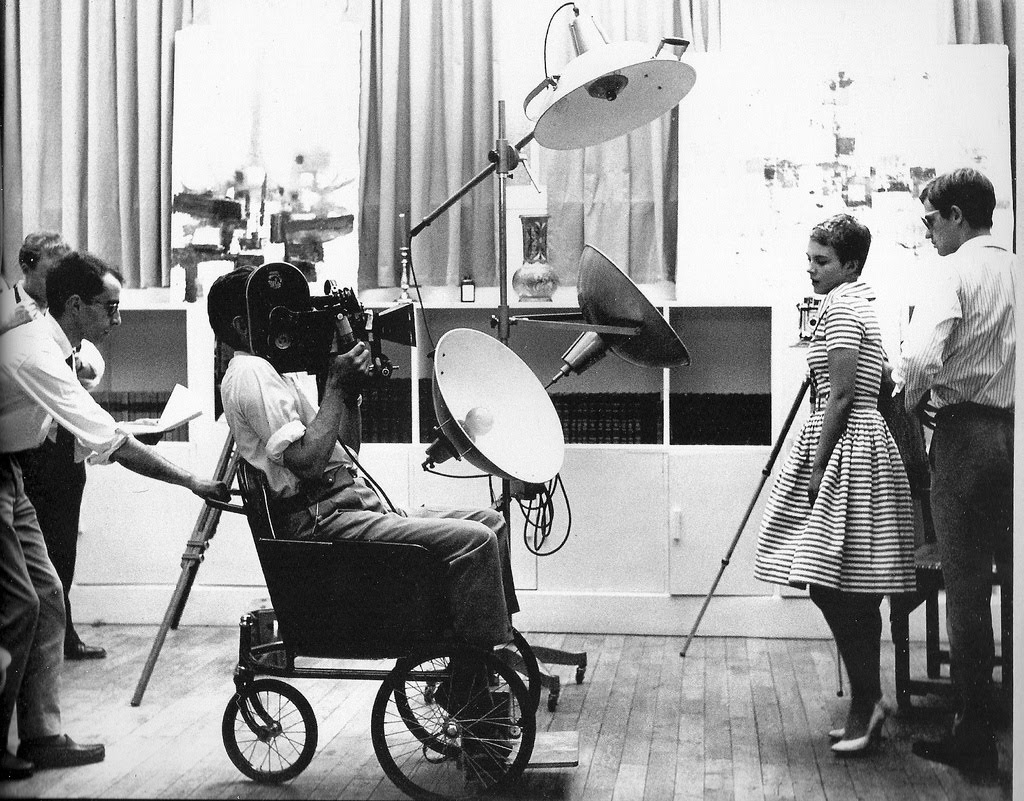
Jean-Luc Godard, who turns 85 today, pushes a cameraman in a wheelchair for a shot of Jean-Paul Belmondo and Jean Seberg in his feature debut, Breathless, in 1959.

Video Essay of the Day:

It’s always fascinating to watch actors portray actors on the screen, especially if the characters are bad actors. See both in this video essay by Phil Whitehead titled “Actors Playing Actors Acting” (via Live for Films):

[embedded content]

Movie Comparison of the Day:

Just in time for the holiday season, here’s a video that shows how Die Hard and It’s a Wonderful Life are nearly the same movie (via One Perfect Shot):

[embedded content]

Alternate Movie Poster of the Day:

Forget all about that RoboCop reboot with this awesome poster design for the original by Matt Ferguson for Grey Matter Art (via Geek Art):

Movie Trivia of the Day:

In honor of this year’s 20th anniversary, CineFix shares seven things you may not know about Clueless:

[embedded content]

Classic Trailer of the Day:

This week is the 35th anniversary of the theatrical release of Superman II … in Australia. Yes, it opened Down Under first, about six months prior to its U.S. release. Watch the original trailer for the superhero movie sequel accompanied by Australian cinema info in the TV ad below:

[embedded content]

Send tips or follow us via Twitter:

and

This entry passed through the Full-Text RSS service – if this is your content and you’re reading it on someone else’s site, please read the FAQ at fivefilters.org/content-only/faq.php#publishers.

No Image

2 More Top FIFA Officials Arrested, 16 Indicted In Corruption Probe

Now-suspended FIFA President Sepp Blatter (left) congratulates Juan Angel Napout after Napout was confirmed as president of CONMEBOL earlier this year.

Now-suspended FIFA President Sepp Blatter (left) congratulates Juan Angel Napout after Napout was confirmed as president of CONMEBOL earlier this year. Jorge Saenz/AP hide caption

toggle caption Jorge Saenz/AP

Swiss police, on behalf of U.S. authorities, arrested two FIFA vice presidents, Alfredo Hawit of Honduras and Juan Angel Napout of Paraguay, in a dawn raid at a hotel in Zurich on Thursday. Hours later, U.S. Attorney General Loretta Lynch announced that a federal grand jury in Brooklyn, N.Y., had returned a new 92-count superseding indictment of 16 men, including Hawit and Napout. Combined with the officials indicted in May, there are now 27 people named in the charging document.

Seven officials named in Thursday’s announcement are from North America’s soccer federation, CONCACAF, and nine are from South America’s federation, CONMEBOL. Of the 16 new defendants, all of whom are facing charges including racketeering, five are current or former members of the FIFA executive committee.

“The betrayal of trust set forth here is outrageous. The scale of corruption alleged herein is unconscionable,” Lynch said at a press conference.

The two men arrested in Zurich Thursday — Hawit, the president of CONCACAF, and Napout, the president of CONMEBOL — are suspected of taking millions of dollars in bribes linked to television rights. Lynch said the new charges primarily involve officials in Central and South America. With the arrests of the two officials, three consecutive presidents of both CONCACAF and CONMEBOL have all been indicted on corruption and conspiracy charges. Lynch addressed the cyclical nature of the corruption in her remarks.

“Consistent with the intergenerational nature of the corruption schemes, they involve payments relating to tournaments that have already been played, as well as matches scheduled into the next decade — including multiple cycles of FIFA World Cup qualifiers and international friendly matches involving six Central American member associations,” Lynch said.

Lynch also said that eight defendants, including former CONCACAF President Jeffrey Webb, had decided to plead guilty.

The arrests overshadowed FIFA’s same-day announcement that it had approved a series of reforms aimed at cleaning up the scandal-ridden soccer-governing body. The proposed changes would set term limits, implement “integrity checks,” distinguish between management and policy positions, and promote more women with the goal of increasing diversity.

Interim President Issa Hayatou, who is heading the executive committee while beleaguered FIFA President Sepp Blatter serves a 90-day suspension, said the FIFA executive committee met as scheduled on Thursday, despite the absences of Hawit and Napout.

“The events underscored the need to establish a complete program of reforms for FIFA today,” Hayatou told reporters, according to the Associated Press. “These recommendations mark the beginning of a change of culture in FIFA. A great step forward has been taken.”

FIFA released a statement saying it was “aware of the actions taken today by the U.S. Department of Justice” and that it “will continue to cooperate fully with the U.S. investigation as permitted by Swiss law, as well as with the investigation being led by the Swiss Office of the Attorney General.”

Thursday’s arrests are just the latest in the investigation into FIFA’s corruption. In May, seven top-level officials were arrested in Zurich, where FIFA is headquartered. In September, FIFA issued a lifetime ban to Jack Warner, also a former head of CONCACAF, who was one of the officials indicted in May. In October, several key FIFA sponsors including Coca-Cola and McDonald’s called for Blatter’s resignation.

The longtime FIFA president did not resign, but he was suspended later in October after Switzerland announced that it had opened criminal proceedings against him. He has repeatedly denied wrongdoing.

In November, the former head of Brazil’s soccer federation, Jose Maria Marin, who was one of the officials arrested in May, was extradited to the U.S. to face charges of bribery. He was the second official to be extradited in the probe, after Webb in July.

This entry passed through the Full-Text RSS service – if this is your content and you’re reading it on someone else’s site, please read the FAQ at fivefilters.org/content-only/faq.php#publishers.


No Image

Federal Jury Hands Down Rare Conviction For Coal Executive

1:39

Download

A federal jury has convicted former Massy Energy CEO Don Blankenship for conspiring to willfully violate mine safety standards at the Upper Big Branch mine, site of a 2010 explosion that killed 29 people. The misdemeanor charge carries a sentence of up to one year in prison. He was acquitted of two more serious charges involving securities fraud and making false statements.

Transcript

ROBERT SIEGEL, HOST:

In West Virginia, a federal jury has convicted former Massy Energy CEO Don Blankenship of conspiring to willfully violate federal mine safety laws. The case concerned the Upper Big Branch mine. In 2010, an explosion there killed 29 miners. Convictions like this are rare among top coal executives. From West Virginia Public Broadcasting, Ashton Marra has more.

ASHTON MARRA, BYLINE: Dozens of West Virginians gathered outside the Charleston courthouse awaiting the verdict – guilty on one misdemeanor charge, not guilty on two felony counts.

SHIRLEY WHITT: They did say guilty, so he’s not walking away from this.

MARRA: Shirley Whitt lost her brother in the mine explosion that sparked the investigation into Massey Energy and its CEO. The two felony charges were for allegedly lying to investors and securities officials. But U.S. attorney Booth Goodwin maintains the misdemeanor conviction is still a victory.

BOOTH GOODWIN: I’m not, in any way, disappointed with this result. I think it brings justice and justice that was long overdue.

MARRA: The prosecution had tied the felony charges to company generated documents about safety which the defense argued could not be traced to Blankenship himself. Bill Taylor is Blankenship’s lead attorney.

(SOUNDBITE OF ARCHIVED RECORDING)

BILL TAYLOR: There’s never been a charge of securities fraud based upon the kind of subjective language like that. You know, there was a quality of make-it-up-as-you-go-along in this case.

MARRA: No further charges are expected in the Massey investigation. Blankenship’s attorneys, however, say they will appeal the misdemeanor conviction. Sentencing is scheduled for March. For NPR News, I’m Ashton Marra in Charleston, W. Va.

Copyright © 2015 NPR. All rights reserved. Visit our website terms of use and permissions pages at www.npr.org for further information.

NPR transcripts are created on a rush deadline by a contractor for NPR, and accuracy and availability may vary. This text may not be in its final form and may be updated or revised in the future. Please be aware that the authoritative record of NPR’s programming is the audio.

This entry passed through the Full-Text RSS service – if this is your content and you’re reading it on someone else’s site, please read the FAQ at fivefilters.org/content-only/faq.php#publishers.


No Image

Hospital Injury Rates Plateau, After 3 Years Of Decline

Behind-the-scenes work to reduce injuries and infections in hospitals has paid off. Further improvements may be more challenging.

Behind-the-scenes work to reduce injuries and infections in hospitals has paid off. Further improvements may be more challenging. iStockphoto hide caption

toggle caption iStockphoto

The rate of avoidable complications affecting patients in hospitals leveled off in 2014, after three years of declines, according to a federal report released Tuesday.

Hospitals have averted many types of injuries where clear preventive steps have been identified, but they still struggle to avert complications with broader causes and less clear-cut solutions, government and hospital officials said.

There were at least 4 million infections and other potentially avoidable injuries in hospitals last year, the study estimated. That translates to a preventable problem in about 12 of every 100 hospital stays.

Among the most common complications that were measured — each occurring a quarter million times or more — were bedsores, falls, bad reactions to drugs used to treat diabetes and kidney damage that develops after contrast dyes are injected through catheters to help radiologists take images of blood vessels.

The frequency of hospital complications last year was 17 percent lower than in 2010 but the same as in 2013, indicating that some patient safety improvements made by hospitals and the government are sticking. But the lack of improvement raised concerns that it is becoming harder for hospitals to further reduce the chances that a patient may be harmed during a visit.

“We are still trying to understand all the factors involved, but I think the improvements we saw from 2010 to 2013 were very likely the low-hanging fruit, the easy problems to solve,” said Dr. Richard Kronick, director of the federal Agency for Healthcare Research and Quality, or AHRQ, which conducted the study.

The Obama administration has been focusing on lowering the rates of medical infections and injuries as it tracks a slew of patient safety initiatives created by the 2010 federal health law. Those include Medicare penalties for poor-performing hospitals, wider use of electronic records to help track patient care and prevent mistakes, and grants to collaborations of medical providers formed to improve the quality of patient care and identify the best ways of addressing each type of problem.

The AHRQ report calculated national rates for 27 specific complications by extrapolating from 30,000 medical cases that officials examined. Decreases in infections, medicine reactions and other complications since 2010 have resulted in 2.1 million fewer incidents of harm, 87,000 fewer deaths and $20 billion in health care savings, the report concluded.

“Those are real people that are not dying, getting infections or other adverse events in the hospital,” said Dr. Patrick Conway, chief medical officer for the Centers for Medicare & Medicaid Services.

Some of the most significant progress was made in lowering the number of infections from central lines inserted into veins — down 72 percent from 2010. Medical researchers have proven that these infections can be virtually eliminated if doctors and nurses follow a clear set of procedures.

Infections from urinary catheters decreased by 38 percent and surgical site infections dropped by 18 percent. In all three cases, the reductions exceeded the goals set by the administration. Conway noted that hospitals had a financial motivation to cut these infections as they are used to determine whether hospitals get Medicare bonuses and penalties each year.

However, hospitals have not made headway in trimming the numbers of falls or pneumonia cases in patients breathing through mechanical ventilators, the report found. And the rates of adverse drug reactions and complications during childbirth were higher than what the administration estimated they should be for 2014.

Conway said that complications are difficult to address because they involve tradeoffs that can cause other problems. For instance, he said, hospitals have to balance efforts to reduce falls with the need to help unstable patients improve their ability to walk. “We’ve got to work with providers to figure out what’s the sweet spot that can keep mobilization occurring but decrease the rate of falls,” he said.

Even though overall complication rates were flat, the report found that some types of injuries became less common in 2014. One was the number of blood clots that form after surgery and travel to the lung; those rates dropped by 30 percent in a year.

In some areas, the report is more optimistic about infection declines than is the Centers for Disease Control and Prevention, which tracks the same infections but uses different methods and different years of comparison. The CDC has reported that urinary tract infections caused by catheters became slightly more prevalent through 2013, while the AHRQ method has found a substantial drop, said Dr. Jennifer Meddings, an assistant professor at the University of Michigan Health System who studies hospital infections. “This is what’s very confusing to hospitals,” she said. “Different data gets picked in different reports.”

Maulik Joshi, an executive at the American Hospital Association, predicted that complications will become even rarer in future years. “Hospitals are working on projects that are just not reflected in these data points,” he said.

But a few conditions became more prevalent in 2014. Infections from methicillin-resistant Staphylococcus aureus bacteria, known as MRSA, increased by 55 percent to an estimated 17,000 incidents last year. The number of times a catheter punctured a femoral artery during an angiography increased by 25 percent to 74,000, the report estimated.

“We think we addressed a lot of the areas where there was a strong evidence base on how to improve patient safety,” Conway said. “We’ll now have to tackle that next wave that has multiple causes.”

This entry passed through the Full-Text RSS service – if this is your content and you’re reading it on someone else’s site, please read the FAQ at fivefilters.org/content-only/faq.php#publishers.


No Image

Watch: New 'Batman v Superman' Trailer Reveals Doomsday and a Ton More

The second full-length trailer for Batman v Superman: Dawn of Justice has dropped, and it’s a doozy. There’s a lot to devour in this one, starting with our first look at the dynamic between Bruce Wayne and Clark Kent — and Lex Luthor (Jesse Eisenberg), who’s much different from any other previous version we’ve seen of the character — as well as another major villain many expected would make an appearance: Doomsday.

Watch the full trailer below.

[embedded content]

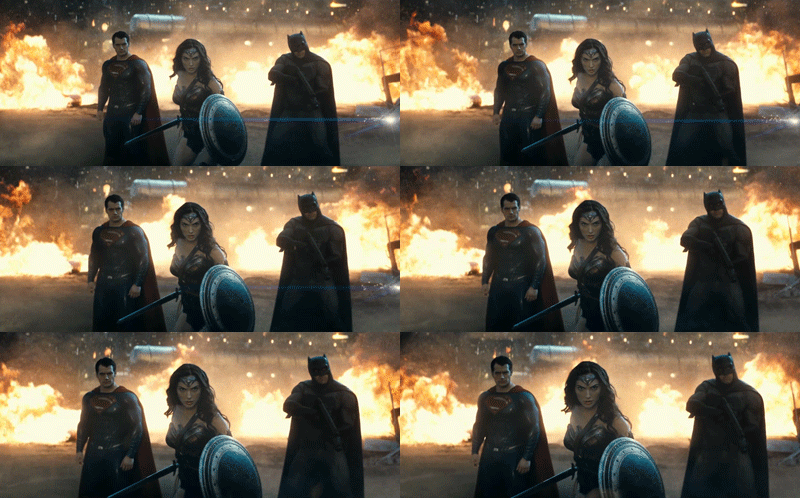
Another huge part of the new trailer is Wonder Woman, who we see get in on the Doomsday action and kinda save both Supes and Bats, but unlike Wayne and Kent, we don’t see the dressed-down version of Wonder Woman, Diana Prince.

But this is still a pretty cool moment…

The biggest debate when it comes to this trailer will be Lex Luthor, who’s campy and cheekier than we’ve seen him in the past. Less Kevin Spacey’s Luthor and more comedic like Gene Hackman’s Luthor. Is he too over the top, or is that the whole point? To make him slimy, unlikable and, eventually, maniacal?

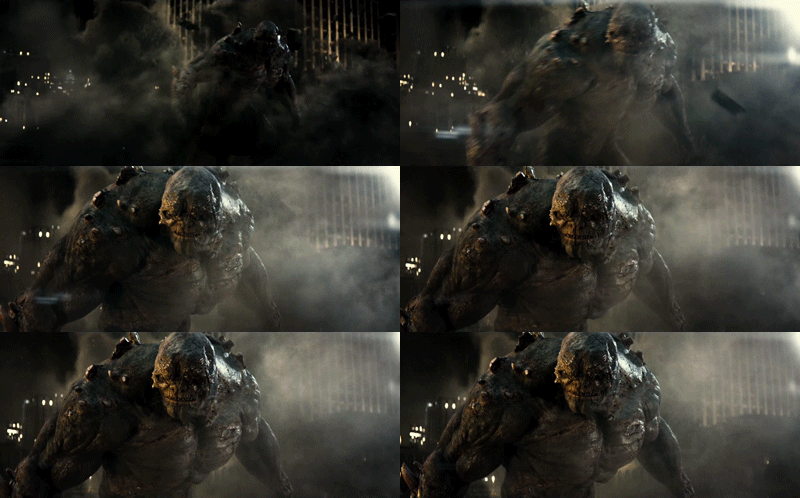
And then there’s Doomsday! The fans have wanted to see Doomsday in one of these movies badly. Well, here he is. And he ain’t happy.

Lots to devour. What do you think?

Batman v Superman: Dawn of Justice hits theaters on March 25, 2016.

This entry passed through the Full-Text RSS service – if this is your content and you’re reading it on someone else’s site, please read the FAQ at fivefilters.org/content-only/faq.php#publishers.


No Image

Facebook Founder's Philanthropic Aspirations Highlighted In Announcement

3:52

Download

NPR’s Robert Siegel talks with Dale Russakoff, author of the book, The Prize, about what lessons Zuckerberg learned from his $100 million donation to fix Newark, N.J., schools.

Transcript

ROBERT SIEGEL, HOST:

When Mark Zuckerberg and his wife, Priscilla Chan, announced the birth of their daughter, they also announced that they plan to give away 99 percent of their Facebook shares to charity. In an open letter to their newborn daughter, Maxima, they wrote about what they hope to accomplish and how they’re going to do it. For people who follow the Facebook founder closely, the details reveal a lot about what he’s learned since he donated a hundred million dollars to fix Newark, N.J.’s public schools back in 2010. That effort was widely seen as falling far short of its goals. Dale Russakoff wrote about it in a book called “The Prize.”

DALE RUSSAKOFF: What I found interesting from the very beginning was, you know, he was disarmingly open about how little he knew about philanthropy. He was 26 years old and he said that the goal of this gift was, you know, first of all, to try to help Newark and Newark students, but he wanted to use it as a chance to learn to become a better philanthropist.

SIEGEL: Well, when you saw the open letter yesterday, what struck you as evidence of lessons that he took away from the Newark experience?

RUSSAKOFF: Well, the first two principles were – seem to be drawn very directly from lessons learned from the problems they had in Newark. The first one, they think that philanthropy has to be for the long-term. I mean, 25, 50, 100 years – and the Newark gift was supposed to be a five-year gift in which they were going to not only turn around the Newark schools but come up with a model that could be used in every district in the country to turn around all the failing schools in urban America. I don’t know that they ever expected to accomplish that in the first place, but five years is not enough time to do that even in one city. And then the second principle was that they wanted to make sure that, you know, in doing philanthropy, that they were engaged from the beginning with the people who they were trying to serve – the community – and that they had to know their needs and their desires in order to serve them and in order to help empower them. And I think one of the real problems in Newark was that there was no – almost no community involvement and that the entire agenda was planned without the input of anyone who had ever taught in the Newark schools or had a child in the Newark schools, and there was tremendous, explosive resistance in Newark that at various points, imperiled the whole effort.

SIEGEL: I wonder if they’ve derived a lesson from the scale of the gift compared to the institution they were giving to. That is, a hundred million dollars is a huge amount of money, but the Newark public schools spend about a billion dollars a year.

RUSSAKOFF: That’s right. In over five years, a hundred million dollars is only 2 percent of what the district schools were already spending. So, you know, they were talking about trying to change the systems in the school – the management systems. And I think they had hoped that by changing systems and changing incentives and having better data and better evaluation systems and better pay systems, to reward teacher excellence – that all of those things would translate into better student performance. And I think they realized that you have to do a lot more in the community and the neighborhoods and in the lives of the kids as well as in the system of the schools.

SIEGEL: Why a new philanthropic organization? Zuckerberg and Priscilla Chan are 31 and 30. They’re not very experienced in charitable works even with the experience of Newark. They could have given the money to the Bill and Melinda Gates Foundation instead. What’s the point of creating a new philanthropic institution do you think?

RUSSAKOFF: Well, I think that they want to do things differently. You know, they’re – what they’re looking at in education is very different from what Bill Gates is looking at. And they want to do not just charitable investments but, you know, perhaps some profit-making investments to develop technologies that they think can make a different. So it’s not a foundation, it’s a – kind of a hybrid organization, it’s an LLC.

SIEGEL: Dale Russakoff, thanks for talking with us about it.

RUSSAKOFF: Oh, thanks for having me.

SIEGEL: Dale Russakoff is author of the book “The Prize.” It’s about Newark, N.J.’s attempt to fix its schools with a hundred million dollar donation from Mark Zuckerberg.

Copyright © 2015 NPR. All rights reserved. Visit our website terms of use and permissions pages at www.npr.org for further information.

NPR transcripts are created on a rush deadline by a contractor for NPR, and accuracy and availability may vary. This text may not be in its final form and may be updated or revised in the future. Please be aware that the authoritative record of NPR’s programming is the audio.

This entry passed through the Full-Text RSS service – if this is your content and you’re reading it on someone else’s site, please read the FAQ at fivefilters.org/content-only/faq.php#publishers.

No Image

Remembering The Forgotten Of The Sports World

Yes, the Little Brown Jug harness race lives on. The horse in the lead here, Vegas Vacation, driven by Brian Sears, holds on to win the 2013 race in Delaware, Ohio.
2:59

Download

Yes, the Little Brown Jug harness race lives on. The horse in the lead here, Vegas Vacation, driven by Brian Sears, holds on to win the 2013 race in Delaware, Ohio. Mark Hall /AP hide caption

toggle caption Mark Hall /AP

Sports gets bigger all the time, everywhere. But even with a superabundance of sport, that’s not enough to satisfy our appetites, and so now we have to have make-believe sport, too. Who would’ve ever thought we would bet real money on our sports fantasies?

Maybe H.L. Mencken was right when he said: “I hate all sports as rabidly as a person who likes sports hates common sense.” And Mencken didn’t even know about Ultimate Fighting or the halfpipe of snowboarding.

However, even in the biggest bull markets, there are always a few stocks that fail, so I began to contemplate what in sports is bucking the trend and losing out.

Click the audio to hear Frank Deford’s commentary.

This entry passed through the Full-Text RSS service – if this is your content and you’re reading it on someone else’s site, please read the FAQ at fivefilters.org/content-only/faq.php#publishers.