Articles by admin

No Image

The U.S. Is Pumping All This Oil, So Where Are The Benefits?

An oil drilling rig near Williston, N.D., in 2014. The U.S. has joined Saudi Arabia and Russia as one of the world's top oil producers. But the benefits that many forecasters predicted have not materialized.
3:37

Download

An oil drilling rig near Williston, N.D., in 2014. The U.S. has joined Saudi Arabia and Russia as one of the world’s top oil producers. But the benefits that many forecasters predicted have not materialized. Eric Gay/AP hide caption

toggle caption Eric Gay/AP

The U.S. has ramped up oil production so dramatically that it’s joined Saudi Arabia and Russia as one of the world’s largest producers. Just glance at the chart below.

Since this surge began in 2008, American production rocketed from 5 million barrels a day to nearly 10 million barrels a day at the high point last year.

More importantly, oil analysts confidently predicted that a tide of benefits would flow as freely as the oil now coming out of the ground.

First, the U.S. economy would get a boost that would include a renaissance in manufacturing. Second, the U.S. would be far less dependent on the vagaries of foreign energy producers. And third, America could shrink its footprint in the volatile Middle East.

Yet none of this has happened. Why not?

Forecast No. 1: An Economic Boost

The boom, fueled by shale oil fields in places like North Dakota, was supposed to turbo-charge the economy. Energy would be abundant and cheap. Consumers would have more money to spend on other stuff.

And that’s all true. You see it in places like convenience stores. When it costs drivers less to fill up the tank, they buy more soda. Good for Coke. Good for Pepsi.

But many forecasters failed to see the other side of the equation. More American companies and workers are now linked directly or indirectly to the oil industry, and they get hurt when prices go down.

“Actually, oil has become more important to the U.S. economy because of this almost doubling of U.S. oil production,” said Daniel Yergin, the author of best-selling books on the industry, including The Prize and The Quest.

Americans used to worry only about high oil prices, he noted. But now the country needs to consider what happens when prices go down.

“You have people working all across the United States that are in effect part of the supply chains. So when the oil price goes down, and companies cut spending, this reverberates in Illinois, Ohio and many other states,” said Yergin, who is vice chairman of the economics firm IHS.

The U.S. economy has grown steadily since the 2008-2009 recession. But that growth has been modest compared to previous recoveries. Since oil prices crashed in the summer of 2014, going from more than $100 a barrel to around $30 today, the economy has continued at roughly the same pace.

So what’s the overall impact of cheap oil? Yergin describes it as a “titter-totter.” Some gains here, some losses there, but overall, pretty neutral.

Forecast No. 2: Energy Independence

U.S. imports have dropped dramatically, but this really hasn’t set the U.S. free in the ways anticipated.

All this new American oil contributes to the current worldwide glut and the low prices. And neither the U.S. nor any other country wants to be the one that cuts back and sacrifices its own production for the greater good.

“Someone has to cry uncle,” says oil analyst Steve LeVine, who writes for Quartz and teaches at Georgetown University. “The conventional wisdom is that American shale oil producers will be the ones. And they are in trouble.”

The reason is cost. Saudi Arabia and other low-cost producers still make a profit when oil is $30 a barrel. Much of the U.S. production is relatively high-cost, and many companies are losing money at the current price.

Every day, world production of oil exceeds demand by more than 1 million barrels. Many countries are running low on places to store the excess.

In the U.S., that place is Cushing, Oklahoma, home of huge and rapidly filling storage tanks, LeVine says.

Some 500 million barrels of oil are in storage around the world, says LeVine.

“That’s the largest volume in storage since the Great Depression,” he notes, adding that some forecasters are predicting that if storage runs out, oil could go below $20 a barrel.

Forecast No. 3: U.S. Pulls Back In The Middle East

Forecasters also argued that more U.S. oil would mean a reduced American need to resolve conflicts in the Middle East. Oil was, after all, the main reason the U.S. was drawn into the region decades ago.

But here’s the catch: Cheap oil can destabilize Middle Eastern countries that depend almost entirely on oil revenue.

Consider Iraq. It’s desperately short of cash as it fights the Islamic State and tries to stay current on salaries to millions of government workers.

President Obama pledged to end the wars in Iraq and Afghanistan, and he has withdrawn the large contingents of U.S. large ground forces. Yet in Obama’s final year in office, the U.S. is still engaged in three regional wars — Iraq, Afghanistan and Syria — and dealing with instability throughout the region.

All the forecasts looked at the potential upside of more American oil, but never fully factored in the downside.

Greg Myre is the international editor of NPR.org. Follow him @gregmyre1.

Let’s block ads! (Why?)


No Image

Snowmobiler Kills Dog Competing In Iditarod; Attack Apparently Intentional

Aliy Zirkle handles her dogs during a rest in Galena along the Yukon River, her last stop before heading towards Nulato. Late in the night, as she approached Nulato, Zirkle was attacked by a snowmobiler a few miles outside the small community.

Aliy Zirkle handles her dogs during a rest in Galena along the Yukon River, her last stop before heading towards Nulato. Late in the night, as she approached Nulato, Zirkle was attacked by a snowmobiler a few miles outside the small community. Zachariah Hughes/Alaska Public Media hide caption

toggle caption Zachariah Hughes/Alaska Public Media

One dog has been killed and multiple dogs have been injured by a snowmobiler in what appears to be an intentional attack on competitors in the Iditarod Race in Alaska.

Iditarod veteran Aliy Zirkle was the first to report an attack.

A snowmachiner had “repeatedly attempted to harm her and her team,” the Iditarod Trail Committee says, and one of Zirkle’s dogs had received a non-life-threatening injury.

Zirkle reported the attack when she arrived in Nulato, Alaska, in the wee hours of the morning, and race officials and law enforcement were notified.

In what sounds like an intentional incident, a snowmachiner ran into Jeff King’s dogs outside Nulato, kill 3-yo Nash pic.twitter.com/xG4eJpiMeR

— Zachariah Hughes (@ZachHughesAK) March 12, 2016

Then Jeff King, a four-time Iditarod champion who was behind Zirkle, reported a similar encounter.

King’s team was hit by a snowmobiler, injuring several dogs and killing one — Nash, a 3-year-old male.

Reporter Emily Schwing tells our Newscast unit that King’s sled has lights and reflectors.

“It really felt like reckless bravado and playing chicken,” King told Emily.

Zachariah Hughes, a reporter for Alaska Public Media, says that neither King nor Zirkle were injured, according to state troopers.

A suspect has been identified, race officials say, and an investigation has begun.

“Regrettably, this incident very much alters the race of the two mushers competing for a win,” the Trail Committee writes. “However, both are going to continue on their way toward Nome.”

After a four-hour rest, Zirkle left Nulato — leaving one dog behind — in third place. King is still at the checkpoint as of 1 p.m. Eastern.

Emily says on Twitter that King explained, “I’m not gonna let this schmuck take any more of the fun away.”

Alaska State Troopers released a statement saying they’ve arrested Arnold Demoski, 26 of Nulato. He faces two counts of assault in the third degree, one count of reckless endangerment, one count reckless driving and six counts of criminal Mischief in the fifth degree.

You can find updates on this story, as well as full coverage of the Iditarod race, at Alaska Public Media.

Let’s block ads! (Why?)


No Image

SOS: Puerto Rico Is Losing Doctors, Leaving Patients Stranded

A doctor walks through a hallway at the Centro Medico trauma center in San Juan, Puerto Rico, in 2013. A medical exodus has been taking place for a decade in the Caribbean territory as doctors and nurses flee for the U.S. mainland, seeking higher salaries and better reimbursements from insurers.
3:55

Download

A doctor walks through a hallway at the Centro Medico trauma center in San Juan, Puerto Rico, in 2013. A medical exodus has been taking place for a decade in the Caribbean territory as doctors and nurses flee for the U.S. mainland, seeking higher salaries and better reimbursements from insurers. Ricardo Arduengo/AP hide caption

toggle caption Ricardo Arduengo/AP

Puerto Rico is losing people. Due to a decade-long recession, more than 50,000 residents leave the U.S. territory each year—most for jobs and new lives on the mainland. This issue is especially affecting healthcare, where it’s estimated that at least one doctor leaves Puerto Rico every day.

The mass exodus of doctors is creating vacancies that are hard to fill and waiting lists for patient care. Dr. Antonio Peraza is among those doctors who recently left for the mainland. He specializes in internal medicine and for nearly 14 years, had a private practice in Bayamon, Puerto Rico.

His was a wrenching decision to close his practice and take a job offer in Miami, Florida.

“I wish you could have seen my patients. My patients, the day I told them I was going to close my office, they cried,” Dr. Antonio Peraza says. “I felt like I was betraying them.”

For decades, long before Obamacare, Puerto Rico has had a government-run healthcare system that provides coverage for nearly everyone on the island. It offers generous benefits, but has never been adequately funded.

Nearly two-thirds of the island’s residents are covered by Medicaid or Medicare. But both of those programs cap payments to Puerto Rico at levels far below what the states receive.

And in the last few years, Peraza says Medicare payments—already low—have been cut further.

“What they have been doing unfortunately is taking these Medicare cuts and passing them along to providers and the patients. Which, we are the weakest link of the chain,” Dr. Peraza says.

Faced with a declining income, Peraza decided to move to Florida and sell his office building and practice in Bayamon. But so far he says, he hasn’t found a doctor interested in buying him out.

“Because most of them are in the same plan as I am doing. Maybe they are a little behind. Plan B is you have to leave the island because there’s no other way, there’s no choice,” he says.

Congress is working on a plan to help Puerto Rico fix its economic problems and avoid defaulting on its more than $72 billion debt. Puerto Rican officials are hoping the plan will also include an increase in Medicare and Medicaid funding.

Meantime, the exodus of doctors, nurses and other healthcare professionals is making it hard for hospitals and clinics on the island to fill vacant positions. Puerto Rico already had a shortage of specialists.

Domingo Cruz Vivaldi is vice-president of San Jorge Children’s Hospital in San Juan and he says, with so many doctors leaving, it’s getting worse.

“To see an adult rheumatologist right now, today, the waiting period it can be four to five months. And some of them are moving out. And then to replace those physicians, it takes a decade,” Cruz Vivaldi says.

The outlook is no better for young doctors just starting their careers. At the University of Puerto Rico, one of four medical schools on the island, Manuel Rodriguez is doing a residency in orthopedic surgery. He says of his friends, only about one in five plan on staying in Puerto Rico to practice.

“I would love to stay here,” Rodriguez says. “But seeing the reality we live every day here with the resources that the hospital has, with the resources that the government has. It’s difficult to think that we’re going to stay here in Puerto Rico.”

After his residency, Rodriguez says he’ll look for a fellowship on the mainland. Fourth year medical student Milagros Lopez says opportunities and pay are better there, but Puerto Rico is home.

“There’s a huge economic incentive to stay away, which is a sad, sad truth. But the thing is, we are a different group of people,” Lopez says. “This has our home, our family, our language. So, I think there is an attachment that’s kind of unavoidable there.”

Lopez says she hopes to come back to Puerto Rico after completing a fellowship on the mainland, but knows life might intervene. Her brother left for a surgical fellowship in the states five years ago, she says. Today, he’s married, has two kids and lives in Detroit.

Let’s block ads! (Why?)


No Image

Best of the Week: Marvel's Spider-Man Finally Revealed, SXSW Film Festival Previewed and More

The Important News

Marvel Madness: The new MCU Spider-Man was finally revealed in the new Captain America: Civil War trailer. Zendaya will co-star in the next Spider-Man movie.

DC Delierium: J.K. Simmons will play Commissioner Gordon in the Justice League movies.

Star Wars Mania: J.J. Abrams admitted to a big mistake with Star Wars: The Force Awakens.

Sequelitis: Assassin’s Creed 2 is already in the works. Arnold Schwarzenegger has had talks about the next Predator movie.

Remake Report: Jake Johnson and Annabelle Wallis are joining The Mummy. Daisy Ridley might star in the Tomb Raider reboot.

Adaptation Information: Seth Rogen and Evan Goldberg are producing a Where’s Waldo movie. Aaron Paul might join The Dark Tower. Tom Taylor has joined The Dark Tower.

Casting Net: Adam Sandler and Ben Stiller will star in Noah Baumbach’s Yen Din Ka Kissa. Michael Keaton will star in American Assassin. Fionn Whitehead will star in Christopher Nolan’s Dunkirk.

Box Office: Zootopia broke some records for Walt Disney Animation releases.

Awards Season: MTV Movie Award nominees include Star Wars: The Force Awakens and Deadpool.

Distribution Outlet: Netflix is looking to pick up David Ayer’s Bright.

The Videos and Geek Stuff

New Movie Trailers: Captain America: Civil War, Ghostbusters, Popstar: Never Stop Never Stopping, High-Rise, Boo! A Madea Halloween, The Girl in the Photographs, I Am Wrath, Hardcore Henry and The Adderall Diaries.

Behind the Scenes: Daddy’s Home, Camino and The Hunger Games: Mockingjay – Part 2.

See: New images from Batman v Superman: Dawn of Justice. And new images from Baywatch. And more images from Baywatch.

Watch: Kylo Ren infiltrates other movies. And a new Darth Maul fan film.

See: What J.K. Simmons might look like as Commissoner Gordon. And what Ice Cube would look like as J. Jonah Jameson.

Watch: 10 Cloverfield Lane trailer redone in Lego.

See: How Serbian movie fans are taking back a landmark movie theater.

Watch: Chloe Moretz on the South Korean SNL.

See: Creed as a 1990s movie on VHS.

Learn: How Superman’s heat vision works.

See: Gallery 1988’s art show paying tribute to sports movies.

Watch: A fake commercial for a Playmobil set for The Witch.

Our Features

Film Festival Guide: 2016 SXSW Film Festival preview.

Interview: Dan Trachtenberg on 10 Cloverfield Lane.

Marvel Movie Guide: What’s next for Fox after Deadpool.

Comic Book Movie Guide: All you need to know about the new Spider-Man.

Sci-Fi Movie Guide: Found-footage sci-fi worth a look.

Geek Movie Guide: Everything that geeks need to read and see this month.

List: 8 great sequels you can watch without seeing the original.

Home Viewing: Here’s our guide to everything hitting VOD this week.

and

MORE FROM AROUND THE WEB:

Let’s block ads! (Why?)


No Image

Clinton's Comments On Nancy Reagan And HIV/AIDS Cause An Uproar

Patti Davis (left) greets Rosalynn Carter as Hillary Clinton looks at the casket during the graveside service for Nancy Reagan at the Ronald Reagan Presidential Library on Friday in Simi Valley, Calif.

Patti Davis (left) greets Rosalynn Carter as Hillary Clinton looks at the casket during the graveside service for Nancy Reagan at the Ronald Reagan Presidential Library on Friday in Simi Valley, Calif. Chris Carlson/AP hide caption

toggle caption Chris Carlson/AP

Hillary Clinton apologized on Friday after she called the late Nancy Reagan a “very effective, low-key” advocate on HIV/AIDS awareness.

The Democratic presidential candidate now says she “misspoke” when she told MSNBC during Reagan’s funeral that the former first lady and her husband, President Ronald Reagan, pushed for recognition of the disease in the national community.

“It may be hard for your viewers to remember how difficult it was for people to talk about HIV-AIDS back in the 1980s. And because of both president and Mrs. Reagan — in particular Mrs. Reagan — we started a national conversation,” Clinton said.

“When before nobody would talk about it, nobody wanted to do anything about it, and that too is something that I really appreciate with her very effective, low-key advocacy, but it penetrated the public conscious, and people began to say, ‘Hey, we have to do something about this, too.'”

However, it wasn’t until 1987 that President Reagan gave his first speech on the topic, calling for more testing (but not making it mandatory). At that time, according to the New York Times, there had been nearly 36,000 cases of AIDS and nearly 21,000 deaths. Reagan has been roundly criticized for not doing enough to educate the public and draw attention to the growing HIV/AIDS epidemic during his administration.

Clinton released a statement hours later, apologizing for her remarks.

Hillary Clinton’s statement on her comments about the Reagans’ record on HIV and AIDS: pic.twitter.com/RtIs0zpJfk

— Hillary Clinton (@HillaryClinton) March 11, 2016

Even Clinton supporters were up in arms over her ill-phrased comments.

Former Clinton White House aide and Human Rights Campaign President Chad Griffin, whose organization has endorsed Clinton, tweeted the former first lady was “no hero” on the issue.

While I respect her advocacy on issues like stem cell & Parkinson’s research, Nancy Reagan was, sadly, no hero in the fight against HIV/AIDS

— Chad Griffin (@ChadHGriffin) March 11, 2016

Other LGBT activists, such as columnist Dan Savage, also pushed back on social media.

Reagans started a “national convo about AIDS” only if people screaming “WHY WON’T YOU TALK ABOUT AIDS?!?” at them counts. @HillaryClinton

— Dan Savage (@fakedansavage) March 11, 2016

Let’s block ads! (Why?)


No Image

Here's What Obama Said At SXSW Festival

President Obama speaks during the South by Southwest Interactive conference in Austin, Texas, on Friday.

President Obama speaks during the South by Southwest Interactive conference in Austin, Texas, on Friday. Mandel Ngan/AFP/Getty Images hide caption

toggle caption Mandel Ngan/AFP/Getty Images

In his wide-ranging keynote interview at South by Southwest, the music, film and tech festival in Austin, Texas, President Obama focused on technology’s role in civic life.

Obama, who was interviewed by Evan Smith, editor of the Texas Tribune, cited low voter turnout as an area in which technology could improve citizens’ participation in government. He said it was “easier to order a pizza than to vote” and said we need to think about how to “redesign our systems so that we don’t have 50 percent or 55 percent voter participation in presidential elections.”

Calling on government and private companies to work together, Obama said it’s vital to “create systems that make government more responsive and make it work better.”

When asked about people who are ideologically anti-government, the president pointed to the collective good, saying someone checking the weather on a smart phone is benefiting from government services.

“When government does great things, we take it for granted and it’s not a story,” he said, citing roads, geosatellite systems, armed forces and other public benefits as evidence.

Smith also asked Obama about the “massive digital divide” in the U.S., pointing to the fact that minorities have significantly less access to the Internet, which makes it more difficult for them to be engaged citizens or even do their homework.

Obama responded by describing a program called the Opportunity Network, which installs Wi-Fi in low-income housing and rural areas. He acknowledged that this was only part of the answer, saying “I’m trying to solve every problem.”

But, Obama said, solving problems requires cooperation. He said the country needs to re-imagine the relationship between government and the private sector “so that we use technology data, social media in order to join forces around problems.”

If the U.S. does that, he said, “there’s no problem that we face in this country that’s not solvable.”

At the end of the interview, when asked about the ongoing legal battle between Apple and the FBI over accessing data on the iPhone of the San Bernardino shooters, Obama declined to comment specifically, but urged against “absolutist” views on either side of the issue.

The president said that while there must be some concessions to personal privacy (he cited airport security as one such existing concession) he said he was “way on the civil liberties side” of the debate. Obama said technology is evolving so rapidly that there are questions being asked now that have never been asked before.

“We’re going to have to make some decisions about how we balance these risks,” he said.

Let’s block ads! (Why?)


No Image

Why Fastest U.S. College Mile Runner Won't Be Vying To Be NCAA Champ

Izaic Yorks, a senior at the University of Washington, recently ran a mile in 3:53 — the fastest mile of any American collegiate athlete. Here, he competes on Feb. 27 in Seattle.
2:32

Download

Izaic Yorks, a senior at the University of Washington, recently ran a mile in 3:53 — the fastest mile of any American collegiate athlete. Here, he competes on Feb. 27 in Seattle. Stephen Brashear/Red Box Pictures hide caption

toggle caption Stephen Brashear/Red Box Pictures

Last week, Izaic Yorks, a senior at the University of Washington, ran a mile in 3:53 — the fastest college mile ever by an American. The effort qualifies him for the Olympic trials this summer.

So why isn’t Yorks running in the mile at this weekend’s NCAA championships in Birmingham, Ala.?

Turns out, he had to make a decision: run that mile alone, or run with his team in the distance medley relay or DMR.

If he decided to run the mile race, he would have been required to run a preliminary round right before the DMR — compromising his team’s shot at a national title.

Yorks recalls when his coach, Greg Metcalf, pulls him aside to ask what he thinks about running the mile race.

“I was just, no way. I want to do the DMR,” Yorks replied. “That’s what I told these guys I would do. And I’m gonna stick to that word.”

Metcalf continues.

“I’m sitting in my office on Sunday, making our declarations,” Metcalf says. “And I hit the ‘scratch’ button next to Izaic’s name, next to 3:53, I think, ‘Am I the biggest idiot of all time?'”

Maybe. But in a sport that so often celebrates individual glory, Yorks is not only very fast, he’s also very loyal.

Let’s block ads! (Why?)


No Image

Songs We Love: Chimurenga Renaissance, 'Girlz With Gunz'

Chimurenga Renaissance
3:54

Chimurenga Renaissance Kelly O./Courtesy of the artist hide caption

toggle caption Kelly O./Courtesy of the artist

Girlz With Gunz (Glitterbeat Records 2016)

Girlz With Gunz (Glitterbeat Records 2016) Courtesy of the artist hide caption

toggle caption Courtesy of the artist

In the aftermath of an eventful Black History Month and in the midst Women’s History Month, Chimurenga Renaissance’s “Girlz With Gunz” feels incredibly appropriate for the time in which it was released. It’s the title cut from the experimental hip-hop duo’s recently released EP, a project inspired by and dedicated to “revolutionary African women.

And by “African,” vocalist/ multi-instrumentalist Tendai “Baba” Maraire (of Shabazz Palaces) and guitarist Hussein Kalonji mean both women from the continent and those who are part of the diaspora. Invoking names like Nehanda (Nehanda Charwe Nyakasikan) and Afeni (Afeni Shakur) they celebrate black women who have fought oppression throughout history — “chimurenga” is a Shona word meaning “struggle” and the name of 19th century revolt against British colonizers in what is now Zimbabwe.

There’s a Pan-Africanist through-line present in Chimurenga Renaissance’s creations that not only informs their lyrics, but the very music itself. Maraire and Kalonji are the American-born sons of lauded musicians from Zimbabwe and Congo respectively — and their own compositions bring together traditional instruments like the mbira, with the modern, synthesized sounds of the West. The result is a trans-Atlantic mélange of melodies, polyrhythms, glitches, and distortion.

On “Girlz With Gunz,” they use all these sounds to construct a song in praise of black women and a pledge of devotion. Keep their sonic spectrum broad, Maraire and Kalonji celebrate the black woman in her various incarnations from celebrity to soldier. A revolutionary African woman need not carry a pistol to make her presence felt and she certainly doesn’t have to be beholden to a patriarchal society’s standards in order to be respected or revered. One time, for the “girlz with gunz.”

Girlz With Gunz EP is out now on Glitterbeat.

Let’s block ads! (Why?)


No Image

Today in Movie Culture: Deadpool Responds to the New Spider-Man, 'The Witch' Toy Playset and More

Here are a bunch of little bites to satisfy your hunger for movie culture:

Mashup of the Day:

It’s such a simple gif, but it’s such a perfect gif. Here’s Deadpool‘s reaction to Spider-Man‘s appearance in the new Captain America: Civil War trailer:

Nailed it! #spiderman #CaptainAmericaCivilWar #deadpool pic.twitter.com/fmGLdEFEv6

— Phil Edwards (@Live_for_Films) March 10, 2016

Movie Science of the Day:

With Batman v Superman: Dawn of Justice arriving very soon, it’s time to learn from Kyle Hill how the Man of Steel’s heat vision works:

[embedded content]

Vintage Image of the Day:

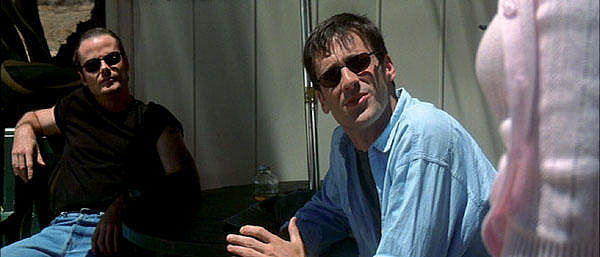
Jon Hamm, who turns 45 today, in his first movie appearance in Space Cowboys. He’s on the right playing the part of “Young Pilot #2”:

Fake Toys of the Day:

Let other movies have the Lego treatment, The Witch gets a fake Playmobil playset, complete with a Black Phillip toy (via Geek Tyrant):

[embedded content]

Cosplay of the Day:

Think nobody likes Ghostbusters 2? Tell it to this guy brilliantly cosplaying as the Vigo painting from the sequel (via Fashionably Geek):

Movie Comparison of the Day:

Does J.J. Abrams repeat himself as a producer? Couch Tomato shows us 24 reasons Cloverfield and Super 8 are the same movie:

[embedded content]

Movie Art of the Day:

The below painting inspired by Close Encounters of the Third Kind is from artist Jordan Buckner’s sci-fi landscapes series “Visions of a Past, Present and Future.” See others from Alien, The Fly, Blade Runner, Star Wars and Moon at Live for Films.

Inappropriate Musicals of the Day:

The Late Late Show host James Corden and Martin Short show us what Broadway musical versions of Goodfellas, The Revenant and Gladiator might look like (via Above Average):

[embedded content]

Throwback Collectible of the Day:

Queen of Earth writer/director Alex Ross Perry shares a gift he just received, and retro-loving VHS fans are sure to be jealous (via Robert Greene):

Classic Trailer of the Day:

In honor of today’s return of our friendly neighborhood web head in a movie trailer, let’s revisit the original, pre-9/11 teaser for 2002’s Spider-Man, which had to be removed from distribution for obvious reasons:

[embedded content]

This entry passed through the Full-Text RSS service – if this is your content and you’re reading it on someone else’s site, please read the FAQ at fivefilters.org/content-only/faq.php#publishers.


No Image

Apple Vs. The Government, In Their Own Words

Seats are reserved for Apple and FBI at a House Judiciary Committee hearing this month. Apple and the government are fighting over whether the company needs to make it possible for investigators to read data on the encrypted iPhone used by San Bernardino shooter Syed Rizwan Farook.

Seats are reserved for Apple and FBI at a House Judiciary Committee hearing this month. Apple and the government are fighting over whether the company needs to make it possible for investigators to read data on the encrypted iPhone used by San Bernardino shooter Syed Rizwan Farook. Drew Angerer/Getty Images hide caption

toggle caption Drew Angerer/Getty Images

The legal dispute between Apple and the FBI continues: the government has filed a response to Apple’s refusal to cooperate with a federal magistrate’s order instructing it to assist the FBI in circumventing the security features on an iPhone used by one of the San Bernardino shooters.

In their legal filings, Apple and the government face off on a number of issues. Apple says the government is using the court system to assert broad authority that hasn’t been granted by Congress; the government says Apple is overstating the wide-reaching security concerns and creating “warrantproof” devices.

Below, in the words of their own filings, are a few of the issues where the two parties most fiercely disagree:


Is Apple too far removed from the Farook case?

The magistrate judge’s order instructing Apple to cooperate with the FBI’s request relies on the All Writs Act, a 1789 law that courts have used to compel companies’ assistance in investigations. The All Writs Act, or AWA, can only be used if it’s not an unreasonable burden on the company, and if the company isn’t “too far removed” from the situation.

  • Apple says its connection to the case doesn’t justify it being “drafted into government service”: “Apple is a private company that does not own or possess the phone at issue, has no connection to the data that may or may not exist on the phone, and is not related in any way to the events giving rise to the investigation.”
  • The government argues that Apple has a “continued connection” to phones after they are sold: “Apple intentionally and for commercial advantage retains exclusive control over the software that can be used on iPhones, giving it monopoly-like control over the means of distributing software to the phones. … Having established suzerainty over its users’ phones—and control over the precise features of the phones necessary for unlocking them—Apple cannot now pretend to be a bystander, watching this investigation from afar.”

[In case you, like us, were thrown for a loop by the word “suzerainty,” it means the position or power of a suzerain, or feudal overlord.]


What about a possible future burden?

  • Apple argues writing the software would pose an undue burden, particularly because its burden would be multiplied by future requests: “If Apple creates new software to open a back door, other federal and state prosecutors—and other governments and agencies—will repeatedly seek orders compelling Apple to use the software to open the back door for tens of thousands of iPhones.”
  • The government says there’s no precedent for considering potential future burdens, and says only the burden of writing software for this phone should be considered: “By accumulating its hypothetical future burdens, Apple suggests that because so much criminal evidence is hidden on its warrant-proof iPhones, it should not be compelled to assist in gathering evidence related to the terrorist attack in San Bernardino. Apple is wrong.”

Is using the All Writs Act an example of judicial overreach?

  • Apple also argues that this particular use of the AWA extends beyond precedent in a way that ought to be decided by Congress: “Congress has never authorized judges to compel innocent third parties to provide decryption services to the FBI. Indeed, Congress has expressly withheld that authority in other contexts, and this issue is currently the subject of a raging national policy debate. … The unprecedented order requested by the government … would preempt decisions that should be left to the will of the people through laws passed by Congress and signed by the President.”
  • U.S. Attorneys respond … : “Congress intended for the Act to be broad and flexible, capable of rising to meet new obstacles to the courts’ lawful exercise of jurisdiction. The Act is not a judicial usurpation of congressional power, but rather an example of Congress’s reliance upon the courts’ sound discretion and close familiarity with specific facts to ensure that justice is done.” … and also argue this precise argument has been used before, and the nation’s highest court found it wanting: “In deciding New York Telephone, the Supreme Court directly confronted and expressly rejected the policy arguments Apple raises now. Like Apple, the telephone company argued: that Congress had not given courts the power to issue such an order in its prior legislation; that the AWA could not be read so broadly; that it was for Congress to decide whether to provide such authority; and that relying on the AWA was a dangerous step down a slippery slope ending in arbitrary police powers. … In the forty years since that decision, it has become clear that the Court was correct because those fears have proved unfounded.”

Could such software be reused?

  • Apple: “Once the process is created, it provides an avenue for criminals and foreign agents to access millions of iPhones. And once developed for our government, it is only a matter of time before foreign governments demand the same tool.”
  • The government: “As Apple well knows, the Order does not compel it to unlock other iPhones or to give the government a universal ‘master key’ or ‘back door.’ It is a narrow, targeted order that will produce a narrow, targeted piece of software capable of running on just one iPhone, in the security of Apple’s corporate headquarters.”

Could such a program be requested for other criminal cases in the future? Maybe, the FBI says, but it’s not relevant now: “future cases involving other iPhones will be decided on their specific facts.”


Does the magistrate’s order violate the First Amendment?

  • Apple: “The code must contain a unique identifier ‘so that [it] would only load and execute on the SUBJECT DEVICE,’ and it must be “signed’ cryptographically by Apple using its own proprietary encryption methods.’… This amounts to compelled speech and viewpoint discrimination in violation of the First Amendment.”
  • The government: “There is reason to doubt that functional programming is even entitled to traditional speech protections. …To the extent Apple’s software includes expressive elements—such as variable names and comments—the Order permits Apple to express whatever it wants, so long as the software functions. … “At most, the Order compels conduct—namely, the removal of barriers from Farook’s iPhone—with an incidental effect on ‘speech’ (i.e., programming).”

Did the FBI effectively cause this legal standoff?

  • Apple: ‘”Unfortunately, the FBI, without consulting Apple or reviewing its public guidance regarding iOS, changed the iCloud password associated with one of the attacker’s accounts, foreclosing the possibility of the phone initiating an automatic iCloud back-up of its data to a known Wi-Fi network … which could have obviated the need to unlock the phone and thus for the extraordinary order the government now seeks. Had the FBI consulted Apple first, this litigation may not have been necessary.”
  • The FBI calls that “both untrue and irrelevant”: “A forced backup of Farook’s iPhone was never going to be successful, and the decision to obtain whatever iCloud evidence was immediately available via the password change was the reasoned decision of experienced FBI agents investigating a deadly terrorist conspiracy. … Both the FBI’s testing and Apple’s security documentation show that entire categories of evidence … reside only on the iPhone and not on an iCloud backup, and that some of the backup data would still have been encrypted.”

Who wants to set a dangerous precedent?

  • Apple says this court order leads down a slippery slope that expands government’s reach into Americans’ private lives: “If the government can invoke the All Writs Act to compel Apple to create a special operating system that undermines important security measures on the iPhone, it could argue in future cases that the courts should compel Apple to create a version to track the location of suspects, or secretly use the iPhone’s microphone and camera to record sound and video.”
  • The FBI says Apple is undermining the country’s legal system and usurping the government’s authority: “Apple’s rhetoric is not only false, but also corrosive of the very institutions that are best able to safeguard our liberty and our rights: the courts, the Fourth Amendment, longstanding precedent and venerable laws, and the democratically elected branches of government. … The government respectfully submits that those authorities should be entrusted to strike the balance between each citizen’s right to privacy and all citizens’ right to safety and justice. The rule of law does not repose that power in a single corporation, no matter how successful it has been in selling its products.”

This entry passed through the Full-Text RSS service – if this is your content and you’re reading it on someone else’s site, please read the FAQ at fivefilters.org/content-only/faq.php#publishers.