Articles by admin

No Image

#NPRreads: Take Your Pick Of Space, Race Or Celebrity

The side of Jupiter's moon Europa that faces the giant planet.

#NPRreads is a weekly feature on Twitter and on The Two-Way. The premise is simple: Correspondents, editors and producers from our newsroom share the pieces that have kept them reading, using the #NPRreads hashtag. Each weekend, we highlight some of the best stories.

From national security editor Philip Ewing:

Speaking of @airspacemag, great story this month on the search for life on the moons of Jupiter and Saturn #NPRreads https://t.co/VBDLezocRV

— Phil Ewing (@philewing) April 29, 2016

Some of the most promising potential homes for life away from Earth are the moons of Jupiter and Saturn. NASA and researchers want to “visit” them all — but given the cost, time and distances involved with sending missions to the outer solar system, they must think very carefully about picking their shots, as Smithsonian’s Air & Space magazine reports.

The side of Jupiter’s moon Europa that faces the giant planet. NASA/JPL/University of Arizona hide caption

toggle caption NASA/JPL/University of Arizona

When scientists do reach the point of planning a mission, spaceflight challenges don’t get much tougher: The radiation and gravity forces are brutal. Plus some potential missions require inventing whole new techniques for astro-amphibious-underwater exploration. A future mission to Jupiter’s moon Europa, for example, could involve sending a probe across the expanse of space, then having it drop a robot submarine through the crust of ice on the surface to explore the liquid ocean below. Another proposal calls for sending a spacecraft to Saturn’s Titan — a moon larger than our own, and larger even than the former planet Pluto — which would launch what I insist be called a Space Boat to sail on its lakes of methane.

Air & Space also details the case for life on Saturn’s moon of Enceladus, and makes clear that exploration in the coming decades may determine whether life in the universe is unique to Earth or whether — just as probably — it’s abundant.

From business news intern Naomi LaChance:

When a suggested Facebook tag evokes centuries of racism and oppression. From the brilliant @tejucole #NPRreads https://t.co/D78A4gFyAO

— Naomi LaChance (@lachancenaomi) April 28, 2016

When Toronto-based photographer Zun Lee started taking the “orphaned Polaroids” of African-Americans that he’d bought secondhand and uploading them to Facebook, he found that they were not so orphaned after all. Facebook’s facial recognition system gave him suggested tags of people he had never met, but whose memories he held in his hand.

Lee is an artist, but at his computer he had waded into a whole new territory.

Teju Cole explores this artist’s responsibility, the responsibility to protect intimate moments, with great tact and poise in his new essay in the New York Times Magazine, The Digital Afterlife of Lost Family Photos. Cole writes: “Black Americans, for most of their time in this country, were named, traded and collected against their will. They were branded — physically tagged — both to hurt and control them.”

In a time of mass data collection and widespread surveillance, Lee’s conundrum faces new urgency, one that finds its ideal home in the writing of Teju Cole. If you have family photos or use a computer, you should read this piece.

From executive producer for editorial franchises Tracy Wahl:

I came across this piece in a typical way — I saw it on social media from an old friend at the Dallas Morning News, Mike Drago.

How a priest views the sad #JohnnyManziel saga. @frjoshTX does it again. https://t.co/XP2Wji8gm9 pic.twitter.com/RXdgqNz4xK

— Mike Drago (@MikeDrago) April 27, 2016

I had never heard of the writer and didn’t care very much about the Johnny Manziel story. But once I started reading, I was hooked.

A reminder: Manziel is a free-agent quarterback, most recently with the Cleveland Browns. A Dallas County grand jury indicted him on a misdemeanor assault charge brought by his ex-girlfriend.

Commentator Father Joshua J. Whitfield, a priest at St. Rita Catholic Church in North Dallas, ultimately asks us to think of Manziel as a man who can change.

Whitfield pushes all of us to ask about our own role in creating a sports celebrity that tolerates domestic abuse. But it’s not as if we can just examine one moment in the process of creating a superstar.

Check out this incredible writing about Manziel:

“His is a story of family history and upbringing: of an East Texas wildcatter, cockfighting sort of history. An upbringing by overly-driven parents of a child never given a chance to grow up into a man. It’s a story of the cult of sports and the cult of the child, woven together and raised almost to the status of religion, a religion become abuse in some families, a religion of constant, endless, physically harmful year-round sports shoved down the throats of children for the sake of dreams typically shattered by the age of 18.”

Powerful stuff.

Let’s block ads! (Why?)


No Image

Puerto Rico Headed For Default As Congress Tackles Relief Plan

The U.S. territory is expected to default May 1 on a debt payment of nearly half a billion dollars. Scott Simon examines the impact of a default with Wall Street Journal correspondent Nick Timiraos.

Transcript

SCOTT SIMON, HOST:

Puerto Rico’s financial crisis heads for another deadline and possibly a cliff on May 1 when the U.S. territory may default on a debt payment of almost $500 million. Nick Timiraos is a national economics correspondent for The Wall Street Journal and joins us in our studios. Thanks so much for being with us.

NICK TIMIRAOS: Oh, thanks for having me.

SIMON: The money just isn’t there, so what happens if Congress can’t agree on some kind of relief?

TIMIRAOS: Well, Puerto Rico has $70 billion that it owes creditors and there are several different classes of debts. So the missed payment that’s happening this weekend is for one public agency but you’re basically going to see potential cascading defaults now and so that is why Congress is stepping in here to possibly put forward some kind of restructuring legislation.

SIMON: Speaker Ryan wants something…

TIMIRAOS: Yeah, Paul Ryan has been working on this. The reason Congress is getting involved – you know, a lot of people say, well, why does Congress even have to get involved here? Puerto Rico is in a very interesting place. It’s not a state, but it’s not a country. So if it were a state, its municipal corporations would be able to use the federal bankruptcy code Chapter 9 the same way that Detroit did a couple of years ago to restructure its debts.

For some reason – no one’s quite sure why – in 1984, the bankruptcy code was amended so that territories couldn’t use it. Again, it’s not a sovereign country, so they can’t go to the IMF – the International Monetary Fund – the way, you know, Greece or Argentina have. So they’re in this weird position here and that is why the Treasury Department and the Obama administration have said, you know, Congress, which has responsibility for Puerto Rico since it is a federal territory, needs to come up with some way for the island to restructure its debts.

SIMON: How did this happen?

TIMIRAOS: It happened over a long period of time where the governments was able to continue borrowing. And one of the reasons they were able to borrow so much, again, has to do with this kind of quirk of their political status. Puerto Rico, unlike other states, can issue triple tax-exempt bonds, which means they don’t have to pay federal, state or municipal tax. And so that made these investments very attractive. And when Puerto Rico wasn’t able to balance its budget year in and year out, they went and borrowed in the capital markets and they had investors lining up really to lend money to Puerto Rico.

Meanwhile, their economy has been in a recession since 2006. If you think about the worst parts of the United States – the Rust Belt – Puerto Rico’s situation is every bit as dramatic, if not more so, than that and they’ve had tremendous population loss. It’s very hard to grow your tax base to boost revenues when you’re losing 1 to 2 percent of your population every year.

SIMON: What might congressional legislation look like? Do you have an inkling now?

TIMIRAOS: Yeah. So the deal that the Treasury Department and that the House leadership with Paul Ryan and they’ve been working on would be to pair a federal oversight board with a debt restructuring mechanism. Again, Puerto Rico can’t file for bankruptcy protection, so this would create some kind of alternative bankruptcy-like mechanism for Puerto Rico to restructure its debts. A control board is of course not very popular with the local government. They’d be losing sovereignty to Washington here, but it’s probably the price they’re going to have to pay for being able to have some haircuts on the bonds and the bondholders are going to have to take – of course, bondholders had been fighting this. Some of them had been fighting it very hard. They’ve tried to characterize the legislation as a bailout, which is interesting because there actually isn’t any taxpayer money being put into this. And there probably will be at some point if Congress doesn’t pass legislation that allows a debt restructuring and things get worse on the island. So you could see a scenario two years from now if this isn’t addressed and more people are coming into the United States and Puerto Rico really can’t pay its costs (ph) then you could have, you know, you could actually have a humanitarian crisis and that could actually cost money.

SIMON: Nick Timiraos, national economics correspondent for The Wall Street Journal, thanks so much.

TIMIRAOS: Thanks for having me.

Copyright © 2016 NPR. All rights reserved. Visit our website terms of use and permissions pages at www.npr.org for further information.

NPR transcripts are created on a rush deadline by Verb8tm, Inc., an NPR contractor, and produced using a proprietary transcription process developed with NPR. This text may not be in its final form and may be updated or revised in the future. Accuracy and availability may vary. The authoritative record of NPR’s programming is the audio record.

Let’s block ads! (Why?)


No Image

Best of the Week: Alicia Vikander Became the New Tomb Raider, Wolverine Seen in 'X-Men: Apocalypse' and More

The Important News

Marvel Madness: Nathan Fillion will play Wonder Man in Guardians of the Galaxy Vol. 2. Richard E. Grant will play a villain in Wolverine 3. Robert Downey Jr. might be down for Iron Man 4. The Punisher is officially getting his own Netflix series.

Star Wars Mania: Rian Johnson shared new Star Wars Episode VIII photos. Daisy Ridley shared her martial arts training for Star Wars Episode VIII

Remake Report: Daisy Ridley is the new Lara Croft, Tomb Raider. Disney laid out plans for all their upcoming live-action remakes of animated classics.

Casting Net: Daisy Ridley will star in The Lost Wife. Joaquin Phoenix might play Jesus Christ. Four actresses are up for Alita: Battle Angel.

Sequelitis: Daddy’s Home is getting a sequel. Goosebumps is also getting a sequel.

Prequelitis: The Omen is getting a prequel.

Box Office: The Huntsman: Winter’s War is a flop.

Ways of Seeing: Criterion and Turner Classic Movies teamed up for a new streaming service.

Celebrating the Classics: Universal will present an Exorcist experience at this year’s Halloween Horror Nights.

The Videos and Geek Stuff

New Movie Trailers: X-Men: Apocalypse, Snowden, Kubo and the Two Strings, Southside With You, Florence Foster Jenkins, Here Alone, The Duel, The Ring vs. The Grudge, Weiner and Cell.

TV Spots: Captain America: Civil War.

Clips: Captain America: Civil War and Money Monster.

VFX Reels: The Jungle Book and Deadpool.

Behind the Scenes: X-Men: Apocalypse.

Watch: Keanu trailer redone with cats. And trailers mashing up Alien and Star Wars movies.

See: What Nathan Fillion might look like as Wonder Man.

Watch: Captain America watches a clip reel of all his kills. And Iron Man stars in Gladiator.

See: Captain America: Civil War 1940s version. And The Nice Guys 1970s version.

Watch: Fake Kylo Ren bloopers from The Force Awakens. Lando Calrissian returns in Force Awakens prequel shorts.

See: Concept art of a grown-up Newt in Alien 5.

Watch: Krampus blooper reel.

See: My Cousin Vinny reimagined as a courtroom drama. And Ferris Bueller’s Day Off as a thriller. And The Revenant as an animated feature.

Watch: Deleted scene from A Nightmare on Elm Street.

See: This week’s best new posters.

Watch: Beyonce’s Lemonade is compared to Terrence Malick’s The Tree of Life.

Our Features

Comic Book Movie Guide: Why we’re getting Spider-Man: Homecoming instead of The Amazing Spider-Man 3.

Movie-Related Comic Book Guide: Comics to get on Free Comic Book Day.

Movie Celebration Guide: Alien Day shopping guide.

Grown-Up Movie Guide: The rise of the unexpected R-rated movie.

Horror Movie Guide: All the latest horror news and trailers.

Home Viewing: Here’s our guide to everything hitting Netflix next month.

and

MORE FROM AROUND THE WEB:

Let’s block ads! (Why?)


No Image

Hospital Bombings Highlight Challenges Health Care Providers Face In War Zones

NPR’s Kelly McEvers talks with Jonathan Whittall, head of humanitarian analysis for Doctors Without Borders, about how bombings of hospitals affect relief organizations in war zones.

Transcript

KELLY MCEVERS, HOST:

For more reaction, we reached Jonathan Whittall in Beirut. He’s head of humanitarian analysis for Doctors Without Borders, also known by its French acronym, MSF. I asked him if there needs to be harsher punishment when hospitals are attacked.

JONATHAN WHITTALL: I think there needs to be clear accountability, yes. And what we’ve seen is responses, for example, in the case of Kunduz, the punishment that’s dished out does not match the magnitude and the gravity of the situation. And what we’ve been asking for as Doctors Without Borders is also to have a kind of independent investigation or independent fact-finding capacity when these events happen. And we can’t rely, even in the case of Afghanistan, on the perpetrators of these acts to investigate themselves. So that’s something that’s key for us as well – is to see some capacity for an independent investigation into these – into these attacks.

MCEVERS: The hospital in Kunduz is not an isolated incident. Just this week, a hospital in Aleppo, Syria, was hit by an airstrike, likely by the Syrian government or its ally, Russia, since they are the forces that are attacking that area. Jonathan Whittall says it’s part of a terrible trend in Syria and elsewhere of medical facilities being targeted.

WHITTALL: In Syria last year alone, we had 63 MSF-supported facilities that were hit. This year, 11 facilities that we’ve been supporting have been hit. Estimates of around 23 medical staff have been killed in those various strikes. So we’re dealing with a huge problem when it comes to protection of the medical mission – the ability to operate in these kinds of environments. But there’s two things at stake here. One is in the case where medical facilities are being directly targeted. And in those incidents, what we’re seeing is a kind of criminalization of the enemy, the enemy being regarded as terrorists or criminals and, by extension, the medical facilities at which they seek treatment are being targeted so they kind of – the doctor of your enemy is becoming the enemy as well. And that’s a huge problem because, for medical workers, we don’t distinguish who walked through our front gates, and neither should we. Our responsibility is to provide treatment to whoever needs it and whoever they are. And then, the second kind of issue that we’re seeing is an indiscriminate total war, recklessness in the conduct of hostilities and a complete disregard for civilian life, where not only hospitals are being hit, but schools, bakeries, weddings, all sorts of civilian sites and structures. And this is a huge problem as well. And so the attacks on the medical facilities are indicative and representative of a much bigger disregard for civilian life.

MCEVERS: When do you decide that a location is just too risky for you to have people there?

WHITTALL: It’s based on the agreements that we’re able to reach with the parties to the conflict. So for example, now we’re in a process in Afghanistan of re-evaluating our ability to operate. In Kunduz, for example, we haven’t returned to reopen the hospital in Kunduz because we need to regain some kind of assurances that hospitals are protected sites, that doctors and nurses can’t be punished for providing treatment to whoever walks through the door, whether they’re a person who’s suffered a car crash or whether it’s an insurgent who’s got a bullet hole in his leg. We can’t operate in a hospital where we can expect special forces will storm through the doors and arrest our patients. And we can’t operate when we see the kind of extreme recklessness as we did in the case of Kunduz recently. Next week, we will see a resolution being passed in the Security Council on the protection of hospitals. And this is a positive signal coming from the Security Council, but I’m talking to you from Beirut, which this region is the graveyard of failed UN resolutions. And we need to see words being put into action. And our patients are directly suffering the consequences of UN Security Council members and other state failures to put their words into action and to uphold their responsibilities.

MCEVERS: I was just going to say, you talk about getting reassurances, but it feels like, these days, reassurances don’t mean much.

WHITTALL: Indeed. Reassurances are a starting point, but it’s certainly not the end of the process. We need to see words put into action.

MCEVERS: Jonathan Whittall is the head of humanitarian analysis for Doctors Without Borders. He joined us from Beirut. Thank you very much.

WHITTALL: Thank you so much, Kelly.

Copyright © 2016 NPR. All rights reserved. Visit our website terms of use and permissions pages at www.npr.org for further information.

NPR transcripts are created on a rush deadline by Verb8tm, Inc., an NPR contractor, and produced using a proprietary transcription process developed with NPR. This text may not be in its final form and may be updated or revised in the future. Accuracy and availability may vary. The authoritative record of NPR’s programming is the audio record.

Let’s block ads! (Why?)


No Image

NFL Player Laremy Tunsil Loses Millions In Draft After Twitter Hack

Last night before and during the NFL Draft, the Twitter and Instagram accounts of Laremy Tunsil, one of the draft’s top prospects, were hacked and used to tweet a damaging video and screenshots.

Transcript

AUDIE CORNISH, HOST:

The NFL draft is normally a straightforward event. Teams pick players. Players say, I’m happy to be part of my new team, and off they go. This year, things went differently. University of Mississippi offensive lineman Laremy Tunsil was expected to be picked as high as third overall, but a series of surprising twists meant that didn’t happen. NPR’s Becky Sullivan takes it from here.

BECKY SULLIVAN, BYLINE: Thirteen minutes before the draft last night, this short video showed up on Laremy Tunsil’s Twitter account. There’s a guy on a couch wearing a mask that’s attached to a bong, and it looks like he’s smoking. Then, he takes off the mask. You can see his face. It’s Laremy Tunsil. Tunsil was arguably the best prospect in the country at his position, but the video clearly bothered teams. These days, the NFL is pretty sensitive about character. And practically speaking, teams can be reluctant to draft a player who might be a risk for getting suspended for smoking pot. So team after team passed on Tunsil, until finally he was taken at number 13.

(SOUNDBITE OF 2016 NFL DRAFT)

ROGER GOODELL: The Miami Dolphins select Laremy Tunsil.

SULLIVAN: It doesn’t sound that big, but the drop to 13th probably cost Tunsil six to eight million dollars. Then, things got worse – not for Tunsil, but for his alma mater. On Tunsil’s Instagram account, someone posted two screenshots that seemed to show Tunsil texting with a coach at Ole Miss while Tunsil was still in school there. He’s asking for money to help pay his rent and his mom’s electricity bill. The coach doesn’t say yes, but he does say, quote, “we all agreed on an amount.” This is kind of a big deal because the NCAA usually does not allow schools to give athletes any kind of special compensation above the cost of attending school. Meanwhile, Tunsil is still at the draft and has to give his post-draft press conference. And he said his accounts had been hacked, though it’s not clear who the culprit is. Then, Tunsil admitted that the exchange with the Ole Miss coach was legit.

(SOUNDBITE OF ARCHIVED RECORDING)

LAREMY TUNSIL: That was true. Like I said, I made a mistake of that happening, and it happened.

UNIDENTIFIED REPORTER: So there was an exchange between you and your coach of money?

TUNSIL: I have to say yeah.

SULLIVAN: This is just the latest in a dramatic week for Laremy Tunsil. On Tuesday, he was sued by his own stepfather for defamation related to a fight they had last summer. As for Ole Miss, the school was already in the NCAA’s doghouse, in part because Laremy Tunsil was given free loaner cars by a dealership in Mississippi. Now, with these new allegations, Ole Miss says they plan to, quote, aggressively investigate and fully cooperate with the NCAA. Becky Sullivan, NPR News.

Copyright © 2016 NPR. All rights reserved. Visit our website terms of use and permissions pages at www.npr.org for further information.

NPR transcripts are created on a rush deadline by Verb8tm, Inc., an NPR contractor, and produced using a proprietary transcription process developed with NPR. This text may not be in its final form and may be updated or revised in the future. Accuracy and availability may vary. The authoritative record of NPR’s programming is the audio record.

Let’s block ads! (Why?)


No Image

Apple's Lousy Week Could Signal Times Of Trouble For Tech Giant

Apple got hit with a lot of bad news this week. First, the company posted its first quarterly revenue drop since 2003. And then billionaire activist investor Carl Icahn revealed that he has dumped all of his shares in Apple. NPR explores whether the company is really in trouble or if is this all just a bump in the road.

Transcript

AUDIE CORNISH, HOST:

Apple had a lousy week. It posted its first quarterly revenue drop since 2003, and for the first time ever, falling iPhone sales. And now the billionaire activist investor Carl Icahn says he’s dumping all his shares in the company. Here to discuss Apple’s woes is NPR’s Aarti Shahani. Welcome back to the program, Aarti.

AARTI SHAHANI, BYLINE: Hi.

CORNISH: So first start with this news about this investor saying goodbye to Apple.

SHAHANI: Yeah, Icahn was talking yesterday on CNBC, and that’s where he dropped the news. Let’s have a quick listen.

(SOUNDBITE OF ARCHIVED RECORDING)

CARL ICAHN: We no longer have a position in Apple. We – to start, I think Tim Cook did a great job. I have a great relationship with him. I called him this morning to tell him that, and he was a little sorry, obviously.

SHAHANI: But Icahn goes on to explain, he pulled out because of a huge external threat from his perspective, China. Apple is really dependent on China. It’s the second-largest market after the U.S., and Icahn says the Chinese government could suddenly change its mind, close the doors and make it very difficult for Apple to sell there. Earlier this month, China decided to shut down the iBook store and iTunes movies just like that. In the interview, Icahn said China could do something else erratic, so he’s cutting loose, and he said he made about $2 billion in Apple, which is not bad.

CORNISH: All right, so you’re saying Apple is dependent on China, in what way? What’s the extent of that?

SHAHANI: Well, the company’s overall game plan is to grow all around the world. For example, right now they’re betting big on India, but so far it’s not clear if that market will pan out. And in the past, China was Apple’s go-to. This last quarter, though, lower sales in China and Hong Kong were responsible for much of Apple’s revenue decline. And so, you know, to be clear, there are two separate issues here. One is Icahn’s take on the Chinese government, the other is just the smartphone market and how well Apple will perform against competitors like Samsung.

CORNISH: What is Apple doing in response to all of this? I know it’s not admitting defeat.

SHAHANI: No, no, they’re not taking this lying down. They’re not admitting defeat. You know, right after Apple released its weak quarterly numbers, CEO Tim Cook got on this earnings call. An investor – she asked about the future. Does Apple even think of itself as a growth company anymore, or is it a mature tech company – that is, you know, heyday’s gone? That’s a very loaded question for the largest company on earth. And here’s what Tim Cook says on the call. One, yes, it is a problem that the smartphone market is not growing right now, but the market is tough for – everyone competitors too – and it’s a temporary situation.

(SOUNDBITE OF ARCHIVED RECORDING)

TIM COOK: My view that is – that’s an overhang up through the macroeconomic environment omitting many different places in the world. And we’re very optimistic that this too shall pass and that the market and particularly us will grow again.

CORNISH: This too shall pass. What did the investors say?

SHAHANI: Well, it wasn’t a great week for Apple on Wall Street. But, you know, a lot of tech stocks were down because of disappointing results. Google or, you know, I should say Alphabet, the parent company of Google, also didn’t do too well. On the other hand, Facebook and Amazon, they both reported great earnings and their shares are up. Wall Street is happy with them for the moment.

CORNISH: That’s NPR’s Aarti Shahani, thanks so much.

SHAHANI: Thank you.

Copyright © 2016 NPR. All rights reserved. Visit our website terms of use and permissions pages at www.npr.org for further information.

NPR transcripts are created on a rush deadline by Verb8tm, Inc., an NPR contractor, and produced using a proprietary transcription process developed with NPR. This text may not be in its final form and may be updated or revised in the future. Accuracy and availability may vary. The authoritative record of NPR’s programming is the audio record.

Let’s block ads! (Why?)


No Image

Echoes Of Prince — From Everywhere

Mdou Moctar, a musician from Agadez, Niger, became the star of a Tuareg remake of Purple Rain.

Mdou Moctar, a musician from Agadez, Niger, became the star of a Tuareg remake of Purple Rain. Courtesy of Christopher Kirkley hide caption

toggle caption Courtesy of Christopher Kirkley

Every month, I bring together some of the music from around the world that I’ve enjoyed most in recent weeks. April, however, has been completely overshadowed by Prince‘s death. Few contemporary artists have meant so much, for so long, to so very many people working in wildly disparate corners of the globe.

In the midst of putting together this month’s picks, I realized that I could hear individual facets of Prince’s polymathic, polymorphous talents in each of the tunes I’ve selected for this edition of Latitudes.

Hot guitar licks. I know I’m not the only one who’s been watching Prince’s incendiary solo on “While My Guitar Gently Weeps” for the Rock and Roll Hall of Fame in 2004. And anyone who has seen that (or his own set, which is online, at least for the time being) knows, that Prince was a consummate rock guitarist — if he had only been a guitarist, he would still be a legend.

And that legacy hasn’t lost on young Tuareg musicians, for whom rock-inflected guitar has become an intrinsic part of their own idiom. (See: Tinariwen, Bombino, et al.) Seizing upon that idea, an American filmmaker, music archivist and label head Christopher Kirkley (who collaborated with us at NPR Music and the show Afropop Worldwide a few years back to create a stream of 100 must-hear songs from Mali) directed a Tuareg remake of Prince’s film Purple Rain. He cast Mdou Moctar, a guitarist from Agadez, Niger, in the lead role.

[embedded content]
Christopher Kirkley YouTube

Afro-funk. As my colleague Jason King wrote in his his marvelous remembrance, Prince was an uncategorizeable, “überfunky, hyper-synaptic, wildly eccentric, crazy-magical boho black genius.” Yet he was funk — and rock, and pop, and so much more.

This collaboration between Angolan/Portuguese producer Batida (a.k.a. Pedro Coquenão) and Congolese band Konono Nº1 just hits so many sweet spots, thanks in part to their shared love of funked-out beats and metallic textures. This song, “Nlele Kalusimbiko,” is the opening track on their new joint album, Konono Nº1 Meets Batida.

[embedded content]
Crammed Discs YouTube

Smoky, sultry, sexy. The Turkish band Model, fronted by singer Fatma Turgut, is all about those vibes on their single “Mey” (Wine). The song boasts a catchy chorus — and it really highlights the allure of Turgut’s voice, which references old-fashioned melismatic acrobatics and yet sounds refreshingly up-to-date.

[embedded content]
netd Müzik YouTube

Courting controversy. As my colleague Ann Powers noted after Prince’s death, he was a transgressive force on so many fronts — sexual, spiritual, political and certainly musical. (As he wrote in a 1999 statement explaining his name change to his famous glyph, “It’s all about thinking in new ways, tuning in 2 a new free-quency.”) And certainly that involved playing with gender identity and roles, too.

I can’t help but hear — and see — some of that same sense of new possibilities when I hear a band like Lebanon’s Mashrou’ Leila. They’ve attracted worldwide attention this week for a show scheduled in a Roman amphitheater in Amman, Jordan; governmental permission was rescinded because of a furor over their “political and religious beliefs and endorsement of gender equality and sexual freedom.” The concert was granted approval at the last minute by Jordan’s ministry of the interior, but according to the band, it was much too late to re-coordinate the show.

Mashrou’ Leila has been playing with tropes of all kinds for years now. In one of their early hits, “Fasateen” (Dresses), the band members destroy all kinds of traditional wedding symbols — and toy with the idea of who would wear white tulle in any case.

[embedded content]
Mashrou’ Leila YouTube

Finally, I can’t let April run out without paying another tribute to Congolese singer Papa Wemba, who died last week doing what he clearly loved so much. He collapsed while performing a joyful set for a big crowd in Ivory Coast. The song “Yolele” comes from his 1995 album Emotion. Made for Peter Gabriel’s Real World records, it marked a watershed moment in Wemba’s career, in which he made an overt overture to an “international” — that is, primarily (white) European and North American — audience.

[embedded content]
Real World YouTube

Let’s block ads! (Why?)


No Image

Today in Movie Culture: 'Captain America: Civil War' 1940s Version, 'The Jungle Book' VFX Breakdown and More

Here are a bunch of little bites to satisfy your hunger for movie culture:

Backwards Remake of the Day:

Here’s what Captain America: Civil War looks like remade by someone who went back in time to the 1940s:

[embedded content]

Character History of the Day:

Speaking of past depictions of Captain America, here’s a video chronicling the evolution of the superhero’s appearances in TV and movies:

[embedded content]

Cosplay of the Day:

Another new still from Captain America: Civil War or great cosplay? The latter, but the funny thing is that this cosplayer thinks his Black Panther costume isn’t even good (via Fashionably Geek):

Movie Takedown of the Day:

Star Wars: The Force Awakens isn’t a perfect movie, but did you know there are 135 problems with it? CinemaSins counts them up here:

[embedded content]

VFX Reel of the Day:

See how the visual effects were done for The Jungle Book in this featurette from Mashable (via Geek Tyrant):

Movie Science of the Day:

Kyle Hill explains why every movie depicting death by lava is completely wrong:

[embedded content]

Vintage Image of the Day:

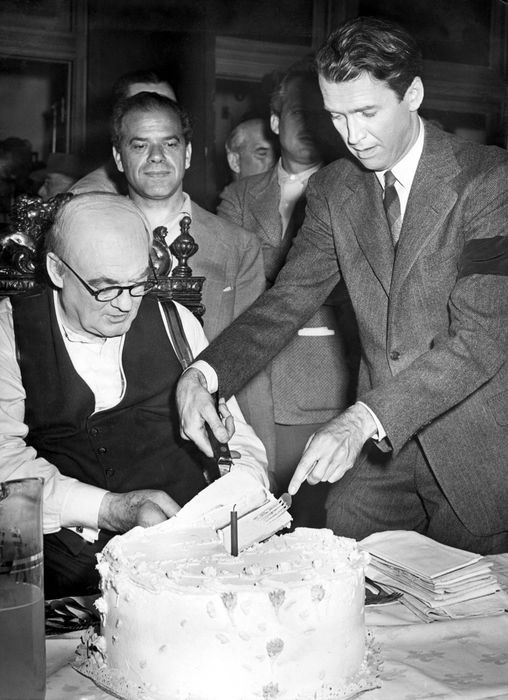
Lionel Barrymore, who was born on this day in 1878, has some cake accompanied by James Stewart and director Frank Capra on the set of It’s a Wonderful Life in 1946:

Movie Comparison of the Day:

Couch Tomato shows us 24 reasons Prometheus and Transformers: Revenge of the Fallen are the same movie:

[embedded content]

Film Studies of the Day:

For Fandor Keyframe, Joost Broeren shows the difference between men and women’s reactions to mirrors in movies, how the former mostly smash and the latter mostly cry (via One Perfect Shot):

[embedded content]

Classic Trailer of the Day:

Today is the 45th anniversary of the theatrical release of Woody Allen‘s Bananas. Watch the original trailer for the comedy below.

[embedded content]

and

Let’s block ads! (Why?)


No Image

3 Things To Know About The NFL Draft That Don't Have Much To Do With Football

The 2016 NFL draft kicks off in Chicago on Thursday.

The 2016 NFL draft kicks off in Chicago on Thursday. Getty Images hide caption

toggle caption Getty Images

The 2016 NFL draft starts tonight so here’s our comprehensive first-round mock draft.

Just kidding. Mock drafts are in such abundance they practically comprise their own genre at this point. So instead, here are three other things to know about the NFL draft.

1. Moritz Boehringer

This 22-year-old wide receiver from Germany has never played a single game of football in the U.S., but his athleticism, strength and speed have some NFL scouts predicting he could be the first German player ever to make it to the NFL.

He started playing football when he was 17, and most recently played in the highest level of German football, NFL.com reported. At 6’4″ and 227 lbs, he impressed scouts at an NFL pro day in March, tallying scores and times in various drills that ranked him among the top wide receiver prospects from the NFL scouting combine in February, the site said. It added that six teams, including the Patriots, Packers and Broncos, expressed interest in him.

Still, relative inexperience could trump his raw talent. After all, as MMQB.com writes, Boehringer was until recently, “a mechanical engineering student in Aalen, Germany, who drove 50 kilometers each way to practice American football once a week.”

If he is drafted, likely in the later rounds, he will be the first European player to be drafted straight into the league.

“I don’t have any expectations,” Boehringer said, according to ESPN. “I’ll just wait and see what happens. The best advice I’ve gotten is just keep working hard. It’s just my dream to play.”

2. The draft takes forever

Get a sandwich and a beer or two (or five) because the first round of the NFL draft, scheduled for Thursday night at 8 p.m., will take a long time. Each of the 32 NFL teams is allotted 10 minutes to make their first round picks, meaning the process can take more than five hours to complete, though it usually doesn’t take that long. ESPN has blocked out 3.5 hours for the first round. Rounds 2 and 3 are scheduled for Friday at 7 p.m. and rounds 4-7 will be held Saturday at noon. Draft protocol stipulates that teams get seven minutes per pick in round 2 and five minutes in rounds 3-6. They have four minutes to make a pick in round 7. If that seems specific and bureaucratic, here’s the six-step process for actually choosing a player, according to NFL rules:

“When a team decides on a selection, it communicates the player’s name from its draft room to its representatives at Selection Square. The team representative then writes the player’s name, position and school on a card and submits it to an NFL staff member known as a runner.

“When the runner gets the card, the selection is official, and the draft clock is reset for the next pick. A second runner goes to the representatives of the team up next and lets them know who was chosen. Upon receiving the card, the first runner immediately radios the selection to a NFL Player Personnel representative, who inputs the player’s name into a database that notifies all clubs of the pick. The runner also walks the card to the head table, where it’s given to Ken Fiore, vice president of player personnel.

“Fiore reviews the name for accuracy and records the pick. He then shares the name with the NFL’s broadcast partners, the commissioner and other league or team representatives so they can announce the pick.”

Something tell us that the first-ever draft in 1936, which featured teams like the Brooklyn Dodgers and the Boston Redskins, was a simpler affair.

3. Scouting reports

Not only are players evaluated on the strength of the “draft stock” and “measurables,” that is, how fast they run, how high they jump, how far they throw and how many passes they catch, future NFL players are increasingly being assessed on subjective factors such as “character.” For example, Carolina Panthers’ quarterback Cam Newton was infamously maligned as “fake” and “selfish” in a scouting report before he was drafted.

Scouts, perhaps attempting to remain relevant in a sports atmosphere where analytics are holding more and more sway (anyone can compare sets of numbers, after all) have taken to citing sources, many of whom are anonymous, as insights into players’ “readiness” for the NFL. Recently, this took the form of a scout questioning the cooking abilities of Ohio State’s Eli Apple. In the Milwaukee Journal Sentinel, an unnamed scout was quoted as saying, “I worry about him because of off-the-field issues. The kid has no life skills. At all. Can’t cook. Just a baby. He’s not first round for me. He scares me to death.”

Several news outlets called out out the “lunacy” of this pre-draft assessment, and posited that these types of reports point to a “weakness” in the drafting process.

Then there’s this from Slate:

“There are two great things about this scout’s foray into food criticism. One is that the last NFL season ended with Peyton Manning winning a Super Bowl and retiring. Peyton Manning, in addition to being a guaranteed Hall of Famer and one of the best football players ever, was once publicly described by members of his own family as not being able to open a can of soup.

The article cites a 1999 Sports Illustrated profile that quotes members of Manning’s family explaining that he not only couldn’t open soup, but had his girlfriend order Chinese food for him.

Let’s block ads! (Why?)


No Image

Why Chobani Gave Employees A Financial Stake In Company's Future

Chobani CEO Hamdi Ulukaya (left) presents an employee with shares of the company on Tuesday at the Chobani plant in New Berlin, in upstate New York.

Chobani CEO Hamdi Ulukaya (left) presents an employee with shares of the company on Tuesday at the Chobani plant in New Berlin, in upstate New York. Johannes Arlt hide caption

toggle caption Johannes Arlt

It’s been a good week for employees of Chobani. They learned that they could eventually own about 10 percent of the rapidly expanding Greek yogurt company. That could potentially make millionaires of some workers, if the privately held company is sold or goes public.

It’s a grand gesture, and reflects a rising trend in employee ownership.

Chobani’s meteoric rise began in a defunct old Kraft yogurt manufacturing plant in upstate New York. Founder Hamdi Ulukaya’s only experience in the dairy business was that his mother made delicious strained yogurt in his hometown in Turkey.

Now, a decade later, the company has reached $1 billion in annual sales. It has two factories, 2,000 employees and is worth an estimated $3 billion.

Ulukaya — still Chobani’s majority owner — told employees on Tuesday to think of the grants as a pledge to expand the company even more.

“We used to work together; now we are partners,” he told workers at the company’s facility in New Berlin, N.Y.

Ulukaya, who also founded Chobani, personally determined the shares each employee received, based on each one's role and tenure at the company.

Ulukaya, who also founded Chobani, personally determined the shares each employee received, based on each one’s role and tenure at the company. Johannes Arlt hide caption

toggle caption Johannes Arlt

Ulukaya is outspoken about corporate civic duty. Ten percent of Chobani profits go to charity. One-third of its workforce is made up of refugees. And an employee ownership grant was always part of Ulukaya’s dream plan.

Still, his announcement came as a surprise to almost all employees.

“We built something; now we’re sharing it,” Ulukaya said.

Employee stock ownership is not all that unusual, especially among technology firms. Food companies like Starbucks and Whole Foods offer stock grants.

Corey Rosen, of the National Center for Employee Ownership, says employee ownership takes many different forms, and in a growing number of companies, workers own the firms outright.

Dairy company Schreiber Foods, for example, is larger than Chobani and is 100 percent employee-owned through an employee stock ownership plan, or ESOP.

Rosen says such plans allow employees to own, control and share in the profits of a company through a trust. Their popularity is increasing, he says, in part because they enjoy large tax benefits and because retiring baby boomers who own companies see it as a good way to transfer ownership. He estimates nearly one-tenth of American workers are part of an ESOP.

“This has kind of been an under-the-radar change in the American economy that’s really very significant,” Rosen says.

As of August 2015, these were the top 10 largest majority employee-owned companies in the U.S. Click here to see a list of the top 100.

1. Publix Super Markets (supermarkets; based in Lakeland, Fla.): 175,000 employees

2. CH2M Hill (engineering & construction; based in Englewood, Colo.): 26,000 employees

3. Lifetouch* (photography; Eden Prarie, Minn.): 25,000 employees

4. Price Chopper (supermarkets; based in Schenectady, N.Y.): 22,000 employees

5. Houchens Industries* (supermarkets & other services; based in Bowling Green, Ky.): 18,000 employees

6. Penmac* (staffing; based in Springfield, Mo.): 17,000 employees

7. Amsted Industries* (industrial components; based in Chicago): 16,800 employees

8. Parsons* (engineering & construction; based in Pasadena, Calif.): 15,000 employees

8. WinCo Foods (supermarkets; based in Boise, Idaho): 15,000 employees

10. Alliance Holdings* (holding company; based in Abington, Pa.): 14,670 employees

Note: Companies marked with an asterisk are 100 percent employee-owned.

Source: National Center for Employee Ownership

He says when employee ownership is distributed throughout the rank and file, whether through an ESOP or a stock grant program, it has powerful impact on worker culture. Rosen claims company performance improves after they start employee ownership programs, and workers build wealth much, much faster.

“We hear all this discussion these days about economic inequality, and the wage system is really not going to solve that problem very well,” Rosen says. “Even if you raise the minimum wage, it’s only going to affect a small minority of the workforce.”

Michael Gonda, a Chobani spokesman and longtime employee, says granting everyone a piece of Chobani was important to Ulukaya.

“One of the hardest things to do for a program like this, is when you have 2,000 employees that you want to participate in it, is figuring out that allocation,” Gonda says. “Obviously, time and role at the company have a huge part to play, but this is a very personal part of the process for Hamdi, and he spent a lot of time going through that.”

The company didn’t disclose details about the allocations, but the longest-serving employees received the largest shares.

Gonda says there was a lot of hugging and crying at the announcement ceremony.

“There’s a very emotional bond and an emotional connection that you don’t typically associate with a manufacturing facility, or a yogurt plant,” he says.

Now that bond includes a joint financial stake in the future performance of the company.

Let’s block ads! (Why?)