Articles by admin

No Image

In Texas, Strict Laws On Clinics Drive Demand For Abortion Pill

The abortion pill is booming in Texas. Since the FDA loosened restrictions, more women are circumventing strict state laws on Texas abortion clinics by taking the pill as an alternative to surgery.

Transcript

ARI SHAPIRO, HOST:

Women who seek an abortion in Texas have slightly more choice these days. In March, the Food and Drug Administration simplified rules on abortion medication. Texas is deeply conservative with some of the most restrictive abortion laws in the nation. But as NPR’s John Burnett reports, there has been a sharp increase in women choosing nonsurgical abortion.

JOHN BURNETT, BYLINE: The waiting room at Whole Woman’s Health Clinic in San Antonio has big, black easy chairs and soothing mauve walls hung with feminist posters. A young woman who asked to be identified by her initials, H.D., says she’s here to terminate a seven-week presidency. Like more and more women in Texas, she’s asking for a small, white tablet.

H D: The reason that I would choose the pill versus the surgical procedure is the comfort of your home without you having to deal with coming to the office and then being hounded outside by, you know, protestors or what have you. And a lot of times you don’t want too many people knowing what’s going on. With the pill, I feel like it’s more kind of to yourself.

BURNETT: Texas is hostile territory for abortion rights. In 2013, the GOP-controlled State House passed a sweeping bill that medical experts say is unnecessary. It imposed new restrictions on surgical and medical abortions. Believing the FDA rules on abortion pills were plenty strict, lawmakers told women to start following the federal protocol. It worked. Use of the abortion drug in Texas fell sharply. Then

in late March, the federal agency relaxed its rules, effectively giving women an end run around the legislature’s anti-abortion posture. The new FDA label on abortion medication requires fewer doctor visits, meaning women can take most of the abortion pills at home. The dosage is lower, and they can take the medication for a pregnancy of up to 10 weeks. Before, it was seven weeks.

The response was immediate. Whole Woman’s Health, which has three Texas abortion clinics, has seen requests for the abortion bill jump from 1 in 10 patients to more than half of all of its patients. Planned Parenthood has noted a of four-fold increase in women seeking the abortion drug at its five clinics in Texas. Rachel Bergstrom-Carlson manages the Planned Parenthood clinic in Austin.

RACHEL BERGSTROM-CARLSON: Many women felt that it was a more natural feeling, a more personal experience that didn’t have to be so clinical and surgical. They were in their home. They were in charge of their own bodies.

BURNETT: Medication abortion is a combination of two pills, Mifepristone and Misoprostol, that stop a pregnancy and induce a miscarriage. Taken together, the pills have a 95 percent success rate. The abortion pill became legal in the United States in 2000. Today in the U.S., just over a third of women who get abortions in the first nine weeks use medication according to the Guttmacher Institute, a non-profit that studies abortion issues.

And the number is climbing. Researchers say more women ask for it, and more abortion providers offer it. To abortion foes, both procedures are equally bad. On a recent weeknight, Rosita Rodriguez stands with a group of Catholic women holding a vigil outside an abortion clinic in McAllen.

ROSITA RODRIGUEZ: We’re against abortion in any way. We are against the pill, and we are against everything that goes against the moment of conception. That’s why we’re praying.

BURNETT: The new FDA guidelines are a rare bit of good news embattled abortion rights advocates in Texas, but it’s far from a cause for celebration, says Janet Crepps. She’s senior counsel at the Center for Reproductive Rights in New York.

JANET CREPPS: This is definitely a positive step for women – the FDA label change and the increased availability of medication abortion. But it’s not addressing the root problem, which is all of the unnecessary regulations that are closing clinics and placing obstacles in the path of women seeking abortions.

BURNETT: Both sides are now watching the Supreme Court, awaiting a landmark ruling on the constitutionality of Texas’ controversial anti-abortion law that’s expected this month. Observers say whether the justices strike down the law or uphold it will dramatically affect access to both types of abortion – medication and surgical. John Burnett, NPR News, Austin.

SHAPIRO: Tomorrow on MORNING EDITION, John reports on the growing number of women crossing the border into Mexico to buy pills for do-it-yourself abortions.

Copyright © 2016 NPR. All rights reserved. Visit our website terms of use and permissions pages at www.npr.org for further information.

NPR transcripts are created on a rush deadline by Verb8tm, Inc., an NPR contractor, and produced using a proprietary transcription process developed with NPR. This text may not be in its final form and may be updated or revised in the future. Accuracy and availability may vary. The authoritative record of NPR’s programming is the audio record.

Let’s block ads! (Why?)


No Image

Drone Taxis? Nevada To Allow Testing Of Passenger Drone

The EHang 184 autonomous aerial vehicle is unveiled at the EHang booth at CES International in January in Las Vegas. The drone is large enough to fit a human passenger.

The EHang 184 autonomous aerial vehicle is unveiled at the EHang booth at CES International in January in Las Vegas. The drone is large enough to fit a human passenger. John Locher/AP hide caption

toggle caption John Locher/AP

The idea: a drone taxi that can transport a single passenger for up to 23 minutes.

A Chinese company called EHang and the state of Nevada are trying to make this happen by moving forward with testing the EHang 184 drone. It’s billed as the “world’s first passenger drone capable of autonomously carrying a person in the air for 23 minutes,” as The Guardian reported.

“I personally look forward to the day when drone taxis are part of Nevada’s transportation system,” Tom Wilczek, Aerospace and Defense Industry Specialist for the Governor’s Office of Economic Development, said in a statement.

As The Guardian points out, that could take a while: “Given that fully autonomous road vehicles are unlikely to be widely available until the middle of the next decade, the time when commuters can simply jump in a flying autonomous taxi drone to get to work appears to be some time off yet.”

The GOED and the Nevada Institute for Autonomous Systems reached an agreement with EHang last month and “will help guide EHang through the FAA regulatory process with the ultimate goal of achieving safe flight,” according to the GOED statement.

The drone was first introduced in Nevada at the 2016 Consumer Electronics Show in January in Las Vegas. Testing is expected to begin this year at the Nevada FAA UAS Test Site, though no specific dates have been announced.

You can see the drone in action here:

[embedded content]
YouTube

According to the video, the designer was inspired to design “an absolute safe aerial vehicle” after two of his friends were killed in airplane crashes.

The experience is meant to be extremely simple for the passenger. The company explains: “After setting up the flight plan with a single click, user can take off on any location, sit, relax and enjoy the flight.”

It’s that simplicity that has raised safety questions. As Business Insider wrote after the drone was unveiled, “The first question I had was what would happen if the flight-control tablet crashed or some technical issue arose mid-flight.” Similarly, “there weren’t any physical controls such as a steering wheel or joystick to be found.” The site says that according to EHang, there are “multiple fail-safes in place to take over if there’s a specific failure,” and a flight control center that “can intervene if necessary.”

Let’s block ads! (Why?)


No Image

Louisville, Ky., Celebrates Muhammad Ali With 'I Am Ali' Festival

A celebration of Muhammad Ali’s life that focused on children happened Wednesday in Ali’s hometown of Louisville, Ky. The festival included music, dance and educational activities and intended to remind young people that they, like Ali, “can become the greatest at whatever they choose.”

Transcript

ROBERT SIEGEL, HOST:

Muhammad Ali will be laid to rest in Louisville, Ky., later this week. Today his hometown celebrated with a festival that focused on children and their dreams for the future. Rick Howlett of member station WFPL reports.

(SOUNDBITE OF ARCHIVED RECORDING)

GREG FISHER: I am Ali.

UNIDENTIFIED CHILD: I am Ali.

UNIDENTIFIED CHILDREN: I am Ali.

RICK HOWLETT, BYLINE: On the steps of the Kentucky Center for the Arts, Louisville Mayor Greg Fisher leads children in a chant of the festival’s theme, I am Ali, which urges young people to recognize their potential for greatness the way Ali did in the boxing ring and beyond.

Nearby people are lining up to sign a large canvas banner. Because of you, we are a better people, wrote one admirer. Truly the greatest, said another. Thank you for all your strength and courage. Inside the center there were educational booths, zoo animals and places to make crafts or color.

Jenny Friesen, who’s not old enough to remember Muhammad Ali’s boxing days, came to the festival with her dad and her sister. But the 11-year-old says Ali has inspired her to work hard toward her goal of becoming a teacher.

JENNY FRIESEN: If you’re passionate about something that – you can do that if you would like to do it because you’re your own person, and you don’t have to listen to what other people say.

HOWLETT: Andrea Houston of Louisville, who brought her young niece and nephew, calls the event a blessing.

ANDREA HOUSTON: It’s celebrating one of your own and teaching your children that excellence and practice and doing good in school and whatever it is that you desire to do – that you can be great at it if you just put your mind to it.

HOWLETT: Just a short walk from the festival, children are being handed roses to place at a makeshift memorial at the cultural center Mohammed Ali helped build. Tony Jackson, his wife and their two young sons are paying their respects. Jackson says there was much more to Ali than what people saw in the boxing ring.

TONY JACKSON: At the same time he was a loving, caring person, and he loved kids. He loved kids.

HOWLETT: Five-year-old Rodderick Woods, visiting with his mom, is wearing boxing gloves, a cape and a gold medal. He’s brought along a poster he’s made for the champ and can recite one of Ali’s most famous lines.

RODDERICK WOODS: Float like a butterfly. Sting like a bee.

HOWLETT: The mayor’s office is planning more Ali events this week, including a bicycle ride through his old neighborhood. For NPR News, I’m Rick Howlett in Louisville.

Copyright © 2016 NPR. All rights reserved. Visit our website terms of use and permissions pages at www.npr.org for further information.

NPR transcripts are created on a rush deadline by Verb8tm, Inc., an NPR contractor, and produced using a proprietary transcription process developed with NPR. This text may not be in its final form and may be updated or revised in the future. Accuracy and availability may vary. The authoritative record of NPR’s programming is the audio record.

Let’s block ads! (Why?)


No Image

Accused Energy Executive's Fatal Car Crash Was Likely An Accident, Police Say

White marks show where Aubrey McClendon's vehicle crossed the road and crashed into an overpass wall in Oklahoma City. Police say they haven't found any reason to suspect the fatal crash was not an accident.

White marks show where Aubrey McClendon’s vehicle crossed the road and crashed into an overpass wall in Oklahoma City. Police say they haven’t found any reason to suspect the fatal crash was not an accident. Sue Ogrocki/AP hide caption

toggle caption Sue Ogrocki/AP

There’s no evidence that Aubrey McClendon, the oil industry veteran who died one day after being charged with antitrust conspiracy, meant to kill himself when his car hit a wall at high speed in March, police say.

“Our investigators found no information which would compel us to believe this was anything other than a vehicular accident,” Oklahoma City Police Department spokesman Capt. Paco Balderrama tells NPR. He also said that the final report will not be released to the public.

News that the police had reached a conclusion was first reported by The Wall Street Journal. The findings come three months after McClendon’s death; the medical examiner has not released their report on the case.

The police findings stand in stark contrast to the thinking of observers who had speculated McClendon, 56, might have ended his own life rather than face the federal charge against him — which had followed debt problems at Chesapeake Energy Corp.

After analyzing the crash and speaking with people who knew McClendon, police investigators found no reason to suspect anything other than an accident, The Journal reports.

For background on McClendon, StateImpact Oklahoma reports:

“McClendon founded Chesapeake Energy, making billions of dollars during the height of the U.S. shale gas boom. He founded American Energy Partners after he was ousted from Chesapeake in 2013.

“Despite those troubles, it’s impossible to overstate McClendon’s role in the revitalization of Oklahoma City.”

McClendon had called the charge against him “wrong and unprecedented.”

Let’s block ads! (Why?)


No Image

Today in Movie Culture: 'Zootopia' Easter Eggs, Namor Dream Casting and More

Here are a bunch of little bites to satisfy your hunger for movie culture:

Easter Eggs of the Day:

Disney shows us some of their signature “Hidden Mickeys” to be found throughout Zootopia, just in time for you to look for yourself on the new video release (via /Film):

[embedded content]

Dream Casting of the Day:

With Marvel getting rights to a Namor movie back, fans have put it out there that Brian Tee should play the aquatic superhero. And BossLogic shows us what that could look like (via Brian Tee):

Cosplay of the Day:

This cosplayer dressed as the Junk Lady from Labyrinth deserved to win big at MegaCon recently (via Fashionably Geek):

[embedded content]

Animated Franchise Recap of the Day:

Mashable shows us everything that happens in the Alien movies in under three minutes:

[embedded content]

Vintage Image of the Day:

Stanley Kubrick directs Sterling Hayden in The Killing, which opened in theaters on this day in 1956:

Fake Trailer of the Day:

Rooster Teeth imagined Tinder as a superhero movie (via Geek Tyrant):

[embedded content]

Fan Art of the Day:

The makers of Swiss Army Man shared some fan art for the much-anticipated new indie on Twitter:

The fan art!? Hooray for the fan art. #makingdatmovielooksocool #SwissArmyMan pic.twitter.com/xTQbCC8mM2

— DANIELS (@DANIELSwastaken) June 1, 2016

Visual Film Analysis of the Day:

See multiple instance of reiteration in Shaun of the Dead placed side by side with the original shots:

[embedded content]

Actor in the Spotlight:

Irish character actor Liam Cunningham, now best known for Game of Thrones, is the latest focus from No Small Parts:

[embedded content]

Classic Trailer of the Day:

Today is the 30th anniversary of Space Camp. Watch a VHS trailer and promotional spot for the movie, which stars a young Joaquin Phoenix, below.

[embedded content]

and

Let’s block ads! (Why?)


No Image

Trump University Customer: 'Gold Elite' Program Nothing But Fool's Gold

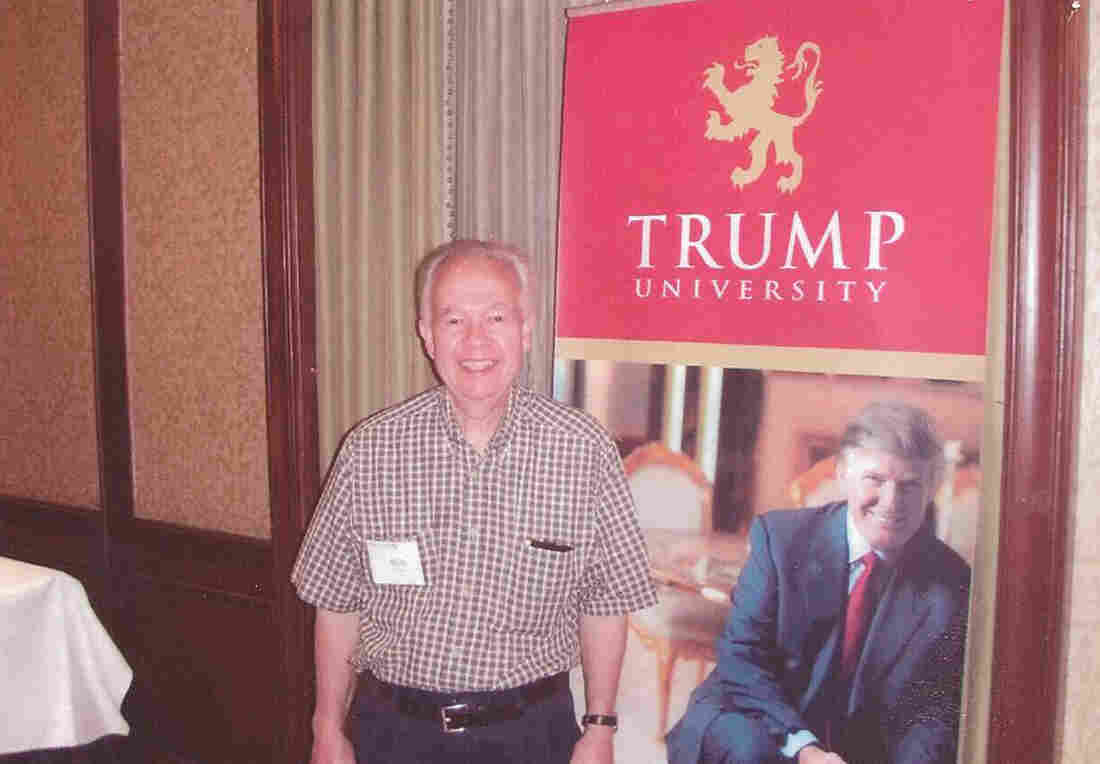
Bob Guillo attended a Trump University retreat session which cost $35,000. He learned little from the program and later asked for his money back.

Bob Guillo attended a Trump University retreat session which cost $35,000. He learned little from the program and later asked for his money back. Courtesy of Bob Guillo hide caption

toggle caption Courtesy of Bob Guillo

A lot of famous and important people have felt the sting of Donald Trump’s invective in recent months, including former Massachusetts Gov. Mitt Romney, British Prime Minister David Cameron and even the pope.

And then there’s Bob Guillo, of Manhasset, N.Y.

The 76-year-old Long Island retiree found himself singled out by Trump in a speech on May 27 because he had criticized Trump University, one of the presumptive Republican presidential nominee’s most controversial business ventures.

Guillo paid nearly $35,000 to be part of Trump University’s “Gold Elite” program, taking money out of his individual retirement account to pay for it. It was a decision he would come to regret.

“At first it was embarrassing,” Guillo says in an interview with NPR. “Then I became very, very angry that the man that scammed me out of all that money had the audacity to run for president. And I’m still angry.”

Guillo’s involvement with the program began in 2009, when he accompanied his grown son, Alex, to a program that promised to teach people how to make money in real estate. The three-day event cost $1,495 to attend.

The session took place at a hotel on Manhattan’s East Side. Guillo remembers signs in the hotel lobby that read, “This Way to Success.” Inside the auditorium was a large cardboard cutout of Trump, and attendees had their picture taken alongside it.

The people running the session were more like motivational speakers than trained real estate professionals, and they were very persuasive, Guillo says.

“The first thing they said was, ‘Guys, Mr. Trump is a multibillionaire and he doesn’t need your money. He’s doing this to be benevolent and to allow people like you to become successful like he is,’ ” Guillo says.

Almost immediately, the speakers began pressuring people to sign up for more classes, and when someone balked at spending more money or asked for time to think about it, they turned up the heat, Guillo says.

“They try to embarrass you, saying, ‘Why do you have to talk to your wife? Why do you have to talk to your husband? Can’t you make decisions by yourself? We’re offering you an opportunity of a lifetime here,’ ” he says.

In fact, Trump University sales people were actively encouraged to sell programs to attendees and were taught ways to overcome their resistance when possible, according to confidential documents released last week.

After signing up for the Gold Elite status, a kind of year-long program of mentoring sessions and educational seminars, Guillo says he realized pretty quickly that the information it provided was largely worthless. Attendees were told to use the real estate website Trulia.com to find properties, or to go to the website of the Internal Revenue Service, irs.gov, to learn about federal tax deductions, he says.

“I knew about those websites before I walked into Trump University. So the more and more I got involved in Trump University, the more and more I found out that I had truly been scammed,” he says.

It’s a picture that Jill Martin, vice president and assistant general counsel at the Trump Organization, disputes.

Far from being worthless, the Gold Elite program featured numerous valuable seminars on different aspects of the real estate industry, allowing attendees to choose what they wanted to focus on, Martin says. In fact, many people complained the classes were too detailed, she says.

But, Martin adds, “No education can guarantee success. Education can only give the students the tools they need to apply in the real world to be successful.”

Ultimately, when Guillo contacted Trump University officials to demand his money back, he was turned down. He subsequently filed a complaint with the office of the New York attorney general.

The office already had heard numerous complaints about the program, according to current Attorney General Eric Schneiderman, and was about to file civil fraud charges against it. Meanwhile, class-action suits had been filed against Trump University in California.

Guillo subsequently appeared in an anti-Trump TV commercial funded by a group with ties to Sen. Marco Rubio of Florida, who was then running against Trump in the Republican primary.

Trump maintains that the legal challenges against the program are politically motivated. He also says the vast majority of attendees were satisfied with the program and filled out cards giving it highest marks. Among the critics he cited by name was Guillo.

“You have this guy, Bob Guillo,” Trump said during his May 27 speech. “He appeared in TV attack ads, even though he rated the programs a five — meaning excellent, the top mark, across the board.”

Guillo acknowledges that he gave the program high marks in comment cards submitted when it was nearly over, but says he and the other attendees were pressured to do so by instructors.

“They would say, ‘OK, if you don’t rate me a five, I’m not going to come back here, and I’ve got a wife and kids,’ and most of the people who were there said, ‘It doesn’t cost me anything,’ ” he says.

But Guillo says none of the attendees knew the cards would later be used by Trump as a defense against lawsuits.

Schneiderman, the New York attorney general, adds, “The Trump system was to have people fill out an evaluation form with the instructor standing right in front of them, and it was not an anonymous form.”

That exerted pressure on the attendees to give high marks, he says.

But Martin, the Trump Organization attorney, says those allegations are “not credible” and insists that instructors were not even in the room nearby when the cards were filled out.

Let’s block ads! (Why?)


No Image

Muhammed Ali Vs. Sonny Liston: The 'Worst Mess In History Of Sports'

In remembrance of Muhammed Ali, NPR looks back at Robert Siegel’s conversation with filmmaker Gary Robinov, director of Raising Ali, about the 50th anniversary of the heavyweight boxing match between Ali and Sonny Liston in Lewiston, Maine. This story originally aired on May 22, 2015, on All Things Considered.

Transcript

ROBERT SIEGEL, HOST:

The death Friday of Muhammed Ali has had me remembering many stories I’ve heard over the years about the champ’s career. Here’s a story that we ran here a little over a year ago. It was about a fight in 1965. In those days, to be boxing’s heavyweight champion was to enjoy global recognition. A title bout was as big as the seventh game of the World Series or the NFL championship game. There was no Super Bowl yet.

But the 1965 fight in question went down as the worst mess in the history of sports. And for a fight that commanded worldwide attention, it happened in a very unlikely place – Lewiston, Maine.

(SOUNDBITE OF ARCHIVED RECORDING)

JOHNNY ADDIE: The main event – 15 rounds for the heavyweight championship of the world.

(SOUNDBITE OF ARCHIVED BROADCAST)

SIEGEL: It was a rematch. The challenger was the former champion.

(SOUNDBITE OF ARCHIVED RECORDING)

ADDIE: Sonny Liston.

(APPLAUSE)

SIEGEL: In the other corner – the champ, who had recently changed his name.

(SOUNDBITE OF ARCHIVED RECORDING)

ADDIE: Muhammed Ali.

(APPLAUSE)

SIEGEL: Previously known as Cassius Clay. The ring announcer Johnny Addie used Ali’s new name there, but throughout that night’s radio broadcast of the match, the sportscasters called him by the name Ali had abandoned.

(SOUNDBITE)

UNIDENTIFIED CASTER #1: Cassius Clay, who’s shadowboxing right above us, weighs…

SIEGEL: This is what I heard that night on New York radio station WHN. I was almost 18 and wouldn’t have missed a heavyweight title fight. Twenty-two-year-old Phil Phil Greiss (ph) was listening too. He made this recording.

(SOUNDBITE OF ARCHIVED RECORDING)

UNIDENTIFIED CASTER #1: The referee has called the two fighters to the center of the ring, and let’s listen to the instructions.

UNIDENTIFIED REFEREE: I know you’re both in good condition…

SIEGEL: The most amazing thing about this fight before it began was that it was in Lewiston, a small Maine mill town. It was supposed to be in Boston, but the DA there wouldn’t have it. There were fears of organized crime being involved. There was a rumored death threat against Ali by members of the Nation of Islam.

GARY ROBINOV: So they scrambled to find a new venue, and most states wouldn’t touch it.

SIEGEL: Gary has made a documentary about the fight and its lasting effect on Lewiston. He says the fight organizers scrambled because tickets had already been sold for closed-circuit telecasts of the bout.

ROBINOV: And got hold of a gentleman by the name of Sam Michael. Sam was a pawnbroker and former economic growth counselor in Lewiston, and he was also a small-town fight promoter.

And they got hold of Sam, and Sam got hold of the then-state boxing commissioner George Russo. And they both got in touch with the governor. The governor agreed to let the fight be held there, and the governor signed the announcement on May 7. So these guys had, you know, 17, 18 days to put together a world heavyweight championship fight in Lewiston, Maine.

SIEGEL: (Laughter) In a city of about 40,000 people, in an arena that had only 2,500 paying customers – and such a mess. It began with the Broadway star Robert Goulet singing “The Star-Spangled Banner.” I can remember this.

(SOUNDBITE OF ARCHIVED RECORDING)

ADDIE: Ladies and gentlemen, national anthem.

ROBERT GOULET: (Singing) O, say can you see by the dawn’s early night…

ROBINOV: That’s true. There are several stories behind it that he had been entertained by family and friends before the fight and maybe had a couple of cocktails. Another was that he was so nervous that he had written the lyrics on the palm of his hand, and he was so nervous and sweating that they blurred on the palm of his hand.

But he got out of sync with the organist and messed up a couple of words, and it followed him for the rest of his life.

(SOUNDBITE OF ARCHIVED RECORDING)

GOULET: (Singing) O’er the land of the free and the home of the brave.

(APPLAUSE)

SIEGEL: So the night begins with a bungled “Star-Spangled Banner,” and then comes one of the strangest heavyweight title bouts that anyone ever saw or, like me, heard on the radio.

(SOUNDBITE OF ARCHIVED RECORDING)

UNIDENTIFIED CASTER #1: They’re staring at each other. There’s the bell, and here’s (unintelligible).

UNIDENTIFIED CASTER #2: And Clay throws a right hand to the head and scores right away, comes in with a left and crosses with a right.

SIEGEL: What went on? How long did it last?

ROBINOV: It varies. The punch – or the phantom punch, as it’s referred to – occurred at a-minute-44 into the first round.

(SOUNDBITE OF ARCHIVED RECORDING)

UNIDENTIFIED CASTER #2: Liston now, his head bobbing – and goes to his knees.

ROBINOV: There’s mass confusion caused by a calamity of events, one of them being that Jersey Joe Walcott, the former heavyweight champ, was actually the referee that night and, being a little inexperienced in that capacity, got out of sync with the official knockdown timekeeper. Muhammad Ali didn’t immediately go to a neutral corner, which delayed the count.

And by the time things got rolling, we’re about a-minute-56 in. Liston’s back up, and the two fighters re-engage. They actually fought. Most people don’t realize that those guys actually started fighting again.

(SOUNDBITE OF ARCHIVED RECORDING)

UNIDENTIFIED CASTER #1: Clay on top of Liston, goes to the left to the top of the head now.

ROBINOV: And at that point, Liston is beckoned over to the timekeepers, and it’s actually a gentleman by the name of Nat Fleischer – was sitting behind the knockdown timekeeper.

SIEGEL: A famous man in the world boxing.

ROBINOV: Yeah. He’s the editor – founder and editor of Ring magazine, and he is waving his arms, saying he’s been down for more than 10; he’s been down for more than 10. This fight is over. So actually, in some strange way, the editor of Ring magazine officially called the fight over.

SIEGEL: (Laughter).

(SOUNDBITE OF ARCHIVED RECORDING)

UNIDENTIFIED CASTER #1: Now here comes Jersey Joe Walcott…

JERSEY JOE WALCOTT: He’s out.

UNIDENTIFIED CASTER #1: …And says it’s all over. They (unintelligible), and it is all over. And they are going wild in the center of the ring.

SIEGEL: I’m trying to imagine what it was like for the people of Lewiston, Maine, to have in there, in this town of about 40,000 people, a huge press corps. There were hundreds of reporters there, yeah?

ROBINOV: Yeah. There was about 600 reporters. The arena held about 4,500 people. They sold 2,400 tickets. They figure with press, people that snuck in, vendors and the like, the tickets they gave away, about 4,000 people were present.

SIEGEL: In addition to the quantity of people who were there, there were some superstars.

ROBINOV: Yeah. The Cinderella Man was there, James J. Braddock. It was an amazing parade, a who’s who of boxing dignitaries. Add to that Liz Taylor, Frank Sinatra, Jackie Gleason. Celebrities from all around the country and the world are flying into this little town, Lewiston, Maine, to attend the world heavyweight championship, the biggest title in all of boxing held in the smallest town ever, to the smallest-attended audience ever. And the whole thing’s over in a-minute-44 seconds or two minutes and two seconds depending who you ask.

SIEGEL: (Laughter).

ROBINOV: And by the time they’re seated and sipping on their first beer or adjusting their coats, the fight’s over.

SIEGEL: Gary Robinov, thanks a lot for talking with us.

ROBINOV: It’s been my pleasure. Thank you so much, Robert.

SIEGEL: That was Maine filmmaker Gary Robinov talking to us about Muhammad Ali’s fight in Lewiston, Maine, in 1965. He made a documentary about the fight called “Raising Ali.”

(SOUNDBITE OF ARCHIVED RECORDING)

MUHAMMAD ALI: Didn’t I tell the world that I had a surprise and that if I told you the surprise, you would not come to the fight? With me was almighty Allah and his messenger, and I’ve been saying my prayers regular, living a righteous life…

UNIDENTIFIED MAN: Right.

ALI: And as you see what happens.

UNIDENTIFIED MAN: Wait a minute, now let me ask you this if I may. Wait a minute.

Copyright © 2016 NPR. All rights reserved. Visit our website terms of use and permissions pages at www.npr.org for further information.

NPR transcripts are created on a rush deadline by Verb8tm, Inc., an NPR contractor, and produced using a proprietary transcription process developed with NPR. This text may not be in its final form and may be updated or revised in the future. Accuracy and availability may vary. The authoritative record of NPR’s programming is the audio record.

Let’s block ads! (Why?)


No Image

For Doctors And Patients, 'Veterans Choice' Often Means Long Waits

Psychologist Diane Adams devotes a portion of her private practice in Renton, Wash., to veterans. But she said the bureaucracy involved in the Veterans Choice program has proved frustrating and veterans have had a hard time getting approval to see her.

Psychologist Diane Adams devotes a portion of her private practice in Renton, Wash., to veterans. But she said the bureaucracy involved in the Veterans Choice program has proved frustrating and veterans have had a hard time getting approval to see her. Patricia Murphy/KUOW hide caption

toggle caption Patricia Murphy/KUOW

When clinical psychiatrist Cher Morrow-Bradley and other health care providers call the Veterans Choice program, they are greeted with a recorded, 90-second “thank you” from Veterans Affairs Secretary Bob McDonald.

It’s not having the intended effect.

“Why don’t you make this easier? The process is so cumbersome, and I have to listen to you thanking me for spending all this time and then I get put on hold,” says Morrow-Bradley, adding that she hasn’t figured out how to skip the message.

She and many others say this is emblematic of the Veterans Choice program that was intended to quickly work through the backlog of vets waiting for medical care. Anyone more than 40 miles from a Veterans Affairs facility or waiting more than 30 days for an appointment could go get private care outside the VA system.

But nearly two years in, there are more vets waiting than before. Health care providers are frustrated with the program, which makes it hard to keep them in the network. Without enough providers to see them, vets end up waiting anyway.

Or, in Morrow-Bradley’s case, the vets get the care and the doctors don’t get paid in a timely fashion, if at all.

She moved to North Carolina to work with veterans, first at the VA and now in a small private practice. Previously she gave VA patients care as a private doctor through a program called PC3. When Veterans Choice started in 2014, she was happy to participate, because she knows VA mental health specialists are overwhelmed.

A Satisfied Patient

One Afghanistan vet, Jacob Hansel, gives Morrow-Bradley a rave review.

“I believe therapy is stronger than medicine,” says the former Marine, who returned from deployment with serious anxiety and depression issues. When the local VA told him it would be a four-month wait for a therapist, he used the Choice program to see Morrow-Bradley.

“I have days when I almost have panic attacks. … A lot of it is just realizing when the anxiety comes; she’s helped me figure how to keep it under control,” says Hansel.

Morrow-Bradley has treated Hansel since last year, along with others in the Choice program. She has submitted her bills to a company called Health Net, which administers Veterans Choice across most of the Eastern United States.

“I just assumed I was being paid. I found out six months later I had five, six [thousand dollars] outstanding to Veterans Choice,” says Morrow-Bradley.

It took her most of a year to get paid. Health Net refused requests for an interview.

Dr. David Shulkin, the head of the Veterans Health Administration, acknowledges this problem has hindered the Choice program in getting providers big and small.

“One thing I know is that when you perform a service, when you see a patient, you want to be paid. And these hospital systems don’t have the cash flow to be waiting around for months and months to get paid,” he says.

Shulkin points to one rule that has been scrapped to speed up reimbursement — originally providers wouldn’t get paid until they had returned an updated medical record to the VA.

Challenges In Getting Certified

Other providers say they want to join the Veterans Choice program but can’t jump through the hoops to get certified.

Psychologist Diane Adams devotes a portion of her practice in Renton, Wash., to veterans, saying it’s something she considers important.

She sees patients at her home office at the midpoint of a steep winding hill. Adams has provided counseling to veterans as part of the VA’s community care programs for nearly a decade.

Last July, she got a letter inviting her to join the Choice program, from TriWest Healthcare Alliance, the company that administers Veterans Choice in most of the Western U.S.

Adams went online together to begin the credentialing process. It all seemed pretty straightforward.

“We checked that box and waited and waited,” Adams said.

In December, after hearing nothing for five months, Adams finally gave TriWest a call.

“I spoke with somebody and yes, they had received my information and they thought, well maybe it’s just taking a long time for the contractual process,” Adams said.

Adams called back again in January and March. Each time a courteous TriWest representative took a message. No one called back.

Tri West’s chief medical officer, Frank Maguire, acknowledges the Veterans Choice program isn’t exactly nimble.

“Things have gotten much better but I’ll tell you we still have persistent educational confusion issues. The program itself is not uncomplicated,” Maguire said.

As a result, small mistakes can mean big problems. Turns out, way back, when Adams filled out the first form, she checked the wrong box. And that held everything up. Finally, in March, Adams was informed that she’d been credentialed since January and should have gotten a welcome letter. It never arrived.

Maguire says the program is still new and may need more time.

“We think we’ve done consistently a much better job as time has gone on,” Maguire said. “At the same time there’s not a lot of patience. People want it perfect right away and it’s a new program. I think still needs more time to mature.”

Now that she’s in, Adams faces a new hurdle: Some of her regular veteran patients can’t get Veterans Choice to approve visits to see her.

Vets are supposed to be able to call the number on the back of their Choice card and get an appointment. But so far it’s been like climbing that steep winding hill to her office — more phone calls, more faxing, more forms.

“I guess what I’m worried about is what happens to the veterans who can’t handle it and they just don’t have the internal resources to put up with it and so they throw up their hands and they give up,” Adams said.

Interrupting Care

A possible interruption in treatment is a particular problem for mental health care, where continuity is paramount.

It’s no accident that both Adams and Morrow-Bradley are mental health care providers. That’s one of the areas in shortest supply at the VA. Unfortunately the Choice program hasn’t been well-suited to fixing that problem.

In North Carolina, Morrow-Bradley keeps seeing her Choice patients. Some come free. Others use secondary insurance that at least pays some of the bill. She says she can’t just halt treatment.

“It’s not like I’m a dentist. If I start working on your teeth then you could go [elsewhere to] be seen and the work would be completed,” she said. “Post-traumatic stress disorder work is very sensitive. You need to have a relationship with the person; it’s stressful for the therapist and the client.”

And Healthnet won’t authorize enough visits at a time, she says. For patients she needs to see twice a week it would take a new authorization almost every month.

“People have been not very interested in participating,” said Chuck Ingoglia, with the National Council on Behavioral Health, a group of 2,800 mental health organizations nationwide.

He says the Choice program doesn’t cover much beyond basic therapy. If you do anything additional you won’t get reimbursed.

“Participating in the Vets Choice program would limit the kind of robust mental health and substance use treatment they have historically been able to provide to veterans.”

For those reasons and others, at least two states, Maine and Montana, have taken the extraordinary step of excluding mental health care from their Choice program. They use other programs to pay for it and have sent harshly critical letters to the VA about the Choice program.

Let’s block ads! (Why?)


No Image

Seaweed On Your Dinner Plate: The Next Kale Could Be Kelp

Seth Barker of Maine Fresh Sea Farms checks a seaweed line. People have foraged wild seaweed off the Eastern Seaboard for centuries. But now a much more active effort to grow seaweed in the U.S. is afoot.

Seth Barker of Maine Fresh Sea Farms checks a seaweed line. People have foraged wild seaweed off the Eastern Seaboard for centuries. But now a much more active effort to grow seaweed in the U.S. is afoot. Derek Davis/Portland Press Herald via Getty Images hide caption

toggle caption Derek Davis/Portland Press Herald via Getty Images

You’ve heard that you should eat more kale. Now a small but growing industry wants you to eat more kelp.

Seaweed production has long been a big industry in Asia. But recently, American entrepreneurs have launched new enterprises that grow fresh and frozen seaweed right here in the States.

Just off the Maine coast, I caught up with Peter Fischer, Peter Arnold and Seth Barker, whose new venture, Maine Fresh Sea Farms, is yielding its first full harvest. From a small skiff out in the clean waters of Maine’s Damariscotta estuary, they winch up a rope that’s heavy with floppy sheets of glistening kelp.

Back in September, they set tiny starter plants of three varieties of edible seaweed out here: kelp, dulse and alaria. Now they have several wide lines of biomass that extend out for yards, bulging just under the water’s surface.

“These have been growing really fast,” Arnold says, marveling at the seaweed’s speedy growth. “Some of them are well over 10 feet.”

These men are all older than 65, and they’ve worked various marine endeavors for decades. They’ve watched the decline of some of Maine’s traditional fisheries: sardine, cod, and more recently, shrimp.

For this latest venture, they’re getting some financial help from the National Oceanic and Atmospheric Administration, and from a local nonprofit development agency. Arnold says the hope is that seaweed farming can boost and diversify existing infrastructure and expertise in the state’s seafaring communities.

“No one was really doing fresh, at least here in this market,” Arnold says. “So we thought, ‘That’s an opening.’ “

Maybe they’ve found one. The greens are selling for up to $15 a pound at retail; restaurants pay a bit less. Another Maine company, Ocean Approved, is selling truckloads of frozen Gulf of Maine seaweed to hospitals and schools — including the universities of Iowa and Texas.

People have foraged wild seaweed off the Eastern Seaboard for centuries. And some small businesses have grown up around harvesting wild seaweed for human and animal consumption. But now a much more active effort to grow seaweed in the U.S. is afoot.

While some Maine companies harvest wild seaweed, others are now farming it. This rockweed is used in nutritional supplements, cosmetics, fertilizers and animal feed.

While some Maine companies harvest wild seaweed, others are now farming it. This rockweed is used in nutritional supplements, cosmetics, fertilizers and animal feed. Robert F. Bukaty/AP hide caption

toggle caption Robert F. Bukaty/AP

“You know what? Kelp is the new kale,” says Barton Seaver, who directs Harvard’s Healthy and Sustainable Food Program. A former D.C.-area chef, he’s all-in for seaweed and has even published a seaweed cookbook. “Watch out, ’cause it’s coming, and it’ll be everywhere in the next decade,” he says.

The virtues of macro-algae are many, in Seaver’s eyes: They require no fertilizer, no pesticides, no fresh water, no arable land. Their nutritional profile is admirable, he says, providing healthy doses of iodine as well as potassium, calcium and other micro-nutrients, protein, soluble fiber, and Omega-3 fatty acids.

And seaweed’s benefits aren’t just for humans. It’s quick growth means quick carbon dioxide uptake, which can reduce ocean acidification. Seaweed can filter excess nitrogen and phosphorous from the water, too. A National Oceanic and Atmospheric Administration-funded project in Washington State’s Puget Sound is aiming to prove that farmed seaweed can create a “protective halo” around stressed sea habitats.

It’s not just a sustainable crop: Seaver says it’s restorative.

“And that’s a very real difference and a major evolutionary point in the sustainability dialogue,” he notes. “We’re not at a point where we’re just focused on doing no harm. We’re really beginning to investigate and discover food-production methods that allow us to restore and heal environments.”

“And,” Seaver adds, “it’s delicious.”

Really?

“I grew up in Maine, and this is what you used to abuse your younger sister on the beach — whipping her with kelp,” says Neal Harden, the chef at a soon-to-open vegetarian version of New York City’s Michelin-rated ABC Kitchen. He acknowledges that seaweed can seem like a funny choice for haute cuisine.

But Harden says he loves the stuff. “It brings a sort of brininess and this oceanic flavor,” he says, as he tosses together dressing for a fettuccine dish he’s developing for his new restaurant. “This dish just has so much umami, between the giant hen [of-the-woods] mushrooms I just threw in there and the seaweed.”

Harden has been looking for a source of fresh ocean greens for his new menu. He says he’s lucky to have found the Maine product, which he plans to incorporate into several dishes — including the fettuccine and a morel and dulse salad — while it’s in season (seaweed grows best in the colder months).

He’s not the only one getting into kelp. Several chefs in Maine’s vibrant food scene, true to the locavore ethic, are giving Maine sea greens a try.

The collective American palate may still take some time to fully embrace farmed U.S. macro-algae. But if the seaweed revolution hasn’t quite arrived yet, like the kelp in Maine’s Damariscotta River, it’s showing some pretty rapid growth.


Fettucine With Maine Seaweed, Market Mushrooms And Spring Onions

Recipe courtesy of Neal Harden, chef de cuisine at ABCV — the forthcoming vegetarian venture from ABC Kitchen

Ingredients:

½ cup mixed fresh Maine seaweed (sugar kelp, winged kelp, kelp stipes), blanched and shocked in ice water, cut or torn into bite-sized pieces

¼ cup spring onion, white parts, cut into thin rings + 1 tsp. sliced spring onion greens

4 whole shiitake caps, cut in half

½ cup (loosely packed) oyster mushrooms, stems removed, torn or cut into bite-sized pieces

1/8 tsp. salt

1 pinch kelp powder (optional but delicious)

5 grinds of fresh black pepper (plus more to finish)

2-3 tsp. extra virgin olive oil

1 cup fresh fettucine

7 sprigs of fresh dill

Directions:

Bring a small pan to medium-low heat. Sweat the spring onions in the olive oil until they soften and begin to get translucent. Add the mushrooms, salt, pepper and kelp powder. Turn up the heat just slightly. Cook until mushrooms are cooked through and releasing lots of juices. Add the seaweed and cook until it’s heated through and all flavors are melded. Add additional salt to taste.

Add cooked and drained fettuccine to the saute pan. Cook until pasta absorbs the juices, adding a bit of pasta water if sauce begins to dry out. Finish with additional fresh pepper and dill sprigs. Top with fresh, grated Parmesan if desired.

Let’s block ads! (Why?)


No Image

Novak Djokovic Wins French Open, Completes Career Grand Slam

Serbia's Novak Djokovic kisses the trophy after winning the final of the French Open tennis tournament against Britain's Andy Murray in four sets 3-6, 6-1, 6-2, 6-4, at the Roland Garros stadium in Paris, Sunday.

Serbia’s Novak Djokovic kisses the trophy after winning the final of the French Open tennis tournament against Britain’s Andy Murray in four sets 3-6, 6-1, 6-2, 6-4, at the Roland Garros stadium in Paris, Sunday. Michel Euler/AP hide caption

toggle caption Michel Euler/AP

Novak Djokovic, the world’s top-ranked men’s tennis player, outlasted Andy Murray in the French Open final Sunday in Paris. In the process he caps a career Grand Slam and becomes the first man in two generations to hold all four major championships simultaneously.

The eventual champion got off to a slow start, dropping the opening set to Murray 3-6. But behind the strength of his forehand, the No. 1 seeded Djokovic roared back, winning the next three sets 6-1, 6-2, 6-4 en route to his first French Open title.

This major had been elusive for Djokovic. According to the Associated Press, this was his 12th appearance at Roland Garros and the fourth time he advanced to the final.

The AP adds:

“When his victory was over, Djokovic took a racket to etch a heart in the red clay that had given him such heartache in the past and dropped down on his back.

Since losing the 2015 final in Paris, Djokovic has won 28 Grand Slam matches in a row, from Wimbledon and the U.S. Open last year, to the Australian Open in January, and now, at long last, the French Open.”

The last male player to have all four majors in their grasp at the same time was Rod Laver, who accomplished the feat in 1969.

With a French Open now in his pocket, Djokovic can now focus his attention on claiming one of the sports’ most elusive prizes – winning all four majors in a single calendar year.

According to USA TODAY:

“While Djokovic made more history on Sunday, he put himself halfway to the calendar Grand Slam, not done in men’s tennis since Laver in 1969. American Jim Courier was the last men’s player to get halfway to the Slam, having won the Australian and French Opens back-to-back in 1992.”

Let’s block ads! (Why?)