Articles by admin

No Image

Tech Companies Embrace Election Season

More than ever before, U.S. elections are a business opportunity. Social media companies are capitalizing on attention spent on the candidates.

Transcript

AILSA CHANG, HOST:

You may already feel bombarded with election news this morning, but if you’ve logged into Facebook, Twitter or Snapchat, you’re likely to be inundated with even more. That’s because for social media platforms, it’s just good business. NPR’s Scott Detrow has more on how tech companies are embracing the election.

SCOTT DETROW, BYLINE: Walking the halls of the Republican National Convention in Cleveland, there were tech companies everywhere you looked.

All right, so this is Connect with Skype at the RNC. It’s a Skype booth. What it basically looks like is a little paneled off area where you can have a Skype call.

Skype, Twitter, Microsoft – it went on and on; same at the Democratic National Convention in Philadelphia.

And we are standing in the Oval Office.

CRYSTAL PATTERSON: Yeah. We have built a mini Oval Office for people to post on Instagram.

DETROW: That’s Crystal Patterson who works on Facebook’s political outreach team. This mini Oval Office was just one part of a larger lounge the company set up inside the Wells Fargo Center.

PATTERSON: It feels very Facebooky (ph). It’s very bright, open and colorful. More importantly, there’s a lot of areas for people to create content, so people can go live pretty easily.

DETROW: And we should note that Facebook does pay NPR and other leading news organizations to produce video that run on the site. In downtown Philadelphia, Twitter was offering something very similar. Sitting at a table in the back, Twitter’s Jenna Golden said the company was giving out free food, coffee and Wi-Fi.

JENNA GOLDEN: This is supposed to be home base for a host of different people, including our advertising clients, our media partners, any very important tweeters.

DETROW: Why all the freebies and fancy displays? Because Twitter and Facebook are competing with each other, and every other social media company, for your time and attention. They both spent a lot of money to make sure that when people were reporting on the convention or sharing their convention experience, Facebook or Twitter would be a part of it. That makes sense to Tim Calkins, a marketing professor at Northwestern University.

TIM CALKINS: It really – it’s true for any big event in a sense, but elections are a little different because they’re huge events and the build-up commands a lot of attention, a lot of activity, and it goes on for a long time.

DETROW: Cozying up to an election in order to get more attention for your company is nothing new and isn’t limited to technology. Calkins says for years Kraft Macaroni & Cheese would make special election year pasta.

CALKINS: So when the Republican convention was going on, they would have the, you know, elephant macaroni and when the Democratic convention was going on, they would have the donkey macaroni.

DETROW: Social media is all about conversation. And this year, there’s no bigger conversation topic than a contentious high-profile national election. But for social media companies, and especially Twitter, there’s one big factor that’s much more effective than trendy VIP hangouts at conventions. It’s the fact that Donald Trump won the Republican nomination with a communications strategy that relied heavily on tweets.

CALKINS: And that’s exactly the sort of message that Twitter wants to get out there. You know, they’d love to go to companies and say, you know what? You no longer even need to worry about traditional advertising because today you can just rely on us.

DETROW: So all the time that Facebook and Twitter spent wooing people at the convention, the truth is most of those people were already probably spending most of the day staring at their phones waiting to see what Donald Trump had to say next. Scott Detrow, NPR News.

Copyright © 2016 NPR. All rights reserved. Visit our website terms of use and permissions pages at www.npr.org for further information.

NPR transcripts are created on a rush deadline by Verb8tm, Inc., an NPR contractor, and produced using a proprietary transcription process developed with NPR. This text may not be in its final form and may be updated or revised in the future. Accuracy and availability may vary. The authoritative record of NPR’s programming is the audio record.

Let’s block ads! (Why?)


No Image

Trans And Adopted: Exploring Teen Identity

Nathan Tasker is transgender and adopted. He was surprised and delighted to meet other adopted transgender children at his camp in Maine.

Nathan Tasker is transgender and adopted. He was surprised and delighted to meet other adopted transgender children at his camp in Maine. Jesse Costa/WBUR hide caption

toggle caption Jesse Costa/WBUR

Two summers ago, when Nathan Tasker was 13, his mom drove him from Melrose, Mass., to Maine, where he would attend his first session at a transgender camp. Nathan remembers feeling happy for the first time in years.

“I finally, finally finally was not alone,” says Nathan, a young man with dark, sparkling eyes and a wise smile.

But even at this camp, Nathan expected to be different. He’s transgender — and adopted.

“I thought I was just a packaged deal, like, this only happens to one kid in every place in the world,” he says. But then, as fellow campers told their stories, Nathan realized he was not all that different. “I was like, ‘You know what? There are a lot of adopted kids who are trans.’ And that’s pretty amazing.”

Doctors at Boston Children’s Hospital’s Gender Management Service clinic, where Nathan is a patient, began making the same connection a few years ago. They combed through patient records and found that 8.2 percent of the 184 young people seen in the clinic between 2007 and 2015 were raised in adoptive families. Overall, only 2.3 percent of children living in Massachusetts were adopted.

“Before I started seeing transgender kids, it would not have occurred to me that we might see more adopted kids,” says Dr. Daniel Shumer, a pediatric endocrinologist who treated transgender kids at the GEMS clinic for three years before moving to Ann Arbor, Michigan, to work in a similar clinic. Shumer and three co-authors recently presented their adoption data at a conference and have submitted it for publication.

Nathan and his doctors aren’t the only members of the transgender community who’ve noticed this phenomenon.

“People have been talking about this for a long time,” says Dr. Johanna Olson-Kennedy, medical director of the Center for Transyouth Health and Development at Children’s Hospital in Los Angeles, the largest such clinic in the country. Olson-Kennedy says she often hears colleagues around the country say, “we have a lot of kids who are adopted in the gender clinics.”

And Diane Ehrensaft, a psychologist and author of the book, Gender Born, Gender Made: Raising Healthy Gender-Nonconforming Children, says in an email, “I am seeing the same thing in my work as a gender specialist in the San Francisco Bay Area.”

Looking For Explanations

No one seems to know why. But there is some agreement about possible explanations.

First, it may be that there’s a higher percentage of trans adopted children who get health care, rather than a higher rate of trans kids who are adopted.

“Adopted people of all ages, especially children, are disproportionately represented in clinical settings,” says Adam Pertman, president of the National Center on Adoption and Permanency, and author of the book Adoption Nation. “The majority of adoptions today are from foster care. Then add to those the children adopted from institutions abroad and you have a population who suffered early trauma — so of course they are disproportionately represented in clinical settings.”

Shumer suggests another factor when it comes to families with adopted trans children: “Perhaps parents who adopt kids are more open to differences in gender identity — may have less shame in the fact that their child may be transgender,” he says, “[and] may be more likely to present to clinics for help.”

That idea resonates with Olson-Kennedy,

“When parents have biological children [who] are transgender,” she says, “what happens is a blame game, like, ‘Whose fault is it?’ I’ve heard many families say, ‘Well, you know, my husband has two gay cousins’ or, ‘My wife has a trans aunt.’ “

Olson-Kennedy says adoptive parents seem to “let go of the ‘this is my fault’ piece.”

But maybe there’s something else about growing up adopted — about coming to terms with that experience — that explains why transgender clinics are seeing more such children.

“Adopted children who are aware of their adopted status also have an easier time being ‘other’ than their parents, and therefore find greater ease in being forthcoming in expressing their true gender selves,” says Ehrensaft.

Shumer says he wonders whether children who grow up knowing they are adopted might develop their identities in ways that make them more open to rethinking gender.

“As adoptive kids are becoming teenagers,” Shumer says, “they may more actively consider their gender identity in the context of their overall identity [than kids who aren’t adopted]. This might help them identify that they have a gender difference more frequently than kids that aren’t adopted, that aren’t going through as rigorous an identity-formation thought process.”

Pertman says that’s a new, but reasonable idea.

“Identity in adoption is a complex issue,” Pertman says. “I mean it’s complex for everybody, but there’s a whole other layer for adopted people that sort of triggers, in many of them, a deeper look within themselves about identity. And maybe this is part of what they find.”

More Theories — And The Need For More Study

Roz Keith with her son Hunter, who was adopted at birth. Hunter, now 17, began his transition from female to male at age 14.

Roz Keith with her son Hunter, who was adopted at birth. Hunter, now 17, began his transition from female to male at age 14. Courtesy of the Keiths hide caption

toggle caption Courtesy of the Keiths

Maybe, but that reasoning doesn’t ring true to Hunter Keith, a 17-year-old trans male who was adopted at birth – at least not in terms of his own experience. Hunter says the gender transition he started in the eighth grade did not coincide with questions about his adoption.

“I’ve been part of my family my whole life,” Hunter says. “I’ve never had that feeling of not belonging. It’s not something I ever questioned.”

Hunter’s mother Roz, who lives with Hunter and her husband and daughter in the metropolitan Detroit area, would like to see more research about the neurological roots of gender identity. She believes there may be all kinds of connections that no one understands yet.

Here’s one possibility Roz Keith has discussed with friends, based on studies that show greater rates of autism and learning disorders among transgender kids than among the general population: Could the kids be inheriting those conditions from their birth parents, and could those conditions be one reason the mothers place their children for adoption?

“There’s this incidence, then, of children who are adopted who have a genetic history coming from families where there are learning issues — ADD, ADHD,” Roz Keith suggests. “It does seem that those things overlap and correspond in greater numbers [in the transgender population].”

Some members of the transgender community say all these theories deserve more attention, but for now, they don’t see any connection between being trans and being adopted.

“I think it’s a stretch, frankly,” says Jamison Green, the immediate past president of the World Professional Association for Transgender Health. “People, in trying to understand what ‘transness’ is and how it manifests, and why some of us are this way, will elicit all kinds of conjectures.”

Nonetheless, Green, who is adopted, says he would like to see more research in this area.

The speculation “speaks to how little we actually know,” Green says. “There’s much more to be learned about transness, about gender, about gender identity development in all people.”

With so little research, it’s not clear if or how these findings should affect care for children at transgender clinics. Shumer says it may help parents contemplating adoption to learn more about gender identity as a spectrum. Doctors, nurses and counselors may want to set up support groups for adopted children, to help kids who might find such groups useful explore any and all sorts of issues as they arise.

Judy Tasker, Nathan’s mom, says she’s sure that being transgender and adopted makes life more complicated for her son.

“It’s the transgender piece that throws everyone off,” she says, “but, really, it’s his issues from being in a poor foster home for the first 15 months of his life that really make him struggle at school, struggle with anger. The trans piece is this little piece, but it over-complicates what therapists see, what schools see, and they is fixate on it.”

Nathan says he’s always assumed that being adopted and being trans were two separate experiences. But, “maybe somehow they’re connected,” he says. “Maybe adopted kids feel some dimensions that non-adopted kids can’t feel, because they haven’t been in that situation.”

There are a lot of maybes in the expanding world of gender identity.

This story is part of NPR’s reporting partnership with NPR, WBUR and Kaiser Health News.

Let’s block ads! (Why?)


No Image

U.S. Women Edge France, Passing A Tough Test In Olympic Soccer

U.S. women's soccer player Crystal Dunn (in white) contends with Amel Majri of France during their match at Mineirao Stadium in Belo Horizonte, Brazil. The U.S. earned a 1-0 victory in the the Group G first-round meeting in the Rio Summer Olympics tournament.

U.S. women’s soccer player Crystal Dunn (in white) contends with Amel Majri of France during their match at Mineirao Stadium in Belo Horizonte, Brazil. The U.S. earned a 1-0 victory in the the Group G first-round meeting in the Rio Summer Olympics tournament. Pedro Vilela/Getty Images hide caption

toggle caption Pedro Vilela/Getty Images

It was a match that lived up to its billing: the U.S., the world’s top-ranked women’s soccer team, taking on No. 3 France in a close contest that saw stellar play from both goalkeepers and ended with a 1-0 American victory.

The tense tone was set in the first minutes, with both offenses putting the ball into the penalty area for scoring chances – and both defenses quickly defusing those threats. That pattern held for all of the first half, and for part of the second.

The U.S. broke the 0-0 tie nearly 20 minutes into the second half, with Carli Lloyd putting away a ricochet that had eluded French goalie Sarah Bouhaddi’s grasp after a hard shot on the near post by Tobin Heath.

Shortly after that score, U.S. coach Jill Ellis moved to preserve the lead, inserting defender Ali Krieger into the game in place of Crystal Dunn — who had just been given a yellow card for a sliding tackle.

The U.S. was playing without another stalwart of its back line, as defender Julie Johnston wasn’t in the starting lineup. France repeatedly sought to exploit this by lofting corners and free kicks to the 6-foot-2 Wendie Renard.

France used a flurry of substitutions to try to equalize late in the second half, but the French side was unable to convert several scoring chances.

As in the U.S. victory over New Zealand on Wednesday, many spectators in Belo Horizonte seized every opportunity to jeer U.S. goalkeeper Hope Solo. In what’s now become a familiar pattern, whistles rained down on the field as Solo handled the ball. When she kicked it away, fans yelled in unison, “Zika!”

That jeering is how many Brazilian fans have chosen to respond to Solo’s posting of a selfie last month that showed her wearing a protective hat and holding a can of bug spray.

Solo faced at least three dangerous shots in the first half, and she negated them all, getting her gloves on a header off a free kick; a close-range shot on a breakaway, and on another point-blank blast from a French attacker who had eluded the Americans’ defense. More threats came in the second, but Solo turned them away, and in some cases the shots dinged off the goal’s pipes.

France used an organized defense and a solid midfield to dominate possession in the game’s first 20 minutes, owning the ball for nearly 60 percent of the time. But the U.S. team leveled that statistic as the game wore on, and controlled possession in the second half.

With the win, the United States is 2-0 in Group G ahead of Tuesday’s match against Colombia at Amazonia Arena. The Americans are assured of advancing to the tournament’s knockout stage, which begins Friday.

The Americans are going for their fourth straight Olympic gold and their fifth in the last six Summer Games.

Let’s block ads! (Why?)


No Image

At This English Bar, An Old-School Solution To Rude Cellphones

Drinks on a bar

Liam Norris/Getty Images/Cultura Exclusive

There was a time when people went to bars to talk to other people, maybe even meet someone new. But that was in the BC era — before cellphones.

“I’ve been in the pub industry for a long time, and progressively it’s become less and less social and more and more antisocial,” Steve Tyler, the owner of the Gin Tub in Sussex, England, tells NPR’s Scott Simon.

And that’s bad for business. So Tyler wanted to bring back the conversation, and he did by turning his bar into a Faraday cage — a 19th-century invention that reflects electromagnetic fields and conducts currents around, rather than inside, an enclosure.

He installed copper wire mesh in the bar’s ceiling and tin foil on the walls, effectively blocking cell phone signals from getting into the establishment.

A woman sits in a Faraday cage that is struck by lightning that was produced by a large transformer the Phaeno Science Centre in Wolfsburg, Germany, on Aug. 24, 2007. A Faraday cage is a 19th-century invention that reflects electromagnetic fields and conducts currents around, rather than inside, an enclosure.

A woman sits in a Faraday cage that is struck by lightning that was produced by a large transformer the Phaeno Science Centre in Wolfsburg, Germany, on Aug. 24, 2007. A Faraday cage is a 19th-century invention that reflects electromagnetic fields and conducts currents around, rather than inside, an enclosure. Fabian Bimmer/AP hide caption

toggle caption Fabian Bimmer/AP

“It’s not military grade,” Tyler says, but “it does its job.”

Tyler says that, because it doesn’t send a signal to jam phones, the setup is totally legal. But just in case, the Gin Tub has a sign at its entrance that tells people exactly what they’re getting into: “No Wi-Fi, no signal, just friends.”

A week in, Tyler says that people are loving the change.

“I think I’ve hit a nerve in the world, that I think it’s rude, and I think society has accepted people on their phones in bars and in places where it’s socially unacceptable,” he says.

He hasn’t seen sight of any imitators, but Tyler is confident that his approach — or at least the general idea — will win out.

“I think this is gonna be the new way forward for restaurants and bars and clubs,” he says.

Without phones in their hands, people are no longer drinking in silence but instead talking with each other. Tyler says that’s how bars were intended.

“It’s like Cheers, the TV program, when you walk in everyone knows your name,” Tyler says. “Well, there are no pubs now where everyone knows your name.”

That is, except within the Faraday cage.

Let’s block ads! (Why?)


No Image

Best of the Week: Everything You Need to Know About 'Suicide Squad,' the Latest on 'The Avengers' and More

The Important News

Marvel: Avengers: Infinity War will only be one movie.

Star Wars: ABC is actively exploring ideas for Star Wars TV shows.

Disney: James Ponsoldt is the latest indie filmmaker tapped to direct a family film for the Mouse House.

Harry Potter: The Fantastic Beasts and Where to Find Them sequel will arrive in 2018.

Remakes: Jillian Bell and Channing Tatum will be the leads in the Splash redo. Benedict Cumberbatch will star in a new version of Rogue Male. Rami Malek joined the Papillon remake. Rebel Wilson will star in a Dirty Rotten Scoundrels remake.

Sequels: The Secret Life of Pets 2 was greenlit for a 2018 release.

Box Office: Jason Bourne and Bad Moms both had decent openings.

Video Game Movies: Joe Carnahan is writing an Uncharted movie.

YA Movies: Daisy Ridley will star in Doug Liman’s Chaos Walking adaptation.

True Stories: Mel Gibson and Sean Penn will team up for The Professor and the Madman.

Awards: Jimmy Fallon will host the Golden Globes.

The Videos and Geek Stuff

New Movie Trailers: Dunkirk, I Am Not a Serial Killer, Finding Altamira, Land of Mine, Two Lovers and a Bear, Storks, 24X36: A Movie About Movie Posters and Max Rose.

TV Spots: Jack Reacher: Never Go Back and Florence Foster Jenkins.

Clips: Pete’s Dragon.

Watch: A Blu-ray bonus featurette for The Lobster with Colin Farrell.

See: A list of every song in Suicide Squad.

Watch: The Suicide Squad trailer redone in Lego. And a new Suicide Squad music video.

See: What a Marvel vs. DC superhero mashup movie would look like. And the history of Marvel vs. DC at the box office.

Watch: An honest trailer for Watchmen. And a video of everything wrong with Batman v Superman: Dawn of Justice.

See: What Edgar Wright’s Dark Knight trilogy would have looked like. And what Aquaman v Superman would have looked like.

Watch: An Olympics movie supercut.

See: A new Star Wars spaceship from Rogue One.

Watch: A video exploring how Pixar makes us cry.

See: Vin Diesel’s rocket-powered new car for Fast 8.

Watch: A video essay on movies that kill off heroes and other likable characters.

See: Michael Jordan names who should have starred in Space Jam 2.

Watch: Olympic athletes pick their favorite sports movies.

See: The best new movie posters of the week.

Our Features

Monthly Movie Guide: See August’s notable releases and anniversaries above. And why this August will be a great month for movies.

Movie Review: The good and bad about Suicide Squad. And our DC expert’s review of Suicide Squad.

Comic Book Movie Guide: Everything you need to know about The Joker and Harley Quinn. And everything you need to know about Jared Leto’s Joker.

List: 10 Suicide Squad members who should be in the sequel.

Geek Movie Guide: Why a Harry Potter and the Cursed Child movie should wait.

Horror Movie Guide: What to see after you watch Stranger Things.

Classic Movie Guide: When Howard the Duck ruined comic book movies.

Film Festival Guide: See the first wave of Fantastic Fest programming.

R.I.P.: Remembering the reel-important people we lost in July.

Home Viewing: Our guide to everything hitting VOD this week.

and

MORE FROM AROUND THE WEB:

Let’s block ads! (Why?)


No Image

Olympic Opening Ceremony Kicks Off In Brazil

Fireworks have lit up the night sky in Rio de Janeiro with the start of the Olympic opening ceremony. The pageant is celebrating Brazil’s history and culture, which will include music and dance.

Transcript

KELLY MCEVERS, HOST:

The opening ceremony for the Rio Olympics has been a swirl of dance, music and a vintage biplane flying through the stadium and seeming to soar out over the city. And, of course, there’s the athletes Parade of Nations. NPR’s Melissa Block is in Rio, watching the ceremony. And she’s with us now. Hi there.

MELISSA BLOCK, BYLINE: Hey, Kelly.

MCEVERS: So we should explain that you are way ahead of us of knowing what’s going on. NBC, the U.S. rights holder for the Olympics, tape delayed the ceremonies by an hour in the East. It’ll be four hours delayed here on the West Coast. So tell us what we missed.

BLOCK: OK, so spoiler alerts to everybody listening because we do have a jump on you from here in Rio. We have seen a lot of exuberant dance, as you would expect, from – everything from samba, to funk, to native dance, even a bit of twerking. We saw supermodel Gisele Bundchen embodying “The Girl From Ipanema.” Although, Kelly, I have to tell you when I picture that tall and tan and young and lovely girl walk to the sea, I am not picturing her in silver lame and stiletto heels. But that’s just me.

There is also – I mean, on a totally different note, a really strong environmental theme to this ceremony. There was a really somber portion, showing the dire effects of climate change on the planet and sea level rise. There were maps showing Dubai and the Netherlands getting swallowed by the sea. And as part of this green theme, every athlete in this Parade of Nations is being given the seed of a tree – 500 different native species of Brazil. They’re pressing those seeds into soil in capsules. And those capsules are supposed to be planted after the games in one of the Olympic venues to become a new forest.

MCEVERS: So the Parade of Nations, is it still going on?

BLOCK: It is still going on. We are up to – let me check – it was Switzerland a minute ago. And I have to tell you, there was a great moment a few minutes ago. South Sudan just entered Maracana Stadium. There are two new countries who became officially recognized by the Olympic Committee this year – Kosovo is one, South Sudan another. And went the South Sudanese flag bearer came into the stadium, he pumped his fist and did a little dance. And you could they are really excited to be here for the first time.

It’s worth noting that there are a number of athletes who are going to compete later on in the games, in the second week, who aren’t even here in Rio yet. So they’re obviously not taking part in this parade. And there are also some athletes who compete early – you know, this weekend, who aren’t marching in the parade because this is a really long night to be on your feet, and they want to preserve their strength.

MCEVERS: I understand organizers had drastically cut the budget for this opening ceremony. What led to that?

BLOCK: Right. Well, you know, Brazil is in a severe economic crisis. It’s been undergoing a terrible recession. And one of the creative directors of the ceremony, the noted film director Fernando Meirelles, said that look, when we started we were rich. And then we had to cut, cut, cut. We had to get rid of some of our toys, as he put it. He also, though, put it in perspective. He said, look, when 40 percent of the homes in Brazil have no sanitation, you can’t really be spending a billion reals for a show.

And they’ve actually used the term MacGyvering in terms of how they’re approaching this. In other words – and I have to confess, I’ve never seen the show – but I gather the idea is that this is a secret…

MCEVERS: Oh, yeah.

BLOCK: …Agent who improvised – you know better than I.

MCEVERS: Absolutely.

BLOCK: Who improvises with – I’m revealing my ignorance here – improvises with everyday items, fixing big problems, you know, with makeshift fixes. I have to say, it looks pretty great. If they’re MacGyvering, they’re doing a really a good job.

MCEVERS: Quickly, what’s still to come tonight?

BLOCK: Legendary singers Caetano Veloso and Gilberto Gil. Interim…

MCEVERS: Wow.

BLOCK: …Brazilian President Michel Temer will pronounce the games open. He has said he does expect to be booed. But he quoted a Brazilian writer who said that at Maracana Stadium, even the moment of silence gets booed.

MCEVERS: That’s NPR’s Melissa Block in Rio de Janeiro, covering the Olympics. Thanks so much.

BLOCK: You bet.

Copyright © 2016 NPR. All rights reserved. Visit our website terms of use and permissions pages at www.npr.org for further information.

NPR transcripts are created on a rush deadline by Verb8tm, Inc., an NPR contractor, and produced using a proprietary transcription process developed with NPR. This text may not be in its final form and may be updated or revised in the future. Accuracy and availability may vary. The authoritative record of NPR’s programming is the audio record.

Let’s block ads! (Why?)


No Image

U.S. Economy Continues Growth Ahead Of Presidential Election

With new jobs numbers out Friday and the recent anemic growth in the GDP, NPR takes stock of the economy three months before the election.

Transcript

AUDIE CORNISH, HOST:

It’s been a good summer for people looking for work. The Labor Department says U.S. employers added 255,000 jobs last month. That’s a lot more than expected, and it’s the second month in a row in which the economy grew by more than a quarter million workers. These monthly reports are going to start to play a role in how voters see the economy as we get closer to the November election. Here’s NPR’s Scott Horsley.

SCOTT HORSLEY, BYLINE: Tom Maher runs a temporary employment company in Dayton, Ohio, a major center of manufacturing, warehousing and swing-state politics. Late last year, Maher’s business weathered a slowdown in hiring. But so far, he says 2016 has been a story of steady growth.

TOM MAHER: We have more work available than we have people to take the jobs.

HORSLEY: With unemployment just 4.9 percent, Maher says many businesses he recruits workers for are having to pay more.

MAHER: We’ve been working very hard over the last 12 to 18 months to convince our clients that we do need to begin to increase hourly rates, and we’re starting to see success now. The rates are going up, but I don’t think they’re up as high as they need to be.

HORSLEY: Nationwide, wages are on track to grow nearly 3 percent this year, well above the rate of inflation. And hundreds of thousands of new workers entered the labor force last month. In theory, that positive economic news should be good for Democratic presidential hopeful Hillary Clinton since voters have less incentive to shift course in the White House. But there’s a caveat.

NATHAN GONZALES: How the economy is doing is less important than how voters think the economy is doing.

HORSLEY: Nathan Gonzales who edits the Rothenberg-Gonzales Political Report says just as Republicans may have overplayed the message of gloom and doom at their convention last month, Democrats have to be careful not to pop the economic champagne corks too quickly.

GONZALES: Democrats, I think, have to walk the line between promoting positive jobs numbers and economic data that’s out there, but still understanding that there is a segment of the American people who don’t believe that the economy is working for them.

HORSLEY: Those are the voters Donald Trump’s been targeting. Trump is set to deliver an economic speech in Detroit on Monday, and today he announced the members of his economic advisory council. One of those members UC, Irvine Professor Peter Navarro says buried beneath the jobs number is a tangle of discouraging economic data, including a growing trade deficit.

PETER NAVARRO: We’re strumbling (ph) along. We’re probably stronger than the rest of the world at this point because we’re a – such a great nation. But it’s far from good enough. We’re vastly underperforming, and at the end of the day the problem all gets down to bad trade deals.

HORSLEY: The Trump campaign has also been highlighting figures showing lackluster economic growth in recent months of just 1.2 percent. White House economist Jason Furman argues the underlying growth rate is stronger than that. He notes consumer spending during the three-month period was up more than 4 percent.

JASON FURMAN: And when people are nervous, they hold back their spending. That’s not what we’re seeing now. We’re not seeing nervous consumers. We’re actually seeing consumers that are optimistic, that are positive, that are out there spending money because they are making more money and believe that their future is strong.

HORSLEY: Voters have a few more months to consider how they feel about the economy, and the candidates’ competing economic prescriptions before they decide how one important job gets filled. Scott Horsley, NPR News, Washington.

Copyright © 2016 NPR. All rights reserved. Visit our website terms of use and permissions pages at www.npr.org for further information.

NPR transcripts are created on a rush deadline by Verb8tm, Inc., an NPR contractor, and produced using a proprietary transcription process developed with NPR. This text may not be in its final form and may be updated or revised in the future. Accuracy and availability may vary. The authoritative record of NPR’s programming is the audio record.

Let’s block ads! (Why?)


No Image

Zika Cases Surge In Puerto Rico As Mosquitoes Flourish

A health department pickup truck sprays insecticide against mosquitoes in a San Juan, Puerto Rico, neighborhood in January.

A health department pickup truck sprays insecticide against mosquitoes in a San Juan, Puerto Rico, neighborhood in January. Alvin Baez/Reuters hide caption

toggle caption Alvin Baez/Reuters

The Zika outbreak in Puerto Rico is expanding rapidly.

Recently, the island has been reporting more than a thousand new cases of Zika each week.

The situation is expected to get worse before it gets better.

“We are right now probably in the month or 6 weeks of peak transmission,” says Tyler Sharp the lead epidemiologist for the Centers for Disease Control and Prevention’s Zika operation in Puerto Rico.

Previous outbreaks of dengue fever and chikungunya, which are transmitted by the same mosquito as Zika, Aedes aegypti, suggest the hot, wet summer months in Puerto Rico now are just right for Zika to flourish, Sharp says.

“The more rains you get, the more mosquitoes you get. The more mosquitoes, the higher the rate of transmission,” he says. “And also the mosquitoes like warmer temperatures and are able to replicate the virus more efficiently at at least slightly higher temperatures.”

He calls August in Puerto Rico the “Goldilocks zone” for Zika virus replication.

The island has already had more than 8,000 confirmed cases of Zika. The CDC predicts that by the end of the year, 20 percent to 25 percent of the roughly 3.5 million people on the island could be infected with the virus.

Many of those people would have mild symptoms or even none at all. But such a widespread outbreak means that thousands of pregnant women could be exposed and their babies might be at risk of having severe Zika-related birth defects.

And the tools to fight Zika are limited.

Public health officials weren’t able to stop previous outbreaks of dengue and chikungunya while they were in progress, Sharp notes. Zika is even more complicated because it’s transmitted by both mosquitoes and sexually activity.

“So we have things that we think can be effective,” he says. “We know that individuals can take approaches to reduce their risk of infection. But in terms of breaking the epidemic, or stopping transmission, there’s nothing that we know about that’s been scientifically evidenced to show that this will work, that this is the solution.”

There’s no silver bullet.

Even the insecticides that are being used to spray homes or fog some high-risk neighborhoods have been losing their punch. Mosquitoes have been developing resistance to them.

“What we’ve seen in Puerto Rico, as we see in many regions, is that there is a wide variety of resistance not to all insecticides but to many of them,” Sharp notes. “And that [resistance] can change over time depending on what’s being used in the communities, in the population.”

A plan for aerial spraying of an insecticide called Naled caused an uproar here. San Juan’s mayor called the plan “environmental terror” and late last month the governor blocked the proposal. Naled is the same chemical that’s being sprayed from planes over parts of Miami to combat Aedes aegypti mosquitoes there.

Sharp says the efforts against Zika in Puerto Rico rely primarily on people. People protecting themselves from mosquito bites and people attacking mosquito breeding grounds. The only good news is that if previous outbreaks of dengue and chikungunya are any guide, the high levels of Zika transmission here should start to fall in September or October.

Let’s block ads! (Why?)


No Image

From The 2016 Crop Over Festival, A Feast of Caribbean Soca Music

King Bubba (in the hat) at Crop Over last weekend. His song "Calling In Sick" is a robust tribute to rum.

King Bubba (in the hat) at Crop Over last weekend. His song “Calling In Sick” is a robust tribute to rum. Courtesy of the artist hide caption

toggle caption Courtesy of the artist

Soca music fans subsist in a feast-or-famine world. Feasts come during Carnival — especially Trinidad Carnival, king of them all — when the exuberant, dance-driven tunes are released faster than soca icon Machel Montano can wine his waist (i.e. very, very fast). Famine follows, as we wring every last drop of delight from these soca hits while waiting for another island’s Carnival — there’s one somewhere, most months — to serve up a trickle of new music.

Enter Barbados Crop Over, bequeathing ravenous soca lovers with a banquet. It’s the only Caribbean Carnival that can rival Trinidad’s in terms of quality of parties and musical output. Thanks to a thriving local music scene and a prominent forum for its products — Crop Over annually attracts thousands, from all over the world — Barbados has lodged itself at the forefront of the soca music industry. Pour yourself a Mount Gay on ice and feast your ears on some Bajan gems from 2016’s Crop Over celebration, which wrapped this week on the streets of Bridgetown.

Hear The Songs

  • Lil Rick, ‘Iz A Bajan’

    Hyperactive and hyper-productive — he graced revelers with nearly a dozen hits this Crop Over season — veteran party-starter Lil Rick won multiple Carnival titles with this vigorous homage to patriotism, an ideal tune for Barbados’s 50th anniversary of independence.

    [embedded content]
    YouTube
  • Peter Ram, ‘Good Morning’

    “Show them how we does jump up, show them how we does free up,” croons Peter Ram in a tune demanding to be sung along with (especially when it creates dulcet harmony from the word “gross”). The operative word here is “them”: Carnival is about community, so either you get it and you’re with us, or you don’t — and, alas, you’re one of them.

    [embedded content]
    YouTube
  • Marvay, ‘Know The Face’

    Ever danced with so many people for so many days, after so many alcoholic beverages at so many different Crop Over fetes — and you just know you know this person you’re wining on yet can’t quite figure out where you know her from, or whether you ever knew her name? This groovy soca song is for you.

    [embedded content]
    YouTube
  • King Bubba, ‘Calling In Sick’

    No one can craft a tribute to rum like King Bubba, and this robust hit — designed to maintain high energy levels during the Grand Kadooment parade on Carnival day — upholds his gold standard. “Rum is me only medicine,” sings the King. Nuff said.

    [embedded content]
    YouTube
  • Stiffy, ‘Tek Off Something’

    If there were a soca cartoon, Stiffy — with his ribald lyrics and over-the-top stage persona — would be it. This omnipresent Crop Over jam instructs revelers to take off something and “pelt it ‘way,” which might be a metaphor for shedding oneself of all negativity (“bad mind,” as West Indians say) during the life-affirming ritual that is Carnival. Or maybe it’s just license for revelers to liberate themselves from even more articles of clothing.

    [embedded content]
    YouTube
  • Fadda Fox, ‘Dirty Habits’

    Here’s the beauty of Carnival: it’s that time of year when the “nasty, dirty habits” that Fadda Fox sings of here — strong rum, dancing a little, er, too close — aren’t really nasty or dirty at all, just standard seasonal bacchanal. Call it Carnival catharsis.

    [embedded content]
    YouTube
  • Marzville feat. Snap Brandy, ‘Bang Bim’

    Behold an irrepressibly catchy song containing barely a complete word but plenty of monosyllabic ejaculations — perfect, in other words, for making revelers do as they should during Carnival: shut up and wine.

    [embedded content]
    YouTube
  • Leadpipe & Saddis, ‘Dreams’

    The melodies, the harmonies, the sweet and smooth sound of this tune — it’s like Barbadian sugar for the ears.

    [embedded content]
    YouTube
  • DJ Private Ryan, ‘Scorch Summer 16’

    Non-Bajan alert! DJ Private Ryan is Trinidadian, and he’s the Funkmaster Flex of soca: the man with the mix everyone is listening to, pre- and post-Carnival. Scorch, meanwhile, is the A-list brand of Carnivals Caribbean-wide — the promotion company with the fetes everyone is trying to get into. Bring them together and behold a soca-driven musical mix that’s nothing short of indispensable.

[embedded content]

Let’s block ads! (Why?)


No Image

Today in Movie Culture: Lego 'Suicide Squad' Trailer, 'Kubo and the Two Strings' Interactive Map and More

Here are a bunch of little bites to satisfy your hunger for movie culture:

Redone Trailer of the Day:

It’s been a while since we saw a trailer remade with Lego, so here’s one for Suicide Squad (via Geek Tyrant):

[embedded content]

Movie Trilogy Recap of the Day:

With a new Batman movie out this week (sort of), here’s a rap recap of the Dark Knight trilogy:

[embedded content]

Movie Comparison of the Day:

Now it makes sense why Batman v Superman: Dawn of Justice is bad: Couch Tomato shows how it’s the same movie as Iron Man 2:

[embedded content]

Interactive Movie Promotion of the Day:

Before seeing Kubo and the Two Strings, explore its world with this very cool interactive map:

[embedded content]

Vintage Image of the Day:

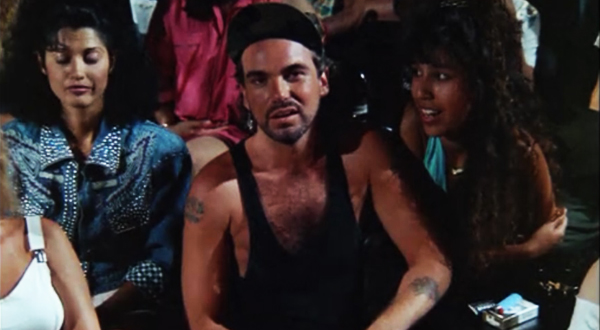
Billy Bob Thornton, who turns 61 today, made one of his first movie appearances in the 1989 Adam Sandler comedy Going Overboard, pictured below:

Supercut of the Day:

Ranker celebrates the art of door slamming in movies in this noisy supercut:

[embedded content]

Video Essay of the Day:

Jacks Movie Reviews explores the idea of a protagonist or major likelable character dying in a movie in the following spoiler-heavy video essay (via One Perfect Shot):

[embedded content]

Cosplay of the Day:

We’re still catching up with some of our favorite cosplay from Comic-Con, including this great dinosaur Deadpool mashup getup (via Fashionably Geek):

Filmmaker in Focus:

Beyond the Frame spotlights the movies that influenced the work of Wes Anderson side by side with the homage (via One Perfect Shot):

[embedded content]

Classic Trailer of the Day:

Today is the 10th anniversary of Talladega Nights: The Ballad of Ricky Bobby. Watch the original trailer for the Will Ferrell comedy below.

[embedded content]

and

Let’s block ads! (Why?)