
Articles by admin

No Image

Doll Therapy May Help Calm People With Dementia, But It Has Critics

Vivian Guzofsky, 88, holds a baby doll at Sunrise Senior Living in Beverly Hills, Calif. Guzofsky, who has Alzheimer’s disease, is calm when taking care of the dolls. Heidi de Marco/Kaiser Health News hide caption

toggle caption

Heidi de Marco/Kaiser Health News

Sitting beside a neatly made crib, 88-year-old Vivian Guzofsky holds up a baby doll dressed in puppy dog pajamas.

“Hello gorgeous,” she says, laughing. “You’re so cute.”

Guzofsky, who has Alzheimer’s disease, lives on a secure memory floor at a home for seniors in Beverly Hills, Calif. She visits the dolls in the home’s pretend nursery nearly every day. Sometimes Guzofsky changes their clothes or lays them down for a nap. One morning in August, she sings to them: “You are my sunshine, my only sunshine. You make me happy when skies are gray.”

No one knows whether she believes she is holding a doll or a real baby. What the staff at Sunrise Senior Living do know is that Guzofsky, who can get agitated and aggressive, is always calm when caring for the dolls.

Doll therapy is catching on at nursing homes and other senior facilities across the country. It’s used to help ease anxiety among residents with dementia, who can experience personality changes, agitation and aggression. But the therapy is controversial.

Supporters say the dolls can lessen distress, improve communication and reduce the need for psychotropic medication. Critics say the dolls are demeaning and infantilize seniors.

Marilou Roos, 87, rarely speaks and sleeps much of the day. But caregiver Jessica Butler says Roos brightens up when caring for the dolls. Heidi de Marco/Kaiser Health News hide caption

toggle caption

Heidi de Marco/Kaiser Health News

Typically, caregivers will give residents the option of holding, changing or dressing the dolls, without saying whether the dolls are babies or toys. Caregivers may also use the dolls to start conversations about the residents’ own children or grandchildren.

Care providers who use the technique say the dolls help engage elderly people who are no longer able to participate in many activities.

“A lot of people with Alzheimer’s are bored and may become depressed or agitated or unhappy because they aren’t engaged,” says Ruth Drew, director of family & information services at the Alzheimer’s Association.

Caregivers aren’t trying to make their charges believe the dolls are real infants, Drew says. They are just “trying to meet them where they are and communicate with them in a way that makes sense to them,” she says.

But some care providers do not like the technique.

“They are adults and we want to treat them like adults,” says Stephanie Zeverino, who works in community relations at a Belmont Village center in Los Angeles. “These are very well-educated residents.”

Staff members there work with residents to play brain games that promote critical thinking, she says. And they use other types of therapy including art and music.

“We want to provide a sense of dignity,” Zeverino says.

Studies on doll therapy are limited, but some research has shown it can reduce the need for medications and lessen agitation, aggression and wandering.

“Having the doll … offers them an anchor or a sense of attachment in a time of uncertainty,” says Gary Mitchell, a nurse specialist at Four Seasons Health Care facilities in Northern Ireland, and author of a new book: Doll Therapy in Dementia Care: Evidence and Practice.

“A lot of people associate the doll with their younger days and having people to care for,” Mitchell says.

However, he acknowledges that doll therapy can perpetuate the stigma associated with dementia that care givers are trying to get away from.

Some families worry about their relatives being laughed at when they engage in doll therapy, Mitchell says. He had the same concerns when he worked at a senior residential center. But when one resident requested that he allow her to continue caring for a doll, he saw the positive impact of the therapy. Mitchell says doll therapy should be used cautiously and more studies are needed.

At Sunrise Beverly Hills, the nursery is set up like a baby’s room. A stuffed bear rests inside the wooden crib. On a shelf above are framed photos of Guzofsky and a few other women who regularly interact with the dolls. A few bottles, a Dr. Seuss book and diapers sit on a nearby changing table.

The nursery is just one of several areas designed to engage residents, says Rita Altman, senior vice president of memory care for Sunrise, which has facilities in the U.S., Canada and the United Kingdom. There are also art centers, offices, gardens and kitchens where residents may find familiar objects from their past.

Altman says the nurseries tend to attract residents who have an instinct to care for babies. Some people may not be able to talk anymore, but still find a sense of security with a doll, she says. “You can read it in their body language when they pick up the doll.”
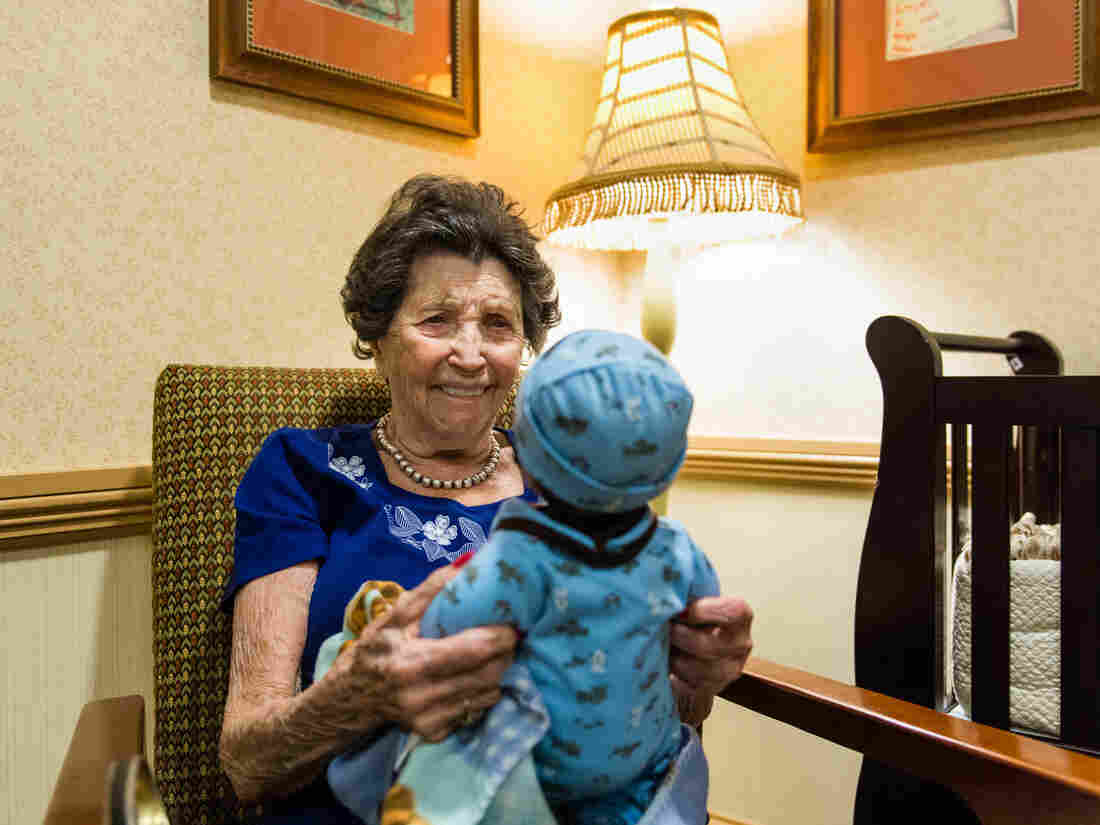
When asked what she likes about the dolls, Guzofsky says, “I love babies.” Heidi de Marco/Kaiser Health News hide caption

toggle caption

Heidi de Marco/Kaiser Health News

Sunrise caregivers also use the dolls to spark conversations by asking questions: How many children do you have? Was your first baby a boy or a girl? What are the best things about being a mom?

The executive director of the Beverly Hills facility, Jason Malone, says he was skeptical about the use of dolls when he first heard about them.

“I almost felt like we were being deceitful,” he says. “It didn’t feel like it was real.”

But he quickly changed his mind when he realized that staff could use the dolls respectfully.

“We don’t want to confuse treating our seniors as children,” Malone says. “That’s not what this activity is truly about.”

Guzofsky began caring for the dolls soon after moving into the facility. When asked what she likes about them, she says, “I love babies. I have some very nice ones back where I live now.”

Guzofsky’s daughter, Carol Mizel, says her mom raised three children and volunteered extensively in Colorado and Mexico before being diagnosed with Alzheimer’s about five years ago. Mizel doesn’t see any downside to her mother caring for the dolls.

It is a “creative way of dealing with her where she is now,” she says.

For some residents, including 87-year-old Marilou Roos, holding the dolls is one of the only times they interact with the staff. Roos uses a wheelchair and rarely speaks. She sleeps much of the day.

“There is not much [Marilou] can participate in,” says Vladimir Kaplun, former coordinator of the secure memory floor. “When she spends some time with the babies, she wakes up and she brightens up.”

On a recent day, caregiver Jessica Butler sits next to Roos, who holds a doll against her chest and pats her on the back. She kisses the doll twice.

“The baby’s beautiful like you,” Butler says.

“It’s a boy,” Roos says. “Five months.”

Caring for the dolls is second nature to Roos, who made a career of being a mom to five children, according to her daughter, Ellen Swarts.

It’s been difficult for Swarts to watch the decline of her mother, who hasn’t called her by name in over a year. Watching her with the dolls helps, Swarts says.

“To see the light in her eyes when she has a baby in her arms, I don’t care if it’s real or if it’s pretending,” she said. “If that gives her comfort, I am a-OK with it.”

Kaiser Health News is an editorially independent program of the Henry J. Kaiser Family Foundation, a nonprofit, nonpartisan health policy research and communication organization not affiliated with Kaiser Permanente.

Let’s block ads! (Why?)


No Image

How Donald Trump Would Be Able To Not Pay Income Taxes For 18 Years

Donald Trump speaks about his tax plan in New York on Sept. 28. Julie Jacobson/AP hide caption

toggle caption

Julie Jacobson/AP

We don’t really know what Donald Trump paid in taxes, because unlike every other major presidential candidate in the last four decades, the GOP nominee has refused to release his tax returns. But the New York Times offers a tantalizing theory that Trump could have legally escaped income tax liability on hundreds of millions of dollars, thanks to staggering losses from two decades ago.

That he could have done so while still enjoying a lavish lifestyle is testament to both the flexibility of the federal tax code—especially when it comes to real estate professionals—and the willingness of creditors and investors to keep propping up a businessman who had already lost nearly a billion dollars.

The Times account is based on a fragmentary sample of Trump’s tax returns from a single year that were leaked to the newspaper by an anonymous source. Trump’s former accountant confirmed their authenticity for the paper.

The forms show that in 1995, Trump claimed a business loss of nearly $916 million. Much of that likely resulted from Trump’s business losses in previous years, including money-losing casinos in Atlantic City and the Trump Shuttle airline.

At the time, the tax code allowed such losses to be “carried forward” up to 15 years, offsetting income and reducing or even eliminating tax liability and carried backward on income up to 3 years prior. (The allowance has since been changed to carry forward 20 years and carry back 2 years.) The code is particularly flexible when it comes to real estate professionals like Trump.

A doctor who owns a rental property and loses money on it can only use that loss to offset rental income, not what he or she earns practicing medicine.

But thanks to more generous allowances for real estate professionals, Trump would have been allowed to use his casino losses to offset income from unrelated work, including the millions he earned as star of “The Apprentice” television show, or licensing his name to the maker of Trump neckties.

“Here’s the magic of real estate,” says Lee Sheppard, contributing editor of Tax Notes, a Washington-based journal. “Congress, which writes the tax laws, affirmatively subsidizes commercial real estate through the mechanism of the tax code.”

The favorable treatment of real estate developers is just one example of the way the tax code rewards real estate development and investment. The popular tax deduction for home ownership is another, and one of the costliest in the overall code.

“Real estate is a very powerful lobby in Washington,” Sheppard says. “There used to be a running joke that it would be cheaper for the government to make real estate tax-exempt.”

The losses cited on Trump’s 1995 return were so massive, he could have earned up to $50 million dollars a year for nearly two decades without owing any income tax.

“Mr. Trump was a spectacular loser,” said Steve Rosenthal, a former staffer for the Joint Congressional Committee on Taxation and a senior fellow at the Tax Policy Center.

Because the tax records obtained by the New York Times are fragmentary, we don’t know the detail behind the losses that Trump claimed that year. A separate statement describing the losses was not included in the leaked documents.

“That’s why we should see his tax returns,” said Rosenthal. “Was Mr. Trump really losing money that spectacularly? Or was he ginning up his losses” through accounting maneuvers?

It’s a provocative question for a presidential candidate whose campaign is largely based on his purported success as a businessman.

“Donald Trump has a long, well-documented history of reporting different numbers” to different audiences, said David Cay Johnston, an investigative reporter, tax expert, and author of The Making of Donald Trump.

Trump’s Atlantic City casino empire, overbuilt and overleveraged, hemorrhaged money during the 1990s and ultimately filed for bankruptcy. Investors in his public company lost more than $1 billion, and a number of businesses that worked on the casinos went unpaid.

But debts that were personally guaranteed by Trump were transferred to others, while Trump himself collected tens of millions of dollars in salary and bonuses.

For years, investors and creditors went along in the belief that Trump and his lavish public lifestyle added value to the aspirational casino business.

“If his lifestyle is part of the brand, his lifestyle is kind of a business expense in itself,” said Sheppard.

Let’s block ads! (Why?)


No Image

A Bygone Era: When Bipartisanship Led To Health Care Transformation

Construction of Moses H. Cone Memorial Hospital in Greensboro, N.C., was partially funded by the Hill-Burton Act. The hospital, seen circa 1973, was at the center of a court case, Simkins v. Moses H. Cone Memorial Hospital, that brought an end to racially segregated health care. Cone Health Medical Library hide caption

toggle caption

Cone Health Medical Library

People might be forgiven for thinking that the Affordable Care Act is the federal government’s boldest intrusion into the private business of health care.

But few know about a 70-year-old law that is responsible for the construction of much of our health system’s infrastructure. The law’s latest anniversary came and went without much notice in August.

The Hill-Burton Act was signed into law by President Harry S. Truman on August 13, 1946 — and its effect on health care in the U.S. was nothing short of monumental. Perhaps more importantly, it stands as an example, warts and all, of how a bipartisan Congress can forge compromises to bolster American infrastructure and boost the well-being of our people.

Known formally as the Hospital Survey and Construction Act, Hill-Burton started as a Truman initiative. In November 1945, only two months after the official end of World War II, he gave a speech to Congress outlining five goals to improve the nation’s health. The first and least controversial of these called for constructing hospitals and clinics to serve a growing and rapidly demilitarizing population.

Hill-Burton provided construction grants and loans to communities that could demonstrate viability — based on their population and per capita income — in the building of health care facilities. The idea was to build hospitals where they were needed and where they would be sustainable once their doors were open.

Over the subsequent decades, new facilities sprang up all around the country, including many in the 40 percent of U.S. counties that lacked hospitals in 1945.

By 1975, Hill-Burton had been responsible for construction of nearly one-third of U.S. hospitals. That year Hill-Burton was rolled into bigger legislation known as the Public Health Service Act. By the turn of the century, about 6,800 facilities in 4,000 communities had in some part been financed by the law. These included not only hospitals and clinics, but also rehabilitation centers and long-term care facilities.

In 1997, this type of direct, community-based federal health care construction financing came to an end. However, numerous Hill-Burton clinics and hospitals still exist around the country, specifically financed by a part of law to provide care to those unable to afford it.

“After the passage of Medicare and Medicaid, Hill-Burton ranks right up there among the most important pieces of health legislation in the 20th century,” physician and historian Howard Markel told Shots.

Hill-Burton introduced many ideas in health care financing that are still in use today. Chief among them is that hospitals receiving federal monies are obligated to provide free or subsidized care to a portion of their indigent patients. U.S. non-profit hospitals (still the vast majority) must demonstrate evidence of ‘community benefit’ to maintain tax-exempt status. Providing care to the uninsured is one of the most common ways to meet this obligation.

Grace Hospital in Morganton, N.C., was funded in part by the Hill-Burton Act. Construction began in 1969. Courtesy of Blue Ridge Healthcare Foundation hide caption

toggle caption

Courtesy of Blue Ridge Healthcare Foundation

Another idea rooted in Hill-Burton is federal-state matching, meaning that federal appropriations must be matched by dollars from states, which is how Medicaid is financed.

Hill-Burton also has a poorly remembered dark side: Because of its provenance as a bipartisan law named for a Northern Republican (Sen. Harold Burton of Ohio) and a Southern Democrat (Sen. Lister Hill of Alabama), the law codified the idea of “separate but equal” in hospitals and health care facilities.

In order to achieve compromise and the necessary Democratic votes for passage, Southern Democrat segregationists had to be appeased. When this aspect of the law was overturned in a federal court challenge in 1963, Hill-Burton went on to become a major driver of hospital desegregation.

It seems worth noting that Sen. Hill’s surgeon father named him after Dr. Joseph Lister, a pioneer of antiseptic surgery.

A month after enactment of the law, Truman, a Democrat, appointed Republican Sen. Burton to the Supreme Court in a bipartisan gesture that doesn’t seem imaginable in today’s polarized political landscape. And consider this: Burton was unanimously approved by the entire Senate the same day he was appointed. With no committee hearings! He joined the court the very next day.

“Hill-Burton speaks to an earlier time in our history when the American people and those who represented them had confidence that government could do good things,” Markel said. “And that makes it all the more phenomenal to me.”

John Henning Schumann is a writer and doctor in Tulsa, Okla. He serves as president of the University of Oklahoma-Tulsa. He also hosts StudioTulsa: Medical Monday for KWGS – Public Radio Tulsa. You can follow him on Twitter: @GlassHospital.

Let’s block ads! (Why?)


No Image

How We Got Here: Treating Addiction In 28 Days

After a string of inpatient rehabilitation stays, Louis Casanova, who lives near Philadelphia, says he is still trying to break his addiction. Ben Allen/WITF hide caption

toggle caption

Ben Allen/WITF

Louis Casanova is playing cards with a friend on the back deck of a recovery house in Philadelphia’s northern suburbs.

He’s warm and open as he talks about his past few years. The guy everyone calls Louie started using drugs like Xanax and Valium during his freshman year of high school. At age 18, Casanova turned to heroin. About two years later, the rehab shuffle began.

“I relapsed and then I was just getting high. And then I went to treatment again in February of 2015,” he says. “Then I relapsed again and went back to treatment.”

He’s 23 now. He’s hurt people close to him and his criminal record, fueled by his drug addiction, is long. By Louie’s count, he has been through eight inpatient rehabs. Louis says his stays have ranged from about 18 to 45 days.

“I did 30 days, and after that I came here,” he concludes, talking about his latest visit.

A month’s stay can be pretty typical among people who go to an inpatient facility.

But why?

“As far as I know, there’s nothing magical about 28 days,” says Kimberly Johnson, director of the Center for Substance Abuse Treatment at SAMHSA, the federal agency that studies treatment services.

Anne Fletcher, author of the book Inside Rehab, agrees.

“It certainly is not scientifically based,” she says. “I live in Minnesota where the model was developed and a lot of treatment across the country really stemmed from that.”

She says the late Daniel Anderson was one of the primary architects of the “Minnesota model,” which became the prevailing treatment protocol for addiction specialists. At a state hospital in Minnesota in the 1950s, Anderson saw alcoholics living in locked wards, leaving only to be put to work on a farm.

To find a path for them to get sober and leave the hospital, he came up with the 28-day model.

Marvin Ventrell, executive director of the National Association of Addiction Treatment Providers, has studied the model’s history. He says the month-long standard comes from the notion that when “someone is suffering from addiction — and in the days that this began, we’re pretty much talking about alcoholism — it made sense to people that it took about four weeks to stabilize somebody.”

And then, Ventrell says, “It became the norm because the insurance industry was willing to pay for that period of time.”

Now the model has spread to treatment for opioid addiction, even though recovering from addiction to those powerful drugs may require a different method.

Ventrell admits there isn’t enough research about the most effective length for an inpatient stay for opioid addiction.

“Treatment centers have to step up and say, ‘Just like cancer or heart disease, we’re going to measure our outcomes and show them to you,’ ” he says.

The federal government estimates spending on treatment for all substance abuse will hit a high of $42 billion by 2020. Some people pay tens of thousands of dollars, desperately hoping inpatient treatment will work.

But there’s increasing evidence that medication assisted treatment with the synthetic opioids methadone or suboxone can help those addicted by helping to relieve symptoms of withdrawal and reduce craving, especially when paired with strong outpatient counseling and other support.

Fletcher says it’s important for treatment to move away from the default month-long model.

That may be enough for some people, she says, but it “isn’t the case for most people. It’s like any other chronic disorder, it waxes and wanes.”

After his inpatient stays, Casanova is still trying to break his addiction. While he says recovery largely depends on the person, he preferred longer stays because it gave him more time to learn from other patients in a supportive environment. But Casanova is just one person; others prefer inpatient stays that are shorter than a month, followed by intensive outpatient programs.

Casanova relapsed in February, before I talked to him, and recently had to serve some jail time. But he’s back in the recovery house, and hoping to soon make the leap to the next stage — a house with even more independence.

This story is part of a reporting partnership with NPR, WITF’s Transforming Health and Kaiser Health News.

Let’s block ads! (Why?)


No Image

Best of the Week: Fantastic Fest Coverage, Disney is Fast-tracking a 'Lion King' Remake and More

The Important News

Disney: Jon Favreau will direct the live-action remake of The Lion King.

Marvel Cinematic Universe: Winston Duke will play villain Man-Ape in Black Panther, Sam Neill has a secret role in Thor: Ragnarok. Stan Lee shot his next four cameos in one day.

DC Extended Universe: Ben Affleck’s Batman movie might only be 18 months away.

Jurassic Park: The next sequel will be scarier than Jurassic World.

Reboots: Jumanji cast some junior players.

Sequels: MacGruber 2 is now being written. Adria Arjona joined Pacific Rim 2.

Prequels: The Purge 4 will go back to the origins of the Purge.

Remakes: Viola Davis will star in Steve McQueen’s Widows. Johnny Depp, Daisy Ridley and more were cast in Murder on the Orient Express.

Box Office: The Magnificent Seven had a magnficient opening.

Family Films: Peter Rabbit will star Rose Byrne and the voices of James Corden, Daisy Ridley and Elizabeth Debicki. Justin Lin will direct Hot Wheels.

Biopics: Michael Shannon will play George Westinghouse in The Current War.

The Videos and Geek Stuff

New Movie Trailers: Doctor Strange, Fantastic Beasts and Where to Find Them, Jack Reacher: Never Go Back, Desierto, King Cobra, Dog Eat Dog, Paterson, Fences, Rules Don’t Apply, The Beat Beneath My Feet, The Space Between Us, Justin Timberlake and the Tennessee Kids, 13th and 20th Century Women.

TV Spots: Doctor Strange.

Watch: An Honest Trailer for Warcraft. And a fake trailer for a live-action Lion King. And a fake trailer for Reign of the Supermen.

Learn: What Sam Neill thinks happened to his Jurassic Park character.

See: Why the death of widescreen is imminent.

Watch: An awesome animated Indiana Jones short film.

See: Michael Bay’s Mad Max-style stunt car used for shooting Transformers: The Last Knight.

Watch: John Malkovich plays David Lynch and characters from his movies.

See: Tom Hanks crashed a wedding photoshoot.

Watch: An incredible interview with the real man behind Deepwater Horizon.

See: All of this week’s best new posters. And a Doctor Strange motion poster.

Our Features

Fantastic Fest Reviews: Split, Safe Neighborhood, The Invisible Guest, The Autopsy of Jane Doe, S Is for Stanley and The Crew.

Festival Preview: Our guide to the 6 New York Film Festival movies everyone’s talking about.

Classic Movie Guide: We look back on the cultural impact of Crocodile Dundee.

Interviews: Operation Avalanche filmmakers Matt Johnson and Matt Miller on tricking NASA to be in their movie.

Horror Movie Guide: All the latest horror movie news and trailers.

Comic Book Movie Guide: We pick 5 villains for Marvel superheroes to face in film after Thanos.

Home Viewing: Our guide to everything hitting VOD this week.

and

MORE FROM AROUND THE WEB:

Let’s block ads! (Why?)


No Image

Episode 727: You Asked For It, Again

Cinnamon rolls have a bloody history.

Michael Rutherford/AFP/Getty Images

We dug through the trash and tracked down experts around the globe to make sense of economic mysteries that you sent us. There’s a puzzle about the cost of postage stamps, a debate over the price of happiness, fatal pastries and a little stop at the Federal Reserve, because, yeah, we’re Planet Money.

You, our enthusiastic, curious listeners, can get a little wonky with your questions and we love you for it. But we can still have way too much fun fishing out the answers from all corners of the word. Today on the show, we answer your questions, wherever they lead us.

If you have a question you want us to answer, hit us up on Facebook or Twitter. Or better yet, tell us a great story about economics that answered a question you had. We’ll take that too.

Music: “Cowboy Casanovas and “Bout That Live.” Find us: Twitter/ Facebook.

Let’s block ads! (Why?)