Articles by admin

No Image

Startups Turn To Seniors For Product Feedback

Young entrepreneurs developing products for older adults have found a way to get instant feedback. They move into senior housing so residents can test their products on the spot.

SCOTT SIMON, HOST:

The market for products designed for older adults could reach $30 billion by next year. Some startups want in. But they sometimes lack reaction from the people they hope will use the product, including, perhaps one day, B.J. Leiderman, who writes our theme music.

So the country’s largest owner of retirement communities has invited a few select entrepreneurs to just move in for a few days, show off their products and hear what the residents have to say. NPR’s Ina Jaffe covers aging and filed this report.

INA JAFFE, BYLINE: It’s lunchtime at the Brookdale senior residence in Torrance, Calif. And resident Cecelia Graham has a recommendation.

CECELIA GRAHAM: And I had a hamburger ’cause their hamburgers are good.

DAYLE RODRIGUEZ: Should I order a hamburger?

JAFFE: The guy with the British accent is 28-year-old Dayle Rodriguez. He’s the community and marketing manager for a product called SENTAB TV. It allows users to access email, video chat and social networks through their televisions. He’s here to get feedback on the system, though it doesn’t seem that way.

RODRIGUEZ: And I’m just going to enjoy the rest of the day, to be honest. Do you know what’s happening today?

GRAHAM: There’s billiards and pool. Do you play mahjong?

RODRIGUEZ: I’ll do some billiards. And I think I might learn some mahjong while I’m here.

GRAHAM: OK.

RODRIGUEZ: Yeah.

JAFFE: Rodriguez says it’s important that residents here don’t feel like he’s selling them something.

RODRIGUEZ: I’ve had more feedback and a more passive approach just, you know, playing pool, playing cards, having dinner, having lunch than actually going through, like, a survey of questions. Them getting to know me and to trust me and knowing I’m not selling them something – it’s more honest feedback that way.

JAFFE: Rodriguez is the seventh entrepreneur to move into one of Brookdale’s 1,100 senior-living communities. Other new products in the program have included a kind of full-body blow dryer and specially designed clothing that allows people with disabilities to dress and undress themselves.

Brookdale has no financial relationship with these startups. But that’s not what motivates the program, says Andrew Smith, Brookdale’s director of strategy and innovation.

ANDREW SMITH: First and foremost thing is residents love it. It also provides Brookdale the opportunity to learn about and experience new technologies very quickly and very inexpensively and to make sure that we understand what residents want and need.

JAFFE: Rodriguez’s product, SENTAB TV, enables older adults to communicate and network the way they might on a computer. But all they have to do is use a conventional remote control.

RODRIGUEZ: It’s nothing new. It’s nothing too complicated. And it’s quite intuitive because lots of people have TV remotes.

JAFFE: Ninety-three-year-old Mary Lou Busch agreed to try the SENTAB system. She tells Rodriguez that it might be good for someone but not for her.

MARY LOU BUSCH: I have the computer. And I have FaceTime, which I talk with my family on. And I have an iPad. And I have a smartphone. And so I do pretty much everything I need to do.

JAFFE: Rodriguez takes it pretty well.

RODRIGUEZ: I’m not going to to lie. Obviously, I’d like a more positive response. But, again, it is kind of that research. I mean, if people don’t need it or don’t want it, then it makes sense for us to try and adapt or change what we’re doing or figure out what can make it more useful.

JAFFE: To be fair, if Rodriguez wanted feedback from some more technophobic seniors, he may have ended up in the wrong Brookdale community. This one’s located in the heart of Southern California’s aerospace corridor. He met residents with backgrounds in engineering, business and academia. But Rodriguez says he still learned something important.

RODRIGUEZ: People are more tech-savvy than we thought. There you go.

JAFFE: And where else would he learn to play mahjong? Ina Jaffe, NPR News.

Copyright © 2016 NPR. All rights reserved. Visit our website terms of use and permissions pages at www.npr.org for further information.

NPR transcripts are created on a rush deadline by Verb8tm, Inc., an NPR contractor, and produced using a proprietary transcription process developed with NPR. This text may not be in its final form and may be updated or revised in the future. Accuracy and availability may vary. The authoritative record of NPR’s programming is the audio record.


Let’s block ads! (Why?)


No Image

Best of the Week: Dumbledore is Returning, What We Want From 'Doctor Strange 2' and More

The Important News

The Wizarding World: Young Albus Dumbledore will be in Fantastic Beasts 2?. And he might be openly gay in the movie. Johnny Depp will play Gellert Grindelwald in Fantastic Beasts 2.

Marvel Cinematic Universe: Michael Keaton was confirmed as Vulture in Spider-Man: Homecoming.

X-Men: Deadpool 3 is already in the works. The main X-Men series is getting another soft reboot.

Star Wars: J.J. Abrams disclosed the all-star list of contributors to Star Wars: The Force Awakens.

Jurassic World: Toby Jones and Rafe Spall joined Jurassic World 2.

Transformers: The Bumblebee spinoff has a script.

Other Sequels: Mission: Impossible 6 set a summer 2018 release date.

Remakes: Sacha Baron Cohen will star in a redo of the Danish film Klown. Tyler Perry is redoing the Korean hit Miss Granny. Max Landis will redo his dad’s An American Werewolf in London.

Other Comic Book Movies: Jessica Chastain will star in Painkiller Jane.

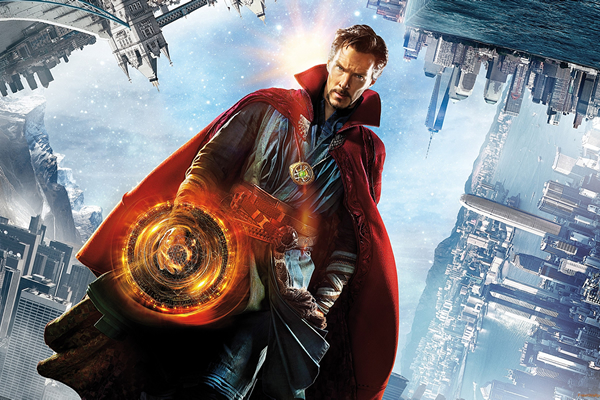
Box Office: Doctor Strange had a better movie opening than Thor, Ant-Man and Captain America.

Biopics: Rami Malek will star as Freddie Mercury in Bohemian Rhapsody.

Retirement: Robert Redford is quitting acting.

R.I.P.: Leonard Cohen passed away at age 82.

The Videos and Geek Stuff

New Movie Trailers: Rogue One: A Star Wars Story, Valerian and the City of a Thousand Planets, Live By Night, Underworld: Blood Wars and Solace.

TV Spots: Rogue One: A Star Wars Story and Moana.

MovieClips: Arrival.

First Look: Kong in Kong: Skull Island.

Watch: A sneak peek at more footage from Ghost in the Shell.

See: All the Easter eggs and references in Doctor Strange. And why the Marvel movie formula is flawed.

Watch: Superman vs. Hulk mashup.

See: Works of art that inspired Batman v Superman: Dawn of Justice. And a retro trailer for Wonder Woman.

Watch: Transformers: The Last Knight stunt reel.

See: The positive buzz on Disney’s Moana.

Learn: Why Andrew Stanton is taking a break from animation.

See: Similarities already visible between Trainspotting and T2: Trainspotting.

Learn: Why Independence Day has that title.

Watch: Honest Trailer for Independence Day: Resurgence.

Learn: All about the Avengers-like team in charge of real alien arrivals.

See: Lincoln reworked as a kung-fu movie.

Watch: A look inside the world of alternate movie posters.

See: All of this week’s best new posters.

Our Features

Doctor Strange Guides: All you need to know about the big bad of Doctor Strange. Where to find a possible Captain Marvel Easter egg in Doctor Strange. A list of Doctor Strange stories that would be great for the sequel.

Marvel Movie Guide: We point out where to find all the MCU Infinity Stones.

Horror Movie Guide: All the latest horror news and trailers.

Home Viewing: Our guide to everything hitting VOD this week. And our guide to all the new indie and foreign films you need to see.

and

MORE FROM AROUND THE WEB:

Let’s block ads! (Why?)


No Image

Mexico Breaks 4-Game Losing Streak In U.S. To Win World Cup Qualifier

Mexico’s Diego Reyes, top, jumps on United States’ Jozy Altidore during the a World Cup qualifying soccer match Friday in Columbus, Ohio. Jay LaPrete/AP hide caption

toggle caption

Jay LaPrete/AP

Rafa Marquez scored a tiebreaking goal on a header in the 89th minute, giving Mexico a 2-1 win Friday night, and its first road victory against the United States in World Cup qualifying since 1972.

Miguel Layun put Mexico ahead in the 20th minute in the opener of the final round of qualifying in North and Central America and the Caribbean, but Bobby Wood tied the score in the 49th.

The U.S. dominated the second half before the 37-year-old Marquez, unmarked and drifting across the penalty area at the near post, got the back of his head on Layun’s corner kick. The Mexican captain lifted the ball over goalkeeper Brad Guzan for his 17th international goal.

“It gets a sense of anger in us. It gets a sense of absolutely urgency,” U.S. coach Jurgen Klinsmann said. “It’s not a problem, but it’s obviously disappointing.”

The U.S. had beaten Mexico four straight times by 2-0 scores in home qualifiers — all at Columbus — and Marquez had gotten two yellow cards and a red in those matches. The Americans had been 30-0-2 at home in qualifying since a 3-2 loss to Honduras at Washington’s RFK Stadium in September 2001.

Article continues after sponsorship

A pro-American crowd of 24,650 chanted “Dos a cero!” at the start, but Mexican supporters yelled “Dos a uno!” as they left.

Mexico’s previous win at the U.S. in qualifying was also by a 2-1 score, at Los Angeles.

“I think we deserved this match,” Layun said. “We were focused.”

Klinsmann said John Brooks was supposed to mark Marquez on the corner kick.

“We lost him there. Individual mistake,” Klinsmann said.

Guzan had lost the U.S. goalkeeper job to Tim Howard, who started at the past two World Cups — but Howard pulled a muscle in his right leg on a goal kick and was replaced in the 40th minute.

The Americans play Tuesday at Costa Rica, where it never has won in qualifying, in the second of its 10 games in the round, and Klinsmann said Howard likely will miss the match. The top three teams in the six-nation round qualify for the World Cup, and the fourth-place country advances to an inter-region playoff.

With the U.S. struggling early in what Klinsmann called a 3-4-3 formation, Mexico could have led 3-0. Howard tipped Jesus Corona’s 10th-minute shot off a post and Carlos Vela’s 25th-minute header hit a crossbar.

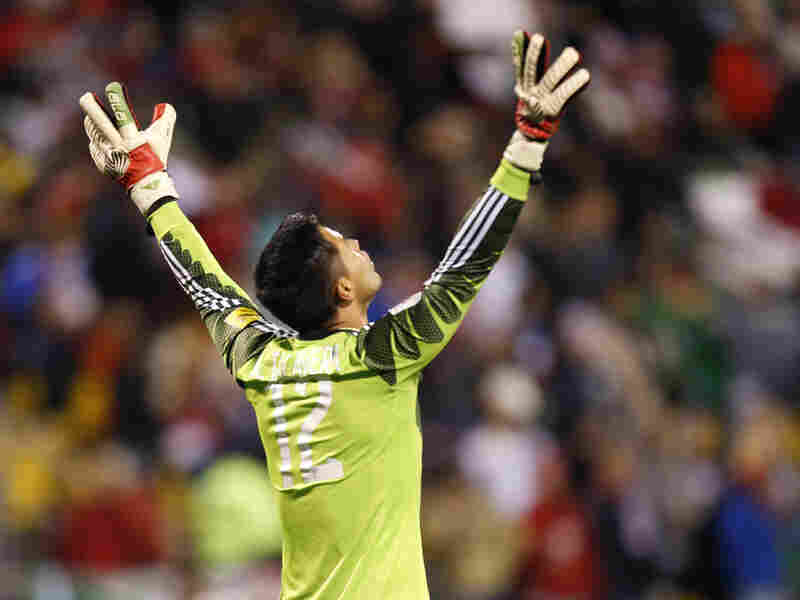
Mexico’s Alfredo Talavera celebrates a goal against the United States Fridayin Columbus, Ohio. Jay LaPrete/AP hide caption

toggle caption

Jay LaPrete/AP

“Out midfielders didn’t get into the one-on-one battles we expected them to,” Klinsmann said, citing Jermaine Jones and Michael Bradley.

Mexico went ahead after Bradley and Giovani dos Santos battled for the ball 30 yards out. The ball skipped to Layun, who took a touch, and his right-footed shot deflected off Timmy Chandler and in to Howard’s left for his fourth international goal in 46 appearances.

After switching to a more familiar 4-4-2 formation in the 27th minute, the Americans began to find their rhythm, and Wood scored off a pass from Jozy Altidore.

Wood tied the score after John Brooks forced a turnover. Jozy Altidore turned his defender and passed to Wood, who took two touches as he split defenders. His 8-yard, left-footed shot deflected off a leg of Layun for his eighth goal in 28 international appearances. Wood also scored against Mexico last fall during an extra-time loss in the playoff for a berth in the 2017 Confederations Cup.

Let’s block ads! (Why?)


No Image

Episode 735: President Trump

Republican president-elect Donald Trump delivers his acceptance speech.

Chip Somodevilla/AFP/Getty Images

Last month, Donald Trump released his plans for his first 100 days in office. He talked about dismantling NAFTA and repealing the Affordable Care Act. He called for deporting millions of undocumented immigrants and building a wall along the southern border. He promised to slash taxes and ban White House officials from lobbying for five years.

Now that Donald Trump is President-elect, what can he actually do? What’s possible and what would it would actually take? We look at the laws on breaking trade agreements and how much concrete he’d need to construct a wall along the border.

Music: “Bout That Live,” “Move Your Feet,” and “Shimmer Sunrise.” Find us: Twitter/ Facebook.

Let’s block ads! (Why?)


No Image

What Happens To Medicaid In California Under A Trump Administration?

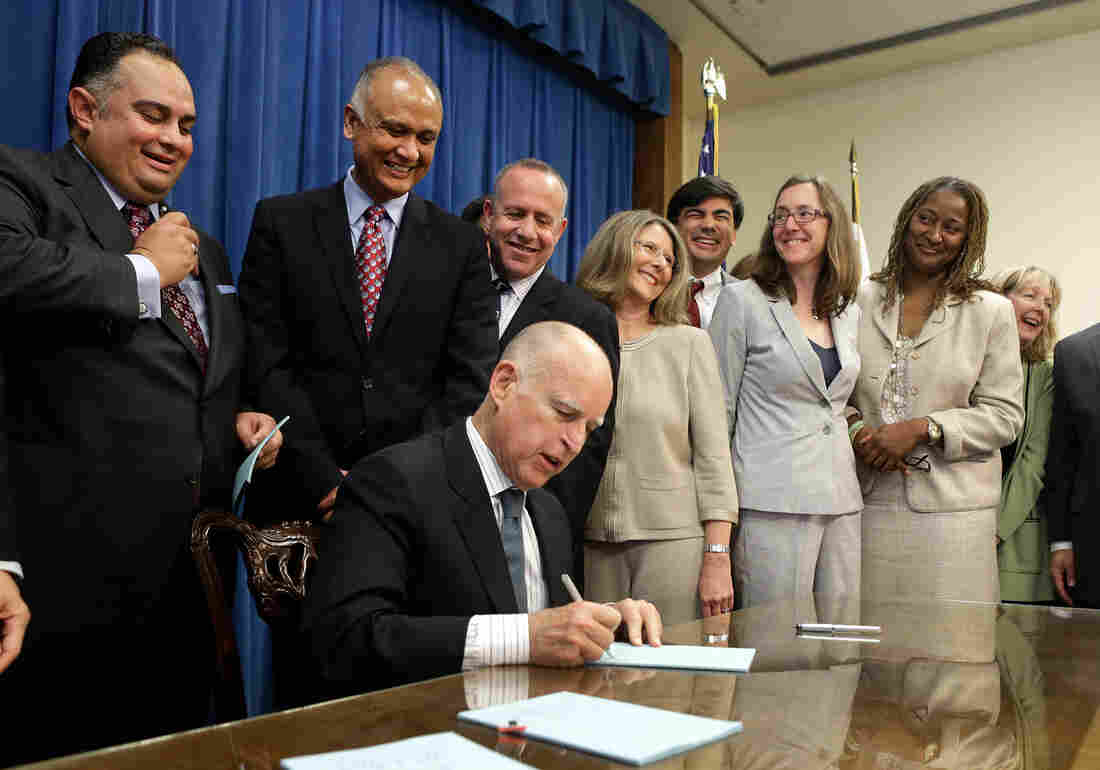
California Gov. Jerry Brown signed a Medicaid expansion into law as part of the state’s budget authorization in 2013. Rich Pedroncelli/AP hide caption

toggle caption

Rich Pedroncelli/AP

President-elect Donald Trump has vowed that he will repeal and replace Obamacare. Specifics are scarce, but one plan Trump has outlined would change how the federal government funds Medicaid, health coverage for low-income people.

Twenty-million Americans now have health coverage because of Obamacare. A full quarter of them are in California. And most of them are covered by Medi-Cal, California’s version of Medicaid.

“Winding back the clock would create all kinds of turbulence and disruption,” says Larry Levitt, senior vice president for special initiatives at the Kaiser Family Foundation.

Right now, the federal government shares the cost of Medicaid with the states, no matter how many people are enrolled. But Trump wants to put a limit on that funding and give states a fixed pot of money called a block grant.

“A block grant would give California greater flexibility in running the Medi-Cal program, but it would also give the state less money,” Levitt says.

California would feel the pain more than other states. “The effect is magnified in California in part because the state has been so successful in getting people signed up for coverage,” Levitt says.

Article continues after sponsorship

And in California, 62 percent of Medi-Cal enrollees who have signed up since Obamacare allowed states to expand Medicaid are Latino, African-American, or Asian-American.

To save money, some states could pay doctors and hospitals less. But in California, payment rates are already the second lowest in the country.

“California can’t really pay much less than it does to providers,” says Gerald Kominski, a professor of health at the University of California, Los Angeles.

In the face of severe budget cuts, Kominski says, the only choice California really would have is to reduce services or reduce the number of people who get Medi-Cal.

“That would have a devastating consequence on the Medicaid expansion population in California, and would basically put everyone who’s been newly enrolled in the program back off the program,” he says.

It’s unclear how soon a Trump administration would change Medicaid funding, so health advocates are encouraging people to continue signing up for Medicaid and other coverage during the current Obamacare open enrollment season.

“California is not an island,” says Anthony Wright, executive director of Health Access, an advocacy group, adding that the state “must engage fully in the coming national debate on the future of health reform — especially as an example of what has been achieved, and what we can’t give up.”

This story is part of a reporting partnership with NPR, KQED and Kaiser Health News, which is an editorially independent news service that is part of the nonpartisan Henry J. Kaiser Family Foundation.

Let’s block ads! (Why?)


No Image

Today in Movie Culture: 'Transformers: The Last Knight' Stunt Reel, Retro 'Wonder Woman' Trailer and More

Here are a bunch of little bites to satisfy your hunger for movie culture:

Stunt Reel of the Day:

Check out some action scenes being filmed for Transformers: The Last Knight in this reel via Heroic Hollywood:

[embedded content]

Redone Trailer of the Day:

Darth Blender already showed us the new Wonder Woman trailer with the ’70s TV series music. Now here’s a version of the trailer using ’70s TV series footage and audio from the upcoming movie:

[embedded content]

Cosplay of the Day:

Family cosplay doesn’t get more clever than this multi-size representation of the title hero from Ant-Man (via io9):

#winning @ life…. #ANTMAN #cosplay pic.twitter.com/J72TafeSY9

— Ricky Tan (@i_am_ricky_tan) November 6, 2016

Prop Replica of the Day:

Check out a fan-made replica of the book from The Babadook as its maker reads it (via Geek Tyrant):

[embedded content]

Movie Science of the Day:

Have you ever wondered how Cyclops can actually see stuff? Kyle Hill attempts to explain how it is the X-Men character isn’t in fact blind:

[embedded content]

Vintage Image of the Day:

Claude Rains, who was born on this day in 1889, stands in opposition to James Stewart in this classic shot from Mr. Smith Goes to Washington:

Filmmaking Lesson of the Day:

This video essay from De Filmkrant uses The Hustler and Magic in the Moonlight to show how and how not to depict internal thinking that leads a character to an important decision (via Film School Rejects):

[embedded content]

Fan Art of the Day:

Here’s a series of drawings by Alejandro Giraldo titled “Sad Movie Couples,” including pairs from The Empire Strikes Back, Fight Club and more (via Design Taxi):

Supercut of the Day:

A lot of people need a hug this week after the election results, so here’s a supercut of hugs in movies (via Geek Tyrant):

[embedded content]

Classic Trailer of the Day:

This weekend is the 20th anniversary of the theatrical release of Lars von Trier’s Breaking the Waves. Watch the original trailer for the movie below.

[embedded content]

and

Let’s block ads! (Why?)


No Image

Dow Hits All-Time High As Investors Anticipate Transition To Trump

Stocks were up Thursday, as Wall Street looked for less regulation under the Trump administration. Richard Drew/AP hide caption

toggle caption

Richard Drew/AP

The Dow Jones Industrial Average closed up more than 1 percent Thursday at an all-time high of 18,807.88, as investors bet that the Donald Trump presidency will mean less regulation and more potential stimulus spending.

Specific policies remain to be seen, but the president-elect pledged during the campaign to dismantle regulations, especially the Dodd-Frank financial law, which is now boosting financial stocks. Pharmaceutical stocks posted more gains Thursday, on the anticipation that the Trump administration is much less likely to scrutinize the drug industry than his rival Hillary Clinton.

Trump heavily emphasized more infrastructure spending, pledging to offer tax credits to encourage private financing for investment. With an all-Republican Congress, political gridlock is also less likely, and the anticipation of stimulus pushed manufacturing and defense stocks up.

On the other hand, the prospect of more government spending spurred a selloff in the bond markets. The yield on 10-year Treasury bonds posted its largest one-day gain in three years.

The stock market’s gains in the industries that stand to benefit were partially offset in other industries, like hospitals. Trump’s promises to dismantle the Obama administration’s Affordable Care Act would hurt hospital bottom lines.

The technology-focused Nasdaq fell 0.81 percent, to 5,208, on the day. The tech sector declined because those companies rely on immigrant talent, which those companies anticipate will be harder to attract during the Trump presidency.

NPR thanks our sponsors

Let’s block ads! (Why?)


No Image

Cigarette Smoking In The U.S. Continues To Fall

Cigarette smoking continues to decline as taxes on tobacco rise. Gerald Herbert/AP hide caption

toggle caption

Gerald Herbert/AP

The number of cigarette smokers in the United States has dropped by 8.6 million since 2005 — and that fall could be accelerated by a tobacco tax just passed in California.

The Centers for Disease Control and Prevention says smoking rates have fallen from 21 percent of the adult population in 2005 to 15 percent in 2015, when the agency conducted its latest survey. The smoking rate fell by 1.7 percentage points between 2014 and 2015 alone — a substantial decline, according to a report Thursday in Morbidity and Mortality Weekly Report.

The proportion of cigarette smokers in the U.S. population, broken down by age, in 2005 and 2015. CDC hide caption

toggle caption

CDC

Smokers light up less when cigarettes are more expensive. So, more smokers may have been nudged to quit after the federal government increased tobacco taxes by 62 cents a pack in 2009. California voters approved a $2 a pack tax on Election Day, so rates there are likely to fall further.

“Raising the tobacco tax is probably the single most effective way to reduce smoking, especially among kids,” says Vincent Willmore, vice president for communication at the Center for Tobacco Free Kids. That organization and other public health advocates pressed for passage of the California tobacco tax. “The California vote was a huge victory for kids and health,” he says.

The tax will not only discourage people from purchasing cigarettes, it will also fund a renewed anti-smoking effort in the state, Willmore says.

While that initiative won, tobacco control advocates lost similar efforts in Colorado and North Dakota.

The story was topsy-turvy in Missouri, where the tobacco industry actually supported a 17-cent-per-pack tax, while advocates opposed it as too little to discourage smoking. Voters in Missouri rejected that tax.

Article continues after sponsorship

Tobacco is the leading preventable cause of death in the United States. The CDC says it’s linked to 40 percent of all cancer cases, and 30 percent of cancer deaths. The government is striving to reduce smoking rates to 12 percent of the adult population by the year 2020, and is making progress toward that goal.

The latest drop in smoking rates was documented in the National Health Interview Study, which relies on people meeting face-to-face with survey-takers and reporting their habits. The 1.7 percentage-point drop between 2014 and 2015 is especially sharp, but it follows a recent downward trend.

In addition to the higher federal cigarette tax, there have been several national stop-smoking campaigns, such as The Truth. The Affordable Care Act has also increased access to smoking-cessation programs.

Progress nationally is uneven. The CDC’s new report notes that smoking rates are lowest in the West, even though taxes are higher elsewhere. They are highest in the Midwest.

Smoking is more common among men, and among American Indian/Native Alaskans. Smoking rates are low among Asians and people with college degrees.

Another trend has paralleled the recent decrease in cigarette smoking: Vaping has taken off in the United States. That has led some researchers to wonder whether some of the decline in cigarette use is a result of people switching to these vaping devices. At this point, there’s no data to show how much vaping is contributing to the downward trend in smoking.

E-cigarettes certainly aren’t a panacea. About 60 percent of adult people who use them also smoke cigarettes. Vaping also provides users with addictive nicotine doses. And public health officials are concerned that some youngsters who start vaping will then become smokers.

You can contact Richard Harris with comments: rharris@npr.org.

Let’s block ads! (Why?)


No Image

Today in Movie Culture: Finding Art in 'Batman v Superman,' the Originality of the 2016 'Ghostbusters' and More

Here are a bunch of little bites to satisfy your hunger for movie culture:

Video Essay of the Day:

Batman v Superman: Dawn of Justice looks a lot more artistic when you watch this video showcasing its allusions and its framing (via Live for Films):

[embedded content]

Redone Trailer of the Day:

Watch the new trailer for The Lego Batman Movie redone with footage from the ’80s and ’90s live action Batman movies:

[embedded content]

Reworked Movie of the Day:

In honor of the election, CineFix mashed together Lincoln and Abraham Lincoln: Vampire Hunter for a presidential martial arts movie:

[embedded content]

Vintage Poster of the Day:

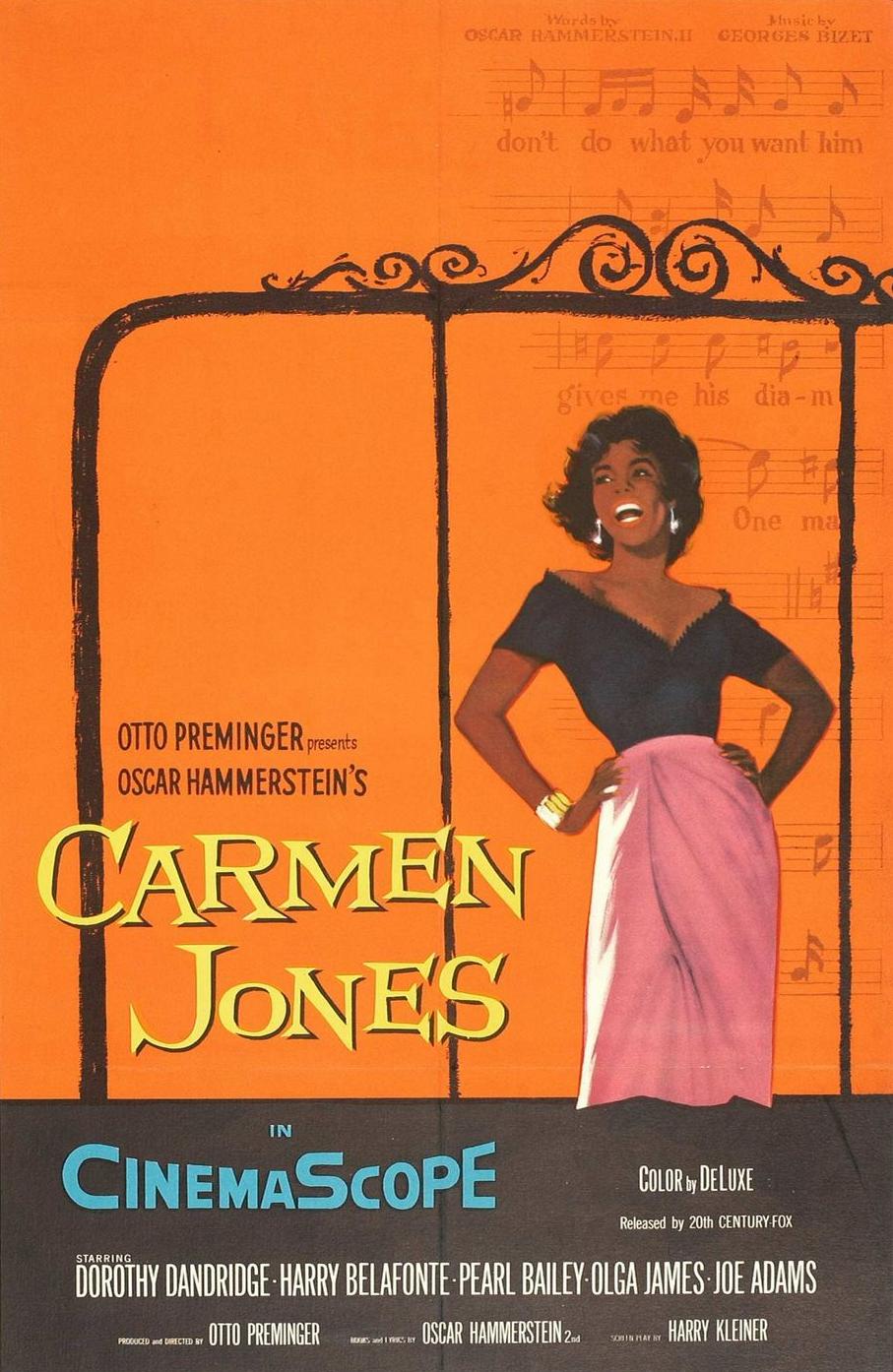
Dorothy Dandridge, who was born on this day in 1922, was the first ever African-American woman nominated for the Oscar for Best Actress, for her performance in 1954’s Carmen Jones Here’s the movie’s poster designed by Saul Bass:

Fan Theory of the Day:

The Film Theorists explores the idea that it wasn’t love that saved Snow White in Snow White and the Seven Dwarfs:

[embedded content]

Movie Comparison of the Day:

Couch Tomato shows us 24 ways the new Ghostbusters is unlike the 1984 original besides the gender of its main characters:

[embedded content]

Alternate Poster of the Day:

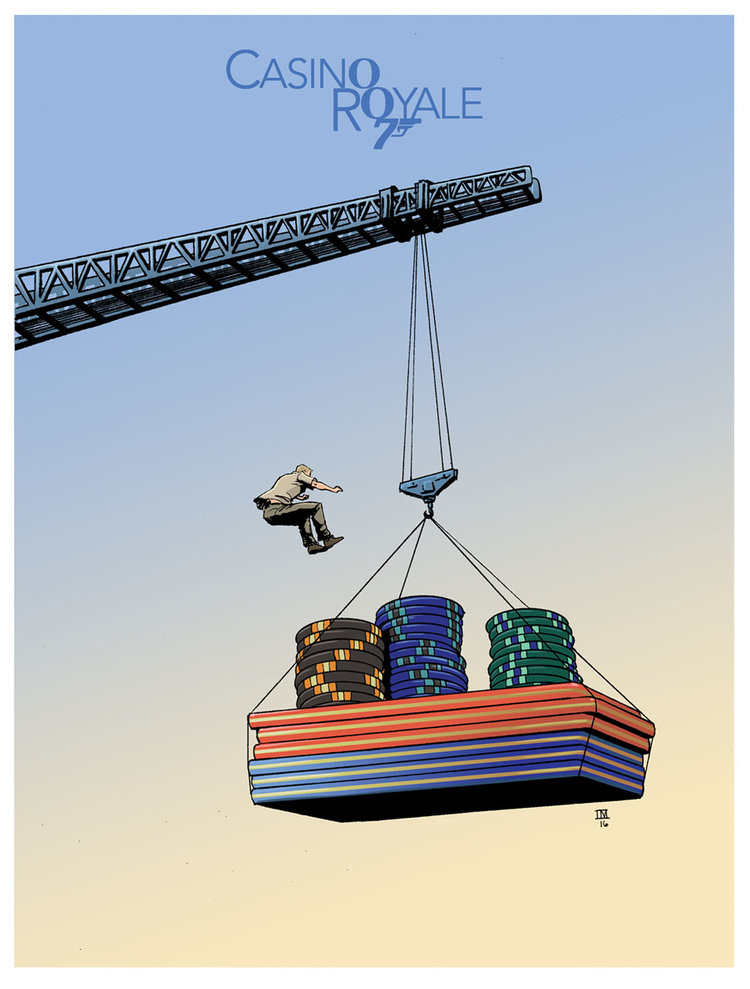
Artist Ibrahim Moustafa designed original posters for Daniel Craig’s four James Bond movies, including one for Casino Royale below. See the others at Geek Tyrant.

Filmmaker in Focus:

For Fandor Keyframe, LJ Frezza explores the representation of mass media in the films of Paul Verhoeven:

[embedded content]

Actor in the Spotlight:

Ranker’s latest actor supercut shows us how Liam Neeson talks about his family a whole lot:

[embedded content]

Classic Trailer of the Day:

This week is the 20th anniversary of the release of Ron Howard’s Ransom, starring Mel Gibson. Watch the original trailer for the movie below.

[embedded content]

and

Let’s block ads! (Why?)


No Image

Wall Street Rebounds After Donald Trump's Victory

Traders work on the floor of the New York Stock Exchange Wednesday morning, after Donald Trump won a major upset in the presidential election. Spencer Platt/Getty Images hide caption

toggle caption

Spencer Platt/Getty Images

U.S. stocks closed up Wednesday. It was a dramatic reversal from the deep losses in overnight trading. Investors were concerned that Donald Trump’s unexpected victory would create uncertainty and damage the overall view of the U.S. economy. Overnight financial markets reacted with fear as Hillary Clinton’s loss became apparent.

Throughout the summer and into the fall, U.S. markets had behaved quietly, as investors became confident of a Clinton victory. In late October, when it appeared the FBI would reopen an inquiry into Clinton’s email, stocks began a steady fall.

But with the election settled, each of the major indexes closed up by more than a point on Wednesday. A closer look reveals that investors poured money into sectors that could potentially benefit from the Trump presidency.

Shares of most oil and gas producers, energy companies, construction and pipeline operators rose while crude oil prices also went up.

“The market’s basically looking at old economy stocks coming back … and those stocks did pop up today,” says Juli Niemann, an analyst with Smith Moore and Co.

Article continues after sponsorship

Health care companies did poorly, with the anticipation that the Obamacare insurance coverage law will end. And tech stocks dipped. “That’s the new economy,” she continues, “and [investors think] this is not going to be a new economy kind of president.”

Financial stocks were up in part because analysts believe interest rates will rise because the dollar is declining. Europe and Asia are worried about the Trump presidency, and their investment money could potentially move out of U.S. markets.

“We’re not alone in this [new economy], ” says Niemann, “So this rally was nothing more than Alka Seltzer bubbles relieving election pain and fizz. Now the ulcers are developing nicely — isolationism and protectionism.”

One of the sectors facing uncertainty is automotive. Auto stocks were mixed upon news of the election, with car companies — one of the industries Trump criticized during the campaign — vowing to work with the president-elect. The Detroit News looks how the auto industry is reacting to the impending Trump presidency.

“Carmakers have banked on using Mexico, which offers low labor costs, to aid small-car production, which have lower profit margins. Mexico represents about 20 percent of light vehicles made in North America, according to a recent analysis of the country’s impact on the automotive industry by the Center for Automotive Research.

” ‘We agree with Mr. Trump that it is really important to unite the country – and we look forward to working together to support economic growth and jobs,’ Ford, which congratulated Trump, said in a statement.

“Trump repeatedly used an April 2015 announcement by Ford to invest $2.5 billion for small car production in Mexico as a talking point throughout his campaign. The Republican businessman has said he would renegotiate NAFTA. If that’s not a success for Trump, he has indicated he would end the trade pact with Canada and Mexico and slap a tariff as low as 10 percent, or as high as 35 percent, on vehicles and parts made in Mexico that are imported into the U.S. He also has threatened tariffs of up to 45 percent on China for goods exported to the U.S.”

Let’s block ads! (Why?)