Articles by admin

No Image

Inside The Climate Change Dispute Between Exxon Mobil And Rockefeller Family

Exxon Mobil is accusing the Rockefeller family of masterminding a conspiracy against the company on climate change. New York Times reporter John Schwartz tells the story.

LAKSHMI SINGH, HOST:

Oil and gas giant ExxonMobil is accusing one of America’s best known philanthropic families, the Rockefellers, of using their wealth and influence to mastermind a conspiracy against ExxonMobil. To find out more, we reached John Schwartz, a science writer for The New York Times. He joined us from New York, and I asked him to walk us through Exxon’s allegations.

JOHN SCHWARTZ: They’re saying that the Rockefeller family through funding lots of private organizations and encouraging attorneys general has been at the center of a network of activism that has gone after ExxonMobil both for its past research and its present statements and past statements about climate change. And they used the word conspiracy in saying it, and the attacks have gotten pretty fierce.

SINGH: It’s not unusual for them to use the word conspiracy or is it?

SCHWARTZ: It’s not the kind of language that you normally hear from corporations, but Exxon when challenged can be pretty tough. Now, the point of contention is over how much Exxon actually knew. There’s a whole hashtag and activist movement built around the idea that Exxon knew uniquely that climate change had catastrophic consequences for the planet and used this knowledge both to improve its processes and to plan its – for instance, floating platforms and stuff like that, but that it also fought climate change regulation and fought action in Washington by funding activist groups, by funding groups that would spread doubt about whether climate change is real or not to emphasize the controversy.

SINGH: How is the Rockefeller family responding to ExxonMobil’s accusations?

SCHWARTZ: You know, they’re very private people. I mean, Rockefellers have run for office, but they don’t generally go out and make big public statements about things. And, in this case, as they’ve increasingly come under fire, they’ve decided to fight back.

And so David Kaiser and Lee Wasserman who runs the Rockefeller Family Fund, they together wrote a piece for The New York Review of Books that lays out the Rockefeller family positions over time, how they’ve tried to work with Exxon quietly as large shareholders to get the company to change its ways and then talked about their funding and who they funded and why, what they’re doing is civic engagement and not a conspiracy. And so they are going out and, you know – and standing their ground.

SINGH: You know, John, your article points to irony in these claims because much of the family’s wealth actually comes from John D. Rockefeller’s founding of Standard Oil which later became ExxonMobil. So how does this generally – taking a step back – how does this generally square with the family?

SCHWARTZ: Well, first of all, they are fully conscious of the fact that Rockefellers going against Exxon is news in and of itself. And they hoped that the weirdness of that would propel the story, and it has. Look, they got in the New York Times, OK? You know, it’s – it is an attention-getting stand for them to take, but it is not a stand inconsistent with the way the family has been over the last few generations that they have been very big in conservation, environmental protection and very, very focused on climate change both in their personal work and their philanthropies since the ’80s.

You know, when they talk about their – like David Kaiser’s great-great-grandfather John D. Rockefeller and other members of the family I’ve spoken with, what they say is, look, he was a very smart person. If he were alive today, he wouldn’t be betting everything on fossil fuels, and he would be looking toward moving into renewable and alternative energy because those things are going to be the profit centers of the future. And he was always looking toward the future.

SINGH: That’s New York Times science writer John Schwartz. John, thank you so much for joining us.

SCHWARTZ: It’s a pleasure.

Copyright © 2016 NPR. All rights reserved. Visit our website terms of use and permissions pages at www.npr.org for further information.

NPR transcripts are created on a rush deadline by Verb8tm, Inc., an NPR contractor, and produced using a proprietary transcription process developed with NPR. This text may not be in its final form and may be updated or revised in the future. Accuracy and availability may vary. The authoritative record of NPR’s programming is the audio record.


Let’s block ads! (Why?)


No Image

Paul Ryan's Plan to Change Medicare Looks A Lot Like Obamacare

House Speaker Paul Ryan, R-Wisc., speaks to the media during a briefing on Capitol Hill in September. Mark Wilson/Getty Images hide caption

toggle caption

Mark Wilson/Getty Images

President-elect Donald Trump and House Speaker Paul Ryan agree that repealing the Affordable Care Act and replacing it with some other health insurance system is a top priority.

But they disagree on whether overhauling Medicare should be part of that plan. Medicare is the government-run health system for people aged 65 and older and the disabled.

Trump said little about Medicare during his campaign, other than to promise that he wouldn’t cut it.

Ryan, on the other hand, has Medicare in his sights.

“Because of Obamacare, Medicare is going broke,” Ryan said in an interview on Fox News on Nov. 10. “So you have to deal with those issues if you’re going to repeal and replace Obamacare.”

In fact, the opposite appears to be true — Obamacare may actually have extended the life of Medicare.

This year’s Medicare trustees report says the program would now be able to pay all its bills through 2028, a full 11 years longer than a 2009 forecast — an improvement Medicare’s trustees attribute, in part, to changes in Medicare called for in the Affordable Care Act and other economic factors.

Article continues after sponsorship

And the irony of the Ryan Medicare plan, say some health policy analysts, is that it would turn the government program into something that looks very much like the structure created for insurance plans sold under the ACA.

“The way it works is comparable to Obamacare,” says physician and conservative policy analyst Avik Roy, founder of the Foundation for Research on Equal Opportunity.

Ryan’s plan would set up “Medicare exchanges” where private insurance companies would compete with traditional government-run Medicare for customers. Obamacare exchanges sell only private insurance plans.

People would get “premium support” from the government to pay for their insurance under the Ryan Medicare plan.

The subsidy would be tied to the price of a specific plan offered by an insurer on the exchange, much like the Affordable Care Act subsidy is tied to the second-cheapest “silver” plans.

And the payment would be linked to a recipient’s income, so lower-income people would get a bigger subsidy. The subsidy would rise as beneficiaries get sicker, to ensure access to insurance. Like in Obamacare, people who choose plans that cost more than the government subsidy would have to pay the balance.

Insurers would have to agree to issue policies to any Medicare beneficiary, to “avoid cherry-picking,” and to ensure that “Medicare’s sickest and highest-cost beneficiaries receive coverage.”

The changes would start in 2024, when people who are now about 57 become Medicare eligible.

Roy agrees with Ryan that Medicare is going broke and that a program structured in this way would save money through “the magic of competition.”

“If you have 10 insurers competing for that business, you’re going to negotiate a better deal,” he said.

Medicare is already a dual public-private program. Most seniors today are enrolled in what’s known as traditional Medicare, where the government pays for medical appointments, tests and hospital stays on a fee-for-service basis.

Alongside that program is Medicare Advantage, an insurance plan provided by a private insurer which may offer seniors additional services like dental care at the same price.

The government pays a fixed monthly fee to the insurer for each Medicare Advantage patient, rather than paying for every service separately, as it does in traditional Medicare.

About half of Medicare’s new enrollees choose Medicare Advantage plans, says Henry Aaron, a health care economist at the Brookings Institution.

Aaron says Ryan’s proposal aims to move almost all seniors into Medicare Advantage-style insurance by making traditional Medicare too expensive for the consumer.

But, he says, there are risks to that approach.

“The real question here is whether the requisite safeguards are in place to ensure that the elderly and people with disabilities would be able to maneuver in such a system,” he says.

That’s because the health care and health insurance systems are very complex. Doctors move in and out of networks, copayments can vary and plans can change.

Millions of people on Medicare are also eligible for Medicaid, meaning they are poor and vulnerable, Aaron says. And at least 8 million Social Security beneficiaries have been declared financially incompetent and are assigned a representative to manage their money.

“What you’ve got here is a group of people who are very sick, poor, and often cognitively impaired one way or the other,” Aaron says. “Tossing people like that into a health care marketplace and saying, ‘Here, go buy some insurance,’ is a recipe for problems.”

Seniors may feel the same way. Researchers at Brown University last year found that as people get older and sicker, they tend to drop Medicare Advantage and opt for traditional Medicare.

Ryan has been working on his plan to change Medicare for many years. A version of his “premium support” plan was included in several budget proposals he put forth when he was chairman of the House Budget Committee.

The Congressional Budget Office says the proposals would reduce federal spending on Medicare.

At this point it’s unclear whether Trump shares Ryan’s ambitions to upend the current Medicare system. Trump didn’t include Medicare reform on his campaign web site. But since his election, “modernize Medicare” has been included on the list of health care priorities on his transition web site.

Let’s block ads! (Why?)


No Image

The Latest In Sports: Cuban Edition

NPR’s Scott Simon talks to Howard Bryant of ESPN about major figures in Cuban sports and the potential expiration of Major League Baseball’s collective bargaining agreement.

SCOTT SIMON, HOST:

And now it’s time for sports.

(SOUNDBITE OF MUSIC)

SIMON: Among the many changes that Fidel Castro imposed on his country after his 1959 revolution was a ban on professional sports. That ban lasted until 2013, and it made it difficult for the country’s best athletes to compete professionally abroad. Many made dangerous escapes to try to do that. Howard Bryant of espn.com and ESPN The Magazine joins us.

Howard, thanks so much for being with us.

HOWARD BRYANT, BYLINE: Good morning, Scott.

SIMON: And sports is very popular in Cuba. It’s an important part of the Cuban nation. I want to bring up the name Teofilo Stevenson, one of the great boxers of all time, I think – one of the great Cuban athletes, certainly. He won three consecutive Olympic gold medals for Cuba, the first in 1972. I always thought he was the one boxer of his time, until Joe Frazier, who might’ve defeated Muhammad Ali. But we’ll never know.

BRYANT: Yes. And a lot of people did. It’s the fight that never took place. And I think one of the things about the death of Fidel Castro is it is so generational. And if you are of a certain age, that little island 90 miles away from where I am right now in Key West was a gigantic figure in your life because of the raging Cold War battle.

And the Olympics made so much headway for us. They made – Olympics were everything. And Stevenson was one of the guys that you knew – if you were watching the Americans fight at the heavyweight level, that if they had to face Stevenson, they were going to lose. Nobody beat him in Olympic competition in three Olympics.

And he’s another one of those athletes that you always wondered what could’ve been. And the tension between these two countries – it’s really difficult to understand if you weren’t really a child of the Cold War how big sports played in it.

SIMON: Yeah. And I have to wonder how many great Cuban baseball players never got their chance to play in the United States because jumping off the Cuban national team or trying to figure out passage to the U.S. or Mexico or the Dominican Republic or someplace where a professional athlete could simply try and play at the highest level to which he or she was entitled to play – that was a very dangerous proposition.

BRYANT: Well, no question. And also, let’s not forget about the history – as you well know – the history of baseball in Cuba in general. The Brooklyn Dodgers – Jackie Robinson in 1947, 1948 – they trained in Cuba. And the relationship between that sport and that island is so powerful. We always think about, once again, the great Dominican players, the great Puerto Rican players, the Venezuelan players.

And the Cuban players are some of the ones that we remember most because of the road that they’ve had to take to get to the major leagues. Let’s not forget Orlando Hernandez, the great El Duque, in 1998, defecting and finally succeeding in defecting…

SIMON: Yeah.

BRYANT: …After being a national hero in Cuba – and then was essentially banned from playing by Fidel Castro because he would not turn on some of the players who had defected. He would not rat on his friends.

SIMON: Yeah.

BRYANT: And then what happened? He was stripped of all of his glory and then finally came to the New York Yankees and was an indispensable member of that team. Luis Tiant, Boston Red Sox and Aroldis Chapman with the Cubs – there’s just so many figures. Baseball, Cuba – it’s – and 1997, obviously, as well, when the Orioles went over as well. It’s just such an incredible, incredible history.

SIMON: Howard Bryant from ESPN, thanks very much for being with us.

BRYANT: Thank you.

Copyright © 2016 NPR. All rights reserved. Visit our website terms of use and permissions pages at www.npr.org for further information.

NPR transcripts are created on a rush deadline by Verb8tm, Inc., an NPR contractor, and produced using a proprietary transcription process developed with NPR. This text may not be in its final form and may be updated or revised in the future. Accuracy and availability may vary. The authoritative record of NPR’s programming is the audio record.

Let’s block ads! (Why?)


No Image

Best of the Week: Martin Scorsese's 'Silence' Trailer, Another 'Game of Thrones' Star Joins 'Star Wars' and More

The Important News

Star Wars: Emilia Clarke joined the Han Solo spinoff. And that spinoff was revealed to be like a Western. The canceled Boba Fett spinoff reportedly had a teaser trailer. Tickets for Rogue One will go on sale Monday.

Marvel Cinematic Universe: Angela Bassett joined Black Panther. Kevin Feige announced it’s impossible for the X-Men to join the MCU.

X-Men: Fox scheduled two new X-Men movies for 2018 and 2019. The villain in New Mutants might be Demon Bear.

Disney Remakes: Marc Forster will direct Christopher Robin.

Sci-fi Remakes: Legendary Pictures will bring Dune back on the big screen. Chad Stahelski will direct the Highlander reboot.

Video Game Movies: Paul W.S. Anderson wants to make a Monster Hunter movie.

Comic Book Movies: Ben Wheatley and Tom Hiddleston will reunite for Hard Boiled.

Dance Movies: Step Up 6 will be a Chinese movie.

YA Adaptations: Chloe Grace Moretz will star in The Miseducation of Cameron Post.

Biopics: Adam McKay is making a movie about Dick Cheney.

Secret Movies: Casey Affleck, Rooney Mara and director David Lowery made a movie under the radar.

Box Office: Fantastic Beasts and Where to Find Them opened at number one.

Awards: Moonlight and Jackie are among the Independent Spirit Awards nominees.

The Videos and Geek Stuff

New Movie and TV Trailers: Silence, Cars 3, T2: Trainspotting, The Book of Love, Goon: Last of the Enforcers, Passengers, The Comedian, and The Last Face.

Proof of Concept Teaser: New Mutants.

TV Spots: Fifty Shades Darker.

Movie Clips: Hidden Figures.

Easter Eggs: Fantastic Beasts and Where to Find Them.

Movie Comparisons: The Thing and The Hateful Eight, Whiplash and Black Swan and Double Dragon and Teenage Mutant Ninja Turtles: Out of the Shadows.

Memes: Trailers redone “Logan style.”

Contests: Sing‘s Real Talent, From Real Life.

Remade Movies: 8-bit video game version of Doctor Strange.

Mashups: Batman fights classic movie villains and Fantastic Beasts and Where to Find Them meets Pokemon.

Fan Theories: Cannibalism in Wall-E.

Movie Posters: All of this week’s best new posters.

Our Features

Wizarding World Guide: Everything we know about the Fantastic Beasts and Where to Find Them sequel.

Marvel Guide: We looked at why the new Marvel civil war is about ABC versus Netflix.

Film History Lesson: We remembered when The Addams Family encouraged movies based on TV shows.

Geek Movie Guide: We spotlighted the geeky things we’re thankful for this year.

Home Viewing: Our guide to everything hitting VOD this week.

and

MORE FROM AROUND THE WEB:

Let’s block ads! (Why?)


No Image

College Football Fans Abroad Prepare For Thanksgiving Weekend Games

There’s no day bigger than the Saturday after Thanksgiving for college football rivalries. Even fans abroad make a point of tuning in. NPR’s Ari Shapiro talks with a Michigan fan in London and an Ohio State fan in the Netherlands about their matchup.

ARI SHAPIRO, HOST:

For college football fans, there is an order to Thanksgiving weekend. Family on Thursday, leftovers Friday, game day Saturday. Tomorrow is the biggest day for college football rivalries. For super fans who live overseas it can be a little more complicated to bring your blood up to a full boil for game day. We’ve called up a couple of rivals who have never met, both of them ex-pats struggling with this challenge. In London, Eric Kumbier is a University of Michigan fan. Hi there.

ERIC KUMBIER: Hello.

SHAPIRO: And in the Netherlands, Samik Parsa (ph) is an Ohio State fan. Hello to you.

SAMIK PARSA: Hey, Ari.

SHAPIRO: So how are you each planning on watching the game tomorrow? Eric, you first.

KUMBIER: Well, I teach in Beirut. But my college roommate, I’m meeting him up in London because he teaches in Lithuania. And we’re watching it at a sports bar in London.

SHAPIRO: And Samik?

PARSA: Wow, that’s perfect. We’re actually – I’m having a few friends over here at my place here in Holland. And we’re going to gather, you know, as many Buckeye fans as we can to keep the emotion high.

SHAPIRO: No Michigan fans allowed?

PARSA: Well, you know, it’s TBD. So, like, I don’t have – I didn’t invite any, but if they happen to show up…

SHAPIRO: I mean, God forbid you would be friends with somebody like that.

PARSA: (Laughter).

SHAPIRO: Are you both planning on running the streets of these European cities with, like, your faces painted and your bare chests with the letter of your school on them?

KUMBIER: I did that in my university days. I’ve got my Michigan gear, my Michigan apparel. So that’ll have to be good enough for now. I don’t have the face paint with me right now.

SHAPIRO: Samik?

PARSA: Same here. I don’t know that Holland’s ready for that yet.

SHAPIRO: (Laughter).

PARSA: Maybe if it was closer to Carnival I could – I might be able to get away with it but, yeah, probably not this weekend.

SHAPIRO: Can you explain why these two particular teams are each other’s rivals? I mean, why not like Pennsylvania or Indiana or something?

KUMBIER: It’s a historic rivalry. I think it dates back past football. A lot of it is we’re upset with them when they got Toledo. There was a dispute between the state line.

SHAPIRO: You mean like an actual war, like, over Toledo, Ohio, like, there was fighting among the states?

KUMBIER: Sounds absurd today, but it was actually a big deal back in the 1800s. But then the college football rivarly got going and it really picked up when both Schembechler and Woody Hayes coached against each other. Bo was Woody’s protege. He went on to coach at Michigan. They coached against each other for 10 years and that was kind of the most intense stuff. Well, well before I was born but the hatred kind of carries over from one generation to another.

SHAPIRO: You know, it’s funny you two obviously have this innate hatred for one another. And yet, it seems that you understand each other better than any of the people in the country around you understand either of you.

KUMBIER: It’s hardwired into you. So, I mean, Michigan-Ohio State on this side of the pond, same with the European football rivalries on the other side. So a little bit of that is hardwired into us wherever we come. But I think Michigan-Ohio State kind of takes it up a couple notches.

PARSA: To me it’s the rivalry in all of sport. You could take Red Sox-Yankees, Celtics-Lakers. I don’t know. I can’t think of a bigger rivalry in all of sport.

KUMBIER: There isn’t one.

SHAPIRO: So at least you agree on that.

PARSA: We do. We do.

SHAPIRO: Samik Parsa on the line with us from the Netherlands and Eric Kumbier joining us via Skype from the U.K. Good luck to you both.

KUMBIER: All right, thank you very much.

PARSA: Thanks, Ari.

Copyright © 2016 NPR. All rights reserved. Visit our website terms of use and permissions pages at www.npr.org for further information.

NPR transcripts are created on a rush deadline by Verb8tm, Inc., an NPR contractor, and produced using a proprietary transcription process developed with NPR. This text may not be in its final form and may be updated or revised in the future. Accuracy and availability may vary. The authoritative record of NPR’s programming is the audio record.

Let’s block ads! (Why?)


No Image

Holiday Shoppers Expected To Spend Most Money Online

Early indications are that Black Friday will be healthy for retailers, But analysts say the Black Friday fever has broken. Almost all the growth in holiday retail sales are in online and mobile shopping. One in six holiday dollars will be spent online giving consumers more bargaining power.

ARI SHAPIRO, HOST:

As I probably don’t have to remind you, today is Black Friday, when retailers traditionally begin turning a profit. NPR’s Sonari Glinton has been out with shoppers since he got up from the Thanksgiving table last night. He is now at the Baldwin Hills Crenshaw mall in South Los Angeles where he’s been talking to people about their plans. We’re going to listen to a little bit of what they have to say first.

CLAUDETTE JOHNSON: I’ve been to Black Fridays many times.

UNIDENTIFIED MAN #1: She’s a veteran.

JOHNSON: I’m a veteran.

UNIDENTIFIED MAN #2: That’s right.

JOHNSON: I am, and I hated them. They’re crazy. They’re nuts.

UNIDENTIFIED MAN #1: She got up at 3 o’clock in the morning and got TVs.

JOHNSON: (Laughter).

GAIL OTERO: Yeah, I’m being a little bit more conservative.

SONARI GLINTON, BYLINE: Why is that?

OTERO: Just not knowing what to expect in this new administration.

KAREN KEARNS: You avoid the crowds, you avoid the parking, the hassle, and you get – sometimes you get better specials online.

SHAPIRO: That was Claudette Johnson, Gail Otero and Karen Kearns. And Sonari Glinton is on the line with us now. Hey, there.

GLINTON: Hey, Ari.

SHAPIRO: Besides all the shoppers you’ve been talking to, you have been checking in with some economists and analysts. What are they saying about this Black Friday?

GLINTON: Well, we expect more foot traffic. The presidential election distracted shoppers, and so they’re coming back after that. The stock market is good, so that means that people at the top end of the scale will have more money to spend. And also you might think that this isn’t that important, but there isn’t a big blockbuster in movie theaters like last year when there were “Star Wars” that hit right in the middle of shopping season. So we expect malls to be packed and people to be standing in lines, but it’s not as big as it used to be.

SHAPIRO: Not as big as it used to be – why not? Especially when unemployment is low, wages are up, gas is cheap, seems like it would be a big deal.

GLINTON: Well, the election is one thing. A recent study by ShopTalk showed that people who are making less than $50,000 say that they’re going to spend less because they’re concerned about the election. Also, retailers are offering discounts literally that began at Halloween, so it’s become more like Black November. And also, this has been an unseasonably warm year, so folks haven’t had to invest in, you know, that heavy winter coat yet. And then finally there’s the online sales where shoppers are getting smarter about finding deals.

SHAPIRO: It seems like we hear every year that online sales, mobile sales are growing. Are they threatening to overtake in-store sales?

GLINTON: Well, 1 in 6 dollars spent this holiday season will be spent online, and that’s double what it was just a few years ago. Overall, retail is looking like it’ll grow between – about 3.7 percent. But online sales – they’re going to increase by 15 percent. So, Ari, people will still go out and stand in line and have fun, but Black Friday has kind of jumped the shark. It’s like “The Godfather” – the third “Godfather.” You know, it still has Al Pacino and Diane Keaton, but it’s a little different. And that’s the way Black Friday is going to be.

SHAPIRO: (Laughter) NPR’s Sonari Glinton speaking with us from the Black Friday crowds in South Los Angeles. Thanks, Sonari.

GLINTON: Always a pleasure, my friend.

Copyright © 2016 NPR. All rights reserved. Visit our website terms of use and permissions pages at www.npr.org for further information.

NPR transcripts are created on a rush deadline by Verb8tm, Inc., an NPR contractor, and produced using a proprietary transcription process developed with NPR. This text may not be in its final form and may be updated or revised in the future. Accuracy and availability may vary. The authoritative record of NPR’s programming is the audio record.

Let’s block ads! (Why?)


No Image

In Conservative Poland, People Pushed Back In Battle Over Aborton Rights

Poland has some of the most restrictive abortion laws in Europe, but the right-wing government failed in a recent attempt to make them tougher as the public pushed back.

ARI SHAPIRO, HOST:

Poland has recently gone through a battle over abortion rights. The country’s right-wing government tried to pass laws for a near-total ban on abortions. The effort ran into heavy opposition and failed. NPR’s Joanna Kakissis went to Warsaw to look at how people in this conservative society pushed back this fall.

JOANNA KAKISSIS, BYLINE: This fall, a group called Stop Abortion testified before the Polish parliament.

JOANNA BANASIUK: (Foreign language spoken).

KAKISSIS: Every child deserves to be born, said the group’s spokeswoman Joanna Banasiuk, even children with severe birth defects and those conceived through rape or incest. Currently in these three circumstances, Polish women are allowed to terminate their pregnancies. The new proposal would have only preserved a fourth exception – to save the life or health of the mother.

The health ministry says there are only about a thousand legal abortions each year, though activists estimate there are up to 100,000 illegal abortions. Polish women sometimes travel to neighboring Germany to terminate pregnancies. But they’re too ashamed to talk about it, says Agnieszka Legucka. She’s an academic and a mom of two who talked to us in a Warsaw cafe.

AGNIESZKA LEGUCKA: It’s completely difference between even 20, 30 years ago in Poland. It was quite normal thing to have an abortion.

KAKISSIS: That was during communist rule, when abortion was permitted.

LEGUCKA: Today, you cannot say aloud that you had an abortion. It’s…

KAKISSIS: What would people say to you if you did?

LEGUCKA: That you are not a woman. You are evil.

KAKISSIS: About 90 percent of Poles are Catholic. And the church gave them an identity outside communism. Adam Szostkiewicz, a religion columnist at the country’s largest newsweekly, says the church’s power grew after Poland became a democracy.

ADAM SZOSTKIEWICZ: And, of course, the bishops were smart enough to use this for their own interests.

KAKISSIS: They pushed for the current restrictions. When the idea of a total abortion ban came up earlier this year, some bishops backed it. So did members of the ruling Law and Justice Party, including the country’s female prime minister, Beata Syzdlo. Lawmakers said women who violated the ban and any doctors who helped them could face up to five years in jail. For Agnieszka Legucka, that went way too far.

LEGUCKA: Where is the line between church influence and your live – way of life? So you think that’s – what it’s going on here? It’s not my country anymore.

KAKISSIS: So last month, she joined more than 100,000 women marching through Polish cities. Zofia Marcinek, a 22-year-old university student, said critics called them feminazis and…

ZOFIA MARCINEK: Prostitutes, whores, witches, crazy women. You know, it’s a very common actually way of dismissing someone’s views.

KAKISSIS: But parliament listened to the protesters. After the marches, most lawmakers voted against the proposed ban and it failed. The church’s influence remains strong. I meet 31-year-old environmental engineer Katarzyna Jaszczyszyn during Sunday mass at a newly-opened Catholic shrine. She says being Catholic means being absolute about carrying every fetus to term.

KATARZYNA JASZCZYSZYN: Because even if it will live only a few hours, even in those few hours it can give us so much love.

KAKISSIS: Under a new law, the government will pay women nearly a thousand dollars if they go ahead and have a baby with serious birth defects. For NPR News, I’m Joanna Kakissis in Warsaw.

Copyright © 2016 NPR. All rights reserved. Visit our website terms of use and permissions pages at www.npr.org for further information.

NPR transcripts are created on a rush deadline by Verb8tm, Inc., an NPR contractor, and produced using a proprietary transcription process developed with NPR. This text may not be in its final form and may be updated or revised in the future. Accuracy and availability may vary. The authoritative record of NPR’s programming is the audio record.

Let’s block ads! (Why?)


No Image

Emergency Rooms Experience Spike In Football Injuries On Thanksgiving

For a lot of families, one of the rituals of Thanksgiving is playing a little backyard football. That may be why football injuries at the emergency room spike on Thanksgiving every year. FiveThirtyEight reporter Ben Casselman dug into the numbers.

ARI SHAPIRO, HOST:

You probably already know some of the big Thanksgiving safety tips – defrost your bird in the fridge, not on the counter. No frozen turkeys in the deep fryer. Don’t bring up politics around uncle Mike. Well, here’s one more way a lot of people hurt themselves on Thanksgiving – playing football. Ben Casselman learned that lesson the hard way. A few years ago, he was home for the holiday with his family and they assembled in the backyard for a friendly scrimmage.

BEN CASSELMAN: My brother and I are always on opposite teams. And somehow between the two of us the touch football blends into full contact pretty quickly.

SHAPIRO: So maybe it’s not that surprising that one of those games left Ben Casselman with a broken finger.

CASSELMAN: So off I went to the emergency room, where I found a whole collection of other men in their kind of 30s and early 40s, a few years past all of our athletic prime with knee injuries and ankle injuries and finger injuries and generally a lot of people who had maybe overexerted themselves on the backyard gridiron.

SHAPIRO: These days, Ben Casselman is a reporter and editor for the data journalism site fivethirtyeight.com, so he decided to dig into the numbers. The Consumer Product Safety Commission collects statistics on emergency room visits.

CASSELMAN: And it turns out that Thanksgiving is far and away the day which dominates football injuries. There were around a thousand Americans a year who get hurt playing football on Thanksgiving.

SHAPIRO: One-thousand broken, strained and sprained fingers, shoulders, ankles and knees. We should say Casselman only looked at adults age 25 and older, no high school or college games.

CASSELMAN: And this, of course, is just the people who end up in the ER. This isn’t counting all of the – the ankle sprains and whatever else that, you know, you just have a beer and try to forget about.

SHAPIRO: Casselman suspects that most of the victims are, like him, holiday weekend-warrior types.

CASSELMAN: We haven’t been on the football field in a few years. And we go out there and we’re convinced we can still do what we did in our 20s. And it turns out that that’s not as true as it used to be.

SHAPIRO: If you’re wondering how not to become one of those backyard football casualties, we have some tips. Casselman got this advice from a doctor at the hospital where his broken finger was treated.

CASSELMAN: Well, so the big thing he recommended, of course, is that you should get athletic activity throughout the year. But it’s a little too late for that now. So if you’re not an athlete but you’re going to play football anyway, he recommended stretching; he recommended knowing your limits; and he recommended that football first, alcohol second, not the other way around.

SHAPIRO: Thanksgiving words of wisdom from Ben Casselman of FiveThirtyEight.

Copyright © 2016 NPR. All rights reserved. Visit our website terms of use and permissions pages at www.npr.org for further information.

NPR transcripts are created on a rush deadline by Verb8tm, Inc., an NPR contractor, and produced using a proprietary transcription process developed with NPR. This text may not be in its final form and may be updated or revised in the future. Accuracy and availability may vary. The authoritative record of NPR’s programming is the audio record.

Let’s block ads! (Why?)


No Image

After Disorder Threatens Honey Bees, Wild Bees Get More Pollinating Jobs

Beekeepers are still losing honey bees to colony collapse disorder, though the crisis isn’t as bad as a few years ago. Scientists are looking at other kinds of bees to pollinate crops: wild ones.

DAVID GREENE, HOST:

OK. Now let’s look at the business of bees. Much of the food on the Thanksgiving table depends on bees for pollination, like the apples in your apple pie, for example. Well, turns out, professional beekeepers have had a rough go recently because of something called colony collapse disorder. Some farmers have been using wild bees as Molly Samuel from member station WABE reports.

MOLLY SAMUEL, BYLINE: Joe Dickey picks apples in his orchard in the Blue Ridge Mountains in North Georgia on the Tennessee border.

JOE DICKEY: Right now I’m just kind of lightening the load of these small trees so they won’t break.

SAMUEL: He bought the property more than 50 years ago, when he was 17, with money he saved from shining shoes.

DICKEY: We’ve got a couple of thousand trees now. We’ve got 16 varieties of apples – planted every tree with a shovel.

SAMUEL: One thing Dickey doesn’t need to do is rent honeybees.

DICKEY: I didn’t know I didn’t need to because everybody else was using them.

SAMUEL: The reason he didn’t is because wild bees already swarm his orchard. Honeybees aren’t native to North America. But there are more than 4,000 species of wild bees that are.

NICK STEWART: The first time I came here during bloom was eye-opening for me.

SAMUEL: Nick Stewart studies bees at Georgia Gwinnett College.

STEWART: It looked almost like the entire orchard was kind of on fire a little bit. It was smoking a little bit, like a faint black mist. Get up in there and you actually realize it’s not smoke. It’s just thousands and thousands and thousands of bees. And they’re all native.

SAMUEL: He’s working with his colleague Mark Schlueter to study how more farms can use those wild bees.

MARK SCHLUETER: What we have right here is this wildflower patch.

SAMUEL: Everything is in bloom and vibrating with bees. Schlueter says this is where the science is happening. The idea is to attract wild bees with these flowers when the apple trees aren’t blooming, so that when the trees do Bloom, the insects will already be here, ready to get to work.

SCHLUETER: You can see that they’re – just in a small area, you’ve already seen over a dozen species.

SAMUEL: Bumblebees, carpenter bees, a bright emerald green one with black and yellow stripes that’s a kind of sweat bee. There are similar research projects in other parts of the country, including at big farms out in California. But relying on wild bees isn’t necessarily simple. Different kinds live in different regions and pollinate different things. So it’s not a one-size-fits-all science. Diana Cox-Foster is with the U.S. Department of Agriculture.

DIANA COX-FOSTER: It’s not like you can just plug in a wild bee and expect them to be healthy.

SAMUEL: Still, relying on the wild bees is working for apple farmer Joe Dickey. This is his first year he hasn’t used honeybees.

DICKEY: It’s as good a crop as I’ve ever had. And I think maybe that’s due to not as much frost, plus the pollination, you know. But I’m real pleased with my crop this year.

SAMUEL: The scientists say this research isn’t about replacing honeybees. It’s about helping the insects out, having a backup plan and supporting the wildlife that’s been here all along. For NPR News, I’m Molly Samuel in McCaysville, Ga.

Copyright © 2016 NPR. All rights reserved. Visit our website terms of use and permissions pages at www.npr.org for further information.

NPR transcripts are created on a rush deadline by Verb8tm, Inc., an NPR contractor, and produced using a proprietary transcription process developed with NPR. This text may not be in its final form and may be updated or revised in the future. Accuracy and availability may vary. The authoritative record of NPR’s programming is the audio record.

Let’s block ads! (Why?)


No Image

Today in Movie Culture: Batman vs. Classic Movie Villains, Thanksgiving in Movies and More

Here are a bunch of little bites to satisfy your hunger for movie culture:

Mashup of the Day:

Batman finds the hangout of all classic movie villains, including Voldemort and Loki, and takes them on himself in this animated parody:

[embedded content]

Supercut of the Day:

For Fandor Keyframe, Jacob T. Swinney spotlights dysfunctional Thanksgiving dinner scenes in movies:

[embedded content]

Movie Reenactment of the Day:

A British couple likes to recreate scenes from movies, like Alien, with their cats. See more, including The Shining and E.T. at Geekologie.

Movie Comparison of the Day:

Couch Tomato shows 24 reasons that Teenage Mutant Ninja Turtles: Out of the Shadows is basically a remake of Double Dragon:

[embedded content]

Movie Homages of the Day:

Here’s another showcase of paintings side by side with the shots in movies they inspired, including one in Eraserhead, from Candice Drouet:

[embedded content]

Reimagined Movie of the Day:

What if Titanic was a modern cruise line instead of a movie? CineFix imagines it so with this fake ad:

[embedded content]

Vintage Poster of the Day:

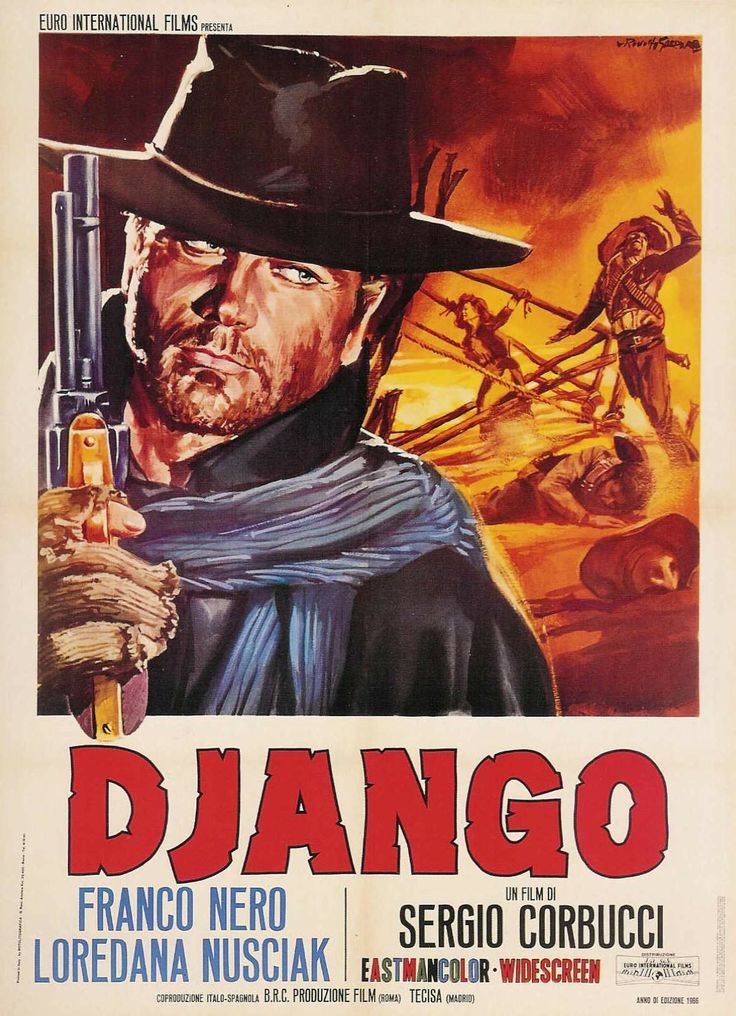
Franco Nero, who turns 75 today, broke out as the original Django in this 1966 Spaghetti Western:

Actor in the Spotlight:

In honor of the release of Allied, check out some trivia about Brad Pitt via ScreenCrush:

[embedded content]

Film Studies Lesson of the Day:

The Nerdwriter looks at brilliant lighting in animation with focus on the anime classic Akira:

[embedded content]

Classic Movie Trailer of the Day:

Tomorrow is the 60th anniversary of the release of Giant, starring Rock Hudson, Elizabeth Taylor and James Dean. Watch the original trailer for the movie below.

[embedded content]

and

Let’s block ads! (Why?)