Articles by admin

No Image

Economist Says Manufacturing Job Loss Driven By Technology, Not Globalization

NPR’s Scott Simon talks to economist Michael Hicks about how most of the manufacturing jobs lost in this country are due to increased use of technology and not outsourcing to foreign countries.

SCOTT SIMON, HOST:

American manufacturing jobs are disappearing. Donald Trump certainly hammered that theme home during this year’s campaign. The country’s lost more than 7 million factory jobs since the late 1970s, and yet the amount of stuff the U.S. produces is at an all-time high. A lot of these jobs have not been lost to other countries, according to Michael Hicks who’s an economist. He co-authored a report last year – “The Myth And Reality Of Manufacturing In America.” He says automation is responsible. Michael Hicks who teaches at Ball State University joins us now from the studios of Indiana Public Radio in Muncie. Professor Hicks, thanks for being with us.

MICHAEL HICKS: It’s good to be with you.

SIMON: And, boy, Indiana has been in the crosshairs of this recently – hasn’t it? – because of the Carrier plant. What do you make of President-elect Trump’s representation that hundreds of jobs were saved?

HICKS: Well, clearly, for the workers that are there, it appears that there are going to be more jobs available for the next several years. The question that I have is whether or not the jobs are saved or the workers are saved? As the plant probably goes through an automation period, we just don’t know how many of the workers that are there now are going to be able to fit into the new, highly technical automated factory of 2020.

SIMON: Yeah. Do you believe people that talk about our outsourcing haven’t accounted for the powerful impact of automation in industry?

HICKS: You know, it’s very clear to me in talking about the subject and writing about it for the past couple of years that there’s a real disconnect between what we talk about, which is jobs floating overseas to Mexico and China and Vietnam, and the reality, which is that automation and technological improvement have really accounted for the vast majority of job losses in Indiana nationwide.

SIMON: Yeah. Well, explain to us how that works. How could we be producing more stuff with fewer people?

HICKS: Everything from statistical process control that cuts down on waste and mistakes and measurement to robotics. And digitisation of a production process is going to make things quicker. So to sort of put in context, in 1990, the average American autoworker made 13 cars a year. In 2010, the average American autoworker made 18 cars a year. So we don’t need as many auto workers as we did a generation and a half ago.

SIMON: Are new jobs being created by automation?

HICKS: To be sure, they’re harder to see, but the entire tech industry is really fueled by the need for factories and for service providers to have more technology. And then, you know, of course, logistics – between the time that manufacturing peaked in 1977 and today, we’re down about 7 and a half million manufacturing jobs, but we’re up about 9 and a half million logistics jobs.

SIMON: What about the promise that I daresay some people find to be smug that is sometimes made to people who work in factories? Oh, don’t worry. More jobs are going to be created, and we’ll train you for those. Is that practical?

HICKS: You know, it’s a difficult thing to ask a 56-year-old guy or gal who hasn’t been around middle school math since the early ’70s to, you know, jump into a training program at our community technical college or with our workforce development board and get retooled for a technology job or to work in a health care setting. It’s a very difficult thing to do. I mean, we may have to face up to it, but it’s not a simple and seamless task.

SIMON: Are we talking about a landscape eventually in this country – and I don’t mean in two or three years, but I perhaps within the lifetimes of people listening – where there is no manufacturing? Everything is robotic.

HICKS: That’s an interesting question. I think it’s – to think about the challenge that manufacturing may face, is – it’s good to look at agriculture. We were, within living memory, at a time when most Americans in the Midwest and certainly the grain states – Nebraska, Kansas – were working in agriculture, and those are very important industries. Two thousand fifteen was a record agricultural production here in the United States. We’re doing that with a very, very small share of the population. So the challenge of places like Muncie or Youngstown or Detroit that have a lot of manufacturing is – what are you going to do afterwards to keep people here that was less successful for much of the agricultural industry?

SIMON: Michael Hicks at Ball State University, thanks so much for being with us.

HICKS: Delighted.

Copyright © 2016 NPR. All rights reserved. Visit our website terms of use and permissions pages at www.npr.org for further information.

NPR transcripts are created on a rush deadline by Verb8tm, Inc., an NPR contractor, and produced using a proprietary transcription process developed with NPR. This text may not be in its final form and may be updated or revised in the future. Accuracy and availability may vary. The authoritative record of NPR’s programming is the audio record.


Let’s block ads! (Why?)


No Image

Don't Skip Medicare Coverage For Doctor Visits, Even If You Have Other Insurance

When Cindy Hunter received her Medicare card in the mail last spring, she said she “didn’t know a lot about Medicare.” She and her husband, retired teachers who live in a Philadelphia suburb, decided she didn’t need it because she shared his retiree health insurance, which covered her treatment for ovarian cancer.

Cindy Hunter, who is battling ovarian cancer, says she mistakenly thought she didn’t need to enroll in Medicare because her husband’s retiree insurance would cover her. Steph Brecht/Courtesy of Cindy Hunter hide caption

toggle caption

Steph Brecht/Courtesy of Cindy Hunter

“We were so thankful we had good insurance,” she said. So she sent back the card, telling officials she would keep Medicare Part A, which is free for most older or disabled Americans and covers hospitalization, some nursing home stays and home health care. But she turned down Part B, which covers doctor visits and other outpatient care and comes with a monthly premium charge. A new Medicare card arrived that says she only has Part A.

Her story isn’t unique.

When Stan Withers left a job at a medical device company to become vice president of a small start-up near Sacramento, Calif., he took his health insurance with him. Under a federal law known as COBRA, he paid the full cost to continue his coverage from his previous employer. A few years earlier, when he turned 65, he signed up for Medicare’s Part A. With the addition of a COBRA plan, he thought he didn’t need Medicare Part B.

Hunter and Withers now know they were wrong and are stuck with medical bills their insurance won’t cover. Hunter called it “an honest mistake” and said there was nothing in the written materials she and her husband received indicating that if they had Medicare Part A, his retiree coverage could not replace Medicare Part B. Withers had no idea he made a bad choice

Thousands of seniors unwittingly make similar mistakes every year, believing that because they have some type of health insurance they don’t have to worry about signing up for Medicare Part B. Generally, insurance other than that provided by a current employer will not exempt them from Medicare’s strict enrollment requirements.

Article continues after sponsorship

Advocates for seniors and some members of Congress want to fix the problem, backed by a broad, unlikely group of unions, health insurers, patient organizations, health care providers and even eight former Medicare administrators.

Medicare’s Part B enrollment rules haven’t changed since the program was created in 1965. Seniors can enroll only when they first become eligible — usually three months before and after the month they turn 65 — or when their job-based insurance ends. If they miss this chance, they have to wait until the months of January through March to enroll and then coverage only begins July 1. Most won’t be allowed to buy any other health insurance policy during that time.

If people delay signing up for 12 or more months after becoming eligible, many will be hit with a permanent penalty added to their Part B monthly premium. In 2014, about 750,000 beneficiaries paid late penalties, raising their Part B premiums an average of 29 percent, according to the Congressional Research Service.

“The rules have not changed, but our lives have,” said Joe Baker, president of the Medicare Rights Center, an advocacy group that is leading the effort to update the enrollment process. When Medicare began, the government wanted seniors, especially younger and healthier people, to sign up quickly and so the deadlines and late penalties were incentives to get them in the program.

But these days more seniors work past the Medicare eligibility age, get health insurance through their employer or their spouse’s, or have coverage through the health insurance marketplaces, Baker said. The problem isn’t that people are going without insurance. “The confusion that we really see is with how Medicare interacts with other insurance coverage,” he said.

Hunter, 62, became eligible for Medicare earlier than 65 because she gets Social Security disability benefits. She’s receiving two chemotherapy drugs to control a second reoccurrence of ovarian cancer. This fall her oncologist’s office told her there’s “something going on with your insurance,” she recalled. After many calls to her husband’s retiree plan, Social Security, Medicare and even her congressman, she learned that her insurance would only pay a share of the bills for her cancer treatment after deducting the amount the insurer said was Medicare’s responsibility. “But Medicare isn’t paying because I don’t have Part B,” she said. So Hunter is probably responsible for that portion.

Withers thought the health plan he purchased through his old employer would count as job-based coverage, but COBRA is not a substitute for Medicare Part B, a point no one mentioned when he submitted his paperwork. He should have signed up for Part B when he left his previous job.

“How could there be a rule that no one knows about?” Withers asked.

In addition, the private plan has refused to pay thousands of dollars in medical bills because the company argued that he should have had Part B and those are Medicare’s responsibility.

Confusion over COBRA is just one of many reasons that people miss their opportunity to enroll in Part B. Others think, incorrectly, that getting Veterans Health Administration benefits, job-based-health insurance from a company with less than 20 workers, retiree coverage from a former employer, or coverage from the health law’s insurance marketplace exempts them from Part B’s lifetime late penalties and waiting periods with no insurance.

To help seniors avoid such mistakes, bipartisan legislation has been introduced in both the House and Senate that would allow people who miss their initial Part B enrollment deadline to sign up in the fall, when millions of seniors already in Medicare are choosing private drug or medical policies. Part B coverage would begin the month after they enroll, said Stacy Sanders, federal policy director at the Medicare Rights Center. It would also allow most people who enroll late to apply for retroactive coverage to their initial eligibility date and request a waiver of the late penalties if they can prove they were misled by an employer, health plan, insurance broker or state official (currently, an exemption may be based only on misinformation from a federal government representative).

“Because I didn’t ask Social Security and they didn’t give me the wrong information, there was nothing they could do,” Hunter said. “They said if they had given me the wrong information, they might be able to do something.”

Seniors “shouldn’t face penalties or gaps in their Part B coverage simply due to bureaucratic snafu,” said Rep. Patrick Meehan, R-Pa., who co-sponsored the House bill. “I’ve had seniors contact my office and say they simply had no idea of existing deadlines — or that they faced penalties down the road for missing them.”

The legislation also would require Medicare officials to notify all Americans prior to their 65th birthday about signing up for Medicare. Currently, the federal government and some states notify only those 64-year-olds who have health insurance though the Affordable Care Act’s marketplaces.

Although the bill appears unlikely to see action before the end of the current congressional session, Meehan said he will reintroduce it in 2017.

Getting an official government notice before turning 65 explaining when to sign up for Part B would “absolutely” help, said Withers. “There should be something that tells people what they need to do.”

Kaiser Health News is an editorially independent news service that is part of the nonpartisan Henry J. Kaiser Family Foundation. You can follow Susan Jaffe on Twitter: @susanjaffe.

Let’s block ads! (Why?)


No Image

Best of the Week: New 'Spider-Man' and 'Guardians of the Galaxy' Trailers, Amy Schumer Cast as Barbie and More

The Important News

Universal Monsters: Tom Cruise had special stuntwork demands for The Mummy. Dracula Untold is no longer part of the Universal Monsters mega franchise..

Marvel Cinematic Universe: Alan Tudyk wants a Marvel movie role, preferably in Guardians of the Galaxy.

DC Extended Universe: Aquaman has been pushed back to October 2018. Will Smith looks forward to playing Deadshot again.

Ocean’s Cinematic Universe: Damian Lewis will play the villain in Ocean’s Eight.

Sequels: Harrison Ford’s part in Blade Runner 2049 is not as big as we thought.

Remakes: Greg Berlanti will direct a new version of Little Shop of Horrors.

Walt Disney Animation: Coco will star Benjamin Bratt and Gael Garcia Bernal and is set in the Land of the Dead.

Movies Based on Toys: Amy Schumer will play the title role in Barbie.

Movies Based on TV Shows: Baywatch and CHiPS moved their release dates.

War Movies: Christopher Nolan’s Dunkirk will preview footage in front of Rogue One.

Anthologies: Paramount scheduled the next Cloverfield movie for October 2017.

Documentaries: Paul Haggis is making a doc about the Flint water crisis.

Box Office: Disney’s Moana is still going strong at number one.

Awards Season: Jimmy Kimmel will host the 2017 Oscars. Fifteen feature documentaries were announced for the Oscar shortlist.

The Videos and Geek Stuff

New Movie and TV Trailers: Spider-Man: Homecoming, Guardians of the Galaxy Vol. 2, The Fate and the Furious, The Mummy, War for the Planet of the Earth, Transformers: The Last Knight, Rogue One: A Star Wars Story, Baywatch, Fifty Shades Darker, A United Kingdom, Fist Fight, The Wall, The Autopsy of Jane Doe and The Circle.

Movie Clips: La La Land.

Behind the Scenes Featurette: 20th Century Women.

Movie Images: Dwayne Johnson in action for Jumanji.

Easter Eggs: All the references in the new Guardians of the Galaxy Vol. 2 trailer.

Supercuts: Die Hard body count tally.

Mashups: The Mummy mixed with Mission: Impossible – Ghost Protocol, Batman v Superman combined with Star Wars and E.T. meets Home Alone.

Remade Trailers: Rogue One: A Star Wars Story sweded trailer.

Reimagined Movies: Finding Dory as a thriller and Weiner if focused on Huma Abedin.

Movie Posters: All of this week’s best new posters.

Our Features

Fox Preview: We report on footage we saw from Alien: Covenant, Wolverine and War for the Planet of the Apes.

Interview: Alan Tudyk on whether his Rogue One character could reappear in any more Star Wars movies.

Marvel Movie Guides: We consider the possible spinoff future of Groot and Rocket Raccoon and three reasons why Spider-Man: Homecoming might be the best Spidey movie yet.

Geek Movie Guide: We recommend everything a movie geek needs in December.

Horror Movie Guide: We highlight all the latest horror movie news and trailers.

Home Viewing: Our guide to everything hitting VOD this week.

and

MORE FROM AROUND THE WEB:

Let’s block ads! (Why?)


No Image

Trump Transition Asks Energy Dept. Which Employees Work On Climate Change

A participant visits the Africa pavilion Nov. 9 at a UN climate conference, in Marrakech, Morocco. President-elect Donald Trump’s transition team has asked the Department of Energy to provide the names of all employees who attended such conferences. Mosa’ab Elshamy/AP hide caption

toggle caption

Mosa’ab Elshamy/AP

Among his campaign promises, President-elect Donald Trump vowed to increase domestic energy production and roll back President Obama’s efforts to combat climate change. A lengthy questionnaire recently sent to the Department of Energy suggests that effort may dig deep.

Among the transition’s inquiries, NPR’s Jennifer Ludden reports:

“It wants to know who at the Department of Energy attended domestic and international climate talks. It wants emails about those conferences. It also asks about money spent on loan-guarantee programs for renewable energy. … The Trump team questionnaire also asks about the Energy Department’s role in the Iran nuclear deal, which Trump has called ‘stupid.’ And it asks for the 20 highest paid employees at the department’s national laboratories.”

The full list of the transition’s questions for DOE is available here.

The questionnaire brought immediate negative reaction from Democratic lawmakers and environmental groups, including a letter to Trump from Sen. Ed Markey of Massachusetts:

“This request suggests that your administration may intend to retaliate against career employees who faithfully executed their responsibilities. … If any of this information is used to demote, sideline, terminate or otherwise discriminate against federal civil servants whose only ‘crime’ was to execute the lawful policy directives of their supervisors, then your administration would violate U.S. law that protects employees against such wrongful acts of retaliation.”

Energy secretary is one of the few posts for which Trump has not yet announced a nominee, but earlier this week he made Oklahoma Attorney General Scott Pruitt, a steady opponent of federal environmental regulation, his pick to lead the Environmental Protection Agency.

The Washington Post notes a recent history of clashes between Republican administrations and federal environmental scientists:

“In [Ronald] Reagan’s first term, Anne Gorsuch was appointed to head the Environmental Protection Agency amid a major push for regulatory rollback. But after Gorsuch resigned amid controversy in 1983, Congress opened investigations into supposed “hit lists” at the agency used to track the views of members of scientific advisory boards, according to contemporary news reports.

“During the George W. Bush administration, there were complaints that scientific documents had been edited to raise doubts about the science of climate change and that researchers had been prevented from speaking openly to the media and sharing their expertise.”

NPR thanks our sponsors

Let’s block ads! (Why?)


No Image

Anti-Doping Report Details Years Of Misconduct Sponsored By Russian State

Attorney Richard McLaren released final details of his investigation into Russian state-sponsored doping on Friday. His earlier report led to more than 100 Russian athletes being banned from the Rio Olympics.

AUDIE CORNISH, HOST:

The man who led a months-long investigation into Russian doping calls the scandal unprecedented in modern times. Today in a report commissioned by the World Anti-Doping Agency, he says there were over a thousand Russian athletes involved in state-sponsored doping. That’s over a recent four-year period, including the Olympic Games in London and Sochi. NPR’s Tom Goldman has more.

TOM GOLDMAN, BYLINE: Investigator Richard McLaren released evidence in July showing Russia had undertaken a massive state-sponsored doping operation. Today he was back with more damning details.

(SOUNDBITE OF PRESS CONFERENCE)

RICHARD MCLAREN: The conspiracy was perpetrated from at least 2011 to 2015.

GOLDMAN: At a London press conference, McLaren said the thousand-plus athletes involved in the conspiracy competed in the summer and winter games and Paralympics. There are medal winners, and in the case of two female hockey players, male DNA in their urine samples. Proof, McLaren says, of the kind of sample tampering that was widespread. For years, he says, international competitions have been hijacked by the Russians.

(SOUNDBITE OF PRESS CONFERENCE)

MCLAREN: Coaches and athletes have been playing on an uneven field. Sports fans and spectators have been deceived.

GOLDMAN: Along with his nearly 150-page report, McLaren also released evidence, including nearly 1,200 documents, photos, forensic reports, emails and test results – no names of athletes, however, since their alleged doping cases are under review. We have the evidence, McLaren says – not so, say Russian state media. The official government newspaper says empty talk is Mr. McLaren’s distinguishing feature.

There was similar criticism in July when McLaren released his initial report. It was right before the Rio Summer Olympics, and it led to more than 100 Russian athletes being banned from those games. Many were angry the International Olympic Committee decided not to ban the entire Russian team from Rio. U.S. Olympic hurdler Jeff Porter says now the IOC has another chance. It should ban Russia from the next Olympics, the 2018 Winter Games, and even beyond.

JEFF PORTER: If an athlete tests positive, that’s a four-year ban. But if a national governing body and an Olympic Committee conspires to dope athletes, we’re giving them other chances.

GOLDMAN: Porter is leading a petition campaign to strengthen anti-doping efforts. He’s the new chairman of USA Track & Field’s Athlete Advisory Committee. Three-hundred-sixty-two U.S. athletes have signed the petition so far demanding more money for anti-doping and less conflict of interest.

Critics note the president of the World Anti-Doping Agency has been a high-ranking IOC member as well. Doping historian John Hoberman says the IOC has to get out of the anti-doping business.

JOHN HOBERMAN: History shows us that the IOC has been ineffectual.

GOLDMAN: And Hoberman says now the IOC is facing a crisis of its own making.

HOBERMAN: Because they were negligent and in some cases corrupt about subverting the anti-doping process. That is why you cannot have the IOC anywhere near the reconstruction process.

GOLDMAN: The IOC is not talking about reconstruction. The committee released a statement today saying it has two commissions dedicated to following up on McLaren’s report. The IOC thanked McLaren and acknowledged the evidence he produced shows there was a fundamental attack on the integrity of the Olympic Games and on sports in general. Tom Goldman, NPR News.

Copyright © 2016 NPR. All rights reserved. Visit our website terms of use and permissions pages at www.npr.org for further information.

NPR transcripts are created on a rush deadline by Verb8tm, Inc., an NPR contractor, and produced using a proprietary transcription process developed with NPR. This text may not be in its final form and may be updated or revised in the future. Accuracy and availability may vary. The authoritative record of NPR’s programming is the audio record.

Let’s block ads! (Why?)


No Image

First 'Spider-Man: Homecoming' Trailer: Spidey Takes Down The Fake Avengers

It hasn’t been too long since the Spider-Man franchise was rebooted, but fans are doubly excited about Spider-Man: Homecoming (in theaters July 7) because it is the first full Spider-Man movie to be part of the ever expanding Marvel Cinematic Universe, which includes the Avengers and the Guardians of the Galaxy.

We caught a glimpse of the new Spider-Man (played by Tom Holland) when he dropped in to one of the most epic battles ever featured in a superhero movie, stuffed right in the middle of Captain America: Civil War. And now we have our first good look at his first feature film — one Marvel promises will be very different than what we’ve seen previously from both Tobey Maguire and Andrew Garfield’s Spider-Man movies.

Watch the first trailer below.

[embedded content]

This time around Spidey is back in high school, and the new film looks to embrace those sensibilities with a mix of a John Hughes-centric high school film combined with plenty of high-flying superhero action. Marisa Tomei returns as Peter Parker’s younger, hipper Aunt May and Michael Keaton co-stars as the villain Vulture. And just so audiences know this is a new kind of Spider-Man who is part of a much bigger universe, both Robert Downey Jr. and Jon Favreau will reprise their roles as Tony Stark/Iron Man and Happy Hogan, respectively.

Spider-Man: Homecoming hits theaters on July 7, 2017.

Let’s block ads! (Why?)


No Image

Slam Dunk: Michael Jordan Wins Trademark Dispute In China

A shopper walks past a Qiaodan Sports retail shop on Thursday in Beijing, China. Ng Han Guan/AP hide caption

toggle caption

Ng Han Guan/AP

China’s top court has handed basketball legend Michael Jordan a victory in a long-running trademark dispute over the use of his name by a Chinese company.

“Nothing is more important than protecting your own name, and today’s decision shows the importance of that principle,” Jordan said in a statement after the ruling. Here’s more from Jordan:

“Over the past three decades, I have built my reputation and name into a globally recognized brand. From my earliest playing days in the NBA, through my trip to China last fall, millions of Chinese fans and consumers have always known me by my Chinese name, ‘Qiaodan.’ Today’s decision ensures that my Chinese fans and all Chinese consumers know that Qiaodan Sports and its products have no connection to me.”

The ruling by Supreme People’s Court overturns a previous ruling from a lower court that favored Qiaodan Sports Co., which makes sportswear and shoes and had registered the name as its trademark. The company has no relationship to the Nike Air Jordan brand.

Article continues after sponsorship

Jordan is widely known as Qiaodan in China, and he initially filed a lawsuit against the company in 2012.

The court “approved Jordan’s appeal that the trademark of his name’s translation in Chinese characters infringed on his right to own his name and violated the country’s trademark law,” according to the state-run Xinhua news agency.

This company is not subtle; according to Xinhua, it also used “Jordan’s old jersey number 23, basketball player logo and even names of his children.” As NPR’s Becky Sullivan has reported, the company does hundreds of millions of dollars of business annually, with some 6,000 locations in China.

U.S. President Barack Obama and NBA athlete Michael Jordan share a smile during the presentation of the Presidential Medal of Freedom, the nation’s highest civilian honor, in the White House last month. Saul Loeb /AFP/Getty Images hide caption

toggle caption

Saul Loeb /AFP/Getty Images

After the ruling, Qiaodan “defended its actions but said it would respect the court’s decision,” The Associated Press reported.

The court’s chief judge Tao Kaiyuan “said there was an established link between Jordan and the Chinese characters for ‘Qiaodan,’ which are commonly used by the public when referring to the former basketball player, meaning that Jordan was entitled to protection under the Trademark Law,” according to the wire service.

However, it’s not a completely clear-cut victory: Xinhua added that court also “ruled that the former Chicago Bulls star does not own the right of name for Qiaodan, Chinese pinyin transcription of his surname Jordan.”

That means the company can use the word “Qiaodan” in Roman letters, but not in Chinese characters. The court said “there was not sufficient evidence to show that Chinese consumers associated” this version with Jordan, according to The New York Times.

The case could have broad implications; the Times calls it a “landmark decision that lays out ground rules for protecting personal names in trademark cases.”

In a country where foreign companies regularly come up against trademark disputes, lawyers tell the Times that this “establishes the scope of protection for personal names in trademark cases, indicating that foreign celebrities can successfully challenge third parties that use the Chinese characters of their names in China.”

Let’s block ads! (Why?)


No Image

Slam Dunk: Michael Jordan Wins Trademark Dispute In China

A shopper walks past a Qiaodan Sports retail shop on Thursday in Beijing, China. Ng Han Guan/AP hide caption

toggle caption

Ng Han Guan/AP

China’s top court has handed basketball legend Michael Jordan a victory in a long-running trademark dispute over the use of his name by a Chinese company.

“Nothing is more important than protecting your own name, and today’s decision shows the importance of that principle,” Jordan said in a statement after the ruling. Here’s more from Jordan:

“Over the past three decades, I have built my reputation and name into a globally recognized brand. From my earliest playing days in the NBA, through my trip to China last fall, millions of Chinese fans and consumers have always known me by my Chinese name, ‘Qiaodan.’ Today’s decision ensures that my Chinese fans and all Chinese consumers know that Qiaodan Sports and its products have no connection to me.”

The ruling by Supreme People’s Court overturns a previous ruling from a lower court that favored Qiaodan Sports Co., which makes sportswear and shoes and had registered the name as its trademark. The company has no relationship to the Nike Air Jordan brand.

Article continues after sponsorship

Jordan is widely known as Qiaodan in China, and he initially filed a lawsuit against the company in 2012.

The court “approved Jordan’s appeal that the trademark of his name’s translation in Chinese characters infringed on his right to own his name and violated the country’s trademark law,” according to the state-run Xinhua news agency.

This company is not subtle; according to Xinhua, it also used “Jordan’s old jersey number 23, basketball player logo and even names of his children.” As NPR’s Becky Sullivan has reported, the company does hundreds of millions of dollars of business annually, with some 6,000 locations in China.

U.S. President Barack Obama and NBA athlete Michael Jordan share a smile during the presentation of the Presidential Medal of Freedom, the nation’s highest civilian honor, in the White House last month. Saul Loeb /AFP/Getty Images hide caption

toggle caption

Saul Loeb /AFP/Getty Images

After the ruling, Qiaodan “defended its actions but said it would respect the court’s decision,” The Associated Press reported.

The court’s chief judge Tao Kaiyuan “said there was an established link between Jordan and the Chinese characters for ‘Qiaodan,’ which are commonly used by the public when referring to the former basketball player, meaning that Jordan was entitled to protection under the Trademark Law,” according to the wire service.

However, it’s not a completely clear-cut victory: Xinhua added that court also “ruled that the former Chicago Bulls star does not own the right of name for Qiaodan, Chinese pinyin transcription of his surname Jordan.”

That means the company can use the word “Qiaodan” in Roman letters, but not in Chinese characters. The court said “there was not sufficient evidence to show that Chinese consumers associated” this version with Jordan, according to The New York Times.

The case could have broad implications; the Times calls it a “landmark decision that lays out ground rules for protecting personal names in trademark cases.”

In a country where foreign companies regularly come up against trademark disputes, lawyers tell the Times that this “establishes the scope of protection for personal names in trademark cases, indicating that foreign celebrities can successfully challenge third parties that use the Chinese characters of their names in China.”

Let’s block ads! (Why?)


No Image

Retired Coal Miners At Risk Of Losing Promised Health Coverage And Pensions

Retired coal miners could face the loss of health benefits if Congress doesn’t implement a fix by Friday. Steve Helber/AP hide caption

toggle caption

Steve Helber/AP

Without congressional intervention, about 16,000 retired miners in seven states will lose their health care coverage by the end of the year.

A proposal to temporarily extend the benefits is working its way through Congress. But two Senate Democrats, who are advocates for a more comprehensive plan, say the temporary provision isn’t enough.

They are threatening to hold up a spending bill that needs to pass by Friday night to keep the government running.

Coal mining is dangerous work. For many miners, a government-backed promise of lifelong health care for them and their dependents made the risk worth taking.

Roger Merriman, 65, worked in the coal industry for 28 years.

“When we all started in the mines, we were promised health care for life – cradle to grave,” he says. Merriman’s employer, Patriot Coal, filed for bankruptcy in 2012, then again in 2015. He is now slated to lose his pension and benefits. Merriman says that possibility of losing health benefits for his wife, who is younger than he is (at 65, he qualifies for Medicare), and their pension, is devastating.

Article continues after sponsorship

“We’ll have to make a choice of whether [we’re] going to the doctors and buying prescriptions or paying bills and eating. It’s a life and death situation realistically is what it is,” he says.

In 1946, the United Mine Workers of America and the U.S government agreed that union miners who put in 20 or more years would get lifelong pension and health benefits. Patriot is one of six major coal producers in the U.S. that has sought bankruptcy protection in the last few years, a process that often includes an attempt to drop retiree benefits.

After the Patriot bankruptcy in 2012, the UMWA negotiated a $400 million payment in bankruptcy court for retirees benefits. Existing companies pay into a UMWA fund for retirees, but as those mines close, there is less money going into the pot and the number of retired miners who are drawing from it is increasing. The fund is about to run out of money.

The UMWA’s hope was that the $400 million would give federal lawmakers the time they needed to pass legislation that would protect the miners.

Senate Democrats have been working for years to pass the Miners Protection Act — a bill that would move money from the Abandoned Mine Lands Reclamation Fund into a fund to pay for the pension and health care benefits of tens of thousands of coal miners and retirees.

West Virginia Sen. Joe Manchin, a Democrat, is frustrated by the benefits Band-Aid. “We’re asking for a permanent fix, we have a pay for for a permanent fix, it’s the excess that we have, the surplus in the AML money,” he said Tuesday on the Senate floor.

Manchin and colleague Sherrod Brown, D-Ohio, are trying to block a key government spending bill on the Senate floor until miners get their full health care and pension money.

“I haven’t ever used this tactic before, but I feel so compelled that I said we are going to do whatever we can to keep this promise,” he said Tuesday.

But the Miners Protection Act has met with resistance from Senate Republicans, who are wary of bailing out unionized workers.

Senate Majority Leader Mitch McConnell, R-Ky., proposed a temporary fix — tacking on $45 million taken from the existing UMWA fund to the continuing resolution that is needed to fund the federal government through April 2017.

The continuing resolution must be approved by Friday. Manchin and others are frustrated that it is only a solution for a few months and that it doesn’t include any money for pensions.

Critics of the Miners Protection Act say there are many struggling pension and benefits funds and that a government bailout sets a bad precedent.

This story is part of a reporting partnership with NPR, West Virginia Public Broadcasting and Kaiser Health News.

Let’s block ads! (Why?)


No Image

Today in Movie Culture: Zack Snyder Mashes 'Batman v Superman' and 'Star Wars,' Bruce Willis Fights Everybody and More

Here are a bunch of little bites to satisfy your hunger for movie culture:

Mashup of the Day:

Zack Snyder continues the friendly rivalry between the DC Extended Universe and Star Wars with this mashup trailer aligning Batman with the Dark Side and making Superman out to be a Jedi (via Screen Rant):

[embedded content]

PSA of the Day:

Rogue One: A Star Wars Story‘s Felicity Jones settles it once and for all that she and Star Wars: The Force Awakens‘ Daisy Ridley are not the same person in this MTV News video:

[embedded content]

Promotion of the Day:

Disney turned Epcot Center’s Spaceship Earth into the Death Star to promoe Rogue One (via Geekologie):

[embedded content]

Year-End Recap of the Day:

Here’s yet another great 2016 movie montage, this one edited by Ken Wu:

[embedded content]

Reimagined Movie of the Day:

CineFix turns Pixar’s hit sequel Finding Dory into a dark thriller in this re-edited trailer:

[embedded content]

Vintage Image of the Day:

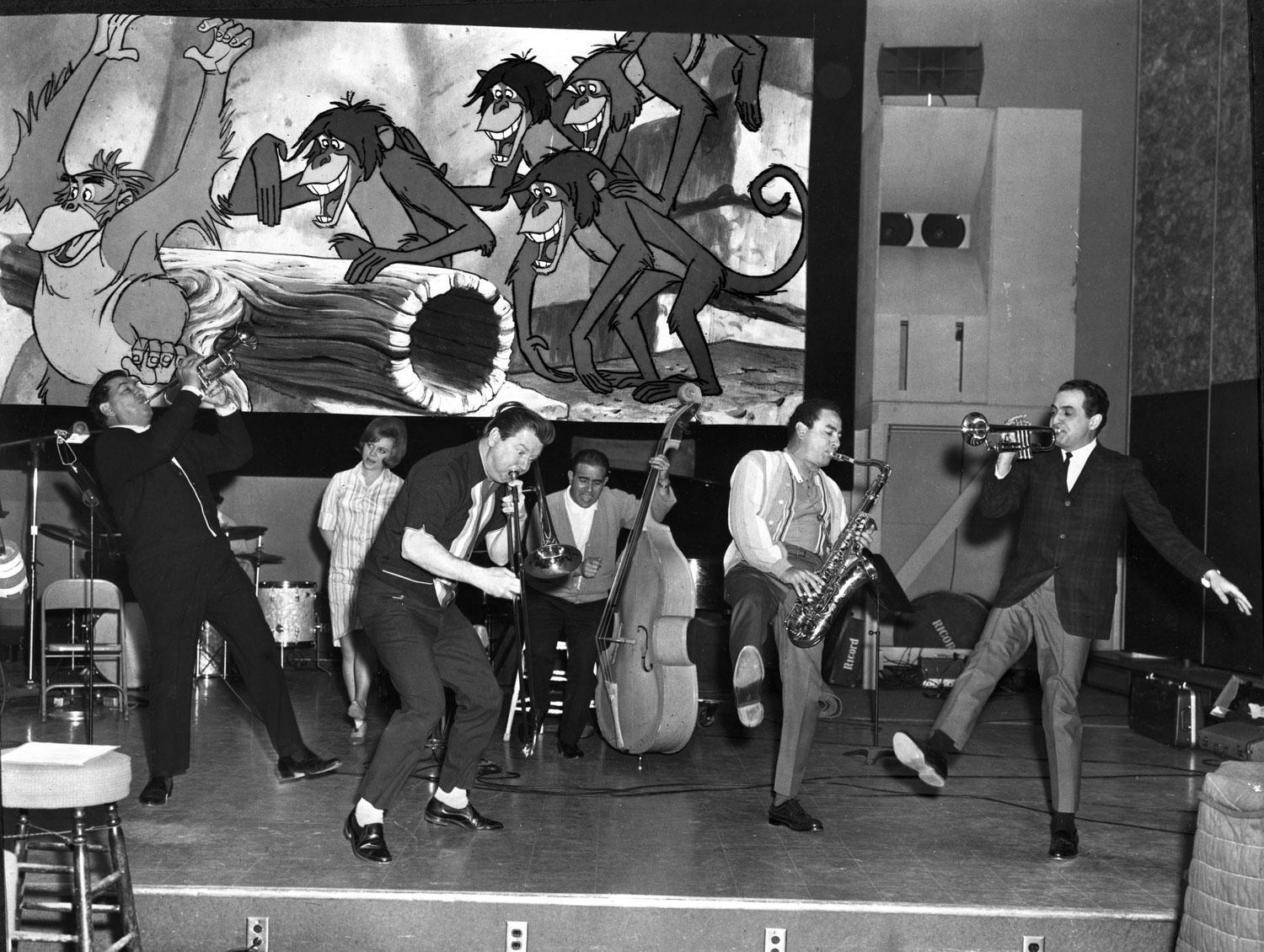
Louis Prima, who was born on this day in 1910, records music for Disney’s 1967 version of The Jungle Book with Sam Butera and the Witnesses while the animated feature plays in the background:

Actor in the Spotlight:

Bruce Willis goes up against characters from numerous other movies in the following two mashup videos by Movie Blender (via Geek Tyrant):

[embedded content]

[embedded content]

Filmmaker in Focus:

The power of faces in the films of Steven Spielberg is the focus of this video essay by James Hayes (via Film School Rejects):

[embedded content]

Supercut of the Day:

Famous director cameos (Martin Scorsese, Alfred Hitchcock and more) are all compiled toegether in this trailer for a fake movie called Cameo by Filmscalpel:

[embedded content]

Classic Trailer of the Day:

Today is the 15th anniversary of the release of Steven Soderbergh’s Ocean’s Eleven. Watch the original trailer for the hit remake below.

[embedded content]

and

Let’s block ads! (Why?)