
CBO Releases Score For House-Approved American Health Care Act

The Congressional Budget Office gave its projections Wednesday on the costs and impact of the version of the American Health Care Act passed by the House earlier this month.
The Congressional Budget Office gave its projections Wednesday on the costs and impact of the version of the American Health Care Act passed by the House earlier this month.

The Charlotte Hornets, who play in the city’s Time Warner Cable Arena, will host the 2019 NBA All-Star game.
Streeter Lecka/Getty Images
hide caption
toggle caption
Streeter Lecka/Getty Images
The NBA has announced that Charlotte, N.C., will host the 2019 All-Star Game, after the state partially repealed its controversial law that limited civil rights protections for LGBT people.
The professional basketball league moved last year’s All-Star game from Charlotte, where it was originally scheduled, to protest the state’s HB2 law.
“While we understand the concerns of those who say the repeal of HB2 did not go far enough, we believe the recent legislation eliminates the most egregious aspects of the prior law,” NBA Commissioner Adam Silver said in a statement.
Today’s decision has drawn criticism from some transgender advocates, who say the state is still not providing adequate protections. “This is a disgrace from the NBA but not surprising,” Chase Strangio, a staff attorney at the ACLU working on LGBT issues, wrote on Twitter. “Lessons in why you should never trust corporations as your allies.”
HB2 is also known as the “bathroom bill” because it said that in public institutions, transgender people must use the bathroom corresponding to the sex on their birth certificate, rather than their gender identity.
The law created an intense backlash, ultimately costing the state an estimated $3.7 billion after businesses pulled out and events moved elsewhere.
In March, lawmakers came up with a compromise to partially repeal the measure – but “the deal prohibits local communities from passing anti-discrimination ordinances for at least three years,” as NPR’s Camila Domonoske reported. “That will block cities from imposing their own protections for LGBT people.”
The NBA commissioner said that the league would work with the Charlotte Hornets to “apply a set of equality principles” so that the game and other associated events “will proceed with open access and anti-discrimination policies.”
North Carolina Gov. Roy Cooper, a Democrat, applauded the decision: “Hosting the All-Star Game will pump millions of dollars into our economy and provide an incredible showcase for our state, but it will also remind us of the work that remains to ensure equal rights and protections for all North Carolinians.”
Michael Jordan, the legendary basketball player and Charlotte Hornets chairman, said he was “thrilled” about the announcement and emphasized that it would have a “tremendous economic impact to our community.”
Charlotte has been the focus of the state’s debate over the HB2 law. As Camila reported, “the city passed a measure protecting gay, lesbian, bisexual and transgender people from being discriminated against by businesses. It included a provision allowing trans people to use bathrooms corresponding to their gender.”
State lawmakers then convened and rapidly passed the HB2 law, ultimately overriding the Charlotte city measure.
Other events that fled during the controversy are slowly coming back to the state; last month, the NCAA announced that it will bring back college sports events, though it said it was doing so “reluctantly,” as Camila reported.

Here are a bunch of little bites to satisfy your hunger for movie culture:
Movie Takedown of the Day:
Logan is so good that Honest Trailers has trouble making fun of it and can’t even get Deadpool to say anything mean about it:
[embedded content]
Franchise Recap of the Day:
In anticipation of Pirates of the Caribbean: Dead Men Tell No Tales, Hal Rudnick of Screen Junkies recaps the first four movies:
[embedded content]
Vintage Image of the Day:
In anticipation of the new Pirates of the Caribbean movie, here’s a classic behind the scenes shot of Keira Knightley on the set of the original installment, Pirates of the Caribbean: The Curse of the Black Pearl, in 2002:
Movie Parody of the Day:
Witness Darth Vader fandom within the Empire this Malaysian Stormtrooper sketch made for Star Wars Day (via Geek Tyrant):
[embedded content]
Fake Movie Posters of the Day:
James Gunn has shared all the movie poster parodies featuring Nathan Fillion as actor Simon Williams, aka Wonder Man, from the set of Guardians of the Galaxy Vol. 2:
Actor in the Spotlight:
In anticipation of the release of Baywatch this week, ScreenCrush shares some trivia you might not know about Dwayne Johnson:
[embedded content]
Filmmaker in Focus:
Mr. Nerdista celebrates the talents of Taika Waititi and shows why he’s perfect for the MCU and Thor: Ragnarok in this video essay:
[embedded content]
Mashup of the Day:
Speaking of the MCU, BossLogic crossed Scarlett Johansson’s Avengers and Ghost in the Shell characters for a futuristic Black Widow:
Mashed up Ghost in the shell with Black Widow, I have always liked the concept of a futuristic BW 😀 yes widow maker is the inspiration pic.twitter.com/oguZIwz7Mu
— BossLogic (@Bosslogic) May 23, 2017
Supercut of the Day:
Movie characters love pizza, as seen in this supercut from IMBd:
[embedded content]
Classic Trailer of the Day:
Today is the 20th anniversary of the release of The Lost World: Jurassic Park. Watch the original trailer for the sequel below.
[embedded content]
and

A tractor pulls a planter through a field as corn is planted in Princeton, Ill.
Daniel Acker/Bloomberg/Getty Images
hide caption
toggle caption
Daniel Acker/Bloomberg/Getty Images
Top officials at the U.S. Department of Agriculture didn’t even try to act enthusiastic as they unveiled details of their agency’s proposed 2018 budget, which includes drastic cuts in spending. “We’re going to do the best we can,” said Agriculture Secretary Sonny Perdue. “It’s my job to implement that plan.”
The broad outlines of this budget, with its 20 percent cut in the USDA’s discretionary spending, had been released two months ago. This week, it became clear exactly what the Trump administration wants to cut: agricultural research, food aid for the poor, and programs that benefit small rural communities.
The budget also includes a surprise that’s particularly unwelcome to big Midwestern farmers. It proposes new restrictions on government-subsidized crop insurance, a program that is particular favorite of grain farmers. The changes, which would require congressional approval, would limit the ability of large farmers to take advantage of those programs and cut government subsidies by more than $2.5 billion each year.
In a statement, the American Farm Bureau Federation said that “this budget fails agriculture and rural America.” Similar criticism came from the American Soybean Association and the National Corn Growers Association.
The impact of those cuts, however, is dwarfed by proposed restrictions on the SNAP program, which helps the poor buy food. Those changes would cut SNAP spending by $4.6 billion in 2018, increasing to more than $20 billion annually by 2022.
The budget reduces funding for the Agricultural Research Service by $360 million, or 26 percent. This would mean closing the doors at 17 research centers.
It also completely eliminates the country’s flagship program of international food aid, called Food For Peace. The current USDA budget includes $1.7 billion for that program.
All of this, of course, is merely a proposal for Congress to consider, and by all indications, Congress is inclined to reject much of it. The Republican chairmen of the agricultural committees in both the Senate and the House released a muted joint statement that said nothing at all about the proposal itself, but promised to “fight to ensure farmers have a strong safety net.” They also pledged “to take a look at our nutrition assistance programs to ensure that they are helping the most vulnerable in our society” — a signal that they hope to revive the rural-urban coalition in Congress that has traditionally defended a package of food aid and farm subsidies.
Congressman Collin Peterson (D-MN) said in a statement that “this budget is going nowhere on Capitol Hill but it is still a statement of priorities and should be of concern to all rural Americans.” Sen. Debbie Stabenow (D-MI) called it “harsh and short-sighted.”
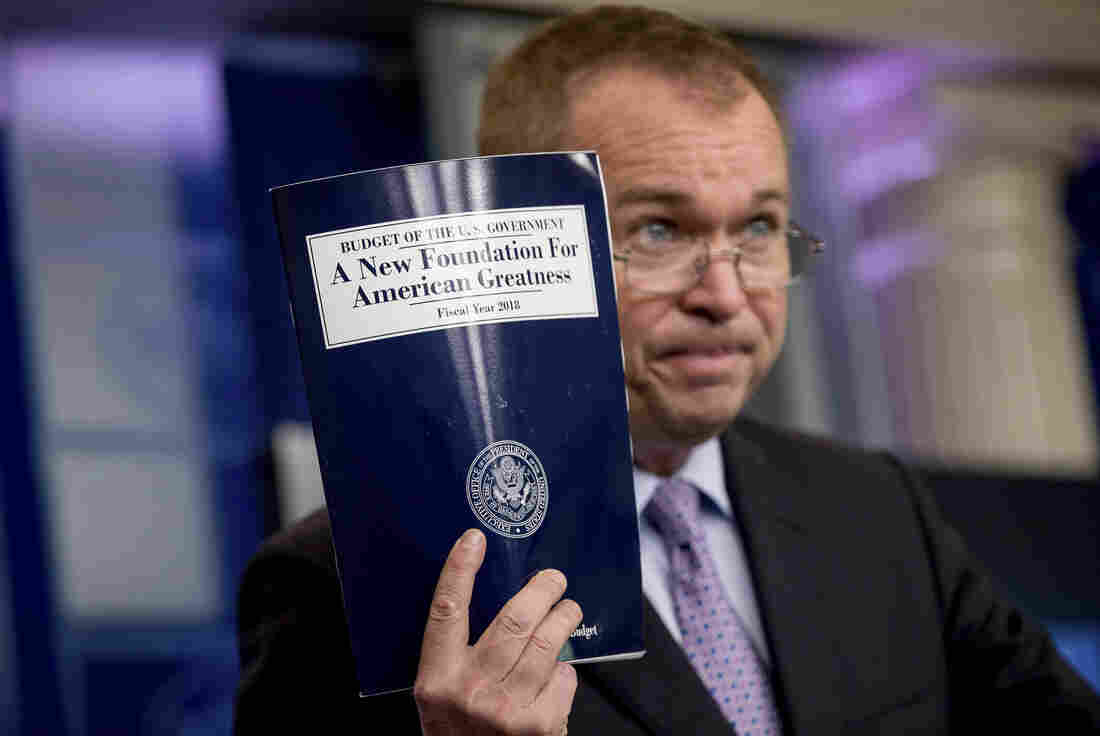
Budget Director Mick Mulvaney holds up a copy of President Trump’s proposed fiscal 2018 federal budget at the White House on Tuesday.
Andrew Harnik/AP
hide caption
toggle caption
Andrew Harnik/AP
The proposed budget unveiled Tuesday by the Trump administration doubles down on major cuts to biomedical research; programs to fight infectious disease outbreaks; health care for the poor, elderly and disabled; and prevention of HIV/AIDS.
It restates the goals of the “skinny budget” the administration released in March, which was widely condemned by scientists and public health advocates.
Mick Mulvaney, director of the Office of Management and Budget, said Monday that the goal is to cut back on public assistance and instead put people back to work. “We are going to measure compassion and success by the number of people we help get off of those programs and get back in charge of their own lives.”
No one thinks the president’s budget will pass as proposed, since Congress has budget and spending authority. But it does provide a baseline from which negotiations may begin.
“The president is right to take a close look at spending,” says Sen. Chuck Grassley, R-Iowa. But “Congress has the power of the purse strings. I’ve never seen a president’s budget proposal not revised substantially.”
Here’s a rundown of the budget’s medical research and health care proposals.
Medicaid: The budget proposes cutting Medicaid and CHIP, the Children’s Health Insurance Program, by $616 billion over 10 years, with almost half the savings occurring in the last two years.
The joint federal-state programs provide health care and support services for 75 million low-income, elderly and disabled people, about half of whom are children. In 2015, federal and state spending on Medicaid was about $545 billion.
The budget mirrors the changes in Medicaid included in the health care overhaul bill passed by the House earlier this month. Rather than the federal government matching state spending based on beneficiaries’ health care needs, it would give states a fixed amount of money per enrollee or, alternatively, offer states a fixed block grant. That would cut the program’s growth over time and reduce services because health care costs grow faster than the broad economy.
Medicaid benefits for the elderly and disabled: Medicaid pays for services — including personal care, shopping or cooking for the elderly, and occupational therapy and work support for the disabled — that allow people to continue to live on their own.
Under the law, those services are considered optional. But Medicaid is required to pay for nursing home and institutional care.
“We’ll see a return to more people with disabilities and more older adults not having access to services that allow them to remain at home,” says Barbara Beckert, director of the Milwaukee office of Disability Rights Wisconsin. “Instead, we may see people forced into institutions, forced into nursing homes.”
Refugee benefits: The proposed budget makes the argument that the U.S. should reduce the number of refugees it brings into this country because those fleeing persecution in their home countries often end up using public assistance, including 50 percent who were on Medicaid in 2015. “The larger the number the United States admits for domestic resettlement, the fewer people the United States is able to help overall,” the budget document says.
National Institutes of Health: The NIH, which funds research into medical treatments and basic science, would see cuts of almost $6 billion, to about $26 billion. That would include a $575 million cut to the National Heart, Lung and Blood Institute and $838 million cut to the National Institute of Allergy and Infectious Diseases, which is involved in a wide range of diseases including AIDS and Zika. The National Institute of Diabetes and Digestive and Kidney Diseases would be cut by $355 million.
The proposed cuts drew immediate and harsh criticism.
The cuts would “cripple our nation’s scientific efforts, undermining our economic growth, public health and national security,” Mary Sue Coleman, president of the Association of American Universities, said in a statement. The cuts could “hobble our ability to provide tomorrow’s cures and technologies.”
Centers for Disease Control and Prevention: The administration proposes trimming the CDC, which helps states and other countries fight infectious disease outbreaks, by $1.3 billion — 17 percent. That could include a $186 million cut in programs at the CDC’s center on HIV/AIDS, hepatitis and other sexually transmitted diseases. The CDC’s chronic disease prevention programs, such as those for diabetes, heart disease, stroke and obesity, would be cut by $222 million.
The proposed cut to CDC “would be perilous for the health of the American people,” says John Auerbach, president and CEO of the Trust for America’s Health. “From Ebola to Zika to opioid misuse to diabetes to heart disease, the CDC is on the front lines keeping Americans healthy.”
Food and Drug Administration: A 31 percent proposed cut, from $2.7 billion to $1.89 billion, would be offset by $1.3 billion in proposed increased fees to be paid by drugmakers and device-makers.
The budget shows a basic misunderstanding of how these agencies function, says Ryan Hohman, vice president of public affairs at the group Friends of Cancer Research. “To further suggest that private sector industry make up for such a significant cut to the FDA as proposed by the president shows a lack of knowledge for how user fees can be used and the scope of the FDA’s pivotal role in assuring the safety of the daily lives of Americans.”
The budget doesn’t explicitly address high drug costs, though Trump has frequently inveighed against drug prices, telling Congress in February that it should “work to bring down the artificially high price of drugs and bring them down immediately.”
Planned Parenthood: The family-planning organization has been the target of efforts to cut funding for years because it provides about one-third of the nation’s abortions.
This budget would be the first to bar a specific provider, according to Planned Parenthood. And it would bar the organization not only from Medicaid funding but also from any other Health and Human Services program, including the Title X family planning program, maternal and child health, STD testing and treatment, and Zika prevention.
“From Day 1, President Trump has worked to keep his pro-life promises, including stopping taxpayers from being forced to fund abortion and abortion businesses,” says Marjorie Dannenfelser, president of the anti-abortion group Susan B. Anthony List. “Taxpayers should not have to prop up Planned Parenthood’s failing, abortion-centered business model.”
Planned Parenthood officials said Tuesday that many of their clients don’t have other places to get health care. “We’ve already seen the results of these sorts of policies in Texas, so we know what would happen,” says Kevin Griffis, vice president at Planned Parenthood Federation of America. “The heartbreaking truth is that if this budget were enacted, the results would be catastrophic for countless women and their families — cancers and diseases going undetected, higher maternal mortality and more unintended pregnancies.”

Here are a bunch of little bites to satisfy your hunger for movie culture:
Easter Eggs of the Day:
Now that Alien: Covenant has opened and dominated the box office, here’s Mr. Sunday Movies with all the Easter eggs and other references you might have missed:
[embedded content]
Movie Score Performance of the Day:
Watch Spider-Man: Homecoming composer Michael Giacchino conduct a new version of a familiar theme song in this video shared on Twitter:
Who’s ready for your friendly neighborhood you-know-who?@SpiderManMovie@MarvelStudiospic.twitter.com/iSHk4IvVgk
— Michael Giacchino (@m_giacchino) May 19, 2017
Casting Rendering of the Day:
Speaking of Spider-Man, Tom Hardy has been cast as the new Venom, so BossLogic shows us what he might look like in the role:
Worked on Tom Hardy as Venom with @comicbook today, personally I love the casting because I love tom 😀 pic.twitter.com/4indLVl10c
— BossLogic (@Bosslogic) May 20, 2017
Trailer Reaction of the Day:
Layer upon layer upon layer, here’s a video of The Avengers watching Lego Batman watching Superfriends watching the Justice League trailer:
[embedded content]
Superhero Movie Parody:
In this Saturday Night Live sketch, Dwayne Johnson pokes fun at how amazing superheroes’ costumes are with a possible nod to his role in The Scorpion King:
[embedded content]
Vintage Image of the Day:
Laurence Olivier, who was born on this day 110 years ago, directs while in costume as the title character on the set of Hamlet in 1947:
Filmmaker in Focus:
Adam Mckay is celebrated as a master of smart dumb comedy in this video essay by Patrick (H) Willems (via Geek Tyrant):
[embedded content]
Cosplay of the Day:
Watch Adam Savage build an animatronic C-3PO additon to his Chewbacca costume:
[embedded content]
Fake Movie of the Day:
Car Botz is the old school Russian Transformers knockoff that never was, and it stars Tommy Wiseau as the President of the United States:
[embedded content]
Classic Trailer of the Day:
Today is the 25th anniversary of the release of David Fincher’s Alien 3. Watch the original trailer for the Alien sequel below.
[embedded content]
and

White House Budget Director Mick Mulvaney (second from right) holds a copy of the president’s 2018 budget at the Government Publishing Office’s plant in Washington, D.C. Mulvaney describes the plan as “taxpayer first.”
Carolyn Kaster/AP
hide caption
toggle caption
Carolyn Kaster/AP
The Trump administration says it can balance the federal budget within a decade. Its blueprint calls for significant cuts to social safety net programs and assumes more robust economic growth.
The administration plans to release what it calls a “Taxpayer First” budget on Tuesday.
“This is, I think, the first time in a long time that an administration has written a budget through the eyes of the people who are actually paying the taxes,” White House Budget Director Mick Mulvaney told reporters on Monday.
The plan was crafted with a skeptical eye toward programs that serve the needy. Over a decade, it calls for hundreds of billions of dollars in cuts to Medicaid, food stamps and disability benefits.
“We are no longer going to measure compassion by the number of programs or the number of people on those programs,” Mulvaney said. “We are going to measure compassion and success by the number of people we help get off of those programs to get back in charge of their own lives.”
Critics call the spending blueprint “Robin Hood in reverse.”
“The president is essentially abandoning many people the economy has left behind — a large number of whom voted for him — and is pursuing policies that would make their lives more difficult than they already are,” said Robert Greenstein, president of the left-leaning Center on Budget and Policy Priorities.
Two months ago, the White House released a preliminary budget that covered only “discretionary” spending — those parts of the government that Congress has to authorize every year. The new budget also covers “mandatory” spending, including such big-ticket items as Medicare and Social Security.
Some of the proposed cuts to programs like Social Security’s disability benefits are designed to push more people into the workforce. With 10,000 baby boomers hitting retirement age each day, and an official unemployment rate of 4.4 percent, it would be difficult for the U.S. economy to grow as fast as the administration envisions without enlisting an army of new workers.
“We need folks to work,” Mulvaney said. “There’s a dignity to work. And there’s a necessity to work to help the country succeed.”
The budget assumes that annual economic growth accelerates from 1.6 percent last year to 3 percent by 2021, and remains at that level for the rest of the decade. Faster economic growth would generate trillions of dollars in additional revenue, allowing the government to balance its books by 2027.
Fiscal watchdogs say while the goal of a balanced budget might be commendable, they’re doubtful that it’s realistic.
“Given the demographic challenges that we face, there is really very little chance that we will be able to sustain 3 percent growth,” said Maya MacGuineas, president of the Committee for a Responsible Federal Budget. “We should be realistic about the projections we make and not use aggressive economic projections to try to wish our fiscal problems away.”
The budget does not call for big changes to the Social Security retirement program or Medicare, which Trump promised during the campaign to preserve. And while the president has proposed trillions of dollars in tax cuts — aimed mostly at the wealthy — the budget assumes tax revenues are largely unaffected.
“The Trump administration has taken so many important pieces of the budget off the table,” MacGuineas said. “They’re saying they won’t raise taxes. They’re going to increase defense spending. And they’re not going to address our biggest programs: Social Security and Medicare. And so when you’re trying to reach balance by relying on such a tiny sliver of the budget, it’s very difficult to make those numbers add up.”
The new budget incorporates Trump’s priorities from the earlier version, including increased spending on the military and border security, with corresponding cuts to the State Department and the EPA.
The plan also includes $200 billion over a decade as a down payment on infrastructure investment, and a modest $19 billion to establish a paid parental leave program. The president’s daughter, Ivanka Trump, has championed parental leave as a way to help women in the workforce, although the budget provides little detail of how the program would work.

Motorcycle champion Nicky Hayden on May 12 in Misano Adriatico, Italy. Hayden died Monday after being hit by a car while bicycling.
Mirco Lazzari/Getty Images
hide caption
toggle caption
Mirco Lazzari/Getty Images
Nicky Hayden, a champion motorcycle racer, died at an Italian hospital Monday, five days after being struck by a car while bicycling as part of his training on the Rimini coast.
The 35-year-old had suffered trauma to his head, chest and abdomen after colliding with the car’s windshield, leaving him in critical condition at Maurizio Bufalino Hospital in Cesena.
The hospital confirmed Monday that he died “following a very serious polytrauma.”
At the time of his death, Hayden’s mother and fiancee were by his side, according to a statement by the Red Bull Honda World Superbike Team.
“Although this is obviously a sad time, we would like everyone to remember Nicky at his happiest – riding a motorcycle,” his brother Tommy Hayden — also a motorcycle racer — said in the statement.
Nicky Hayden was in Italy after competing in the Superbike World Championship races at Imola on May 14.
Judicial authorities have opened an investigation into the crash and have questioned the 30-year-old driver of the black Peugot that hit Hayden, reports The Associated Press.
Born in Owensboro, Ky., to parents who both raced dirt track, Hayden, dubbed the Kentucky Kid, began racing professionally at age 16 — as soon as he became eligible.
He began MotoGP racing in 2003 and was crowned the MotoGP World Champion three years later. This season, he was ranked 13th in Superbike, racing for the Red Bull Honda team.
The Washington Post reports, Hayden’s is the latest in a series of high-profile collisions between cars and bicycles in Europe. Last month an Italian pro bicyclist was killed during training after a van crashed into him in Italy.
And on May 9, Tour de France winner Chris Froome tweeted that he was “rammed on purpose,” while cycling in France. Froome said his bike wound up crumpled, but he was okay.
Hayden’s brother says the family hopes to have the body returned home soon.

The federal CHIP program funds health care for almost 9 million children.
Terry Vine/Blend Images/Getty Images
hide caption
toggle caption
Terry Vine/Blend Images/Getty Images
Back in January, Republicans boasted they would deliver a “repeal and replace” bill for the Affordable Care Act to President Donald Trump’s desk by the end of the month.
In the interim, that bravado has faded as their efforts stalled and they found out how complicated undoing a major law can be. With summer just around the corner, and most of official Washington swept up in scandals surrounding Trump, the health overhaul delays are starting to back up the rest of the 2018 agenda.
One of the immediate casualties is the renewal of the Children’s Health Insurance Program. CHIP covers just under 9 million children in low- and moderate-income families, at a cost of about $15 billion a year.
Funding for CHIP does not technically end until Sept. 30, but it is already too late for states to plan their budgets effectively. They needed to know about future funding while their legislatures were still in session, but, according to the National Conference of State Legislatures, the local lawmakers have already adjourned for the year in more than half of the states.
“If [Congress] had wanted to do what states needed with respect to CHIP, it would be done already,” says Joan Alker of the Georgetown Center for Children and Families.
“Certainty and predictability [are] important,” agrees Matt Salo, executive director of the National Association of Medicaid Directors. “If we don’t know that the money is going to be there, we have to start planning to dismantle things early, and that has a real human toll.”
In a March letter urging prompt action, the Medicaid directors noted that while the end of September might seem far off, “as the program nears the end of its congressional funding, states will be required to notify current CHIP beneficiaries of the termination of their coverage. This process may be required to begin as early as July in some states.”
CHIP has long been a bipartisan program. One of its original sponsors is Sen. Orrin Hatch, R-Utah, who chairs the Finance Committee that oversees it. It was created in 1997, and last reauthorized in 2015, for two years. But a Finance hearing that was intended to launch the effort to renew the program was abruptly canceled this month, amid suggestions that Republicans might want to hold the program’s renewal hostage to force Democrats and moderate Republicans to make concessions on the bill to replace the Affordable Care Act.
“It’s a very difficult time with respect to children’s coverage,” says Alker. Not only is the future of CHIP in doubt, but also the House-passed health bill would make major cuts to the Medicaid program, and many states have chosen to roll CHIP into the Medicaid program.”
“We’ve just achieved a historic level in coverage of kids,” she says, referring to a new report finding that more than 93 percent of eligible U.S. children now have health insurance under CHIP. “Now all three legs of that coverage stool — CHIP, Medicaid and ACA — are up for grabs.”
But it’s not just CHIP at risk due to the congested congressional calendar. Congress also can’t do the tax bill Republicans badly want until lawmakers wrap up the health bill.
That is because Republicans want to use the same budget procedure, called reconciliation, for both bills. That procedure forbids a filibuster in the Senate and allows passage with a simple majority.
There’s a catch, though. The health bill’s reconciliation instructions were part of the fiscal 2017 budget resolution, which Congress passed in January. Lawmakers would need to adopt a fiscal 2018 budget resolution in order to use the same fast-track procedures for their tax changes.
And they cannot do both at the same time. “Once Congress adopts a new budget resolution for fiscal year 2018,” says Ed Lorenzen, a budget-process expert at the Committee for a Responsible Federal Budget, that new resolution “supplants the fiscal year 2017 resolution and the reconciliation instructions in the fiscal year 2017 budget are moot.”
That would mean that if Congress wanted to continue with the health bill, it would need 60 votes in the Senate, not a simple majority.
There is, however, a loophole of sorts. Congress “can start the next budget resolution before they finish health care,” said Lorenzen. “They just can’t finish the new budget resolution until they finish health care.”
So the House and Senate could each pass its own separate budget blueprint, and even meet to come to a consensus on its final product. But they cannot take the last step of the process — with each approving a conference report or identical resolutions — until the health bill is done or given up for dead. They could also start work on a tax plan, although, again, they could not take the bill to the floor of the Senate until they finish health care and the new budget resolution.
At least that’s what most budget experts and lawmakers assume. “There’s no precedent to go on,” said Lorenzen, because no budget reconciliation bill has taken Congress this far into a fiscal year. “So nobody really knows.”
Kaiser Health News is an editorially independent part of the Kaiser Family Foundation.

In Detroit, Ford Motor Co. Executive Chairman Bill Ford, left, greets President and Chief Executive Mark Fields at the North American International Auto show in January.
Carlos Osorio/AP
hide caption
toggle caption
Carlos Osorio/AP
Ford Motor Company is replacing its President and Chief Executive Officer Mark Fields, according to multiple media reports.
According to The Associated Press, “a person familiar with the situation says CEO Mark Fields is retiring at age 56 after 28 years at the company.”
Ford’s stock price has fallen nearly 40 percent since Fields took the reins of the company three years ago. Just last week, Ford announced it would cut its white-collar workforce by 10 percent in North America and Asia, as the auto industry in general faced new challenges.
As NPR’s Sonari Glinton has reported, “In many ways, the other shoe is dropping all over the automotive world. Toyota says profits will fall two years in a row. That’s a first for the 21st century. Volkswagen is likely to have more layoffs. And Ford is slashing jobs despite the fact that it’s the leading seller of trucks and SUVs when trucks and SUVs are booming.”
Jim Hackett, chairman of Ford Smart Mobility LLC, in a photo provided by Ford Motor Company.
AP/Ford Motor Company
hide caption
toggle caption
AP/Ford Motor Company
The auto manufacturer is expected to announce on Monday that Fields will be replaced by Jim Hackett, who currently oversees Ford’s efforts on autonomous vehicles as chairman of Ford Smart Mobility LLC. Hackett took that position in March, 2016, after serving three years on Ford’s board of directors. Previously, Hackett was chief executive of Steelcase, the office furniture company.
The ouster of Fields is part of a larger management shakeup at Ford, according to Forbes:
“Other executives will assume larger roles, including James Farley, president of Ford’s Europe, Middle East and Africa business, and Joseph Hinrichs, head of Ford North America, people familiar with the changes said.
“Also leaving the company is Ford’s group vice president of communications, Ray Day, who will be replaced by Mark Truby, vice president of communications for Ford’s Asia-Pacific operations.”

