
Articles by admin

No Image

Box Office Report: 'Pirates’ Sails Through International Waters While ‘Baywatch’ Is Beached

Here’s your estimated 3-day box office returns (new releases bolded):

1. Pirates of the Caribbean: Dead Men Tell No Tales – $77.0 million ($77.0 million total)

2. Guardians of the Galaxy Vol. 2 – $25.1 million ($338.4 million total)

3. Baywatch – $23.0 million ($23.0 million total)

4. Alien: Covenant – $13.1 million ($59.9 million total)

5. Everything Everything – $7.3 million ($22.7 million total)

6. Diary of a Wimpy Kid: The Long Haul – $5.8 million ($14.9 million total)

7. Snatched – $4.8 million ($41.1 million total)

8. King Arthur: Legend of the Sword – $4.1 million ($34.8 million total)

9.The Boss Baby – $2.3 million ($169.5 million total)

10.Beauty and the Beast – $1.9 million ($500.9 million total)

The Big Stories

Memorial Day weekend used to be one of the biggest friends to Hollywood. Kids are getting out plus an extra day off for adults. The summer box office used to kick off here. Over the last two years though it has been one of the few thorns in the side of current box office juggernaut, Walt Disney. Last year, Alice Through the Looking Glass bombed over this weekend and the year before Brad Bird’s anticipated, if mysterious, Tomorrowland, failed to connect with audiences. Since the diminishing returns on the reportedly “final adventure” of the Pirates of the Caribbean will likely be saved in international waters, it may turn out to be Paramount that will be hating on this holiday that was supposed to help save them from a year full of flops.

Yo Ho Yo Ho Four Billion Bucks For Thee
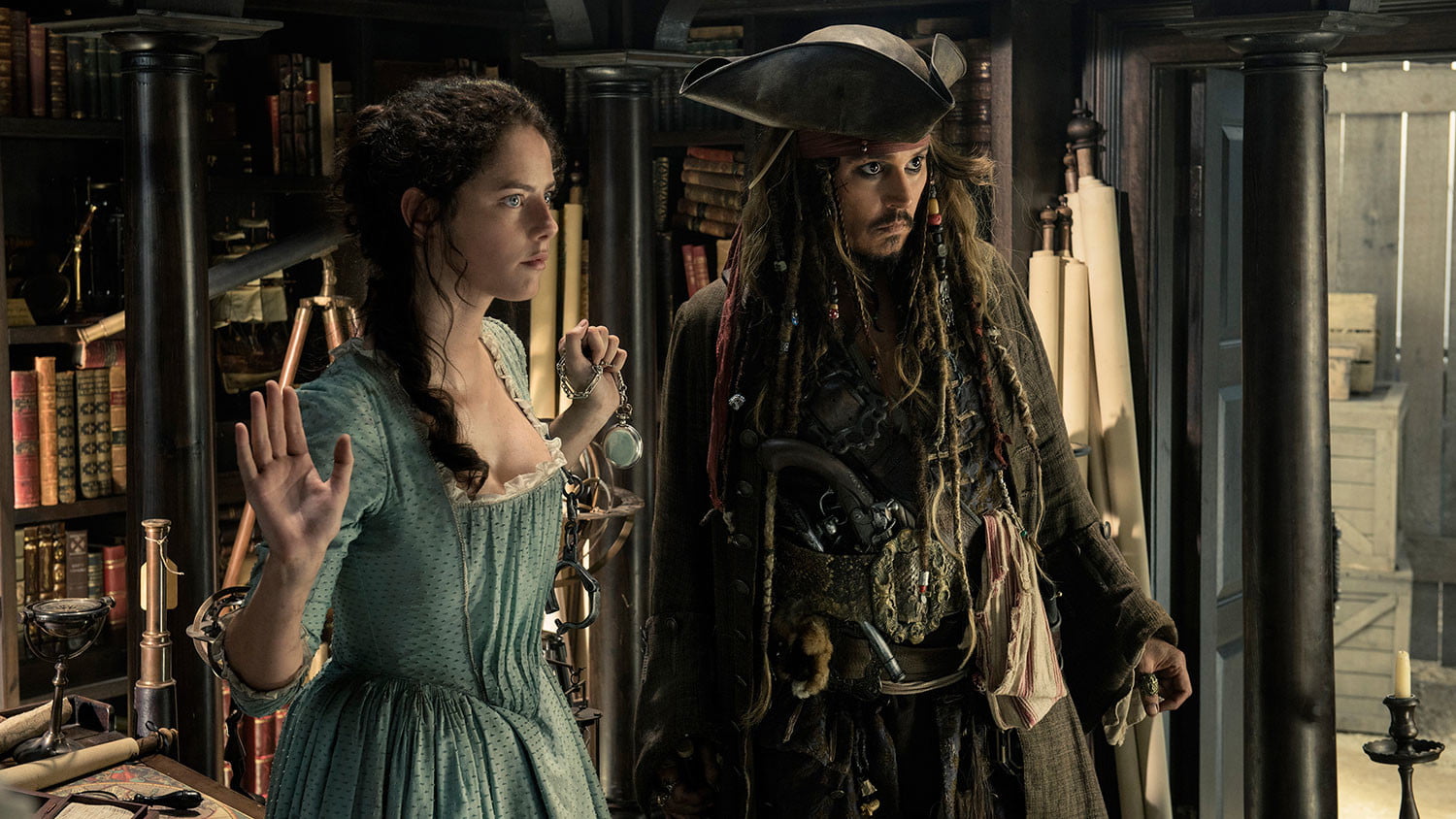
The Pirates of the Caribbean franchise reached four billion dollars across the globe thanks to a $285 million weekend. The second and fourth films made a cool billion each and the expectations that number five should be in store for at least $750 million worldwide are well founded. Once again, though, that total will be with little thanks to the overall ticket sales in North America. Charting the path of the sequels after the breakout success of The Curse of the Black Pearl, we saw Dead Man’s Chest jump to a $135.6 million opening weekend; the highest July opening at the time (and still fourth all-time.) At World’s End dropped to a $114.7 million opening (and was also nearly three hours long.) When Jerry Bruckheimer and Disney decided to expand the trilogy into further adventures for Jack Sparrow, Rob Marshall’s On Stranger Tides still managed a $90.1 million start. Those were all over three-day weekends.

Dead Men Tell No Tales only managed a $77 million start. Still, that just misses the top ten all-time Memorial Day weekend openings. (At World’s End is still #1 with $139.8 million.) What should give Disney a bit of pause over that start is that last year’s X-Men: Apocalypse rests in the ten slot (after a $79.8 million holiday) and only managed to come away with $155 million domestically. What should give them hope is that even that best-forgotten entry managed to break into the black thanks to its international earnings.

The budget on Pirates 5 is a bit higher ($230 million vs. $178 million) which means it is going to need close to the vicinity of $700 million just to break even. As mentioned earlier this does not appear to be an issue. On Stranger Tides grossed over $800 million internationally alone. The multiples for the last two Pirates films are a respectable 2.69 and 2.67 (for huge openers like those) and if that’s the case it is headed for about $180 million domestic. Seeing as how the international numbers have jumped up with every film, it seems unlikely it will fall below the $642 million earned overseas by Dead Man’s Chest. So far it has grossed an additional $208 million and should ease Disney’s holiday headache.

Paramount Afraid To Step Into the Light

[embedded content]

Wouldn’t you if you had an 18-month stretch like Paramount has had? Oscar nominations for Arrival and Fences aside, this is a box office column and nobody has been having as tough a go of it as the Mountain has. Focusing just on 2017 at the moment, they should at least be saved the embarrassment of xXx: The Return of Xander Cage being included amongst their flops. Sure the $44.8 million domestic doesn’t look good, but add $301 million overseas and you have a hit. In fact, it is their biggest estimated success since 2015’s Mission: Impossible – Rogue Nation; bigger than Daddy’s Home, 10 Cloverfield Lane and Arrival. The success of those last three combined, though, couldn’t cover the losses of either Star Trek Beyond or Ben-Hur and not even close to the disasters of Monster Trucks and Ghost in the Shell.

That is where Baywatch was supposed to come in.

With a minimalist $69 million budget and the growing star power of Dwayne Johnson, this is a film that should have come close to doubling that budget at home and then get the remainder of its costs covered overseas. If it was any good. Don’t take my word for it though. 19% at Rotten Tomatoes makes it one of the worst-reviewed films of the year and so far the worst of the summer season. This didn’t sit well with Mr. Johnson, who took to Twitter to denounce the “glaring disconnect” between fans and critics who “showed up with their knives ready.” Funny, but that didn’t seem to be the case with the Jump Street fims, which got scores of 85% & 84%. Critics don’t mind television adaptations when they are good and funny. They do when they are not (see: CHiPs – 16%.) Johnson even touted the “B+” Cinemascore the film received, so let’s test the significance of that.

Taking out films such as The Other Guys and Be Cool, how has the Dwayne Johnson resume fared with audiences given the Cinemascore survey.

“A” (The Fate of the Furious, Moana, Furious 7, Fast & Furious 6, G.I. Joe: Retaliation, Fast Five, The Game Plan, Gridiron Gang)

“A-“ (Central Intelligence, San Andreas, Journey 2: The Mysterious Island, Tooth Fairy, The Rundown)

“B+” (Hercules, Race to Witch Mountain, Get Smart, Walking Tall)

“B” (Snitch, The Scorpion King)

“B-“ (Doom)

“C+” (Pain & Gain, Faster)

That is 13 films with an “A-“ or higher and 9 films with a “B+” or below. So Rock, can we at least agree that even “fans” with a small inkling of critical opinion have placed Baywatch in the bottom 41% of your resume? If you want a little more of that “glaring disconnect” between critics and fans, here is a sample of some of the films getting a “B+” combined with a Rotten Tomatoes score between 15-19%:

Transformers: Revenge of the Fallen, Obsessed, Underworld: Blood Wars, Thunderbirds, Firewall, The Huntsman: Winter’s War, Monster-in-Law, The Wedding Planner, XXX: State of the Union, Underworld: Evolution, The Santa Clause 3: The Escape Clause, Garfield: The Movie, A Good Day to Die Hard, White Chicks

Welcome to the club, Baywatch. But I did mention this was a box office column, right? Plus how long can we really stay mad at Mr. Johnson? He’s in a terrible movie. We move on to his Presidential bid with Tom Hanks in 2020. Paramount, on the other hand, only have one other film this summer and that is Transformers: The Last Knight. That is likely to follow a similar path wih Pirates 5, so a little money will be coming back to the studio, but likely not with Baywatch. Films with a “B+” since 2001 to open between $18-19 million (based on the 3-day numbers) have an average multiple of 3.59. Take out highest and lowest scores and it’s still 3.09. That can still put Baywatch between $66-70 million; more Hercules than Central Intelligence. Can it find roughly another $135 million overseas? (It’s up to just $873,000 so far.) Gonna depend heavily on those fans listening to other fans who may just not be fans of this one.

Tales of the Top Ten

Guardians of the Galaxy Vol. 2 shows no signs of letting that top summer slot go. As I said weeks ago, no film is going to top it this summer. Not only has it surpassed the original’s gross and jumped over last week’s winner, Alien: Covenant, as expected, but in its fourth weekend also bested Baywatch. Admittedly with a little help from the Monday holiday. Last week I said it needed over a $23 million four-day weekend to maintain it’s $400+ million pace and it made $25 million. Whether it can make $34 million over the next two weekends will further determine its pace, but with it approaching $800 million worldwide, a billion dollars is going to come sooner than later. In related Disney news, Beauty and the Beast crossed the $500 million mark at the domestic box office this weekend

Last week’s marginal victor, Alien: Covenant, showed just how marginal it was in weekend two. Dropping nearly 71% over the weekend – even boosted by a holiday – means it is falling faster than even Prometheus (which dropped 59.4%.) $100 million in the U.S. is already off the table and now one has to wonder if it can even pass the 1979 & 1986 grosses of, arguably, the only good films in this franchise with $80 & $85 million. Covenant still has roughly $130 million to go before breaking even. Between that, Snatched and Diary of a Wimpy Kid: The Long Haul, this is not how Fox wanted to begin its summer after the dual successes of Logan and The Boss Baby; the latter of which just had a sequel greenlit. It will be up to Captain Underpants next week and the warring Apes in July to help even out the season for the studio.

The good news for Warner Bros. is that Everything, Everything is looking like a winner for them. A nice hold gives the film over $25 million and on just a $10 million budget it looks headed for a minor victory. The bad news is that they are still reminded at just what a failure King Arthur: Legend of the Sword is. If you add up the profits this year for The Lego Batman Movie, Kong: Skull Island and, yes, even Zach Braff’s Going in Style that only covers roughly 21% of the losses on King Arthur. Add in the profits from last year’s Fantastic Beasts and Where to Find Them and there is still roughly 11% of the loss unaccounted for. And that doesn’t even include losses on Fist Fight, CHiPs, and Unforgettable. If ever they needed some good press and even better word-of-mouth for Wonder Woman next week, it’s now. No wonder they moved up the embargo.


– Erik Childress can be heard each week evaluating box office on WGN Radio with Nick Digilio as well as on Business First AM with Angela Miles and his Movie Madness Podcast.

[box office figures via Box Office Mojo]

Let’s block ads! (Why?)


No Image

Top-Seeded Woman Defeated In First Round Of French Open

The French Open just started and already the women’s No. 1 seed is out. NPR’s Robert Siegel talks with Jon Wertheim of Sports Illustrated.

ROBERT SIEGEL, HOST:

The French Open tennis championship began yesterday in Paris. And this year, the most celebrated clay court tournament is missing some big names. Here to tell us more is Jon Wertheim, executive editor with Sports Illustrated. He joins us on the line from Paris. Hi, John.

JON WERTHEIM: Hi, Robert.

SIEGEL: There’s been some exciting play in the first round for the women. The number one seed, Angelique Kerber, is out. And there was a heartwarming victory for the Czech Republic’s Petra Kvitova. Tell us about those two matches.

WETHEIM: Angelique Kerber was the top seed and shown the egress by about lunchtime on the first day. This is in keeping with women’s tennis these days which is wide open. That’s accelerated by some of the absences here, but the women’s field really wide open. But you’re right, the big heartwarming story, Patra Kvitova, who has won Wimbledon twice, a very accomplished player.

And she was stabbed in a home invasion in the Czech Republic in December, which was horrific. And she decided to try and come back here. She said she still can’t quite make a clenched fist, but she decided at the last minute to enter. And she played very well in her first round match and seems emotionally to sort of have made a nice comeback as well, so that’s been a heartwarming story here.

SIEGEL: On to one of the big absences – Serena Williams, winner of the Australian Open, is out due to pregnancy. How did her big sister Venus play?

WETHEIM: Venus, who was a few weeks away from turning 37 years old, is the 10th seed and really has to be considered a contender. Venus played quite well. And the fact that Serena is not here emotionally might be different, but I think that opens up the draw for Venus among so many other players.

SIEGEL: These are the headliners. Who are some lesser known women players who may have a shot this year?

WETHEIM: I liken the women’s draw to the, you know, the 2016 GOP slate of candidates. I mean, there are any of 15 names that you could choose from. And who knows how it will go? Simona Halep is a Romanian player who has never won a major, but people suspect it is her time.

American Madison Keys is a big heavy hitter. Clay is not her best surface, but she might be the most powerful ball striker this side of Serena. I’ve never seen an event like this where it’s just – you literally could pick 25 names and you might not get the winner. I mean, it is wide, wide open.

SIEGEL: Let’s turn to the men’s side now. Roger Federer won the first big tournament of the year, the Australian Open, but he’s skipping the French Open, saying scheduling will be the key to my longevity going forward. What is that supposed to mean?

WETHEIM: The clay is always going to be the toughest surface for him, especially as he gets on in years. And Wimbledon really represents his best chance to win another major. He won the Australian Open in January and has had this terrific year so far, but I think he really wants to peak in time for Wimbledon and the U.S. Open then later in the summer.

And I think the thinking was that clay is so demanding, and his body can be so temperamental at this age that sort of the risk-reward didn’t make sense. And so he is skipping this major entirely.

SIEGEL: Rafael Nadal, the so-called king of clay, advanced easily today, as did Novak Djokovic who’s the reigning French Open champion. Are they still the favorites this year?

WETHEIM: They are absolutely the favorites. Nadal is far and away the favorite to win here for the 10th time. Djokovic is the defending champion. He’s probably the second favorite, then a long, long staircase down to other contenders. As wide open as the women’s draw is, the men’s draw looks really to be a two-man race.

SIEGEL: Djokovic made news by hiring tennis legend Andre Agassi to be his coach for this year’s tournament. Any sense of Agassi’s impact or what he’ll offer as a coach?

WETHEIM: I think that’s a really an inspired move by Djokovic. Djokovic has been slumping lately. And Agassi, of course, is known for this career resuscitation right around the same age. He’s a smart guy. He’s a measured guy. He’s a very good communicator. I think it’s really an inspired move by Djokovic. I’m impressed that he was able to talk Agassi into it.

SIEGEL: Jon Wertheim, executive editor of Sports Illustrated at the French Open. Thanks so much.

WETHEIM: Anytime. Thanks, Robert.

(SOUNDBITE OF KHRUANGBIN’S “MASTER OF LIFE”)

Copyright © 2017 NPR. All rights reserved. Visit our website terms of use and permissions pages at www.npr.org for further information.

NPR transcripts are created on a rush deadline by Verb8tm, Inc., an NPR contractor, and produced using a proprietary transcription process developed with NPR. This text may not be in its final form and may be updated or revised in the future. Accuracy and availability may vary. The authoritative record of NPR’s programming is the audio record.

Let’s block ads! (Why?)


No Image

Cash-Strapped Seniors Turn To Assisted Living Centers In Mexico

Some seniors are moving to Mexico for assisted living care. Costs at these facilities are much cheaper, but family members worry about the distance and their loved one’s access to medical care.

ROBERT SIEGEL, HOST:

People are living longer, which means they need their retirement savings to stretch further than before. Some retirees are choosing an unusual option to make their money last longer. They are moving to assisted living centers in Mexico. From member station KPBS in San Diego, reporter Claire Trageser here has the story.

CLAIRE TRAGESER, BYLINE: A visit to Serena Senior Care isn’t your typical over the river and through the woods.

(SOUNDBITE OF TRAIN HORN)

TRAGESER: To get there, you have to cross the U.S.-Mexico border and wind your way through Tijuana traffic. Eventually, you’ll find a long dirt road in the small beach town of Rosarito. When you arrive, you’ll find a typical senior assisted living residence – private rooms, a small gym and a garden.

PETER FOWLER: That’s sugarcane or pineapple.

TRAGESER: Peter Fowler, a 93-year-old World War II veteran is strolling among the plants.

FOWLER: I’m very lucky ’cause they – not only in one piece, but I think my marbles are all OK.

TRAGESER: He’s from the U.S. but has been at Serena since it opened 10 years ago. He says the decision came down to lower costs.

FOWLER: I was running out of money before I ran out of month.

TRAGESER: That was before Fowler moved to Mexico.

FOWLER: Here, the cost of living is so good, I now run out of month before I run out of money.

TRAGESER: This retirement center caters to Americans looking for cheaper options. About half of its residents are from the U.S. It costs about $1,500 a month for full-time care. In California, the average cost is $5,000 a month.

SUSAN CUZIC: I started looking around, and the price was undoable.

TRAGESER: Susan Cuzic decided to move her mother, who has Alzheimer’s, here two years ago. It was a difficult decision because visiting from San Diego now takes more effort.

CUZIC: It is a bit, you know, more to drive. And this isn’t going to be an option for people living in like the New York or Wisconsin or something like that.

TRAGESER: But Cuzic says the care her mother receives south of the border is excellent.

CUZIC: The Mexican culture really reveres older people. They are treated with a lot of respect.

BRENDA SHORKEND: I’ve heard of people who’ve been very, very satisfied with the care there, and they think it’s possibly better than in some places in the States. And I’ve heard of people where it’s been a disaster.

TRAGESER: Brenda Shorkend is an elder care consultant outside Los Angeles. She cautions assisted living centers are regulated differently in Mexico, and the transition to another country can be a huge challenge.

SHORKEND: The language is different. The food is different. It’s hard enough moving from home to an assisted living. So to do that to another country, it can be very, very confusing for people.

TRAGESER: Shorkend says the biggest hurdle is that most U.S. seniors have Medicare and that doesn’t pay healthcare providers in Mexico. That turned out to be a problem for Peter Fowler, the World War II veteran.

FOWLER: Because I had a burst appendix.

TRAGESER: When that happened, he had to cross the border in a special lane for medical emergencies. He also travels an hour each way every month to pick up his prescriptions, but Fowler says he enjoys those outings.

FOWLER: And on the way, I stop off at a place called El Yogurt Place in Tijuana. Beautiful eggs benedict, oh, my goodness. I look forward to that every month.

TRAGESER: For Fowler, a longer life doesn’t mean an independent life, but living in Mexico means he can afford to spend the rest of his days in comfort and dignity. For NPR News, I’m Claire Trageser in Rosarito, Mexico.

(SOUNDBITE OF ELLIOTT BROOD’S “VALLEY TOWN”)

Copyright © 2017 NPR. All rights reserved. Visit our website terms of use and permissions pages at www.npr.org for further information.

NPR transcripts are created on a rush deadline by Verb8tm, Inc., an NPR contractor, and produced using a proprietary transcription process developed with NPR. This text may not be in its final form and may be updated or revised in the future. Accuracy and availability may vary. The authoritative record of NPR’s programming is the audio record.

Let’s block ads! (Why?)


No Image

Trump Hopes To Lure Companies Back To The U.S.With Lower Tax Rates

A key part of President Trump’s tax plan is to repatriate corporate profits held overseas back to the U.S. With the lure of lower corporate rates, the idea is that companies will free up overseas earnings and instead invest in jobs and equipment in the U.S. A similar scheme was tried during the administration of George W. Bush, but companies used most of the money on stock buybacks or to pay dividends to shareholders.

ROBERT SIEGEL, HOST:

American companies have stashed an estimated $2.6 trillion in foreign profits overseas to avoid paying corporate taxes in the U.S. President Trump wants to cut the tax rate to encourage companies to bring that money here. He says it would boost investment and create jobs. As NPR’s John Ydstie reports, history suggests otherwise.

JOHN YDSTIE, BYLINE: It’s a pile of money worth more than the yearly economic output of countries like France and the United Kingdom. Under U.S. law, companies owe a 35 percent tax on those foreign profits, but they can defer the tax by holding the money overseas. President Trump’s tax overhaul proposal aims to get it back, as Treasury Secretary Mnuchin explained in late April.

(SOUNDBITE OF ARCHIVED RECORDING)

STEVEN MNUCHIN: We will have a one-time tax on overseas profits which will bring back trillions of dollars that are offshore to be invested here in the United States to purchase capital and to create jobs.

YDSTIE: During the campaign, President Trump said it would be a phenomenal thing.

(SOUNDBITE OF ARCHIVED RECORDING)

PRESIDENT DONALD TRUMP: By taxing it at 10 percent instead of 35 percent, all of this money will come roaring back into our country, and lots of good things will start to happen.

YDSTIE: But it turns out it’s not a new idea. Back in 2004, under President George W. Bush, Washington enacted a similar tax break that promised the same things.

C FRITZ FOLEY: It’s called the Homeland Investment Act. It was also referred to as the American Job Creation Act.

YDSTIE: Harvard Business School professor C. Fritz Foley says that law temporarily reduced the tax on foreign profits to just 5.25 percent. And it’s specified that the repatriated money be used only for investments in the United States. Five years later, Foley co-authored a report that found the so-called tax holiday did not result in new investments and new jobs.

FRITZ FOLEY: We found that the money that was repatriated was not associated with increased capital expenditures, increased employment or increased research and development.

YDSTIE: Instead, Foley says, the money was used to pay dividends to shareholders or buy back shares in companies. Foley says there was probably some economic benefit in that as shareholders reinvested their payouts or increased their consumption. So the tax holiday did not live up to its billing, Foley says, but it did provide one more sign that the U.S. corporate tax system needs to be fixed.

FRITZ FOLEY: We badly need tax reform, international tax reform here in the United States. Our system puts our companies at a disadvantage. And this holiday was a temporary relief from some of the distortions that our tax system imposes.

YDSTIE: Joseph Rosenberg of the Tax Policy Center says there is broad agreement that corporate tax policy needs an overhaul.

JOSEPH ROSENBERG: Unfortunately, that’s about where the agreement ends.

YDSTIE: In fact, Republicans and business groups are fighting among themselves right now over how to proceed. Foley and Rosenberg agree that a lower tax on profits currently stashed overseas would make sense as part of broader tax reform, but Rosenberg is concerned that broad reform might fail, and the temporary tax holiday might survive.

ROSENBERG: That would be unfortunate because it really does not address the fundamental problems of the corporate tax system and in some ways makes it much worse.

YDSTIE: Because if it did unfold that way, it would reinforce the notion among companies that it’s a good idea to build another hoard of cash overseas and just wait for the next tax holiday. John Ydstie, NPR News, Washington.

Copyright © 2017 NPR. All rights reserved. Visit our website terms of use and permissions pages at www.npr.org for further information.

NPR transcripts are created on a rush deadline by Verb8tm, Inc., an NPR contractor, and produced using a proprietary transcription process developed with NPR. This text may not be in its final form and may be updated or revised in the future. Accuracy and availability may vary. The authoritative record of NPR’s programming is the audio record.

Let’s block ads! (Why?)


No Image

From NFL Player To Neurosurgeon: 'Why Can't I Do Both?'

Myron Rolle talks about his long journey from playing football at Florida State University and joining the NFL to going to Harvard medical school to start his residency in neurosurgery.

MICHEL MARTIN, HOST:

We will soon crown the latest NBA champion and in honor of that, we’ll continue our series of conversations Across the Generations with father and son ballers Rick and Canyon Barry. They’ll tell you why they tune out the haters and remain true to the underhand free throw. That’s coming up.

But first football and the brain. And when I said that I bet your mind went to all the recent stories about brain trauma and America’s most watched sport. But I’m actually talking about a former NFL player who is now training to become a neurosurgeon. Myron Rolle played at Florida State then after taking a brief detour to enjoy his Rhodes scholarship, he played for the Tennessee Titans and Pittsburgh Steelers.

Last week, though, he graduated from Florida State University’s College of Medicine. And next month, he will head to Harvard Medical School to start his residency in neurosurgery. And Dr. Myron Rolle is with us now from Orlando, Fla. Dr. Rolle, welcome. Congratulations to you.

MYRON ROLLE: Thank you very much for having me.

MARTIN: Now, you know I have to ask you when you were growing up when you were a little boy what did you want to be?

ROLLE: I actually wanted to be a neurosurgeon, believe it or not. I – also a football player, but my brother Marchant gave me this book, “Gifted Hands” by Ben Carson and put him in front of my face as somebody who looked like me, came from a similar background as me.

And as I got older, I started to learn more about neurosurgery, the brain and how it functions. And it just piqued my interest even more. And I’m glad that I am starting this journey soon and going to join the likes of someone like Dr. Carson.

MARTIN: You know, it’s funny because a lot of kids if you ask them they say – well, what do you want to be when they grow up? They’ll say I want to be a baseball player and a veterinarian. You know? When people say that people, you know, generally laugh and pat them on the head and go, yeah, that’s cute. But did people do that to you? I mean, did you ever doubt that you could actually do both?

ROLLE: No. I honestly – I never had a doubt. And I cannot take the credit. I give that to my parents. You know, we came from the islands of the Bahamas, and I left there when I was very young, ended up moving to New Jersey. And in New Jersey, my parents were prophesied to my brothers and I and speak and hardwire into our minds that just because we come from a small country, just because we have dark skin, just because we don’t have a lot of money does not mean that we cannot accomplish our goals in this country that has an abundancy (ph) of resources.

We have to develop our firm foundation of education. We have to believe in ourselves. We have to be good citizens, good leaders, stay true to our Christian principles, and these things could happen for us. So they poured the confidence in me, and I walked out of my house in New Jersey every morning thinking, yeah, why not? Why can’t I do both? Why can’t I do all things? Once I had that firm belief, it gave me, you know, the initiative to kind of go and pursue those things with all veracity.

MARTIN: I want to go back to your days as an undergrad at Florida State where you faced a difficult decision. You know, first there was your interview for the Rhodes scholarship and that – for people who, you know, this is a highly competitive award. It’s very prestigious.

People may know that, you know, Bill Clinton was a Rhodes Scholar, Cory Booker was a Rhodes, Susan Rice. So first, the interview conflicted with a game that you were scheduled to play in, and then you knew that if you did win the award that it could interfere with your chance of being a first-round draft pick in the NFL. There had to have been people talking in your ear saying you’re crazy, you know.

ROLLE: Oh, yes.

MARTIN: You get your money, and I just wondered how did you decide what to do?

ROLLE: You’re right. It was an absolutely hard decision, very, very difficult. I had been playing football since I was 6. And I chose Florida State University because I wanted to get to the NFL. That school had a pedigree of putting players into the National Football League, and I had two cousins who played in the NFL. And my daddy started the Commonwealth American Football League back home in the Bahamas, so, you know, it was – all roads were leading towards playing professional football.

And then, as you said, I was projected as a first-round draft pick. But the Rhodes committee – I – I’ll be completely frank with you. I asked them if I could postpone my Oxford experience for a little bit and go to the NFL first, and then go back to Oxford. They said no. So that made it – OK, you either take the Rhodes scholarship now or you lose it forever. I prayed about the decision. I talked to my family, but I think what really helped me make that decision was talking to young people actually, young people who looked at my story and said that they drew inspiration from it.

And the fact that I was up for something so prestigious that was academic based, it kind of gave them, you know, the motivation to pursue knowledge and to, you know, try to go for their degrees and things like that. So the fact that I was placed in this position of being a role model for young people by choosing academics and that Oxford experience over the fast money and the early draft pick in the NFL, that was big for me. So I did it. I made the decision, and I don’t regret it today.

MARTIN: Do you see yourself as having some opportunity to be influential in the issues that are so present in the NFL right now and, frankly, in the minds of the public? Frankly, some people are wondering whether it’s still ethical to be a football fan, knowing what we know about the impact of the sport on players, particularly something as consequential as brain trauma. Do you see yourself having a role in this discussion?

ROLLE: Yes, I do actually. You know, I think that I can potentially have a very strong voice in this coming from the athletic side and now from the scientific side. But neurosurgeons are doing a lot of work in it already. There are some neurosurgeons out of Stanford that are looking at some type of concussions based on the predominant symptoms – is a cognitive decline? Is at equilibrium problems? Is it ocular motor issues? Is it anxiety or depression?

And once you can kind of categorize concussions based on those symptoms, then you could have a more targeted therapy, and then there’s neuroscientists, neurologists looking at the pathophysiology of concussions and then social psychologists looking at the failure to report and physicists looking at the circular or linear rotations. So there are a lot of people taking a bite out of this issue and trying to preserve this game that I love and that we all love.

I want the game to stay, and I want it to be safe. I want it to still exist because it’s done so much for me. It’s giving me tools that I’m using now in the operating room learning how to mitigate pressure, communicating, strategizing – all these things that I did every day on the field in the weight room, I do now as a physician. So it’s a powerful sport. And, like you said, I just definitely hope to have a voice in it and keep it around.

MARTIN: That’s Dr. Myron Rolle, former NFL player. He’s about to start his residency in neurosurgery at Harvard Medical School, and he was kind enough to join us from Orlando. Dr. Rolle, thank you so much for speaking with us.

ROLLE: Thank you very much for having me. I really do appreciate this.

Copyright © 2017 NPR. All rights reserved. Visit our website terms of use and permissions pages at www.npr.org for further information.

NPR transcripts are created on a rush deadline by Verb8tm, Inc., an NPR contractor, and produced using a proprietary transcription process developed with NPR. This text may not be in its final form and may be updated or revised in the future. Accuracy and availability may vary. The authoritative record of NPR’s programming is the audio record.

Let’s block ads! (Why?)


No Image

South Korean Youth Struggle To Find Jobs After Years Of Studying For Tests

Students try out a Samsung Electronics Galaxy S8 Plus smartphone at a shop in Seoul, South Korea, on April 27. Many post-college grads in South Korea spend years studying for tests in the hopes of winning a job at a company like Samsung.

Ahn Young-joon/AP

hide caption

toggle caption

Ahn Young-joon/AP

Lim Hyuk-ju lives in a tiny apartment in a bustling student neighborhood of South Korea’s capital, Seoul.

The apartment is just 30 sq. ft. — basically a walk-in closet with a toilet, shower and shared kitchen — for $400 a month.

“It’s uncomfortable, because when I lay down my legs hit the back wall,” explains Lim, 25.

She has to be quiet because the walls are thin. Lim’s neighbors are all young people like her, studying 15 hours a day for job entrance exams.

Lim graduated at the top of her high school class. She wants to be an accountant. So for now, her parents support her on a path that’s typical for young South Koreans: Study for months or years to pass exams for jobs in government, or in big family-run Korean conglomerates like Samsung, LG and Hyundai.

“All these tests, and memorizing the right answers,” says Lim, “I sometimes wonder if this is really the only way to succeed.”

Lim Hyuk-ju, 25, in her 30 sq. ft. apartment in Seoul. Lim pays $400 a month for this tiny space, where she studies 15 hours a day for job entry exams. Her path is similar to many youth in South Korea, where unemployment among 15- to 29-year-olds is nearly three times the overall rate.

Lauren Frayer/NPR

hide caption

toggle caption

Lauren Frayer/NPR

South Korea’s economy has slowed, and it appears to have hurt young people the most. Some 11.3 percent of youth aged 15 to 29 are out of work. That’s nearly three times the overall jobless rate.

A new liberal president, Moon Jae-in, won office earlier this month, with huge support from young voters. Now one of his first tasks — on top of dealing with nuclear-armed North Korea — is to improve the economic prospects for young South Koreans.

Big conglomerates, or chaebols, run South Korea’s economy. Sales revenue from the top five chaebols amounted to 58 percent of South Korea’s GDP in 2015. And it’s not only cellphones and cars. In Korea, there’s a Samsung art gallery and a Samsung amusement park. You can buy life insurance from Samsung. In the case of Hyundai, the big Korean carmaker, the company also runs a hospital in Seoul. LG, another electronics giant, also has a Korean cosmetics line — and dozens of other businesses and subsidiaries.

“They’re just giant conglomerates that control so much of the economy on a scale just not seen in a lot of the world,” says Geoffrey Cain, who trained as an anthropologist and is writing a book about Samsung.

Cain says South Korea’s conglomerates are so pervasive, they squeeze out smaller businesses.

“They can basically tell a small business to supply them a part and just pay them whatever they want, and then pay them whenever they want, and give them a terrible contract,” he says.

Small businesses struggle to grow.

“So that’s what creates so few job opportunities,” Cain says.

For many Korean youth, it’s the dream of a job-for-life with a big conglomerate — or nothing at all. As the economy slows, there aren’t enough jobs for all the college graduates here. So many turn to test-taking, as competition rises.

Like Lim in her tiny apartment, many Koreans study for years. Hyundai requires a six-hour exam, just to get your foot in the door. Samsung has its own version of the SAT.

President Moon won office May 9 in part on a promise to ease youth unemployment by creating more public sector jobs. But some economists say that’s only a short-term fix.

“Job creation should be [by] business, not the government,” says Kim Gwang-Suk, an economist and professor at Seoul’s Hanyang University. “In the long term, all the government should do is make an environment in which companies can invest more.”

Kim says the new president should help small businesses, boost entrepreneurship, and reform the conglomerates. On the campaign trail, Moon promised to do just that. But the conglomerates remain the backbone of the Korean economy. It’s unclear whether he really has the will or ability to change them.

In the test prep section of a big Seoul bookstore, young people sit on the floor, pouring over test materials on a Saturday morning.

“As the economy goes bad, there aren’t many good jobs, and the competition is fierce,” says Baek Eui-hyun.

He’s 28 and still unemployed, after studying for two years for a public administration exam. He failed twice, and is browsing for other tests he might take. He says young Koreans are frustrated.

“Of course they don’t want to spend their time being stuck in a tiny room studying books for exams,” he says. “But there aren’t any alternatives.”

The President Moon’s success may be measured not only in how he deals with North Korea, but in the alternatives he offers some of his youngest voters.

Let’s block ads! (Why?)


No Image

In The Age Of Digital Medicine, The Humble Reflex Hammer Hangs On

The good old reflex hammer (like this Taylor model) might seem like an outdated medical device, but its role in diagnosing disease is still as important as ever.

Meredith Rizzo/NPR

hide caption

toggle caption

Meredith Rizzo/NPR

Receiving a diagnosis in 2017 — at least one made at a medical center outfitted with the latest clinical gadgetry — might include a scan that divides your body into a bread loaf of high-resolution digital slices. Your DNA might be fed through a gene sequencer that spits out your mortal code in a matter of hours. Even your smartphone might soon be used to uncover health problems.

Yet nearly 130 years since its inception — after decades of science has mapped out our neuronal pathways — a simple knob of rubber with a metal handle remains one of medicine’s most essential tools. I’m referring to the cheap, portable, easy-to-use reflex hammer.

This unassuming device can be invaluable in diagnosing nervous and muscular disorders, and in determining whether a patient’s pathology lies in the brain or elsewhere in the body. It can also help curtail healthcare spending by preventing unnecessary, often expensive testing. Yet like so many major medical and scientific discoveries, the reflex hammer has humble origins, in this case: the basement of a Viennese hotel.

The inn was run by the father of Leopold Auenbrugger, an 18th century doctor who is considered to be among the founders of modern medicine. To gauge how much wine was left for customers, hotel employees would thump casks with their hands and listen for a dull thud or hollow tympany. Auenbrugger realized that the same technique — now called “percussing” — could be applied to the human torso to, say, determine how much fluid had built up around a diseased heart. He wrote as much in his 1761 paper New invention to detect diseases hidden deep within the chest.

Leopold Auenbrugger (here with his wife, Marianne) is regarded as one of the founders of modern medicine, having applied the idea of detecting disease by sound.

Wellcome Library, London

hide caption

toggle caption

Wellcome Library, London

Relflex hammer warfare

Thought to be more accurate than the human hand, it wasn’t long before percussion hammers were being designed to more precisely diagnose disease. Competition ensued.

Scottish physician Sir David Barry’s model, released in the 1820s, was the first. German doctor Max A. Wintrich’s came shortly after and was more popular, but was not without its critics: “[Wintrich’s hammer] is inconvenient to hold, it is rigid … it required education to use it, and even then it does not fulfill its purposes,” a rival inventor commented.

As neurologist Dr. Douglas J. Lanksa wrote in a 1989 paper on the many types of reflex hammers, “Some were T-shaped or L-shaped, others resembled battle axes, tomahawks, or even magic wands.” He adds that no material was off limits: wood, ebony, whale bone, brass, lead, even “velvet-covered worsted” (a type of yarn).

As percussion hammer warfare waged on, doctors and scientists were also beginning to understand the concept of reflexes, or involuntary, near-immediate responses to stimuli that occur before any sensory information reaches the brain. Muscular jerks. Blinking. Sneezing. Gagging. All of these are automatic feedback loops between sensory and motor neurons that help us navigate our environment and protect us from danger.

In 1875, German neurologists Drs. Heinrich Erb and Carl Friedrich Otto Westphal were among the first to realize that eliciting a reflex by briskly tapping the tendons of major muscles might be useful. They felt the knee jerk — or “patellar-tendon” reflex — in particular could help assess nerve function.

Anton Wintrich introduced this percussion hammer model in 1841.

Wellcome Library, London

hide caption

toggle caption

Wellcome Library, London

Hammers specifically suited to test reflexes were soon developed, the first of which had the now classic shape we’re accustomed to — a thin metal handle with a triangular rubber head. Designed by American physician John Madison Taylor in Philadelphia in 1888 — and modified ever since by many — the simple device was heavy enough to elicit reflexes, and had round edges to ease impact. An entry level model runs just $2.25 on Amazon.

The Krauss hammer, developed by German-American physician William Christopher Krauss, was designed around the same time. It had two rounded heads: a large one for knees and a smaller one for biceps. Dr. Ernst L.O. Trömner’s did too, but it also tapered to a thin end to assess skin reflexes. There were also the Queen Square hammer, the Babinski hammer, the Buck hammer and the Berliner hammer. The Stookey hammer flaunted a camel hair brush to get a better sense of touch sensation. The list goes on.

Past to present

Daniella C. Sisniega is a third year medical student at the Boston University School of Medicine. Last month at the American Academy of Neurology’s annual meeting, she presented a poster explicating the reflex hammer’s past.

“I’m fascinated by how the reflex hammer started out as a percussion hammer, but was [then] adapted to elicit reflexes and has been in every neurologist’s tool box ever since,” she told NPR. “I also did not know that the little rubber triangle was the first reflex hammer. I feel like I owe it an apology!”

Sisniega jokes about the lackluster quality of the inexpensive Taylors.

“The little tomahawk is included in the kit everyone receives when they enter medical school,” she recalls. “The rubber is cheap and very light, while the other hammers are heavier on the head so that you can use the ‘swing’ of the hammer as opposed to the strength of the strike to test the reflex.”

While attending the AAN conference myself, I asked multiple sclerosis expert Dr. Stephen Krieger about the role of the reflex hammer in modern medical diagnosis.

“We could argue about the nuances of the hammer — the Queens Square, the Tomahawk, plastic handle, metal handle, weighted, flexible or rigid — but the hammer itself is always in the hand. Reflexes tell the story of neurologic diseases of all sorts,” he says.

Krieger explains how disorders of the brain, like a stroke or brain tumor, result in hyperactive reflexes, while conditions affecting muscles and peripheral nerves usually result in reduced or non-existent reflexes. Reduced reflexes are, for example, a common symptom of back pain due to degenerative disk disease.

Dr. Andrew Wilner, an assistant professor of neurology at the Mayo Clinic, recounted the story of one of his patients, who had back pain, weakness and numbness of the legs. Wilner was leaning toward a diagnosis of either Guillain-Barre Syndrome (GBS) — an autoimmune disorder of peripheral nerves — or a myelopathy, an injury of some kind to the spinal cord. Both conditions can lead to medical emergencies, but each requires drastically different treatment.

“The reflex hammer was arguably our most important tool in narrowing down the differential diagnosis,” he says. “Had we found diminished or absent deep tendon reflexes, GBS would have been more likely. As it turned out, the patient had brisk pathological knee jerks, pointing to a lesion in the brain or spinal cord.”

Based on these findings, Wilner ordered an imaging study of the patient’s spinal cord, where a lesion was found — as opposed to pursuing the costly tests involved in a GBS diagnosis.

Wilner feels that the simple art of interviewing and examining a patient can get overshadowed by the myriad new diagnostic technologies. When it comes to clinical tools, he feels, sometimes basic is better.

“Technology is glorious,” admits Krieger, “and [it] will teach us things about patients that we could never have known or imagined. But the simple, elegant, inexpensive almost plebeian swing of the reflex hammer has a cost/benefit ratio that I think no advanced technology will likely ever match.”

Bret Stetka is a writer based in New York and an editorial director at Medscape. His work has appeared in Wired and Scientific American, and on The Atlantic.com. He graduated from the University of Virginia School of Medicine in 2005. He’s also on Twitter: @BretStetka

Let’s block ads! (Why?)


No Image

Latest College Graduates Enter A More Optimistic Economy

Harvard Business School professor Mihir Desai says the unemployment rate is the lowest its been in a decade. He speaks with NPR’s Michel Martin about the increasing options for recent graduates.

MICHEL MARTIN, HOST:

As the class of 2017 prepares to enter the job market, there is some good news waiting for them. The unemployment rate is the lowest it’s been since 2007, but these students have also come of age during a recession followed by a sluggish recovery. So we were wondering how all this could be affecting these freshly minted graduates and job seekers.

To talk about this, we called Mihir Desai. He’s a professor at the Harvard Business School. He has a new book out called “The Wisdom Of Finance.” But we called him because he published a piece this week in The Crimson, Harvard’s student newspaper. In the spirit of full disclosure, that was my first journalism gig. Professor Mihir Desai, thank you so much for joining us.

MIHIR DESAI: Thanks so much. It’s a pleasure.

MARTIN: So the last time the unemployment numbers were this low, these students were in third grade. Do you see an impact on this generation of having grown up in this timeframe?

DESAI: Yeah. I think part of what’s happened is they don’t allocate as much importance to economic outcomes that, perhaps, previous generations did. So they grew up in an era of reduced expectations in some ways. And as a consequence, they look for different ways to fill their life up which is not purely professional.

In some ways, that’s quite helpful. On the other hand, it is a time in their life when they really should be dedicating themselves to building the human capital that will last them through the rest of their lives.

MARTIN: And let me get to the piece that caught our eye which is the piece that you posted in The Crimson, “The Trouble With Optionality” which is a way of saying – can you break it down in layman’s terms for us – what? – hedging your bets?

DESAI: Yeah, exactly.

MARTIN: Keeping your options open?

DESAI: Yeah. So the number of young people I see who talk about maximizing optionality which is just a fancy way of saying I want to make sure and have as many options as possible, so I think that sounds like a great strategy. But what I’ve observed over the last several years is these people become obsessed with optionality, you know, with having options. And instead of doing what we think that we do, which is enable risk-taking, you know, which is what options are supposed to be able to do. Right? You don’t acquire options just for their own use. You do it, so you can actually take on big risks. What I observed these people doing is just habitually acquiring options. They just get so used to the process of acquiring options that they never really execute on this larger vision of what they want.

So part of what I wanted to do in the piece is say, look, that’s not the right way to think about this. In fact, when you do these things that acquire options, for example, working at prestigious firms – these are, again, for the elite graduates going to grad school – you know, your social network, yes that’s wonderful. It allows you to have a lot of optionality. But don’t forget that the really great things in life come from big, risky investments. And I think that’s a really important piece of what people are missing out on. And in particular, you can get stuck. You can get stuck in a place where you think you’re maximizing your options, and then you wake up. And you’re, you know – you’re still there 20 years later.

MARTIN: That was going to be my last question. It’s commencement season, and everybody from Hillary Clinton to Will Ferrell is – as we just heard – are offering advice to recent graduates. So any other advice that I didn’t have the wit to squeeze out of you to this point?

DESAI: Well, yeah. It is – it’s always remarkable how in some ways consistent graduation advices, and, in some ways, that makes it anodyne, but that doesn’t make it any less true, which is the pursuit of things that we truly love is the secret to professional happiness and blocking out the noise.

I guess that’s one thing I would add which is there is so much noise out there, noise about what, you know, the unemployment rate is or noise about what you should be doing with your life or noise about what your friends are doing or what your parents want you to do. Just block it all out. Look inside yourself. Find out who you are and pursue that. So block out all the noise I think is an important piece of it as well.

MARTIN: That was Mihir Desai, professor at the Harvard Business School. His latest book is “The Wisdom Of Finance: Discovering Humanity In The World Of Risk And Return.” And as we said that we also called him for his piece posted in The Crimson, “The Trouble With Optionality.” Professor Desai, thank you so much for speaking with us.

DESAI: Thanks so much Michel.

Copyright © 2017 NPR. All rights reserved. Visit our website terms of use and permissions pages at www.npr.org for further information.

NPR transcripts are created on a rush deadline by Verb8tm, Inc., an NPR contractor, and produced using a proprietary transcription process developed with NPR. This text may not be in its final form and may be updated or revised in the future. Accuracy and availability may vary. The authoritative record of NPR’s programming is the audio record.

Let’s block ads! (Why?)


No Image

Jim Bunning, Hall Of Fame Pitcher And Former U.S. Senator, Dies At 85

Then-Sen. Jim Bunning, a Hall of Fame pitcher, delivers a pitch prior to a game in Arlington, Tex., in 2003. Bunning died Friday at age 85.

Ronald Martinez/Getty Images

hide caption

toggle caption

Ronald Martinez/Getty Images

Jim Bunning, an imposing Hall of Fame pitcher and a cantankerous, resolutely conservative U.S. Senator from Kentucky, died Friday at age 85.

The New York Timesreports that he had a stroke last October. The AP confirmed the death with Bunning’s former chief of staff, Jon Deuser.

Bunning served six terms in the House and two in the Senate. As a major league pitcher from 1955 to 1971, he played for the Detroit Tigers, Philadelphia Phillies, Pittsburgh Pirates and Los Angeles Dodgers. He was the only Hall of Fame baseball player to have served in Congress, according to the AP.

The six-foot-three ballplayer had a reputation as intimidating. As the Louisville Courier-Journalwrites:

“In his 15-year career in the big leagues, Bunning developed a reputation for throwing the ball close to batters, trying to back them off the plate. ‘If he had to brush back his mother, I think he’d do it to win,’ former Detroit Tigers second baseman Frank Bolling said of his one-time teammate.

In his second career, instead of baseballs, Bunning went after opponents and issues with strong rhetoric and an intense certainty in the correctness of his own views.

That was especially true with abortion. A Roman Catholic with nine children, Bunning voted consistently to limit abortion as an option for women and had contempt for colleagues who softened their position on the highly emotional issue.”

In 1964, Bunning pitched a perfect game, one of just 23 in the modern era. It was the first perfect game pitched in the National League since 1880. In addition to throwing no-hitters in both the American and National Leagues, he was also the second pitcher after Cy Young to win 100 games and pitch 1,000 strikeouts in both leagues, according to the Hall of Fame. Bunning was inducted into the Hall in Cooperstown, NY., in 1996.

[embedded content]

On June 21, 1964, Bunning pitched a perfect game, the ninth in major league history.

MLBYouTube

In 1968 he led Athletes for Nixon, according to the Courier-Journal; Bunning first entered politics in 1977, winning a seat on Fort Thomas, Ky., city council. He was elected to the House of Representatives in 1986 and to the Senate in 1998.

The Courier-Journalreports that in his 1998 Senate race, Bunning tried to look more moderate, “talking about the need to clean up the environment and educate children, endeavors that he had not emphasized previously. In fact, in the House he voted to cut the Environmental Protection Agency budget and kill the U.S. Department of Education,” it says.

“Bunning was best known for his efforts to safeguard Social Security benefits, sponsoring, among other things, legislation that made the Social Security Administration a separate agency,” writes Politico. “He also supported legislation to aid adoptive parents and was known for actively working on local Kentucky issues and, whenever they came before Congress, baseball-related issues.”

As a politician, he was known as “blunt and abrasive,” according to the publication. “In 1993, for instance, he referred to President Bill Clinton as ‘the most corrupt, the most amoral, the most despicable person I’ve ever seen in the presidency.’ In 2009, he made headlines by predicting Supreme Court Justice Ruth Bader Ginsburg would be dead of cancer within nine months.”

In 2009, he said he would not seek another term in the Senate; his fellow Kentuckian, then-Senate Minority Leader Mitch McConnell, “all but pushed Bunning into retirement,” NPR’s David Welna reported at the time. McConnell’s hand-picked choice to succeed Bunning lost in the primary to Tea Party candidate Rand Paul, whom Bunning endorsed.

We mourn the passing of Jim Bunning, a Hall of Fame pitcher and former U.S. Senator. He was 85. pic.twitter.com/NVTdhQuYmr

— MLB (@MLB) May 27, 2017

At the end of his run as a senator, in what NPR’s Ron Elving called “a lonely crusade to become a fiscal hero,” Bunning single-handedly held up unemployment payments for millions of Americans during a two-day filibuster against $10 billion in stimulus spending.

His son David Bunning is a U.S. district judge in Kentucky, who made the headlines in 2015 for jailing Kim Davis, the county clerk who refused to issue same-sex marriage licenses. On Saturday morning, David tweeted “Heaven got its No 1 starter today. Our lives & the nation are better off because of your love & dedication to family.”

Let’s block ads! (Why?)


No Image

Two Sisters Try To Tackle Drug Use At A Montana Indian Reservation

Charmayne Healy (l) and Miranda Kirk (r), co-founders of the Aaniiih Nakoda Anti-Drug Movement, have helped Melinda Healy, center, with their peer-support programs.

Nora Saks/MTPR

hide caption

toggle caption

Nora Saks/MTPR

There’s a narrative about the methamphetamine epidemic in Montana that says the state tackled it in the 2000s, yet now it’s back with a vengeance because of super labs and drug cartels in Mexico. But here on the Fort Belknap Indian Reservation, it never really went away.

“Getting high in your car in front of the store; that ain’t a big deal,” says Miranda Kirk.

Kirk works on the reservation, which is about 40 miles south of the Canadian border. She says no one even bothers to hide their drug use.

“Leaving your paraphernalia out in the open for someone to walk in, that’s alright. Having and seeing needles everywhere, that’s ok. Even talking about selling your needles — that’s normal too,” Kirk says.

Kirk is a 27-year-old mother of four. Born and raised in Fort Belknap, home to the Aaniiih and Nakoda tribes, she grew up around drugs, alcohol and addiction. She struggled with opioids after a miscarriage landed her in the ER and she was discharged with a handful of prescriptions. But, she says, with the help of her church, she broke that addiction. Now, she wants to help others.

According to the Tribal Epidemiology Centers of the Indian Health Service, dependence on methamphetamine and other psychostimulants more than tripled for tribal members in Montana and Wyoming between 2011 and 2015.

“People are saying they’re seeing it as young as third grade, because, ‘Oh that’s ok, I see that at home — my aunt does this, my mom does this, my dad does this, my grandpa does this.’ So, they can’t see the error in it. Or they don’t see it as a risk,” says Kirk.

Miranda Kirk and her sister, Charmayne Healy, felt like everyone had given up trying to do anything about the rampant drug use. And, they worried about their kids falling into the same trap. So they went to tribal leaders last year and said someone needs to do something — now.

George Horse Capture, Jr., vice president of the Fort Belknap Tribal Council, helped the sisters persuade the council to declare a state of emergency against methamphetamine last January. Tribal leaders then gave Kirk and Healy $150,000 to fund a substance-abuse prevention and treatment program.

The sisters were caught off guard, but right away, Kirk started hunting for a model that might work with the strengths of Fort Belknap. She heard about something called peer recovery, a movement centered on the idea that people who have succeeded in conquering from their own addictions are uniquely equipped to coach others.

The Fort Belknap Indian Reservation in north central Montana is home to two tribes, and substance abuse is a major problem.

Nora Saks/MTPR

hide caption

toggle caption

Nora Saks/MTPR

“The light bulb came on,” Kirk says. “That works, because what got me clean, in a sense, were peer mentors. They’ve been there. That made it easier for me to be able to express myself and not feel judged, or condemned. Like I’m a horrible person for what I was going through.”

She’s determined to break the stigma attached to reaching out for help.

In early 2016, Kirk and her sister officially launched the Aaniiih Nakoda Anti-Drug Movement, a native-led peer recovery project.

Jessica Healy, 30, came knocking before they were even up and running. Her only son was taken away last year.

“They helped me. And it took a big step … it took all that I had,” Jessica Healy says.

She had been using drugs on and off since the age of 18.

Once a week, one of Kirk’s peer recovery groups, the Life Givers Circle, meets at the Lodge Pole Elementary school.

“We talk about stuff and we make ribbon skirts, [do] activities, and we just help each other out,” Jessica Healy says.

It’s one of about four peer support groups that Kirk and Charmayne Healy have helped start, both on and off the reservation.

“It was a good feeling to be clean and to be close to people that had been going through the same thing. To know that there are others out there,” Jessica Healy says.

In addition to peer meetings, Aaniiih Nakoda members go to schools and talk to kids about prevention. They help organize events like zombie walks, in which people pretend to be the drug-addled walking dead.

There’s only one outpatient drug treatment facility in Fort Belknap, and no emergency housing or sober-living facilities. The only longer-term support available is Kirk’s group.

Dr. Aaron Wernham, of the Montana Healthcare Foundation, says that what Montana needs is a more integrated, team-based approach to treating addiction. That means primary care doctors working next to behavioral health professionals, and coordinating care all along the way.

“Peer recovery fits in very well with it, but if you decided you were just going to build a whole treatment system around peer recovery, you probably wouldn’t end up getting the results you want,” he says.

A new state law enacted in March goes a long way toward recognizing peer support specialists as legitimate members of a treatment team.

The law sets clear professional standards, and paves the way for billing insurance companies and, potentially, Medicaid.

The challenge is how to bring that comprehensive care to Fort Belknap.

Until that happens, the sisters’ grassroots peer program is one of the only options available for people. And she’s intent on doing that work, no matter what.

“You have to keep your phone on during the night because addiction don’t sleep and normally we don’t either,” she says.

This story is part of a reporting partnership with NPR, Montana Public Radio and Kaiser Health News.

Let’s block ads! (Why?)