Articles by admin

The U.S. Census Bureau released a trio of reports Tuesday on income, poverty and health insurance coverage. All three measures showed improvement. Real median household income increased by 3.2 percent in 2016 over the previous year, and now stands at just over $59,000. The official poverty rate fell for the second year in a row to 12.7 percent.
KELLY MCEVERS, HOST:
There’s a new number out today that shows things are continuing to get better for the middle class in the long recovery from the Great Recession. The Census Bureau says the median household income rose last year to just over $59,000. And at the same time, the poverty rate was down in 2016 and fewer Americans were without health insurance. It’s the second year in a row that things have improved. With us to talk about all this is NPR economics correspondent John Ydstie. Hi, John.
JOHN YDSTIE, BYLINE: Hi, Kelly.
MCEVERS: OK, so let’s start with that median income number. Tell me more about that.
YDSTIE: Well, as you said, the median household income – that’s the yearly income of households right in the middle of the income ladder – it rose significantly to $59,039 in 2016. That’s the highest median income ever recorded, though the Census Bureau cautions the changes they’ve made in their survey make historical comparisons very difficult. And it is the second year of very strong growth in incomes. Now, that said, adjusted for inflation, middle American households are still at about the same income level as they were in 2007 just before the Great Recession. And get this, Kelly; they’re at the same level they were at the end of the tech boom in 1999. So really, when you zoom out, not much improvement in this century for those middle-income households.
MCEVERS: And we’re talking about, though, this improvement in the year 2016. Of course, that was the last year of the Obama administration. I think people will wonder, you know, is this improvement the result of Obama-era policies?
YDSTIE: Well, the folks at the Census Bureau were very careful not to credit specific administration policies. They did say that increased employment is driving these numbers. As more Americans find jobs or move into full-time work, households are seeing their incomes rise.
MCEVERS: So then who benefited from these income increases?
YDSTIE: Well, there’s some good news there, too. The increases came across the income ladder and across all age and racial groups, although the gains weren’t quite as strong at the bottom. And of course, there continue to be big levels of income inequality, and a measure of that in today’s data did not show any improvement.
MCEVERS: The census also reports that poverty declined last year, as I said. What’s behind that?
YDSTIE: Right. The number of people living in poverty declined by 2 and a half million in 2016, and the poverty rate fell to 12.7 percent. Now, a quick definition here – a family of two adults and two children officially lives in poverty if its annual income is $24,339 or less. Again, a growing economy and job creation helped lift families above that number. That said, 1 in 8 Americans continues to live in poverty. And that’s more than 40 million people in all.
MCEVERS: Wow. Did poverty go down the way median income went up across age and racial groups?
YDSTIE: Yes, it did. Only one demographic group saw poverty increase slightly. That was among people 65 and older. Now, in terms of policies that contribute to the decline in poverty in this area, the Census Bureau does provide data. It shows that programs like Social Security, the earned income tax credit and SNAP, or food stamps, do lift tens of millions of Americans out of poverty every year.
MCEVERS: These federal programs we hear so much about. Finally, there was also data today on health insurance coverage. What’s the news there?
YDSTIE: Health insurance coverage increased in 2016. 8.8 percent of Americans were without health insurance. That’s a slight improvement. Still, that means 28 million people did not have health insurance last year. And of course, with the future of the Affordable Care Act still up in the air, there’s lots of uncertainty about where those numbers will be in the future.
MCEVERS: NPR economics correspondent John Ydstie, thank you very much.
YDSTIE: You’re welcome, Kelly.
Copyright © 2017 NPR. All rights reserved. Visit our website terms of use and permissions pages at www.npr.org for further information.
NPR transcripts are created on a rush deadline by Verb8tm, Inc., an NPR contractor, and produced using a proprietary transcription process developed with NPR. This text may not be in its final form and may be updated or revised in the future. Accuracy and availability may vary. The authoritative record of NPR’s programming is the audio record.
Let’s block ads! (Why?)
NPR’s Kelly McEvres talks with MLB.com columnist Joe Posnanski about why the Cleveland Indians’ 19-game winning streak is unlike any in baseball history.
KELLY MCEVERS, HOST:
Let’s talk about the number 19. That is the number of games the Cleveland Indians have won in a row.
(SOUNDBITE OF ARCHIVED RECORDING)
UNIDENTIFIED MAN #1: Indians breeze to the 5-2 win, their season-high 10th straight.
(SOUNDBITE OF ARCHIVED RECORDING)
UNIDENTIFIED MAN #2: Fifteen consecutive wins.
(SOUNDBITE OF ARCHIVED RECORDING)
UNIDENTIFIED MAN #3: Guyer near the line – makes the catch. Nineteen in a row for the Indians.
MCEVERS: The question tonight, as Cleveland plays Detroit, is, can the Indians turn that 19-game streak into a 20-game streak? The last time that happened – 2002. It was the Oakland A’s. Their 20-game streak was celebrated in the book and the movie “Moneyball.”
(SOUNDBITE OF ARCHIVED RECORDING)
UNIDENTIFIED MAN #4: What is happening in Oakland?
(SOUNDBITE OF ARCHIVED RECORDING)
UNIDENTIFIED MAN #5: It defies everything we know about baseball.
MCEVERS: Joe Posnanski says, regardless of whether the Indians take their streak to 20 tonight, there is something remarkable going on. And he is a columnist for mlb.com. And he’s with us now. Welcome.
JOE POSNANSKI: Great to be here.
MCEVERS: So you write that, quote, “no team has ever played baseball like the Cleveland Indians have been playing during this streak.” What makes you say that? What’s so special about this moment?
POSNANSKI: Well, it’s obviously special for a lot of reasons. You start with the streak itself. This is just not something that tends to happen in baseball. But the way Cleveland has been winning these games – I mean, baseball is a game where mediocre teams beat good teams all the time, where, no matter how good you are, you lose 60 games, plus…
MCEVERS: Right.
POSNANSKI: …Every full season. So for a team to be playing at this level, where not only have they won 19 in a row, they really have hardly ever been challenged – they’ve been trailing for only, like, four innings the entire streak. This is a completely different kind of streak from anything we’ve ever seen before. And this has been a pretty special run.
MCEVERS: And they’ve also been doing this with a lot of their star players on the disabled list and players from the minors stepping up. I mean, that’s kind of a big deal, too, right?
POSNANSKI: It is. It is a big deal. I mean, obviously, it’s a long season, and that’s what happens to teams. But two of their better hitters are out. Their best relief pitcher, Andrew Miller, who made a real name for himself last year as a 6-foot-10 reliever in the postseason – he’s been out for this entire streak. So not only is this a team playing at an extremely high level. You get the feeling that when some of these guys come back, they’re going to be even better.
MCEVERS: So let’s talk about this game tonight against the Detroit Tigers. It’s a home game. How do you think it’s going to go? I mean, will the Indians get to 20?
POSNANSKI: Well, I do. I do think they’re going to win 20 for a couple of reasons. One is Detroit is not very good. The other thing is Cleveland has their best pitcher starting tonight, a guy by the name of Corey Kluber, who many people, to his disdain, call him the Klubot because he’s so unemotional in the way he pitches. He is their best pitcher. He’s one of the best pitchers in baseball. So odds are pretty good tonight that Cleveland’s going to get number 20.
MCEVERS: And the playoffs are just around the corner. What does it mean that Cleveland is peaking now?
POSNANSKI: It’s a very interesting question. And the truth is nobody really knows what it means. I mean, for one thing, this is so unique for a team to be playing at this level at any point, much less in September. For another, the Los Angeles Dodgers, who are a team that had been called the best team in baseball history for about four months, suddenly can’t win a game.
MCEVERS: I don’t want to talk about it. I don’t want to talk about it.
POSNANSKI: They’ve lost 15…
MCEVERS: I don’t want to talk about it.
POSNANSKI: Right.
MCEVERS: I do not want to talk about the Dodgers right now…
POSNANSKI: So…
MCEVERS: …As a person based in LA.
(LAUGHTER)
MCEVERS: So what does any of it mean? – is your point. Yeah.
POSNANSKI: Exactly. So once October starts, everybody’s on a clean slate. It’s actually a weird thing because baseball is obviously a game that’s played over a very long season. There’s a strategy to being the best team over 162 games. That strategy is very different when, suddenly, you have to win a bunch of short series like you do in October. So what does it mean? I don’t think we know anything. It might not mean anything, other than it’s incredible to watch right now.
MCEVERS: MLB columnist Joe Posnanski – he also co-hosts the PosCast with Michael Schur. Thank you very much.
POSNANSKI: Thank you.
(SOUNDBITE OF JOE SATRIANI’S “LORDS OF KARMA”)
Copyright © 2017 NPR. All rights reserved. Visit our website terms of use and permissions pages at www.npr.org for further information.
NPR transcripts are created on a rush deadline by Verb8tm, Inc., an NPR contractor, and produced using a proprietary transcription process developed with NPR. This text may not be in its final form and may be updated or revised in the future. Accuracy and availability may vary. The authoritative record of NPR’s programming is the audio record.
Let’s block ads! (Why?)
Fans of movies about super females and other extraordinary characters, here are some updates to some highly anticipated projects:
Patty Jenkins to Direct Wonder Woman 2
Although not surprising, news that Patty Jenkins will return to helm the Wonder Woman sequel is now official, according to Variety. Jenkins, whose DC superhero movie is the second-highest grossing release of this year in the US, has already been busy writing the script for Wonder Woman 2 with Geoff Johns.
She’s signed on to earn the highest payday ever for a woman director, with her salary being somewhere around $8 million and profit points sure to make her even richer. Deservedly so! With Jenkins back with returning star Gal Gadot, we can anticipate a sequel as good as the first, possibly set in the 1980s.
Wonder Woman 2 is due for release on December 13, 2019.

Rian Johnson Not Likely to Direct Star Wars: Episode IX
In other directorial news, the vacant seat left by a departing Colin Trevorrow to helm Star Wars: Episode IX remains up in the air. Rian Johnson, who helmed the upcoming Star Wars: The Last Jedi (aka Star Wars: Episode XIII), stated in a recent Japanese press conference that he isn’t sure who will be at the helm, but probably not him. Here are his exact words, via /Film:
It was never in the plan for me to direct Episode IX, so I don’t know what’s going to happen with it…for me, I was entirely focused on Episode VIII and having this experience. Now I’m just thinking about putting the movie out there and seeing how audiences respond to it. So no, I’m not really thinking about that right now. Whoever does it, I’m going to be really excited to be an audience member again, and to sit down and see what the next filmmaker has to show us and where this story ends up going.
Just two months ago, however, Johnson did offer this hint that he wouldn’t be against coming back for more:
I would do another SW movie in a heartbeat. I’ve had the time of my life.
— Rian Johnson (@rianjohnson) July 20, 2017
Star Wars: Episode IX is currently set for release on May 24, 2019.

Joseph Gordon-Levitt Cameo in Star Wars: The Last Jedi
Speaking of Johnson, the writer-director also told Japanese press that his pal Joseph Gordon-Levitt will have some sort of cameo in the upcoming Star Wars: The Last Jedi. Gordon-Levitt, who has starred in two of Johnson’s previous features and appeared in a third, will apparently be heard rather than seen, according to ScreenCrush.
Will he be a Stormtrooper? An alien? We’ll have to wait until the movie comes out and listen closely. Another of Johnson’s pals and regular actors, Noah Segan, also has a brief role. Other non-confirmed cameos for The Last Jedi include Justin Theroux, Gareth Edwards, Tom Hardy, and Prince William and Prince Harry.
The Last Jedi opens on December 15.
and
Let’s block ads! (Why?)
Journalist Franklin Foer worries that we’re all losing our minds as big tech companies infiltrate every aspect of our lives.
In his new book, World Without Mind: The Existential Threat of Big Tech, Foer compares the way we feel about technology now to the way people felt about pre-made foods, like TV dinners, when they were first invented.
“And we thought that they were brilliant because they did away with pots and pans — we didn’t have to go to the store to go shopping every day — and then we woke up 50 years later and realize that these products had been basically engineered to make us fat,” Foer says. “And I worry that the same thing is happening now to the things that we ingest through our mind.”
Interview Highlights
On why tech companies’ control of the market is problematic
They pose as these neutral marketplaces, yet when they have their own things to sell, they give them special advantages. We saw this with Yelp and Google, where Yelp was this great way to get recommendations about what restaurant to go to, and it used to be when you type in a restaurant name into Google, the Yelp review was the first thing that came up. Well, Google saw that this was a good business to be in and so they started to publish their own user reviews of restaurants, and suddenly, those leap-frogged over Yelp.
And so I think we accept these platforms as being neutral, they pose as neutral. Even if you look at their looks — a search engine seems like it’s a mechanical thing, but it’s not a mechanical thing. It imposes the economic interests of these companies on the platform, and it imposes their values on the platform as well.
On how tech companies’ algorithms are not impartial
All these algorithms are constructed by human beings to serve human purposes. They’re systems, and these systems are devised in order to create certain outcomes. And so the fact that they’re so invisible, I think actually enhances their power because most people have the dimmest awareness, if any awareness at all, that Facebook is being patterned to try to give them some information above others.
Right now, Facebook is obsessed with promoting video because that’s where money is to be had. So right now, Facebook is loading up your News Feed in order to give you much more video. And there are all these media companies — I bet NPR is one of them — that makes certain commitments to certain editorial processes and investments in certain editorial apparatus in order to achieve certain results on Facebook because Facebook brings a lot of traffic. It’s where users are. And then when Facebook, somewhat capriciously, decides to change its strategy, it hurts all of the organizations that are dependent upon Facebook.
Disclosure: Facebook pays NPR and other leading news organizations to produce live video streams that run on the site.
On why the threat of big tech companies is an existential one
If you’re of a certain age, you have a good appreciation for the ways in which we’ve all become a little bit cyborg. I grew up using maps and having a sense of direction, and now I have a phone. I used to try to remember numbers, and now I … can just call them up instantly. And that’s great. But what’s happening right now is that we’re in a phase of human evolution where we’re merging with machines.
It’s not necessarily a bad thing, but we’re not just merging with machines. We’ve been merging with tools since the beginning of human evolution and arguably, that’s one of the things that makes us human beings. But what we’re merging with [now] are machines that are run by companies that act as filters for the way in which we interact and process the world.
And so the values of those companies become our values. We become dependent on these companies in a way in which we’ve never really been dependent on companies before. And this could all work out in a utopian, beautiful sort of way, or it could unfold as a dystopian, sci-fi nightmare. And I just think that because the stakes are so high, we have to be extra skeptical.
On the lack of regulation to limit the influence of tech companies
The Internet was invented in an age when our entire approach to regulation has been extremely lax, and so you’d think, “OK, there might be a law on the books that governs how these corporations can handle our data.”
Well, you could kind of pull pieces of [legal] code … that shows maybe instances where companies could potentially cross boundaries, but there really isn’t a coherent approach that we have to regulating these companies, and so they have an incredible amount of freedom. …
There’s this proud American tradition of worrying about the power of communication companies. That going all the way back to the founding, we’ve tried to limit the power of monopolies that played a role in our democracy. And so even with the U.S. Postal Service to take the first communications monopoly in the United States, we didn’t let them get into the telegraph business. And when Western Union got a monopoly in the telegraph business, we were careful not to let them get into telephony.
And this extends even into our own era back up into the Clinton administration when they put pressure on Microsoft, and really hemmed them in it came to the browser. And were it not for the case that the United States brought against Microsoft, Google probably would’ve been strangled in its crib.
Let’s block ads! (Why?)
Firefighters work beneath the vertical struts of the World Trade Center’s twin towers, in Lower Manhattan, following the attacks of Sept. 11, 2001.
Mark Lennihan/Associated Press
hide caption
toggle caption
Mark Lennihan/Associated Press
Following the attacks of Sept. 11, 2001, first responders rushed to ground zero in Manhattan, where they braved dangerous conditions to rescue people buried in the rubble, retrieve the remains of the dead and clear the debris. Among them was demolition supervisor John Feal.
Feal arrived at ground zero on Sept. 12; just five days later, he was seriously injured when an 8,000-pound piece of steel fell and crushed his foot.
He became septic from the deeply infected wound, and nearly died. The accident cost Feal half his foot — and his job. His despair grew deeper when the government denied him medical compensation for his injury.
Speaking with other first responders, Feal realized that he was not alone. Not only were others also being denied money to help pay for their injuries and illnesses, but the trauma was ruining people’s lives.
“They were losing their homes,” he says. “They were getting divorced, or separated, or their kids were in rehab for drugs because Daddy or Mommy were miserable.”
Feal formed the FealGood Foundation, which advocates on behalf of emergency personnel. He also began working to pressure Congress to pass a bill that would provide compensation for medical care and monitoring for first responders. On Dec. 22, 2010, the James Zadroga 9/11 Health and Compensation Act was passed.
Looking back, Feal thinks about the injury he suffered at ground zero with mixed emotions: “At the time, it was devastating. It altered my life and I thought it was for the worst. But I look back now and it gives me a chance to show everybody how my mother raised me, so I’m thankful.”
Interview Highlights
On injuring his foot while working at ground zero
Roughly 8,000 pounds of steel crushed my left foot. … I jumped and I didn’t get all the way out of the way. It caught my left foot. The guy next to me fainted, because the blood was shooting out of my foot about 6 feet in the air. I made a tourniquet. … I took his belt off and I made a tourniquet below my knee.
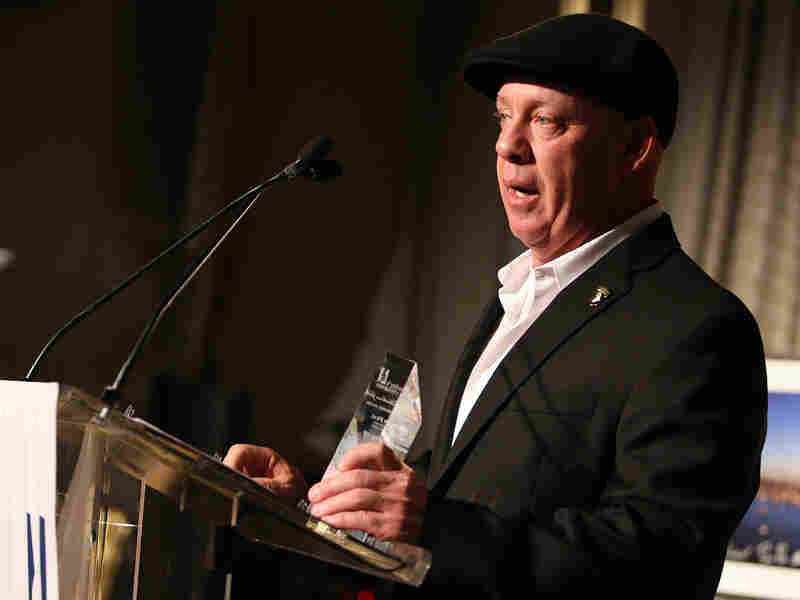
John Feal has received recognition nationally for his work helping first responders get medical compensation and other support for the trauma, illnesses and injuries they suffered from their work related to Sept 11.
Paul Morigi/Getty Images for Tuesday’s Child
hide caption
toggle caption
Paul Morigi/Getty Images for Tuesday’s Child
Before 9/11, in my mind, I was the world’s greatest athlete and I was John Wayne. I was that cool. I didn’t think I could even be hurt — and that was a rude awakening for me, physically and mentally. But I was able to get to safety. … By that time the fire department was there and they put a towel in front of me, I was yelling at everybody to get back to work — “I’ll be back in an hour,” you know — and it was a very humbling experience.
On remembering the moment the steel beam hit his foot
I can block out my injury. I can block out my five days there [at ground zero]. I can’t block out the smell. Probably why I don’t sleep enough. When I close my eyes, I can smell ground zero. Everybody always asks what [did] it smell like? There’s not a word invented yet that describes the smell of ground zero. … It’s a smell that I’ve never smelled before or [since]. It’s a smell of destruction, devastation, carnage. It was everything combined in one that created the smell.
It’s not just me saying this. This is other 9/11 responders and first responders or volunteers who will say the same thing. Especially this time of the year, when I shut my eyes, that smell comes back and it’s like it’s putting its hand over my mouth and nose, and it gets tough.
On the reoccurring nightmare he had after Sept. 11
This time of the year, this anniversary … it’s tough. Not just for me — it’s tough for all 9/11 responders and volunteers and survivors and people who lived and worked down in ground zero. They call these “scars” — they’re not scars, they’re scabs, and these scabs get pulled right off round this time of the year. It’s tough.
You know, when I was going to therapy back in 2002 and ’03 and ’04 and ’05, I had these same recurring nightmares … where I would see the plane crash; and one day I’d be sitting on a park bench with my dog, the plane would be driving by and I couldn’t do anything. Then it was personal. The next day I’m sitting on the park bench with my dog and I would see my mother in the window of the plane waving. Then, little by little, after doing therapy, I was able to get off the park bench and get up and, like Superman, stop the plane from crashing into the building.
On how he became an activist, working to get medical compensation for Sept. 11 first responders
When I was not only going for individual counseling, right after Sept. 11 … I started going to support groups and I started meeting other 9/11 responders. …
And then I was telling people about my experience on workmen’s comp or social security, and I started helping them. And I started going to their hearings. And then, the next thing you know, I started taking other Sept. 11 responders to somebody else’s hearings, and then the judges and the lawyers were like, “Oh here comes Feal, with his crew!”
I look back and it was primitive, but it was effective. Again, at the end of the day I don’t apologize or second guess myself, because we’re talking about human life. We’re talking about human beings who are trying to put food on their table for their kids, or pay their utilities, or put gas in their car to get to a chemotherapy appointment. So it didn’t matter what elected official or what lawyer or what judge or what doctor I pissed off, because the only thing I care about at the end of the day is helping people.
On how going to so many funerals has shaped his thoughts on death
I’m not so much into all that biblical religious stuff, but I do believe there’s a God. I believe we’re here for a purpose, and I believe when we leave there’s also a purpose. I think our energy goes to other people and our energy continues. I’m not afraid of dying, no. Listen … I went to therapy when I wanted to kill myself after getting out of the hospital; those thoughts creep up. I do have my bad days. Would I do it? No. Am I strong enough to stop myself? Yes. But I am not afraid to die, and there are times where I wish I would have died instead of a friend or somebody who left behind four kids. I begged God — my God — totake me instead of them.
On the importance of remembering the sacrifice of first responders
Most people think on this anniversary that two buildings came down that day and 2,753 innocent lives were lost [in New York City]. … But since then, about 2,000 [more] people have died because of their illnesses. They, too, are heroes. And in many ways — I talk to a lot of them — they wish they would have died that day, because what they have had to go through and fight, not only their illnesses but the bureaucracy and the poor leadership, and to see their other friends pass away from Sept. 11-related illnesses. These men and women have been through the ringer, through the mill. …
We call ourselves the greatest nation in the world. But yet we have a strange way of repeating history, and letting veterans come home from war, or 9/11 responders, or just responders now across the nation, how they sacrifice themselves and then we don’t take care of them. That’s sad.
Amy Salit and Thea Chaloner produced and edited the audio of this interview. Bridget Bentz and Molly Seavy-Nesper adapted it for the Web.
Let’s block ads! (Why?)
In the 1950s, the poultry industry began dunking birds in antibiotic baths. It was supposed to keep meat fresher and healthier. That’s not what happened, as Maryn McKenna recounts in her new book.
Express/Getty Images
hide caption
toggle caption
Express/Getty Images
Editor’s note: In the 1950s, the U.S. poultry industry began adopting a new process: Acronizing. Ads that ran in women’s magazines pictured crisp-skinned whole chicken that tasted “fresh,” “wholesome” and “country sweet” thanks to a “revolutionary process which helps maintain freshness in perishables” like chicken. In reality, Acronizing referred to the use of antibiotics. Birds were doused in a diluted solution of antibiotics while they were being butchered. The goal was to keep the meat from spoiling, allowing birds to be sold not just days, but weeks after slaughter.
But as Acronizing became widespread, so too did its misuse. Slaughterhouse workers didn’t always get training on how to use the antibiotics properly, and even those who did sometimes used way more of the drugs in their solutions than the manufacturers called for. That meant some birds might be getting far more antibiotics than could be denatured through the heat of cooking.
As Maryn McKenna writes in her new book, Big Chicken: The Incredible Story of How Antibiotics Created Modern Agriculture and Changed the Way the World Eats, which examines the use of antibiotics in modern agriculture, “it was possible that housewives were unwittingly feeding their families tetracycline-laced fish and chicken. And doctors would soon discover that the people responsible for getting those proteins to dinner tables were being exposed to antibiotics in a manner that no one had accounted for.”
Below is an excerpt from Chapter 4 of the book.
The outbreak looked like a mystery, one that required a detective. Fortunately, Ravenholt was one. He was a graduate of the Epidemic Intelligence Service, an elite training program for epidemiologists—disease detectives—maintained by the CDC. Ravenholt was one of the first graduates of the two-year program, which was designed to create a rapid-reaction force that could deploy across the country. It had begun in 1951, and Ravenholt entered the next year. When Seattle-area doctors began calling him in 1956, fewer than 100 people in the United States had been schooled, as he had been, in what the CDC called “shoe-leather epidemiology”: sleuthing the details of disease outbreaks by leaving the office to meet victims, wherever they happened to be.
Thanks to that training, Ravenholt was equipped to recognize the pattern of an outbreak, even though everything that was known about staph indicated that an outbreak with no hospital connection ought not to exist. The 31-year-old physician called the doctors who had seen the men, pored over the medical records, tracked down the patients, and interviewed them all. It did not take long to discover that they were in fact connected. They had not gone to the same hospital — or any hospital, for that matter — but they did share another institution, one that they visited every day: their workplace. They were slaughter workers at a single poultry processing plant.
Ravenholt called the plant’s owners. He half-expected that they would refuse to talk to him and was surprised when they said he could come by. When he got there, they told him why they allowed the visit: They were struggling with poor-quality poultry, sold to them by local farms, that showed the same problems processors would complain about to Congress later that year. They wanted it known that they were doing what they could to get out a clean, quality product, and they felt they were being undermined.
They showed him what they were dealing with. Birds that looked healthy turned out, once killed and defeathered, to be riddled with hidden abscesses, pockets of pus layered in their breast muscles. Ravenholt took some of the pus and cultured bacteria from it. The lesions were caused by staph. He told the owners the bacteria in the abscesses were leaking out when the birds were cut apart, contaminating the ice bath where the just-killed chickens were chilled, and getting into nicks and cuts that the knife-wielding workers naturally accumulated over the course of a workday. Well, that was frustrating, the owners said back to him. They had spent a lot of money and invested a lot of time to add a hygienic new process, called Acronizing, that was supposed to prevent bacterial contamination. They had only installed it in May.
May was when the workers’ doctors had started calling.
Ravenholt had never heard of Acronizing before, but he instantly perceived the contradiction. If the point of the antibiotic soak was to kill bacteria that cause spoilage, it also should have killed the staph bacteria that were oozing from the meat and infecting the workers. He asked the plant owners for the names of all the farmers who raised the birds that were killed at the slaughterhouse. There were 21 farms, and he wrote letters to all of them, asking them whether there had been disease outbreaks in any of their poultry. Fifteen wrote back, and all of them assured him that their flocks showed no visible signs of illness. Thirteen of the 15 said they were shocked to hear of the problems, because they were taking special steps to keep their poultry healthy. They were dosing their chickens with Aureomycin to prevent them from developing any disease.
The lab tools that were available in 1956 were much cruder than the ones that exist today; it was more difficult and time-consuming then to distinguish between staph strains or demonstrate that a cluster of cases of illness came from a single source. Ravenholt could not prove in a lab that the antibiotic doses, the chickens’ lesions, the antibiotic soaks, and the workers’ health problems were linked. But he was confident that what happened had proceeded like this: Drugs in the feed had affected bacteria in the birds, habituating them to antibiotics, and the low dose of the same antibiotics in the chilling bath had eliminated all the bacteria except for the ones that had become resistant. Those had survived to infect the workers who were plunging their hands and arms into the contaminated water.
Ravenholt is in his 90s now and still lives in Seattle. More than 60 years later, his memory of his conclusions then is sharp.
“Instead of the old tried-and-true preventatives of contamination, they had switched to these miraculous new drugs that they thought did everything,” he told me. “Instead of preventing a problem, it was like putting kerosene on a blaze.”
By the time he was done investigating, the problem had spread from one slaughterhouse to several, and fully half the workers in the plants had the same hot, painful abscesses and boils. Even without lab evidence, that was enough to demonstrate that Acronizing was creating a problem. Ravenholt was able to persuade the slaughter plant owners to cease using the antibiotic dunks, and when they stopped, the outbreak did too.
With the outbreak over and other diseases clamoring for his attention, Ravenholt had no reason to keep poking at the issue of the plant workers’ illnesses. But the episode nagged at him, and periodically he looped back to the problem of how the men became infected, scrutinizing any blip that suggested farms and slaughterhouses might be conducting illnesses into the city undetected. He conducted a survey of meat cutters in processing plants, asking about lacerations and boils and hospitalizations. The workers he interviewed all told the same story: of skin eruptions that hurt and ached, gave them fevers, kept them away from work, and recurred for years. They believed their problems originated in the meat and fish they were handling. The illnesses had names on the cutting floors, they told him. They were called “pork infection” and “fish poisoning.”
Ravenholt thought back to the terrible 1955 hospital outbreak in mothers and babies. He had assumed at the time that the staph ravaging mothers and newborns in Seattle’s hospitals had arisen there first and then leaked into the outside world. Now it occurred to him that the bacterial traffic might have gone the other way. Perhaps the virulent staph originated in the meat trade, affected by the antibiotics that the animals consumed while they were living and that they soaked in after they died. Meat cutters were overwhelmingly men, but maybe one of them had brought the bacteria home on his bloody clothing or his soaked boots or in the cuts on his injured hands. Maybe he had passed the bacterium without knowing it to his pregnant wife or girlfriend, and she had carried it innocently into a hospital and sparked an explosion of disease.
It was years later and there was no way to know. And there was not even a ripple of concern yet in the wider world about the possibility of resistant bacteria arising from antibiotic use in food animals. But at the CDC, Ravenholt had learned that diseases could echo in odd ways down the decades of a career; an outbreak that seemed mysterious at the time might eventually be explained by a discovery years later. So he noted his concerns, in case they might be useful in the future. In 1961 he wrote:
The outbreak of boils among workers in a poultry-processing plant … is the only such outbreak in this community in at least the last 15 years … That outbreak coincided in time and place with the use of the chlortetracycline process, which was discontinued shortly thereafter …
These findings suggest that the use of tetracycline in the processing of poultry somehow caused the outbreak … And if so, that possibly hospital outbreaks … are in some way, not yet defined, related to the use of tetracycline.
THE OUTBREAK THAT Ravenholt unraveled was a small one, even by the standards of the 1950s, and until he published his description in 1961, it received no attention outside Seattle. But elsewhere in the United States, the problem of disease organisms in food and food workers, and the ways in which antibiotic use might be affecting them, was gathering attention.
The first sign of trouble surfaced in cheese — or rather, in milk that was supposed to become cheese but would not coagulate. The reason was penicillin. Automatic milking machines had recently come on the market, replacing the laborious hand milking that dairy farmers had done for millennia. The suction generated by the machines was tough on cows’ udders, bruising them and causing infections. Injecting large doses of penicillin into the teats cured the problem, but the antibiotic lingered in the udder and could contaminate the cow’s milk for a while. To prevent any of that penicillin from being consumed accidentally, the FDA required dairymen to throw away any milk that was collected in the first few days after the drugs were injected. (The British government had a similar but looser rule that hinged on how advanced a cow’s infection was.) Yet some farmers must have objected to sacrificing that small amount of profit lost in that discarded milk — because starting in the mid-1950s, penicillin allergies in both countries suddenly became much more common.
This was strange timing, because penicillin had just been made prescription only, precisely because enthusiastic buyers of the drug had sensitized themselves into becoming allergic when it was sold over the counter. With the introduction of prescription penicillin, allergies to the drug should have been decreasing. They were not. Doctors reported adults and, even more, children — who drink more milk than adults — breaking out in the kinds of rashes that previously had affected nurses who handled raw penicillin in the early days. In 1956, the FDA tested milk that it bought in supermarkets across the United States and found that more than 11 percent of the samples contained penicillin; some contained so much that the milk could have been administered as a drug. By 1963, the situation was serious enough for the World Health Organization to flag it in a special report.
Other foods were getting close examination as disease vehicles rather than resistance risks. In March 1964, the CDC summoned physicians, epidemiologists, and federal planners to its headquarters in Atlanta to discuss an urgent trend: Salmonella infections in the United States had increased 20-fold in 20 years. Eggs seemed to be to blame. In the largest single outbreak, liquid eggs — ones that are broken open, combined, frozen while still raw, and sold to food service companies — sickened more than 800 ill and fragile patients in 22 hospitals. Dr. Alexander Langmuir, the founder of the Epidemic Intelligence Service, who had trained Ravenholt, complained: “It certainly piques our pride that in these days of heart surgery, artificial kidneys and organ transplants, we cannot take dominance over a minuscule little bacillus … that gets into our hospitals, causes no end of trouble, and has us stumped.”
Foodborne illness outbreaks in institutions — hospitals, prisons, schools — were usually assumed to be the fault of whoever was in the kitchen. The CDC’s investigation established that this was wrong. There was no way that identical outbreaks could have happened in so many hospital kitchens at the same time, caused by the same food, and yet be unconnected. Salmonella was not a kitchen problem; it was a food system one. That shift in emphasis enraged the egg industry, in a way that would echo through every foodborne outbreak thereafter, pitting the suffering of the victims against companies’ lost sales. After the egg outbreaks were publicized, “There was probably an egg price depression of somewhere near a cent a dozen,” Dr. Wade Smith, Jr., a veterinarian with the Tennessee egg producer Blanton-Smith, fumed during the CDC meeting. “A cent a dozen does not sound like very much to those of us who buy a dozen eggs a week. But a cent a dozen for six months is approximately half a bird’s production.”
The concern for foodborne outbreaks and the new worries over resistant foodborne bacteria forced a reexamination of Acronizing. At the USDA, several scientists who had been monitoring poultry plants — watching how much drug they used in the chilling bath and how long they soaked the birds — went back to their federal laboratory to try to recreate the process. Their results, once they replicated what slaughterhouses were doing, confirmed Ravenholt’s suspicions from years before. Acronizing treatment changed the mix of bacteria on the surface of meat, encouraging resistant bacteria to develop and multiply — resistant bacteria that were present only on pieces of meat that had been Acronized.
Everyday shoppers were probably not reading the scientific publications where those results were made public. Nevertheless, in supermarkets and home kitchens, a cultural shift was occur ring: Consumers were scrutinizing food additives and losing trust in food production. “We have felt for a long time that something was wrong with the poultry we buy,” “A Consumer” wrote to the editor of the Pottstown, Pennsylvania, Mercury. “It does not have the good flavor that it had in the past, regardless of how it is pre pared. We would like to see a ban on the use of all dyes and preservatives in the food we buy, including the acronizing of chicken.” Lois Reed of Twin Falls, Idaho, wrote to the Montana Standard-Post: “How about the acronizing of chickens? When you purchase one such chicken you are completely in the dark as to the time it was prepared for market — two days ago — six months ago — who knows? …We are doing ourselves and our children a great injustice by being indifferent to these various practices. Our very lives depend upon action now!” “Non-Acronized” began to appear in grocery-store advertisements across the country — including in the Helena, Montana, Independent Record; the Bend, Oregon, Bulletin; and the Eau Claire, Wisconsin, Daily Telegram — as prominently displayed as “Acronized” had been just a few years before. “Even your children can tell the difference,” Capuchino Foods promised in the San Mateo, California, Post. Colorado and then Massachusetts banned Acronized birds from being sold within their borders.
The weight of negative opinion changed the FDA’s mind. In September 1966, the agency canceled the licenses it had granted a decade earlier for Acronizing and the rival process, Biostat [from Pfizer]. Antibiotics could no longer be added to food as it was packaged. But the agency did nothing about antibiotics fed to animals before they were slaughtered and became food. That was not yet on the public’s agenda, and only a few scientists were concerned. One was Marie E. Coates, a scientist at England’s National Institute for Research in Dairying, who studied poultry nutrition. In 1962, at a conference on antibiotics and agriculture that was held periodically at the University of Nottingham, she worried aloud:
Widespread use of antibiotic feed supplements may induce the establishment of strains of organisms resistant to their action. The least harmful result would be the loss of efficiency of antibiotics as growth promoters. A more disastrous consequence might be the development of resistance in pathogens against which antibiotics are at present the only means of defense.
Coates was prescient. Just a few years later, a little more than a hundred miles away, a tragic outbreak would demonstrate that she was right to be afraid.
Excerpted from Big Chickenby Maryn McKenna; published by National Geographic Partners on Sept. 12.
Let’s block ads! (Why?)