
Now What? 5 Looming Challenges For The Affordable Care Act

Republicans in Congress say they haven’t given up on getting rid of the Affordable Care Act. They’re just switching tactics.
Katherine Streeter for NPR
hide caption
toggle caption
Katherine Streeter for NPR
Republicans officially pulled the plug on their last-ditch effort to repeal and replace the Affordable Care Act on Tuesday.
“We don’t have the votes,” said Sen. Bill Cassidy, R-La., after a closed-door meeting of Senate Republicans. “And since we don’t have the votes, we’ve made the decision to postpone the vote.” Cassidy, along with Sen. Lindsey Graham, R-S.C., put together the proposal they hoped could pass the Senate.
As of Sunday, though, the Senate will no longer be able to pass a health law overhaul bill with only a simple majority. That means the bill is effectively dead, for now.
That message was underscored by Senate Majority Leader Mitch McConnell, R-Ky., who said, “Where we go from here is tax reform.”
But that does not mean all is smooth sailing for the ACA. Here are five ongoing challenges the law faces.
1. Insurers still face tremendous uncertainty.
Wednesday is the deadline for health insurers to finalize rates for the 2018 individual market open enrollment season, which starts Nov. 1. Yet there has been no resolution to the question of whether the federal government will continue to reimburse insurers for subsidies known as cost-sharing reductions. Those are payments insurers are required to provide to moderate-income enrollees to help them afford deductibles and out-of-pocket costs. The law says the federal government is supposed to make those payments, but a lawsuit has left that an open question, and the Trump administration has repeatedly threatened to stop making the payments.
Without reimbursement of those subsidies, Pennsylvania Health and Human Services Secretary Teresa Miller told the Senate Finance Committee Monday, insurers in her state “reported they would need to request a statewide average increase of 20.3 percent” in the cost of health plan premiums. Those increases are similar nationwide.
A bipartisan effort led by Senate Health, Education, Labor and Pensions Committee Chairman Lamar Alexander, R-Tenn., and Patty Murray, D-Wash., to advance legislation to affirmatively fund the payments was reportedly progressing until Republican leaders stopped them to concentrate on efforts to pass the Graham-Cassidy legislation.
But Alexander and Murray now appear back at it.
Murray said Tuesday she is “ready to keep working on the bipartisan path that could lead to results.”
Alexander similarly released a statement that he would “consult” with Murray and others “on a limited bipartisan plan that could be enacted into law to help lower premiums and make insurance available to the 18 million Americans in the individual market in 2018 and 2019.”
2. The Trump administration has cut funding for efforts to sign people up for insurance.
Administration officials announced earlier this month major cuts to the “navigator” program, which provides funding to community groups that guide people through the complex task of signing up for health insurance through the online marketplaces. Some groups are losing more than 90 percent of their budgets.
The cuts have forced many groups to lay off workers just before open enrollment begins and to limit the areas they serve.
3. The 2018 enrollment period is half the length of 2017’s, and now it will be shorter still.
Trump officials are also slashing by 90 percent the advertising budget that reminds people about open enrollment and how to sign up — from $100 million to $10 million.
Those cuts are even more significant this year because for the first time since the law’s implementation, open enrollment starts in November, rather than December, and lasts only 45 days.
“Most people don’t know the open enrollment dates, and they don’t know that the deadline this year is Dec. 15, not Jan. 31, like last year,” wrote Lori Lodes, who ran outreach for the ACA in the Obama administration, in a recent op-ed for Vox.
Trump administration officials said they don’t think advertising is cost-effective, but Lodes wrote that “my office produced reams of data that proved the overall effectiveness of outreach advertising.”
Additionally, HHS announced late last week that it will shut down HealthCare.gov for maintenance from 12 a.m. to 12 p.m. every Sunday during open enrollment, except for Dec. 10 – a step critics say could further undermine enrollment efforts.
4. The Trump administration is dragging its feet on giving states flexibility to stabilize their markets.
Back in March, Health and Human Services Secretary Tom Price and Centers for Medicare & Medicaid Services chief Seema Verma, who oversees the ACA, sent a letter to states encouraging them to use the law’s waiver process to improve the functioning of their individual insurance markets. In particular, they suggested states could create “reinsurance” programs that would help lower premiums by providing a payment mechanism for the most expensive patients.
But when Minnesota took up that invitation, the administration delayed its response. When it finally did grant permission last week, HHS also informed the state that it will lose significant funding for a program that provides insurance to the state’s low-income residents.
Gov. Mark Dayton, a former Democratic senator, said in a letter to Price that “we have now been informed that Minnesota would lose more federal Basic Health Plan funding than we would receive in federal support for reinsurance,” and described the entire waiver process as “nightmarish.”
5. Republicans could take another shot at a full overhaul next year — or even this year.
While the acknowledgment that the GOP lacks the votes to overhaul the health law means an immediate vote will not happen, the Republicans have potentially two more shots to try to pass a bill with a simple majority vote.
What triggers the ability to pass a bill in the Senate without threat of filibuster is a formal budget resolution. Republicans have still not passed a budget resolution for fiscal 2018, which begins Oct. 1. The upcoming resolution is expected to call for a major tax cut bill. Some Republicans, notably Graham himself, have suggested adding health language to that resolution, which would be allowed.
But that would complicate efforts for both bills.
More likely is that Republicans could try again for a health overhaul via its fiscal 2019 budget resolution, which is due next April. That would leave them only a few months before the 2018 elections. Still, it’s possible, particularly if they can use the time to reach consensus.
That is clearly what sponsors of the latest GOP bill have in mind.
“We’re on a path to pass” his bill, Graham told reporters. “It’s just a matter of when. It will be in this Congress, under a better process.”
Kaiser Health News, a nonprofit health newsroom, is an editorially independent part of the Kaiser Family Foundation.
Facebook Faces Increasing Scrutiny Over Election-Related Russian Ads

For months, Facebook CEO Mark Zuckerberg had claimed that security experts at Facebook had found no evidence of Russians involved in fake news. Now, Facebook is turning over thousands of ads to Congress it said had been placed by a Russian agency.
Noah Berger/AP
hide caption
toggle caption
Noah Berger/AP
Facebook is under increasing pressure to scrutinize its advertising content after it discovered that at least 3,000 ads on the site had been placed by a Russian agency to influence the 2016 presidential election. The revelations about the ads came after months of denial by CEO Mark Zuckerberg that Facebook played any role in influencing voters.
As has been widely reported, the pressure on the company began shortly after the 2016 election. But Zuckerberg rejected the idea that fake news on the network had any impact on voters. He called that a “crazy idea” and said “voters make decisions based on their lived experience.”
But at a conference in Lima, Peru, shortly after the election, then-President Barack Obama pulled Zuckerberg aside and made a personal appeal to him to take the threat of fake news seriously because it wasn’t going away and would return again to haunt the next election, The Washington Post reported. Sen. Mark Warner, D-Va., also had conversations with the company trying to push Facebook to look carefully at activity on the site leading up to the election.
For months, Zuckerberg hclaimed that security experts at Facebook had found no evidence of Russians involved in fake news. Then, last week Facebook said it would turn over the content of ads to Congress it said had been placed by a Russian agency.
Members of a hacking group connected to Russia’s military intelligence unit, the GRU, began creating fake Facebook accounts as early as June 2016 to amplify stolen emails from the Democratic National Committee, the Post reported.According to the Post, some of those ads specifically sought to deepen disagreements about Muslims and the Black Lives Matter movement.
In a live video, Zuckerberg announced a series of reforms meant to guard against international agents trying to influence voters. He announced changes to the way political ads would be placed. Advertisers will be required to disclose who sponsored their ads. Users will be able to see an advertiser’s webpage, who is behind an ad, what other ads they’ve sponsored and who else is being targeted. This should enable users to understand the deeper motivations of an advertiser. The company is also adding 250 employees to focus on election integrity and security.
However, Zuckerberg also admitted, “I wish I could tell you we’re going to be able to stop all interference, but that wouldn’t be realistic.”
It is especially hard to catch bad actors because of the way that Facebook’s advertising model works. Before the Internet, there were human salespeople who sold ads and did the placements. Now, the process is automated. An advertiser signs up online and pays money to target a specific kind of user — say, someone who lives in a certain area and is interested in leather shoes. That makes it much easier for bad actors like Russia to outsmart the computers.
This is a problem not only at Facebook but at most tech companies — including Google and Microsoft. In fact, lawmakers are beginning to think these companies need more government oversight around political advertising, which has been true for other media for decades. A company like Facebook is virtually a monopoly. Close to 70 percent of Americans use the social network.
Senate Democrats have been crafting legislation that would require Internet companies to disclose the names of individuals and organizations that spend more than $10,000 on election-related ads.
Undoubtedly, the fear of being regulated is part of why Facebook is trying to take the lead now on the issue of fake news on the site. Google and other tech companies are likely to lobby hard against any regulations. However, congressional deadlock could be on their side since Congress hasn’t been passing much of anything lately.
(Facebook pays NPR and many other media companies to create video content on the site.)
4 College Basketball Coaches, Adidas Executive, Charged In Bribery Case

The Department of Justice announced fraud and corruption charges for a scheme allegedly involving four college basketball coaches and the head of global sports marketing for Adidas, plus five other defendants. NPR’s Robert Siegel talks to Mike DeCourcy of Sporting News about the case.
ROBERT SIEGEL, HOST:
The Department of Justice has brought charges in a wide-ranging college basketball bribery and fraud case. Here’s how U.S. Attorney Joon Kim laid it out at a news conference today.
(SOUNDBITE OF PRESS CONFERENCE)
JOON KIM: Coaches at some of the nation’s top programs soliciting and accepting cash bribes, managers and financial advisers circling blue-chip prospects like coyotes and employees of one of the world’s largest sportswear companies secretly funneling cash to the families of high school recruits.
SIEGEL: Ten people have been charged, including four assistant college basketball coaches and an executive at Adidas. All have been arrested. Mike DeCourcy is a college basketball columnist with The Sporting News, and he’s been covering this case. Welcome to the program.
MIKE DECOURCY: Thank you, Robert.
SIEGEL: The U.S. attorney for the Southern District of New York described two separate schemes. Let’s talk about the first one. This involved the assistant coaches being bribed. What was the alleged scheme, and who did they say was involved?
DECOURCY: Well, there are four assistant coaches, including a coach at Auburn, associate head coach Chuck Person, as well as assistant coaches at Oklahoma State, Southern California and Arizona. They are charged with accepting bribes for delivering particular players who had gone through their programs to a particular financial management firm. And then of course the financial management firm would profit from their association with those players as they turned professional.
SIEGEL: It’s alleged that the coaches took money in order to direct the players to those companies. And the second scheme – what’s charged there?
DECOURCY: The second case involves a scheme to direct particular players to particular schools who were affiliated with one of the conspirator’s apparel company.
SIEGEL: And we should say the apparel company isn’t named I guess in this. But the – it’s Adidas obviously from reading between the lines.
DECOURCY: The – one of the indicted people was an executive at Adidas.
SIEGEL: Bill Sweeney of the FBI New York field office said at the news conference today that this investigation is ongoing. And he said to others conducting business this way in college sports, we have your playbook. Do you assume they’re going to be more indictments in this case?
DECOURCY: I would not rule that out. But I think the point that was made by the FBI agent was more like, don’t do this stuff because we’ll catch you. And before, the problem had always been if you get caught, well, you might lose your job at school, or your school might go on probation or lose a post-season tournament or something like that. Now there’s a lot more at stake. I think there was a cavalier attitude when it was only the NCAA. They had to be worried about – those three letters, the FBI, are a lot more intimidating than the four in the NCAA.
SIEGEL: Yeah. Of the people indicted, only one name rings a bell with me, and that’s Chuck Person, an assistant coach at Auburn but also a former star basketball player there and a longtime NBA player.
DECOURCY: What’s interesting about that is Chuck Person, according to statistical websites, made over $22 million in his NBA career and is making over a quarter of a million dollars a year as the associate head coach at Auburn. So why would he need the money that he was alleged to have accepted as a bribe? And I think that’s the question that people in basketball are asking and that they wonder if the federal authorities will ask as well.
SIEGEL: Mike DeCourcy, college basketball columnist for The Sporting News, thanks for talking with us.
DECOURCY: Thank you very much.
Copyright © 2017 NPR. All rights reserved. Visit our website terms of use and permissions pages at www.npr.org for further information.
NPR transcripts are created on a rush deadline by Verb8tm, Inc., an NPR contractor, and produced using a proprietary transcription process developed with NPR. This text may not be in its final form and may be updated or revised in the future. Accuracy and availability may vary. The authoritative record of NPR’s programming is the audio record.
Today in Movie Culture: Batman vs. Pennywise, Ridley Scott Breaks Down a 'Blade Runner' Scene and More

Here are a bunch of little bites to satisfy your hunger for movie culture:
Mashup of the Day:
Because Batman needs more clowns as enemies, here’s a fan-made trailer for a crossover where Batman fights Pennywise from It:
[embedded content]
Filmmaker in Focus:
Speaking of Batman, Wisecrack focuses on the Dark Knight trilogy in its latest look at the philosophy of Christopher Nolan:
[embedded content]
Director’s Commentary of the Day:
With Blade Runner 2049 out soon, Wired got Ridley Scott to break down his favorite scene from the original:
[embedded content]
Movie Analysis of the Day:
Speakin of Philip K. Dick adaptations, in his latest video essay, Rob Ager analyzes the subway chase and escalator battle from the original Total Recall:
[embedded content]
Vintage Image of the Day:
Mark Hamill, who turns 66 today, looks way too chummy here with Peter Cushing on the set of Star Wars:
Star Wars: A New Hope, 1977 (George Lucas, Behind the Scenes Photograph of Mark Hamill and Peter Cushing) pic.twitter.com/2U4N0ZKNJK
— Galactic Archivist (@GalacticArchvst) May 2, 2017
Movie Takedown of the Day:
Speaking of Star Wars, Dorkly animates a classic showdown from the original movie while also criticizing it:
[embedded content]
Local Commercial of the Day:
Also speaking of Star Wars, check out this small town dentist’s parody of the first movie as a commercial for his practice (via Geekologie):
[embedded content]
Movie Trivia of the Day:
As long as we’re looking at Star Wars parodies, here’s CineFix with a bunch of Spaceballs trivia:
[embedded content]
Cosplay of the Day:
This tweet says it all, little Logan for the win:
all other cosplay is cancelled pic.twitter.com/z7NmtY0IJl
— Sam | SleepCon (@SamMaggs) September 25, 2017
Classic Trailer of the Day:
Today is the 30th anniversary of The Princess Bride. Watch the original trailer for the classic fantasy film below.
[embedded content]
and
Athletes On The Track And The Slopes Are Pulled Into Trump Controversy
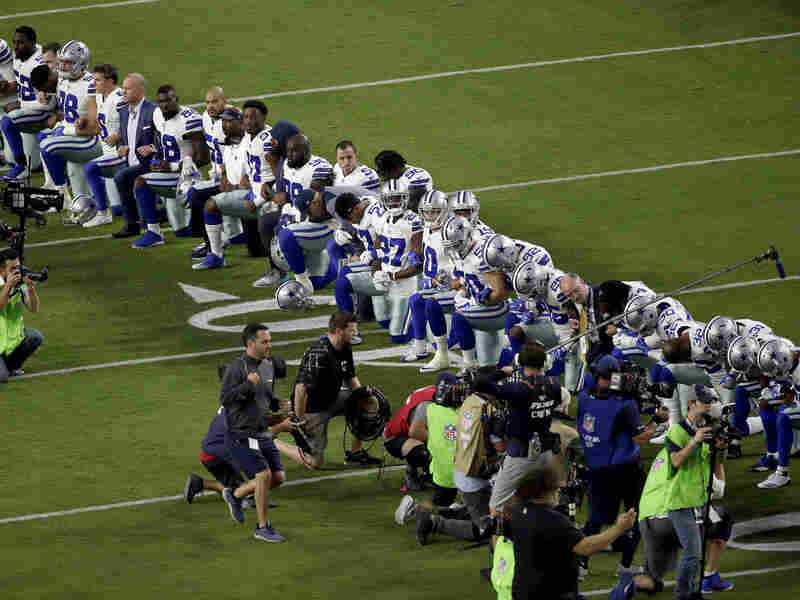
The Dallas Cowboys, led by owner Jerry Jones have their picture taken making a protest gesture during the national anthem before their game against the Arizona Cardinals Monday.
Matt York/AP
hide caption
toggle caption
Matt York/AP
The tumult in the sports world continued Monday after President Trump’s incendiary remarks criticizing NFL players who have protested racial inequality during the playing of the national anthem. While the Dallas Cowboys and Arizona Cardinals showed solidarity with the protesters before their Monday night football game, NASCAR figures and Olympic athletes also weighed in.
The president had targeted the NFL and, to a lesser extent, the NBA but on Monday he praised professional racing, saying, “So proud of NASCAR and its supporters and fans. They won’t put up with disrespecting our Country or our Flag — they said it loud and clear!”
Trump was responding to support from legendary racer Richard Petty and Hall of Fame team owner Richard Childress during the weekend. It served as a coda to a remarkable few days — a series of events that seemed to put to rest for good the idea that sports and politics don’t mix.
“Anybody that don’t stand up for that [the anthem] ought to be out of the country, period,” Petty said. “If they don’t appreciate where they’re at, what got them where they’re at? The United States.”
Although Yahoo Sports notes it wasn’t long ago that NASCAR drivers sat in their cars during the national anthem.
NBC Sports reported this is what Childress said if one of his team members protested: “Get you a ride on a Greyhound bus when the national anthem is over. … Anybody that works for me should respect the country we live in. So many people gave their lives for it. This is America.”
Since most of the anthem protests have been conducted by African-American athletes, Trump’s critics have said the president’s use of the term “S.O.B.” last Friday to describe protestors was racially insensitive. Critics say Trump’s endorsement of NASCAR, a sport with, historically, an overwhelming number of white drivers, inflamed the racial component of the controversy.
Trump said several times Monday his comments had nothing to do with race.
NASCAR released a statement saying “Sports are a unifying influence in our society, bringing people of differing backgrounds and beliefs together. Our respect for the national anthem has always been a hallmark of our pre-race events. Thanks to the sacrifices of many, we live in a country of unparalleled freedoms and countless liberties, including the right to peacefully express one’s opinion.”
And then NASCAR’s most popular driver, Dale Earnhardt, Jr. tweeted this message, quoting former President John F. Kennedy: “All Americans R granted rights 2 peaceful protests. Those who make peaceful revolution impossible will make violent revolution inevitable.”
The flag and the anthem arguably are most significant in Olympic sport. Carrying the flag during opening and closing ceremonies is considered a high honor; winning a gold medal is followed by an emotional playing of the anthem while the flag rises.
Park City, Utah, is a long way from the pro football fields of America. But it’s where many of this country’s Winter Olympians are gathered for several days of media interviews in advance of next February’s game in South Korea.
And like everywhere else in the sports world, talk in Park City turned to the president, NFL players and anthem protests.
“I think the president of the United States has a very important job,” says U.S. figure skater Adam Rippon. “I think there are so many things going on in the world that we should be focused on. President Trump speaking up and against freedom of speech is dangerous and divisive.”
“Some people think that we should just shut up and ski or shut up and play,” says Alpine ski racer Laurenne Ross. “But the fact that the Internet exists and there’s all this social media and news spreads so fast, is actually a really wonderful thing for us and it helps us have a voice.”
Gold medal winning skier Mikaela Shiffrin says it’s “cool” to see sports play a bigger role than it has in the past.
“It gives us all a really great opportunity to share our values with the world,” says Shiffrin, adding, “I think the Olympics will be the same thing. We have to be careful not to offend anyone when we’re there because we’re not just talking about the U.S., we’re talking about the entire world. But it has been interesting to see how sports has taken a stronger role these past few months.”
Figure skater Ashley Wagner says she absolutely respects the different ways Americans express their freedom of speech. But Wagner, a self-described army brat, also respects how special a flag and an anthem are in an Olympic Games.
“I think for me going into South Korea, when I hear the anthem, I hear it when I’m standing on top of the podium,” she says. “So for me it’s a huge moment of pride and it’s a moment I really hope to experience for myself in Korea.”
As far as a possible anthem protest at the games, the most famous of which took place in Mexico City in 1968, International Olympic Committee rules strictly forbid what we’ve seen over the past weekend on NFL fields.
According to Rule 50 of the Olympic Charter, “No kind of demonstration or political, religious or racial propaganda is permitted in any Olympic sites, venues or other areas.”
Still, USOC CEO Scott Blackmun said in Park City he and other officials support the right of athletes to speak their minds.
“[NFL] athletes are protesting because they love their country, not because they don’t.”
GOP Health Care Bill Appears Dead After Sen. Collins Declares Opposition
The latest effort to repeal the Affordable Care Act appears to be blocked after Maine Sen. Susan Collins opposed the bill. Her opposition means the bill cannot pass the Senate with only GOP support.
AILSA CHANG, HOST:
The latest Republican effort to repeal the Affordable Care Act appears all but dead tonight now that Republican Senator Susan Collins of Maine says she does not support the proposal. She joins Republican senators John McCain and Rand Paul in opposing the bill, and that is one too many noes for the bill to pass the Senate with only Republican support. Collins’ announcement comes minutes after the Congressional Budget Office said the plan known as Graham-Cassidy would leave millions more people without health insurance coverage. And all this caps a dramatic day of hearings and protests on Capitol Hill.
Joining us now to talk about the day is NPR health policy correspondent Alison Kodjak. Hi, Alison.
ALISON KODJAK, BYLINE: Hi, Ailsa.
CHANG: So why does Senator Collins say she’s opposed to this plan?
KODJAK: Well, Senator Collins says, you know, she’s worried about the cuts to the Medicaid program. This plan would roll back the expansion of Medicaid that happened under the Affordable Care Act, and it would grow the program more slowly over time. Now, Medicaid covers the poor, low-income people and people with disabilities. And, you know, it’s very hard to see how they can grow it more slowly than inflation and still cover those people.
She also says she’s worried about people with pre-existing conditions. This bill doesn’t actually have the same level of protection as the current law. And, you know, if it were to go into effect, insurers potentially in some states could charge people more if they have a pre-existing condition. And it could eliminate some types of coverage like mental health care or maternity care, which then wouldn’t give people who need those coverages the care they need.
CHANG: Senator Collins’ decision came on the heels of this Congressional Budget Office analysis. What did the CBO say about this proposal?
KODJAK: Yeah. You know, it was interesting. The CBO was only supposed to talk about the deficit impact of this bill. And it did say that it would reduce the deficit by $133 billion. But the CBO decided to go further. It said that while it didn’t have time to do its thorough analysis, it concluded that millions fewer people would have insurance under this plan. It said that a lot of people would lose coverage because of that Medicaid rollback and that who lost insurance would really depend on what state they lived in. And that’s because this bill would have taken all this money from the Affordable Care Act and instead redistribute it to states to design their whole – their own health plans.
CHANG: Right.
KODJAK: And it was unclear what each state would do.
CHANG: So that report comes on this day where there was a lot of drama on Capitol Hill, right? What happened?
KODJAK: Yeah, there were protests. And they were pretty dramatic on Capitol Hill.
CHANG: Yeah.
KODJAK: There was a hearing in the Senate, the Senate Finance Committee, which is going to be the only hearing on this bill. And early in the day, a lot of advocates for people with disabilities showed up. And they were determined to fill that hearing room. And a lot of them were in wheelchairs. And as soon as the hearing opened, they started chanting. And they were chanting, no cuts to Medicaid, save our liberty. The senators couldn’t speak over them. They couldn’t proceed. And it delayed the hearing. And eventually, the Capitol police were called in. And they had to drag people out of the room. They took some out of their wheelchairs. They wheeled them out in their wheelchairs.
CHANG: Wow.
KODJAK: It really made for some unsettling images.
CHANG: So now that at least three senators, Republican senators, are opposing this bill, I suppose now Senate Majority Leader Mitch McConnell has a decision to make, right?
KODJAK: Yeah. He has to decide whether or not to pull this bill or to take it to a vote. And, you know, it’s unclear what he’ll do. If at some point he does pull it or the bill fails, there is a bipartisan effort standing in the wings, waiting to go forward. And so we’ll see what happens, whether that can get done after this bill finally disappears.
CHANG: All right. Alison Kodjak is NPR’s health policy correspondent. Thank you, Alison.
KODJAK: Thank you, Ailsa.
Copyright © 2017 NPR. All rights reserved. Visit our website terms of use and permissions pages at www.npr.org for further information.
NPR transcripts are created on a rush deadline by Verb8tm, Inc., an NPR contractor, and produced using a proprietary transcription process developed with NPR. This text may not be in its final form and may be updated or revised in the future. Accuracy and availability may vary. The authoritative record of NPR’s programming is the audio record.
Rental Firms' Disaster Readiness May Help Usher The Age Of Self-Driving Cars

Cars sit along the street in Houston following Hurricane Harvey on Aug. 30. Car rental companies made preparations to move vehicles into affected areas even before the storm hit.
Scott Olson/Getty Images
hide caption
toggle caption
Scott Olson/Getty Images
With more than 1 million autos damaged in recent U.S. hurricanes, car rental firms have had to move vehicles quickly into affected areas. The ability to manage large fleets involves artificial intelligence and data — tools that are keys to a future of self-driving fleets.
Often even before the first rain falls in a hurricane, rental cars are on the way.
Lisa Martini, with Enterprise Holdings, the nation’s largest car rental company, says that in anticipation of this hurricane season, the company started getting ready to send cars. “For example, in Texas we started anticipating the replacement vehicle need … . We brought in about 17,000 vehicles in Texas and that was part of that recovery process,” she says.
First responders, officials, volunteers, residents and reporters need cars in the immediate aftermath of a disaster, Martini says. “We really just understand where the demand is highest and, especially when a disaster hits, we just move those vehicles where they’re needed,” she says.
Enterprise, which also owns the Alamo and National Car Rental brands, has 6,400 locations throughout the U.S. As peak vacation season ended, just before the hurricanes, cars came from as far away a Green Bay, Wis., Seattle and Cape Cod.
That shift could have had an effect on vehicles in, say, Washington state. Martini says that for a couple of days, renters who didn’t have an insurance claim might have had to wait a little bit longer. “The Mustang might have not been where you would have hoped it would have been,” she says.
Chris Brown, executive editor of the trade publication Auto Rental News, says preparing for natural disasters is a part of the DNA of the rental car companies. Moving the 2.1 million vehicles in the rental fleet around the country is a microcosm of what’s to come.
Rental cars may appear low tech on the surface, but Brown says the companies “have the ability to use artificial intelligence now, big data, combined with the collective wisdom of people that have been in the industry for 30 years to understand a customer’s wants and needs.”
Despite their low-tech image, car rentals are the wave of the future. Getting you the car you want, when you want it, for the time you want it will be increasingly important skills to have as cars become autonomous.
Fleet management admittedly is not something the average consumer is likely to think about. We just expect that the Mustang we wanted will be there.
Brown says fleet management is paramount to a successful operation. “But more than that, it only gets more important moving forward into this era of autonomous vehicles,” he adds.
Trump Renews Debate Over National Anthem Protest, NFL Players Respond

New Orleans Saints players sit on the bench during the national anthem before Sunday’s NFL football game against the Carolina Panthers in Charlotte, N.C.
Bob Leverone/AP
hide caption
toggle caption
Bob Leverone/AP
It seemed like the controversy involving NFL players kneeling during the national anthem had died down a bit — that is until President Trump stirred up a hornet’s nest Friday night during a campaign trip to Alabama.
Trump unleashed a tirade of strong comments against NFL players who don’t stand during the playing of “The Star Spangled Banner.”
Kneeling during the national anthem in protest over perceived social injustices against African-Americans began last year.
A handful of white players didn’t stand Sunday, but the vast majority of those actively protesting were black, The Associated Press reports.
Trump’s take: It’s unpatriotic and NFL team owners should fire those refusing to stand.
Trump’s comments festered over the weekend and by the various game times on Sunday, roughly 200 players sat, knelt or raised their fists in defiance during the anthem.
Most of the players locked arms with their teammates — some coaches and team owners also joined in.
Other teams, such as the Pittsburgh Steelers, stayed off the field until the anthem was finished. One Steeler, Army veteran Alejandro Villanueva, ventured out of the tunnel and placed his hand over his heart during the singing of the anthem.
A week ago, less then 10 players protested.
Great solidarity for our National Anthem and for our Country. Standing with locked arms is good, kneeling is not acceptable. Bad ratings!
— Donald J. Trump (@realDonaldTrump) September 24, 2017
The last NFL game of the day, Washington hosted Oakland, was played in Landover, Md. — not far from the White House.
Most of Oakland’s team sat on their bench during the anthem while most of Washington’s team stood arm-in-arm along with owner Dan Snyder and president Bruce Allen.
Trump tweeted earlier on Sunday: “Standing with locked arms is good, kneeling is not acceptable. Bad ratings!”
The Associated Press reports that among the strongest criticisms of the president was from New Orleans Saints coach Sean Payton:
“I’m disappointed in the comments that were made. I think we need a little bit more wisdom in that office,” he said of the White House. “I want that guy to be one of the smarter guys in the room and it seems like every time he’s opening up his mouth it’s something that is dividing our country and not pulling us together.’ “
Kneeling during the national anthem began as a protest more than a year ago when former San Francisco 49ers quarterback Colin Kaepernick refused to stand during the song as a protest of police treatment of minorities.
This season, no team has signed him, and some supporters believe NFL owners are avoiding him because of the controversy.
Trump’s comments may have helped to publicize a cause that not all NFL fans were aware of.
What's Next For The Affordable Care Act?
Julie Rover, chief Washington Correspondent for Kaiser Health News, talks about the state of health care in the U.S. today, and how it could move forward.
MICHEL MARTIN, HOST:
Finally tonight, we know that health care is a very complicated issue. We have many questions. We figured you do, too. So yesterday, we asked you to send us your questions about the health care debate. Today, we’re going to try to answer them with the help of Julie Rovner. She’s chief Washington correspondent with Kaiser Health News. Julie, thanks so much for joining us for this.
JULIE ROVNER: My pleasure.
MARTIN: So a popular comment on Facebook relates to the single-payer conversation we just heard. Keith Miller writes, I personally believe that everybody should have access to affordable health care and I don’t mind paying a bit more in taxes to make that happen. So he was talking broadly, Julie, but do you think that the tax issue is why single-payer hasn’t gained steam in this country when it is, in fact, the dominant model elsewhere in the world?
ROVNER: Well, of course, single-payer, as we just heard, means different things in different places. But I think in the U.S., it’s been slowly building steam. It’s always – it’s been around. It was a big issue during the Clinton health reform in the early ’90s. And the trouble is it would create different winners and losers as we’ve seen all year. Some people would pay more taxes. Some people, you know, would pay less than they pay now. Some people would pay more than they pay now. We saw two states – California and Vermont – try to do their own single-payer plans. They couldn’t do it. They mostly stumbled over this big tax issue. It would be just a huge redistribution of money in addition to a big change in the health care system. And we have trouble with change.
MARTIN: We have a lot of questions about the whole issue of pre-existing conditions. A lot of people want to know how the whole question of – the idea of converting much of the federal funding to block grants relates to pre-existing conditions. For example, Julie Wirt on Twitter asks – I’m curious what constitutes a pre-existing condition. I had cancer in 2006. I’m healthy now. Would that be considered pre-existing still? And others like CSchneider asks, what safeguards are there to protect pre-existing conditions? What happens to lifetime caps which are based on essential health benefits when some states can change it? What’s the answer to that?
ROVNER: OK. If you’ve ever been sick, that’s now a pre-existing condition. So the answer to the first one is yes. And that’s what – you didn’t used to be able to get insurance if you’d ever basically been sick or you couldn’t get insurance for that thing that you had been sick with. The – there are serious protections now in the Affordable Care Act. That was considered one of the big achievements, something Republicans say that they like. But in the new bill, you know, the bill that’s up now, states would have to say that they would – states would have to say how they intend to protect people with pre-existing conditions. But that’s not the same as states actually having to protect people with pre-existing conditions.
And, as you mentioned, it’s very complicated because there are these essential health benefits that you’re required to provide – that insurers are required to provide right now. States, again, would be able to waive those so they wouldn’t have to have those. If the states can waive the essential health benefits, there would not necessarily be any out-of-pocket caps because – over the lifetime limits because those are tied to coverage of the essential benefits. So no essential benefits, no lifetime caps.
MARTIN: A number of listeners asked about the ACA itself, the Affordable Care Act. It’s still the law of the land. If this bill is defeated, that will continue to be the case. But both sides agree that it needs fixing. For example, a Facebook user wrote to us to say that, quote, “it didn’t work for me. We had to switch doctors. And finding a doctor we liked that accepted that coverage was a challenge.” On Twitter, Jon Fowler asked – it seems likely the ACA could use overhauling but isn’t the uncertainty of legislation also causing massive instability in the market? So talk a little bit about the problems with the ACA.
ROVNER: There are problems with the ACA. Even Democrats acknowledge there are problems with the ACA. The biggest problems are people who aren’t getting help, this government helped to pay their premiums. They’re paying these huge enormous increases. There are, as one of the listeners said, narrower networks. It can be harder to find a doctor. There are a whole lot of issues. And the Republicans are very good at saying these are things that are wrong with the Affordable Care Act. But most of the things they’ve been proposing aren’t things that would fix the things that were wrong.
MARTIN: So that’s the last question. We have 30 seconds. So if this new iteration doesn’t pass, what’s next?
ROVNER: What’s next is they may go back to this bipartisan effort that was going on a couple of weeks ago that would stabilize it at least at the beginning. It might not fix everything, but it might fix it at least going forward into next year.
MARTIN: Well, that was a heroic effort, Julie, to answer all of these questions. We appreciate it. That was Julie Rovner, chief Washington correspondent with Kaiser Health News, here with me in our studios in Washington, D.C. Thank you so much.
ROVNER: You’re so welcome.
Copyright © 2017 NPR. All rights reserved. Visit our website terms of use and permissions pages at www.npr.org for further information.
NPR transcripts are created on a rush deadline by Verb8tm, Inc., an NPR contractor, and produced using a proprietary transcription process developed with NPR. This text may not be in its final form and may be updated or revised in the future. Accuracy and availability may vary. The authoritative record of NPR’s programming is the audio record.
Trump Embroiled In 2 Controversies About Professional Sports, Race And Culture

San Francisco 49ers quarterback Colin Kaepernick and outside linebacker Eli Harold kneel during the playing of the national anthem before an NFL game in 2016.
John Bazemore/AP
hide caption
toggle caption
John Bazemore/AP
In the span of less than 24 hours, President Trump catapulted himself into the center of two racially-charged controversies involving professional sports, reigniting criticism that he is divisive and insensitive — a month after Trump struggled with criticism of his multiple remarks in response to violence in Charlottesville, Va.
The president was stumping for Sen. Luther Strange, R-Ala., at a campaign rally Friday night, when he used a segue in his speech that was supposed to convince voters that continuing to have Strange in the Senate would make all Alabamans winners — an argument with emotional appeal in a state known for its fierce love of football.
And, while he was on the subject of football, Trump took the opportunity to expound on his thoughts regarding NFL players, like Colin Kaepernick, who last year began kneeling during the national anthem in protest over perceived social injustices against African-Americans. Trump’s take: It’s unpatriotic and NFL team owners should fire those refusing to stand.
“Wouldn’t you love to see one of these NFL owners, when somebody disrespects our flag, to say, ‘Get that son of a bitch off the field right now,’ ” he said to roaring applause.
“He’s fired!” Trump said, paraphrasing his popular reality TV catchphrase.
Then Trump took on Stephen Curry of the NBA champion Golden State Warriors in a tweet Saturday morning. The president rescinded an offer for what has become a traditional celebratory visit to the White House for any championship team of a major professional sport.
He wrote: “Going to the White House is considered a great honor for a championship team. Stephen Curry is hesitating, therefore invitation is withdrawn!”
Going to the White House is considered a great honor for a championship team.Stephen Curry is hesitating,therefore invitation is withdrawn!
— Donald J. Trump (@realDonaldTrump) September 23, 2017
The president was reacting to Curry’s statement Friday that the popular star player didn’t want to visit the White House and meet with Trump because Curry believed passing on the traditional event sent the message that “we won’t stand for” some of Trump’s past remarks. “This is my opportunity to voice that,” Curry also said, of the possibility of not going to the White House as expected.
Saturday afternoon, Trump was back online attacking the NFL.
If a player wants the privilege of making millions of dollars in the NFL,or other leagues, he or she should not be allowed to disrespect….
— Donald J. Trump (@realDonaldTrump) September 23, 2017
…our Great American Flag (or Country) and should stand for the National Anthem. If not, YOU’RE FIRED. Find something else to do!
— Donald J. Trump (@realDonaldTrump) September 23, 2017
“If a player wants the privilege of making millions of dollars in the NFL, or other leagues, he or she should not be allowed to disrespect our Great American Flag (or Country) and should stand for the National Anthem. If not, YOU’RE FIRED. Find something else to do!” Trump tweeted.
While none of Trump’s tweets or remarks were explicitly about race, they led to an escalating war of words between the president and black athletes, activists and celebrities on social media. And the president, who was almost immediately cast as being divisive, took a serious pummeling from NFL team owners and notable black public figures.
NFL Commissioner Roger Goodell said in a statement Saturday morning, “Divisive comments like these demonstrate an unfortunate lack of respect for the NFL, our great game and all of our players.”
Late Friday night, before Trump had sparked controversy involving Curry, Max Garcia of the Denver Broncos couldn’t help comparing Trump’s comments about kneeling in the NFL during the campaign rally with how he responded to events in Charlottesville, Va., last month that left one counterprotester dead.
“What an emphatic response, where was this passion in response to Charlottesville…” Garcia wrote on Twitter with a video of Trump.
What an emphatic response, where was this passion in response to Charlottesville…? https://t.co/OkVZTdloXx
— Max Garcia (@MGarcia_76) September 23, 2017
Individual NFL teams, including the New York Giants, Miami Dolphins, Green Bay Packers and San Francisco 49ers all issued statements Saturday condemning Trump’s remarks.
Jed York of the San Francisco 49ers, for whom Kaepernick played last year when he began the kneeling protest, issued this statement:
“The callous and offensive comments made by the President are contradictory to what this great country stands for. Our players have exercised their rights as United States citizens in order to spark conversation and action to address social injustice.”
Dolphins owner Stephen Ross said, “Our country needs unifying leadership right now, not more divisiveness. We need to seek to understand each other and have civil discourse instead of condemnation and sound bites.”
Meanwhile, current and former luminaries in the NBA weighed in online Saturday expressing support for Curry and criticizing Trump.
Basketball megastar LeBron James, who has nearly as many followers on Twitter (38.4 million) as Trump does on his personal account (39 million), defended Curry, his sometimes rival on the court.
James wrote, “U bum @StephenCurry30 already said he ain’t going! So therefore ain’t no invite. Going to White House was a great honor until you showed up!”
U bum @StephenCurry30 already said he ain’t going! So therefore ain’t no invite. Going to White House was a great honor until you showed up!
— LeBron James (@KingJames) September 23, 2017
James’ tweet has been liked more than a 1.1 million times and retweeted more than a half million times. According to Twitter, the message is James’ most retweeted post to date.
James later recorded and posted a two-minute video to Twitter in which he said, “It’s not about dividing. We as American people need to come together even stronger.”
“It’s not about dividing. We as American people need to come together even stronger.” — @KingJames responds to @realDonaldTrump‘s comments. pic.twitter.com/UHpzXpb42K
— UNINTERRUPTED (@uninterrupted) September 23, 2017
Chris Paul, who plays for the Houston Rockets and is president of the NBA Players Association, questioned the president’s attention to the issue in the first place. “With everything that’s going on in our country, why are YOU focused on who’s kneeling and visiting the White House??? #StayInYoLane,” Paul wrote on Twitter.
Retired longtime Los Angeles Laker Kobe Bryant contributed this to the online conversation, suggesting Trump was not living up to his ubiquitous campaign slogan: “A #POTUS whose name alone creates division and anger. Whose words inspire dissension and hatred can’t possibly ‘Make America Great Again.’ “
A #POTUS whose name alone creates division and anger. Whose words inspire dissension and hatred can’t possibly “Make America Great Again”
— Kobe Bryant (@kobebryant) September 23, 2017
By Saturday afternoon, the Warriors formally announced they were not visiting the White House — or Trump. “We accept that President Trump has made it clear that we are not invited,” the team said in a statement. “In lieu of a visit to the White House,” the NBA champions added, “we have decided that we’ll constructively use our trip to the nation’s capital in February to celebrate equality, diversity and inclusion — the values we embrace as an organization.”
NBA Commissioner Adam Silver said he was “disappointed” the team would not be visiting the White House. Curry, for his part, suggested Trump’s effort to target him was beneath the dignity of the presidency.

Cleveland Cavaliers forward LeBron James and Golden State Warriors guard Stephen Curry during the first half of Game 5 of basketball’s NBA Finals in Oakland, Calif., in June.
Ben Margot/AP
hide caption
toggle caption
Ben Margot/AP
The dual controversies also elicited reaction Saturday from black celebrities including musician John Legend, actor Jesse Williams and filmmaker Ava DuVernay, among others.
Some politicians also joined the fray on Twitter.
Rep. Adam Schiff, D-Calif., took a jab at Trump for comments he has made in the past ridiculing Sen. John McCain, R-Ariz., for being of prisoner of war. “And if a person wants the privilege of serving as President, they shouldn’t be allowed to disrespect military heroes who were taken prisoner,” Schiff tweeted.
And if a person wants the privilege of serving as President, they shouldn’t be allowed to disrespect military heroes who were taken prisoner https://t.co/mvuijIyXBc
— Adam Schiff (@RepAdamSchiff) September 23, 2017
California’s lieutenant governor and former San Francisco Mayor Gavin Newsom, a Democrat, congratulated the Warriors for the stance. “Couldn’t be more proud of the @warriors. Thank you for speaking truth to power and standing up for our fundamental California values,” he wrote.
Sen. Ben Sasse, R-Neb., a frequent critic of the country’s growing divisiveness, suggested that if the kneeling protest spread, NFL players would be playing into Trump’s hands: “btw, Trump wants you to kneel—because it divides the nation, with him and the flag on the same side. Don’t give him the attention he wants,” Sasse tweeted.
btw, Trump wants you to kneel–because it divides the nation, with him and the flag on the same side. Don’t give him the attention he wants. https://t.co/ic5Vc9oGyB
— Ben Sasse (@BenSasse) September 23, 2017
Seemingly answering Sasse, Trump backers argued the president’s comments have nothing to do with race and are purely about patriotism and respect for the flag.
“Has our world turned upside down! Our President criticized for believing our flag & anthem shoud be respected & honored #StandForTheFlag,” Ronna Romney, chairwoman of the Republican National Committee, wrote on Twitter.
Former Trump campaign aide Corey Lewandowski expressed similar sentiments on Fox News Saturday.
Some in the Washington press corps wrote Saturday that the president is deliberately using coded language to appeal to his base of white voters who see themselves as part of an aggrieved group in America, rapidly losing power and influence relative to ethnic and racial minorities.
“To addressa largely white crowd as ‘people like yourselves,’ and refer to protesting athletes, often African American, as ‘those people,’ does nothing to heal the wounds of Charlottesville,” political journalist Mike Allen wrote on Axios.com Saturday morning.
Ron Brownstein, another seasoned political journalist in D.C., spent most of the day on Twitter putting forth the argument that exploiting racial and economic anxieties and divisions was one of Trump’s key political strategies.
“Point of this fight is not very hard to find- more signaling to white racial resentment, which has been central to Trump message from day 1,” Brownstein tweeted.
Brownstein reaffirmed his point in a later tweet when another journalist questioned whether Trump was utilizing any strategy at all. “Yes, pretty clearly from day 1: to appeal to parts of older, blue-collar, non-urban white America most uneasy about demographic & eco change,” Brownstein wrote.
Another journalist was more blunt. “There is an unmistakable racial element at play, since he is targeting prominent black players,” CNN media reporter Brian Stelter wrote Saturday afternoon about Trump’s NFL comments.
And Stelter’s CNN colleague Chris Cillizza saw something similar, writing Saturday that the context of Trump’s criticisms was inherently racial given that both the NBA and NFL have mostly white team owners and mostly black players. Cillizza went on to point out that Trump’s comments Friday and Saturday bore two rhetorical hallmarks that went back to his presidential campaign: using racially coded language and espousing a seemingly simplistic view of the black community.
Meanwhile, throughout most of Saturday the hashtag #TakeAKnee trended on Twitter across the U.S., as people sympathetic to Kaepernick wondered about what NFL players would do Sunday and as they talked about posting photos of themselves kneeling in solidarity.
Saturday night the Kaepernick-style protest spread to professional baseball.
Catcher Bruce Maxwell of the Oakland A’s took a knee during the national anthem before a game Saturday night in California. Like the rest of his team, Maxwell had his hand on his heart and was facing the flag; as Maxwell knelt, a teammate is shown in photos with a comforting hand on Maxwell’s shoulder.

Oakland Athletics catcher Bruce Maxwell kneels during the national anthem Saturday in Oakland. Maxwell is the first Major League Baseball player to kneel during the national anthem.
Eric Risberg/AP
hide caption
toggle caption
Eric Risberg/AP
“This now has gone from just a BlackLives Matter topic to just complete inequality of any man or woman that wants to stand for Their rights!” Maxwell posted on Twitter Saturday.
