
U.S. Fugitive Eric Conn, Guilty In $550 Million Fraud, Is Captured In Honduras

Eric Conn, who was sentenced in absentia to 12 years in prison after fleeing justice this summer, has been arrested in Honduras. He’s seen here in a photo released by the Public Ministry of Honduras.
Public Ministry of Honduras
hide caption
toggle caption
Public Ministry of Honduras
Eric Conn, the Kentucky lawyer who defrauded the Social Security system of more than half a billion dollars before fleeing the U.S. in June, has been arrested in Honduras, according to that country’s Public Ministry. Wanted by the FBI, he also sent taunting messages while on the lam.
Conn had been under house arrest when he cut off his ankle monitor a month before his sentencing hearing and left it in a backpack along I-75 in Lexington, Ky. He was later traced to New Mexico, where a truck he had been using was found near the border. The FBI says the vehicle had been provided by a co-conspirator.
Conn eventually made it to Honduras, where agents of the Technical Agency for Criminal Investigation arrested him in the northern city La Ceiba, along the Caribbean coast. At the time, he was leaving a restaurant in a shopping center. Honduran officials say Conn is being sent back to the U.S. on Tuesday.

Eric C. Conn fled from house arrest in June, days before he was slated to testify against a co-conspirator in a massive fraud involving Social Security benefits.
FBI
hide caption
toggle caption
FBI
Known as “the E-Man” in splashy ads and billboards, Conn once headed the largest Social Security law firm in Kentucky, promising to help clients get money from the government. But he was actually at the center of a corrupt group that included doctors, two federal administrative law judges and others who conspired to rig Social Security’s disability benefit system, authorities said.
“The negative impact of Conn’s presence in our community will be felt for generations,” FBI Special Agent in Charge Amy S. Hess said this summer. “His flight from prosecution has diminished any legitimacy and integrity he once held as an attorney and officer of the court.”
Members of the ring were indicted in April 2016 on federal charges that included conspiracy to commit mail fraud and wire fraud, mail fraud, wire fraud and making false statements. Conn entered a guilty plea in March 2017, agreeing to testify against others. But two months later, he disappeared.
After Conn fled, federal agents spotted him in surveillance video at a gas station and at a Walmart in New Mexico, where one image showed him pushing a bicycle.
From Louisville, Ky., member station WFPL, Eleanor Klibanoff reports that federal charges were recently lodged against Curtis Lee Wyatt, who allegedly “bought Conn a car, tested security protocols at the U.S.-Mexico border so Conn would know what to expect and helped him escape from house arrest.”
Klibanoff adds, “The pair allegedly spent a year on the plan — twice as long as Conn managed to remain on the run.”
Reporting on Conn after his flight from the law this summer, Klibanoff noted that he seems to have insisted on getting in touch with people in his home community. Here’s a portion of the transcript from her story:
“KLIBANOFF: Bill Estep, a newspaper reporter with the Lexington Herald-Leader, started getting emails from Conn or someone who knew a lot about him. He said he’d fled to a country without an extradition treaty and provided details on his escape. Conn wanted to correct news stories, asked for unflattering mugshots to be taken down and demanded stricter sentences for his co-conspirators.
“ESTEP: I thought it was odd to — for someone who’s supposedly on the run to reach out to a reporter that way. But the more I learned about him, the more I became convinced that fits with his personality.
“KLIBANOFF: Conn has also sent taunts via fax to former colleagues like Ned Pillersdorf. Pillersdorf represents Conn’s former clients, 800 of whom lost their benefits as a result of the fraud. Pillersdorf says the scheme caused a crisis for whole communities in eastern Kentucky. At least two people who lost their benefits committed suicide.”
On July 12, Conn was sentenced in absentia to 12 years in prison. A federal judge also ordered him to pay nearly $170 million in restitution, along with a $50,000 fine and a forfeiture judgment of $5,750,404. That figure of some $5.7 million represents money the Social Security Administration paid to Conn.
The case got its start in late 2011, when two Social Security Administration employees filed a whistleblower lawsuit against Conn and a federal judge, David B. Daugherty — who was sentenced to four years in prison in August, for accepting more than $600,000 in bribes from Conn.
Daugherty approved at least 3,149 disability cases filed by Conn, the Herald-Dispatch reports in Huntington, W.Va., where Daugherty heard disability appeals cases. The newspaper adds, “More than 1,700 have been deemed fraudulent by government investigators.”
The Department of Justice joined the civil case against Conn and Daugherty in 2016. In a civil judgment earlier this year, Conn and his firm were ordered to pay $31 million to the government and the whistleblowers.
Today in Movie Culture: Best of 2017 Countdown, a Recap of the Year in Movies Overall and More
Here are a bunch of little bites to satisfy your hunger for movie culture:
End of Year Countdown of the Day:
It’s the time for best-of-the-year countdowns, including this annual treat from IndieWire critic David Ehrlich:
[embedded content]
End of Year Supercut of the Day:
There’s no ranking in this video, but Sleepy Skunk’s annual movie trailer mashup is a terrific overview of 2017 in film:
[embedded content]
Trailer Remake of the Day:
The trailer for Avengers: Infinity War has been redone with cartoon footage again, this time by Smart Aleck Comedy:
[embedded content]
Documentary Parody of the Day:
Nerdist sends up the great new documentary Jim & Andy and reimagines it being about Jim Carrey’s performance in How the Grinch Stole Christmas instead of Man on the Moon:
[embedded content]
Vintage Image of the Day:
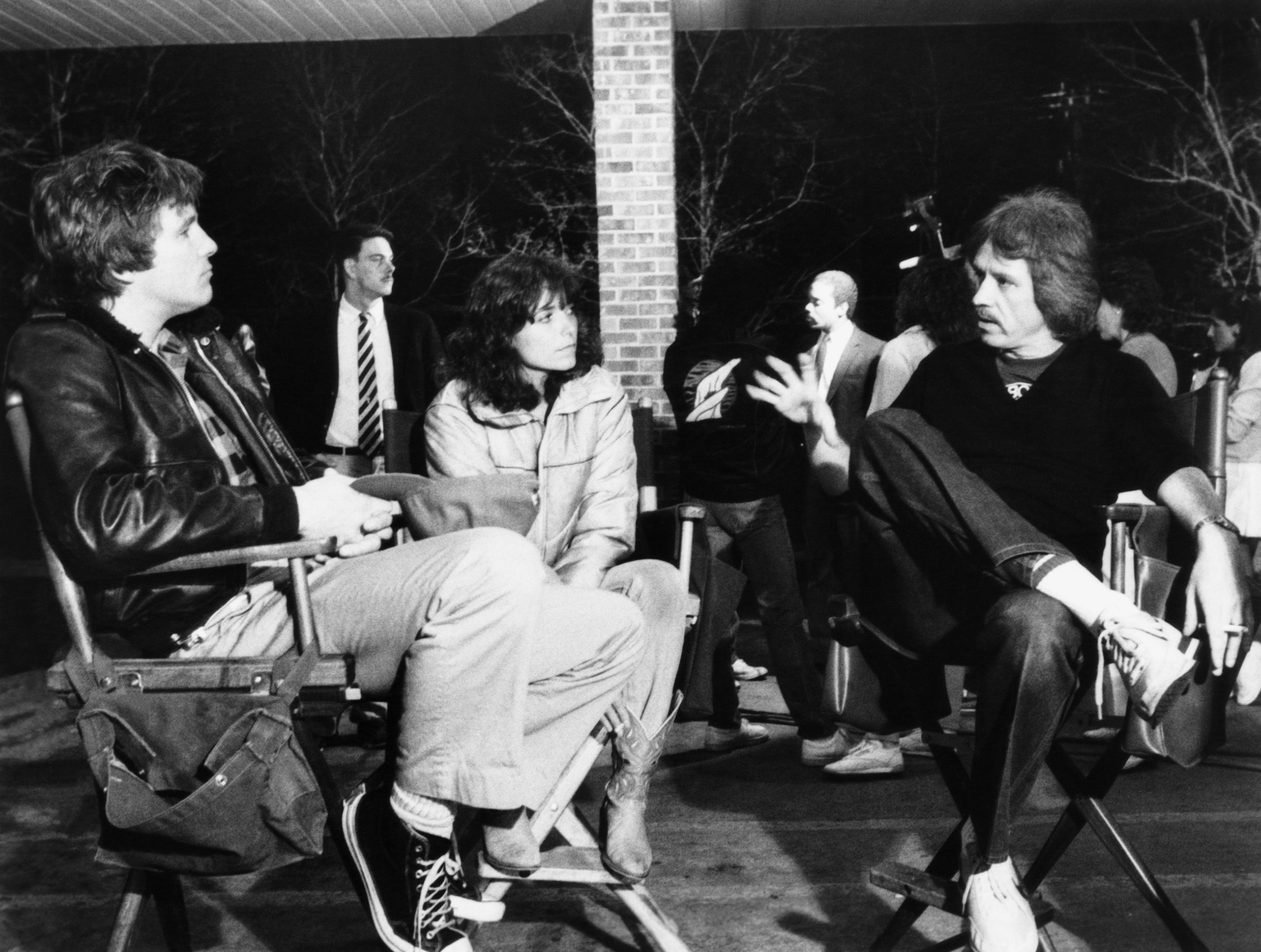
Jeff Bridges, who turns 68 today, with co-star Karen Allen and director John Carpenter on the set of Starman in 1984:
Actor in the Spotlight:
The latest installment of No Small Parts looks at the career of character actor Keith David:
[embedded content]
Movie Comparison of the Day:
Spider-Man: Homecoming isn’t just the best Spider-Man movie in years, but it’s also an improvement on the very similar Steel according to Couch Tomato:
[embedded content]
Cosplay of the Day:
Here’s some more perfect Wonder Woman cosplay inspired by this year’s enormously successful movie:
Look at this amazing Wonder Woman cosplay. It looks like she just straight up borrowed the costume from the movie set, it’s PERFECT. pic.twitter.com/uHUfnUAk8C
— Denizcan James (@MrFilmkritik) December 3, 2017
DIY Custom Build of the Day:
If you want to cosplay as a TIE Fighter pilot on Star Wars: The Last Jedi opening day next week, here’s a cheap and easy way to make a helmet:
[embedded content]
Classic Movie Clip of the Day:
This week is the 20th anniversary of the release of Good Will Hunting. Watch a classic scene from the Oscar-winning movie below.
[embedded content]
and
Is This The Right Time For a Big Tax Cut?

Senate Majority Leader Mitch McConnell addressed a tax reform news conference on Capitol Hill last Thursday, alongside Sen. Shelley Moore Capito of West Virginia and representatives of small-business groups.
Chip Somodevilla/Getty Images
hide caption
toggle caption
Chip Somodevilla/Getty Images
Republicans say the tax-cutting overhaul being debated in Congress will jump-start the U.S. economy, leading to a lot more investment and hiring by companies.
But some economists say the tax plans — which would sharply cut corporate and business taxes and eliminate numerous deductions for individuals — come at precisely the wrong time. Lower taxes could also be undercut by Federal Reserve policymakers, who are gradually raising interest rates, they say.
Tax cuts can be a good way to stimulate the economy when growth is slowing down, by encouraging businesses and people to keep spending when their finances are growing tighter.
But the economy is in the midst of its longest postwar recovery on record, with an annual growth rate of 3.3 percent last quarter. The unemployment rate is down to 4.1 percent.
Economists often argue that during periods of growth like this, governments should be paring down debt, giving them more fiscal breathing room during the next recession.
“It’s always valuable to keep your powder dry, if you can, so you do have fiscal space if there is a downturn,” says former Fed governor Randall Kroszner, now a professor of economics at the University of Chicago Booth School of Business.
But the Republican tax cuts would create more than $1 trillion in debt over the next decade, according to Congress’ Joint Committee on Taxation.
“I think the timing of this tax cut from the perspective of the deficit is completely upside down,” says Jared Bernstein, senior fellow at the Center on Budget and Policy Priorities.
He adds, “When you get to this stage of recovery and you’re closing in on full employment, you absolutely want your deficit and debt to be coming down.”
There’s an even bigger, macroeconomic problem with pushing through tax cuts right now.
If tax cuts are done right, they can increase incentives for investment and lead to productivity growth, Kroszner says.
But they can also lead to higher inflation, which can spur the Fed to raise interest rates. “If it’s seen as something that’s just short term, the Fed is likely to offset that by making sure the economy doesn’t overheat and inflation doesn’t get too high,” Kroszner says.
That’s a real concern right now. To Fed policymakers, the economy is already at or near full employment. They’ve already raised rates twice this year and are widely expected to do so again this month.
While supporters say that tax cuts would boost growth, Fed officials may decide they amount to more stimulus than the economy needs.
“I think they would say we already have pretty much a fully employed economy. A boost to aggregate demand is not exactly what the doctor ordered at this point. So maybe we should offset some of it by raising interest rates faster,” says former Fed Vice Chairman Alan Blinder, a professor of economics and public affairs at Princeton University.
In an interview with The Wall Street Journal last week, New York Fed President William Dudley said he supported efforts to make the tax code simpler, but he appeared to question the need for a tax cut.
“It would be a reasonable question to ask, is this the best time to apply fiscal stimulus, when the economy’s already close to full employment?” Dudley said. “It’s probably not the best time.”
What The CVS And Aetna Merger Has To Do With Amazon

The $69 billion merger of the drug store chain CVS with insurer Aetna is about several things. Depending on whom you ask, it’s about transforming the pharmacy store experience, getting a stronger foothold in lucrative sales of specialty prescription drugs — or about preparing for a future threat from Amazon.
MARY LOUISE KELLY, HOST:
To other news now – drugstore giant CVS wants to buy the insurance company Aetna for $69 billion. This would be a huge deal with ramifications for the whole health care industry, and we’re going to explore now why these two companies want to pair up. I have a hint for you, which is, it may or may not have something to do with an online giant named Amazon.
NPR business reporter Alina Selyukh is here to walk us through all this. Welcome.
ALINA SELYUKH, BYLINE: Hello.
KELLY: So what’s the driving force behind this merger? Why do CVS and Aetna want to get together?
SELYUKH: Well, in many ways, this was kind of the logical next step both for CVS and Aetna. They’re both already feeling pressure in core businesses from competitors like UnitedHealth. Aetna had tried to grow by buying a rival insurer, Humana. The government interrupted that merger. And as for CVS, it’s a company that spent the past few years attempting a bit of a metamorphosis. They’re trying to shed the image of a corner drugstore and become a health care company. And this merger could help that.
KELLY: What does that mean – to become a health care company? Has CVS shared what their grand vision is here?
SELYUKH: The head of CVS, Chief Executive Larry Merlo, has been using this catchphrase America’s front door to health care. And one of the things that companies are promoting is this plan for a nationwide network of community medical clinics. The idea is to use CVS locations, of which there are 9,700, and turn them more into clinics where you can get a wide array of basic health services like seeing a nurse practitioner, getting some labs, dealing with chronic conditions like high blood pressure or diabetes.
KELLY: Ok. So I mentioned the name Amazon – threw that into our conversation a moment ago – Amazon, which does not run health care clinics yet.
SELYUKH: No, not yet.
(LAUGHTER)
KELLY: But they do sell a lot of the things that you could walk into a CVS and buy like your toothpaste, your Band-Aids, whatever. Why is Amazon a factor here?
SELYUKH: So it depends on whom you ask whether Amazon even is a factor. Amazon has a powerful and threatening backstory. It forced major bookstores out of business, and so its share – its shadow often looms larger than any kind of specific thing the company might do.
So remember; Amazon bought Whole Foods. Immediately after that, there was a – epic predictions of just how the – Amazon might use those physical locations to become the store that sells you everything. And so that kind of a spread to pharmacies as well – Amazon has been coming up on earnings calls in the health care industry, including for CVS, whose CEO, Merlo, was asked about the threat of Amazon earlier this year. Here’s what he said.
(SOUNDBITE OF ARCHIVED RECORDING)
LARRY MERLO: Listen. There’s no question that Amazon is a competitor in the marketplace. They’ve done a great job. And you don’t take anything that they’re doing for granted. But at the same time, I think that we have a lot of capabilities and a value proposition that can compete effectively in the market.
SELYUKH: In short, CVS is just kind of watching Amazon for now.
KELLY: Well, and Alina, what do we know about Amazon’s ambitions? I mean, does Amazon want to get into the prescription drug business?
SELYUKH: The company itself does not say, but analysts have been reading various tea leaves to speculate about Amazon’s plans. And some even think that the merger of CVS and Aetna was a defensive move against that possibility. But I also spoke with an industry consultant, Adam Fein, president of Pembroke Consulting. And he is a skeptic.
ADAM FEIN: We actually know almost nothing about what Amazon wants to do. And so I think the speculation about Amazon has far, far exceeded anything they’ve said or hinted at.
SELYUKH: Fein points out that the big money in prescription drugs is not in selling your routine meds for cough or blood pressure, which is kind of implausible Amazon territory. But it’s the expensive specialty drugs for very serious conditions like cancer or MS.
KELLY: Right.
SELYUKH: Plus, many people may not realize that CVS already has a foot in the insurance business. It makes a lot of its money serving as a sort of middleman, negotiating prices of prescriptions between insurers and drug companies. All of that makes for very tough competition for a company like Amazon to enter after never being in the health care industry before.
KELLY: That’s NPR’s Alina Selyukh. And you heard her here on NPR News.
Copyright © 2017 NPR. All rights reserved. Visit our website terms of use and permissions pages at www.npr.org for further information.
NPR transcripts are created on a rush deadline by Verb8tm, Inc., an NPR contractor, and produced using a proprietary transcription process developed with NPR. This text may not be in its final form and may be updated or revised in the future. Accuracy and availability may vary. The authoritative record of NPR’s programming is the audio record.
Team Russia Waiting To Learn Fate For 2018 Winter Olympics
On Tuesday, Russia will learn whether it will be allowed to compete in the 2018 Winter Olympics in PyeongChang, South Korea. Officials have already stripped six medals won by Russia in the previous Winter Olympics because of doping.
KELLY MCEVERS, HOST:
The Winter Olympics in South Korea are coming, and tomorrow we will find out if Russia is going. The International Olympic Committee is set to decide whether the Russian team can compete because of Russia’s ongoing doping scandal. NPR’s Tom Goldman reports the IOC’s decision could have a major impact on the entire Olympic movement.
TOM GOLDMAN, BYLINE: The IOC faced a similar decision last year. Leading up to the Rio de Janeiro Summer Games, an independent report detailed a widespread state-sponsored doping system in Russia during a period that included Russia’s hosting of the 2014 Winter Olympics in Sochi. Russian athletes won the most gold medals there and the most medals overall.
There were calls to ban Russia from the Rio Olympics, but the IOC essentially punted and had the federations that run individual sports decide. This resulted in a last-minute patchwork Russian team competing in Brazil. This time, says Olympic historian Jules Boykoff, the IOC has to act.
JULES BOYKOFF: I think we have too much evidence now.
GOLDMAN: Boykoff wrote the book “Power Games,” a political history of the Olympics.
BOYKOFF: Unlike ahead of the Rio Olympics, the process has moved through IOC channels. And so the IOC commissions that have been set up to look at doping are now banning Russians on what seems like an almost daily basis.
(SOUNDBITE OF ARCHIVED RECORDING)
UNIDENTIFIED WOMAN: (Speaking Ukrainian).
GOLDMAN: This Ukrainian newscast announced some of the nearly two dozen Russian athletes who’ve been sanctioned since last month, including Olympic medal winners. And the numbers are expected to grow. Additionally, the World Anti-Doping Agency, WADA, says Russia still hasn’t fully complied with WADA standards. The push for IOC action includes a call to ban all Russian athletes from the upcoming Winter Olympics. But even those most affected by doping think that’s a step too far.
(SOUNDBITE OF ARCHIVED RECORDING)
UNIDENTIFIED MAN: (Speaking German).
GOLDMAN: When American biathlete Lowell Bailey earned his first podium finish top three in this 2014 race, he didn’t know the Russian athlete who finished one place ahead of him was, in Bailey’s words, doped to the gills. The Russian served a two-year suspension and returned to competition. The incident sharpened Bailey’s attitudes toward doping.
LOWELL BAILEY: Such a vile act, the worst thing you can do as a competitor.
GOLDMAN: But the anger doesn’t blind him to the fact that a total Russian athlete ban for the upcoming games would unfairly punish the clean Russian athletes.
BAILEY: In this case, I would like to see due process first and foremost. I think every athlete deserves that.
GOLDMAN: Many agree. And among those calling for the strongest possible action, the consensus is this. Ban the Russian Federation, but allow individual athletes to compete if they pass stringent drug tests. And those who get in would compete under a neutral flag, wearing a neutral uniform. Russian leaders who continue to deny state sponsored doping don’t like that, and they say they might respond by boycotting the games. For the IOC, it’s a delicate balancing act. Russia’s a major power player in the Olympic movement. But Jules Boykoff says the IOC also knows it has to be firm to back up all its tough talk about fighting doping, especially at a vulnerable time for the Olympics.
BOYKOFF: There’s no getting around the fact that fewer and fewer cities are game to host the Olympic Games. And what could happen if they make a decision that Russia reacts very negatively to – they could fracture the Olympic movement in perhaps a way that would be unfixable, at least in the near term.
GOLDMAN: Critics say the IOC has a history of deflecting tough decisions. Rarely has the call been stronger for the Committee to confront and act and start to repair a tarnished brand. Tom Goldman, NPR News.
(SOUNDBITE OF CFCF’S “RAINING PATTERNS”)
Copyright © 2017 NPR. All rights reserved. Visit our website terms of use and permissions pages at www.npr.org for further information.
NPR transcripts are created on a rush deadline by Verb8tm, Inc., an NPR contractor, and produced using a proprietary transcription process developed with NPR. This text may not be in its final form and may be updated or revised in the future. Accuracy and availability may vary. The authoritative record of NPR’s programming is the audio record.
What's Behind Bitcoin's Recent Price Surge?
The bitcoin value has soared recently and continues to rise as more and more people invest in the currency. NPR’s Michel Martin asks business writer Roben Farzad what’s behind the sudden skyrocketing value.
MICHEL MARTIN, HOST:
So while we’re talking about money, you may have heard over the last few weeks bitcoin is hot. As of today, one bitcoin is worth – well, I don’t even want to say because by the time we finish this conversation, it could have changed. But let’s just say for now that it’s been bouncing between $11,000 and $12,000 all day, which is quite a leap from yesterday or last week or even 2009 when the digital currency was created. We’re wondering what all this volatility means – if anything – so we called Roben Farzad. He is a business reporter and the host of Full Disclosure, which covers topics related to business and economics. Roben, thanks so much for joining us.
ROBEN FARZAD, BYLINE: Michel, how are you?
MARTIN: I’m great. Thank you. So as we just said, the bitcoin prices have been changing hour to hour. What do you make of all this?
FARZAD: You know, I’m like so many of those other people on the sidelines on the cheap seats, saying, oh, it’s a speculative bubble, it’s a speculative bubble and once it breaks – what was it? – $800 last year, breaks 1,000, 2,000, 3,000. At every step in the game even with crashes, it has managed to break $10,000. And increasingly, the cold-eyed observers on Wall Street can’t make sense of it. I mean, what does it represent? It’s kind of a Rorschach for whatever you want it to be.
MARTIN: Well, you know, it was created in 2009. But until pretty recently – I think I’m fair to say this – it had a somewhat of a negative reputation as the currency of cyber criminals. I mean, people – some people who’ve had the unfortunate experience of being hacked will say that, you know, that people offer to unlock their information if they’re paid in bitcoin. Has the reputation changed?
FARZAD: We do not see it accepted at many places. It’s not like you can walk into a Dairy Queen or something and pay with bitcoin. I mean, there are occasional Tech Crunch articles about a bitcoin atm. But it doesn’t have as much in the way of practical application right now. I think for people who are skeptical about currencies like the euro and the dollar, that those central banks have just been printing left and right to get out of the global economic crisis, they just want something that’s decentralized – in theory, that is person-to-person, that cuts out the man and the middle man.
In practice, it really hasn’t gotten there yet. It’s more something that’s really run ahead of itself. It reminds me of the Internet browsers like Netscape and Mosaic when they first came out in ’93 and ’94, and everybody just thought that they were going to lead to a brave, new world. And they had to crash several times for people to understand what the true business justification for a price was.
MARTIN: And I’m wondering if a number of people heard about bitcoin from family members over the Thanksgiving weekend or just because there’s been – there have been a number of stories in the media about it because of all these, you know, this wild kind of volatility. And so that makes me wonder if some of this sudden surge is from people jumping into it just because they’ve heard about it.
FARZAD: Indeed, Michel. I regret to inform your dear listeners that the Roben Farzad Iranian contrarian relative index has been triggered. When I hear from people I didn’t even know were related to me – Farzad, bitcoin is good. Should I buy it? That means you need to stay the heck away or get out. And we are close to that.
MARTIN: Before we let you go, what would it take to give this digital currency more legitimacy among professional investors and, frankly, users? I mean, what is the business case?
FARZAD: For a system to work like this, you really need a major economy or a major corporation to somehow be able to bring it online and show that it can work in real time. Right now, I think it remains something in theory that sounds great. You know, it sounds rebellious. It sounds like opting out of the system. It sounds like you’re being an iconoclast by adopting it. In practice, you are hardly seeing it anywhere but these headlines about it running up 1,000 percent in a year.
MARTIN: That’s Roben Farzad, business reporter and host of the podcast Full Disclosure on NPR One. He’s also the author of a book that has nothing to do with bitcoin called “Hotel Scarface.” Roben, thanks so much for speaking with us.
FARZAD: My pleasure, Michel.
Copyright © 2017 NPR. All rights reserved. Visit our website terms of use and permissions pages at www.npr.org for further information.
NPR transcripts are created on a rush deadline by Verb8tm, Inc., an NPR contractor, and produced using a proprietary transcription process developed with NPR. This text may not be in its final form and may be updated or revised in the future. Accuracy and availability may vary. The authoritative record of NPR’s programming is the audio record.
CVS To Buy Health Insurer Aetna For $69 Billion

A CVS store is pictured in 2015 in San Francisco. CVS Health is reportedly preparing to purchase Aetna for $69 billion.
Justin Sullivan/Getty Images
hide caption
toggle caption
Justin Sullivan/Getty Images
Updated at 8 p.m. ET
CVS is preparing to buy the health insurance giant Aetna for $69 billion, the companies say.
The acquisition, which has been reportedly in talks for months, would be one of the largest such mergers in the history of health care. It would combine CVS Health Corp, which has more than 9,000 pharmacy stores and more than 1,000 walk-in clinics, with an insurance company that covers more than 22 million members.
In a press release Sunday, CVS says it will pay $207 for each share in cash and stock, reflecting a 29 percent premium over Aetna’s share price on Oct. 25, The Associated Press reports. (Oct. 25 is the last day not affected by talk of the sale; on the 26th, The Wall Street Journalreported on CVS and Aetna’s acquisition talks.)
The companies say, “This transaction fills an unmet need in the current health care system and presents a unique opportunity to redefine access to high-quality care in lower cost, local settings — whether in the community, at home, or through digital tools.”
In October, Amanda Starc, associate professor of strategy at Northwestern’s Kellogg School of Management, spoke with NPR about the implications of any deal between CVS and Aetna.
She noted that CVS is not just “the drugstore on the corner.”
“In practice, CVS provides a lot of drug insurance through something called a pharmacy benefits manager,” Starc says. Large national insurers like Blue Cross Blue Shield already contract with CVS for their pharmacy benefits.
In fact, that program accounts for “the majority of their revenue,” Starc says. “So while you might think of them as the drugstore, they’re ultimately a big insurance company.”
Buying Aetna will make CVS even moreof an insurance company, instead of a retail pharmacy, she says.
“It will allow them to have a large, captive audience for that insurance arm, and that might allow them to do a couple of things. They might be able to negotiate lower drug prices from manufacturers by virtue of their sheer size,” Starc says, while noting that doesn’t necessarily mean lower prices for consumers.
“They might also be able to better align your pharmacy benefits and your health care benefits,” she says. For instance, an integrated insurer could “provide pharmacy benefits to incentivize you to do things like fill your blood pressure pills so that you don’t end up in the hospital.”
As The Wall Street Journalpreviously noted, and The New York Times and Bloomberg emphasize today, Amazon is one motivation for CVS to buy Aetna. The web-based behemoth, which has shaken up so many industries, is now eyeing the pharmacy business, prompting companies like CVS to worry about their future.
The Wall Street Journalnotes that Aetna also faces challenges of its own — “A judge’s decision led Aetna earlier this year to give up its planned acquisition of Humana Inc. and [Aetna] has retreated from the unprofitable Affordable Care Act exchange business, leaving it with an unclear path to future growth, analysts say. It also lacks the diversity of larger rival UnitedHealth Group Inc., which has a fast-expanding health-services arm that includes a pharmacy-benefits manager as well as doctor practices and surgery centers.”
New Jersey Takes On Major Professional Sports Leagues In Sports Betting Case

The justices of the U.S. Supreme Court have been known to play a long shot in an election betting pool or to bet a colleague about the outcome of the World Series. But the stakes are usually just a few dollars. Not so for the winners and losers in a case to be heard Monday that tests whether the federal ban on sports betting in most states unconstitutionally tramples on state sovereignty.
The Bradley Act
The ban was known as the Bradley Act, after its chief promoter, Sen. Bill Bradley, D-N.J.
New York Knicks player Bill Bradley is shown in New York City in Oct. 1970.
AP
hide caption
toggle caption
AP
Bradley played 10 years for the New York Knicks, helping them win two NBA championships. The former Princeton star and Rhodes scholar went on to serve three terms in the Senate, winning accolades as a serious legislator.
In all of his 18 years on Capitol Hill, Bradley introduced just one bill related to sports — a ban on sports betting.
The bill, which passed easily, banned gambling on sports in 46 states, exempting four states — Delaware, Montana, Nevada and Oregon — that had already legalized it, and giving all the rest a year in which to legalize sports gambling if they wanted to.
In an NPR interview, Bradley said his motivation was simple, and personal. “Betting on sports was betting on human beings, and I thought that was wrong,” he explained. “It turns players into roulette chips. It makes the game, which is a game of high-level competition and excellence, into slot machines, and I don’t think that should be what we do in this country.”
Bradley said there was virtually no congressional opposition to his bill back in 1992. Though Bradley added that Donald Trump, with failing investments in Atlantic City casinos, lobbied against it, believing that sports betting was the answer to his financial problems there.
After the bill passed, New Jersey did not seek to legalize gambling in its one-year window of opportunity.
That was then, and this is now, however.
Now the American Gaming Association estimates that illegal sports betting has grown to $150-billion-a-year market. And cash-starved states are salivating at the thought of raising billions from legalizing and licensing that activity, not to mention taxing the proceeds.
Down the shore
Enter New Jersey, home to at least a half dozen shuttered Atlantic City casinos, and a state where Republicans and Democrats since 2011 have been trying to overturn the federal ban or somehow get around it.

Casinos are seen along the boardwalk in Atlantic City, N.J., in June. In the background is the former Revel Casino.
Seth Wenig/AP
hide caption
toggle caption
Seth Wenig/AP
“We intend to go forward to allow sports gambling to happen,” Gov. Chris Christie, R-N.J., said bluntly at an event to promote Atlantic City in 2012. “If someone wants to stop us, then they’ll have to take action to try to stop us.”
Twice the state has tried to legalize sports betting. Twice, the major sports leagues and the NCAA have taken the state to court, each time contending that the state is violating the federal ban enacted in 1992. And twice the state has lost in federal appeals court.
Now, however, the issue has reached the Supreme Court, with the state contending that the federal law unconstitutionally commandeers the states to enforce the federal ban.
Playing puppet master or just business as usual vis-a-vis states?
Arguing Monday’s case will be two men, each of whom served as solicitor general in the George W. Bush administration.
Representing New Jersey is lawyer Ted Olson who argues that the federal government cannot tell the states they have to carry out the federal ban on sports betting.
He contends the federal government cannot say to the states: “You’re just working for us. You take the responsibility. We’ll give the instructions. We’ll be the puppet master.”
He rests his case on two prior Supreme Court cases holding that the federal government cannot commandeer a state’s apparatus to enforce a federal law. Most notably, in 1997 the Supreme Court ruled that the federal law requiring state and local officials to carry out background checks on gun buyers was unconstitutional because it commandeered, or conscripted, state and local officials to enforce a federal law.
But lawyer Paul Clement, representing the sports leagues and backed by the Trump administration, says this case is very different. He contends that the federal ban on sports betting doesn’t commander anything. All it does is set out what states may not do.
Clement says that the federal ban simply says that the states “can’t authorize sports betting. They can’t authorize a state lottery system that involves a component of sports gambling.”
Clement argues that “it’s just not that unusual for Congress to tell states that they can’t do things that they want to do.”
Congress, in such cases, is establishing a federal policy that pre-empts what the states can do.
The Supreme Court has often upheld such federal pre-emption statutes — for example, barring states from adding to federally approved labels for pharmaceuticals, or barring states from setting trucking rates.
The clash of constitutional theories in this case, however, may be besides the point in the real world. In the modern economic landscape, there is a growing tolerance for sports betting. Even among the sports leagues that are fighting New Jersey in this case there is more interest in Congress in changing the federal law.
Money, money, money
The reason boils down to one simple word: money.
Everybody sees a chance to profit, from the states to the professional sports leagues.
In 2014, Adam Silver, commissioner of the National Basketball Association, wrote an op-ed piece in the New York Times calling for “a federal framework” to legalize sports betting.
The National Football and National Hockey Leagues have decided to move major sports teams to the capital of sports betting, Las Vegas.

Odds are displayed on a screen at a sports book owned and operated by CG Technology in Las Vegas in 2015.
John Locher/AP
hide caption
toggle caption
John Locher/AP
Major League Baseball, as well as the NBA and the NHL, have invested in sports fantasy companies. And the NFL, as well as Major League Baseball, are increasingly partnering with data dissemination firms for gambling purposes overseas.
So it is no surprise that even if the court does not uncork the bottle of legalized sports betting, Congress just might revisit its ban.
For the man who started it all — Bill Bradley — that is dispiriting.
“A lot of things make money,” he said. “The question is what’s right and what’s wrong. Do you want your children involved in betting on sports? How about little league? How about junior high school?”
After all, he says, there’s money to be made by betting on the spread in those games, too.
A decision in the sports betting case is expected later in the Supreme Court term.
5 Trends At The LA Auto Show That May Change How We Move

The Infiniti QX50 Crossover is displayed at the 2017 LA Auto Show in Los Angeles. The car features a new engine that shows automakers are still finding ways to improve the gasoline engine, even as electric vehicles are gaining in popularity.
Mark Ralston/AFP/Getty Images
hide caption
toggle caption
Mark Ralston/AFP/Getty Images
There’s more than cars at an auto show.
Auto shows are not only a place for consumers but for vendors, executives, reporters, activists, investors and consumers. They are more like conventions. With 10,000 parts on a car, that means a lot of vendors.
This year’s LA Auto Show definitely had its stand out cars. Jeep redesigned the Wrangler. Volkswagen’s latest entry in the electric car world seems aimed at Tesla. Porsche’s fans were all abuzz about word of plug-in hybrid 911.
All these cars and concepts were cool, but there wasn’t some game-changing technology that was introduced to overtly change the world (car CEOs nowadays often ape the tech world bombast). Walk around the show and you’ll find some technology and advances that aren’t necessarily sexy but are changing the way we move around.
Baby you subscribe my car
Economists and sociologist have been talking about consumers beginning to prefer access instead of ownership. The newest car subscription services are the industry’s long-awaited answer to car sharing services. Book By Cadillac costs about $1,600 a month, including insurance and maintenance, and you can get any Cadillac. Book was introduced in New York this year, and is coming to Los Angeles, with a national launch pending.
Volvo announced its own service for its XC-40 crossover and there’s a similar service from the struggling Lincoln brand.
“Lincoln and Volvo’s moves to new vehicle subscription services are reflective of a broader shift we’ve been seeing across the industry as sales decline,” says Jessica Caldwell with Edmunds. Automakers “appear to be more open to exploring new business models.” It’s an attempt to make their brands stand out and keep more customers while also grabbing market share from the competition, she says.
ICE ICE baby: New twists on the internal combustion engine
As cool as the slew of hybrid, all-electric and other alternative fuel vehicles are, we still live in the world of the gasoline engine. While the internal combustion engine is the Rodney Dangerfield of the car world (“I get no respect!”), engineers continue extraordinary innovation.
Karl Brauer with Cox Automotive points to the Infiniti QX-50’s new variable compression engine as sign of the leaps being made. “It allows you to get more performance when you need it and more fuel savings,” he says.
In addition, there’s Mazda new compression-ignition engine, which represents a leap forward in fuel efficiency. Brauer says this innovation could keep the internal combustion engine around for a lot longer. “They keep making electric cars and even hybrid cars seem a little better and then that damn internal combustion engine evolves again,” he says. The constant innovation of the “boring” ICE is what keeps its lead “in terms of cost versus efficiency,” he adds.
Build a better map
As we look toward a world where computers drive cars, maps and map technology become more important. Google Maps, Microsoft and Tom Tom don’t just provide maps for your phone but for automakers and various other industries that need them.
One of the smaller companies that’s trying to change the mapping space is what3words. It creates addresses that make sense to both computers and humans.
“Think of how frustrating it is when you call an Uber and you spend 10 minutes trying to find each other,” says company executive Clare Jones. “Try to find Juarez Street in Mexico City,” she jokes. That’s because the city has more than 600 streets with that name.
The company has divided the world into a grid, with trillions of 10-foot squares. Each square gets a three-word name. “The computer wants to hear longitude and latitude, and people don’t think that way,” Jones says. The point of such services is to make it easier for the transition to autonomous cars.
My bicycle: Personal transport
As the big car companies’ race toward the electric and self-driving future, there’s growing competition for the personal transportation world. Think everything from skateboard to three-wheeler. There is intense demand for small personal conveyances. Companies such as Micro Kickboard, Razor USA, Propella Electric Bikes, and the foldable scooter Urb-B were some of the exhibitors.

The $899 URB-E Sport foldable electric vehicle includes a removable battery that can charge up to five devices simultaneously.
Daniel Seman
hide caption
toggle caption
Daniel Seman
Current motorcycles and mopeds use gas or diesel and often have lower fuel economy and high soot output which contributes to air pollution and greenhouse gases. These new electric alternatives could aid in cutting pollution in major cities around the globe.These companies are aiming at the what’s called “the second commute” — the trip from the train station to the office, for example.
These new vehicles currently appeal to the young, but they could help provide mobility or ease transportation for older and disabled people. The hope of many in this mini-industry is that as cars go autonomous the roads will get safer for smaller vehicles.
Saturday Sports: Tiger Woods And Eli Manning
Tiger Woods is attempting yet another comeback and Eli Manning will not start for the first time in 13 years.
SCOTT SIMON, HOST:
And now it’s time for sports.
(SOUNDBITE OF MUSIC)
SIMON: Eli Manning’s streak of consecutive games is scheduled to come to an end tomorrow. But in golf, Tiger Woods might be back again. NPR sports correspondent Tom Goldman joins us. Tom, thanks so much for being with us.
TOM GOLDMAN, BYLINE: Scott, thanks for having me.
SIMON: (Laughter) And Tiger’s looking like he can play golf again, isn’t he?
GOLDMAN: You know, he certainly doesn’t look like a nearly 42-year-old man returning from his fourth back surgery. In his first competitive golf in almost a year, he has shot two straight rounds in the 60s. He’s swinging free and hard. He’s hitting the ball far. He’s chipping and putting. It looks solid. Granted, Scott, this tournament he’s playing in is a nice, little cushy event hosted by him in the Bahamas. It only has 18 players, although many of them are the world’s top-ranked guys.
SIMON: It’s his own – he’s hosting his own event? Surely, that’s stacking the deck, isn’t it? But go ahead. Yeah?
GOLDMAN: (Laughter) No, no, no. I mean, everyone has a shot. There is no cut after two rounds, so it’s not the pressure cooker of a regular PGA Tour event. But he led for a time Friday. Going into today, he was five shots behind the leader. And Tiger Mania (ph) is growing. There’s so many people who are so eager to see him do magical things on the golf course again.
SIMON: He’s had a lot of back trouble, as you note – four surgeries – and, to be sure, personal trouble, much of his own making. But he’s only 41, 42. He could have some very strong years – tricky as backs are – couldn’t he?
GOLDMAN: Yeah. Well, he could. You know, a few. Backs are very tricky, especially with violent torquing golf swings like Tiger’s. And we should note that he played this event last year. He did really well – raised expectations like he is now. And then in a couple of events after that, his back deserted him. He did play golf for nine straight days before this event began to get his back and his body and his mind ready. After two really good rounds, the back appears to be holding up. He said he took some Advil during the round yesterday not because he was hurting but because of his surgeon’s orders. So we shall see. If he can stay healthy, 2018 could be a fascinating year on the Tour.
SIMON: Yeah. Eli Manning doesn’t start tomorrow – New York Giants against the Oakland Raiders – ending a streak of 210 regular season games at that number. Now, the Jints have had a miserable season, but is Eli Manning the reason?
GOLDMAN: Well, he’s not the entire reason. It’s always – you know, it’s a team failure. But yeah. You look at a few key stats, and Manning doesn’t appear to be the guy who led the Giants to two Super Bowl titles in the last nine years. You know, perhaps it was time to move on.
But it’s the way the Giants did it that has appalled many fellow players and fans. He was told he could keep starting the final games of the season to keep the streak alive but that he’d come out of games so the team could take a look at his backups. He wanted none of that. He said that was more about chasing hollow numbers than competing.
SIMON: Yeah. The NFL’s been dealing with social actions and protests this season. They announced a social action plan initiative of their own this week. What do you see in it?
GOLDMAN: It’s a response to the player protests begun by Colin Kaepernick last season, which, you know, multiplied this season. The NFL reportedly will put up about $90 million over seven years for social justice programs – programs that deal with improving education, community police relations, the criminal justice system. Some players still are suspicious of this and say the league is trying to buy its way out and get players to stop protesting. But there are a lot supporting the plan. And at the very least, this appears to be a step in a good direction.
SIMON: NPR’s Tom Goldman, thanks so much for being back with us. Talk to you soon.
GOLDMAN: Always a pleasure, Scott.
(SOUNDBITE OF SPEEDOMETER SONG, “TROUBLED LAND”)
Copyright © 2017 NPR. All rights reserved. Visit our website terms of use and permissions pages at www.npr.org for further information.
NPR transcripts are created on a rush deadline by Verb8tm, Inc., an NPR contractor, and produced using a proprietary transcription process developed with NPR. This text may not be in its final form and may be updated or revised in the future. Accuracy and availability may vary. The authoritative record of NPR’s programming is the audio record.
