
Kenyan Woman Abused By Nurses During Childbirth Wins Landmark Case

Extreme lack of attention is not unusual in hospitals in poor countries, says Martin Onyango, legal advisor for the Center for Reproductive Rights based in Nairobi.
Thomas Mukoya/Reuters
hide caption
toggle caption
Thomas Mukoya/Reuters
When Josephine Majani came to, she was on a hard hallway floor in the Bungoma District Hospital in Bungoma, Kenya.
Majani heard nurses yelling: “I saw them carry the baby away. They screamed at me, ‘Why have you delivered on the floor? Who is going to clean up all this blood? Get up. Get your things and go back to the delivery room.’ I was helpless.”
Majani has no memory of being slapped, she says, but when she regained consciousness her cheeks stung. She did as she was told. She struggled to her feet and followed nurses back to the room to deliver the placenta.
This was in August 2013. Eight years earlier, she had safely delivered a girl at home. Then four years before, she gave birth to a boy at a hospital.
“It was good, clean care. I had assistance. It was a good experience,” she says of that delivery.
Her third baby had been overdue — so three days before his birth, she went to the hospital. She was given medication to induce labor. As her labor progressed, she found herself on her own.
“There were no attendants, no one to assist me,” she says. “I called for help, and no one ever came. I got out of bed to find someone to help me. I was in the hall, and I fell on the floor. I was unconscious.”
That’s when the baby came.
This extreme lack of attention is not unusual in hospitals in poor countries, says Martin Onyango, the senior Africa legal advisor for the Center for Reproductive Rights based in Nairobi.
“This is a systemic problem in Kenya,” he says. Onyango is Majani’s attorney in a landmark case against the hospital.
What was unusual was that a hospital intern captured it all on video: the mother and newborn on the floor, the slaps, the verbal abuse, the public humiliation.
The video fell into the hands of a Kenyan journalist. It ran on television programming nationally in Kenya — and went viral not long after the incident.
“We got to know of Josephine’s case because we saw it on TV,” Onyango says. More than four years later, in February, the court issued a landmark ruling awarding Majani $25,000 (2.5 million Kenyan shillings) in damages, requiring that hospital staff formally apologize to her and setting a precedent that demands women be given quality care and treated with dignity during childbirth.
“The court ruled that nothing excuses behavior that is so degrading to a woman, a human being,” Onyango says.
Dr. Sanghvi Harshad is chief medical officer of Jhpiego, a group that works in 40 countries to improve health care for women and families.
“What happened to this lady is unfortunately all too common,” says Harshad, a Kenyan who formerly headed up the University of Nairobi Hospital. “I recently visited a hospital in western Kenya. They are equipped for 10 to 15 births a month. But they’re doing almost 300 births a month. You can imagine the overcrowding, the shortage of supplies.”
Such conditions can be fatal. A report released by the Kenya government in February found that of 484 maternal deaths in Kenyan hospitals studied in 2014, 90 percent were the result of substandard care.
According to statistics reported by the CIA, Kenya has the 19th highest rate of maternal mortality among 184 countries studied — with 510 deaths per 100,000 births. Finland, Poland, Iceland and Greece are the safest countries to give birth in, with 3 deaths per 100,000 births. The United States ranks 138th with 14 maternal deaths per 100,000 births.
But Peter Johnson, senior director for nursing and midwifery at Jhpiego, says most people go into health care, nursing or midwifery because they sincerely want to help people in need. He has seen people he calls heroes and saints delivering maternity care under the most difficult circumstances.
“Nobody wants to be mean. They want to make a difference,” Johnson says. “But these folks can work under horrendous conditions. I’ve been in labor wards in India where I’ve watched midwives kick rats out of the way to get to the woman.”
Midwives in poor countries are not always trained as thoroughly as they are in the developed world, Harshad says. And often, because they are usually women in places with great gender inequality, they are not respected. Add to that overcrowded conditions and lack of supplies and resources, and nurses and midwives can feel enormous pressure to move women along during labor.
“Providers can be in a state of panic,” Harshad says. “Under those conditions, mothers will get pushed, slapped, verbally abused, partly because of the provider’s panic.”
When nurses and midwives see the abuse in their training, they copy the behavior, and the cycle of abuse continues, he says. “We need to fix how people are being trained.”
Harshad looks to a program he worked on in Afghanistan as a model for how to develop a system of maternity care.
“Midwifery schools were wiped out. We needed to completely revamp them,” he says. “We wanted to empower midwives to be full professionals. We taught them computer skills. We taught them English so they could read the medical literature. It has paid off tremendously. They are extremely competent.”
Another program in Mozambique has encouraged mothers to ask for a companion— a husband, mother, sister or friend — to accompany them in the hospital through labor and delivery. Such so-called companionship programs have been shown to improve the quality of care in hospitals, according to a February World Health Organization report, Intrapartum Care for a Positive Childbirth Experience.
“Fifteen years ago, the level of companionship was essentially zero,” Harshad says. “As of a year ago, 58 percent of mothers in Mozambique now have a companion.”
And in Kenya, a program of anonymously surveying mothers about their hospital maternity care is beginning to pay off. Harshad explains:
“Everyone, even poor people, have cell phones in Kenya. We told mothers they would receive a text message survey when they got home. We asked: Was it clean? Were they treated with kindness? Were they scolded? We showed the results to the hospital. And they took action. If we told them that 26 percent of patients said they did not receive privacy, they took action. It’s hard, because of overcrowding, but they started putting up curtains.”
The Center for Reproductive Health, along with Jhpiego, are part of an international movement to improve the birth experience most recently exemplified by the WHO recommendations on childbirth, Harshad says.
“Those guidelines are unique,” he says. “They focused not just on hard science, but on what women themselves want in their childbirth experience.”
Women all over the world have struggled to have their voices heard regarding labor and delivery, and even wealthy countries can fall short, says Johnson:
“I’ve worked in the city of Baltimore as a midwife for many years. I’ve seen some of the same phenomena — people living under chronic stress; nurses, midwives and physicians working under difficult circumstances; a feeling of bad chemistry, bad communication; women being induced before they’re ready; withholding water if they’re thirsty, or food if they’re hungry; not letting them out of bed to walk around so they can be more comfortable. These are things that we’re promoting globally, but we don’t always promote it here in the U.S.”
Maternity care may be changing at a glacial pace, but Majani is proud that her horrendous experience has helped move the needle toward better care.
“I just know this is going to be a lesson to all the clinical attendants who perform their work in maternal health care,” she says. “They are going to serve the people equally. They are going to be loving and perform their work with kindness.”
Susan Brink is a freelance writer who covers health and medicine. She is the author of The Fourth Trimester, and co-author of A Change of Heart.
Today in Movie Culture: 'Solo: A Star Wars Story' Easter Eggs, How 'Justice League' Should Have Ended and More
Here are a bunch of little bites to satisfy your hunger for movie culture:
Easter Eggs of the Day:
There’s a new trailer for Solo: A Star Wars Story, so here’s Mr. Sunday Movies with a funny breakdown highlighting Easter eggs and other things we need to know:
[embedded content]
Movie Homages of the Day:
Speaking of Easter eggs, Moon Film highlights all the movie references in the Despicable Me/Minions movies:
[embedded content]
Alternate Ending of the Day:
Green Lantern finally shows up in this amusing animated look at how Justice League should have ended:
[embedded content]
Cosplay of the Day:
Jeff Goldblum met a fan cosplaying as his Thor: Ragnarok character, the Grandmaster, at Fan Expo Dallas 2018 over the weekend:
THIS IS THE BEST JEFF GOLDBLUM PHOTO EVER
(Cosplayer : @Pharaohmone#DallasComicCon#FanExpoDallas) pic.twitter.com/K8G6cvy73V
— Cosplay in America (@cosplayamerica) April 9, 2018
Game Show Parody of the Day:
Chadwick Boseman reprises his role as Black Panther for a Saturday Night Live sketch where he’s a contestant on “Black Jeopardy”:
[embedded content]
Vintage Image of the Day:
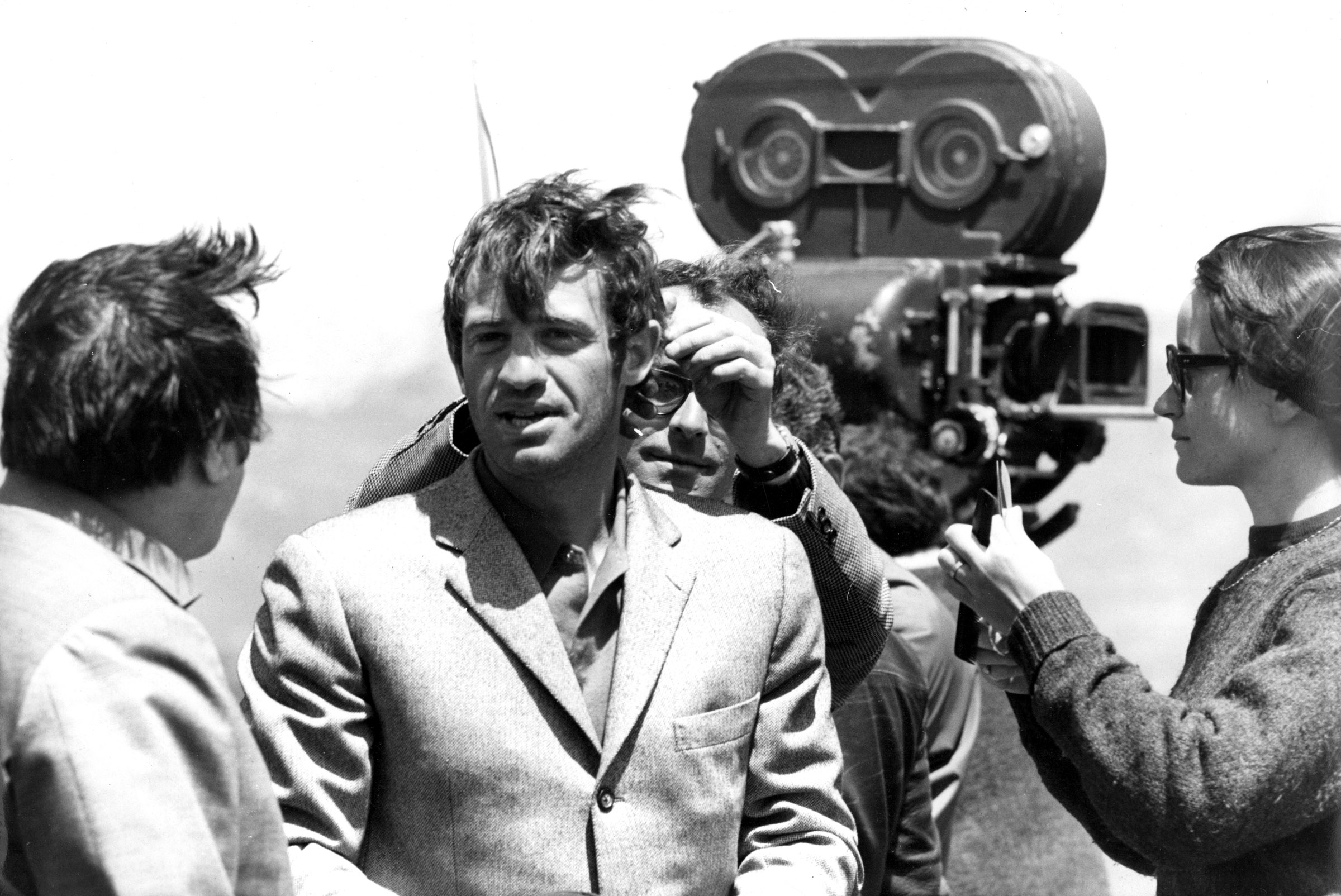
Jean-Paul Belmondo, who turns 85 today, receives direction from Jean-Luc Godard on the set of Pierrot le Fou in 1965:
Filmmaker in Focus:
In honor of the release of You Were Never Really Here, Fandor and Daniel Mcilwraith spotlight the films of Lynne Ramsay:
[embedded content]
Film History of the Day:
One Hundred Years of Cinema looks at the landmark production of Snow White and the Seven Dwarfs, Disney’s first animated feature:
[embedded content]
Mashup of the Day:
It could use some Dick footage, but this Watergate crossover using clips from The Post, All the President’s Men and Forrest Gump is otherwise perfect:
[embedded content]
Classic Trailer of the Day:
Today is the 25th anniversary of This Boy’s Life starring Robert De Niro and a young Leonardo DiCaprio. Watch the original trailer for the classic drama below.
[embedded content]
and
Ky. Lawmakers Didn't Consult Federal Experts About Limiting Black Lung Claims Reviews

Excised and preserved lungs on display at the National Institute for Occupational Safety and Health in Morgantown, W.Va., in 2012, show the dramatic effect of black lung disease.
Howard Berkes/NPR
hide caption
toggle caption
Howard Berkes/NPR
Updated at 8 p.m. ET
The federal agency that trains, tests and certifies the physicians who read X-rays and diagnose the deadly coal miners’ disease black lung said today it was not consulted by Kentucky lawmakers in the 14 months they considered a new law that mostly limits diagnoses to pulmonologists working for coal companies.
As NPR and Ohio Valley ReSource first reported, the new Kentucky law bans certified radiologists from reading X-rays used to award state black lung compensation. That leaves out radiologists with extensive experience in reading chest X-rays and diagnosing black lung, a disease caused by inhalation of coal and silica dust.
Instead, the law reserves that task for pulmonologists, and only six in Kentucky are certified to read black lung X-rays. Four of those six typically work for coal companies, according to an NPR review of federal black lung claims.
Training, testing and certification are provided by the National Institute for Occupational Safety and Health, a federal research agency. The agency certifies “B readers” who are uniquely qualified to diagnose black lung based on X-rays.
“NIOSH was not consulted about this bill,” said spokeswoman Christina Spring, who also provided the comparative pass/fail rates of certified physicians who are required to take recertification exams.
“There is no evidence that performing ILO classification, a standardized process for describing findings present on chest radiographic images used in evaluating black lung cases, is done differently by B Readers with medical backgrounds in radiology vs. pulmonology,” Spring said.
In fact, radiologists have a slight edge with 90 percent passing the exams in the last 10 years, while 85 percent of pulmonologists were recertified.
Calling for repeal
“To have that established process superseded by legislators and a political process is inappropriate,” said Dr. William Thorwarth, CEO of the American College of Radiology.
“This is a matter of life and death for many people,” Thorwarth added. “Politics should be left out of it.”
Thorwarth also called on the Kentucky Legislature to repeal the changes, which came in larger “reforms” of the state’s workers’ compensation law.
The revised law is “off base,” said Bill Bruce, the executive director of the American College of Occupational and Environmental Medicine, a group representing 5,000 physicians who specialize in occupational and environmental injury, illness and disability.
“There is no rationale for limiting X-ray interpretation to pulmonary physicians,” Bruce told NPR Monday. “Qualified physicians in other specialties should be allowed to do so if they have demonstrated competency.”
Coal miners in Kentucky suffering from black lung can seek state or federal compensation for black lung disease, although state benefits may be greater and easier to obtain.
As NPR has reported, the rate of the advanced stage of disease, known as complicated black lung, is at epidemic levels.
State black lung claims in Kentucky have risen about 40 percent since 2014, according to an analysis of state data by Ohio Valley ReSource.
The state Department of Workers’ Claims reports that more than $3.3 million in black lung benefits went to coal miners in 2014.
“Open to a better way of doing it”
The lead sponsor of the legislation was Rep. Adam Koenig, a Republican and real estate agent from Erlanger, Ky., who told NPR he “relied on the expertise of those who understand the issue — the industry, coal companies and attorneys” during the 14 months he spent working on the changes.
In response to criticism of the law, Koenig said “not everyone who had a specific interest was involved. … I’m not sure I was even aware of NIOSH.”
Koenig added that he is “open to a better way of doing it” and may seek a hearing on possible changes in the law during legislative interim committee meetings this summer and fall.
“If the radiologists feel slighted, we’re going to talk about it,” he said. “And if they’re right, we’ll fix it.”
Kentucky’s Legislature has completed its 2018 regular session except for addressing any vetoes by Republican Gov. Matt Bevin, who signed the workers’ comp law that contains the new black lung provisions.
Pulmonologists object
“For all practical purposes, this eliminates the state workers’ compensation black lung program,” said Timothy Wilson, a Lexington attorney who represents coal miners.
Wilson is also president of the Kentucky Workers’ Association and participated in confidential negotiations focused on the black lung claims legislation.
“The coal industry was directly involved,” Wilson said, but he would not name the participants in the talks given an agreement that the discussions remain confidential.
Even one of the nation’s leading groups on pulmonology and respiratory disease has criticized the Kentucky law and urged repeal.
“This law seems to have been specifically passed to exclude physicians who are neutral” in assessing black lung disease, said Dr. Robert Cohen, a pulmonologist at the University of Illinois, Chicago who has spent 30 years focused on black lung disease.
Cohen spoke on behalf of the American Thoracic Society, which represents more than 15,000 pulmonologists, physicians, other health care providers and researchers focused on respiratory disease.
The Kentucky law “is a disservice to miners,” Cohen said. “It was ill-considered.”
Benny Becker is a reporter with Ohio Valley ReSource, a regional journalism collaborative reporting on economic and social change in Kentucky, Ohio and West Virginia.
Canadian Community Mourns Loss Of 15 Members Of Youth Hockey Team

Over the weekend 15 members of a Canadian youth hockey team were killed in a bus collision in rural Saskatchewan. NPR’s Mary Louise Kelly speaks to Globe and Mail reporter Carrie Tait about how the community is coping.
MARY LOUISE KELLY, HOST:
In Humboldt, Saskatchewan last night, families, friends and fans gathered for a vigil at the ice rink where the Humboldt Broncos practice. The youth hockey team was headed to a game on Friday when its bus collided with a tractor-trailer. Ten players, two coaches, a broadcaster, a statistician and the driver were killed – 15 people in all. Broncos team president Kevin Garinger spoke to mourners last night.
(SOUNDBITE OF ARCHIVED RECORDING)
KEVIN GARINGER: We are gathered in a state of shock and unthinkable heartache. This tragedy has devastated our families, our Humboldt Broncos organization, our community, Saskatchewan, Canada and our world.
KELLY: Globe and Mail reporter Carrie Tait was at that vigil. She’s been reporting from Humboldt all this last awful weekend. And, Carrie Tait, welcome to the program.
CARRIE TAIT: Thank you for having me.
KELLY: Set the scene for us. What was this vigil like last night?
TAIT: Well, this is in the Humboldt Broncos’ arena, and that’s sort of the social heartbeat in a small town. And so at the very, very front, you had people like the man you just heard speaking. In front of that, on the ice surface, there were families and the billet families. And the billets are the parents who take kids in who aren’t from here. And then there was overflow, and overflow for the overflow, and overflow for the overflow.
KELLY: To make sure I understand what you’re saying about the billet families, this youth team that’s based in Humboldt – Humboldt’s a small town. The players are from all over Canada. So is the way it works the players come and they find a host family that – where they live for a period of time while they’re playing for the team?
TAIT: Yeah, it’s like any hockey league or sports league where you’re drafted. And in towns like this, particularly hockey towns, there’s families who take kids in constantly. That’s sort of the double whammy here is that it’s both biological families have lost their children, and then billet families have lost their children. And they look at these kids like they’re sons.
KELLY: And we mentioned this is a junior team. The players on this team would’ve been – what? – in their late teens up to early 20s?
TAIT: Yeah. The youngest is 16, and then you’re sort of graduated out of it age-wise at 21.
KELLY: So these boys are a big deal in this town. These are the heroes of this town.
TAIT: Yeah, absolutely. And, you know, it’s not just like they are kids who play hockey. They’re the kids who really do have organized, call us and we’ll go shovel your driveway in the winter, or where they’re helping out with fundraisers. And that’s why people have much more of a connection to them. They’re heroes, and they’re great hockey players, but they’re part of the town.
KELLY: As awful as this tragedy is, I understand that a mistake at the coroner’s office has added to the awfulness. There was a mix-up in identifying one of the deceased and one of the survivors. I saw that the coroner’s office was saying maybe some part of the problem was all these boys looked alike ’cause they had all dyed their hair blond in solidarity for the playoffs.
TAIT: A couple of things. A – you know, the hockey players often, you know, have a similar physique. This was an obviously horrific crash, and there was, you know, this isn’t about bumps and bruises.
And something like hair color – as a tidbit, that is something the team and others in town, because the younger kids play hockey or because they’re supporters, have their hair dyed this sort of bleach-blond yellow for good luck in the playoffs. But a lot of this wasn’t about hair color. It sort of shows the magnitude of the car crash.
KELLY: Carrie Tait, thank you very much.
TAIT: Thanks for having me.
KELLY: That’s Globe and Mail reporter Carrie Tait.
(SOUNDBITE OF MUSIC)
Copyright © 2018 NPR. All rights reserved. Visit our website terms of use and permissions pages at www.npr.org for further information.
NPR transcripts are created on a rush deadline by Verb8tm, Inc., an NPR contractor, and produced using a proprietary transcription process developed with NPR. This text may not be in its final form and may be updated or revised in the future. Accuracy and availability may vary. The authoritative record of NPR’s programming is the audio record.
At 78, Carlos Do Carmo, The 'Sinatra Of Fado,' Makes His New York Debut

Carlos do Carmo performs in New York for the first time at Town Hall NYC on April 7, 2018 as part of Fado Festival New York.
Sachyn Mital/Courtesy of Town Hall NYC
hide caption
toggle caption
Sachyn Mital/Courtesy of Town Hall NYC
Carlos do Carmo is known as the Sinatra of fado, Portugal’s national music. In 2014, do Carmo became the first Portuguese artist to receive a Latin Grammy Lifetime Achievement Award. This past weekend, the 78-year-old singer made his New York debut at Town Hall NYC as part of Fado Festival New York.
Often called the Portuguese blues, fado (literally, “fate”) is emotional music. “People think that fado is connected with sadness only. It’s not true,” do Carmo says. There is fado menor — sad fado in minor — joyful fado and really joyful fado, sung in a major key. A corrido is an example of really joyful fado. “The ‘corrido’ is something you even can dance and there’s got to be a smile when you sing it,” do Carmo says.
Carlos do Carmo grew up in Lisbon, Portugal and is the son of Lucília do Carmo, one of the great singers of the golden age of fado, which began in the late 1920s. His mother’s club in Lisbon became a gathering place for all of the older fado singers, says musicologist and author Rui Vieira Nery.
“He absorbed that tradition, but then he went on to re-process that heritage and he was always very curious about the interaction between fado and other genres,” Vieira Nery, the author of A History of Portuguese Fado, explains. Vieira Nery cites the singer’s keenness on Frank Sinatra and “the crooners.”
“Sinatra was the best fado singer I ever heard,” do Carmo says. “I mean it. You heard Sinatra. The same song in different records — never the same song. That’s fado.”
Do Carmo took Sinatra’s approach and applied it to his own records. Until do Carmo came along in the early 1960s, fado was usually performed by a singer and two guitarists. He brought in the orchestra.Vieira Nery says do Carmo also invited musicians who were outside the scene to compose music for fados.
“He managed to attract people from pop rock, from jazz, from art music and convinced them to actually try to get into the language of fado and write melodies for fado, just as much as he attracted some of the very best contemporary poets to write for him,” Vieira Nery says.
Ary dos Santos was one of those poets. In 1977, three years after the collapse of Portugal’s Estado Novo dictatorship, the two men collaborated on an album called Um Homem na Cidade — A Man in the City.

In the 1970s, Carlos do Carmo brought fado music out of its authoritarian past.
Courtesy of the Fado Museum in Lisbon
hide caption
toggle caption
Courtesy of the Fado Museum in Lisbon
“We lived in a dictatorship for almost 50 years. There were censorship. So if you sing under censorship, you can’t express yourself. And I lived that, I know what I’m talking about. It’s terrible, it humiliates you,” do Carmo says. “My good friend Ary dos Santos, that was a very, very good popular poet. We had an idea together: Let’s make an album about Lisbon in freedom.”
Before that album came out, fado had become old-fashioned, aligned with the regime even as do Carmo was pushing its boundaries. Um Homem na Cidade was a watershed. It was a call to artists, poets and musicians according to director of the Museu do Fado, Sara Pereira.
“Carlos was fundamental, so that [the people] could understand that fado … it can also be a song of intervention, can also be a song of protest,” she says.
Vieira Nery believes that do Carmo has helped ensure that the fado tradition will live on. And whether a fado is sad or happy, do Carmo says the music has to be deep; the lyrics have to be strong and go straight to the heart.
“For me, it’s life, love, it’s my entire life, fulfilling my dreams, the love of my hometown, the love of my country,” do Carmo says.
Bill Of The Month: A Tale Of 2 CT Scanners — One Richer, One Poorer

Maria Fabrizio for NPR
Benjamin Hynden, a financial adviser in Fort Myers, Fla., hadn’t been feeling well for a few weeks last fall. He’d had pain and discomfort in his abdomen.
In October, he finally made an appointment to see his doctor about it. “It wasn’t severe,” he says. “It was just kind of bothersome. It just kind of annoyed me during the day.”
The doctor, John Ardesia, checked him out and referred him to a nearby imaging center for a CT scan, or CAT scan as it used to be called. The radiologist didn’t see anything wrong on the images, and Ardesia didn’t recommend any treatment.
A few weeks later, Hynden, who has a high-deductible health insurance policy with Cigna, got a bill for $268. He paid it and moved on.
But three months later, in mid-January, Hynden was still feeling lousy. He called Ardesia’s office again. This time the doctor wasn’t available. A nurse practitioner, concerned that Hynden might be suffering from appendicitis, advised him to go to the hospital right away.
“I was a little worried,” Hynden recalls. “When he told me to go to the ER, I felt compelled to take his advice.”
Hynden arrived later that morning at Gulf Coast Medical Center, one of several hospitals owned by Lee Health in the Fort Myers, Fla., area. The triage nurse told him the problem wasn’t his appendix, but she suggested he stick around for some additional tests – including another CT scan — just to be safe.
It was the same kind of scanner, he said. “It was the exact same test.”
The results were also the same as the October scan: Hynden was sent home without a definitive diagnosis.
And then the bill came.
Patient: Benjamin Hynden, 29, a financial adviser in Fort Myers, Fla.
Total bill: $10,174.75, including $8,897 for a CT scan of the abdomen.
Service provider: Gulf Coast Medical Center, owned by Lee Health, the dominant health care system in southwest Florida.
Medical procedure: A CT scan, which uses X-rays to create cross-sectional images of the body. Hynden got his October scan at Summerlin Imaging Center, a stand-alone facility in Fort Myers that offers a range of diagnostic tests, including X-rays, MRI and CT scans.

Benjamin Hynden was surprised when he received a bill for a CT scan that was 33 times higher than a scan he received a few months before at an imaging center.
Alison Kodjak/NPR
hide caption
toggle caption
Alison Kodjak/NPR
Rick Davis, co-owner of Summerlin, says his center is small and independent, so he doesn’t have much bargaining power. That means insurance companies pretty much dictate what he can charge for a scan. In Hynden’s case that was $268, including the cost of a radiologist to read the images.
Ultimately, what Medicare decides to pay for a scan sets the standard. “The Medicare fee schedule is what all the other companies use as their guideline,” Davis tells me as he gives me a tour of Summerlin. “It’s basically the bible. It’s what everyone goes by.”
Summerlin’s office manager, Kimberly Papiska, says the maximum the center ever bills for a CT scan is $1,200. But the rates insurance companies pay are usually less than $300.
Hynden was shocked when he got the second CT scan in January, and the listed price was $8,897 — 33 times what he paid for the first test.
Gulf Coast Medical Center is part of his Cigna insurance plan’s approved network of providers. But even with Cigna’s negotiated discount, Hynden was on the hook for $3,394.49 for the scan. The additional ER costs added $261.76 more to that bill.
What gives: We called Gulf Coast Medical Center and its parent company, Lee Health, to understand why they billed nearly $9,000 for a single test. No one at the health center or hospital would agree to an interview.
Lee Health spokeswoman Mary Briggs responded with an emailed statement:
“Generally that it is not unusual for the cost of providing a CT scan in an emergency department to be higher than in an imaging center,” the statement said. “Emergency department charges reflect the high cost of maintaining the staffing, medical expertise, equipment, and infrastructure, on a 24/7-basis, necessary for any possible health care need — from a minor injury to a gunshot wound or heart attack to a mass casualty event.”
Do the hospital’s costs and preparations justify a list price that’s so much higher than the nearby imaging center’s tab? We asked some experts in medical billing and management for their thoughts.
Emergency rooms often charge people with insurance a lot of money to make up for the free care they provide to uninsured patients, says Bunny Ellerin, director of the Health Care and Pharmaceutical Management program at Columbia Business School in New York. “Often those people are what they call in the lingo ‘frequent flyers,’ ” Ellerin says. “They come back over and over again.”
She says hospitals also try to get as much money as they can out of private insurance companies to offset lower reimbursements from Medicare and Medicaid.
Even in that context, the price of Hynden’s hospital CT scan was high.
Healthcare Bluebook, an online pricing tool, says the range for an abdominal CT scan with contrast, like Hynden had, in Fort Myers is between $474 and about $3,700. It pegs a fair price at $595.
The higher price from Gulf Coast and its parent company could be a result of their enormous pricing power in Fort Myers, says Gerard Anderson, a professor of health policy and management at Johns Hopkins University.
Lee Health owns the four major hospitals in the Fort Myers area, as well as a children’s hospital and a rehabilitation hospital, according to its website. It also owns several physician practices in the area. When you drive around Fort Myers, the blue-green Lee Health logo appears on buildings everywhere.
“Anybody who’s in Fort Myers is going to want to get care at these hospitals. So by having a dominant position, they have great bargaining power,” Anderson says. “So they can raise their rates, and they still do OK.”
Anderson says his research shows hospital consolidation has been driving prices higher and higher in recent years. And because more and more people, like Hynden, have high-deductible insurance plans, they’re more likely to be on the hook for huge bills.
So Lee Health and other dominant hospital systems mark up most of their services on their master price lists — the list that prices a CT scan at Lee Health at $8,897. Anderson calls those lists “fairy-tale prices” because almost no one actually pays them.
“Everybody who’s taken a look at it agrees — including the CFO of the organization — that it’s a fairy-tale thing, but it does have relevance,” Anderson says.
The relevance is that insurance companies usually negotiate what they’ll pay at discounted rates from list prices.
So from the master price of $8,897, Cigna negotiated Hynden’s bill down to $5,516.14 — a discount of almost 40 percent. Then Cigna paid $2,864.08, leaving Hynden to pay the rest.
“If it wasn’t for that CT scan, I don’t think this whole thing would have been so difficult and so blatantly obvious that they’re extremely overcharging for that service,” Hynden says.
Resolution: Hynden never got a definitive diagnosis from the CT scans. Several weeks after his second test, however, he went to a nearby urgent care center, also run by Lee Health, and they performed an ultrasound on his abdomen. That test, which cost about $175, revealed some benign cysts that his doctor says are likely to go away on their own.
The takeaway: Tests and services are almost always going to be more expensive in an emergency room or hospital setting. If your doctor suggests you go to an ER, it might be worth asking whether an imaging center, urgent care or walk-in clinic would suffice.
Sources: Explanations of benefits provided by Hynden and interviews.
Non-Crowd Favorite Patrick Reed Holds Off Rickie Fowler To Win The Masters

Former Masters champion Sergio Garcia, of Spain, helps Patrick Reed with his green jacket after winning the Masters golf tournament Sunday in Augusta, Ga.
Chris Carlson/AP
hide caption
toggle caption
Chris Carlson/AP
Golfer Patrick Reed was best known for the trophies he shared at the Presidents and Ryder Cup . It’s for his performance at the latter that he picked up the nickname “Captain America.”
But all that changed on Sunday when Reed, 27, won his first major championship at the Masters in Augusta, Ga. Reed is the fourth consecutive Masters champion to capture his first major at that tournament.
On the 18th hole, Reed finished with a 1-under 71 to hold off challenger Rickie Fowler. For Fowler, it was his eighth top-five finish in a major championship and third as runner-up. He’s still waiting to celebrate his first major title win.
From the beginning of play at Augusta National, it was clear that Reed, who’s originally from Texas, was not the crowd favorite. He picked up on that when he and four-time major winner Rory McIlroy, who’s from Northern Ireland, were announced on the tee box — McIlroy got a noticeably louder ovation.
ESPN reports it’s understandable why the fans didn’t want Reed to win:
“It was never going to be pretty with Patrick Reed, the golfer who collected more enemies than most on his stormy rise from boyhood prodigy to college bad boy to self-promoting PGA Tour winner to master of the Masters. Reed was kicked off his University of Georgia team, and nearly voted off his Augusta State team by his schoolmates, for offenses that ranged from alcohol-fueled misbehavior to an arrest for underage drinking and constantly talking down to lesser teammates, as well as alleged cheating infractions. His coach at Augusta State, Josh Gregory, suspended him and warned him that his entire career was about to go up in smoke.”
Reed’s parents live in Augusta but they weren’t at the tournament and it is reported that they weren’t at their son’s wedding in 2012. Despite the estrangement, Golf.com reports Reed’s mom Jeannette and dad Bill hosted a Masters party.
“The Reeds lived and died with every shot on the back nine, hooting and hollering at the TV. When the final putt dropped, they clung to each other like survivors in a life raft. Struggling to catch her breath, tears streaming down her cheeks, Jeannette said, “I can’t believe my son is the Masters champion. It’s surreal.” It was a dizzying mix of pride and pain.”
Reed won’t discuss his family situtation. When asked about it after his Masters victory, Reed told reporters, “I’m just out here to play golf and try to win golf tournaments.”
A Career Trucker Helps To Steer The Path For Self-Driving Trucks

Safety driver Jeff Runions with one of Starsky Robotics’ autonomous testing trucks.
Alexi Horowitz-Ghazi/NPR
hide caption
toggle caption
Alexi Horowitz-Ghazi/NPR
When Jeff Runions started his trucking career nearly 40 years ago, he had high hopes for what the job might bring.
“I wanted the American dream.”
Since then he’s seen the industry from every step of the ladder — as an independent owner-operator, a full-time company driver, a parts manager, and finally a trucking depot manager.
In his latest job developing autonomous trucks, Runions, 58, has a front row seat to what many see as the future of the 700 billion dollar trucking industry. He’s found himself in the middle of a heated race between Silicon Valley juggernauts like Uber and Google to get their self-driving trucks out onto the road first.
“It’s like when they went to the moon,” Runions says. “We’re not going to the moon, but it feels kinda like a new technology’s coming up and how many people would think a semi would be driving itself?”

Jeff Runions, during his years as an owner-operator, with his truck.
Courtesy of Jeff Runions/Courtesy of Jeff Runions
hide caption
toggle caption
Courtesy of Jeff Runions/Courtesy of Jeff Runions
Runions, who lives in Jacksonville, Fla.,works a startup called Starsky Robotics — a company smaller than Uber or Google. Instead of trying to beat their competition to developing fully autonomous vehicles, Starsky’s strategy is to develop trucks that are fully autonomous on the highway — then let remote drivers take the wheel from offices filled with arcade-style consoles, when they hit city streets.
The strategy is still in its testing phase: Runions is a safety-driver. He sits in the driver’s seat of the truck cabin, ready to take control if there’s trouble.His test rides range from an hour and a half to eight hours-long.
He also works alongside his company’s programmers to test and tweak the truck’s sensors and software.
“I come up with some suggestions once in a while and they do work. I’m not an engineer like these guys are, but sometimes they listen to me. So, that means I’m part of the team too,” he said.
Runions, after all, has nearly four decades of experience in the trucking industry under his belt.
In the mid-80s, he became an owner-operator, and purchasing a truck and leasing out his services on contract to freight companies.
For a while, Runions enjoyed the freedom that came with having his own truck and the camaraderie he found with fellow truckers he met while crisscrossing the country.
“We were like the cowboys of the old days, doing our own thing,” he said. “We were truckers, and we were young. We were having a good time.”
But as the years dragged on, life on the road began to lose its luster. Between regular sleep deprivation and a diet based on truck stop junk food, Runions started to feel that the trucker lifestyle was unhealthy. And the hectic schedule took a toll on his family life.
“You just get tired of the same stuff all the time and sleeping in the truck,” he said. You’re in this little box all the time. You can’t really go anywhere. The only thing you gotta do is go to sleep and get up and do it again.”
After fuel prices surged in the early 2000s, Runions decided that going it alone didn’t make financial sense for him anymore. After more than 20 years of contracting himself out, Runions sold his truck and took a job with a commercial trucking company.
But he soon found that the new gig had its own downsides.
“A normal driver that works for a company, they gotta stay out three weeks at a time, and they give them two days off when they get home,” he said. “Soon as they get home, after their two days, they gotta go right back out for 21 more days. That ain’t much of a life. Then you’re staying in that box again.”
Runions eventually worked his way up to management, but despite the position’s better pay, he found its hours and stress were even worse.
“I was always in there from 3 o’ clock in the morning to 3 o’ clock in the afternoon,” he said. “I was [worn] out, so I decided to try something that was different. And you can’t get more different than this.”
Runions came across an online ad for a technology company in search of experienced truck drivers. At first, he was unsure about getting behind the wheel of a self-driving truck, but he says he’s come to enjoy the work and its hours. “I’m home when I need to be,” he said. “I’m a happy person now.”
Runions says that since he began as a test-driver in early 2017, he’s heard pushback from people who doubt the safety of autonomous vehicles.
“People are scared of this technology because they don’t understand exactly what’s going on with it,” he said.
That’s one of the reasons Runions finds his new job meaningful.
“I feel like I’m helping make this truck right. And we want to make sure that it’s safe as it can be being on the highway,” he said.
He’s also heard from fellow truckers who fear that the new technology will put them out work. But Runions points out the of tens of thousands of open trucking jobs now that the industry is struggling to fill. He thinks that demand plus the growing need for remote drivers mean there’ll be plenty of trucking jobs down the road.
And, Runions says that allowing drivers to work remotely will ultimately make their lives better.
“If you can get where you can [have] a 40-hour hourly [weekly] job like a regular person and be home for your family, can’t ask no more than that,” Runions said.
“That’s like a regular life. A lot of drivers don’t have that.”
NPR’s Emily Sullivan produced this story for digital. NPR’s Eliza Dennis helped produce this story for broadcast.
5 Thoughts On 'Moving Day' At The Masters

Tiger Woods hits on the fourth hole during the second round at the Masters golf tournament Friday.
Chris Carlson/AP
hide caption
toggle caption
Chris Carlson/AP
Saturday at the Masters golf tournament begins with American Patrick Reed holding a two-shot lead over Australia’s Marc Leishman. Reed expertly handled the tricky, shifty winds and slick greens to post the best round of the day Friday – 6 under par 66.
He’s the only golfer in the field to score both rounds in the 60’s. Now that field has been whittled from 87 to 53 following yesterday’s cut. Saturday, nicknamed “Moving Day,” is when the tournament begins in earnest.
Here are 5 things to know as Moving Day begins.
1. Tiger’s Down But Not Out
Pre-tournament publicity for four-time Masters champion Tiger Woods was off the charts – understandably so considering his improbable comeback from severe back problems that threatened to end his career prematurely.
Huge expectations led to Woods being tabbed one of the favorites at Augusta, even though he hadn’t won a tournament since 2013. But his recent second and fifth place finishes were all Tiger fans needed. Alas, the expectations, so far, have proved too huge – his difficult 3 over par 75 in Friday’s second round left him 13 shots behind leader Patrick Reed. “I hit my irons awful today,” Woods said afterwards. “I didn’t control my distance, my shape, my spins. I left myself in bad spots.”
But.
No one is proclaiming the Tiger Woods’ comeback over. Woods reminds eager reporters it was only six months ago he wondered if he’d ever play golf again.
You scan his face now for hints of a grimace after another violent swing, and it’s not there. You look for a limp or a painful bend at the hip with hands on knees – not there. As long as the back fusion surgery he had last year continues to hold him together, Woods insists he will reclaim the game that once left the sports world in awe.
Can he do it the next two days in Augusta? It’s a very tall order even he acknowledged after Friday’s round. He said he has to shoot two rounds in the mid-60’s, while a bunch of really good golfers fall apart. Probably won’t happen. But as he said following his fifth place finish at last month’s Arnold Palmer Invitational in Florida, “If I can play with no pain and I can feel I can make golf swings, I’ll figure it out. I’m starting to piece it together tournament by tournament and each tournament’s gotten a little bit crisper and a little bit better.”
Woods fans are waiting for “crisper” and “better” in Augusta. If it doesn’t happen, at least there’s this – for the first time since April 2015, he made the cut at a major championship and got to play on the weekend.
2. The Leader
Twenty-seven-year-old Patrick Reed has never won a Major Tournament…but there would be some definite symmetry if his first were the Masters, in Augusta, Georgia. Reed went to Augusta State University, where he helped the men’s golf team win the NCAA Division 1 title in back-to-back years: 2010 and 2011.
As Reed’s professional career has evolved, he’s become known as a fiery Ryder Cup competitor. His duel with Northern Ireland’s Rory McIlroy was a highlight of the 2016 team event
Reed is paired Saturday with Australian Marc Leishman, also trying to win his first major championship. Leishman’s best Masters finish is a tie for 4th in 2013.
3. Champions Are Lurking
For the most part, the Masters always brings out the best in the best. Not surprisingly, there’s tremendous talent right behind Reed and Leishman. Henrik Stenson, McIlroy, Jordan Spieth, Dustin Johnson and Justin Thomas all have won at least one major title and all are considered among the best in the men’s game.
A big part of the Masters’ allure is its tradition (“unlike any other”) and so what would an Augusta National leaderboard be without champions from the past? On this Saturday they are well represented with Vijay Singh (2000), Fred Couples (1992) and Bernhard Langer (1985, 1993) making the cut as well.
4. The Weather Will Be Frightful
Already the weather has had an impact on this Masters – while the Augusta National Golf course has appeared as picturesque as ever to TV viewers, the winds on Friday turned tricky and inconsistent. Players talked about being thrown off by the shifting breezes and how they sometimes had to wait to hit their ball until the winds resumed blowing in the directions that were expected.
But the Saturday forecast predicts even worse, plus rain. According to golf.com, tournament officials say showers are “likely in the morning, but by the afternoon the weather will turn worse with occasional heavy downpours and the potential for thunderstorms.”
Bad news for Patrick Reed and all those others near the top of the leaderboard – their reward for working so hard and doing so well Friday, is a later start on Saturday. Later and, now it appears, soggier.
During Friday’s broadcast of the Masters on ESPN, commentator and former player Curtis Strange, said, with maybe just a shade too much hyperbole, “with the weather forecast for the weekend, anybody who makes the cut has a chance to win. No telling what will happen.”
One potential advantage to the rain – the water should soften up the greens and make them less treacherous. Perhaps meaning fewer putts gently tapped rolling across and off the greens; or maybe players will have an easier time spinning shots and having them stick on the green rather than scoot off. Too bad defending champion Sergio Garcia won’t be around to take advantage of that. Garcia missed the cut after his golf balls did anything but stick on his disastrous 15th hole during the first round.
5. Who wins? 6 is the magic number
As in six shots behind. According to this chart, players need to be within 6 shots of the lead after Friday to win the Masters. And this 2013 assertion plays out over the following years. In 2014, eventual winner Bubba Watson led after two rounds. In 2015, winner Jordan Spieth led after two rounds. In 2016, winner Danny Willett trailed the leader by 4 shots after two rounds. And last year, winner Sergio Garcia was tied for the lead after two rounds.
So? There are six golfers within six shots of Patrick Reed’s halfway lead of 9 under par. They are Leishman, Stenson, McIlroy, Spieth, Johnson, Thomas. One of these seven men will win the 2018 Masters.
Unless of course Curtis Strange’s prediction comes true, and the rain and wind turn the tournament completely upside down.
Rep. Ro Khanna On Silicon Valley And Facebook
Facebook’s Mark Zuckerberg heads to Congress next week. NPR’s Scott Detrow talks to Rep. Ro Khanna, Democrat of California, who represents Silicon Valley.
SCOTT DETROW, HOST:
This coming week, Facebook CEO Mark Zuckerberg will sit before House and Senate committees. He’ll be answering questions about how a conservative political firm improperly obtained data about up to 87 million Facebook users. The Cambridge Analytica scandal looks like it may be a tipping point when it comes to how the public and how politicians view social media.
Congressman Ro Khanna is a Democrat, and he represents Silicon Valley in Congress, and he joins us now. Congressman, thanks for coming on the show.
RO KHANNA: Absolutely.
DETROW: So what do you want to hear from Mark Zuckerberg this week? What questions do you think he needs to answer?
KHANNA: Well, I’m glad he’s testifying. I’m glad he’s doing media interviews, and I hope he will come out for well-crafted regulations. I personally have advocated that we need an Internet Bill of Rights. It’s time that tech leaders like Zuckerberg embrace that, including a right to know what your data is, a right to be able to transfer your data, a right to be able to delete your data. There are a number of commonsense provisions that we need enshrined into law.
DETROW: Do you think there’s room, especially in an election year, to get something passed that deals with this?
KHANNA: I absolutely think there is. The reason is that even Republicans and Libertarians will support, I believe, an individual’s right to privacy to their own data. This is a case where technology has moved lightning-fast, and the laws haven’t caught up. There should be some commonsense principles that will assure the American public that their rights are going to be protected online.
DETROW: You know, both political parties have long embraced Silicon Valley, and you yourself got a lot of key endorsements from tech figures, including Facebook COO Sheryl Sandberg. But from the beginning, the whole point of social media was to monetize people’s personal data. And in recent years, campaigns have done a lot of bragging about how efficiently they can microtarget voters. So what’s changed here?
KHANNA: Well, I’m still very proud of representing Silicon Valley, proud of having Sheryl’s support, and I think she can play a very constructive role now in articulating the right type of regulation that we need. I guess what I’d say is I still believe in the power of social media. The Parkland kids are using Facebook Live to get their message out and mobilize – and Twitter to help mobilize a new generation. It would be wrong to say, let’s not have social media, when the next generation is being inspired politically by it.
DETROW: Yeah.
KHANNA: But what 2016 showed us is that these technologies can be very dangerous if they are abused.
DETROW: Sandberg and Zuckerberg have both said in recent days that they misjudged this. They focused too much on the positive and not enough on the potential downsides of social media. Do you think Congress misjudged this as well?
KHANNA: I do. I put more blame on Congress. I mean, we shouldn’t rely on 30-year-old entrepreneurs to come up with legal frameworks for protecting our national security or protecting American citizens. This is an area where Congress, I think, has been derelict, and where we need to step up and do our jobs.
DETROW: You know, to the joy and relief of congressional reporters like me, Congress has been in recess over the past two weeks, so you’ve been able to spend a lot of time in your district. And I’m wondering what the mood is there. Is there a circling of the wagons in the tech community?
KHANNA: There’s a sense that tech needs to get out ahead of this – that we need to take the lead on being a positive force when it comes to job creation and when it comes to protecting American citizens. So I think there’s been a social, political awakening of the valley – a recognition that they really need to engage in thinking about the common good and the proper types of regulation to make sure that they safeguard their reputation.
DETROW: That’s Congressman Ro Khanna. He represents California’s 17th Congressional District, which includes a lot of Silicon Valley. Thanks for coming on the show.
KHANNA: Thanks for having me.
Copyright © 2018 NPR. All rights reserved. Visit our website terms of use and permissions pages at www.npr.org for further information.
NPR transcripts are created on a rush deadline by Verb8tm, Inc., an NPR contractor, and produced using a proprietary transcription process developed with NPR. This text may not be in its final form and may be updated or revised in the future. Accuracy and availability may vary. The authoritative record of NPR’s programming is the audio record.
