Articles by admin

No Image

Documents Show How Close The Trump Administration Is With 'Fox News'

The ties between Fox News and the Trump administration are strong as can be on-air. Documents show how producers ran questions and at least one script by staffers for former EPA chief Scott Pruitt.


AUDIE CORNISH, HOST:

Newly released documents underscore just how close the Trump administration is with Fox News. The documents show how Fox producers ran questions for former EPA chief Scott Pruitt by his staffers before he went on air. NPR media correspondent David Folkenflik has been following all this and more. He joins us now. And, David, what exactly have you learned about what Fox producers would do?

DAVID FOLKENFLIK, BYLINE: So this all goes back to the spring of 2017 when Pruitt was still in office. He later left under an ethical cloud. The Sierra Club obtained emails from producers for the popular morning show “Fox & Friends” in which they were basically in April and May of 2017 running questions by Pruitt’s top staffers, getting their approval on questions, making sure he got to make the talking points that he wanted to make and even in one case saying here’s the script with which we intend to introduce him – an unusual level of coordinations. And here’s what it sounded like when the questions that they approved ahead of time sound like on the air. We’re hearing from Steve Doocy here posing the first question.

(SOUNDBITE OF TV SHOW, “FOX & FRIENDS”)

STEVE DOOCY: The press made President Obama out to be the environmental savior. And yet when you look at the number of toxic dumps left on your plate, it’s a big number.

SCOTT PRUITT: Absolutely. In fact, Ainsley you said these sites across the country have some of the, you know, uranium and lead posing great risk to the citizens in those areas. An example…

FOLKENFLIK: Scott Pruitt making the talking points he wanted to make bashing the Obama administration. Similarly, Ainsley Earhardt did a follow-up question exactly going to a point that he wanted to make.

(SOUNDBITE OF TV SHOW, “FOX & FRIENDS”)

AINSLEY EARHARDT: Does this mean you can get cancer from – if you’re exposed to all of this?

PRUITT: Quite possibly, yes, and that’s why it’s so important to focus the core of the mission on those areas.

CORNISH: Now, the policy here at NPR is not to share questions with guests beforehand, right? But there are TV news shows where it’s quite common for hosts to at least confer with guests. So help us understand. What’s the harm here?

FOLKENFLIK: You don’t do it with public officials. You don’t do it with people in positions of power who you want to hold to account. Even if you’re sympathetic, even from a conservative outfit, there has to be some critical distance. Even Fox News – a spokeswoman texted me a statement to say this is serious. It’s being addressed internally. You can’t collaborate like that.

CORNISH: Is this part of a larger pattern?

FOLKENFLIK: I think there are too many examples to marshal all at once, but we don’t have to go far. Just think back a couple of weeks just before this month’s elections earlier this month, Sean Hannity and Jeanine Pirro, two of the network’s most prominent opinion hosts, were literally on the platform on stage with President Trump campaigning for Republican candidates.

CORNISH: Now, we also learned that Fox is still paying a former executive who is now at the White House. What more have you learned about that?

FOLKENFLIK: Bill Shine is the White House communications director, deputy chief of staff. He also was the president of Fox News and left the network, took this job and is still being paid significantly $3.5 million this year by the parent company of Fox News and $3.5 million next year while making decisions about the media, making decisions in fact about how the administration will handle Fox and its competitors. That’s, you know, the kind of payments that, in some cases, previous administrations, people would forego.

A point of irony – the woman that Bill Shine replaced, Hope Hicks, left the White House. She’s now headed to go to the parent company of Fox News to become their senior executive in charge of their communications policy – another sign of the close ties between the two institutions.

CORNISH: That’s NPR’s David Folkenflik. David, thanks.

FOLKENFLIK: You bet.

Copyright © 2018 NPR. All rights reserved. Visit our website terms of use and permissions pages at www.npr.org for further information.

NPR transcripts are created on a rush deadline by Verb8tm, Inc., an NPR contractor, and produced using a proprietary transcription process developed with NPR. This text may not be in its final form and may be updated or revised in the future. Accuracy and availability may vary. The authoritative record of NPR’s programming is the audio record.

Let’s block ads! (Why?)


No Image

Stalemate To Checkmate: After 12 Draws, World Chess Championship Will Speed Up

Reigning chess world champion Magnus Carlsen (right), from Norway, plays Italian-American challenger Fabiano Caruana in the first few minutes of round 12 of their World Chess Championship match on Monday in London.

Matt Dunham/AP


hide caption

toggle caption

Matt Dunham/AP

The World Chess Championship is heading toward a dramatic conclusion on Wednesday, which could give the U.S. its first champion since Bobby Fischer took the crown in 1972.

The players will embark on a series of fast-moving tiebreaks at the event in London, which will get faster and faster if they continue to draw.

Fabiano Caruana, the 26-year-old Italian-American prodigy who grew up in Brooklyn, is definitely the underdog. For 12 games so far, he has taken on the current world chess champion, Magnus Carlsen. And each game has ended in a draw.

“I’ve had mediocre years, I’ve had good years,” Caruana said in a recent interview with The New York Times. “This year has been the best by far.”

According to the organizer World Chess, it’s the first championship match where nobody has won a game through the first 12 games of regular play.

Carlsen, who is 27 and from Norway, has been on top of the game for much of his adult life. He’s held the world champion title since 2013.

But some observers think he may be losing his edge. “He’s a shadow of himself, of his best times,” chess grandmaster Judit Polgár tells NPR’s Here & Now.

Carlsen raised eyebrows at a crucial moment in Game 12, when he appeared to be in a stronger position, yet suddenly offered to leave the game as a draw.

“For whatever reason, he chose not to invest the energy and, instead, proposed a draw after 31 moves, which Caruana accepted,” according to a write-up from World Chess.

That decision was baffling to legendary chess grandmaster Garry Kasparov.

In light of this shocking draw offer from Magnus in a superior position with more time, I reconsider my evaluation of him being the favorite in rapids. Tiebreaks require tremendous nerves and he seems to be losing his.

— Garry Kasparov (@Kasparov63) November 26, 2018

“In light of this shocking draw offer from Magnus in a superior position with more time, I reconsider my evaluation of him being the favorite in rapids,” Kasparov wrote on Twitter. “Tiebreaks require tremendous nerves and he seems to be losing his.”

At the same time, World Chess pointed out that even though computer calculations say Carlsen was more likely to win when he offered the draw, “the position was complicated and it was clear that it would take a lot of maneuvering, and many hours, if Carlsen hoped to break through.”

“I wasn’t in a mood to find the punch,” Carlsen said after the game, according to FiveThirtyEight.

Polgár said Carlsen has previously been known for avoiding draws. She says the two players are very evenly matched. “I think he lost the appetite of winning, or it is not so much important for him to win again, somehow he cannot motivate himself so much as he could before,” she said.

These past 12 games have been played according to time regulations that mean each game can take hours. The players have 100 minutes each for the first 40 moves, with even more time added after that.

But on Wednesday, the pace of the game is going to speed up – a lot. The challenge of the tie-breaks is that play happens in smaller and smaller amounts of time.

The faster play is expected to work in Carlsen’s favor. He’s higher-ranked in styles of chess with tighter time regulations.

The first four tie-breaker games start with 25 minutes each on the clock, and 10 additional seconds after each move.

After those four games, if the scores are still tied, it moves to even faster rounds called “blitz games.”

First, the players play two games with five minutes each plus three seconds after each move. If they’re still tied, they’ll play another two games, and this could continue up to 10 games total.

And if it’s still even after the end of the blitz games, they’ll go to a round referred to as “Armageddon.”

The player who has white pieces gets five minutes on his clock, one more minute than the player who has black. But, should the game end in a draw, the player with black pieces is automatically the winner.

And unless the referee decides otherwise, according to the rules, the players will have just 10 minutes between each of these tie-break games.

Besides the coveted title of world champion, there’s a lot of money on the line. The players are duking it out for a prize fund of 1 million euros ($1.1 million). If it had been decided in regular games the winner would get 60 percent and the loser 40 percent — now, because it has gone to tie-break games, the winner will get 55 percent and the loser 45 percent.

It’s worth noting that it’s highly unlikely that the matches will actually get to the epic conclusion of a sudden death round.

In fact, according to calculations by FiveThirtyEight, there’s a 0.02 percent chance this World Chess Championship will end in Armageddon.

We’ll just have to watch to find out. Games kick off Wednesday at 10 a.m. ET.

Let’s block ads! (Why?)


No Image

Chronically Ill, Traumatically Billed: $123,019 For 2 Multiple Sclerosis Treatments

Shereese Hickson was diagnosed with multiple sclerosis in 2012 and is unable to work. She supports herself and her son, Isaiah, on $770 a month.

Shane Wynn for KHN


hide caption

toggle caption

Shane Wynn for KHN

Shereese Hickson’s multiple sclerosis was flaring again. Spasms in her legs and other symptoms were getting worse.

She could still walk and take care of her son six years after doctors diagnosed the disease, which attacks the central nervous system. Earlier symptoms such as slurred speech and vision problems had resolved with treatment, but others lingered: She was tired and sometimes fell.

This summer, a doctor switched her to Ocrevus, a drug approved in 2017 that delayed progression of the disease in clinical trials better than an older medicine did.

Do you have a bill for us to look into?

If you have a billing experience that you’d like to share with NPR and Kaiser Health News, you can submit it here.

Genentech, a South San Francisco, Calif.-based subsidiary of Swiss pharmaceutical giant Roche, makes Ocrevus. The drug is one of several for multiple sclerosis that are delivered intravenously in a hospital or clinic. Such medicines have become increasingly expensive, priced in many cases at well over $80,000 a year. Hospitals delivering the drugs often make money by charging a premium on top of their cost or adding hefty fees for the infusion clinic.

Hickson received her first two Ocrevus infusions as an outpatient two weeks apart in July and August. And then the bill came.

Patient: Shereese Hickson, 39, single mother who worked as a health aide and trained as a medical coder, living in Girard, Ohio. Because her MS has left her too disabled to work, she is now on Medicare; she also has Medicaid for backup.

Total bill: $123,019 for two Ocrevus infusions taken as an outpatient. CareSource, Hickson’s Medicare managed care plan, paid a discounted $28,960. Hickson got a bill for about $3,620, the balance calculated as her share by the hospital after the insurance reimbursement.

Medical service: Two Ocrevus infusions, each requiring several hours at the hospital.

Service provider: Cleveland Clinic, a nonprofit, academic medical center based in Ohio. (Cleveland Clinic has provided financial support for NPR.)

What gives: Hickson researched Ocrevus online after her doctor prescribed the new medicine. “I’ve seen people’s testimonies about how great it is” on YouTube, she said. “But I don’t think they really go into what it’s like receiving the bill.”

That was particularly shocking because, covered by government insurance for her disability, she had never received a bill for MS medicine before.

“I have a 9-year-old son and my income is $770 a month,” said Hickson. “How am I supposed to support him and then you guys are asking me for $3,000?”

Even in a world of soaring drug prices, multiple sclerosis medicines stand out. Over two decades ending in 2013, costs for MS medicines rose at annual rates five to seven times higher than those for prescription drugs generally, found a study by researchers at Oregon Health & Science University.

“There was no competition on price that was occurring,” said Daniel Hartung, the OHSU and Oregon State University professor who led the study. “It appeared to be the opposite. As newer drugs were brought to market, it promoted increased escalation in drug prices.”

With Ocrevus, Genentech did come up with a price that was slightly less than for rival drugs, but only after MS medicines were already extremely expensive. The drug launched last year at an annual list price of $65,000, about 25 percent lower than that of other MS drugs, Hartung said. MS drugs cost about $10,000 per year in the 1990s and about $30,000 a decade ago.

“We set the price of Ocrevus to reduce price as a barrier to treatment,” said Genentech spokeswoman Amanda Fallon.

[embedded content]

It was also probably a response to bad publicity about expensive MS drugs, Hartung said. “Now companies are very aware at least of the optics of releasing drugs at higher and higher prices,” he said.

Patients starting Ocrevus get two initial infusions of 300 milligrams each and then 600 milligrams twice a year. Cleveland Clinic charged $117,089 for Hickson’s first two doses of Ocrevus — more than three times what hospitals typically pay for the drug, said John Hennessy, chief business development officer at WellRithms, a firm that analyzes medical bills for self-insured employers.

As is typical of government programs such as Medicare, the $28,960 reimbursement ultimately collected by the Cleveland Clinic was far less — but still substantial.

“We kind of got ourselves in a pickle here,” he said. “We’re more excited about the discount than we are about the actual price.”

Hickson’s nearly $3,620 bill represented the portion that Medicare patients often are expected to pay themselves.

Last year, the Institute for Clinical and Economic Review, an independent nonprofit that evaluates medical treatments, completed a detailed study on MS medicines. It found that Ocrevus was one of three or four medicines that were most effective in reducing MS relapses and preventing MS from getting worse. But it also found that patient benefits from MS drugs “come at a high relative cost” to society.

At the same time, deciding which MS drug — there are about a dozen — would best suit patients is something of a shot in the dark: The science showing the comparative effectiveness of MS drugs is not as strong as it could be, researchers say.

“In general, there’s a real lack of head-to-head studies for many of these drugs,” said Hartung. The [Food and Drug Administration] has no required comparison standard for MS drugs, an agency spokeswoman said. Sometimes they’re rated against placebos. With everyone able to charge a high price, the companies have little incentive to see which works better and which worse.

Resolution: After Hickson questioned the charges over the phone, the billing office told her to apply to the hospital for financial assistance. Hickson had to print a form, provide proof of her disabled status, mail it and wait.

Hospital officials told her in October she qualified for assistance based on her income through a state program funded by hospital contributions and federal money. Cleveland Clinic wiped out the $3,620 balance.

“I’m grateful that they approved me for that, but not everybody’s situation is like that,” she said. She was worried enough about being billed again for her next Ocrevus infusion that she considered switching back to her old medicine. But her doctor wants her to give it more time to gauge its effects.

The takeaway: Always ask about charity care or financial assistance programs. Hospitals have different policies and wide discretion about how to apply them, but they often do not even tell patients such programs exist.

Because health care costs can be so high, you may be eligible even if you have a decent salary. Cleveland Clinic gives free care to everybody below a certain income, said spokeswoman Heather Phillips. But it wasn’t until Hickson called that the hospital agreed to erase the charge.

“I’ve seen people’s testimonies about how great it is” on YouTube, said Hickson about the drug Ocrevus. “But I don’t think they really go into what it’s like receiving the bill.”

Shane Wynn for KHN


hide caption

toggle caption

Shane Wynn for KHN

While there are multiple new drugs to treat serious chronic conditions, they have often not been tested against one another. Moreover, your doctor may have no idea about their prices. But he or she should.For newer drugs, all options may well be very expensive.

Keep in mind that drugs that must be infused often come with facility fees and infusion charges, which can leave patients with hefty copayments for outpatient treatment. Ask about oral medicines or those you can self-inject at home.


NPR produced and edited the interview with Kaiser Health News’ Elisabeth Rosenthal for broadcast. Marlene Harris-Taylor, from member station Ideastream in Cleveland, provided audio reporting.

Do you have an exorbitant or baffling medical bill that you’d like KHN and NPR to look into? You can tell us about it and submit a copy of the bill here.

KHN is a nonprofit news service covering health issues. It is an editorially independent program of the Kaiser Family Foundation that isn’t affiliated with Kaiser Permanente.

Let’s block ads! (Why?)


No Image

Today in Movie Culture: 'Anna and the Apocalypse' Music Video, How to Be a Great Line Producer and More

Here are a bunch of little bites to satisfy your hunger for movie culture:

Music Video of the Day:

In honor of this week’s release of Anna and the Apocalypse, here’s the clip-filled music video for Ben Wiggins’ “Soldier at War” off the movie’s soundtrack:

[embedded content]

Movie Comparison of the Day:

In honor of the hit sequel Ralph Breaks the Internet, Couch Tomato shows 24 reasons why Wreck-It Ralph is the same movie as Shrek:

[embedded content]

Cosplay of the Day:

Speaking of Ralph Breaks the Internet, here’s a Disney Princess cosplayer with a good point:

” I wore Cinderella because I thought it be nice to use this opportunity to show girls and guys of color that you can cosplay whoever you want. I wanted to show that cosplay is for everyone!” – Alyssa Sneed pic.twitter.com/Nh8WqvK6jt

— ejen @ Ikkicon (@cosplayamerica) November 25, 2018

Video Essay of the Day:

The latest video from Renegade Cut examines the Catholic themes in Sam Mendes’ Road to Perdition:

[embedded content]

Vintage Image of the Day:

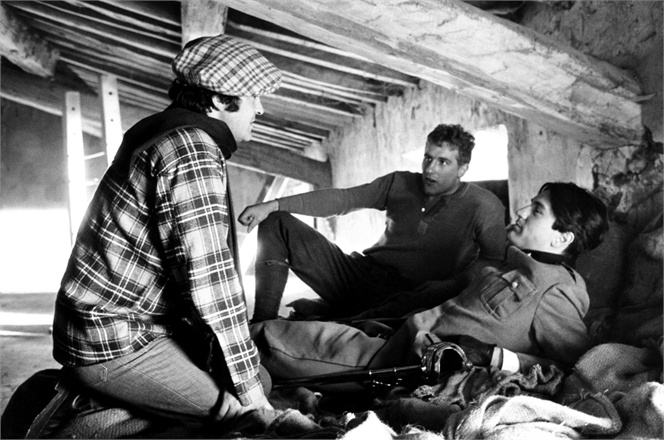
Bernardo Bertolucci, who died today at age 77, directs Robert De Niro and Gerard Depardieu on the set of his 1976 movie 1900:

Filmmaker in Focus:

For Fandor, Philip Brubaker and Andrew Warner look at the influence of Carl Jung on the movies of Terry Gilliam:

[embedded content]

Film Studies Lesson of the Day:

Also for Fandor, Jacob T. Swinney explores what food means for characters in the movies, including those in The Breakfast Club and Pulp Fiction:

[embedded content]

Filmmaking Lesson of the Day:

Ever wonder what a line producer does? The latest video from Studio Binder spotlights the job and how to be good at it:

[embedded content]

Screenwriting Lesson of the Day:

The new Lessons from the Screenplay video shows how the first 10 pages of the script for The Devil Wears Prada is a good example of how to write a good movie opening:

[embedded content]

Classic Movie Trailer of the Day:

Today is the 80th anniversary of the release of Angels with Dirty Faces. Watch the original trailer for the classic gangster movie below.

[embedded content]

and

Let’s block ads! (Why?)


No Image

Super-Fast Shipping Comes With High Environmental Costs

Getting your online purchase delivered at home in just two days puts more polluting vehicles on the road. M. Sanjayan, the CEO of Conservation International, explains what that means for the planet.


AUDIE CORNISH, HOST:

Black Friday may be over, but there’s still a lot of Cyber Monday left. And companies like Amazon and Walmart are touting free two-day shipping to entice you to click buy on that must-have item.

M SANJAYAN: The problem with that is that it does not allow for the most efficient method to be used to ship those goods to us.

CORNISH: That’s M. Sanjayan, CEO of Conservation International. He studied the environmental effects of super-fast shipping with the University of California.

SANJAYAN: While online shopping does have a smaller carbon footprint than traditional retail shopping, it’s only really better for the environment if you don’t get rush delivery.

MARY LOUISE KELLY, HOST:

Sanjayan says trucks from online retailers may go out less than full to get you your products more quickly. But it can increase harmful emissions. And another aspect of online shopping, returned items, has the same effect.

SANJAYAN: We generally think online shopping is better for the environment because it saves you from driving around, trying to find a place to get things and all of that. That only works if you’re not constantly returning things. So if you are a kind of person that buys a lot of things, tries them all out, then does multiple returns, then it’s really not going to actually be better for the planet.

KELLY: Still, with a little patience, we can get the goods we love and try to help keep the environment cleaner.

SANJAYAN: By basically checking the take your time and deliver this to me in the best method possible would mean that the trucks are going to be filled to the brim with goods when they’re being sent, and the company’s going to use the most efficient way to get it there.

CORNISH: Some companies say that their big warehouses, called fulfillment centers, are located near their customers, thus cutting down on long-haul trucking. But Sanjayan says that’s just shifting the problem.

SANJAYAN: The vast majority of stuff is still getting from Point A to Point B. It still has to get to those fulfillment centers.

CORNISH: A Walmart representative told us the company does a number of things to reduce its carbon footprint, like asking people to bundle their purchases and pick them up at stores. But Sanjayan also thinks companies can be more upfront when telling you there could be a greener way to ship your goods.

SANJAYAN: Wouldn’t it be fantastic if there was a green button that when you go and shop online, whether you’re shopping at Amazon or Walmart or any other store, you press that green button, and it assures you maximum efficiency within some reasonable period? So it says, within five days, we’ll get this to you in the most efficient means possible. It would be even better if that green button also took some of those savings that the company is now seeing because they don’t have to pay high shipping costs, and that savings is put back into the environment.

KELLY: And he says people can go even farther.

SANJAYAN: You don’t need a pair of socks to get to you swiftly. It probably makes just as as much sense to get it to you efficiently.

KELLY: M. Sanjayan. He studied the environmental effects of super-fast shipping with the University of California.

(SOUNDBITE OF MUSIC)

Copyright © 2018 NPR. All rights reserved. Visit our website terms of use and permissions pages at www.npr.org for further information.

NPR transcripts are created on a rush deadline by Verb8tm, Inc., an NPR contractor, and produced using a proprietary transcription process developed with NPR. This text may not be in its final form and may be updated or revised in the future. Accuracy and availability may vary. The authoritative record of NPR’s programming is the audio record.

Let’s block ads! (Why?)


No Image

Former Michigan State President Arraigned On Charges Tied To Larry Nassar Scandal

Former Michigan State University President Lou Anna Simon at Eaton County Court Monday.

Cheyna Roth/Michigan Radio


hide caption

toggle caption

Cheyna Roth/Michigan Radio

The former president of Michigan State University was arraigned Monday on felony and misdemeanor charges surrounding her involvement with the school’s handling of serial sexual predator, Larry Nassar. Attorneys for Lou Anna K. Simon say pleaded not guilty, and plans to fight the charges. Officials say Simon lied to or mislead law enforcement officers about her knowledge of details about a Title IX investigation by the school into Nassar.

Nassar is the former Michigan State University sports doctor who sexually assaulted his patients for decades, many of them young girls. Nassar is currently serving a de facto life sentence in prison.

Simon was president of Michigan State from 2005 until January of 2018. She stepped down amidst mounting criticism over how the university handled Nassar.

After the proceedings, Simon was sent to the county jail to be fingerprinted. Her attorney, Lee Silver said, “Dr. Simon is about as far from a criminal as anybody that I could think of and it’s ridiculous that she is being treated like a common criminal.”

Simon faces two felonies and two misdemeanor charges. The felonies each carry a maximum penalty of up to four years in prison and/or $5,000 in fines. The misdemeanors carry up to two years in prison each and/or fines.

For years, Simon has said she didn’t know about any reports against Nassar until 2016, the year the IndyStar published an investigation into USA Gymnastics’s handling of sexual abuse complaints, and Rachael Denhollander, one of the first survivors to publicly come forward against Nassar, filed a complaint with Michigan State University Police accusing Nassar of sexual assault when she was a teenager.

The charges Simon faces stem from a 2014 internal investigation into Nassar after Amanda Thomashow reported Nassar for sexual misconduct to the Michigan State Sports Medicine Clinic director.

According to court documents, Simon met with law enforcement officials in May during their ongoing investigation into who knew what and when at Michigan State about Nassar. Simon told investigators that she was aware there was a “sports medicine doc” who was the subject of a review in 2014, but she didn’t know the doctor or what the complaint was about until 2016.

Officials say they have written documents to show that Simon knew Nassar was the subject of a sexual assault complaint.

Lou Anna Simon, former president of Michigan State University, testifies during a Senate Commerce, Science and Transportation Committee hearing in June.

Mark Wilson/Getty Images


hide caption

toggle caption

Mark Wilson/Getty Images

When asked about the evidence mentioned in court documents, Simon’s attorney Mayer Morganroth said, “Look we’re not going to get into the evidence because the evidence is false, ridiculous and would even be stupid for any of you to even consider it. You’ll find out.”

The former Michigan State University president is the third person charged during the state Attorney General’s Office’s investigation into the university’s handling of Nassar. Former dean of osteopathic medicine, and Nassar’s former boss, William Strampel is awaiting trial on various charges for failing to properly oversee Nassar and using his position as a dean to try and get sexual favors from students.

A former Michigan State coach also faces a criminal trial for allegedly lying to law enforcement. Two women testified during a court proceeding in September that when they were teens they told Kathie Klages that Nassar digitally penetrated them during treatment. But Klages told law enforcement – while it was conducting an investigation – that she didn’t recall those conversations.

Let’s block ads! (Why?)


No Image

For Doctors Who Want To Provide Abortions, Employment Contracts Often Tie Their Hands

Dr. Kimberly Remski was told by a potential employer that she couldn’t provide abortions during her free time, something she felt called to do. “I realized it was something I really needed to do,” she says.

Kim Kovacik for NPR


hide caption

toggle caption

Kim Kovacik for NPR

Doctors who are opposed to abortions don’t have to provide them. Since the 1970s, a series of federal rules have provided clinicians with “conscience protections” that help them keep their jobs if they don’t want to perform or assist with the procedure.

Religious hospitals are also protected. Catholic health care systems, for example, are protected if they choose not to provide abortions or sterilizations. Doctors who work for religious hospitals usually sign contracts that they’ll uphold religious values in their work.

But as the reach of Catholic-affiliated health care grows, these protections are starting to have consequences for doctors who do want to perform abortions — even as a side job.

Religious hospitals often prohibit their doctors from performing abortions — even if they do so at unaffiliated clinics, says Noel León, a lawyer with the National Women’s Law Center. León was hired about two years ago to help physicians who want to be abortion providers. They have little in the way of legal protection, she says.

“Institutions are using the institutional religious and moral beliefs to interfere with employees’ religious and moral beliefs,” León says.

This kind of legal argument, León says, may prevent doctors from providing care they feel called to offer. And since many clinics that provide abortions rely heavily on part-time staff, it may also prevent these clinics from finding the doctors they need to stay open.

Dr. Kimberly Remski sought help from León when she was job hunting. She is a primary care physician but had always been interested in women’s health. When she first set foot in a clinic that provides abortions, she realized it was her passion.

“A lot of the things we spend our time doing in training are monotonous, or you’re getting swamped in work,” she says. “I just remember leaving the clinic feeling like I was doing something really important.”

She interviewed for a job as a primary care doctor with IHA, one of the largest physician groups in Michigan, in 2017. She says she was clear about her desire to work one day a week in an independent clinic that provides abortions.

Part-time work is common for outpatient physicians, and Remski says the doctors she interviewed with were receptive.

“I was very upfront. I told that them that was a special interest of mine. I wanted to be able to pursue it,” she says.

She signed a contract, and started preparing for her move. Then she got a call that the offer was off.

Noel León oversees a National Women’s Law Center program that provides legal support to doctors who want to perform abortions.

Mary Mathis for NPR


hide caption

toggle caption

Mary Mathis for NPR

Remski learned that her potential employer was actually owned by a larger Catholic hospital network called Trinity Health, and it requires physicians to “provide services in a manner consistent with the Ethical and Religious Directives for Catholic Health Care Services,” according to her contract.

And, she says, she was shocked to learn Trinity Health would also have had a say over how she spent her free time. IHA officials told her that she couldn’t work on the side as an abortion provider if she took the job, Remski says.

Trinity Health had merged with IHA in 2010, part of a wave of mergers that has led to a net increase in Catholic ownership of hospitals. According to a 2016 report from MergerWatch, an organization that tracks hospital consolidation, 14.5 percent of acute care hospitals are Catholic-owned or affiliated. That number grew by 22 percent between 2001 and 2016, while the overall number of acute care hospitals dropped by 6 percent.

And as Catholic-affiliated health care expands, says León, doctors increasingly encounter morality clauses that prohibit them from performing abortions.

León says she has worked with at least 30 physicians and nurse practitioners from 20 different states who faced problems similar to Remski’s when they disclosed to their employers, or potential employers, that they planned to provide abortions.

“They’re being told, ‘We can’t provide the care we went into medicine to provide,’ ” León says. “We shouldn’t be putting providers in the position of caring for their patients or keeping their jobs.”

Representatives of IHA would not agree to a phone interview about Remski’s situation, but spokesperson Amy Middleton explained in an email that IHA “works hard with our physicians to enable them to pursue other positions.” But, she added, “outside work that interferes with a physician’s ability to serve patients or contradicts the organization’s practices could present a conflict of interest.”

IHA physicians follow Catholic health care guidelines, Middleton wrote, which requires that physicians “not promote or condone contraceptive practices.”

Dr. Barbara Golder, the editor of the Catholic Medical Association journal, Linacre Quarterly, says that language about morality is ubiquitous in contracts — and that it is reasonable that religious institutions might not want to be associated with abortion providers.

“The person is seen primarily as Dr. X of Catholic hospital Y, and then it turns out that Dr. X of Catholic hospital Y is doing abortions on the weekends,” Golder says. “There’s sort of a cognitive dissonance about that. It’s in opposition to what Catholic health care is.”

According to Lance Leider, a Florida attorney who has reviewed hundreds of physician contracts, it is “exceedingly common” for contracts, not just at religiously affiliated hospitals, to include language about the reasons an employer can fire a doctor, including but not limited to morality clauses.

“There’s always a laundry list of things the employer can terminate the contract for,” Leider says. “There’s usually a catch-all. Anything that calls into question the reputation of the practice.”

These clauses tend to be vague, León adds, which means employers can invoke them to prevent a wide range of activities, like political activity, controversial posts on social media or, in religious hospitals, physicians spending time at clinics that provide abortions.

The restrictions may have ramifications not only for physicians but for many clinics that provide abortions. Smaller clinics may be staffed almost entirely with part-time doctors, and when they can’t find enough, they’re sometimes left unable to meet the demand for services.

“We don’t have full-time doctors,” says Shelly Miller, the executive director of Scotsdale Women’s Center in Detroit, one of the clinics where Remski worked. “We really cannot afford to have a provider sit here all day and wait for patients to come in.”

Through her involvement with the National Abortion Federation, Miller often talks with other directors of small clinics that provide abortions and sometimes other women’s health services. She says that many of her counterparts say they exclusively hire part-time physicians because they simply don’t need somebody full time. If more physicians are prohibited from part-time abortion work, it may put some smaller clinics out of business, Miller worries.

It’s hard to know exactly how many of these clinics primarily use part-time staff, according to Rachel Jones, who studies the demographics of U.S. abortion services at the Guttmacher Institute, a family planning research organization. Ninety-five percent of abortions take place in clinics as opposed to hospitals, Jones notes, which may be more likely to utilize a team of part-time staff.

León doesn’t have data to show how common it is for physicians to be threatened with termination for providing abortions. She guesses that doctors will either give up on providing abortions — or, like Remski did, look for a different job that allows them to. León spends much of her time speaking to groups of doctors about how to approach contract negotiation if they want to provide abortions.

Ultimately, Remski says, she parted amicably from IHA, since “it felt like the wrong place for me.”

She ended up finding a job at an urgent-care clinic in Michigan, which allowed her to work part time at three separate clinics that provide abortions. She has since moved to Chicago, where she also splits her time between providing abortions and primary care.

“I was providing a service that was needed and necessary,” Remski says. “I realized it was something I really needed to do.”


Mara Gordon is a family physician in Washington, D.C., and a health and media fellow at NPR and Georgetown University School of Medicine.

Let’s block ads! (Why?)


No Image

Dangerous Infection Tied To Hospitals Now Becoming Common Outside Them

Infections with Clostridium difficile can crop up after a round of antibiotics.

BSIP/UIG via Getty Images


hide caption

toggle caption

BSIP/UIG via Getty Images

Named from the Greek kloster, for spindle, a class of bacteria known as Clostridia abounds in nature.

Staining deep violet under the microscope, they appear as slender rods with a bulge at one end, like a tadpole or maple seed. They thrive in soil, marine sediments and humans. They live on our skin and in our intestines.

And sometimes, they can kill you.

Most strains are harmless, but tetanus, botulism and gangrene are caused by clostridial species. Vaccination, sanitation and improved medical care have made these infections less common, but one variety has been difficult to contain.

Clostridium difficile, or C. diff, can cause diarrhea and a life-threatening infection of the intestines. The bug was associated with nearly 30,000 deaths in 2011.

First seen as a problem mainly confined to hospitals and nursing homes, research suggests C. diff rates in the community are on the rise, and that traditional risk factors may no longer tell the whole story.

C. diff was discovered in 1935 by scientists in Denver in the intestinal flora of healthy infants. The bacterium was harmless to the infants but proved lethal when injected into rabbits, providing an early clue to its danger.

At the same time, scientists in the United Kingdom were pioneering the use of penicillin to treat bacterial infections. The drug’s efficacy was near miraculous, but some patients developed severe diarrhea as a side effect. As antibiotics became widely available in the 1950s, this adverse effect became more common.

Early researchers speculated that Staphylococcus aureus, a common pathogen, was the cause. The usual treatment for staph is the antibiotic vancomycin, and many patients improved. But the true cause was C. diff — it was a stroke of simple luck that vancomycin is effective against both.

In 1974, scientists in Cincinnati discovered a toxin in affected patients’ stool, and traced it to C. diff.

A surge of interest in C. diff followed, and investigators quickly determined risk factors for the disease. Antibiotic use was already known, but hospitalization emerged as another dominant factor — so much so that C. diff became known almost exclusively as a hospital-acquired infection.

Clostridial species can revert to hardy spores that resist disinfectants, which is why so many infections occurred in hospitals and nursing homes. Health care workers were unknowingly spreading the spores and inoculating patients.

Scientists also began to ask why antibiotics triggered the infection. The answer appeared to be simple ecology. In healthy intestines, the sheer diversity of bacteria meant that C. diff couldn’t establish a foothold for out-of-control growth. But once a round of antibiotics had purged the normal flora, C. diff could take over.

Improved infection control in hospitals began to cut infection rates, but a few studies suggested that the problem might be bigger than anyone realized.

In 1991, Australian scientists found that C. diff was responsible for 5.5 percent of outpatient diarrheal infections, and researchers in Boston published additional evidence of community-acquired C. diff in 1994. Subsequent work confirmed the existence of C. diff in the community but suggested that the prevalence was low.

Things changed in 2006, when a hospital in North Carolina reported that 35 percent of C. diff infections were occurring outside the hospital, and that only half could have involved antibiotic exposures. A Centers for Disease Control and Prevention investigation, using different methods, found that 20 percent of infections had no recent health care exposure and only half had antibiotic exposure.

Work published in 2011 found that 40 percent of all C. diff infections in southern Minnesota were community-associated. Even more concerning, the investigators noted a marked increase over time of community-associated C. diff.

The CDC estimated that nearly 350,000 C. diff infections occurred outside of hospitals in 2011, and found that 46 percent were fully community-acquired and 36 percent had no antibiotic exposure. And just last year, researchers in California found that 1 in 10 emergency room patients with diarrhea tested positive for C. diff, and that 40 percent had no risk factors at all.

Traditional risk factors — antibiotics and hospitalization — can no longer explain many infections. Scientists have long suspected that antibiotics trigger C. diff infections by disrupting the intestinal microbiome.

Could it be that other factors are having a similar effect? Is our microbiome growing more susceptible to these dangerous infections?

Dr. Alice Guh, a researcher with the CDC, thinks so. “There’s definitely something going on,” she says, “but we don’t fully understand what.”

Diet strongly influences the microbiome and could be an element, she says. A recent study found that trehalose, a common food additive, markedly enhances the virulence of C. diff, although Guh cautions that there have been difficulties replicating the findings.

Guh thinks some common medications could be involved, too. Popular drugs for heartburn that suppress acid in the stomach are associated with C. diff infections, and have been shown to disrupt the microbiome.

And in March a study in Nature evaluated the effects of a thousand non-antibiotic medications on friendly bacteria in the human colon and found that 25 percent had antimicrobial activity.

Rising rates of C. diff infection in the community are a major public health concern. But could they be a sign of an even larger problem—that our guts are becoming ever more fragile? Scientists have already uncovered links between changes in the microbiome and a slew of other human diseases.

Perhaps C. diff is just a canary in the mine.


Clayton Dalton is a resident physician at Massachusetts General Hospital in Boston.

Let’s block ads! (Why?)


No Image

National Report Confirms Climate Change 'Is Affecting Every Sector,' Scientist Says

The economy could take a major hit if climate change continues at its current pace, according to the latest National Climate Assessment. NPR’s Michel Martin speaks with climate scientist Michael Mann.


MICHEL MARTIN, HOST:

We hope you had a wonderful holiday connecting with family and friends and perhaps doing a bit of traveling or shopping. Remarkably, a new government report suggests that all of those activities could be affected by climate change. The Fourth National Climate Assessment represents the work of 13 federal agencies. According to the report, if climate change continues at its current pace, the United States will suffer major economic losses from crop failures to severe disruptions to trade to major stress on critical infrastructure – even the possibility of large-scale migration within the U.S. The report also confirms that a wide range of disasters from wildfires and hurricanes to famine and disease are the product of human-made changes to the environment.

We asked Michael Mann, a professor of atmospheric science at Pennsylvania State University, to speak with us about the report. And he’s with us now from State College, Pa.

Professor Mann, thank you so much for speaking with us.

MICHAEL MANN: Thanks. Good to be with you.

MARTIN: How significant is this report?

MANN: I consider it quite significant. We’ve just lived through a summer – an unprecedented summer of weather extremes – droughts, wildfires, floods, superstorms. We are now seeing the impacts of climate change play out in real time. They’re no longer subtle. And this report does a very good job in sort of putting meat on the bone – in providing the science behind what we can already see with our own two eyes – that dangerous climate change is already beginning to happen.

MARTIN: The report says that the country’s economic activity, the GDP, is actually going to shrink if the current policies aren’t addressed, right? How does that actually happen? Like, what does that look like?

MANN: Climate change is impacting every sector of our lives and every sector of our economy. There’s a huge national security cost. We have to defend the new coastline and Arctic coastline as the Arctic sea ice disappears. There’s increased conflict around the world as a growing global population competes for less food and water and space. There is a real cost when it comes to agriculture. We’ve seen devastating impacts on the breadbasket of the United States – California, one of our most important agricultural states, that’s been hit very hard by extreme heat and drought. The health care cost – people who are suffering the health consequences, whether it’s infectious diseases or the impact of exposure to extreme heat. And you can go on down the list.

The cost of inaction is reaching into the tens of billions of dollars. And, as this report makes clear, we will be talking about hundreds of billions of dollars in the future. So what is now maybe a 1 percent tax on our economy from climate change impacts will become a 10 percent tax on our economy.

MARTIN: Now, you may consider this to be outside of your wheelhouse, but the timing of the release is curious. The White House released it on Friday afternoon, the day after Thanksgiving. The former Vice President Al Gore views this as the administration trying to bury this news. On the other hand, the White House doesn’t seem to have intervened in the report itself. What do you make of it?

MANN: Yeah. No, this isn’t outside of my wheelhouse. In fact, I’ve written a whole book, “The Hockey Stick And The Climate Wars,” about my experiences as a climate scientist under attack by politicians and fossil fuel industry groups. And Donald Trump has been a godsend to them. He has used the bully pulpit to attack the science of climate change almost on a daily basis. And he has appointed to his Cabinet fossil fuel lobbyists and climate change deniers who have done everything they can to literally dismantle the progress that we actually made in tackling climate change under previous administrations.

And this is the latest example trying to bury a climate report that they couldn’t eliminate. It’s congressionally mandated, so they had to put out the report. And they chose to try to bury it over a Thanksgiving weekend when, ironically, the fact that they were trying to bury this report has probably garnered a lot more attention for this report than we would’ve otherwise seen.

MARTIN: Well, as you noted, the president has consistently pushed for environmental deregulation. And he tweeted just this week, whatever happened to global warming? Evidently, that was in response to the cold snap in the Northeast. On the other hand, the fact is that these 13 federal agencies did produce this extremely blunt report. And so the question that I then have is, is there a track on which progress can be made without executive leadership? Or is that just a fantasy?

MANN: No, absolutely there is. And, in fact, one of the sort of good pieces of news when you look at what’s happening in the United States is that just based on what states are doing – individual states and cities and municipalities – and our largest companies who are all acting on climate change. It turns out that even without Trump’s support we will still meet our obligations under the Paris accord. Most likely, you know, two years from now, we can obviously decide to elect a president who will build on the progress we are already making.

MARTIN: That’s Michael Mann, director of the Earth Systems Science Center at Pennsylvania State University. He was kind enough to talk to us.

– Professor Mann, you so much for talking to us.

MANN: Thank you. It was a pleasure.

Copyright © 2018 NPR. All rights reserved. Visit our website terms of use and permissions pages at www.npr.org for further information.

NPR transcripts are created on a rush deadline by Verb8tm, Inc., an NPR contractor, and produced using a proprietary transcription process developed with NPR. This text may not be in its final form and may be updated or revised in the future. Accuracy and availability may vary. The authoritative record of NPR’s programming is the audio record.

Let’s block ads! (Why?)


No Image

Twin's Difficult Birth Put A Project Designed To Reduce C-Sections To The Test

Dr. Ruth Levesque (right) hands Shaun McDougall his newborn son Brady at South Shore Hospital in Weymouth, Mass. The birth of the second twin, Bryce, was much trickier than Brady’s. Good communication between the health team and parents was crucial to safely avoiding a C-section, obstetricians say.

Jesse Costa/WBUR


hide caption

toggle caption

Jesse Costa/WBUR

The tiny hand and forearm slipped out too early. Babies are not delivered shoulder first. Dr. Terri Marino, an obstetrician in the Boston area who specializes in high-risk deliveries, tucked it back inside the boy’s mother.

“He was trying to shake my hand and I was like, ‘I’m not having this — put your hand back in there,’ ” Marino would say later, after all 5 pounds, 1 ounce of the baby lay wailing under a heating lamp.

This is the story of how that baby, Bryce McDougall, tested the best efforts of more than a dozen medical staffers at South Shore Hospital in Weymouth, Mass., one day last summer.

Please Tell Us What You Think About Shots

Help us make Shots more relevant for you by completing an NPR research survey. Click here to start the questionnaire.

Bryce’s birth also put to the test a new method of reducing cesarean sections that has been developed at Dr. Atul Gawande’s Ariadne Labs, a “joint center for health systems innovation” at Brigham and Women’s Hospital and the Harvard T.H. Chan School of Public Health in Boston.

The story starts before Bryce’s birth, on the last day of August at about 9:30 in the morning.

Melisa McDougall has just checked into South Shore, after a routine ultrasound. She’s in her 36th week, pregnant with twin boys. The doctors have warned Melisa that her placenta won’t hold out much longer. She’s propped up in bed, blond hair pulled into a neat bun, makeup still fresh, ordering a sandwich, when her regular obstetrician arrives.

“How are you?” asks Dr. Ruth Levesque, sweeping into the room and clapping her hands. “You’re going to have some babies today! Are you excited?”

The first of the twins — Brady — is head-down, ready for a normal vaginal delivery. But his brother, Bryce, is horizontal at the top of Melisa’s uterus.

That’s one reason Melisa is a candidate for a C-section. Babies do not come out sideways. And there’s another reason most doctors would never consider a vaginal delivery in Melisa’s case, Levesque says. Four years ago, she delivered the twins’ sister by cesarean.

“[Melisa] has a scar on her uterus,” Levesque explains, “so there’s a risk of uterine rupture — very rare, but there’s always a possibility.”

And that possibility may be greater for Melisa because she’s 37 years old and having twins. But the McDougalls hope to have vaginal deliveries for both boys.

“I just feel like it’s better for the kids — better for the babies,” Melisa says.

How the Team Birth Project came to be

Avoiding C-sections is also better for many moms. With cesareans, there’s a longer recovery period, a greater risk of infection and an association with injury and death. And most are not medically necessary, says Dr. Neel Shah, who directs the Delivery Decisions Initiative at Ariadne Labs.

Low-tech, but highly communicative, a whiteboard in the delivery room made sure all members of the birth team were clued in to procedures and preferences throughout labor.

Jesse Costa/WBUR


hide caption

toggle caption

Jesse Costa/WBUR

“We’re fairly confident that, when you look nationally, the plurality — if not the majority — of C-sections are probably avoidable,” says Shah.

Those avoidable C-sections are the focus of the Team Birth Project, designed by Shah with input from roughly 50 doctors, nurses, midwives, doulas, public health specialists and consumer advocates who focus on childbirth. South Shore Hospital is one of the pilot sites for the project.

In describing the collaboration, Shah begins with an acknowledgement: Childbirth is complicated. You’ve got two patients — the mother and the baby — and an ad hoc, often shifting team that at a minimum includes the mom, a nurse and a doctor.

“So you’ve got three people who have to come together and become a very high-performing team in a really short period of time, for one of the most important moments in a person’s life,” Shah says.

And this team has to perform at its best during an unpredictable event: labor.

Shah says doctors and nurses generally agree about three things: when a mom is in active labor; when a mom can definitely try for a vaginal delivery; and when she must have a C-section.

“And then there’s this huge gray zone,” Shah says. “And actually, everything about the Team Birth Project is about solving for the gray.”

To avoid unnecessary C-sections when what to do isn’t clear, this hospital, in conjunction with the Ariadne project, has changed the way labor and delivery is handled from start to finish.

First, women aren’t admitted until they are in active labor. Secondly, the mom’s preferences — such as whether she would like an epidural or not and whether she wants to have “skin-to-skin contact” with the baby immediately after birth — help guide the members of the labor team. The team members map the delivery plan — including Mom’s preferences and the medical team’s guidance — on a whiteboard, like the one in Melisa’s room.

For the births of Bryce and Brady McDougall, the white erasable planning board gets a lot of use.

Under “team,” Dr. Levesque and registered nurse Patty Newbitt write their names. Melisa and Shaun McDougall are also listed as equal partners. The names of other family members or nurses may be added and erased as labor progresses. Shah’s idea is that this team will “huddle” regularly throughout the labor to discuss the evolving birth plan.

The birth plan itself is divided into three separate elements on the board: maternal (the mom), fetal (the baby) and progress (in terms of how the labor is progressing). A mom with high blood pressure may need special attention — and that would be noted on the board — but she could still have a normal labor and vaginal delivery.

Good communication is key

Dr. Kim Dever, who chairs the OB-GYN department at South Shore, highlights a section of the whiteboard called “Next Assessment.”

That category is included on the board, Dever says, “because one of the things I often heard from patients is that they didn’t know what was going to happen next. Now they know.”

Asking the mom — and the couple — about their preferences for the delivery is crucial, too, Levesque says.

“It forces us to stop and to think about everything with the patient,” she explains.”It makes us verbalize our thought process, which I think is good.”

It took a large team — including parents — at South Shore Hospital to deliver this baby, Bryce McDougall.

Jesse Costa/WBUR


hide caption

toggle caption

Jesse Costa/WBUR

Shaun McDougall walks across the room to get a closer look at the whiteboard.

“Honestly, it seems like common sense,” he says. “I would always think the nurses would have something like this, but to have it out where mom and dad can see it — I think it’s pretty cool.”

With Melisa McDougall’s plan in place, everyone settles in, to wait. About four hours later, Melisa isn’t yet feeling contractions. Levesque breaks the water sac around Brady.

“Looks nice and clear,” Levesque reports. “Hey bud, come on and hang out with us,” she says to the baby, tickling his head.

“So, you’re going to keep leaking fluid until you leak babies,” the doctor explains to Melisa. “Whenever you start getting uncomfortable, we’ll get you an epidural at that point.”

Levesque moves to the board and adds updates: Melisa is 4 centimeters dilated; her waters broke at 13:26; the next assessment will be after she gets an epidural.

The medical team insisted ahead of time that Melisa agree to be numbed from the waist down if she wants to deliver Bryce — the second twin — vaginally. Melissa agreed. The obstetricians may need to rotate the baby in her uterus, find a foot and pull Bryce out, causing pain most women would not tolerate.

One of those doctors — Marino — peeks into the room and waves.

“Just came to say hi,” says Marino, who has more experience than most obstetricians in delivering babies positioned like Bryce. Along with Levesque, Marino has been seeing Melisa regularly in office visits.

Shaun McDougall asks the physicians if they’ll pose for a picture with his wife.

“Can we make funny faces?” asks Levesque.

“I want you to,” says Shaun. “You guys are like her favorite people on the planet.”

As the hours tick by, there’s a shift change, and registered nurse Barbara Fatemi joins the McDougall team. She checks Melisa’s pain level regularly to determine when she’s ready for the epidural.

Melisa says she isn’t feeling much but adds that she has a high tolerance for pain. Shaun tells Fatemi he sees the strain on his wife’s face. Fatemi acts on Shaun’s assessment and calls an anesthesiologist to prepare the epidural, something Shaun later says reinforces his feeling that they’re a team.

Levesque soon arrives for the promised “next assessment.” Melisa is now 10 centimeters dilated and ready to deliver — but she must hold on until nurses can get her into an operating room.

Levesque will still attempt to deliver both babies vaginally, she explains, but in the operating room, Melisa will be in the right place if Bryce doesn’t shift his position inside the uterus, and the doctor needs to do a last-minute cesarean.

“I’ll see you in a few minutes. No pushing without me, OK?” Levesque says over her shoulder as she heads to the operating room to prep.

“I’ll try,” Melisa says, weakly. In a minute, nurses are rolling her down the hall, following Levesque.

Almost five years ago, two women who were wheeled into this hospital’s operating rooms during childbirth died after undergoing C-sections. Though state investigators found no evidence of substandard care, Dever says the hospital scrutinized everything.

“When you have something like that happen, that expedites your efforts,” she says. “Exponentially.”

Now, Dever says, she sees an opportunity, through the Team Birth Project, to model changes that could help women far and wide.

“I would love women everywhere to be able to come in and have a safe birth and healthy baby,” she says. “That’s why I’m doing it.”

“They did not flinch”

Dever is about to see her pilot study of the Team Birth Project pushed to new limits by little Bryce McDougall. First, though, Melisa must deliver Bryce’s brother, Brady. Even his birth, the one that was expected to be easier, is more difficult than anticipated.

Bent nearly in half, her face beet red, Melisa strains for five pushes. She throws up, then gets back to laboring. And suddenly, there he is.

“Oh my goodness, Brady, oh Brady,” wails Shaun. He follows a nurse holding his son over to a warmer.

Marino takes Shaun’s place next to Levesque, who has reached inside Melisa to get the next twin. Levesque’s mission is to grab Bryce’s feet and guide him out. But everything feels like fingers, not toes.

That’s a hand,” she murmurs. “That’s a hand, too.”

Marino rolls an ultrasound across Melisa’s belly, hoping the scan will show a foot. But Bryce’s feet are out of sight and out of reach.

Marino has had more experience than most obstetricians with transverse babies, and this procedure, known as a breech extraction; she asks to try. She reaches into Melisa’s uterus while Levesque moves to Melisa’s right side and uses her forearm to shift Bryce and push him down. Dever, the head of obstetrics, has come into the room and takes over the ultrasound. At least six doctors and nurses encircle Melisa, whose face is taut. Shaun frowns.

“Babe, you OK?” he asks.

Melisa nods. Bryce’s heart rate is steady. But there’s still no sign of a foot. One little hand slips out and Marino nudges it back in.

“Open the table,” says Marino, her voice strained.

It’s open and ready, her colleagues say, referring to the array of sterile surgical instruments that Marino may soon need, to begin a C-section.

For 36 seconds, this room with more than a dozen adults grows oddly quiet. Everyone is watching Marino twist her arm this way and that, determined to find Bryce’s feet. Levesque leans hard into Melisa’s belly. Shaun bites his lip. Then Marino yanks at something — and her gloved, bloodied hand emerges, clenching baby Bryce by his two teeny legs.

“Oh babe, here he comes, here he comes — Woo!” squeals Shaun.

Shaun is overcome with emotion again. Melisa manages an exhausted giggle. Baby Bryce keeps everyone waiting a few more seconds and then howls.

Levesque starts to stitch up a small tear for Melisa, and Marino comes around to congratulate the new mom.

“He was fighting you, huh?” Melisa says, and laughs.

Outside the operating room, Levesque and Marino look relieved and elated. Both agree that most doctors would have delivered Bryce by C-section. But at South Shore, the McDougalls found a hospital that has challenged itself to perform fewer C-sections and a doctor with experience in these unusual deliveries — one who knew and respected the parents’ preference.

“They specifically wanted to have a vaginal delivery of both babies,” Marino says — and that was on her mind during the difficult moments.

A nurse checks the breastfeeding progress with Melisa and Brady. Melisa says she’s grateful she was able to delivery both babies vaginally. “I did not want to have a natural birth and a C-section,” she says. “That would be a brutal recovery.”

Jesse Costa/WBUR


hide caption

toggle caption

Jesse Costa/WBUR

Bryce was fine, says Marino, so the deciding factor for her was that Shaun and Melisa did not panic.

“They did not flinch — they were like, ‘Keep going,’ ” Marino recalls. “Sometimes the patient will say ‘stop,’ and then you have to stop.”

The babies’ father says he came close to requesting that, in the very last minute before Bryce was born.

“That part with the arm — it was pretty aggressive,” Shaun says.

But in that moment, he adds, the feeling that he and Melisa were part of the team made a difference.

“It made us more comfortable,” Shaun says, and that comfort translated to trust. “We trusted the decisions they were making.”

Melisa says she’s grateful for the vaginal delivery.

“I did not want to have a natural birth and a C-section,” she says. “That would be a brutal recovery.”

Instead, 30 minutes after Marino pulled Bryce out of her, Melisa is nursing Brady and talking with family members via FaceTime.

Next assessment for The Team Birth Project

South Shore began using the Team Birth approach in April. Three other hospitals are also pilot sites: Saint Francis in Tulsa, Okla.; EvergreenHealth in Kirkland, Wash.; and Overlake in Redmond, Wash. The test period runs for two years. In the first four months at South Shore, the hospital’s primary, low-risk C-section rate dropped from 31 percent to 27 percent — about four fewer C-sections each month.

Experts who contributed to the development of the Team Birth Project are anxious to see whether other hospitals can lower their rates of C-section and keep them down.

“Once you get past the early adopters, how do you demonstrate the benefits for others that aren’t willing to change?” asks Gene Declercq, a professor of community health sciences at Boston University School of Public Health.

Declercq notes that a few insurers are beginning to force that question, refusing to include in their networks hospitals that have high C-section rates, or high rates of other unnecessary, if not harmful, care.

Declercq says the project’s focus on communication in the labor and delivery room makes sense because many physicians decide when to perform a cesarean based on clinical habit or the culture of their hospital.

“If you can impact that decision-making process, you can perhaps change the culture that might lead to unnecessary cesareans,” says Declercq.

The federal government has set a target rate for hospitals: No more than 23.9 percent of first-time, low-risk mothers should be delivering by C-section. The U.S. average in 2016 was 25.7 percent.

The target was put in place because research has shown that if a woman’s first delivery is a C-section, her subsequent deliveries are highly likely to be C-sections, too — raising her (and her baby’s) risk for complications and even death.

This story is part of NPR’s reporting partnership with WBUR and Kaiser Health News.

Let’s block ads! (Why?)