Articles by admin

No Image

100 Million Quora Users Affected By 'Malicious' Data Breach

Just days after Marriott International disclosed a massive cybersecurity breach, Quora has announced that it too has been attacked by hackers. The popular question-and-answer website said Monday that a “malicious third party” may have lifted the account information of some 100 million users.

Company CEO Adam D’Angelo said that the company uncovered the hack Friday, and that the exposed user information ranged from email addresses and cryptographically protected passwords to private direct messages. It also includes data from other networks, such as Facebook and Twitter, that users can choose to link to their accounts

We have discovered that some user data was compromised by unauthorized access to our systems. We’ve taken steps to ensure that the situation is contained and are notifying affected users. Protecting your information is our top priority. Read more here: https://t.co/uwbdMjoM1v

— Quora (@Quora) December 3, 2018

“Questions and answers that were written anonymously are not affected by this breach as we do not store the identities of people who post anonymous content,” D’Angelo explained in a blog post. “The overwhelming majority of the content accessed was already public on Quora, but the compromise of account and other private information is serious.”

He noted that Quora believes it has “identified the root cause,” but that an investigation by an outside security firm is still ongoing. The company will be notifying affected users, he added, and “we have also notified law enforcement officials.”

The news follows a string of high-profile cybersecurity breaches in recent years.

A massive hack in 2013 likely exposed the personal data of every person who had an account with Yahoo — for a grand total of some 3 billion user accounts.

And though that breach remains the largest ever disclosed, other massive incidents have followed. That includes a breach of Equifax that, according to the credit reporting agency, exposed the sensitive personal information of nearly 150 million people.

Just last week, Marriott revealed that it had learned of a hack affecting about 500 million of its customers worldwide. Attorneys general from several states have already launched investigations into the incident, which appears to have rendered details such as passport numbers vulnerable to third parties.

The breach revealed Monday by Quora stands at a smaller — if still massive — scale. But D’Angelo apologized “for any concern or inconvenience this may cause.”

“There’s little hope of sharing and growing the world’s knowledge if those doing so cannot feel safe and secure, and cannot trust that their information will remain private,” he said. “We are continuing to work very hard to remedy the situation, and we hope over time to prove that we are worthy of your trust.”

Let’s block ads! (Why?)


No Image

NFL Faces More Backlash Over Kareem Hunt Video

There’s more fallout in the NFL after a video surfaced of former Kansas City running back Kareem Hunt getting into an altercation with a woman. Many believe the league didn’t investigate enough.


AILSA CHANG, HOST:

There may have been plenty of great football to watch yesterday as NFL teams jockey for playoff positions, but a whole other football story is on many people’s minds today. The broad strokes sound familiar. A star player is involved in a violent, off-the-field altercation. The player is Kansas City Chiefs running back Kareem Hunt. The altercation happened back in February, but a video of the incident emerged for the first time on Friday. It shows Hunt shoving and kicking a young woman. The Chiefs cut Hunt from the team hours later. Then in an ESPN interview, Hunt apologized.

(SOUNDBITE OF ARCHIVED RECORDING)

KAREEM HUNT: Honestly, I just want to let the world know, you know, how sorry I am for my actions. And, you know, it’s been a tough time for me, and I’m extremely embarrassed because of that video.

CHANG: Joining me now to talk about Kareem Hunt is NPR sports correspondent Tom Goldman. Hey, Tom.

TOM GOLDMAN, BYLINE: Hey, Ailsa.

CHANG: So tell us more about who Kareem Hunt is and what happened here.

GOLDMAN: He is one of the best running backs in the NFL. He’s only 23, led the League in yards gained last year in his rookie season. And he was a big part of one of the best offenses in the NFL. The incident in February happened in a hallway of a hotel in Cleveland where he was living at the time. The video shows an incident that quickly escalated. He shoves a woman. She comes back at him, hits him in the face. He shoves a man, who falls into the woman and knocks her over. Then while she crouches on the floor, Hunt walks up and kicks her in the leg.

CHANG: OK, so the Chiefs have just now released Hunt, right? But did the team and the NFL – did they react at all when this happened back in February? Do they know about it before the video came out?

GOLDMAN: Yeah, they did. The Chiefs talked to him, and he lied to them about what happened, and he admits that. And that’s what they based their decision on when they released him last Friday, that he lied and the video showed that he lied. Now, the NFL’s involvement from the beginning has become a point of contention. After the infamous domestic violence incident in 2014 involving NFL player Ray Rice knocking out his then-fiancee – and it was also seen on videotape – the League admitted it bungled things, and it vowed to do a much better, more complete and more aggressive job investigating and punishing incidents like this if they came up in the future. But it appears the NFL has not done so in this case. Here is ESPN’s Lisa Salters with Hunt in yesterday’s interview.

(SOUNDBITE OF ARCHIVED RECORDING)

LISA SALTERS: Has the NFL ever questioned you about that incident?

HUNT: No, they have not.

SALTERS: Did they ever ask you to talk about that incident?

HUNT: No, they have not.

CHANG: Well, what does the NFL say about that?

GOLDMAN: I reached out twice to the NFL today to ask them that, and I did not hear back by air time. In a tweet last night, NFL spokesman Brian McCarthy said this. The NFL investigation began immediately following the incident in February. Consistent with standard investigatory practices, the NFL continues to pursue a complete understanding of the facts. Now, maybe so, Ailsa, but this looks bad. And it looks like there wasn’t enough urgency on the NFL’s part to interview the two main people involved.

CHANG: Right.

GOLDMAN: I mean, this happened nearly 10 months ago. If the NFL wants us to believe it takes the issue of domestic violence seriously, wouldn’t you think it would do all it can up front, get on top of the issue, interview the principal people involved, go to whatever lengths it can to…

CHANG: Yeah.

GOLDMAN: …Get ahold of a video if it exists. The League says it tried but wasn’t unable to. So it’s left with an awkward situation again.

CHANG: That’s NPR sports correspondent Tom Goldman. Thanks, Tom.

GOLDMAN: You’re welcome.

Copyright © 2018 NPR. All rights reserved. Visit our website terms of use and permissions pages at www.npr.org for further information.

NPR transcripts are created on a rush deadline by Verb8tm, Inc., an NPR contractor, and produced using a proprietary transcription process developed with NPR. This text may not be in its final form and may be updated or revised in the future. Accuracy and availability may vary. The authoritative record of NPR’s programming is the audio record.

Let’s block ads! (Why?)


No Image

Paul Sherwen, Renowned Cycling Commentator, Dies At 62

Cycling commentator Paul Sherwen, pictured at the 2013 Tour Down Under, died on Sunday at the age of 62.

Morne de Klerk/Getty Images


hide caption

toggle caption

Morne de Klerk/Getty Images

Paul Sherwen, one of the best-known pro-cycling commentators who is widely credited with introducing the English speaking world to the sport, died on Sunday at his home in Uganda. He was 62.

Sherwen’s voice became almost inextricable from the Tour de France and other major cycling events after a stellar career as a competitor. He rode in the Tour seven times during the 1970s and 1980s, twice becoming the British national champion. But the British cyclist is best known for his 33 years commentating on the world’s most famous and grueling cycling competition — many with co-commentator, Phil Liggett.

Over more than three decades, Sherwen spread his passion for cycling across British, Australian and American television and radio to new generations of fans. He covered the sport during five Olympic Games as an analyst for NBC Sports.

“We are saddened to offer our condolences to the friends and family of Paul Sherwen, who passed away this morning at his home in Uganda,” the news outlet said in a statement on Sunday.

“Paul was synonymous with the Tour de France in the U.S. and will be greatly missed by his legions of fans and the NBC Sports family, which was honored to be part of Paul’s 40th Tour last July,” NBC wrote. “Our thoughts are with Paul’s wife, Katherine, their children, and all of those in the cycling community who became Paul Sherwen fans over his many years calling the sport he loved.”

Members of the cycling community, including his longtime broadcasting partner, were blindsided by the news of Sherwen’s sudden death.

“I went to bed in Africa with a heavy heart last night feeling sadness like never before,” Liggett wrote on Twitter. “My team mate for 33 years was no longer with me. Your hundreds of messages showed how well @PaulSherwen was loved.”

I went to bed in Africa with a heavy heart last night feeling sadness like never before. My team mate for 33 years was no longer with me. Your hundreds of messages showed how well @PaulSherwen was loved. Let’s think of Katherine and his children with love just now.

— Phil Liggett (@PhilLiggett) December 3, 2018

British Cycling also noted the loss of the former national champion in a tweet, calling him “a great voice of our sport.”

We were truly saddened by the news of the passing of @PaulSherwen. A former national champion and a great voice of our sport, our thoughts are with his family and friends at this time.

— British Cycling (@BritishCycling) December 2, 2018

Lance Armstrong, who won the Tour seven times before being stripped of his championships amid a major doping scandal, wrote about meeting Sherwen in 1992, when he worked as a press officer for Team Motorola. “He was always a class act and a great friend,” Armstrong said.

Completely shocked and saddened to hear of Paul Sherwen’s passing. Met Paul in 1992 when he worked as our press officer for Team Motorola. He was always a class act and a great friend. My deepest condolences go out to his family. RIP Climber.

— Lance Armstrong (@lancearmstrong) December 2, 2018

“The soundtrack to our July and our sport has been silenced,” Australia’s Cycling Central wrote on Twitter. “We are too gutted for words right now.”

The soundtrack to our July and our sport has been silenced. Paul Sherwen died overnight at his home in Uganda. We are too gutted for words right now, but we tried somehttps://t.co/5x0jQZRBqY pic.twitter.com/fSjX0xdarm

— CyclingCentral (@CyclingCentral) December 2, 2018

Cycling commentator and former professional Paul Sherwen has died at age 62. I don’t know specifics, other than he was in Uganda, where he lived and had stake in mining businesses. An extremely warm guy and a true gentleman from the first time I met him to the last time I saw him pic.twitter.com/P05yiang3H

— Neal Rogers (@nealrogers) December 2, 2018

Sherwen was born in Lancashire in the U.K. and raised in Uganda since age 7, NBC Sports reported. “He helped create Paul’s Peloton, which brought bicycles to Africa, and advocated for African wildlife as a chairman of the Ugandan Conservation Foundation and supporter of the Helping Rhinos initiative.”

The cause of Sherwen’s death is not yet known.

Let’s block ads! (Why?)


No Image

U.S. And China Halt Trade War With Temporary Truce

The U.S. and China have called a temporary truce in their trade war, halting the increase in tariffs between the two countries — for now.


MICHEL MARTIN, HOST:

We’re going to spend a few minutes on trade policy now. The G-20 summit in Argentina has ended with a truce between the U.S. and China. The White House says President Trump has agreed to delay a scheduled tariff hike on Chinese goods for the next 90 days so that the two sides can have time to negotiate a trade deal. To understand what the Chinese are saying about this, NPR’s Rob Schmitz reports from Shanghai.

ROB SCHMITZ, BYLINE: U.S. tariffs on $200 billion worth of Chinese imports were scheduled to increase from 10 to 25 percent on January 1. The White House says President Trump will maintain the tariff rate at 10 percent while both sides begin intense negotiations on a deal. If a deal cannot be made within 90 days, the tariffs will be raised to 25 percent.

BILL BISHOP: Which counts as a short-term victory for the Chinese, I think, because they – you know, they’re more than happy to keep talking.

SCHMITZ: Bill Bishop runs a China newsletter, Sinocism. Though Xi Jinping also agreed to purchase what the White House calls a very substantial amount of U.S. products to draw down the trade deficit, Bishop says it’s in China’s interest to delay the U.S. tariff hikes. He says it’ll give the Chinese more time to bolster its economy in case both sides fail to reach a solution on trade, which Bishop says is just the tip of the iceberg.

BISHOP: The trade is just one dimension of multi-dimensional relationship that’s full of tensions and potential problems.

(SOUNDBITE OF PRESS CONFERENCE)

WANG YI: (Foreign language spoken).

SCHMITZ: At a press conference following the meeting, Chinese foreign minister Wang Yi was full of optimism, as was China’s state media, which did not report the crucial details of the agreement, including the 90-day clause. Instead, Wang said both sides had made progress on key issues in their 2.5-hour meeting – issues like Fentanyl, a drug at the heart of America’s opioid crisis. Xi Jinping agreed to designate it a controlled substance in China, with its sales subject to the maximum penalty under law.

In the meantime, both sides will continue to negotiate items like China’s forced technology transfer of U.S. companies, nontariff trade barriers and cyberintrusions until March when, if no progress has been made, U.S. tariffs on $200 billion worth of Chinese goods are scheduled to increase from 10 to 25 percent.

Rob Schmitz, NPR News, Shanghai.

Copyright © 2018 NPR. All rights reserved. Visit our website terms of use and permissions pages at www.npr.org for further information.

NPR transcripts are created on a rush deadline by Verb8tm, Inc., an NPR contractor, and produced using a proprietary transcription process developed with NPR. This text may not be in its final form and may be updated or revised in the future. Accuracy and availability may vary. The authoritative record of NPR’s programming is the audio record.

Let’s block ads! (Why?)


No Image

At G20, Trade Disputes And A Presidential Tribute

The G20 summit in Argentina wraps up on Saturday. World leaders addressed trade disputes and also paid tribute to former President George H.W. Bush.


MICHEL MARTIN, HOST:

World leaders have been paying tribute to former President Bush at the G-20 summit in Argentina, which concludes today. NPR’s Tamara Keith has been there following President Trump in Buenos Aires, and she is with us now.

Tam, welcome. Thanks so much for joining us.

TAMARA KEITH, BYLINE: Glad to be with you.

MARTIN: How is President Trump responding to the death of President Bush?

KEITH: Well, he called his sons, George W. Bush and also Jeb Bush. And he spoke a couple of different times about former President Bush, saying very positive things about him.

(SOUNDBITE OF ARCHIVED RECORDING)

PRESIDENT DONALD TRUMP: He was just a high-quality man who truly loved his family. One thing that came through loud and clear – he was very proud of his family and very much loved his family.

KEITH: Trump also was supposed to have a press conference, as is pretty standard for leaders at summits like the G-20. He was supposed to have a press conference at the end. He decided to cancel that press conference, he says out of respect for Bush. The pool went into a meeting he was having with German Chancellor Angela Merkel and were able to get a couple of questions to him. But when a reporter asked him about past critical comments about Bush and others in his family and whether he regretted it, Trump didn’t answer. He said, thank you, press – time to go.

MARTIN: And it – is it our understanding that President Trump will attend services for President Bush?

KEITH: Yes. That’s what he has said. Additionally, he has declared a national day of mourning for Wednesday of this week – signed an executive order to basically shut the federal government down. Additionally, he is sending Air Force One to Texas to pick up the casket of President Bush and bring it back to Washington, D.C., for services. That is a standard thing that is done when a past president dies.

MARTIN: I did want to ask about the actual business of the G-20 if we could talk about that for just a few minutes. Did this meeting have a goal? And did the participants reach it?

KEITH: These meetings often have many goals, and one thing in particular stands out. They were able to come to consensus – which isn’t always the case – on a communique, sort of a statement of principles that all of the countries agree to. But there was one section where all of the countries agreed to continuing forward with the Paris climate accord. And one country – the United States – had a special section describing why it was not participating in the Paris climate accord. And that was necessary to be there in order to get President Trump to be willing to sign onto this communique.

MARTIN: And did President Trump have a specific goal for this meeting, and did he and the U.S. delegation do what they set out to do?

KEITH: Well, he seems positive about the trip. But in a lot of ways, it was like the incredible shrinking trip. He was supposed to meet with Russian President Vladimir Putin. Then, at the last minute, on the way out, he canceled that trip. There was no press conference, as had been planned. There were other meetings that had been supposed to be formal, bilateral meetings that then became less formal, pull-aside meetings.

And there were a number of occasions where the White House had to sort of bat down rumors or statements that were coming from Saudi Arabia and from Russia about things that President Trump had said or conversations he had had with their leaders – the White House having to come and say, oh, well, it was just a quick thing at dinner, or they only exchanged pleasantries.

MARTIN: That is NPR White House correspondent Tamara Keith traveling with the president.

Tam, thank you.

KEITH: You’re welcome.

Copyright © 2018 NPR. All rights reserved. Visit our website terms of use and permissions pages at www.npr.org for further information.

NPR transcripts are created on a rush deadline by Verb8tm, Inc., an NPR contractor, and produced using a proprietary transcription process developed with NPR. This text may not be in its final form and may be updated or revised in the future. Accuracy and availability may vary. The authoritative record of NPR’s programming is the audio record.

Let’s block ads! (Why?)


No Image

Saturday Sports: NFL Suspends Kareem Hunt

Howard Bryant of ESPN.com and ESPN the Magazine joins NPR’s Scott Simon to talk about sports.


SCOTT SIMON, HOST:

We’re going to go into sports now. Howard Bryant is standing by. The Kansas City Chiefs have released their running back, Kareem Hunt. And the Toronto Raptors are on a hot streak. How long has it been if we heard that, if ever? Howard Bryant of espn.com and ESPN The Magazine joins us. Howard, thanks so much for being with us.

HOWARD BRYANT, BYLINE: Good morning, Scott.

SIMON: Kansas City released Kareem Hunt after a video that shows him knocking down a woman and kicking her was made public. NFL…

BRYANT: In February.

SIMON: Yeah. Nothing was done over this time. But the NFL suspended him now that the video is made public. What do you know about this?

BRYANT: Well, I think that the first thing is you look at this – and I don’t know anyone who’s watched the video who’s not appalled by it. It’s incredibly disturbing. And there’s no sound to it. But you can watch it. And then, of course, TMZ also obtained the interview with the young woman talking with police and then also with Kareem Hunt and some of his friends who were part of the altercation. And you watch this, and it’s just very disturbing in so many different ways. I think one of the things that bothers me most about it is, having covered sports for all these years, you have to – it’s very unspoken in the business. And I think you have to reconcile this relationship between these young men with all of this fame and all of this wealth and entitlement and the women who are in these different places and the relationships between those two, the expectations. And when those expectations aren’t met, whatever they are, things become – they can become violent. And you’re looking at this. And when I watched that video, I was, like, you can just count – anyone who’s been in the business knows that, at some point, this celebrity culture has to change. And this – the relationship between these young men and the women and what happens out there is just – you could just see it happening so many times.

You know, obviously, when you’re watching the video, you can’t go back and think – and not think about the Ray Rice video a few years ago.

SIMON: Yeah.

BRYANT: And it brings you to the NFL and makes you think about the – there’s the player responsibility side of it. But then there’s also the league side of it. The NFL didn’t want to know what was taking place here. They had this information. They trusted the player. And the player told them something that they believed not to be true. They have a security team. They have enormous resources. Yet they weren’t able to obtain this video but TMZ was? I don’t think that the NFL really does take any of this seriously. They are as untouchable – or they act as untouchable as the players believe they are. And then things like this happen.

SIMON: And, at the same time, the Washington football team, whose name I will not utter, has claimed the rights to Rueben Foster just days after he was released by the San Francisco 49ers following an arrest for domestic violence.

BRYANT: Three of them actually, Scott, and I think that’s the other point. So you have these two bookends, and it speaks to a pattern of behavior for the league. The – Washington – not only did they claim Rueben Foster but, on top of that, the people who made the decision – Bruce Allen hasn’t even really been public on it. They stuck Doug Williams out there, the VP of personnel, to pretty much take the fall for this ridiculous signing. And once again, you think about what message this sends. And when it sends this message, it goes back to the very same thing. They don’t care. They’re a $12 billion, $13 billion industry. They have no interest in any of this because there’s no sanction. When the business is affected, then maybe they’ll care. But you cannot look at the NFL to be a moral compass on this.

SIMON: I do want to note Toronto Raptors defeated Golden State Warriors this week by 51 – despite 51 points by Kevin Durant. We’ve got a few seconds left. Are the Raptors going to last?

BRYANT: Yeah. They’re going to last because the NBA is a best-player-wins league, and Kawhi Leonard is the best player in the Eastern Conference. And when you look at that team, everyone’s talking about the Boston Celtics and the others, but Kawhi Leonard is a legit player. And what you saw the other night may very well be an NBA finals preview.

SIMON: Howard Bryant of espn.com and ESPN The Magazine, thanks so much for being with us.

BRYANT: Thanks, Scott.

Copyright © 2018 NPR. All rights reserved. Visit our website terms of use and permissions pages at www.npr.org for further information.

NPR transcripts are created on a rush deadline by Verb8tm, Inc., an NPR contractor, and produced using a proprietary transcription process developed with NPR. This text may not be in its final form and may be updated or revised in the future. Accuracy and availability may vary. The authoritative record of NPR’s programming is the audio record.

Let’s block ads! (Why?)


No Image

Medicare To Cut Payments To Nursing Homes Whose Patients End Up Back In The Hospital

Medicare’s new program will alter a year’s worth of payments to 14,959 skilled nursing facilities across the U.S., based on how often in the past fiscal year their residents ended up back in hospitals within 30 days of leaving.

BSIP/Getty Images


hide caption

toggle caption

BSIP/Getty Images

The federal government took a new step this week to reduce avoidable hospital readmissions of nursing home patients. The move targets the homes’ bottom lines by lowering a year’s worth of payments to nearly 11,000 nursing homes, and giving bonuses to nearly 4,000 others.

These financial incentives, determined by each home’s readmission rates, significantly expand Medicare’s effort to pay medical providers based on the quality of care instead of just the number or condition of their patients.

Until now, Medicare mostly limited these kinds of incentives to hospitals, which have gotten used to facing financial repercussions if too many of their patients are readmitted, suffer infections or other injuries, or die.

“To some nursing homes, it could mean a significant amount of money,” says Thomas Martin, director of post-acute care analytics at CarePort Health, which works for both hospitals and nursing homes. “A lot are operating on very small margins.”

The new Medicare program is altering a year’s worth of payments to 14,959 skilled nursing facilities, based on how often their residents ended up back in hospitals within 30 days of leaving.

Hospitalizations of nursing home residents, while decreasing in recent years, remain a problem: Nearly 11 percent of patients in 2016 were sent to hospitals for conditions that might have been averted with better medical oversight.

These bonuses and penalties are also intended to discourage nursing homes from discharging patients too quickly — something that is financially tempting as Medicare fully covers only the first 20 days of a stay and generally stops paying anything after 100 days.

Over this fiscal year, which began Oct. 1 and goes through the end of September 2019, the best-performing homes will receive 1.6 percent more for each Medicare patient than they would have otherwise. The worst-performing homes will lose nearly 2 percent of each payment. The others will fall in between. (You can check the scores for individual nursing facilities in your area here.)

For-profit nursing homes, which make up two-thirds of the nation’s facilities, face deeper cuts on average than do nonprofit and government-owned homes, a Kaiser Health News analysis of the data found.

In Arkansas, Louisiana and Mississippi, 85 percent of homes will lose money, the analysis found. More than half in Alaska, Hawaii and Washington state will get bonuses.

Overall, 10,976 nursing homes will be penalized, 3,983 will get bonuses and the remainder will not experience any change in payment, the KHN analysis found.

Medicare is reducing payments to 12 of the 15 nursing homes run by Otterbein SeniorLife, an Ohio faith-based nonprofit. Pamela Richmond, Otterbein’s chief strategy officer, says most of its readmissions occurred with patients after they went home, not while they were in the nursing facilities. Otterbein anticipates losing $99,000 over the year.

“We’re superdisappointed,” Richmond says about the penalties. She says Otterbein has started to follow up with former patients or with the home health agencies that send nurses and aides to patients’ houses to care for them. If there are signs of trouble, Otterbein will try to arrange care or bring patients back to the nursing home if necessary.

“This really puts the emphasis on us to go out and coordinate better care after they leave,” Richmond says.

Congress created the Skilled Nursing Facility Value-Based Purchasing Program incentives in the 2014 Protecting Access to Medicare Act. In assigning bonuses and penalties, Medicare judged each facility’s performances in two ways: how its hospitalization rates in calendar year 2017 compared with other facilities and how much those rates changed from calendar year 2015.

Facilities received scores of 0 to 100 for their performances and 0 to 90 for their improvements; the higher of the two scores was used to determine their overall score. Facilities were then ranked highest to lowest.

Medicare is not measuring readmission rates of patients who are insured through private Medicare Advantage plans, even though in some regions, the majority of Medicare beneficiaries rely on those to afford their care.

Through the incentives, Medicare will redistribute $316 million from poorer-performing to better-performing nursing homes. Medicare expects it will keep another $211 million that it would have otherwise paid to nursing homes if the program did not exist.

The new payments augment other pressures nursing homes face from Medicare and state Medicaid programs to lower readmissions to hospitals.

“Skilled facilities have been working toward this and knew it was coming,” says Nicole Fallon, vice president of health policy and integrated services at LeadingAge, an association of nonprofit providers of services for seniors.

The American Health Care Association, a trade group of nursing homes, reports in a written statement that it has supported the program and is gratified to see that more than a quarter of facilities received bonuses.

While most researchers believe that readmissions can be reduced, some consumer advocates fear that nursing homes will be reluctant to admit very infirm residents or to rehospitalize patients even when they need medical care.

“It may end up causing great pain to residents who actually need to be hospitalized,” says Patricia McGinnis, executive director of California Advocates For Nursing Home Reform, which is based in San Francisco.

Fallon says Medicare eventually may penalize homes that have done all they can to prevent return trips to the hospital. But because of the program’s design by Congress, Medicare still will need to punish large numbers of homes.

“There are always going to be winners and losers, even if you make good progress,” Fallon says. “At what point have we achieved all we can achieve?”

Meanwhile, Medicare is looking to expand financial incentives to other kinds of providers. Since 2016, it has been testing quality bonuses and penalties for home health agencies in nine states. Richmond, the nursing home executive, applauded that kind of expansion.

“There are a whole bunch of people in this chain” of institutions caring for patients at different stages, she says, “and we all need to be working in a common direction.”

Kaiser Health News, a nonprofit news service, is an editorially independent program of the Kaiser Family Foundation and is not affiliated with Kaiser Permanente. KHN data editor Elizabeth Lucas contributed to this report.

Let’s block ads! (Why?)


No Image

Today in Movie Culture: 'Solo: A Star Wars Story' VFX Breakdown, Every Pixar Easter Egg and More

Here are a bunch of little bites to satisfy your hunger for movie culture:

VFX Breakdown of the Day:

Industrial Light & Magic shared a video showcasing their digital effects work for the Corellia chase in Solo: A Star Wars Story:

[embedded content]

Cosplay of the Day:

Here’s a fan that’s surely very excited for the upcoming live-action remake of The Lion King:

Best cosplay ever…???? pic.twitter.com/r4mb85tBx3

— Chris Underwood (@ChrisNavarroG) November 30, 2018

Movie Comparison of the Day:

Dimitri Bitu compares the overlapping sequences of Marlin meeting Dory in Finding Nemo and Finding Dory side by side:

[embedded content]

Studio History of the Day:

Speaking of Pixar movies, here’s ScreenCrush with a spotlight on all the Easter eggs in the studio’s movies in just 20 minutes:

[embedded content]

Video Essay of the Day:

This Now You See It video by Jack Nugent analyzes the meaning of characters riding horses in movies:

[embedded content]

Vintage Images of the Day:

Terrence Malick, who turns 75 today, directs Martin Sheen and Sissy Spacek on the set of Badlands in 1972:

On the set of Terrence Malick’s Badlands, 1972 http://t.co/giCNtkWBut pic.twitter.com/vvSkkR2NHK

— Film History In Pics (@FilmHistoryPics) January 15, 2015

Filmmaker in Focus:

This Screened video by Moises and Sergio Velasquez examines the way violence is handled in Guillermo del Toro movies:

[embedded content]

Actor in the Spotlight:

For IMDb, Brandon Hardesty and Kenny Johnson look at the early roles of actress Emma Stone:

[embedded content]

Screenwriting Lesson of the Day:

In honor of Fantastic Beasts: The Crimes of Grindelwald being out in theaters, Just Write looks at how J.K. Rowling writes mystery elements in the new spinoff series:

[embedded content]

Classic Movie Trailer of the Day:

Today is the 25th anniversary of the premiere of Schindler’s List. Watch the original trailer for the classic Spielberg movie below.

[embedded content]

and

Let’s block ads! (Why?)


No Image

Trump And Chinese President Xi Look For Progress In Trade Dispute At G20 Summit

President Trump and China’s President Xi may have an announcement on trade on Saturday, but it will likely be a decision to push back deadlines rather than a breakthrough agreement.


MARY LOUISE KELLY, HOST:

President Trump and Chinese President Xi Jinping have a working dinner tomorrow in Buenos Aires on the sidelines of the G-20 meeting. Will they make progress in solving their trade disputes? Well, President Trump fielded a question along those lines earlier today from a reporter in Buenos Aires.

(SOUNDBITE OF ARCHIVED RECORDING)

PRESIDENT DONALD TRUMP: And we’re working very hard. If we could make a deal, that would be good. I think they want to, and I think we’d like to. And we’ll see.

KELLY: And we’ll see. Well, NPR’s John Ydstie joins us now to talk about just what we might see. Hey there, John.

JOHN YDSTIE, BYLINE: Hi, Mary Louise.

KELLY: So we’ve watched this trade dispute between the U.S. and China go from nasty to nastier with both of them slapping tariffs back and forth on each other. Can Trump and Xi get negotiations back on track?

YDSTIE: Well, both sides hope so. And if they don’t, the dispute could get even nastier. The U.S. already has tariffs on $200 billion worth of Chinese goods coming into the U.S. On January 1, those tariffs are set to go up from 10 percent to 25 percent. And President Trump says if there’s not progress, he’ll levy tariffs on another $267 billion worth of Chinese products. That would raise the cost of virtually every Chinese import into the U.S. Of course China already has tariffs on U.S. goods, too, and they say they’ll respond to any U.S. escalation.

KELLY: OK, so no shortage of threats from either side. But on substance, how far apart are China and the U.S.?

YDSTIE: Well, that’s the problem. They’re not close, not close at all. But in recent weeks, U.S. and Chinese officials have been trying to hammer out at least some kind of cease-fire in this trade war. Among the things they could do is the U.S. could agree not to raise the current tariffs from 10 to 25 percent as planned and not put tariffs on the additional amount of Chinese goods. In exchange, you know, China might reduce a few tariffs on U.S. products or make some commitment to reduce its trade surplus with the U.S.

KELLY: Which I guess would walk them back from the cliff a little bit. But what about the central demand that the U.S. has made of China, which is ending the theft of intellectual property? What kind of prospects are you seeing for progress there?

YDSTIE: Well, not a lot at this meeting. Making real progress in those areas will take time, and the groundwork really hasn’t been laid. U.S. trade ambassador Robert Lighthizer said on Wednesday, quote, “China has not come to the table with proposals for meaningful reform.” So a breakthrough deal is highly unlikely. One possibility, though, is that they might agree on a framework for moving forward on these issues where the U.S. wants action. But the Chinese have complained that the Trump administration hasn’t been clear on exactly what it wants, so there’s still a lot of work to do.

KELLY: One thing we know about President Trump is he likes to make deals. Do we know how motivated he is and how motivated Xi is to come to some kind of agreement?

YDSTIE: Yeah, I think there are reasons for both presidents to want to make some kind of deal. For Trump, there are growing pressures to make progress on trade. One is the U.S. stock market. It’s still well off, its recent highs, partly because of uncertainty caused by trade tensions. And remember; Trump kind of used the stock market as a measure of the success of his policies.

Also, remember; earlier this week, GM said Trump’s tariffs cost the company an additional billion dollars. That was at the same time as GM announced the shutdown of several U.S. auto plants. And that certainly got the president’s attention. As for President Xi, you know, China’s economic growth has slowed considerably, and these trade issues are contributing to that. He would like to eliminate the drag on China’s economy. So we’ll see what happens on Saturday.

KELLY: We’ll see – the words of the president. NPR’s John Ydstie, thank you.

YDSTIE: You’re very welcome.

KELLY: And, John, you knew we weren’t going to let you escape the studio without mentioning that we’re not going to get to talk to you quite so often going forward because this is your last day.

YDSTIE: This is my last day.

KELLY: How many years – you’re retiring after how many years at NPR?

YDSTIE: Thirty-nine years, almost…

KELLY: Thirty-nine.

YDSTIE: …Four decades.

KELLY: We threw you a farewell party…

YDSTIE: Yes, you did.

KELLY: …On Tuesday in the NPR canteen in which I got all choked up. I have no idea how you made it through all the toasts.

AUDIE CORNISH, HOST:

Well, what the listener can’t see is the enormous smile on John’s face right now.

KELLY: Yeah.

(LAUGHTER)

CORNISH: We are sending you into this next…

YDSTIE: Yeah.

CORNISH: …Chapter…

KELLY: Well, we…

CORNISH: …Cheerily I think.

YDSTIE: Yeah, you are. But, you know, I feel so fortunate to have been part of this wonderful organization for four decades.

KELLY: Yeah.

YDSTIE: You know, watched it become a force – this makes a profound difference in the lives of millions of people. I am deeply grateful for the opportunity. I’ve had to bear witness to some inflection points in history like the collapse of the Soviet Union, the creation of the European Union and the first Gulf War, the global financial crisis. But among the greatest privileges has been to do this with you and all of our NPR colleagues, the best colleagues anyone could hope for. I’ll miss seeing you every day, but I hope I’ll be back now and then to do a project or fill in for someone who needs a break.

KELLY: John Ydstie, the feeling is mutual. And we thank you and your family for 39 great years.

YDSTIE: Thank you.

Copyright © 2018 NPR. All rights reserved. Visit our website terms of use and permissions pages at www.npr.org for further information.

NPR transcripts are created on a rush deadline by Verb8tm, Inc., an NPR contractor, and produced using a proprietary transcription process developed with NPR. This text may not be in its final form and may be updated or revised in the future. Accuracy and availability may vary. The authoritative record of NPR’s programming is the audio record.

Let’s block ads! (Why?)


No Image

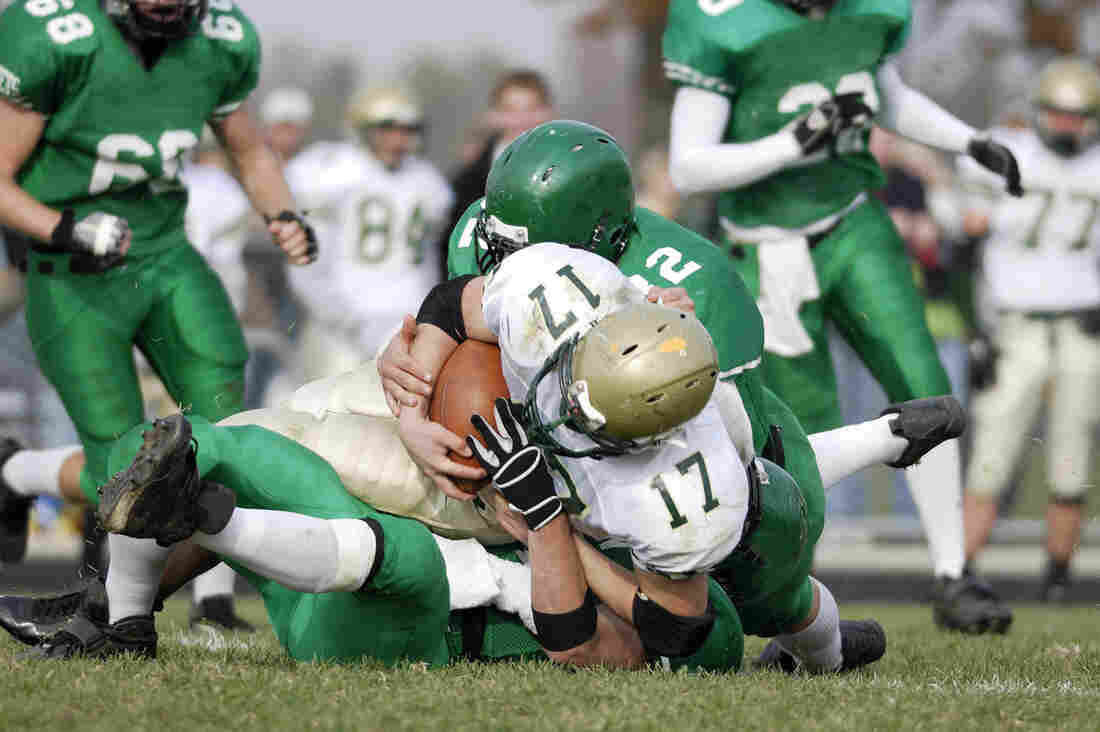
Changes In Brain Scans Seen After A Single Season Of Football For Young Players

MRI scans before and after a season of football showed brain changes in a study of high school players.

groveb/Getty Images


hide caption

toggle caption

groveb/Getty Images

A single season playing football might be all it takes to change a young athlete’s brain.

Those are the preliminary findings of research presented this week in Chicago at the annual meeting of the Radiological Society of North America.

Researchers used special MRI methods to look at nerve bundles in the brain in a study of the brains of 26 young male football players, average age 12, before and after one season. Twenty-six more young males who didn’t play football also got MRI scans at the same time to be used as a control group.

In the youths who played football, the researchers found that nerve fibers in their corpus callosum — the band that connects the two halves of brain — changed over the season, says lead study author Jeongchul Kim, a research associate in the Radiology Informatics and Imaging Laboratory at Wake Forest School of Medicine in Winston-Salem, N.C.

“We applied here two different imaging approaches,” he says. One analyzed the shape of the nerve fibers and the other focused on the integrity of the nerves.

Kim says the researchers found some nerve bundles grew longer and other bundles became shorter, or contracted, after the players’ initial MRI scans at the beginning of the season. He says they saw no changes in the integrity of the bundles.

The team says these results suggest that repeated blows to the head could lead to changes in the shape of the corpus callosum, which is critical to integrating cognitive, motor and sensory functions between the two hemispheres of the brain, during a critical time for brain development in young people.

The researchers say their ultimate goal is to help inform guidelines for safer football play for youths.

A series of MRI images shows the signs of strain in nerve fibers following a season of football.

Courtesy of Wake Forest School of Medicine


hide caption

toggle caption

Courtesy of Wake Forest School of Medicine

Since the discovery of the degenerative brain disease chronic traumatic encephalopathy in the early 2000s, most of the research into the consequences of repeated head injuries during sports has been on adult athletes. This focus has occurred despite growing concerns that young athletes who experience the same kinds of collisions may also be vulnerable to their effects.

Radiologist Christopher Whitlow, a co-author of the new findings, says while the stories about NFL and collegiate players are very important, they have to be put into context.

“You have to understand that the NFL players were also most likely once collegiate players, they were also high school players and they were also probably youth players,” he says. “To us, it’s more than a question about concussions, it’s a question about long-term cumulative exposure.”

That being said, both Whitlow and Kim caution against making their findings out to be more than what they are: preliminary results from a single study with a relatively small number of participants.

“We don’t know what it means,” says Whitlow. “The natural next question is, do these changes persist over time? Do they accumulate with multiple seasons? And then No. 3, probably the most important: Do they have any relevance to long-term health?”

The results, presented at a medical meeting, haven’t been published in a peer-reviewed journal. Whitlow says that the team is working on a paper to be submitted to a journal.

These latest findings are actually part of a years-long research collaboration among University of Texas Southwestern Medical Center, Wake Forest University and Children’s National Health System in Washington, D.C.

Dr. Gerard Gioia is a pediatric neuropsychologist at Children’s National Health whose role in the larger study is to look at the functional outcomes of kids playing football. He says these latest findings are only a part of the piece of the puzzle they’re trying to solve.

“Everybody wants to know, ‘Should my kid play football? Should my kid play soccer? Should my kid play ice hockey?’ And we say, ‘Can we please study this and understand it?’ ” says Gioia, who has been pushing for funding for more long-term studies into youth and sports.

For now, he says, they still have a lot of unanswered questions.

Let’s block ads! (Why?)