Sports

No Image

U.S. Soccer Reaches Back To The Past To Kickstart Its Future

Bruce Arena has been rehired to coach the U.S. Men’s Soccer Team. He’s previously coached the team from 1998-2006 where he posted a record of 71 wins, 30 losses and 29 draws. Alex Gallardo/AP hide caption

toggle caption

Alex Gallardo/AP

Bruce Arena is getting his old job back.

Arena is the winningest coach in the history of the United States Men’s national team and is the only person to lead the U.S. team at two FIFA World Cups.

The announcement of Arena’s return to the team comes a day after U.S. Soccer President Sunil Gulati parted ways with former U.S. Men’s coach Jurgen Klinsmann.

“When we considered the possible candidates to take over the Men’s National Team at this time, Bruce was at the top of the list,” Sunil Gulati said in a statement Tuesday.

“His experience at the international level, understanding of the requirements needed to lead a team through World Cup qualifying, and proven ability to build a successful team were all aspects we felt were vital for the next coach.”

Arena first managed the team from 1998-2006, posting a record of 71 wins, 30 losses and 29 draws. Perhaps his most enduring achievement came during the 2002 World Cup where he led the U.S. team to the quarterfinals.

Article continues after sponsorship

During that tournament, Arena lead the U.S. team to a stunning upset over the heavily favored Portugal in the opening match, before advancing out of group play and notching a 2-0 victory over rival Mexico in the round of 16.

The German-born Klinsmann was supposed to ignite a spark in the U.S. squad when he was hired in 2011.

Initially he did.

In the 2014 World Cup, the men’s team showed promise by advancing to the knockout stage where the Americans fell eventually fell to Belgium in extra time.

A string of poor performances followed.

Earlier this month, the Americans fell to Mexico, 2-1, then days later suffered an embarrassing 4-0 defeat at the hands of Costa Rica in the most recent World Cup qualifiers. This seemingly brought an end to the Klinsmann era after 5 ½ years.

Arena, a Brooklyn native, is excited about taking back the job he lost a decade earlier.

“I’m looking forward to working with a strong group of players that understand the challenge in front of them after the first two games of the Hex,” he said. “Working as a team, I’m confident that we’ll take the right steps forward to qualify for the 2018 World Cup in Russia.”

The Hex, or Hexagonal, is a reference to final round of FIFA World Cup qualifiers in North and Central America as well as the Caribbean. The U.S. team is currently winless, according to ESPN.

“Arena takes over a team that lost its first two games in the final round of World Cup qualifying to Mexico and Costa Rica. The U.S. is at the bottom of the six-team CONCACAF group on goal differential.

“There are eight games remaining in the Hexagonal, with the next set of games taking place next March, including a home game against Honduras as well as an away encounter in Panama.”

Arena will officially start his new job on Dec. 1.

Let’s block ads! (Why?)


No Image

Raiders Beat Texans, 27-20, In Monday Night NFL Game In Mexico City

An Oakland Raiders fan poses at the NFL Fan Fest inside the Chapultepec Park in Mexico City. The Oakland Raiders beat the Houston Texans, 27-20, at a sold-out Mexico City Azteca Stadium on Monday. Dario Lopez-Mills/AP hide caption

toggle caption

Dario Lopez-Mills/AP

Updated at 12:31 a.m. ET Tuesday:

The Oakland Raiders scored two touchdown in the fourth quarter to beat the Houston Texans, 27-20, at Azteca Stadium in Mexico City on Monday night.

Both teams grappled with a major challenge: playing at an elevation 2,000 feet higher than the players have ever confronted.

The game is only the second-ever regular-season NFL game in Mexico. The first was in 2005, also at Azteca Stadium — and at the time, set a record for regular-season attendance.

In the decade since, NFL games have been played in Toronto and London, but not at any other international venues.

“This game is the first of a three-year contract for the NFL to play in Mexico City,” The Associated Press notes, “and the league would like it to become an annual event” — just like it is in London.

USA Today notes that the game might be rough on the players. The elevation at Azteca Stadium is some 7,200 feet (compared to the highest NFL stadium, Denver’s Sports Authority Field, which is aptly called the Mile High Stadium — at 5,280 feet). And pollution can make the thin air even harder to deal with. Soccer player Eric Wynalda told the newspaper that Azteca was “the worst place ever to play.”

But at least both teams — equally unfamiliar with the venue — will be on equal footing. And the thin air will make long-distance field goal attempts easier, reports SB Nation.

The game sold out within minutes, and Mexico City residents — famous for their love for fùtbol — have enthusiasm to spare for American football, too. Over at ESPN, Carlos Alvarez Montero documented a few of the game-celebrating getups of Mexican megafans.

NPR thanks our sponsors

Let’s block ads! (Why?)


No Image

DraftKings-FanDuel Merger Follows Months Of Financial Troubles

FanDuel and DraftKings, two major online fantasy sports companies, merged this week. NPR’s Rachel Martin talks to Mike Pesca of Slate about their financial difficulties.

RACHEL MARTIN, HOST:

Time now for sports.

(SOUNDBITE OF MUSIC)

MARTIN: Two of the biggest names in fantasy sports have become one. DraftKings and FanDuel announced this past week that they have merged into one big old company. Mike Pesca hosts “The Gist” for Slate. He joins us now to tell us why this is going to affect my life. It’s probably not, but it’s still going to be an interesting thing to talk about. Hi, Mike.

MIKE PESCA, BYLINE: For the next three minutes it’ll affect your life.

MARTIN: (Laughter) Sure. OK, so I do remember – you and I had a conversation, and I did remark about how I don’t have ESPN on all the time. But every time I did, there were all these ads constantly from these two companies. And now they’re one. How come?

PESCA: They took out more ads than McDonald’s last year. I mean, they – their marketing push was so dramatic that it actually wound up affecting ESPN’s stock – or Disney’s stock – because there was a falloff this year.

MARTIN: Wow.

PESCA: So to explain how these things work, you know, back in the days of yore of the regular fantasy – fantasy classic – you’d draft the team with your friends, maybe in a league, and you hold those players all year. Well, daily fantasy, as the name implies, you can flit from player to player.

MARTIN: Every single day.

PESCA: There are no allegiances – every single day. It’s like the Snapchat of fantasy. After your team plays that day, it disappears into the ether. And it’s much more about gambling. I mean, it’s about a lot of things, and you don’t have to do it for high stakes.

But there is a huge turnover, and you can keep placing bets because most of this activity is for money. And this is how these sites made money or thought that they would make money, which is they got a little cut of every time someone went to draft Brandon LaFell.

MARTIN: OK, so – but this was not without controversy. I mean, they force – they faced legal problems, right? That’s some of what’s going on here.

PESCA: See, they – that is exactly true. And they didn’t realize how many legal problems that they faced. So they kind of got ahead of their skis, to use a metaphor for a sport that I don’t think you could gamble on on fantasy, daily fantasy.

MARTIN: (Laughter) Not yet.

PESCA: But they – yeah, they aggressively said, we think it’s legal. They marketed the heck out of it. They put it in all these states. And then all these attorney generals say, you know, we have these things called laws and you guys can’t do that. So in some states, it was pretty much legalized. In about 10 or 11 states, you still can’t play.

And I say 10 or 11 because in Texas, for instance, big state, one of their – there was a decision that it can’t be done. One of the states is a – one of the sites is abiding by that decision, one isn’t. So what I’m saying, what this all adds up to, is a pretty chaotic situation, more chaotic than the billion-dollar valuation that was put on these companies.

MARTIN: Wow.

PESCA: But as anyone who, you know, drafted Cam Newton before Thursday night’s game at top dollar, those values can go down when they’re met with reality, I would say.

MARTIN: Is the real NFL affected by any of this at all?

PESCA: Absolutely. They partnered with teams. They’ve partnered with not the NFL, but they partnered with actual leagues. There was a lot of money riding on it, and it is a great tale of hubris. Don Van Natta of ESPN chronicled it well. And like I said, the – some of the – a drop-off of ratings overall, which can be seen in ESPN’s stock, has got to be because of the guys who are just banging out their daily fantasy.

It’s become much less popular. It might be illegal in places. And this, perhaps, is the last gasp effort for these two would-be great companies to join together and maybe make something out of their promising, if quasi-legal, venture.

MARTIN: My money is always on Mike Pesca. He hosts “The Gist.” Thank you so much, Mike.

PESCA: It is and has been a great pleasure.

MARTIN: (Laughter) Talk to you later.

PESCA: You’re welcome, Rachel.

MARTIN: OK, take care.

Copyright © 2016 NPR. All rights reserved. Visit our website terms of use and permissions pages at www.npr.org for further information.

NPR transcripts are created on a rush deadline by Verb8tm, Inc., an NPR contractor, and produced using a proprietary transcription process developed with NPR. This text may not be in its final form and may be updated or revised in the future. Accuracy and availability may vary. The authoritative record of NPR’s programming is the audio record.

Let’s block ads! (Why?)


No Image

Tennis Star Andy Murray Reflects On Elementary School Shooting Tragedy

NPR’s Scott Simon talks with Howard Bryant of ESPN.com and ESPN the magazine about the career of tennis star Andy Murray whose elementary school was the site of a school shooting in 1996.

SCOTT SIMON, HOST:

And time for sports.

(SOUNDBITE OF MUSIC)

SIMON: The tennis world tour continues today. Andy Murray is currently ranked as the best player in the world. And Howard Bryant of ESPN joins us now to talk about Andy Murray’s career on court and the amazing story of survival he represents.

Howard, good to be back with you. Thank you.

HOWARD BRYANT, BYLINE: Good morning, Scott.

SIMON: People used to say, oh, poor Andy, poor British tennis – he always falls just short. Not anymore.

BRYANT: No, not anymore. And now he’s the No. 1 player in the world for the first time. He’s the first British man ever to be No. 1 since the rankings were started in 1973. Amazing story for Murray considering when you look at the number of players that he’s had to go up against. He was ranked No. 2 for the first time in 2009, and no player had spent more time between world No. 2 and reaching world No. 1 than Andy Murray. So the feeling about him had always been that he was a great player.

We remember the Andy Murray histrionics on court and the not-suitable-for-words Andy Murray and the way that we spend so much time, very cruelly, in sports with using a very diminishing language – if you don’t beat the top guy, then you’re a loser. And there are other great players out there – Roger Federer, obviously; Novak Djokovic, Rafael Nadal. And he was in that group, but he was never quite good enough to beat those guys. And we spent so much time thinking about, well, maybe it’s because he was such a maniac on court. And then he finally breaks through, and it’s been a remarkable story.

It’s been an incredible story looking at what Murray has done since 2012 – winning the U.S. Open, first British man to do that since Fred Perry in the 1930s; first Brit to win Wimbledon the next year, first Brit to do that in 77 years; then Davis Cup, first time since 1935 last year; and now world No. 1. It’s been an incredible story.

SIMON: And not to define a whole life by a tragedy – a more remarkable story when you consider the fact that it was almost cut short when he was a kid.

BRYANT: Well, no question. And then I think that’s – the story behind Andy Murray is that 20 years ago in Dunblane, he was part of the school shooting. He and his older brother, Jamie, were hiding when Thomas Hamilton went into the Dunblane preparatory school and shot 16 kids in the school gym.

And when you think about the life that might have been lost and you think about the children that did not survive and what they could have become, thinking what Andy Murray has done after that with his life, is just even more incredible that he would become the greatest tennis player that the U.K. has had in a century. And it almost never happened.

SIMON: Makes you think about what those the lives of those other children might have contributed to our world, too, at the same time, doesn’t it?

BRYANT: Well, no question. Exactly, Scott. And it is bittersweet in a lot of ways. And I think that’s one of the reasons why when you watch Andy Murray, the tennis player, now – I forgive Andy Murray so much of his on-court behaviors because the backstory is so compelling. We sort of refer to him as the real-life Harry Potter. He’s the boy who lived. When you think about what took place, and especially what took place in Dunblane after in the U.K. with the gun laws changing and with the number of tragedies, the almost daily tragedies, that we have here and we still don’t see a lot of change. Whenever you watch Murray, you think about what’s possible – and his brother, who is also now the world No. 1 in doubles. What a remarkable story for their remarkable family.

SIMON: Howard Bryant of ESPN The Magazine, espn.com. Thanks so much for being with us, my friend.

BRYANT: Thank you.

Copyright © 2016 NPR. All rights reserved. Visit our website terms of use and permissions pages at www.npr.org for further information.

NPR transcripts are created on a rush deadline by Verb8tm, Inc., an NPR contractor, and produced using a proprietary transcription process developed with NPR. This text may not be in its final form and may be updated or revised in the future. Accuracy and availability may vary. The authoritative record of NPR’s programming is the audio record.

Let’s block ads! (Why?)


No Image

Daily Fantasy Sports Sites DraftKings And FanDuel Agree To Merge

Daily fantasy sports sites DraftKings and FanDuel say they expect the deal, which is subject to regulatory approval, will close in 2017. Scott Olson/Getty Images hide caption

toggle caption

Scott Olson/Getty Images

FanDuel and DraftKings announced Friday that they have agreed to merge, ending months of speculation over the fates of the two largest players in the daily fantasy sports industry.

Both sites have faced recent legal challenges that center on the question of whether their contests, in which people create and bet on fantasy teams of professional athletes, amount to games of skill or gambling. NPR’s Nathan Rott has reported on the legal questions, which you can read about here.

A Q&A on DraftKings’ site hints that reducing legal costs was a factor in the decision to join forces. “By combining and streamlining resources, FanDuel and DraftKings can work more efficiently and economically with state government officials to develop a standard regulatory framework for the industry,” it reads.

DraftKings and FanDuel have had to “defend themselves as well as lobby for legislation to make the games legal in several states that have declared them illegal gambling operations,” as Reuters reported. They recently reached a “$12 million settlement over false advertising claims with the New York Attorney General.”

Joining forces, the companies said in a statement, will “help the combined company accelerate its path to profitability” and drive “more variety in contest formats, loyalty programs, enhanced social functionality and ancillary sports-oriented content and experiences” as well as promote industry growth.

“Being able to combine DraftKings and FanDuel presents a tremendous opportunity for us to further innovate and disrupt the sports industry,” FanDuel CEO Nigel Eccles said.

The merger requires federal approval before it is final, and the companies did not release the financial terms of the deal. Some analysts are asking whether the deal could potentially violate antitrust laws, The Associated Press reported, because the two sites “represent about 90 percent of the daily fantasy sports market.”

Article continues after sponsorship

FanDuel and DraftKings will operate under their own names “for the foreseeable future,” and “both platforms will remain separate and operational through the 2017 NFL season while the deal is finalized,” the companies said. The combined operation will be headquartered in New York and Boston.

The daily fantasy sites added that the deal is expected to close in 2017. DraftKings CEO Jason Robins will be CEO of the new company, with Eccles as chairman of the board.

Let’s block ads! (Why?)


No Image

Cubs' Kris Bryant And Angels' Mike Trout Named Baseball's Most Valuable Players

The Chicago Cubs’ Kris Bryant celebrating with his teammates after they won the World Series against the Cleveland Indians. The Baseball Writers’ Association of America named him the National League Most Valuable Player for 2016. David J. Phillip/AP hide caption

toggle caption

David J. Phillip/AP

After powering the Chicago Cubs to their historic victory in the 2016 World Series, second-year third baseman Kris Bryant claimed one of Major League Baseball‘s most coveted individual awards on Thursday. He was named the National League’s Most Valuable Player.

Bryant, 24, is only the fourth player in baseball history to win the MVP award one year after being named the Rookie of the Year. He smacked 39 home runs, had a .292 batting average, along with hitting 102 runs batted in and scoring 121 runs, the league’s best. Bryant played third base and outfield.

The last Cubs player to win the MVP award was Sammy Sosa in 1998.

Bryant received 29 of 30 first-place votes in the balloting by the Baseball Writers’ Association of America, beating out Washington Nationals second baseman Daniel Murphy and Los Angeles Dodgers shortstop Corey Seager.

Mike Trout of the Los Angeles Angels has been named the American League’s Most Valuable Player for the second time. Chris Carlson/AP hide caption

toggle caption

Chris Carlson/AP

Over in the American League, the Los Angeles Angels’ Mike Trout was named MVP. The 25-year-old center fielder and five-time All-Star won his first MVP award in 2014. This year, he batted .315, hit 29 home runs, driving in 100 runs, and scoring 123 runs.

Article continues after sponsorship

Trout, widely regarded as the best player in the game, received 19 first-place votes from the baseball writers, surpassing Mookie Betts of the Boston Red Sox and Jose Altuve of the Houston Astros. He’s been in the running for the AL MVP award in each of his five seasons in the majors. However, his club finished a disappointing 74-88, placing fourth in the AL Western Division.

As ESPN reports, Trout is the sixth player to win two MVP awards before the age of 26.

The baseball writers’ vote was held before the start of the postseason.

Let’s block ads! (Why?)


No Image

To Get A College Scholarship: Forget The Field, Hit The Books

Think playing on sports’ travel team will help your kids get a college scholarship? Think again. Commentator John U. Bacon advises that they hit the books instead.

DAVID GREENE, HOST:

If you’re the parent of an athlete, you may not have seen much of him or her recently. It is fall sports season. Winter sports are gearing up, and travel teams are busy. These are teams that can be organized outside school and involve lots and lots of time on the road. But commentator John U. Bacon says those miles just don’t add up.

JOHN U. BACON: Why do we do this? Why do we spend countless hours, week-in and week-out, on endless road trips, transporting our child athletes across the state and even across the country while sacrificing everything else, including other sports, family dinners and even family vacations? Because the coaches tell us we must. If we don’t, our kids won’t get a college scholarship or even make their high school team, let alone go pro.

Now, let’s start with some cold facts. Nationally, less than 2 percent of high school athletes will get college scholarships. That’s true at my alma mater, the University of Michigan, where only 2 percent of students receive athletic scholarships, but a whopping 70 percent receive academic scholarships. That adds up to $23 million for sports, compared to $915 million for academics – 40 times more. You don’t have to be an AP Calculus whiz to figure out where to spend your time. You want a scholarship? Forget the fields. Hit the books. It’s fool’s gold, people. But they keep selling it, and we keep buying it.

Travel teams are also counterproductive. You don’t get better at your sport by sitting in a van. You get burned out. Legendary Yankees catcher Yogi Berra was amazed to see his grandchildren traveling across the country just to take a few at bats. He said when he grew up in St. Louis, playing stickball with his buddy Joe Garagiola, they’d take 48 bats by dinner. Berra learned to hit by hitting.

And what about playing one sport all year? Even the great one, Wayne Gretzky, thinks it’s crazy. He said, I was absolutely ecstatic to see the end of hockey season. One of the worst things to happen to the game, in my opinion, has been year-round hockey. Gretzky spent his springs playing lacrosse.

In the U.S., hotshot tennis players are pushed to enter junior tournaments year-round and enroll in Florida’s tennis academies. But instead of ushering in a golden era of American tennis, it has ruined our most promising players. Since 2003, American men have not won a single major title. On the women’s side, the Williams sisters have been dominant. Why? Instead of entering them and endless tournaments across the country, their father, Richard, taught them himself on the public courts of South-Central, L.A. There’s your answer. The Williams sisters have won 29 major titles. Their American peers have won exactly five and none since 2002.

You want to succeed? Go outside and play. When you come in, do your homework, just like always.

Copyright © 2016 NPR. All rights reserved. Visit our website terms of use and permissions pages at www.npr.org for further information.

NPR transcripts are created on a rush deadline by Verb8tm, Inc., an NPR contractor, and produced using a proprietary transcription process developed with NPR. This text may not be in its final form and may be updated or revised in the future. Accuracy and availability may vary. The authoritative record of NPR’s programming is the audio record.

Let’s block ads! (Why?)


No Image

Jamaican Bobsled Team Stranded After Van Breaks Down

David Schnerch came across the stranded team in Alberta, Canada, while he was running errands. He drove the team to Canada Olympic Park. The 1988 debut of the team inspired the movie Cool Runnings.

DAVID GREENE, HOST:

Good morning. I’m David Greene. Out for an errand in Alberta, Canada, David Schnerch came across a bobsled team from Jamaica – yes, the Jamaican bobsled team, made famous by their 1988 Olympic debut. They’re still at it – until their van broke down. Schnerch wasn’t having that. He drove the team to the Olympic Park himself. And afterwards, with another competition to get to, Schnerch handed them the keys to his truck, saying just focus on the race; we’ll get you what you need. It’s MORNING EDITION.

Copyright © 2016 NPR. All rights reserved. Visit our website terms of use and permissions pages at www.npr.org for further information.

NPR transcripts are created on a rush deadline by Verb8tm, Inc., an NPR contractor, and produced using a proprietary transcription process developed with NPR. This text may not be in its final form and may be updated or revised in the future. Accuracy and availability may vary. The authoritative record of NPR’s programming is the audio record.

Let’s block ads! (Why?)


No Image

Not My Job: Sportscaster Joe Buck Gets Quizzed On Kittens And Rainbows

Joe Buck

Tommy Garcia/Dutton

When the Cubs won the World Series on Nov. 2 — remember that? — the person who told the world it had happened was sportscaster Joe Buck. He has been broadcasting the NFL on Fox since 1993 and Major League Baseball since 1995. He has now written a memoir about his life in broadcasting, called Lucky Bastard: My Life, My Dad, and the Things I’m Not Allowed to Say on TV.

We thought everyone could use a little distraction this week, so we’ve invited Buck to play a game called “It’s all just kittens and rainbows!”

Click the audio link above to hear how he does.

PETER SAGAL, HOST:

And now the game where people who have lead interesting lives answer questions about things that really don’t interest them. It’s called Not My Job. When the Cubs won the World Series last week – you remember that?

(APPLAUSE)

SAGAL: You remember that. Seems a while ago, but it happened. The person who told the world that it had happened as it happened was sportscaster Joe Buck. He has been broadcasting the NFL on Fox since 1993 and Major League Baseball since 1995. He has a new memoir out called “Lucky Bastard” and he joins us now. Joe Buck, welcome to WAIT WAIT… DON’T TELL ME.

(APPLAUSE)

JOE BUCK: Oh, my gosh. I’m honored. Thank you. Thank you very much. And I get it. I mean, everybody in Chicago where they’re laughing and clapping says, oh, that guy hates my Cubs and they – he hates my team. That’s – it couldn’t be further from the truth, but we’ll tackle that another day.

SAGAL: All right, that’s fine. Now, you actually bring up something ’cause you immediately assume that people here are angry at you.

BUCK: Yeah.

SAGAL: And you call your book “Lucky Bastard,” so you kind of lead with the knowledge that there – in the very opinionated sports fan community, there are pockets of people who are not fans of yours.

BUCK: Yeah, but it’s really, I think, born out of the fact that in baseball, all year long, Cub fans are listening to their announcers…

SAGAL: Who are pretty great.

BUCK: …Call the action.

SAGAL: Yeah.

AMY DICKINSON: Yeah.

BUCK: And when we show up, we’re the national guys and yeah, we get excited for Rizzo hitting a homerun or Bryant hitting a homerun or Hendricks pitching great, but we also have to get excited for the other side, and they’re not used to hearing that. So it’s OK. I’ve gone to a lot of therapy for this. I pay, like, $240, $250 an hour to get over it, knowing that people don’t like me in certain parts of the world. And that’s fine. I can accept that.

SAGAL: Right. So that means that any game you do, whether football or baseball, you can be reasonably certain that everybody is going to be furious at you at one point because you’re praising the other team.

BUCK: At some point they’re – they want to throw something at the TV and they say, I hate that guy ’cause he just yelled ’cause the other team just hit a homerun.

SAGAL: Wow.

BUCK: I get it. It’s fine – all good.

SAGAL: Let me – one of the things I am amazed at is that you seem – and I actually – I think you do a great job because a lot of the time, unlike sort of the classic, reserved announcer, you seem very excited and caught up in the game. You seemed really excited when the Cubs finally won last week. So…

BUCK: Well, yeah. I mean, first of all, my name – the name of my book is “Lucky Bastard.” I am the luckiest person to get to sit there and call that. And that was – of the 19 World Series – and I will tell you that that is as good as it will ever get for me, for an announcer of calling any sport. To declare the Cubs champions after 108 years was the highlight of my career.

SAGAL: Right.

DICKINSON: Oh, yay.

BUCK: Might as well just (unintelligible).

(APPLAUSE)

SAGAL: Had you, Joe – had you – I mean, ’cause we all knew if the Cubs won, it was going to make history. Had you prepared something ’cause you – we all remember Al Michaels’ can you believe in miracles and all the other famous calls. Did you have one ready?

BUCK: It was 10th inning of game seven, which is insane in and of itself.

SAGAL: Yeah, I remember.

BUCK: And then a guy hit the chopper to the third baseman, Bryant, and you got to kind of call the play first and then whatever comes out of your mouth after that comes out. So I have to live with whatever happens like you guys have to live with whatever you say spur of the moment. And you have to trust yourself.

MAZ JOBRANI: So what did you say when it was done?

BUCK: I don’t remember.

SAGAL: I believe you said, if I’m not mistaken, the Cubs win the World Series, which had the benefit of being true.

BUCK: Yeah, it was something really deep like that.

SAGAL: Other question – the opposite question. Baseball can be pretty dull.

BUCK: Yes.

SAGAL: One of those endless at-bats where the pitcher keeps throwing over to first base and the batter keeps filing it off. Do you ever just – you have nothing to say and you just…

BUCK: Yeah, and that’s the beauty of TV as opposed to radio. I can just sit there and be like, yeah, listen to the sound of the crowd and the yell of the (unintelligible).

SAGAL: Yeah.

BUCK: Take it all in, everybody, the sounds of the ballpark.

SAGAL: And that’s when you…

BUCK: Yeah, you don’t have to say much.

SAGAL: And that’s when you quietly slip off to the bathroom, right?

BUCK: Yeah, I’ve done that. I’ve…

(LAUGHTER)

SAGAL: OK, so tell me about that. What do you do when you need to go to the bathroom?

BUCK: Yeah, I – so one of the requirements that should be taught in broadcaster school – although I didn’t go to broadcaster school. I went to the school of nepotism – is that you need to have…

(LAUGHTER)

BUCK: …You need to have a great, strong bladder to call professional sports because, especially in football where, you know, you don’t know how long a half’s going to last and then the timeouts happen and a incomplete pass. If you have to go to the bathroom – I actually called a touchdown on national TV in the NFL while going to the bathroom.

DICKINSON: No, no, no.

SAGAL: Wow.

(LAUGHTER)

DICKINSON: No.

SAGAL: Yeah.

JOBRANI: Wait, were you talking about the play or for what – about what you were doing in the bathroom?

BUCK: Well the kind of – they both kind of run together, you know? You could be calling either one.

SAGAL: I guess so. It’s like, it’s out. It’s good.

BUCK: Right.

DICKINSON: Oh, my God.

LUKE BURBANK: Who scored the touchdown?

BUCK: Sterling Sharpe of the Green Bay Packers. And it was Green Bay and Atlanta, and he called a touchdown and let’s just say that we came back from commercial earlier than I thought we were going to.

SAGAL: Wow.

DICKINSON: Wow.

BURBANK: This was at Lambeau?

BUCK: This was – no. Believe it or not – and friends of mine can’t believe this actually happened – they would give up home games at Lambeau to play some games in Milwaukee. So this was a game in Milwaukee County Stadium, the last game the Packers ever played there as the home team.

BURBANK: Well, for obvious reasons.

BUCK: Yeah.

(LAUGHTER)

SAGAL: Yeah, they couldn’t use the stadium anymore. It smelled funny. Nobody knew why.

BUCK: Yeah, it did. It did. I – look, I’m not proud of admitting anything (unintelligible).

(LAUGHTER)

SAGAL: Joe Buck, though we have asked you here today to play a game that we are calling…

BILL KURTIS: It’s all just kittens and rainbows.

SAGAL: This week, we thought everybody could use a little adorable distraction. So we are going to ask you three questions about kittens and rainbows. Get two right, you’ll win our prize for one of our listeners – Carl Kasell’s voice on their voicemail. Bill, who is Joe Buck playing for?

KURTIS: Leslie Bayer of Kansas City, Mo.

SAGAL: So you ready to play?

BUCK: I am. Leslie, I’m sorry, before we start.

(LAUGHTER)

SAGAL: Here’s your first question. In 2007, a kitten in London named Otto made news for doing what? A – its unique mix of short and long fur earned it a TV show called “Mullet Cat.”

DICKINSON: Oh, God.

SAGAL: B – Otto, the kitten, climbed on the composer of “Cats,” Andrew Lloyd Webber’s keyboard, deleting the entire score for his new musical; or C – the queen’s footman lost one of her corgis and attempted to secretly replace it with Otto the cat.

BUCK: I’m going to go with Andrew Lloyd Webber, B.

SAGAL: You’re right.

(SOUNDBITE OF BELL)

DICKINSON: No.

SAGAL: That’s right.

DICKINSON: No kidding.

SAGAL: That’s what happened.

(APPLAUSE)

SAGAL: Lord Weber, as he is actually known, was writing a sequel to “Phantom Of The Opera,” which Otto the kitten saved the world from.

DICKINSON: But how do we know that really happened?

SAGAL: Well, he said it happened.

DICKINSON: Well.

SAGAL: He said, I wrote this musical and my cat…

DICKINSON: I mean…

SAGAL: …On my computer keyboard and erased it.

DICKINSON: Who among us hasn’t told a story like that?

SAGAL: That’s true.

DICKINSON: Like, the dog ate my homework, the cat…

SAGAL: Lord Weber, where’s the score we’ve been waiting for? Funny thing, he says.

BUCK: (Laughter) Right.

SAGAL: Two more questions, Joe. Here we go. Here’s a rainbow. The Rainbow Sheikh of Dubai – a real person – he’s known for his vast wealth. But how did he get that nickname, the Rainbow Sheik? Was it A – for a wedding present he gave his wife, a new Mercedes for each color of the rainbow; B – he picked the name Rainbow Sheikh because the name Iron Sheikh was already taken.

(LAUGHTER)

SAGAL: Or C – it is said that the cuisine he eats in his palace is so fine he literally farts rainbows.

DICKINSON: Oh, God.

BUCK: I’m going to go with A…

SAGAL: You’re going to go with A, for the wedding present?

BUCK: …The Mercedes.

SAGAL: Yes, you’re right.

(SOUNDBITE OF BELL)

SAGAL: He gave his wife…

JOBRANI: Wow.

SAGAL: …Seven Mercedes in the colors of the rainbow, earning the nickname the Rainbow Sheikh.

DICKINSON: You know, we’d better get used to that kind of nonsense.

SAGAL: Yeah, pretty much.

(APPLAUSE)

SAGAL: All right.

DICKINSON: Oh, Donald.

SAGAL: You’ve gotten two right, but let’s go for perfect, Joe – back to kittens. In 2011, an adoption shelter in England took weeks to find a home for one of its kittens. Why? A – was it A – thanks to a typographical error, it was advertised not as the perfect pet but as a perfect pest; B – the kitten insisted on only eating gluten-free cat food; or C – the kitten looked just like Adolf Hitler.

BUCK: I’m going to say C, Adolf Hitler.

SAGAL: You’re right.

(SOUNDBITE OF BELL)

DICKINSON: Whoa.

JOBRANI: Wow.

SAGAL: It was, in fact, Adolf…

(APPLAUSE)

JOBRANI: Way to go, Joe Buck.

KURTIS: Joe.

DICKINSON: Whoa.

JOBRANI: That’s a perfect game.

SAGAL: That’s a perfect game.

KURTIS: It is.

SAGAL: Picture-perfect game.

KURTIS: No-hitter here.

DICKINSON: Somebody’s going to have to call that.

SAGAL: It really does. And it was called – Kitler is the name.

(LAUGHTER)

SAGAL: I’m going to ask you something, Joe. You took a secod before answering each of those questions. So if you had to do a play-by-play for your own thought process, what would it have been like?

BUCK: Well, here’s a guy who’s standing on a street in Manhattan right now listening to a roaring crowd behind three people who he’s never met who are asking him questions about topics he doesn’t care about.

(LAUGHTER)

BUCK: And after examining his career and what could happen if he answered incorrectly, he came up, oddly enough, with the right answer every time.

SAGAL: There you go, Joe Buck at his finest.

(APPLAUSE)

SAGAL: Joe Buck, as you probably know, if you’ve watched any sports at all, is an announcer for Fox Sports, and you heard his voice during the World Series. And on Sundays, you’ll hear it during football season. His new memoir, a very fun and revealing read, is called “Lucky Bastard.” Joe Buck, thank you so much for joining us.

BUCK: Hey, top of the resume – three for three.

SAGAL: You bet me.

BUCK: Three for three, baby.

(SOUNDBITE OF MUSIC)

SAGAL: In just a minute, Bill finds true love with a slug. It’s the Listener Limerick Challenge. Call 1-888-WAIT-WAIT to join us on the air. We’ll be back in a minute with more of WAIT WAIT… DON’T TELL ME from NPR.

Copyright © 2016 NPR. All rights reserved. Visit our website terms of use and permissions pages at www.npr.org for further information.

NPR transcripts are created on a rush deadline by Verb8tm, Inc., an NPR contractor, and produced using a proprietary transcription process developed with NPR. This text may not be in its final form and may be updated or revised in the future. Accuracy and availability may vary. The authoritative record of NPR’s programming is the audio record.

Let’s block ads! (Why?)


No Image

Mexico Breaks 4-Game Losing Streak In U.S. To Win World Cup Qualifier

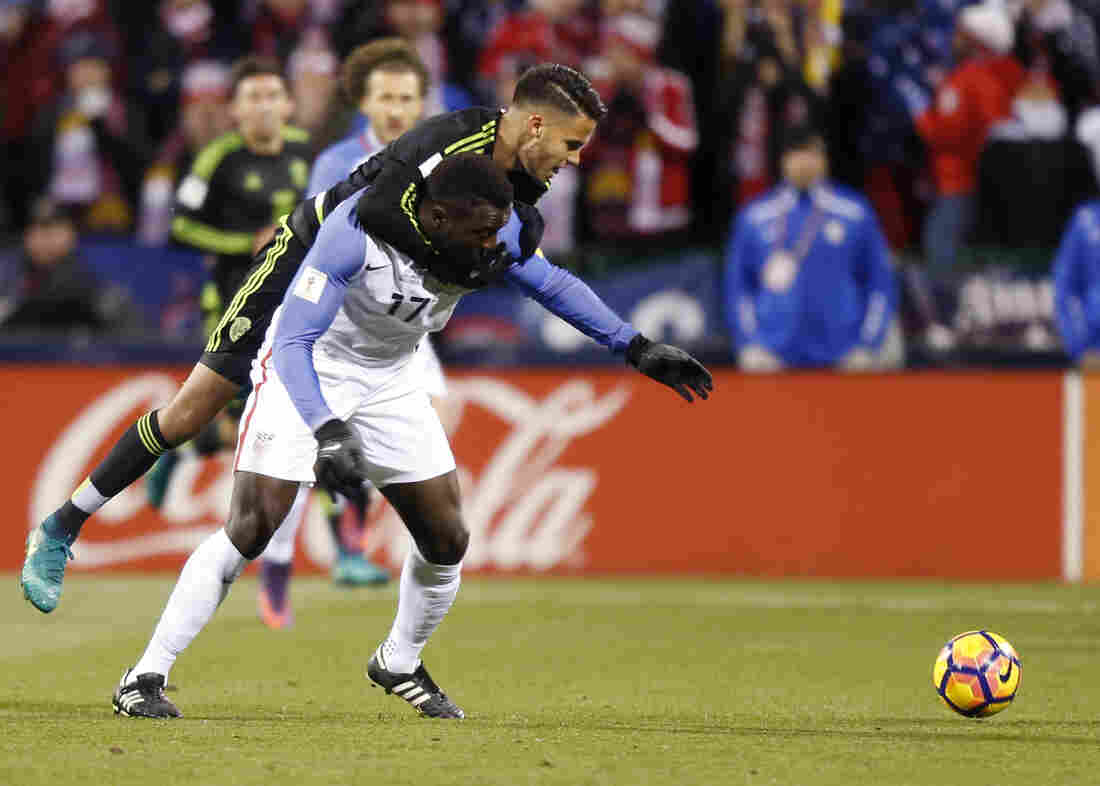
Mexico’s Diego Reyes, top, jumps on United States’ Jozy Altidore during the a World Cup qualifying soccer match Friday in Columbus, Ohio. Jay LaPrete/AP hide caption

toggle caption

Jay LaPrete/AP

Rafa Marquez scored a tiebreaking goal on a header in the 89th minute, giving Mexico a 2-1 win Friday night, and its first road victory against the United States in World Cup qualifying since 1972.

Miguel Layun put Mexico ahead in the 20th minute in the opener of the final round of qualifying in North and Central America and the Caribbean, but Bobby Wood tied the score in the 49th.

The U.S. dominated the second half before the 37-year-old Marquez, unmarked and drifting across the penalty area at the near post, got the back of his head on Layun’s corner kick. The Mexican captain lifted the ball over goalkeeper Brad Guzan for his 17th international goal.

“It gets a sense of anger in us. It gets a sense of absolutely urgency,” U.S. coach Jurgen Klinsmann said. “It’s not a problem, but it’s obviously disappointing.”

The U.S. had beaten Mexico four straight times by 2-0 scores in home qualifiers — all at Columbus — and Marquez had gotten two yellow cards and a red in those matches. The Americans had been 30-0-2 at home in qualifying since a 3-2 loss to Honduras at Washington’s RFK Stadium in September 2001.

Article continues after sponsorship

A pro-American crowd of 24,650 chanted “Dos a cero!” at the start, but Mexican supporters yelled “Dos a uno!” as they left.

Mexico’s previous win at the U.S. in qualifying was also by a 2-1 score, at Los Angeles.

“I think we deserved this match,” Layun said. “We were focused.”

Klinsmann said John Brooks was supposed to mark Marquez on the corner kick.

“We lost him there. Individual mistake,” Klinsmann said.

Guzan had lost the U.S. goalkeeper job to Tim Howard, who started at the past two World Cups — but Howard pulled a muscle in his right leg on a goal kick and was replaced in the 40th minute.

The Americans play Tuesday at Costa Rica, where it never has won in qualifying, in the second of its 10 games in the round, and Klinsmann said Howard likely will miss the match. The top three teams in the six-nation round qualify for the World Cup, and the fourth-place country advances to an inter-region playoff.

With the U.S. struggling early in what Klinsmann called a 3-4-3 formation, Mexico could have led 3-0. Howard tipped Jesus Corona’s 10th-minute shot off a post and Carlos Vela’s 25th-minute header hit a crossbar.

Mexico’s Alfredo Talavera celebrates a goal against the United States Fridayin Columbus, Ohio. Jay LaPrete/AP hide caption

toggle caption

Jay LaPrete/AP

“Out midfielders didn’t get into the one-on-one battles we expected them to,” Klinsmann said, citing Jermaine Jones and Michael Bradley.

Mexico went ahead after Bradley and Giovani dos Santos battled for the ball 30 yards out. The ball skipped to Layun, who took a touch, and his right-footed shot deflected off Timmy Chandler and in to Howard’s left for his fourth international goal in 46 appearances.

After switching to a more familiar 4-4-2 formation in the 27th minute, the Americans began to find their rhythm, and Wood scored off a pass from Jozy Altidore.

Wood tied the score after John Brooks forced a turnover. Jozy Altidore turned his defender and passed to Wood, who took two touches as he split defenders. His 8-yard, left-footed shot deflected off a leg of Layun for his eighth goal in 28 international appearances. Wood also scored against Mexico last fall during an extra-time loss in the playoff for a berth in the 2017 Confederations Cup.

Let’s block ads! (Why?)