Sports

No Image

University of Minnesota Football Players Boycott After 10 Teammates Suspended

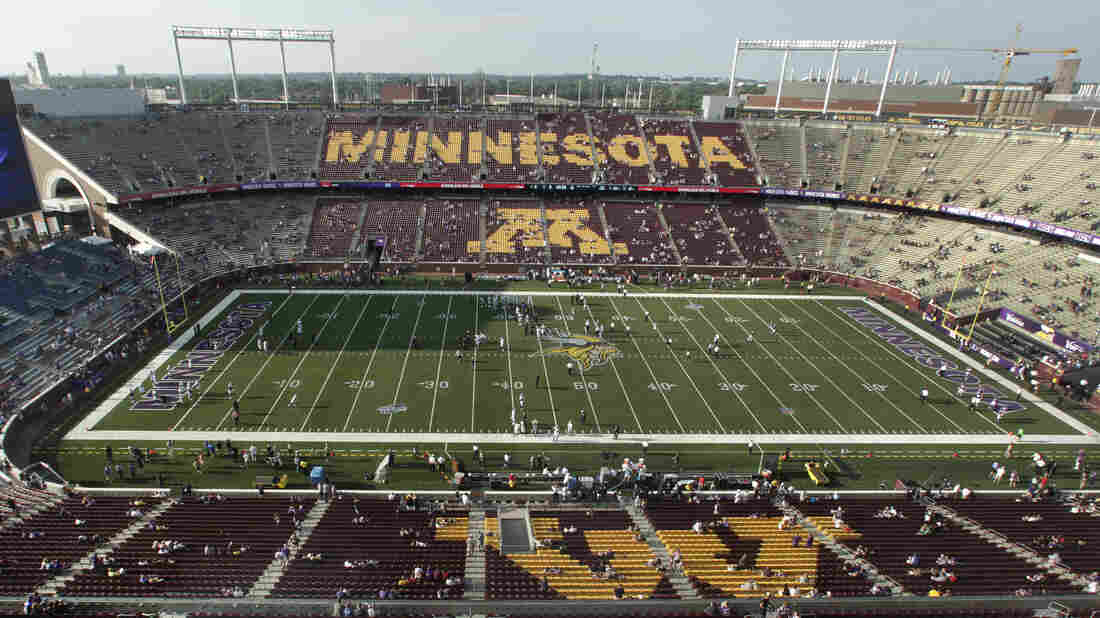
The University of Minnesota Golden Gophers, whose home stadium is pictured, are scheduled to play in the Holiday Bowl on Dec. 27. Paul Sancya/AP hide caption

toggle caption

Paul Sancya/AP

Days after 10 of its members were suspended as part of the University of Minnesota’s response to a sexual assault allegation, the rest of the team has declared a boycott. The team is scheduled to play in the Holiday Bowl on Dec. 27.

Announcing the boycott at the Golden Gophers’ practice facility Thursday night, the players said the suspended athletes, four of whom had already served team suspensions over the case, have now seen their reputations destroyed without the benefit of due process.

“We’re concerned that our brothers have been named publicly with reckless disregard in violation of their constitutional rights,” senior wide receiver Drew Wolitarsky said, according to student-run newspaper Minnesota Daily. “This effort is by players, and for players.”

As the players took their stand against the university, head coach Tracy Claeys tweeted his support: “Have never been more proud of our kids. I respect their rights & support their effort to make a better world!”

Have never been more proud of our kids. I respect their rights & support their effort to make a better world! ???

— GoldenGopherHFC (@GoldenGopherHFC) December 16, 2016

The coach struck a markedly different tone than university president Eric W. Kaler, who had said one day earlier that Claeys had made the decision to suspend 10 players indefinitely, in consultation with the school’s athletics director Mark Coyle.

Article continues after sponsorship

Along with a demand that the players be reinstated, the team is seeking a private meeting with members of the Board of Regents. Wolitarsky said the team wants Kaler and Coyle to apologize, adding that the players “demand that these leaders are held accountable for their actions.”

The suspensions followed a Title IX investigation into a case that had already resulted in a police inquiry and several players being punished. As Minnesota Daily reports:

“A woman reported to police that she was sexually assaulted after midnight Sept. 2, on the same night after the Gophers beat Oregon State in the home-opener. Claeys suspended four of the players — [Ray] Buford, [KiAnte] Hardin, Dior Johnson and Tamarion Johnson — on Sept. 10 for three games for team rule violations.

The Minneapolis Police Department investigated the four players’ involvement in the alleged Sept. 2 sexual assault, but the Hennepin County Attorney’s Office later declined to pursue charges against the players on Oct. 3. No player was arrested, and Claeys lifted the suspensions the following day.”

The case took a new direction Tuesday, when the school’s Office of Equal Opportunity and Affirmative Action recommended suspending those four players and six others.

School president Kaler said it was “incredibly disappointing” to suspend the players. He then cited privacy restrictions that kept him from providing details about the decision, which he said “is based on facts and on our University’s values.”

The dispute comes one year after the University of Minnesota enacted its affirmative sexual consent policy, which is more stringent than policies that require consent to be “mutually understood.”

Let’s block ads! (Why?)


No Image

Turner Sports Broadcaster Craig Sager Dies At 65

Turner Sports NBA court side reporter Craig Sager died Thursday at age 65.

AUDIE CORNISH, HOST:

Craig Sager, the longtime NBA courtside reporter for Turner Sports, has died. He was known for his sense of humor, his public battle with cancer and, it must be said, for his style.

ROBERT SIEGEL, HOST:

Here’s how he described that style in an interview with NPR in 2012.

(SOUNDBITE OF ARCHIVED RECORDING)

CRAIG SAGER: Well, let’s see. I’m looking right here. I’ve got a pair of black alligator shoes that actually have the eyeballs in them. I’ve got another pair next to them. These are crocodile, and then I got a pair of ostrich. I don’t know. It’s just something – my personality. I just like lively colors.

SIEGEL: And garish suits, gigantic lapels, clashing patterns – no suit was too loud.

CORNISH: He told us it was a practical decision.

SAGER: I like to wear bright colors. It helps out to spot me in the audience when my camera guys are looking for me to do interviews.

CORNISH: But underneath those clothes was a reporter remembered for his craft. Here’s his former TNT colleague Rachel Nichols remembering him today on her show “The Jump” on ESPN 2.

(SOUNDBITE OF TV SHOW, “THE JUMP”)

RACHEL NICHOLS: I think the suits and the crazy persona sort of hints, in fact, how good he was. I remember so clearly so many times watching Craig do his job and think, that’s what I want to do.

CORNISH: Sager had a long sports reporting career before his courtside gig. He slept in the stall with Seattle Slew before that horse won the Triple Crown.

SIEGEL: He interviewed Hank Aaron after he broke Babe Ruth’s home run record – technically before he broke it. Sager was by Hank Aaron’s side with a microphone as Aaron ran from third base to home plate. When Sager was diagnosed with leukemia in 2014, he continued to work as his health allowed.

CORNISH: He was open about his illness. This year, he received an ESPY Award. Here he is accepting it on ABC, remembering his life and encouraging fellow cancer patients.

(SOUNDBITE OF ARCHIVED RECORDING)

SAGER: I’ve wrestled gators in Florida. I have sailed the ocean with Ted Turner. I have swam with the oceans in the Caribbean. And I have interviewed Gregg Popovich…

(LAUGHTER)

SAGER: …Mid-game, Spurs down seven. If I’ve learned anything through all of this, it’s that each and every day is a canvas waiting to be painted.

SIEGEL: In a statement, David Levy, the president of Turner, praised Sager’s talent, work ethic and commitment. There will never be another Craig Sager, he said. Craig Sager died today. He was 65 years old.

Copyright © 2016 NPR. All rights reserved. Visit our website terms of use and permissions pages at www.npr.org for further information.

NPR transcripts are created on a rush deadline by Verb8tm, Inc., an NPR contractor, and produced using a proprietary transcription process developed with NPR. This text may not be in its final form and may be updated or revised in the future. Accuracy and availability may vary. The authoritative record of NPR’s programming is the audio record.

Let’s block ads! (Why?)


No Image

Wake Forest Finds Football Radio Analyst Provided Game Plans To Opponents

Wake Forest University has fired one of its football team’s radio analysts, who the school says provided game plans to its opponents. Tommy Elrod is a former player for the Wake Forest Deacons. He had also been doing radio analysis at Wake Forest games, until a school investigation concluded that Elrod had provided play sheets to rival teams.

ROBERT SIEGEL, HOST:

A little sports espionage story now from North Carolina – a scandal at Wake Forest University that is nicknamed…

SCOTT HAMILTON: Wakeyleaks.

AUDIE CORNISH, HOST:

That was Scott Hamilton. He’s a sports columnist with The Winston-Salem Journal. He says the leaks in Wakeyleaks came from one of the football team’s radio broadcasters, a color analyst named Tommy Elrod.

SIEGEL: This week, the university accused Elrod of betraying the team.

HAMILTON: He was divulging details about the game plan to the opponent prior to games.

CORNISH: Yesterday, Wake Forest said they found evidence that he had been sharing game plans as far back as 2014, and they fired Elrod.

SIEGEL: Now, before calling Wake Forest games as a broadcaster, Elrod worked as an assistant coach for the team for more than a decade. And Hamilton says Elrod even played quarterback for the black and gold Wake Forest Demon Deacons.

HAMILTON: He’s from Florida, but he was baptized in black and gold.

CORNISH: Hamilton says the irony in all of this is that Wake Forest has actually had a decent football season.

SIEGEL: And later this month, Wake Forest will play in the Military Bowl in Annapolis.

HAMILTON: People aren’t talking about the ball game. Twenty-four hours ago, that was the buzz. Now it’s Wakeyleaks. Go figure.

CORNISH: So far, Tommy Elrod has not publicly commented on the story, and sports columnist Scott Hamilton only reached Elrod’s lawyer.

SIEGEL: Hamilton says there are a lot of unanswered questions, like what’ll happen to the schools that received the leaked plays? And if the university’s accusations are true, what could have been the motive?

CORNISH: Hamilton says he knows Elrod personally, and so he’s puzzled himself.

HAMILTON: It’s just a bizarre, bizarre story that gets more bizarre by the minute.

SIEGEL: Scott Hamilton, sports columnist at The Winston-Salem Journal and radio host.

CORNISH: He says there’s a lot of speculation about why this might have happened. In a statement, the head football coach called the news simply incomprehensible.

Copyright © 2016 NPR. All rights reserved. Visit our website terms of use and permissions pages at www.npr.org for further information.

NPR transcripts are created on a rush deadline by Verb8tm, Inc., an NPR contractor, and produced using a proprietary transcription process developed with NPR. This text may not be in its final form and may be updated or revised in the future. Accuracy and availability may vary. The authoritative record of NPR’s programming is the audio record.

Let’s block ads! (Why?)


No Image

Supreme Court Rejects Challenges To NFL Concussion Settlement

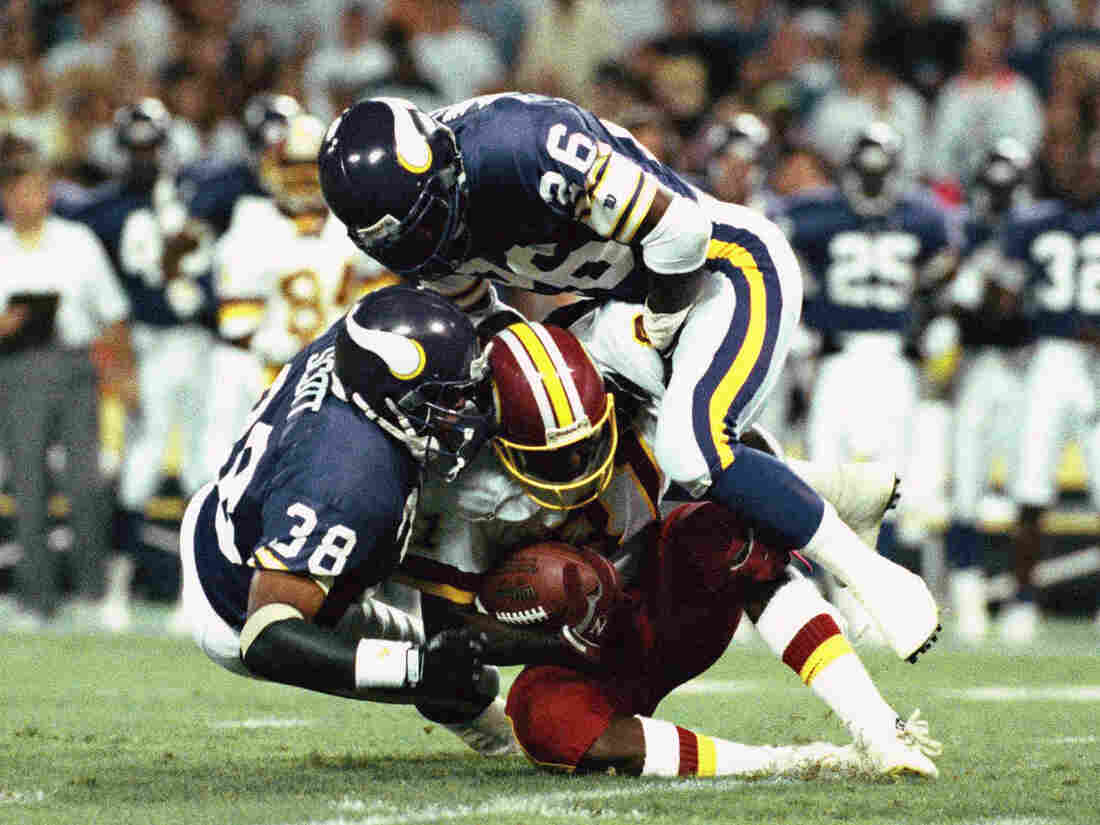
Minnesota Vikings players bring down Washington wide receiver Art Monk during an NFL game in 1992. Monk was one of the lead plaintiffs in the $1 billion settlement with the NFL over brain injuries among former players. Doug Mills/AP hide caption

toggle caption

Doug Mills/AP

The U.S. Supreme Court says it will not consider a challenge to the terms of a concussion-related settlement between the National Football League and more than 20,000 retired players.

The deal settled a class-action filed by former players who accused the NFL of covering up what it knew about the link between playing professional football and the degenerative brain disease known as chronic traumatic encephalopathy, or CTE.

The settlement was given final approval by a judge in 2015. But the deal was later challenged by a small group of dissenting players who argued that it “unfairly favored currently injured retirees and left thousands of former players who have not yet been diagnosed with neurological diseases without any recourse,” NPR’s Nina Totenberg reported.

Attorneys for those players also questioned whether the settlement should be renegotiated in light of comments made by the NFL’s executive vice president for health and safety, who acknowledged during congressional testimony earlier this year that there is a connection between football and CTE, as The Two-Way reported.

But a federal appeals court found the admission did not invalidate the deal, under which the NFL did not admit wrongdoing, and the Supreme Court upheld the lower court’s decision.

Now, with the final legal challenge over, payouts to individual players can begin.

The settlement will pay medical and other benefits to players who suffered concussions and related injuries and could cost the NFL up to $1 billion over 65 years depending on how much the league ends up paying to each of the more than 20,000 former players covered, as we have reported.

Article continues after sponsorship

NFL statement on SCOTUS decision rejecting appeals of $1 billion concussion settlement. pic.twitter.com/Crx7nQ0HK0

— Tom Pelissero (@TomPelissero) December 12, 2016

The Associated Press reported that the NFL estimates 6,000 former players, or nearly one-third, “could develop Alzheimer’s disease or moderate dementia,” and that the average payout would be about $190,000.

Here’s our previously reported breakdown of the maximum financial awards related to different brain injuries diagnosed in former players.

  • Level 1.5 neurocognitive impairment: $1.5 million
  • Level 2 neurocognitive impairment: $3 million
  • Parkinson’s disease: $3.5 million
  • Alzheimer’s disease: $3.5 million
  • Death with CTE: $4 million
  • ALS (Lou Gehrig’s disease): $5 million

In an information page about the settlement, “level 1.5 neurocognitive impairment” is described as “early dementia [with] moderate to severe cognitive decline.” Level 2 is described as “moderate dementia [with] severe cognitive decline.”

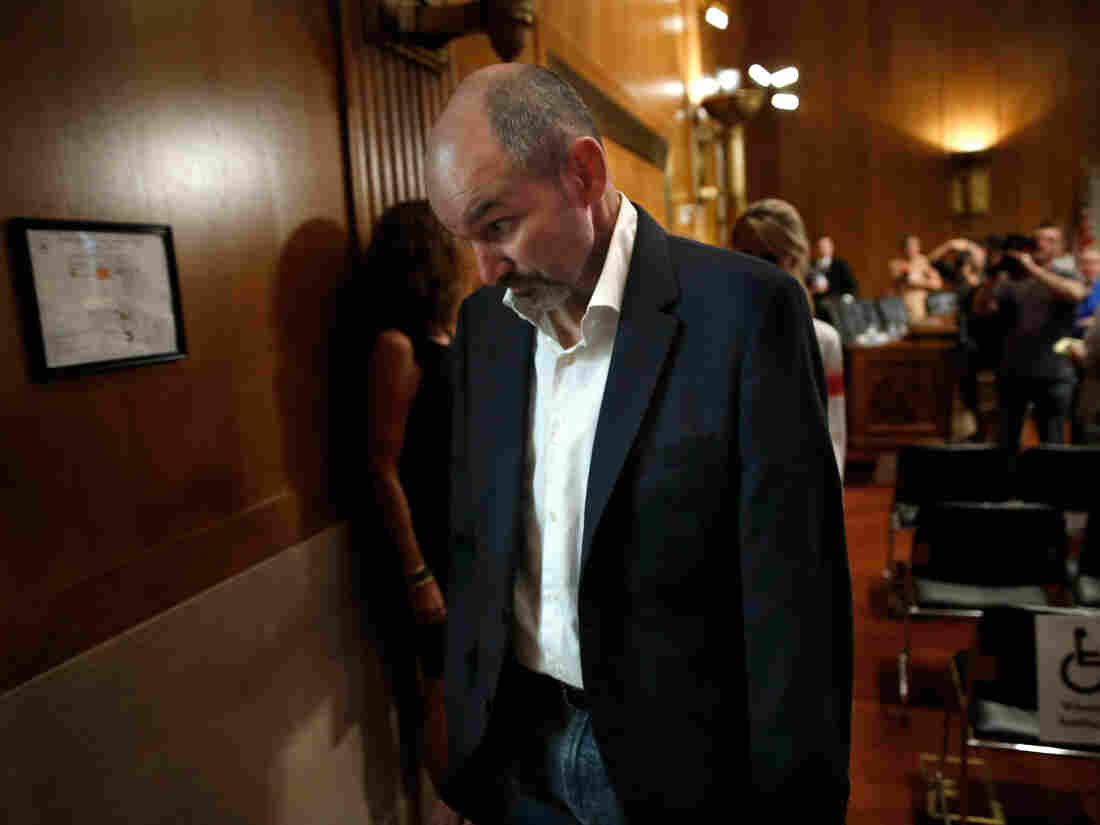
One of the lead plaintiffs in the class-action against the NFL was Kevin Turner, who died earlier this year at age 46. Turner played for both the Philadelphia Eagles and the New England Patriots; he was diagnosed with ALS six years before he died.

Former NFL fullback Kevin Turner leaves a hearing of the Senate Special Committee on Aging in 2014. He died earlier this year from severe chronic traumatic encephalopathy. Win McNamee/Getty Images hide caption

toggle caption

Win McNamee/Getty Images

But that diagnosis was incorrect, according to researchers at Boston University. In November, the Boston Globe reported that “Turner spent his excruciating final years stricken with a severe case of football-related chronic traumatic encephalopathy, or CTE, which caused a motor neuron disease similar to ALS.”

CTE can be diagnosed only through a brain autopsy after a person has died.

In recent seasons, the NFL has changed some rules that it hoped would reduce the number and severity of helmet-to-helmet collisions, but as we reported, an NFL report released in January found the number of concussions last year was 32 percent higher than in the previous year.

Let’s block ads! (Why?)


No Image

Trump Attends Army-Navy Game As Black Knights Snap 14-Year Losing Streak

President-elect Donald Trump greets Army Cadets before the Army-Navy football game on Saturday in Baltimore. Patrick Semansky/AP hide caption

toggle caption

Patrick Semansky/AP

President-elect Donald Trump took in one of college football’s most storied rivalries on Saturday — the Army vs. Navy game.

The annual game between the military service academies was held this year in Baltimore. The soon-to-be commander-in-chief was cheered with chants of “USA! USA!” as he entered the stadium.

Trump talked with CBS Sports announcers Verne Lundquist and Gary Danielson during the third quarter of the game, joking that perhaps he should appoint Ludquist as ambassador to Sweden. Lundquist was calling his final football game for CBS on Saturday.

And while Trump said he was happy to be attending the game, he told CBS the traditional meeting between the rival military academies maybe wasn’t the most exciting football game.

Here’s the President-elect throwing shade at the quality of service academy football pic.twitter.com/lEjlLTN4W1

— Dan Wolken (@DanWolken) December 10, 2016

“I just love the armed forces, love the folks. The spirit is so incredible. I mean, I don’t know if it’s necessarily the best football, but it’s very good, “Trump said. “But boy do they have spirit, more than anybody. It’s beautiful.”

It did end up being an exciting game, with Army snapping their 14-year losing streak over Navy in a close 21-17 win. But Trump left before the game was over.

Article continues after sponsorship

Before he departed for New York, the president-elect split his time by sitting on both the Army and Navy sides, in boxes partially enclosed by bulletproof glass. On the Army side, he was a guest in the box of David Urban, a 1986 West Point graduate who advised Trump’s campaign in Pennsylvania. Also in the box were Gen. Mark A. Milley, chief of staff of the U.S. Army, and Lt. Gen. General Robert L. Caslen, Jr., the superintendent of the West Point academy.

On the Navy side, he was a guest of retired Marine Lt. Col. Oliver North, a graduate of the Annapolis academy and a former national security aide in the Reagan administration who was embroiled in the Iran-Contra affair. Also in the Navy box were Admiral John Richardson, chief of U.S. Navy Operations, and Gen. Robert Neller, Commandant of the U.S. Marine Corps.

Let’s block ads! (Why?)


No Image

Anti-Doping Report Details Years Of Misconduct Sponsored By Russian State

Attorney Richard McLaren released final details of his investigation into Russian state-sponsored doping on Friday. His earlier report led to more than 100 Russian athletes being banned from the Rio Olympics.

AUDIE CORNISH, HOST:

The man who led a months-long investigation into Russian doping calls the scandal unprecedented in modern times. Today in a report commissioned by the World Anti-Doping Agency, he says there were over a thousand Russian athletes involved in state-sponsored doping. That’s over a recent four-year period, including the Olympic Games in London and Sochi. NPR’s Tom Goldman has more.

TOM GOLDMAN, BYLINE: Investigator Richard McLaren released evidence in July showing Russia had undertaken a massive state-sponsored doping operation. Today he was back with more damning details.

(SOUNDBITE OF PRESS CONFERENCE)

RICHARD MCLAREN: The conspiracy was perpetrated from at least 2011 to 2015.

GOLDMAN: At a London press conference, McLaren said the thousand-plus athletes involved in the conspiracy competed in the summer and winter games and Paralympics. There are medal winners, and in the case of two female hockey players, male DNA in their urine samples. Proof, McLaren says, of the kind of sample tampering that was widespread. For years, he says, international competitions have been hijacked by the Russians.

(SOUNDBITE OF PRESS CONFERENCE)

MCLAREN: Coaches and athletes have been playing on an uneven field. Sports fans and spectators have been deceived.

GOLDMAN: Along with his nearly 150-page report, McLaren also released evidence, including nearly 1,200 documents, photos, forensic reports, emails and test results – no names of athletes, however, since their alleged doping cases are under review. We have the evidence, McLaren says – not so, say Russian state media. The official government newspaper says empty talk is Mr. McLaren’s distinguishing feature.

There was similar criticism in July when McLaren released his initial report. It was right before the Rio Summer Olympics, and it led to more than 100 Russian athletes being banned from those games. Many were angry the International Olympic Committee decided not to ban the entire Russian team from Rio. U.S. Olympic hurdler Jeff Porter says now the IOC has another chance. It should ban Russia from the next Olympics, the 2018 Winter Games, and even beyond.

JEFF PORTER: If an athlete tests positive, that’s a four-year ban. But if a national governing body and an Olympic Committee conspires to dope athletes, we’re giving them other chances.

GOLDMAN: Porter is leading a petition campaign to strengthen anti-doping efforts. He’s the new chairman of USA Track & Field’s Athlete Advisory Committee. Three-hundred-sixty-two U.S. athletes have signed the petition so far demanding more money for anti-doping and less conflict of interest.

Critics note the president of the World Anti-Doping Agency has been a high-ranking IOC member as well. Doping historian John Hoberman says the IOC has to get out of the anti-doping business.

JOHN HOBERMAN: History shows us that the IOC has been ineffectual.

GOLDMAN: And Hoberman says now the IOC is facing a crisis of its own making.

HOBERMAN: Because they were negligent and in some cases corrupt about subverting the anti-doping process. That is why you cannot have the IOC anywhere near the reconstruction process.

GOLDMAN: The IOC is not talking about reconstruction. The committee released a statement today saying it has two commissions dedicated to following up on McLaren’s report. The IOC thanked McLaren and acknowledged the evidence he produced shows there was a fundamental attack on the integrity of the Olympic Games and on sports in general. Tom Goldman, NPR News.

Copyright © 2016 NPR. All rights reserved. Visit our website terms of use and permissions pages at www.npr.org for further information.

NPR transcripts are created on a rush deadline by Verb8tm, Inc., an NPR contractor, and produced using a proprietary transcription process developed with NPR. This text may not be in its final form and may be updated or revised in the future. Accuracy and availability may vary. The authoritative record of NPR’s programming is the audio record.

Let’s block ads! (Why?)


No Image

Slam Dunk: Michael Jordan Wins Trademark Dispute In China

A shopper walks past a Qiaodan Sports retail shop on Thursday in Beijing, China. Ng Han Guan/AP hide caption

toggle caption

Ng Han Guan/AP

China’s top court has handed basketball legend Michael Jordan a victory in a long-running trademark dispute over the use of his name by a Chinese company.

“Nothing is more important than protecting your own name, and today’s decision shows the importance of that principle,” Jordan said in a statement after the ruling. Here’s more from Jordan:

“Over the past three decades, I have built my reputation and name into a globally recognized brand. From my earliest playing days in the NBA, through my trip to China last fall, millions of Chinese fans and consumers have always known me by my Chinese name, ‘Qiaodan.’ Today’s decision ensures that my Chinese fans and all Chinese consumers know that Qiaodan Sports and its products have no connection to me.”

The ruling by Supreme People’s Court overturns a previous ruling from a lower court that favored Qiaodan Sports Co., which makes sportswear and shoes and had registered the name as its trademark. The company has no relationship to the Nike Air Jordan brand.

Article continues after sponsorship

Jordan is widely known as Qiaodan in China, and he initially filed a lawsuit against the company in 2012.

The court “approved Jordan’s appeal that the trademark of his name’s translation in Chinese characters infringed on his right to own his name and violated the country’s trademark law,” according to the state-run Xinhua news agency.

This company is not subtle; according to Xinhua, it also used “Jordan’s old jersey number 23, basketball player logo and even names of his children.” As NPR’s Becky Sullivan has reported, the company does hundreds of millions of dollars of business annually, with some 6,000 locations in China.

U.S. President Barack Obama and NBA athlete Michael Jordan share a smile during the presentation of the Presidential Medal of Freedom, the nation’s highest civilian honor, in the White House last month. Saul Loeb /AFP/Getty Images hide caption

toggle caption

Saul Loeb /AFP/Getty Images

After the ruling, Qiaodan “defended its actions but said it would respect the court’s decision,” The Associated Press reported.

The court’s chief judge Tao Kaiyuan “said there was an established link between Jordan and the Chinese characters for ‘Qiaodan,’ which are commonly used by the public when referring to the former basketball player, meaning that Jordan was entitled to protection under the Trademark Law,” according to the wire service.

However, it’s not a completely clear-cut victory: Xinhua added that court also “ruled that the former Chicago Bulls star does not own the right of name for Qiaodan, Chinese pinyin transcription of his surname Jordan.”

That means the company can use the word “Qiaodan” in Roman letters, but not in Chinese characters. The court said “there was not sufficient evidence to show that Chinese consumers associated” this version with Jordan, according to The New York Times.

The case could have broad implications; the Times calls it a “landmark decision that lays out ground rules for protecting personal names in trademark cases.”

In a country where foreign companies regularly come up against trademark disputes, lawyers tell the Times that this “establishes the scope of protection for personal names in trademark cases, indicating that foreign celebrities can successfully challenge third parties that use the Chinese characters of their names in China.”

Let’s block ads! (Why?)


No Image

Diver's Ambassador Life Showed Bigotry Is Never Far From The Surface

Diver Sammy Lee, the first American to win gold medals in platform diving in consecutive Olympic games, was also among the country’s earliest “cultural ambassadors.” Bettmann Archive hide caption

toggle caption

Bettmann Archive

The slew of obituaries that have been published since Olympic diver Sammy Lee’s death on Friday rightly highlight his conquest over racism and indignity on the way to winning gold medals in London and Helsinki nearly 70 years ago. As Greg Louganis, Lee’s most famous protege, reflected in the Los Angeles Times, “At a time of intolerance, being Korean, he broke down racial barriers, setting an example of what it meant to be an Olympian.”

Today, when race remains lodged at the center of our national debate, Lee’s victories and his unique service to this country confirm an enduring truth in American life: One person can make a huge difference, but bigotry is never far from the surface.

In the mid-20th century, Lee’s contemporaries grasped the compelling nature of his journey from the segregated world of the pre-World War II West to U.S. Olympic champion. Federal leaders saw in Lee’s biography a weapon for fighting the Cold War against communism. While the United States tried to win the “hearts and minds” of the planet, racial turmoil and violence at home sullied the image of American democracy abroad. As Mary Dudziak, Penny Von Eschen and other scholars of Cold War civil rights have explained, flesh-and-blood examples of accomplished people of color could do much to boost the nation’s street cred around the globe.

Article continues after sponsorship

Congress passed the U.S. Information and Education Exchange Act of 1948 to do just that. The roster of racial and ethnic “success stories” enlisted by the government included the Harlem Globetrotters and jazz greats like Dizzy Gillespie and Louis Armstrong. With Asia as a major focus of U.S. foreign relations, the U.S. also turned to Asian-American emissaries, among them, ceramicist and writer Jade Snow Wong, painter Dong Kingman, the San Francisco Chinese Basketball Team, Rep. Dalip Singh Saund and Sens. Hiram Fong and Daniel Inouye.

Sammy Lee fit that bill perfectly. Not only was he a world-renowned diver, he was also in the Army, serving in Korea as an ear, nose and throat physician. In a March 1954 staff memo, Secretary of State John Foster Dulles floated the idea of recruiting Lee to work as a cultural diplomat.

“It is felt that with his oriental background, his success as an American doctor, and his international athletic reputation, he could command large and diversified [overseas] audiences,” Dulles wrote.

His colleagues agreed.

In August of that year, Lee set off on a whirlwind tour of Asia that was meant to “increase mutual understanding” between Americans and people elsewhere through the swapping of “persons, knowledge, and skills,” according to the 1948 law. Lee’s itinerary included Japan, India, Ceylon, Pakistan, Turkey, Singapore, Vietnam, Burma, Hong Kong and the Philippines.

Every stop on the months-long tour was crammed with diving exhibitions, speeches, film screenings of his Olympic feats, media interviews and even coaching sessions with young, local divers. During his week in Pakistan, for instance, Lee met with representatives of the Pakistan Swimming Federation, the Punjab Swimming Association, and the military; talked to Radio Pakistan, and dined with the Pakistan Army Medical Corps and the Rotary Club in Lahore. He also squeezed in visits to the Pakistan Army Headquarters in Rawalpindi, the Royal Pakistan Air Force training center in Risalpur, and hospitals and health care facilities. A crowd of 800 turned out to watch him perform his signature moves in Karachi.

Lee charmed his way across Asia, drawing in audiences with his laid-back personality, ready warmth and quick wit. He even poked fun at Cold War tensions. A consulate report sent to Washington from Lee’s stop in Hong Kong recorded his most uproarious anecdote: Lee’s account of his 1952 gold medal victory in Helsinki:

“There were seven judges for the diving, three from the other side of the Iron Curtain and four from our side. They saw this little runt of a guy with this Oriental face climb up on the tower and they knew I was a Korean. But they couldn’t figure out whether I was a North or South Korean. By the time they found [out], it was too late.”

Occasionally, the dispatch noted, Lee would “put in an added fillip, He would walk out on the board, stop and tell the audience, ‘Say, I forgot to tell ya. I’m South!’ “

State Department bureaucrats raved in their propaganda reports to Washington that Lee faithfully emphasized two themes. The first was that Asians in America enjoyed “the equal opportunity … to become what [they] want to become.” Second was the pride that U.S. minority groups retained for their ancestral homelands.

“My father always told me, ‘Sammy, in order to be a good American, you have to be a good Korean at the same time,’ ” Lee was quoted as saying in the Hong Kong report. The U.S. Consulate in Hong Kong wrote that Lee did this with “good humor” and “evident sincerity” and won over even the most “skeptical and sophisticated” people in the audience.

Why did Lee turn so many heads on his junket? U.S. diplomatic officials attributed his magnetism to what was an “Oriental” essence encoded in his DNA. Even as Lee proclaimed his attachment to his native country, he “possess[ed] a perhaps instinctive understanding of the Asian mind which enable[d] him to communicate immediately and fully with audiences and individuals of this area,” officials of the American Embassy in Burma hypothesized.

This was the paradox at the heart of Lee’s ambassadorship. In using him to connect the U.S. to foreign countries that way, the government reinforced the stubborn notion that Asians are never quite all-American. The longtime assumption that “Orientals” were fundamentally alien still held.

While this association may have seemed innocuous in the context of Lee’s overseas expedition, it took on a familiar tint once he returned stateside. He and his wife were blocked from buying a house in Southern California because, as one real estate agent said, “If we had a colored or Oriental family here, all hell would be raised.”

Ironically, as historian Charlotte Brooks has pointed out, Cold War considerations neutralized the xenophobic antagonism. The San Francisco Chronicle leapt to the Lees’ defense, reminding readers of the foreign-policy stakes of anti-Asian discrimination:

“Here was an American of Oriental descent demonstrating to Asians that despite Communist propaganda the United States is a land of tolerance and opportunity. The story of Major Lee’s reception in Garden Grove will embarrass our country in the eyes of the world.”

Hundreds soon flooded the couple with gestures of support and offers to move into their neighborhoods.

As we mark the 75th anniversary of the Pearl Harbor attack, Lee’s story illuminates a relevant lesson about belonging in America. His impressive achievements were no doubt a product of hard work, perseverance and the determination, despite the hurdles, “to prove that in America, I could do anything,” as he once told the Los Angeles Times.

Yet history shows again and again how quickly national security scares can erect new barriers.

Cold War ambitions provided an important opening for Lee to be recognized, celebrated and accepted as a fellow American. But national security will always be shaky ground on which to build a case for civic inclusion, because the pendulum swings both ways for those assumed to be forever foreigners.

Many Japanese-Americans experienced this most traumatically after Pearl Harbor, when the government shipped them off to concentration camps. And with the ratcheting up of Islamophobia and indiscriminate racial and ethnic profiling in our current political moment, the well-being of our South Asian, Arab, Muslim and Sikh communities is at grave risk.

Protecting the rights of the most vulnerable among us — especially all those who might fall under the sweep of mass deportations or a Muslim registry — would be a fitting way to continue Lee’s storied struggle against racism.

Ellen Wu is associate professor of history and director of the Asian-American Studies program at Indiana University, Bloomington. She is the author of The Color of Success: Asian Americans and the Origins of the Model Minority.

Let’s block ads! (Why?)


No Image

Cleveland Weatherman Refuses To Shave Until Browns Win

Cleveland weatherman Scott Sabol isn’t going to shave until the Cleveland Browns win a game. The team is currently 0-12.

ARI SHAPIRO, HOST:

Like many gentlemen, Scott Sabol is always looking for a way to avoid shaving.

SCOTT SABOL: If I’m not focused on it, I’ll cut myself. And then you know how it is. It starts to bleed. And before you know it, you’re trying to, like, you know, hold a tissue on it so it doesn’t bleed. And then you go on TV.

AUDIE CORNISH, HOST:

Sabol is a TV meteorologist for Fox 8 in Cleveland, where not shaving is usually not an option.

(SOUNDBITE OF ARCHIVED RECORDING)

SABOL: Look at the showers. Again, widespread rainfall all afternoon.

SHAPIRO: So he comes up with some pretty elaborate schemes to avoid having to shave for work.

CORNISH: One winter, he says he didn’t shave until the temperature hit 50 degrees.

SHAPIRO: That lasted 74 days.

CORNISH: This year, before the NFL season started, he decided to grow a beard until the Cleveland Browns won their first game of the season.

SHAPIRO: The Browns lost the opening game. But hey, what’s one week without shaving?

SABOL: So the Browns were 0 and 1. And I’m thinking, all right, well, it sets the Browns back a few weeks. Maybe I could go three or four weeks without shaving. They get their first win, it’s early October, and that’ll be the end of it, right?

CORNISH: Wrong.

SABOL: Well, here we are almost 90 days, and the Browns are now 0 and 12. I didn’t think it would last this long at all. There is no way that there was – just – it’s very difficult to lose 12 games in a row.

CORNISH: All right.

SHAPIRO: (Laughter) The meteorologist posted a photo online of his beard progress, and we’re going to pull that up now. You can see some chubby cheeks that slowly disappear…

CORNISH: (Laughter) I don’t know if he’ll like that part.

SHAPIRO: …Under…

(LAUGHTER)

SHAPIRO: It looks sort of like an upside-down cupcake with a big tower of curly brown frosting all over the lower half of his face.

CORNISH: And he says he even fluffs up the beard for when he goes on air.

SHAPIRO: Sabol has been a Browns fan since he was a kid, and he calls his beard a microcosm of the Browns’ terrible season.

CORNISH: Now, some fans are asking what happens if the Browns don’t win any games this season. Sabol says his boss at the TV station raised this issue early on.

SABOL: So it’s really difficult to do. But he said, let’s just put that stipulation in there, that if they do go 0 and 16, you shave it at the end of the season, or else we could run into, you know, kind of a problem.

SHAPIRO: Sabol says the beard does have some advantages for a TV weatherman.

SABOL: Especially when I have to do live shots and I’m outside and the wind’s hitting you right in the face. There is a level of insulation there. So it certainly does help.

CORNISH: But he says it’s not exactly a hit at home.

SABOL: Well, my wife likes beards. She likes a well-groomed beard. She doesn’t like a 90-day beard that hasn’t been touched.

SHAPIRO: Ninety days and counting. The earliest Scott Sabol could shave is this Sunday, when the Browns play the Cincinnati Bengals.

CORNISH: And as for Sabol’s next beard growing challenge, he says he’s always open to new ideas.

Copyright © 2016 NPR. All rights reserved. Visit our website terms of use and permissions pages at www.npr.org for further information.

NPR transcripts are created on a rush deadline by Verb8tm, Inc., an NPR contractor, and produced using a proprietary transcription process developed with NPR. This text may not be in its final form and may be updated or revised in the future. Accuracy and availability may vary. The authoritative record of NPR’s programming is the audio record.

Let’s block ads! (Why?)


No Image

Sammy Lee Climbed Above Racism, Dove Into Olympic History

Sammy Lee, two–-time Olympic diving champion. Liz O. Baylen/LA Times via Getty Images hide caption

toggle caption

Liz O. Baylen/LA Times via Getty Images

Dr. Sammy Lee, the first Asian-American man to win an Olympic gold medal, died over the weekend after battling pneumonia. He was 96.

In the 1930s, Southern California had enough of the South in it that young Sammy Lee could only watch through the iron fence most days when other boys his age swam at the pool in Pasadena’s Brookside Park. The pool, like the area’s beaches and many other public facilities, was segregated. But not on Wednesdays.

The park declared that Wednesdays were International Days. “Basically, anyone who wasn’t white could use the pool,” said Paula K. Yoo, one of Lee’s biographers. “Then they’d drain it afterward.”

Young Sammy, though, had developed a passion for diving, and was determined to practice more often than once a week. In was to become his typical response to prejudice, he found another way.

“He’s very much a problem-solver,” Yoo said. “So when he was told, ‘You can’t use the pool except for that day,’ he decided, ‘Okay, then I’m going to work with a coach who would help me.’ “

Lee found a coach and they worked on his diving over a sand pit, which Yoo said was not uncommon back then. And sand had one advantage over water: “It gave him stronger leg muscles, which is why he was able to jump so high and perform those beautifully executed triple-somersault dives,” she said. ” Ironically, racism made him a better diver.”

The extra strength made Lee a good enough diver that he decided the Olympic team would be his goal. But he had another challenge, one at least as formidable as racial prejudice: his father.

Article continues after sponsorship

Lee was born in the U.S. to immigrant parents who’d made tremendous sacrifices for their child: He was their American dream. His father, Soonkee Rhee (he changed his name after arriving in America), wanted Sammy to be a doctor. He thought his son should be spending as much time on his studies as he did at diving practice. When Lee went to Occidental College, he did a lot of studying and a lot of diving.

“He’d spend a lot of time in labs, then walk 800 feet to the pool house, and practice dives to unwind,” Yoo said. “Then (he’d) go back to the lab and work some more.”

Lee was good enough to make the Olympic team, but the Games were canceled twice because of World War II. He finally got his chance in 1948. He was a 28-year-old medical corpsman in the Army Reserves competing in the London Olympics. As a hushed audience watched, Lee ascended to the high platform, jumped, and performed a triple somersault before elegantly slicing through the water. When he swam to the surface, he discovered he had near-perfect scores.

He’d compete once more in Helsinki four years later during the Korean War. As Major Sammy Lee, he almost didn’t go: Lee thought he needed to tend to the troops. The Army thought otherwise, gave him a month to train, and urged him to go. Lee won his second gold, making him the only Asian-American to win two consecutive Olympic gold medals. (He also earned a bronze in London for the 3-meter springboard.)

As a civilian, Lee discovered that his status as a veteran didn’t shield him from prejudice. He and his wife Rosalind were turned away when they wanted to buy a home in one part of Orange County. Eventually, they bought a home nearby from a sympathetic developer. Eventually they owned a house with a pool, where Lee coached students. He also coached divers for the 1960 Rome Olympics. Later, he’d mentor Olympic gold medalist Greg Louganis, and he served as an ambassador to the Olympics under three presidents.

The winners of the 1948 Olympic Men’s 10m Platform Diving competition, London, England, August 5, 1948. From left, bronze-medal winner Joaquin Capilla Perez (Mexico), gold medalist Sammy Lee (U.S.), silver medal winner Bruce Ira Harlan (U.S.), and American team coach Mike Peppe. FPG/Getty Images hide caption

toggle caption

FPG/Getty Images

Dr. Samuel Lee practiced as an ear, nose and throat doctor for 35 years, and retired in 1990. Until recent years, he still swam several times a week. A Los Angeles magnet school was named for him in 2013. And the childhood pool that barred him from entry, except on International Day? “They changed their policy after he won the gold,” Yoo said. “He became an honored guest. And the pool became open to everyone, which was something that pleased him deeply.

Let’s block ads! (Why?)